vendredi 2 juin 2017

Australian Leader Warns China Against Trying to Bully Neighbors

Turnbull sticks up for smaller nations at security conference, seeks to reassure Asia about U.S. engagement under Trump
By David Tweed and Keith Zhai

Australian Prime Minister Malcolm Turnbull warned China against abusing its growing influence in Asia, while attempting to reassure the region’s leaders that the U.S. remained engaged under Donald Trump.
Turnbull told dozens of defense officials and military leaders at the Shangri-La security forum in Singapore that China shouldn’t bully smaller states into taking its side as its growing might challenges decades of U.S. dominance. 
The prime minister said China had gained the most from the region’s peace and stability and therefore had the most to lose if it were disrupted.
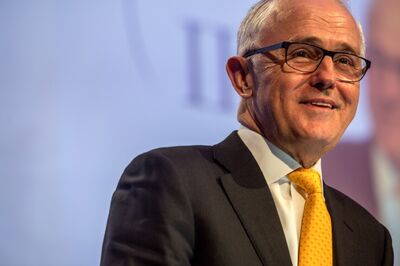
Turnbull at the Shangri-La security forum in Singapore, on June 2.
“A coercive China would find its neighbors resenting demands they cede their autonomy and strategic space, and look to counterweight Beijing’s power by bolstering alliances and partnerships, between themselves and especially with the United States,” Turnbull said in a keynote address Friday. He said a secure world was one in which “the big fish respect the little fish and shrimps.”
Australia has for decades walked a fine line between preserving economic ties with China, its largest trading partner, and the U.S., its most important ally. 
The speech -- Turnbull’s most high-profile foreign policy address since becoming prime minister in 2015 -- saw him advocating for smaller Asian countries that might be reluctant to openly criticize China.
“This was a very good speech -- very realistic,” Malaysia Defense Minister Hishammuddin Hussein told Bloomberg as delegates filed out of the Shangri-La Hotel. 
“This needed to be said. Very pragmatic. I told him that after the speech.”
The Chinese sent only a low-level delegation to the event, the first time since 2012 the country hadn’t been represented by an officer of at least the rank of a four-star general.
Members of the delegation were observed gesticulating and complaining loudly outside the ballroom after the speech.
One official member of the delegation expressed surprise at what they saw as Turnbull’s harsh remarks and “sucking up” to the U.S. 
The official said the remarks were unfair coming so soon after Li Keqiang’s visit in March, during which the two sides announced several trade deals.
Turnbull also sought to reassure regional leaders of the U.S.’s commitment to Asia in the “America First” era. 
Trump’s decision to withdraw from the Trans-Pacific Partnership, which includes 11 Pacific Rim nations, and the Paris climate-change accord, had sown doubts among those who had invested in the U.S.-led world order.
While Turnbull called the TPP and Paris decisions “disappointing,” he said nations “should take care not to rush to interpret an intent to engage on different terms as one not to engage at all.”
“The United States’ own interests in the Indo-Pacific demand more U.S. engagement, not less,” he said.

Mattis Speech
U.S. Defense Secretary James Mattis was set to address the Shangri-La Dialogue on Saturday, where he is expected to offer reassurance that the U.S. has no intention of giving up its role as a guarantor of regional peace and stability.
“We have a good friend and partner in Beijing and a steadfast friend and ally in Washington,” Turnbull said, rejecting the view that Australia had to choose sides. +“Our foreign policy is determined in Australia’s national interest and Australia’s alone.”
Turnbull’s relationship with Trump got off to a bad start in January, after Trump abruptly ended a phone call with the prime minister that he described as “the worst” among the five world leaders he spoke to that day. 
They appeared to bury the hatchet last month when they dined aboard the USS Intrepid museum in New York, and Trump said they “would remain friends for a very long time.”
Australia is concerned about Beijing’s military build-up in the South China Sea, one of the world’s busiest shipping lanes. 
China, whose actions have also worried Southeast Asian nations with competing claims such as Vietnam and the Philippines, has ignored an international arbitration court ruling rejecting its claims to more than 80 percent of the waters.
China should not try to take advantage of its growing economic and military might to attempt to marginalize the contribution of other nations in the region “particularly the United States,” Turnbull said.

‘Rules-Based Structure’

“If we are to maintain the dynamism of the region, then we must preserve the rules-based structure that has enabled it thus far,” Turnbull said. 
“This means cooperation, not unilateral actions to seize or create territory or militarize disputed areas.”
Turnbull said one way China could show its good intentions would be to curb North Korea’s pursuit of nuclear weapons. 
“China has gained the most from the peace and harmony in our region, and consequently it has the most to lose if it is threatened.”
For some, Turnbull’s criticism of China’s didn’t go far enough.
“Very disappointing,” said Kishore Mahbubani, dean of the Lee Kuan Yew School of Public Policy at the National University of Singapore, and a former president of the United Nations Security Council. 
“He was trying to be diplomatic towards the Chinese, but he should have been more direct.”

The Chinese Deal: Reward for Trump's 'China First' Policy

Trump Awarded a New Chinese Trademark, This Time for Catering
By PAUL MOZUR
The Ivanka Trump jewelry store in the lobby of Trump Tower in New York last year. Ms. Trump could sell jewelry and wedding dresses in China under new trademarks granted by Beijing.

Trump and his daughter Ivanka could sell jewelry and wedding dresses and provide catering services in China under new trademarks granted in recent days by Beijing.
The new trademarks expand the president’s business interests in the world’s second-largest economy after the United States’, which have already stirred complaints over a conflict of interest.
During his campaign, Trump regularly blamed China for the loss of American industrial jobs and pledged to take a tough trade stance with Beijing. 
That position has since softened, in particular after an April meeting with Xi Jinping.
As a businessman, Trump has made money by licensing the use of his name on an array of products around the world, like vodka in Israel or soap in India.
He has added to that list since taking office. 
Over the last three weeks, China’s trademark office gave preliminary approval for one trademark to Trump for providing catering services and four to his daughter through her trademarking business, Ivanka Trump Marks. 
Ivanka Trump’s trademarks include those for jewelry, wedding dresses, watches and a range of electronic devices.
Trump applied for the trademark in April 2016, while his daughter applied for the four trademarks from May to July last year.
Trump has at least 89 trademarks registered and 28 others that have won preliminary approval. 
His daughter now has 17 registered trademarks and six that have won preliminary approval. Trademarks with preliminary approval are formally registered three months later if officials receive no objections.
Abigail Klem, the president of Ivanka Trump’s company, said that those trademarks were made “in the normal course of business” and noted that the company had taken similar steps in the past, “especially in regions where trademark infringement is rampant.”
She said the firm had seen a “surge” in companies trying to capitalize on the Trump name. 
“It is our responsibility to diligently protect our trademark,” she said.
The Trump Organization did not immediately respond to a request for comment.
The latest trademarks give the Trump Organization further control over its brand in a country where opportunists frequently register well-known trademarks in a practice called “trademark squatting.”
Since his political rise, leather goods, toilets and cosmetics bearing the Trump name but trademarked by others have been spotted being sold around China. 
To avoid such problems, lawyers often advise that brands register their trademarks across broad categories of goods.
The Trump Organization has said it will not make any more international deals. 
It is currently being run by Trump’s two adult sons.
China has said it has acted in accordance to law regarding Trump’s trademarks. 
Still, the family’s business dealings with China have been criticized.
Last weekend, two activists investigating labor practices at Chinese factories that make shoes for Ivanka Trump, among other brands, went missing, according to their employer, China Labor Watch, and a third was detained.
Trump’s business interests in China have also concerned some senators, who have pointed out that Beijing could use the trademarks to try to sway United States policy.
In February, Trump won a 10-year legal battle over the right to protect his name brand for construction projects. 
The ultimate trademark approval was disclosed days after talks with Xi and after Trump dropped his challenge of China’s Taiwan policy.

Chinese Fifth Column At Harvard, And The Proposed Pro-China Unified Korea

  • Professor Allison states that the crisis could be solved by first, China removing the Kim regime, and unifying North and South Korea under a pro-Beijing Seoul, second, removing U.S. troops, and third, ending the U.S.-South Korea alliance.
  • It is revanchist appeasement on a grand scale. It is a realism ready to throw international law, democracy and human rights away for a fleeting moment of safety.
By Anders Corr

Graham Allison at Harvard University mooted a solution to the North Korea conflict in the New York Times on May 30. 
Allison starts by scaring us with a high likelihood of war, about 75%, in similar conflicts between a major power and a smaller rising power in history. 
That I believe. 
He implies a 33% chance that the North Korea crisis, like the Cuban missile crisis, could spiral into a nuclear war. 
That I doubt.

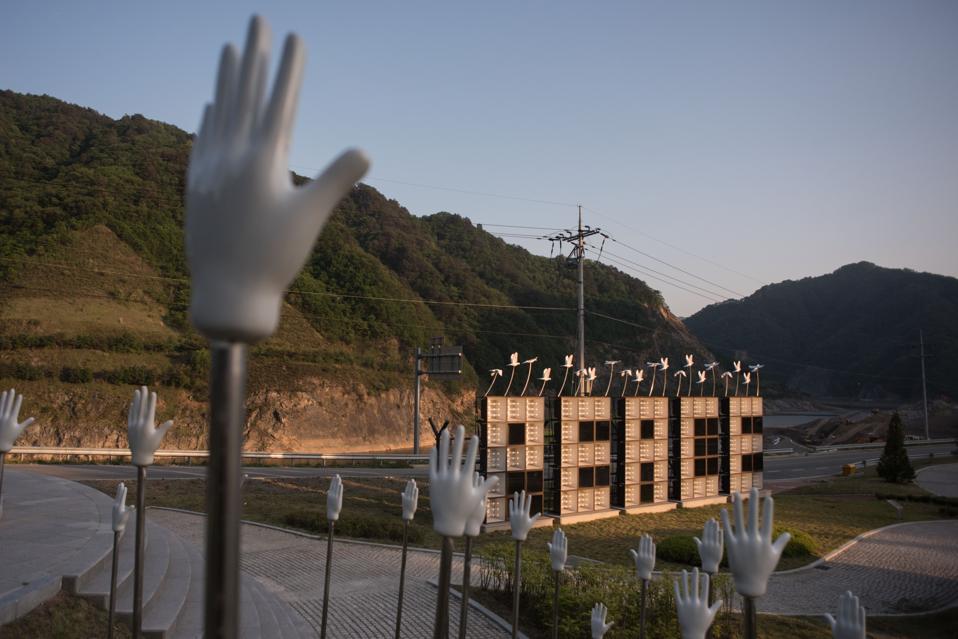
A photo taken on May 21, 2017 shows an art installation featuring propaganda loudspeakers arranged to read: 'Peace', at the Peace dam, north of Hwacheon near the Demilitarized Zone (DMZ) separating North and South Korea. Contruction of the 'Peace Dam' was intermittent from 1987 to 2005, reportedly as a response to the threat of accidental or intentional flooding from the North Korea's Imnam Dam which lies further up river, across the DMZ. North Korea on May 22 confirmed the 'successful' launch of a medium-range ballistic missile, Pyongyang's state media reported, adding the weapon was now ready to be deployed for military action.

After shocking us with the threat of catastrophic war, Allison uses that risk to justify his proposal to avert the crisis. 
Like Xi reportedly provided to Trump, these “people in Mr. Xi’s circle” even give a historical justification to buttress the Chinese proposal for China’s administration and shaping of Korean unification. 
In the core of his argument, Allison says, “Had North Korea not attacked the South in 1950, the United States would never have intervened. So if China were to assume responsibility for removing the Kim regime, denuclearizing the country, and reunifying the peninsula under a government in Seoul friendly to Beijing, would the United States remove all its bases from the South and end its military alliance?”
In other words, Allison appears to advise, or at least uncritically repeat Chinese advice, that China and North Korea are threatening us with nuclear war, so give in and give up South Korea. 
That advice is buttressed by an ostensible lack of U.S. historical presence on the peninsula. 
Allison’s proposal dovetails nicely with Trump’s understanding after Xi’s history lesson, in which “Korea actually used to be a part of China.”
These questionable interpretations of history lead to Allison’s surprising proposal for what amounts to capitulation. 
That is not the America of Paul Revere and George Washington, who risked it all for liberty. 
And, what of other proposals, such as an election in North Korea, or economic sanctions against China until China forces the North to stop its nuclear weapons development? 
If China can remove the Kim regime and unify the peninsula, surely it can remove North Korea’s nuclear weapons. 
Surely tough economic sanctions against China would not result in nuclear war.
These options are not mentioned by Allison, who focuses his opinion piece on fear and allied concessions.
China has taken slivers of territory in the Philippines, Vietnam and India, and since 1972 the U.S. has shown acquiescence, fear and a lack of resolve to defend that territory, and along with it democracy and international law. 
Given demonstrated U.S. fear, why shouldn’t China go for an entire nation like South Korea? 
In the process, did “some people in Xi’s circle” nudge a Harvard professor to write an opinion piece in the New York Times to soften up public opinion beforehand?
What I will call Allison’s proposal, because he is the first I know to make it publicly, lacks any mention of democracy and human rights in South Korea. 
And what of democracy and human rights in the North? 
Would Allison’s proposal mean that the North Korean police could, with support or as part of his “government in Seoul friendly to Beijing”, root out democratic opposition in the South? 
Does Allison really think that China would disassemble North Korea’s police state apparatus, which appears much more like Beijing’s government than does South Korea’s democracy? 
If China is really to make Seoul pro-Beijing, which appears to be a nondemocratic Chinese condition in Allison’s proposal, then one should expect Kim Jong-un’s regime to be transported to Seoul, with or without Kim Jong-un, rather than democracy transported to Pyongyang.
Don’t expect Beijing to deal fairly with pro-democracy South Koreans, or even to honor any protections for South Koreans in this telling Chinese future for the Korean Peninsula. 
We learned our lesson in Hong Kong, where China violated its promise to respect democracy after it took over from the U.K. 
China cannot be trusted. 
Hong Kong citizens who thought they would get democracy are now literally ground into the pavement as Hong Kong police, who answer to mainland authorities, suppress their brothers and sisters in pro-democracy demonstrations with arrests, pepper spray, tear gas, and beatings.

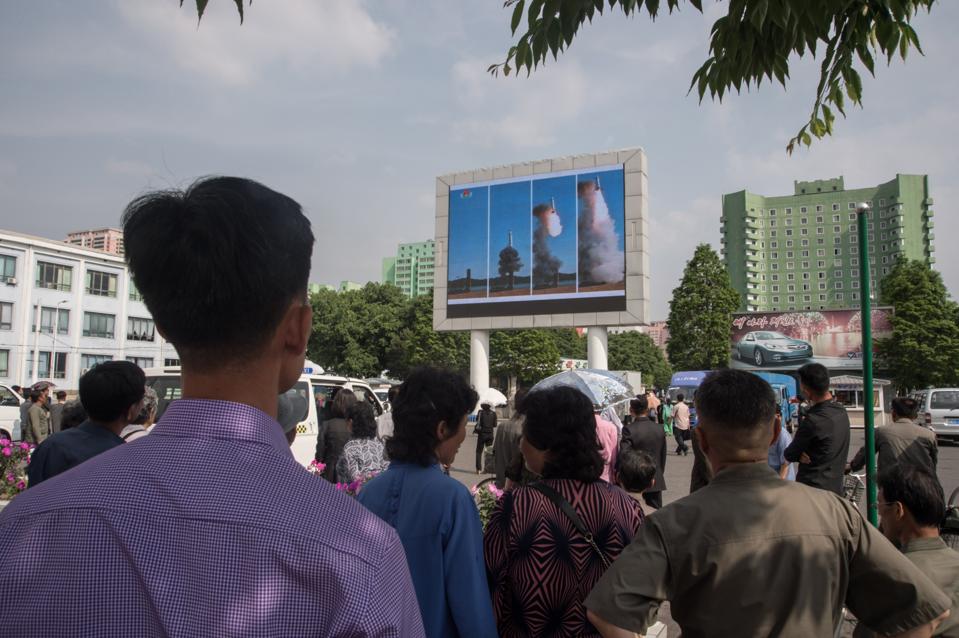
People watch a screen showing news coverage of the Pukguksong-2 missile rocket launch at a public square in central Pyongyang on May 22, 2017. North Korea declared its medium-range Pukguksong-2 missile ready for deployment after a weekend test, the latest step in its quest to defy UN sanctions and develop a weapon capable of striking US targets. 

The proposal from Allison is contrary to principles such as democracy, human rights, and freedom of speech that I, as a graduate of Harvard University, thought my school represents. 
I was frankly shocked when I read the opinion. 
But perhaps I should have expected this. 
Harvard gets significant revenues from Chinese students, including Xi Jinping’s daughter, who graduated in 2014. 
Harvard has a lucrative Harvard-branded school in China itself, and a Harvard China Fund that is seeking $50 million to support Harvard’s presence in China. 
Only four of the Fund’s Web pages actually mention democracy or human rights. 
The Belfer Center at Harvard, which Allison directs, gets millions of dollars annually in corporate and other funding, including from what appear to be Chinese, Saudi, and Singaporean sources. 
The 2013 announcement by the Belfer Center of a new focus on China completely disregards human rights and international law, applauds an authoritarian leader, mentions democracy only once and tangentially, and appears flippant or even accepting of the prospect of China replacing the U.S. as the number one power in the world.
It is unclear whether Harvard, in its engagement with China, is following the United Nations principles on corporate social responsibility. 
Robert Precht writes that U.S. universities operating in China have a duty to follow them, according to which, “an enterprise’s corporate responsibility entails making a clear and public policy commitment, implementing due diligence processes, and providing or cooperating in the creation of remedies for human rights violations. 
Due diligence requires assessing risks of human [rights] violations by both the enterprise itself and by its business partners.”
While my pointing to authoritarian funding sources will be called a “cheap shot”, or the equivalent of an ad hominem attack by academics who benefit from corporate and authoritarian funding, I think that as Chinese influence in the U.S. increases, it is increasingly important for elite institutions of foreign policy to refuse authoritarian funding and return to pure foreign policy research driven by professors not donors. 
It is my belief that corporate and foreign funding of elite institutions lull their foreign policy analysts into a somnolent approach to defense, democracy and human rights, especially when it comes to China. 
The optics of corporate and foreign financial entanglements hurt Harvard’s image of rigorous academic impartiality.
Given that the Harvard Kennedy School of Government is one of the top U.S. foreign policy establishments, we should all be very worried that Allison’s proposal issued forth from those hallowed halls. 
If this pro-China approach is on the surface at Harvard and elsewhere, what lurks beneath? 
I believe the same applies to other foreign or corporate-funded elite foreign policy establishments in the U.S., such as the Council on Foreign Relations, Asia Society, National Committee on U.S.-China Relations, and Center for Strategic and International Studies. 
While all of these establishments have great people, and elements within them that are pro-democratic and pro-human rights, there is a palpable defeatism and lack of emphasis on these liberal topics, and an acceptance of authoritarian realist arguments, that I find disturbing. 
Realism is not tough when it promotes appeasement, it is weak. 
By showing fear, it invites attack. 
Appeasement actually increases the risk of war.
Elite foreign policy think tanks like the Belfer Center are environments largely devoid of the oxygen of the billions whose human rights are violated, and who yearn for more democracy. 
In these institutions, pro-authoritarian proposals such as Allison’s can be made, unopposed. 
Human rights and democracy can be largely ignored while enjoying Champagne and canapés with corporate and authoritarian Chinese donors. 
By falling over themselves in search of ever greater funding, these establishments are out of touch with the people. 
But they are very much in power. That is a threat to democracy.
Their elite myopia causes a bias toward corporate preferences in international relations. 
And these corporate preferences are for a symbiosis of peace, trade and profit. 
Prima facie, that sounds splendid. 
Academics and policymakers alike applaud, even luxuriate in, this positive effect of international trade on keeping the peace. 
But their elision of billions of humans who suffer under the “peace” of increasingly authoritarian governments is inexcusable. 
In Allison’s proposal, for example, the Chinese-manufactured risk of nuclear war with North Korea leads to the implied conclusion that peace should be purchased at any cost, including the cost of suspending democracy and human rights for South Korean citizens, because they would lose those rights under a stipulation of rule by a pro-Beijing Seoul. 
This begs the question. 
If South Korea is not worth fighting for, what is? 
Japan? 
Hawaii? 
America west of the Mississippi? 
In his panicked embrace of peace, that has been left unanswered.
Allison has written a piece that I have made a case in point for a much larger issue of increasing Chinese dominance through violence, threats of violence, and economic influence. 
The increasingly global dominance of China is no minor threat. 
Allison’s proposal is a testament to that. 
China uses violence and economics to seek territorial expansion and increased global influence, and does so through direct attacks on our values of liberal democracy, even in the heart of our most prestigious universities.
Allison makes China’s argument, with absolutely no mention of costs to democracy or human rights. 
He focuses on the threat of nuclear war as if we should run scared at the very mention of this horrific outcome. 
No. 
We and our values must stand resolved before such threats. 
The U.S. and our allies are far more powerful than North Korea and its allies, including China. 
It would be foolish to allow North Korea and China to threaten us with nuclear weapons, and then give concessions as a response. 
That will only encourage more threats down the road, and more concessions. 
That is not peace, it is the failed strategy of appeasement.

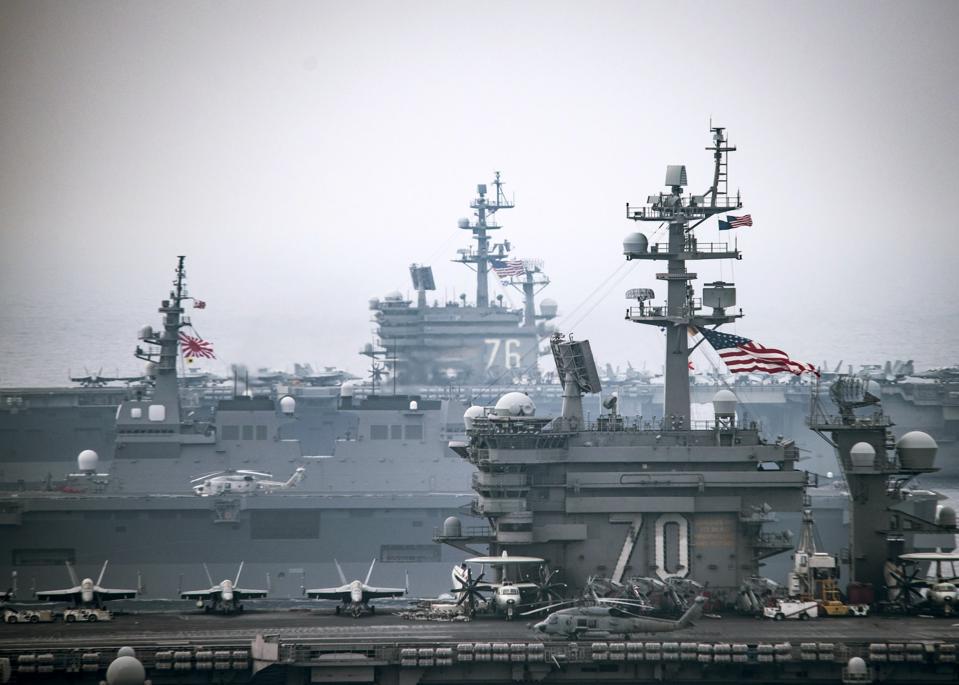
The Carl Vinson Carrier Strike Group, including the aircraft carrier USS Carl Vinson (CVN 70), operate with the Ronald Reagan Carrier Strike Group including, USS Ronald Reagan (CVN 76), and the Japan Maritime Self-Defense Force ships in the western Pacific region June 1, 2017. 

It is time for Harvard to stop allowing professors to take corporate or foreign funding for foreign policy research. 
With an endowment of $36 billion, Harvard has enough money to fund these projects. 
If Harvard truly cares about education, Harvard should encourage donors to give to other far less fortunate universities where dollars will stretch further and cover education, not catering and the compensation of its fund managers. 
Seven of them made a total of $58 million in 2015. 
Perhaps the decrease in political bias, or appearance of such, that results from a principled refusal of foreign and corporate money will help clarify education at Harvard. 
Clarity is all-important during these dangerous times.
The motto of Harvard is Veritas, Latin for “Truth.” 
The Chinese government methodically suppresses truth through disinformation and draconian restrictions on freedom of speech. 
Harvard, per its motto, should take a far more principled stand against the authoritarianism that China, and especially Xi Jinping, is increasingly attempting to foist upon not only Asia, but the world. 
There can be no place for elision or appeasement. 

Rogue Nation: Own Up to Tiananmen Massacre

At 28th Anniversary of Bloodshed, Repression Outweighs Reform
HRW

People fill Tiananmen Square in front of the Mausoleum of late Chinese chairman Mao Zedong and the Monument to the People's Heroes in Beijing, on May 17, 1989.

New York – The Chinese government should acknowledge its role in the massacre of untold numbers of peaceful pro-democracy demonstrators around June 4, 1989, and hold perpetrators to account, Human Rights Watch said today. 
Authorities should allow commemorations of the occasion, and release those imprisoned for having done so in the past.
“While Xi Jinping preaches openness on the world stage, his government buries the truth about the Tiananmen Massacre through silence, denial and persecution of those who mark the occasion,” said Sophie Richardson, China director at Human Rights Watch. 
“Until Beijing reverses course and owns up to its past atrocities, Xi’s calls have little credibility.”
As in past years, to preempt dissent and commemoration of the Tiananmen Massacre, Chinese authorities have heightened surveillance and control of activists as June 4 draws closer. 
In May, the police in Guangzhou repeatedly harassed human rights lawyer Huang Simin and her partner, writer Li Xuewen, forcing them out of the city. 
Guangzhou police also broke up a gathering of activists at a restaurant, including Wang Aizhong, who was detained and interrogated for hours after the gathering at a police station. 
Over a dozen police officers in Shandong Province blocked a group of activists from going to retired professor Sun Wenguang’s home to attend a gathering to commemorate the Tiananmen Massacre.
Over the past year, a number of activists have been detained, charged, or sentenced for commemorating the Tiananmen Massacre. 
In March, authorities in Chengdu, Sichuan’s capital, charged Chen Bing, Fu Hailu, Luo Fuyu, and Zhang Junyong with “inciting subversion of state power” for producing and selling a liquor named “Eight Liquor Six Four,” a homophone for “89.6.4,” the numerical date of the massacre. 
In March a Chengdu court sentenced activist Chen Yunfei to four years in prison for “picking quarrels and provoking trouble” after he organized a memorial service for victims of the massacre. 
In April, Guangzhou-based activist Liu Bing was detained on suspicion of “picking quarrels and provoking trouble” after he held up a poster in public calling for people to go to the street to protest on June 4.
While the last individual known to have been imprisoned for his involvement in the 1989 pro-democracy protests was released in October 2016, many other participants have been re-incarcerated for their continuing pro-democracy activism, including Nobel Peace Prize winner Liu Xiaobo, Sichuan activists Liu Xianbin and Chen Wei, and Guangdong activist Guo Feixiong. 
Under Xi, the Chinese government has aggressively cracked down on a broad array of human rights, targeting civil society activists, further constricting freedom of expression and religion, as well as increasing ideological control.
While the Chinese government continues to ignore international and domestic calls for justice for the Tiananmen Massacre, foreign governments have adopted new measures to bring accountability for human rights violations around the world. 
In December 2016, the US Congress passed the Global Magnitsky Human Rights Accountability Act, which will allow the US to impose sanctions and deny visas to individuals credibly alleged to be responsible for human rights violations. 
In the UK, legislators will also be voting on proposals similar to the Magnitsky Act which, if passed, will enable the UK government and private entities to apply for the freezing of assets of human rights abusers around the world. 
In May 2017, the Canadian government announced that it will support a Senate bill that would expand Canadian sanctions legislation against human rights abusers, freezing their assets and denying them visas.
“New mechanisms to act against rights violators abroad are renewing hopes that one day those responsible for the Tiananmen Massacre could be held accountable,” said Richardson. 
“This should give pause to Xi and other Chinese leaders who continue to commit serious rights abuses.”

Background: Bloodshed in 1989

The Tiananmen Massacre was precipitated by the peaceful gatherings of students, workers, and others in Beijing’s Tiananmen Square and other cities in April 1989, calling for freedom of expression, accountability, and an end to corruption. 
The government responded to the intensifying protests in late May 1989 by declaring martial law.

On June 3 and 4, the military opened fire and killed untold numbers of peaceful protesters and bystanders. 
In Beijing, some citizens attacked army convoys and burned vehicles in response to the military’s violence. 
Following the killings, the government implemented a national crackdown and arrested thousands for “counter-revolution” and other criminal charges, including disrupting social order and arson.
The government has never accepted responsibility for the massacre or held any officials legally accountable for the killings. 
It has been unwilling to conduct an investigation into the events or release data on those who were killed, injured, forcibly disappeared, or imprisoned. 
The nongovernmental organization Tiananmen Mothers, consisting mostly of family members of those killed, has established the details of 202 people who were killed during the suppression of the movement in Beijing and other cities. 
During the 28 years since the massacre, many members of the Tiananmen Mothers as well as participants who had been imprisoned – including Yu Zhijian, who served 12 years in prison for throwing ink onto Mao Zedong’s portrait at in Tiananmen Square – have passed away without seeing justice.
Human Rights Watch urges the Chinese government to mark the 28th anniversary of June 4, 1989, by addressing the human rights violations pertaining to the event. 
Specifically, the government should:
  • Respect the rights to freedom of expression, association, and peaceful assembly, and cease the harassment and arbitrary detention of individuals who challenge the official account of June 4;
  • Meet with and apologize to members of the Tiananmen Mothers, publish the names of all who died, and appropriately compensate the families of the victims;
  • Permit an independent public inquiry into June 4, and promptly release its findings and conclusions to the public;
  • Allow the unimpeded return of Chinese citizens exiled due to their connections to the events of 1989; and
  • Investigate all government and military officials who planned or ordered the unlawful use of lethal force against peaceful demonstrators, and appropriately prosecute them.

jeudi 1 juin 2017

The Totalitarian Temptation

The White House's silence on the state of human rights in China is back in the spotlight following Ivanka Trump's link to spotty Chinese labor policies and ahead of the 28th anniversary of the Tiananmen Square crackdown.
By Nyshka Chandran

Donald Trump interacts with Xi Jinping at Mar-a-Lago state in Palm Beach, Florida, U.S., April 6, 2017.

While U.S. policy on the matter has long remained non-confrontational, "the current dismissive attitude towards human rights is jarring," Margaret Lewis, a professor specializing in China's legal system at Seton Hall University, said in a Wednesday note published by the Council on Foreign Relations.
On June 4, 1989, mainland troops violently targeted pro-democracy demonstrators in Beijing's famed Tiananmen Square and to-date, the detention of political activists and enforced disappearance of critics remain among the top social challenges weighing on the world's second-largest economy.
Other issues include poor employment standards, limited freedom of expression through strict online censorship and media controls. 
This week, China Labor Watch activist Hua Haifeng was arrested and accused of illegal surveillance after investigating conditions of low pay and misuse of student interns at a Chinese company that produces Ivanka Trump-brand shoes.
Around 250 rights lawyers and activists have been targeted in a crackdown by the Chinese government that started in July 2015, according to Amnesty International.
In the run-up to Donald Trump's April 7 meeting with Xi Jinping, many wondered whether the unpredictable leader would stress the need for Beijing to embrace international human rights standards, having already upset the mainland on a myriad of other issues such as trade.
Following the closely-watched summit, Secretary of State Rex Tillerson said in a media briefing that human rights were "embedded in every discussion" and guided Trump's view on bilateral economic, military and foreign policy cooperation.
But as Trump strikes a conciliatory tone with Beijing to resolve the North Korea conflict following months of anti-China remarks, the White House has yet to strongly address the thorny issue. 
The new U.S. ambassador to China, former Iowa Gov. Terry Branstad, who claims to have known Xi Jinping for three decades, has promised to prioritize human rights — but doubts still remain.
"Will freedom of expression be a central component of discussions regarding cybersecurity? And will protections for the accused be at the forefront of conversations regarding repatriating fugitives as part of bilateral law enforcement efforts?" questioned Lewis.

The Chinese Connection

Arrested, missing China activists spark criticism of Trump
By ERIKA KINETZ

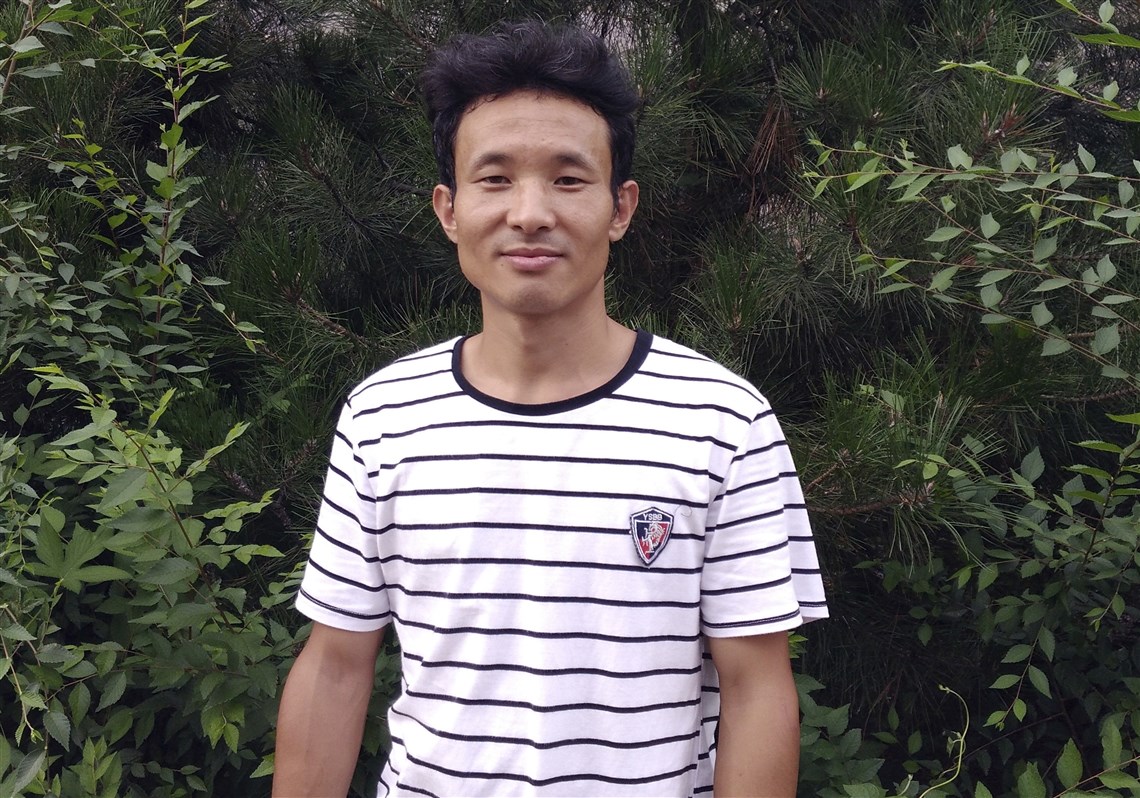
China Labor Watch investigator Hua Haifeng
SHANGHAI — The arrest and disappearance of three labor activists investigating a Chinese company that produces Ivanka Trump shoes in China prompted a call for her brand to stop working with the supplier and raised questions about whether the first family’s commercial interests would muddy U.S. leadership on human rights.
“Ivanka’s brand should immediately cease its work with this supplier, and the Trump administration should reverse its current course and confront China on its human rights abuses,” Adrienne Watson, spokeswoman for the Democratic National Committee, said in a Wednesday email. 
Ivanka Trump must decide, she added, “whether she can ignore the Chinese government’s apparent attempt to silence an investigation into those worker abuses.”
Amnesty International called Wednesday for the release of China Labor Watch investigator Hua Haifeng, as well as his two colleagues, who are feared to have been detained.
The men were working with an American nonprofit group to publish a report next month alleging low pay, excessive overtime and misuse of student labor, according to China Labor Watch executive director Li Qiang, who lost contact with the investigators over the weekend. 
The investigators also witnessed verbal abuse, with one manager insulting staff about poorly made shoes and making a crude reference in Chinese to female genitalia, according to Mr. Li.
China Labor Watch has been exposing poor working conditions at suppliers to some of the world’s best-known companies for nearly two decades, but Mr. Li said his work has never before attracted this level of scrutiny from China’s state security apparatus.
The arrest and disappearances come amid a crackdown on perceived threats to the stability of China’s ruling Communist Party, particularly from sources with foreign ties such as China Labor Watch. Faced with rising labor unrest and a slowing economy, Beijing has taken a stern approach to activism in southern China’s manufacturing belt and to human rights advocates generally, sparking a wave of critical reports about disappearances, public confessions, forced repatriation and torture in custody.
China Labor Watch’s investigation also had an unusual target: a brand owned by the daughter of the president of the United States.
Ivanka Trump’s lifestyle brand imports most of its merchandise from China, trade data show. 
She and her father both have extensive trademark portfolios in China, though neither has managed to build up a large retail or real estate presence here. 
The sister of Jared Kushner, a Trump adviser and husband of Ivanka, traveled to China this past month to court investment from Chinese families for a real estate project in New Jersey.
“The eagerness of members of the family to do business in China while airbrushing very troubling human rights and labor rights records of the country is troubling,” said Nicholas Bequelin, East Asia director for Amnesty International. 
He said it is only a matter of time before it is known “to what extent business is trumping any kind of consideration of the diplomatic capital of the U.S. in promoting human rights, labor rights and democracy.”
White House spokeswoman Hope Hicks referred questions to Trump’s brand. 
The Ivanka Trump brand declined to comment.
Abigail Klem, who took over day-to-day management when the first daughter became a White House presidential adviser, has said the brand requires licensees and their manufacturers to “comply with all applicable laws and to maintain acceptable working conditions.”
China tightened control over foreign NGOs starting this year by requiring them to register with state security. 
Chinese Foreign Ministry spokeswoman Hua Chunying said at a regular news briefing Wednesday that she was not aware of the arrest and disappearances. 
She said China welcomed international NGOs to carry out research, but added, “we also hope that NGOs can also observe Chinese laws and regulations and don’t engage in any illegal actions or behavior.”
Mr. Hua was accused of illegal surveillance, according to his wife, Ms. Deng Guilian, who said the police called her Tuesday afternoon. 
Ms. Deng said the caller told her she didn’t need to know the details, only that she would not be able to see, speak with or receive money from her husband, the family’s breadwinner. 
The crime carries a penalty of up to two years’ imprisonment.
Mr. Li said China Labor Watch asked police about Mr. Hua and the two other investigators, Li Zhao and Su Heng, on Monday but received no reply.
The Associated Press was unable to reach the other investigators’ families. 
China’s Ministry of Public Security and police could not be reached for comment Tuesday, which was a national holiday in China. 
Calls went unanswered Wednesday morning.
The men were investigating Huajian Group factories in the southern Chinese cities of Ganzhou and Dongguan. 
Ms. Su had been working undercover at the Ganzhou factory since April, Mr. Li said.
In January, Liu Shiyuan, then spokesman for the Huajian Group, told the AP that the company makes 10,000 to 20,000 pairs of shoes a year for Ms. Trump’s brand — a fraction of the 20 million pairs the company produces a year. 
A current spokeswoman for the company, Long Shan, did not reply to questions Tuesday or Wednesday morning.
Mr. Li said investigators had seen Ivanka Trump-brand merchandise, as well as production orders for Ivanka Trump, Marc Fisher, Nine West and Easy Spirit.
“We were unaware of the allegations and will look into them immediately,” a spokeswoman for Marc Fisher, which manufactures Ivanka Trump, Easy Spirit and its own branded shoes, said in an email Tuesday. 
Nine West did not respond to requests for comment.

Chinese Peril

How China’s Growing Naval Fleet Is Shaping Global Politics
By David Tweed and Adrian Leung

Ship by ship, port by port, China has over the past two decades been assembling one of the essential engines of global power: a modern navy capable of projecting force far from home.
China’s “blue water” navy -- and how to respond to it -- will be on the minds of Australian Prime Minister Malcolm Turnbull, U.S. Defense Secretary James Mattis and others gathering in Singapore this weekend for Asia’s most high-profile security conference, the Shangri-La Dialogue. 
From the East China Sea to the Horn of Africa, the growing presence of Chinese warships is already shaping world affairs, a trend that will only accelerate.
“By 2030, the existence of a global Chinese navy will be an important, influential and fundamental fact of international politics,” said Patrick Cronin, director of the Center for a New American Security’s Asia-Pacific security program. 
The U.S. and its allies “need to begin preparing for a ‘risen China,’ rather than a rising China.”


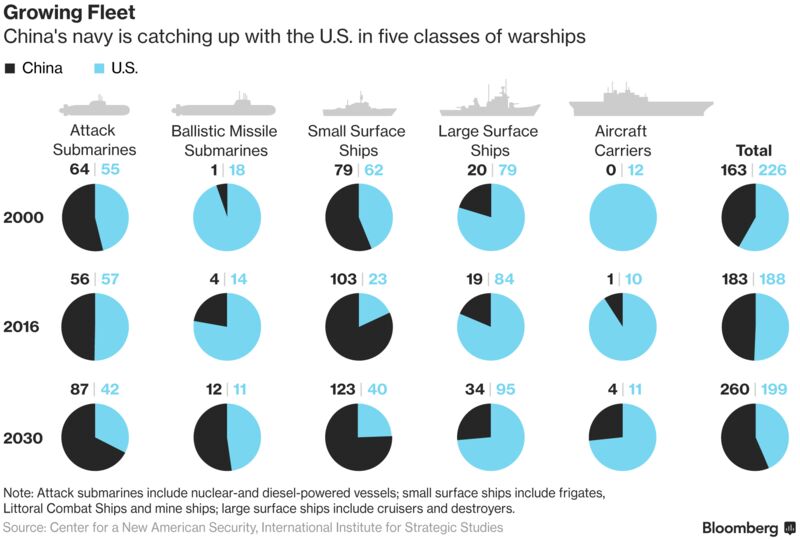
By one measure, the People’s Liberation Army has already caught up with the U.S. -- Asia’s preeminent sea power since World War II. 
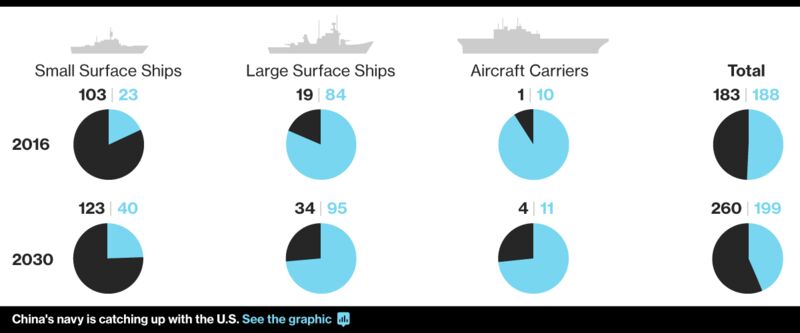
China had 183 cruisers, destroyers, small surface ships and submarines last year, compared with 188 for the U.S. 
That’s according to a CNAS analysis of data supplied by the International Institute for Strategic Studies, which organizes the Shangri-La meeting.
CNAS projected in a March report that the PLA Navy will deploy 260 such ships by the end of the next decade, surpassing an estimated 199 for the U.S. 
That growth has helped fuel calls for a U.S. shipbuilding surge, with the Navy’s operations chief, Admiral John Richardson, saying earlier this month in Singapore that America needed to build more warships -- and fast.
While Donald Trump has called for increasing the U.S. fleet by more than 25 percent, his first budget proposal released last week included funds for only two small Littoral Combat Ships.


To be sure, projecting naval power across oceans often means aircraft carriers. 
And deploying carrier strike groups around the world -- like the 10 the U.S. now operates -- requires a network of overseas bases. 
China lacks both. 
Frigates and other small vessels are expected to comprise the bulk of the country’s future fleet.
Xi Jinping is nonetheless making preparations to be able to project force into the Indian and Pacific oceans, which surround the country’s growing economic interests in Africa, the Middle East and Southeast Asia. 
China launched its first domestically built aircraft carrier in April, the second of as many as six such vessels.
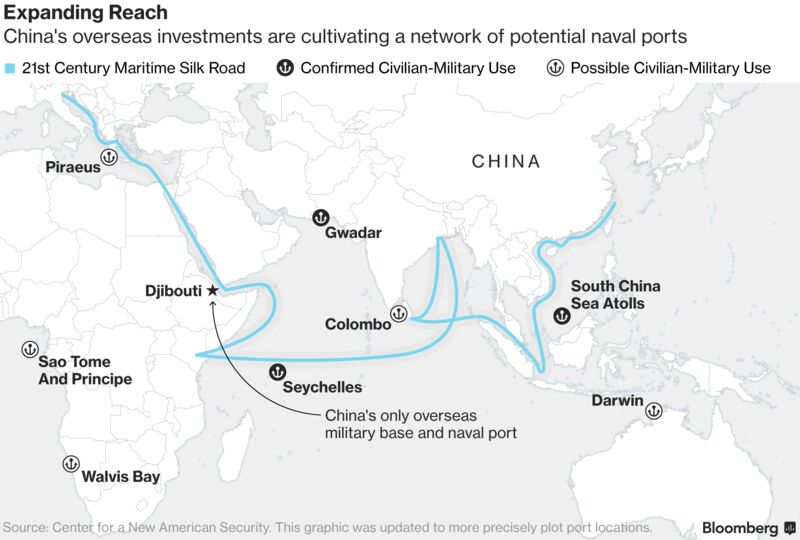
The country is also developing its first overseas base -- Chinese officials call it a “support facility” -- in the East African country of Djibouti, where the French and U.S. also have military installations. Such opportunities are expected to grow as China helps develop ports around the world under Xi’s 21st Century Maritime Silk Road trade-and-infrastructure program.


How to respond to China’s growing naval power has preoccupied many of the admirals, ministers and defense contractors who are expected to begin assembling Friday at the Shangri-La Hotel in Singapore. 
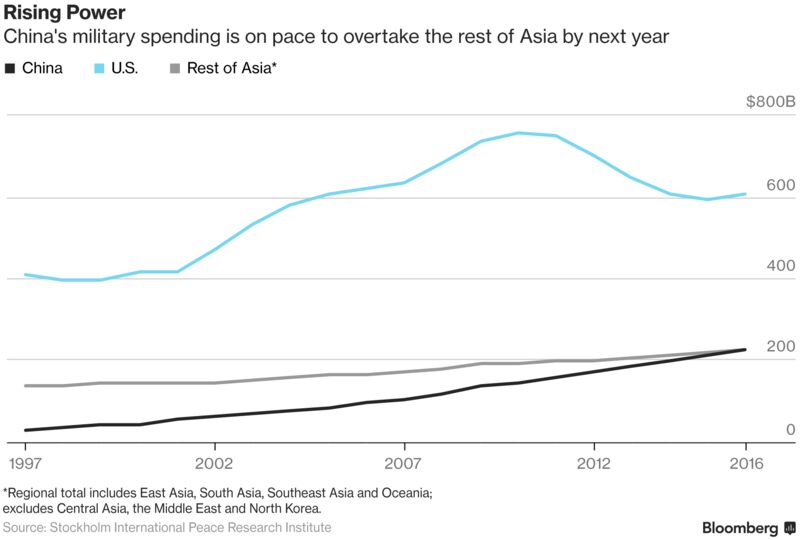
Chinese defense spending is on track to exceed the rest of East Asia, South Asia, Southeast Asia and Oceania combined this year, according to estimates from the Stockholm International Peace Research Institute.
China’s neighbors are now expanding their own fleets. 
This year alone, India, Singapore, Taiwan and Thailand have announced plans to build or acquire submarines. 
India aims to add 60 warships over the next decade to amassing a 200-vessel fleet. 
The proliferation of submarines prompted Singapore’s naval chief, Rear Admiral Lai Chung Han, to call for a code of conduct earlier this month to reduce the risk of accidents.