U.S. warship challenges Chinese illegal claims in South China Sea
BY JESSE JOHNSON
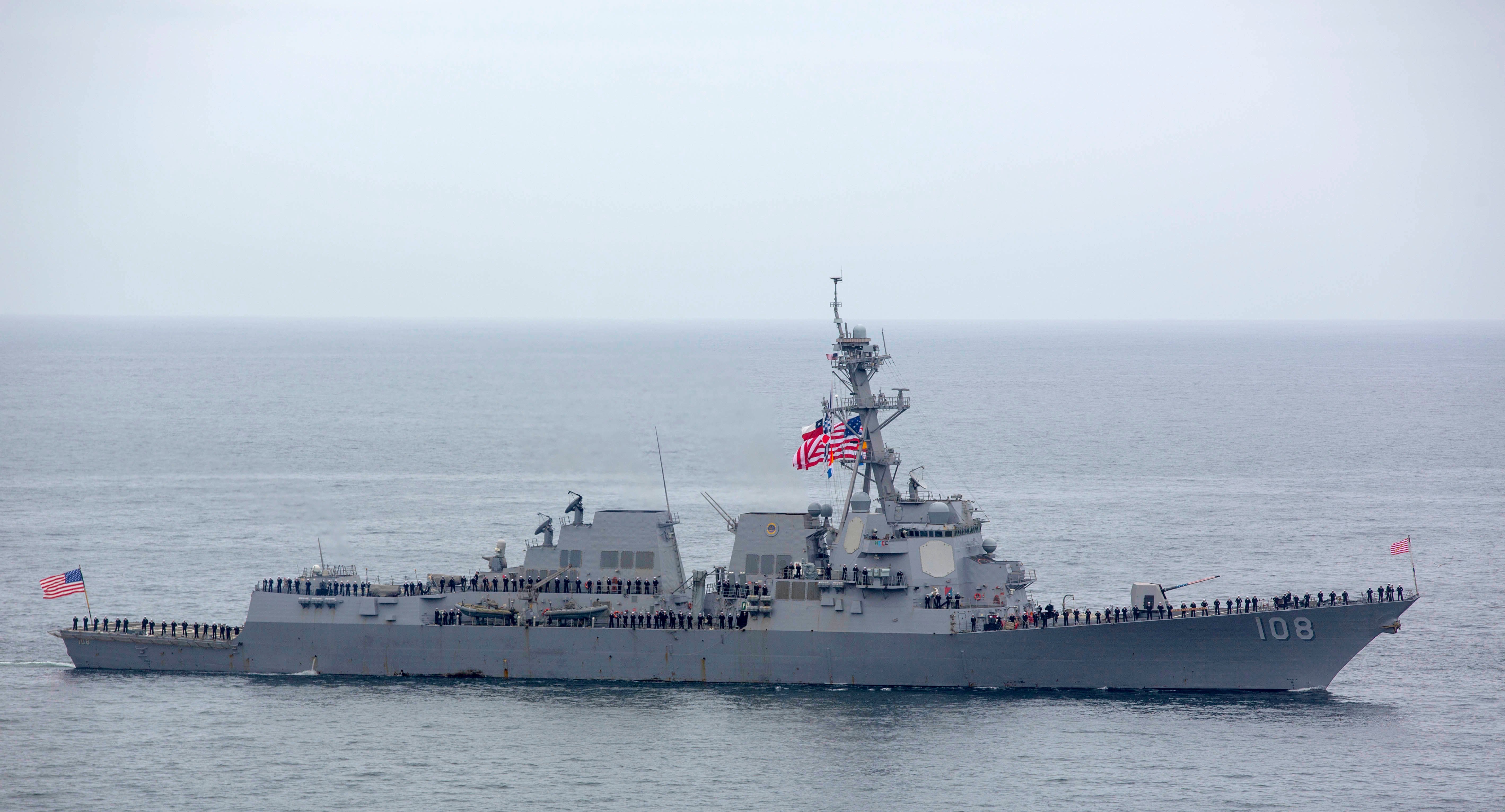
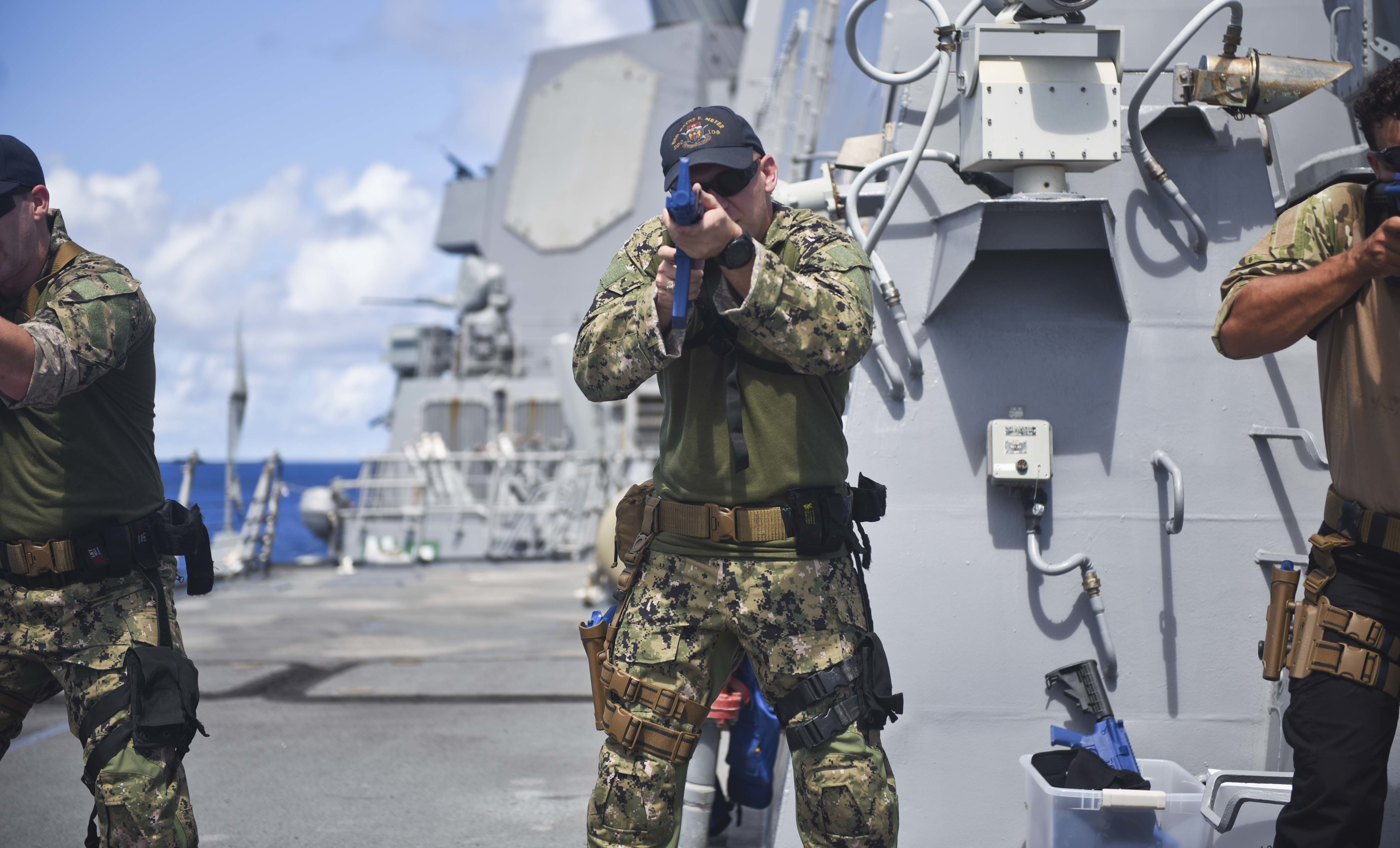
The guided-missile destroyer USS Wayne E. Meyer prepares to refuel at sea with the Nimitz-class aircraft carrier USS Carl Vinson in the Pacific Ocean in November 2017
China sent military vessels and aircraft in an attempt to expel a U.S. warship asserting international freedom of navigation rights in the Paracel Islands of the disputed South China Sea on Friday.
The U.S. Navy said in a statement that guided-missile destroyer USS Wayne E. Meyer had conducted a “freedom of navigation operation” (FONOP) without requesting permission from Beijing — or from Hanoi or Taipei, which also claim the archipelago.
The FONOP “challenged the restrictions on innocent passage imposed by China, Taiwan, and Vietnam and also contested China’s claim to straight baselines enclosing the Paracel Islands,” said Cmdr. Reann Mommsen, a spokeswoman for the U.S. Navy’s 7th Fleet.
Under international law, ships of all states — including their warships — enjoy the right of innocent passage through territorial seas.
Mommsen said that the sailing had also “challenged China’s 1996 declaration of straight baselines encompassing the Paracel Islands.”
Beijing has effectively drawn a line around the entire Paracels archipelago in a bid to claim the entire territory, despite rival claims.
Mommsen noted that international law does not permit continental states like China to establish baselines around entire island groups.
Using these baselines, China, she said, “has attempted to claim more internal waters, territorial sea, exclusive economic zone, and continental shelf than it is entitled under international law.”
The USS Wayne E. Meyer conducted a similar operation last month, sailing within 12 nautical miles (22 km) of the contested Fiery Cross and Mischief Reefs, two Chinese-occupied islands in the South China Sea.
That sailing came just days after the Pentagon issued a strong statement that accused Beijing of employing bullying tactics in the waterway, citing what it said was “coercive interference” in oil and gas activities in waters claimed by Vietnam.
Beijing claims much of the South China Sea, though the Philippines, Vietnam, Malaysia, Taiwan and Brunei have overlapping claims in the waters, where the Chinese, U.S., Japanese and some Southeast Asian navies routinely operate.
Neither Japan nor the U.S. have claims in the waters, but both allies have routinely stated their commitment to a “free and open Indo-Pacific.”
“U.S. forces routinely conduct freedom of navigation assertions throughout the world, including in the South China Sea, as a routine part of daily operations,” Mommsen said.
“The Freedom of Navigation Program’s missions are conducted peacefully and without bias for or against any particular country,” she added.
Washington has lambasted Beijing for its moves in the waterway, including the construction of man-made islands — such as those in the Paracel chain and further south in the Spratlys — some of which are home to military-grade airfields and advanced weaponry.
The U.S. fears the outposts could be used to restrict free movement in the waterway, which includes vital sea lanes through which about $3 trillion in global trade passes each year.
That sailing came just days after the Pentagon issued a strong statement that accused Beijing of employing bullying tactics in the waterway, citing what it said was “coercive interference” in oil and gas activities in waters claimed by Vietnam.
Beijing claims much of the South China Sea, though the Philippines, Vietnam, Malaysia, Taiwan and Brunei have overlapping claims in the waters, where the Chinese, U.S., Japanese and some Southeast Asian navies routinely operate.
Neither Japan nor the U.S. have claims in the waters, but both allies have routinely stated their commitment to a “free and open Indo-Pacific.”
“U.S. forces routinely conduct freedom of navigation assertions throughout the world, including in the South China Sea, as a routine part of daily operations,” Mommsen said.
“The Freedom of Navigation Program’s missions are conducted peacefully and without bias for or against any particular country,” she added.
Washington has lambasted Beijing for its moves in the waterway, including the construction of man-made islands — such as those in the Paracel chain and further south in the Spratlys — some of which are home to military-grade airfields and advanced weaponry.
The U.S. fears the outposts could be used to restrict free movement in the waterway, which includes vital sea lanes through which about $3 trillion in global trade passes each year.
The U.S. military regularly conducts FONOPs in the area.
Beijing says it has deployed the advanced weaponry to the islets for defensive purposes, but experts say this is part of a concerted bid to cement de facto control of the waters.
In a defense white paper released for the first time in years in July, China highlighted a new emphasis on “combat readiness and military training in real combat conditions” and China’s new war-fighting capabilities in the Western Pacific and South China Sea.
Beijing, the white paper said, “has organized naval parades in the South China Sea” and “conducted a series of live force-on-force exercises” while its air force “has conducted combat patrols in the South China Sea and security patrols in the East China Sea, and operated in the West Pacific.”
Beijing says it has deployed the advanced weaponry to the islets for defensive purposes, but experts say this is part of a concerted bid to cement de facto control of the waters.
In a defense white paper released for the first time in years in July, China highlighted a new emphasis on “combat readiness and military training in real combat conditions” and China’s new war-fighting capabilities in the Western Pacific and South China Sea.
Beijing, the white paper said, “has organized naval parades in the South China Sea” and “conducted a series of live force-on-force exercises” while its air force “has conducted combat patrols in the South China Sea and security patrols in the East China Sea, and operated in the West Pacific.”