Affichage des articles dont le libellé est Solomon Islands. Afficher tous les articles

mercredi 16 octobre 2019

China Is Leasing an Entire Pacific Island. Its Residents Are Shocked.

What could Beijing want with Tulagi, where Allied forces fought a bloody battle with Japan in World War II? Some fear military ambitions.
By Damien Cave

Residents of Tulagi, an island of a little over 1,000 people in the Solomon Islands.

SYDNEY, Australia — The island of Tulagi served as a strategic headquarters for Britain and then Japan when each dominated the Pacific.
Before World War II, it was the capital of the Solomon Islands. 
During the war, its natural deepwater harbor across from Guadalcanal made it a military gem fought and died for.
Now Tulagi is about to fall into Chinese hands.
Under a secretive deal signed last month with a provincial government in the South Pacific nation, a Beijing-based company with close ties to the Chinese Communist Party has secured exclusive development rights for the entire island and its surroundings.
The lease agreement has shocked Tulagi residents and alarmed American officials who see the island chains of the South Pacific as crucial to keeping China in check and protecting important sea routes. It is the latest example of China using promises of prosperity to pursue its global aspirations — often by funneling money to governments and investing in local infrastructure projects that critics call debt traps for developing nations.
“The geography tells you that this is a good location,” said Anne-Marie Brady, a China scholar at the University of Canterbury in Christchurch, New Zealand. 
“China is expanding its military assets into the South Pacific and is looking for friendly ports and friendly airfields just like other rising powers before them.”
Beijing’s ambitions in the South Pacific have economic, political and military ramifications.
The region is rich in natural resources, and China’s investments have provoked worries in the United States and Australia that the projects could give Beijing an opening to establish a military foothold for everything from ships and planes to its own version of the Global Positioning System.
China is also pushing to end the region’s status as a diplomatic stronghold for Taiwan.
The Solomons cut ties to Taipei and allied with Beijing just a few days before the Tulagi deal.
A second Pacific nation, Kiribati, followed suit the same week.

A boat in the waters off Tulagi.

Even compared to previous Chinese development deals in nearby countries — including a wharf in Vanuatu, whose terms were not publicly released for yearsthe Tulagi agreement is remarkable for both its scope and lack of public input.
The renewable 75-year lease was granted to the China Sam Enterprise Group, a conglomerate founded in 1985 as a state-owned enterprise, according to corporate records.
A copy of the “strategic cooperation agreement,” obtained by The New York Times and verified by two people with knowledge of the deal, reveals both the immediate ambitions of China Sam and the potential — just as in Vanuatu — for infrastructure that could share civilian and military uses.

CHINA’S SURGE
Signed on Sept. 22, the agreement includes provisions for a fishery base, an operations center, and “the building or enhancement of the airport.”
Though there are no oil or gas reserves in the Solomons, the agreement also notes that China Sam is interested in building an oil and gas terminal.
These are just the explicit possibilities.
The document also states that the government will lease all of Tulagi and the surrounding islands in the province for the development of “a special economic zone or any other industry that is suitable for any development.”
The provincial governor who signed the deal, Stanley Maniteva, could not be reached for comment. Noting that laws and landowner rights would be respected, he told local reporters this week that the agreement had not been completed.
“I want to make clear that the agreement does not bear the official stamp of the province so it is not official and formalized yet,” he said.
But many residents of Tulagi, an island of a little over 1,000 people, are taking the signing of the document to mean it is a real agreement, and outrage has quickly set in.
“They cannot come in and lease the whole island like that,” said Michael Salini, 46, a business owner on Tulagi who is helping organize a petition to oppose the China Sam agreement.
“Everyone is really scared about the possibility of China turning the island into a military base,” he added.
“That is what really scares people — because why else do they want to lease the whole island?”
A military installation would carry strategic and symbolic significance.
China’s efforts in the region echo the period before and during World War II, when Japan wrested control of island assets, which were won back in turn by American and Australian troops in bloody battles.
But it is also a matter of feasibility: China goes where there’s value and interest.
With the United States pulling back in much of the world under Trump’s America First policy, Beijing is often knocking on doors left open.
American and Solomon Islands officials note that Chinese businesses and officials have cultivated local politicians for years with bribes and gifts like luxury trips to China and Singapore. 
In a poor country of 600,000 people with a national Parliament of 50 members, it doesn’t take much to tilt debate.
“What worries me much more about the new Chinese engagement, be it political or economic, in the Pacific is the way in which this engagement is taking place, being lubricated by elite capture and corruption,” said Jonathan Pryke, a Pacific islands expert with the Lowy Institute in Sydney.
Though patronage and corruption have long been a challenge, he added, “this engagement has certainly taken it to a whole new level.”

Li Keqiang and Prime Minister Manasseh Sogavare of the Solomon Islands at the Great Hall of the People in Beijing last week.

The prime minister of the Solomon Islands, Manasseh Sogavare, visited China earlier this month. Photographs from the trip showed him smiling with China Sam executives.
The visit carried a whiff of victory for Beijing.
It followed a failed lobbying effort by Australia and the United States to keep the Solomons loyal to Taiwan and the alignment that began when American Marines dislodged Japanese troops from Tulagi and Guadalcanal in 1942.
Australia’s prime minister, Scott Morrison, visited the Solomons in June — the first official visit by an Australian leader in a decade.
He announced an infrastructure program worth up to 250 million Australian dollars, or about $168 million, in grant financing over 10 years.
Vice President Mike Pence also pressed Sogavare to hold off on deciding about Taiwan, promising infrastructure investments and making plans for an in-person discussion in September around the time of the United Nations General Assembly.
But Sogavare then announced the severing of ties with Taiwan, and Mr. Pence canceled the meeting.
Still, some argue that the United States could revive support.
“It’s not too late in the game,” said Phillip Tagini, a mining executive who served in the Solomons as a prime minister’s adviser from 2012 to 2015.
“At this stage we don’t have the history with China to say we can trust them.”
After an election in 2006, rioting and violence broke out amid allegations that money from Chinese businessmen had rigged the results.
Protests also greeted Sogavare’s election win in April, with demonstrators marching toward the capital’s Chinatown to register discontent.
“Separate from China’s agenda is the risk of destabilizing a vulnerable society,” Professor Brady said.
But the tangible effects of the deals being struck now, some say, could win over even the skeptics.
“The fact is, people in the Solomons are going to see infrastructure from China, and when they see these things happening they are going to say, ‘Wow, this is what we were waiting for,’” Mr. Tagini said.
“If the Americans are going to come, they need to choose where their impacts are going to be seen. They need to be seen.”

mercredi 10 avril 2019

Han Peril: China’s Voracious Appetite for Timber Stokes Fury in Russia and Beyond

After sharply restricting logging in its own forests, China turned to imports, overwhelming even a country with abundant resources: Russia.
By Steven Lee Myers


Logs from Russia stacked outside Manzhouli, a Chinese border town, where the wood is processed and then shipped throughout the country and the world.

From the Altai Mountains to the Pacific Coast, logging is ravaging Russia’s vast forests, leaving behind swathes of scarred earth studded with dying stumps.
The culprit, to many Russians, is clear: China.
Since China began restricting commercial logging in its own natural forests two decades ago, it has increasingly turned to Russia, importing huge amounts of wood in 2017 to satisfy the voracious appetite of its construction companies and furniture manufacturers.
“In Siberia, people understand they need the forests to survive,” said Eugene Simonov, an environmentalist who has studied the impact of commercial logging in Russia’s Far East. 
And they know their forests are now being stolen.”
Russia has been a witting collaborator, too, selling Chinese companies logging rights at low cost and, critics say, turning a blind eye to logging beyond what is legally allowed.
Chinese demand is also stripping forests elsewhere — from Peru to Papua New Guinea, Mozambique to Myanmar.
More than 120 companies and factories have opened in Manzhouli to capitalize on the wood trade, which has skyrocketed since China restricted timber in its natural-growth forests.

In the Solomon Islands, the current pace of logging by Chinese companies could exhaust the country’s once pristine rain forests by 2036, according to Global Witness, an environmental group. 
In Indonesia, activists warn that illegal logging linked to a company with Chinese partners threatens one of the last strongholds for orangutans on the island of Borneo.
Environmentalists say China has simply shifted the harm of unbridled logging from home to abroad, even as it reaps the economic benefits. 
Some warn that the scale of logging today could deplete what unspoiled forests remain, contributing to global warming.
At the same time, China is protecting its own woodlands.
Two decades ago, concerns about denuded mountains, polluted rivers and devastating floods along the Yangtze River made worse by damaged watersheds prompted the Communist government to begin restricting commercial logging in the nation’s forests.
The country’s demand for wood did not diminish, however. 
Nor did the world’s demand for plywood and furniture, the main wood products that China makes and exports.
It is one thing for Chinese demand to overwhelm small, poor nations desperate for cash, but it is another for it to drain the resources of a far larger country, one that regards itself as a superpower and a strategic partner to China.
The trade has instead underscored Russia’s overreliance on natural resources and provoked a popular backlash that strains the otherwise warm relations between the countries’ two leaders, Vladimir Putin and Xi Jinping.
Protests have erupted in many cities. 
Members in Russia’s upper house of parliament have assailed officials for ignoring the environmental damage in Siberia and the Far East. 
Residents and environmentalists complain that logging is spoiling Russian watersheds and destroying the habitats of the endangered Siberian tiger and Amur leopard.
“What we are doing now in Siberia and the Far East is destroying what is left of the original intact forest landscapes,” said Nikolay M. Shmatkov, director of the forestry program for the World Wildlife Fund in Russia. 
The group has documented the destruction using satellite images over a period that coincides with the Chinese logging boom in the country.
“It’s not sustainable,” he said.

Matryoshka Square in Manzhouli, named after the Russian nesting dolls. The square contains hundreds of oversized dolls, called taowa in Chinese, including a 17-story hotel, center, that claims to be the world’s largest.

‘Nothing Will Be Left’
China’s economic transformation over the last four decades has driven its demand. 
It is now the world’s largest importer of wood. (The United States is second.) 
It is also the largest exporter — turning much of the wood it imports into products headed to Home Depots and Ikeas around the world.
The total value of China’s timber imports — rough logs, timber or wood pulp — has increased more than 10 times since China began restricting logging at home in 1998, reaching $23 billion in 2017, the highest ever, according to IHS Markit’s Global Trade Atlas.
The government extended a regional ban to the rest of the country at the end of 2016. 
It now allows commercial logging only in forests that have been replanted, a policy that environmentalists say other countries should emulate.
The problem is that many have not, and Chinese companies have pursued these opportunities.
More than 500 Chinese companies operate in Russia now, often with Russian partners, according to a report by Vita Spivak, a scholar on China for the Carnegie Moscow Center. 
Russia once delivered almost no wood to China; it now accounts for more than 20 percent of China’s imports by value.
“If the Chinese come, nothing will be left,” Marina Volobuyeva, a resident of the Zamensky region south of Lake Baikal, told a television channel after a Chinese company secured a 49-year lease to log in the area.
Russia sells such logging concessions at prices that vary by region and type of wood, but on average, they cost roughly $2 a hectare, or 80 cents an acre, per year, according to Mr. Shmatkov of the World Wildlife Fund. 
That is far below the cost in other countries.
In 2017, China imported nearly 200 million cubic meters of wood from Russia.
Artyom Lukin, a professor of international studies at the Far Eastern Federal University in Vladivostok, noted that government corruption, criminality and the lack of economic development in Siberia and the Far East have also made the crisis worse.
“In many rural areas of the Russian Far East and Siberia, there are few other ways to make money, or to make a living, than stripping natural resources of the vast surrounding forests,” he said.
The border crossing at Manzhouli, marked by two arches and divided on the Chinese side by a green wire fence that stretches for hundreds of miles. The Chinese side is a park that is closed to foreigners. The crossing has become China’s largest landlocked port for goods, including wood, coal and petrochemicals.

Transformed by Timber
For China, though, the trade has been a boon.
Much of the wood from Russia crosses the border in Manzhouli, a former nomadic settlement that became a junction in the Trans-Siberian Railway at the turn of the 20th century. 
The trade has transformed what was once a sleepy border town into one of China’s main hubs for wood processing and production.
In the last two decades, more than 120 mills and factories have sprung up. 
They process raw or rough-cut lumber into plywood, and manufacture veneer panels, laminated wood, doors, window frames and furniture.
The factories cover dozens of acres on the city’s edge and have created more than 10,000 jobs in a city of 300,000 people, according to a municipal official.
New construction has made the city an architectural homage to Russian culture. 
Many buildings have features like onion domes. 
There is even a replica of St. Basil’s Cathedral that is a children’s science museum, and a hotel in the shape of what officials claim is the world’s largest matryoshka, or nesting doll.
Zhu Xiuhua’s career has traced the arc of the Russian trade.
Now 50, Ms. Zhu moved to Manzhouli when China began restricting logging. 
She began brokering imports from Russia, then in 2002 began to seek the rights to log Russian forests directly. 
Four years later, she founded the company she owns today, the Inner Mongolia Kaisheng Group, one of the city’s biggest.
Ms. Zhu now oversees three factories in Manzhouli, as well as concessions to log 1.8 million acres of Russian forests near Bratsk, a city next to Lake Baikal, and to transport them to China. 
“We are growing every year,” she said.
When pressed, she declined to discuss her concessions in detail, but according to the company’s website, she had invested $20 million in Russia by 2015. 
China’s official Xinhua News Agency estimated the conglomerate’s assets at $150 million in 2017.
In Ms. Zhu’s view, the trade is a classic case of supply meeting demand. 
She described it, perhaps overconfidently, as enduring.
The next step will be to seek more concessions westward. 
“Krasnoyarsk,” she said, using first the Mandarin version of the name before pronouncing it in Russian. 
“You could not log all of it in 100 years,” she said.

Zhu Xiuhua built a conglomerate of companies based in Manzhouli that log, transport and process wood from Russia.


Laundering Logs
There are international protocols that seek to control where and what kinds of trees are logged, and the United States extended the Lacey Act in 2008 to ban the import of wood obtained illegally anywhere, but such regulations are difficult to enforce.
In some countries, like the United States and Canada, logging is strictly policed, but Chinese companies often exploit lax oversight elsewhere and log in protected forests, according to officials and environmentalists.
In Russia, logging commonly encroaches on areas outside the allotted boundaries and companies that export wood to China are known to falsify records.
Logging without contracts is also common, while arsonists are suspected of having set fires to forests, because scorched trees can be legally culled and sold.
In 2016, the United States Justice Department accused Lumber Liquidators of illegally importing hardwood flooring that was mostly made in China using timber illegally harvested in Russia’s Far East.
Accusations of corruption have stirred public anger in Russia. 
A question on the extent of illegal logging prompted an acerbic response from Putin in his annual news conference in December. 
He called Russia’s forestry industry “a very corrupt sector.”

The booming trade with Russia has transformed Manzhouli, which was once a sleepy border town. Much of the architecture has Russian features, while many shops and restaurants advertise in both languages, catering to tourists and traders.

‘Barbaric Deforestation’
Protests against logging — and Chinese logging in particular — have erupted across Siberia and the Russian Far East. 
They have stoked ethnic tensions along a border that extends over 2,600 miles between Russians and Chinese who had long had mutual suspicions shaped by political and cultural differences.
One protest last May in Ulan Ude, a regional capital near Lake Baikal, resulted in scuffles with the police and eight arrests. 
“Stop the barbaric deforestation,” a sign declared.
The issue has become so politically volatile that in January the head of Russia’s forestry service, Ivan Valentik, faced pointed questioning in the upper house of parliament, which does not usually challenge Putin’s government directly.
He defended the concessions, but also sought to shift blame to the Chinese companies for not fulfilling their contracts — by, for example, replanting forests. 
He suggested that Russia could be forced to end direct sales of timber to China.
In China, the State Forestry and Grassland Administration did not respond to written questions. Officials have previously pledged that Chinese companies would adhere to local laws and be mindful of the environmental impact.
Ms. Zhu initially said she did not worry about the protests inside Russia since everything her company did was done according to Russian laws. 
After the latest round of public hearings in Moscow, however, she sounded less sanguine.
“Russia is changing now,” she said by telephone, and then declined to answer any more questions.

lundi 23 juillet 2018

A New Battle for Guadalcanal, This Time With China

By Damien Cave
Australia pledged in June to build an undersea internet cable to the Solomon Islands.

GUADALCANAL, Solomon Islands — When Toata Molea looks to the sea and his fleet of fishing boats on the island of Guadalcanal, he imagines the possibilities from a new connection to the outside world: a planned undersea internet cable to be built by Australia.
When he turns the other way, however, to the main road passing through Honiara, the capital of the Solomon Islands, he sees another form of foreign investment: dozens of buildings and businesses bought or built by Chinese immigrants.
“They own everything,” Mr. Molea, 54, said of his ethnic Chinese neighbors. 
My fear is that in the next 10 years, this place will be taken over by the Chinese.”
The last time Guadalcanal concerned itself with a takeover, 60,000 American troops were fighting Japanese soldiers for control of the island in one of the fiercest battles of World War II
Now, this stretch of jungle — a linchpin of the Australian-American alliance with a long history of naval importance — has become the stage for a new cold war of strategic competition.
After years of largely unchecked Chinese investment and immigration throughout the South Pacific, Australia and the United States are stepping up their efforts here and across the region — warning local officials against relying too much on China, and pushing to compete with more aid, infrastructure and diplomacy.
There is no denying that “strategic competition for influence in the Indo-Pacific region is on the rise,” said Matt Matthews, a deputy assistant secretary of state in the Bureau of East Asian and Pacific Affairs. 
As a result, he said, “we must not take our longstanding friendships with the Pacific islands for granted.”
At the central market in Honiara, the capital, many of the employees are locals but the owners are Chinese immigrants.

The United States has committed more than $350 million to Pacific island countries, in the form of law enforcement assistance, help with managing fisheries and other aid. 
The World Bank more than doubled its main development budget for the Pacific too, increasing it to $808 million over a three-year period.
But Australia has gone even further. 
Pacific aid jumped to 1.3 billion Australian dollars ($960 million) in this year’s budget, an 18 percent increase. 
Nearly a third of Australia’s aid budget is now set aside for the Pacific — a region of nearly two dozen countries and territories with around 11 million people spread across more than 20,000 islands.
A large portion of that money will go toward installing the undersea cable connecting Guadalcanal (and Papua New Guinea) to Australia’s global internet hub.
Experts consider Australia’s spending spree the strongest example yet of its intensified push to counter Chinese efforts in the region.
The Chinese networking company Huawei announced last year that it planned to lay a cable and provide the Solomon Islands with a high-speed internet connection.
When Australia learned of that plan, it threatened to withhold a connection license when the cable reached Sydney because Huawei is a cybersecurity threat.
Australian officials immediately offered an alternative: Australia would pay for a cable and it would be up and running by 2019.
“The Australian government had been tracking that very closely,” said James Batley, a former Australian high commissioner to the Solomons and other countries in the region.
When they saw the Chinese cable proposal, he said, the Australians “made an intervention and said, ‘Sorry, that’s a red line for us.’”
For business owners in particular, the undersea cable is long overdue. 
Connectivity is so weak across the Solomons that storm clouds often interfere with the satellites that currently provide internet access.
“It’s important,” said Mr. Molea, the fish wholesaler, who also praised a small grant program from Australia that helped him build an ice factory for his sustainable fishing business
“With that cable, hopefully we can set up electronic banking and payment.”
But to truly compete with China, many people said, Australia, the United States and their allies need to do more, more visibly, with less bureaucracy.
Anthony Veke, the premier of Guadalcanal Province, said he was willing to work with any foreign partners who presented a good opportunity.

The cable stands out because it is a rarity. 
The aid packages cited with pride by officials in Canberra and Washington tend to focus not on the tangible infrastructure that struggling countries like this one crave, but rather on institutional assistance with governance and law enforcement.
That work is gradual, vital and complicated. 
Many Solomon Islanders still see Australia through the lens of a security intervention that ended last year after more than a decade of mixed reviews for its effort to establish stability in the wake of chronic ethnic violence.
And just as some Pacific islands have become more vocal about Australia’s “paternalistic aid,” officials in the Solomons often complain that the Australian and American governments do more dictating than developing.
Regional officials often argue that too much of the aid money is tightly restricted or boomerangs back to foreign consultants and contractors, leading many to ask: Well, why not try our luck with China?
Anthony Veke, 41, the ambitious premier of Guadalcanal, counts himself among those pushing toward a future with various partners.
He told me he has gone to China twice in the past year to pursue investment for a tourism development on the island’s west coast that would include a new airport.
Islanders attend a birthday celebration for Queen Elizabeth II, the head of state. The occasion was a reminder of the country’s historic links to the West.

He added that he would like to see a new road circumnavigating Guadalcanal, and an upgrade for the international airport.
“We can’t be boxed in,” Mr. Veke said, sitting in his office on the main road through Honiara, where dust and potholes still dominate. 
“We have to be given an opportunity to look at other places for things that are good for our people.”
Given the history, it is a striking shift — for the Solomons and the postwar order.
Honiara exists largely because of World War II and the United States Navy.
The airport Mr. Veke wants to upgrade was originally Henderson Field, the airstrip that thousands of American Marines in particular fought and died to capture and defend.
Naval Construction Battalions, better known as Seabees, built most of the city’s roads, its major bridges and what was until recently its largest hospital.
Little development has occurred since — the airport still feels like a World War II relic — but much of what is new or prosperous seems to be owned by someone from China.
Honiara’s Chinatown has been the scene of racial tension in the past.

Many, if not most, of the shops along the main road have Chinese owners, who sit in corner booths towering over their China-made merchandise and local employees.
In Honiara’s Chinatown, a small strip of shops that has existed since the first wave of Chinese migrants arrived a century ago, signs of growth are visible: Scaffolding climbs above a new Chinese school that has received financial support from the Chinese government.
Matthew Quan, 52, the president of the Solomon Islands’ Chinese Association and a third-generation Solomon Islander who runs a large wholesale business across from the school, said Chinese expansion had been organic, driven by migration and economic factors rather than political or military direction from Beijing.
Centrally planned or not, the influx has not always been welcome. 
Frustration with Chinese shop owners flared up in 2006, leading to riots, and in 2014 Chinatown was set ablaze during another spasm of violence.
The main concern for many people on Guadalcanal involves not Chinese government interference, but rather cronyism and corruption fueled by Chinese wealth
No one knows the extent of Chinese property ownership in the Solomons; even the size of the Chinese population is a mystery, Mr. Quan said, since many migrants come in as tourists and bribe officials for visas that let them stay.
“I suppose you could say they’re a lot more ruthless in how they do things,” Mr. Quan said, referring to the recent migrants. 
“And the government of the Solomon Islands is easily manipulated.”
The World Bank has pledged to build a power plant along the Tina River.

Mr. Molea called what’s happening “a different form of colonialism that’s a consequence of democracy.”
He has called on officials to halt all Chinese purchases and investment until there is a public accounting of who owns what.
But such an audit is unlikely. 
For Guadalcanal and many other islands in the region, this is a moment to embrace competing offers from world powers, not spurn them.
It is a contest seen across the South Pacific in countries like Vanuatu, where a new wharf has spurred a heated debate about China’s ambitions, and even in communities far from major cities.
An hour or two inland from the Guadalcanal coast, along the Tina River, the World Bank hopes to build a hydroelectric dam that could drive down electricity prices. 
But more than a decade after it was proposed, the dam has yet to be constructed, leading World Bank officials to praise the legal precedents that have been set rather than the services they have provided.
Not far away, by contrast, is an obvious example of Chinese productivity: a large gold mine that was closed by an Australian company in 2014, then sold last year to a Chinese developer who made a fortune in Australian real estate.
The mine reopened in May, providing jobs — but in a riskier work environment.
Local tribes have discovered that the new owners are less careful about worker safety than the Australians. 
According to a monitor they sent to investigate, employees don’t wear goggles or safety boots as often as they should, and tasks that used to be closely monitored no longer are.
The company that owns the mine, the AXF Group, did not respond to requests for comment.
Asked whether the return of the mining jobs was worth the potential danger to workers, the tribes’ investigator, Densley Kesi, said he couldn’t be sure.
“The Australians had a lot of regulation,” he said. 
“The Chinese don’t. It worries me.”

mercredi 20 juin 2018

Chinese Peril

With cash to burn, China now has the power to disrupt the rest of the world — and its first targets are a big problem for us.
By Charis Chang


CHINA finally seems to have completed its coming of age, and now has the power and money to disrupt diplomatic relations around the world.
After decades of taking its neighbors for granted, Australia is starting to wake up to China’s potential to dominate the Pacific region.
The superpower has been splashing its cash and growing its influence in the region at the same time as Australia’s assistance has stalled.
Now some experts warn China could eventually establish a military presence right on Australia’s doorstep.
“It’s got global ambitions and it’s challenging the rules based international order,” security analyst Malcolm Davis told 60 Minutes on Sunday.
“What the Chinese tend to do is that they put heavy investment into countries that simply don’t have the means to pay back the debt.
“So they’re getting countries addicted to debt and then when they call in the debt and the countries can’t pay, the Chinese will take a port or a territory or take an island.”
In places like Sri Lanka and the African nation of Djibouti, China has been granted control over ports after the countries defaulted on massive loans taken out to build the ambitious projects. 
There are now fears the same pattern will play out in Vanuatu where China has loaned the country $114 million to build a wharf at Luganville — the site of America’s second largest base in the Pacific during World War II.
While the port was built to attract cruise ships to the region, it is big enough to accommodate foreign naval ships including guided missile destroyers, cruisers and even aircraft carriers.

The new wharf at Luganville, Vanuatu. 

“The Chinese wouldn’t be building all this just to cash in on a very limited tourist market,” Dr Davis said. 
“They’re thinking commercial influence, political influence and ultimately a military presence.
“If the Chinese were to bring naval forces into this region, it fundamentally changes our strategic outlook in a way not seen since the 1940s.”
Director of the East Asia Program at the Lowy Institute, Merriden Varrall told news.com.au that Australia seems to have had taken the region for granted but this was likely to change now that China has stepped up its presence.
“I think it has been rather overlooked in the past and rather taken for granted by Australia,” she said.
But while China’s aid in the region was significant, it was no where near what Australia contributed.
Vanuatu Foreign Minister Ralph Regenvanu admits the country made mistakes on some projects it has done with China but says it would never give China a military base in Vanuatu.
“We are a non-aligned country... so this big power play that’s happening in which China is involved, in which Australia is involved, Vanuatu wants to be no part of it,” Mr Regenvanu said.

WHY IS THE PACIFIC IMPORTANT?
Australian National University’s Development Policy Centre deputy director Matthew Dornan said there were many reasons why the Pacific was important strategically.
For Australia, the most important islands were the ones that were the closest: Papua New Guinea, Vanuatu and the Solomon Islands.
From China’s perspective, Dr Dornan said those same islands were also important, as well as Fiji, as they had the most minerals and natural resources.
“I don’t think the Pacific tops its list in terms of strategic importance, even if it does for Australia,” Dr Dornan said.
While the Pacific may not be high on China’s agenda, Australia appears to have woken up to the importance of the region to its own interests.
Foreign Minister Julie Bishop recently returned from a bipartisan trip to some Pacific nations with Labor shadow minister Penny Wong
They visited Palau, the Federated States of Micronesia and the Marshall Islands.
Ms Bishop has denied that the trip was aimed at countering Chinese influence but in an interview with Fairfax media, acknowledged that China’s construction of roads, ports, airports and other infrastructure in the region had triggered concern that small Pacific nations may be saddled with unsustainable debts.
“We want to be the natural partner of choice,” Ms Bishop told Fairfax Media on Tuesday.
“We want to ensure that they retain their sovereignty, that they have sustainable economies and that they are not trapped into unsustainable debt outcomes.
“The trap can then be a debt-for-equity swap and they have lost their sovereignty.”
Australia is aiming to provide the counterbalance to the influence of other nations in the region, including Russia.
Australia has also stepped in to build a high-speed underwater communications cable project to connect the Solomon Islands and Papua New Guinea to Australia.
The Solomon Islands had originally made a deal with rogue Chinese company Huawei in late 2016 to construct the fibre-optic cable, to improve the country’s often unreliable internet and phone services.
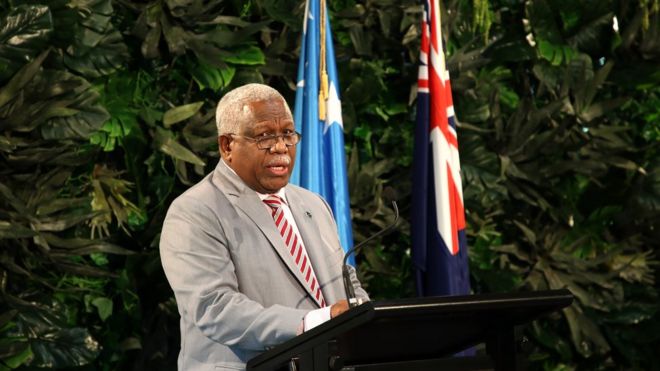
But Solomon Islands Prime Minister Rick Houenipwela said earlier this month there had been a change of heart following “some concerns raised with us by Australia”, without elaborating.

Prime Minister Malcolm Turnbull with the Prime Minister of the Solomon Islands, Rick Houenipwela. 

Ms Bishop refused to detail what concerns Canberra had with telecom giant Huawei.
“I would not elaborate on security issues, that’s not appropriate,” she told reporters.
“What we have offered the Solomon Islands, and they have accepted, is an alternative to the offer, and ours is cheaper. It’s likely to be a faster result for them, and technically superior.”
Huawei has long disputed claims of any links to the Chinese government but it was blocked from bidding for contracts on Australia’s national broadband project in 2012, due to concerns about cybersecurity.
In another sign of the importance Australia is now putting on its relationship with its Pacific neighbours, it has bumped up its foreign aid spending in the region to its highest ever, from $1.1 billion to $1.3 billion.
This is in contrast to the heavy cuts it has made to the overall aid budget since 2015/16, which have hit countries in Africa and the Middle East in particular.

‘WE COULD HAVE PAID MORE ATTENTION’
While Dr Dornan does not think Australia has completely dropped the ball in the Pacific, especially as it has largely maintained aid to the region, it could be doing more and not just when it comes to foreign aid.
“Certainly I think Australia could have paid more attention to the region and been responsive to what the region would like from Australia,” he said.
This includes considering the region’s requests for its citizens to be able to work more freely in Australia, as well as addressing its concerns about climate change — instead of making them the butt of jokes.
Dr Dornan said New Zealand had a special migrant category for Pacific Islanders in recognition of its history as a colonial power in the region.
“Australia also has that history but there are very few Papua New Guineans in Australia despite being our neighbor,” he said.
He also believed links between Australian and Pacific Islander peoples should be improved.
“Generally the public’s understanding of the Pacific in Australia is limited,” he said. 
“We are not taught about the Pacific like we are taught about the history of Europe.”
While Pacific Islanders had a good understanding of Australia because it was such a large country, the reverse was not true.
“It’s very hard to have strong relationships with countries with no common understanding,” he said.
But he said he thought the biggest challenge that would impact the ongoing relationship was climate change.
“It’s hugely important for the Pacific, it’s an existential problem for some countries which may disappear in the future,” he said.
“The federal government has really been dragging the chain on climate change action, it won’t be resolved easily but I think Australia could do more, and that would help to improve relations with the Pacific.”

The Conflict Islands in Papua New Guinea.

mercredi 13 juin 2018

How an Australian spy stopped China from growing internet influence South Pacific

As China's plan to spread itself across the South Pacific grew, one Australian spy took matters into his own hands.
By Matt Young

Australia to build comms cable for Solomons and PNG: Bishop

AN AUSTRALIAN spy is being hailed after intervening in a major deal that would have seen a surge in China’s influence in the South Pacific.
Today Australia and its neighbour, the Solomon Islands, will sign off on the first stage of a 4000km high-speed undersea internet cable in a deal that has swiped China off the map.
The multimillion-dollar deal will provide a high speed internet link between Australia and the fifth-largest Oceanian country by population which struggles with unreliable and ineffective internet services. 
It will also connect Papua New Guinea to Australia.
SBS described it as a “significant leap forward for communications” for the impoverished country, which currently relies on satellite networks.
The Solomon Islands had originally awarded the contract to Chinese telecommunications giant Huawei in 2016 but it was “diplomatic pressure and rare intervention” from a top Australian spy that saw the deal take a change of course, according to the ABC.
“Australian intelligence agencies never wanted the Solomon Islands to allow Chinese company Huawei to build the link, and were keen to prevent it happening,” journalist Matthew Doran reported.
Huawei has become the world’s third largest smartphone maker in recent years but the company faces headwinds in its expansion plans due to its close links with the Chinese communist party.
Australia halved the cost of the project for the island nation and refused to allow a “landing point” for the cable on Australian territory if China took control.

Nick Warner, director-general of the Australian Secret Intelligence Service at the launch of the Foreign Policy White paper at DFAT in Canberra. 

A map of submarine cable systems and their landing stations around Australia. 

Julie Bishop this morning defended the decision, saying Australia’s neighbours needed other options than simply China.
“What we have offered the Solomon Islands, and they have accepted, is an alternative to the offer, and ours is cheaper. It’s likely to be faster results for them, and technically superior. And also more resilient,” she said.
“We put up an alternative, and that’s what I believe Australia should continue to do. We are the largest aid donor in the Pacific.
“We are a longstanding partner of Solomon Islands, and I want to ensure that countries in the Pacific have alternatives, that they don’t only have one option and no others, and so in this case we are in a position to be able to offer a more attractive deal for Solomon Islands and PNG, and they accepted it.”

Prime Minister @TurnbullMalcolm welcomes the Prime Minister of #SolomonIslands Rick Houenipwela and Madam Rachel Houenipwela to @Aust_Parliament with a Ceremonial Welcome today, including a 19 gun salute and an inspection of Australia's Federation Guard. pic.twitter.com/HJh9mM5n80— PM&C (@pmc_gov_au) June 13, 2018

Jonathan Pryke, director of the Pacific Islands Program at the Lowy Institute, warned in November last year that if Beijing had its way, it would result in some “really significant national security issues for Australia.
“Having a Chinese state-owned enterprise connecting up to a piece of critical domestic infrastructure is pretty unpalatable for the Australian Government.”
The contract change was only after Nick Warner, the head of Australia’s foreign spy agency, ASIS, intervened in July 2017. 
He warned the Solomon Island’s former Prime Minister that allowing the Chinese such measures would create a cybersecurity risk for Australia and its allies by giving the Chinese access to the “back end” of the Australian network.

President Rodrigo Roa Duterte discusses matters with Australian Secret Intelligence Service Director General Nicolas Peter 'Nick' Warner who paid a courtesy call on the President at the Malaca — an Palace on August 22, 2017.

Today Solomon Islands’ current Prime Minister, Rick Houenipwela, and Australian Prime Minister Malcolm Turnbull will cement the deal in Canberra.
“We have had some concerns raised with us by Australia, and I guess that was the trigger for us to change from Huawei to now the arrangements we are now working with Australia on,” Mr Houenipwela told Sky News in New Zealand last week.
Taxpayers will be slugged for about two-thirds of the price, the government revealed in the 2018 Budget. 
The exact price of the deal, though, is unknown, despite reports it could cost more than $100 million from the aid budget.
Last month, the Pentagon ordered U.S. military bases worldwide to ban mobile phones and other telecommunications equipment made by the Chinese company Huawei after senior U.S. intelligence officials warned the phones could be used to spy on Americans and U.S. service members.
Although there has been steadfast denials from Huawei, that the Chinese tech company eavesdrops on behalf of Beijing, for a number of years the US has prohibited Huawei from bidding for government contracts out of fears for national security
Both Labor and Liberal government blocked Huawei from tendering for the National Broadband Network in 2012 and 2013.

Huawei Menace

Australia cements Solomon Islands deal
BBC News

Solomon Islands PM Rick Houenipwela says Australia raised concerns about a previous deal
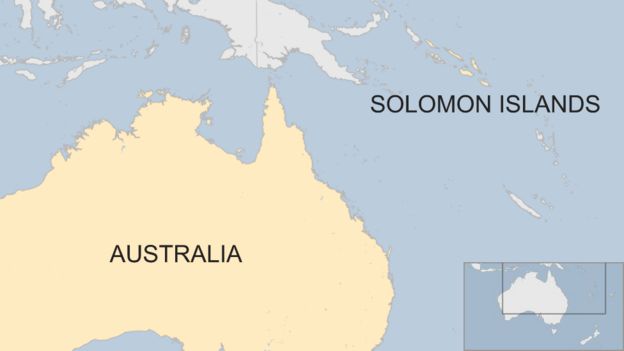
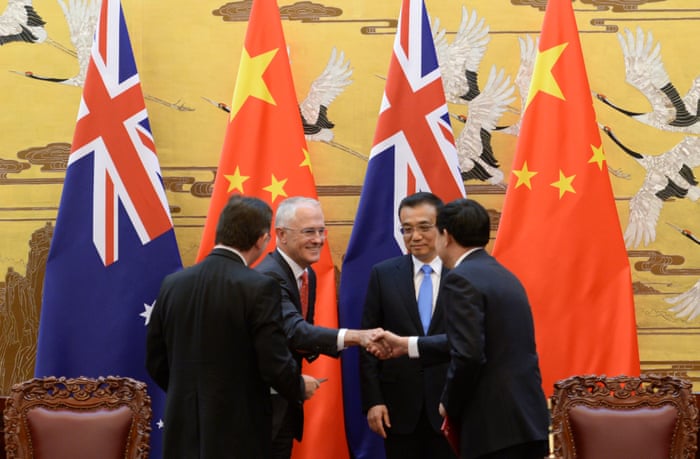
Australia has formally agreed to a deal to help build a 4,000km (2,500 mile) internet cable to the Solomon Islands.
The Solomon Islands, a small Pacific nation, had originally given the contract to Chinese company Huawei.
Prime Minister Rick Houenipwela has said the decision followed concerns raised by Australia, which neither nation has elaborated upon.
Analysts say Canberra is concerned about China's influence in the region, a subject of recent Australian debate.
Australian Prime Minister Malcolm Turnbull said on Wednesday: "As we step up our engagement in the Pacific, we are working as partners with Solomon Islands more closely than ever to ensure stability, security and prosperity in the region."
Australia is expected to commit about A$100m (£56m;$75m) of its foreign aid budget to the project.
The deal will bring high-speed internet to the island chain via an underwater cable from Sydney. Australia agreed to a similar deal with Papua New Guinea last year.
Australia is the dominant source of foreign aid for the Solomon Islands. 

What is the controversy?

Mr Houenipwela said his country had abandoned its 2016 agreement with Huawei, a Chinese telecommunications giant.
"We have had some concerns raised with us by Australia, and I guess that was the trigger for us to change from Huawei to now the arrangements we are now working with Australia on," he said last week.
Canberra has previously blocked Huawei from taking part in Australian infrastructure projects, citing national security concerns.
The Australian Broadcasting Corporation reported that Australian spy chiefs had been opposed to Huawei's deal with the Solomon Islands, arguing it might compromise the security of infrastructure in both nations.
Australia is keen to offset what it sees as efforts by China to gain regional influence, according to Peter Jennings, executive director of think tank Australian Strategic Policy Institute.
"Our government was very concerned about the prospect of Huawei providing the Solomons with its sole internet access connection, because that does create an opportunity for Chinese intelligence organisations to monitor all of the communications traffic coming in and out of the island," he told the BBC.
Tensions between Australia and China have been strained in recent times after Canberra announced new laws designed to prevent "foreign" interference.

dimanche 29 octobre 2017

Taiwan president arrives in Hawaii despite Chinese objections

Reuters

Taiwan President Tsai Ing-wen gives a speech during the National Day celebrations in Taipei, Taiwan, October 10, 2017.

HONOLULU -- Taiwanese President Tsai Ing-wen landed in Honolulu on Saturday en route to the island’s diplomatic allies among Pacific nations and set off for a visit to a Pearl Harbor memorial, despite strong objections to the visit from China.
China regards self-ruled Taiwan as sovereign territory and regularly calls it the most sensitive and important issue between it and the United States, complaining to Washington about transit stops by Taiwanese presidents.
China has not renounced the possible use of force to bring the island under its control.
Tsai, who China believes is seeking formal independence for Taiwan, left on Saturday on a week-long trip to three Pacific island allies -- Tuvalu, the Solomon Islands and the Marshall Islands -- via Honolulu and the U.S. territory of Guam.
For her part, Tsai says she wants to maintain peace with China but will defend Taiwan’s democracy and security.
Earlier this week, the U.S. State Department said Tsai’s transits through U.S. soil would be “private and unofficial” and were based on long-standing U.S. practice consistent with “our unofficial relations with Taiwan”.
It noted there was “no change to the U.S. one-China policy” which recognizes that Beijing takes the view that there is only one China, and Taiwan is part of it.
Tsai, accompanied by her entourage and members of the media, left on a short boat ride for the USS Arizona Memorial, which is built over the remains of the battleship sunk in Pearl Harbor in the Second World War, on Saturday afternoon.
The memorial, where Tsai was expected to lay a wreath, now forms a centerpiece of the World War Two Valor in the Pacific National Monument, a site administered by the National Park Service.
Donald Trump is due to visit China in less than two weeks. 
He angered Beijing last December by taking a telephone call from Tsai shortly after he won the presidential election.
The trip to the United States is Tsai’s second this year. 
In January she stopped over in Houston and San Francisco on her way to and from Latin America, visiting the headquarters of Twitter, which is blocked in China.
China has claimed sovereignty over Taiwan since 1949, when Mao Zedong’s Communist forces won the Chinese civil war and Chiang Kai-shek’s Nationalists fled to the island.

mardi 19 septembre 2017

Chinese Fifth Column

Australian university's research being used for China's military purposes
By Anders Furze and Louisa Lim

Li Keqiang (centre right) attends a signing ceremony with Australian prime minister Malcolm Turnbull at the Great Hall of the People in Beijing on 14 April 2016. 

Aworld-first collaboration between the University of New South Wales and the Chinese government, celebrated as a $100m innovation partnership, opens a Pandora’s box of strategic and commercial risks for Australia.
These include the loss of sensitive technology with military capability, an unhealthy reliance on Chinese capital and vulnerability to Beijing’s influence in Australia’s stretched research and technology sector.
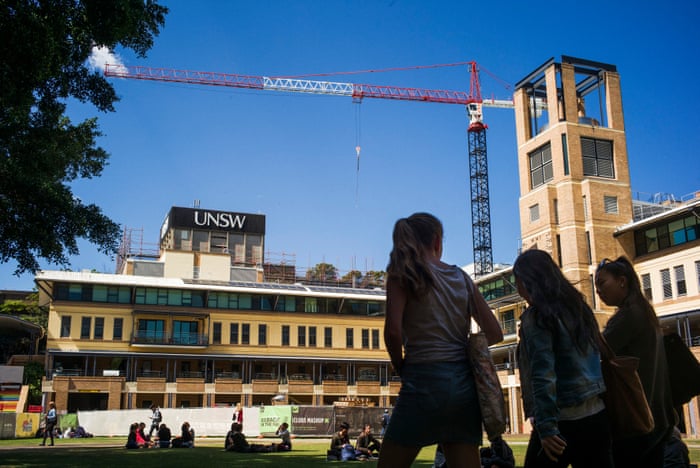
The UNSW Torch Innovation precinct, the first outside China, was unveiled last year with Malcolm Turnbull present at the signing ceremony in Beijing’s Great Hall of the People, alongside the Chinese premier, Li Keqiang.
Since 1988 the Torch program has brought businesses together with universities and researchers inside China to create high-tech startups. 
The Chinese government says it has accounted for 11% of the country’s GDP. 
This $100m deal included an initial $30m from eight Chinese companies to support Australian research.
Since then 29 Chinese partners and one Indian one – Adani Solar, a subsidiary of the resources giant – have signed on to the UNSW Torch project. 
They include at least seven firms working in industries with dual use military potential such as aerospace, GPS navigation, underwater cameras and nanotechnology
The research is not funded directly by the Chinese government but by the companies themselves.
One of the companies participating in the scheme is Huawei Technologies, the Chinese firm banned from participating in Australia’s national broadband network in 2013 on security grounds, based on the advice of Asio – the Australian national security agency. 
Earlier this year, it was reported that Nick Warner, the Australian Secret Intelligence Service’s director general warned the Solomon Islands against using Huawei to connect its under-sea cable.
On its Torch website designed to draw in potential investors, the university highlights research with explicitly military applications such as unmanned military vehicles.
Richard Suttmeier, an American expert on China’s science policy and emeritus professor at the University of Oregon, raised US concerns that Beijing’s aggressive decades-long technology acquisition drive was allowing China to quietly supersede other countries in certain fields.
On the UNSW cooperation he said: “One can’t help wondering about a Faustian bargain quality to the program. Increasingly China is able to dangle very, very attractive incentives for cooperation. International partners can reap benefits in the short run but may lose out in the longer run if they lack farsighted strategies.”
Clive Hamilton, professor of public ethics at Charles Sturt University, said: “I think the Torch program will make UNSW a client university of the People’s Republic of China in its science and technology areas, and more broadly because PRC and its agencies will have a huge amount of sway over university decision-making.”
Rory Medcalf, the head of the Australian National University’s national security college, has expressed concern that research with potential for military use could bypass existing controls.
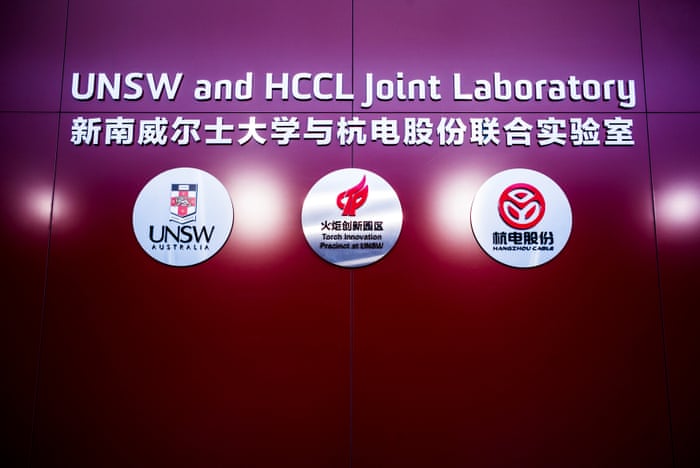
UNSW and HCCL joint laboratory on the university’s Sydney campus. The Torch program will make UNSW a client university of the People’s Republic of China in its science and technology areas.

“The fundamental question to ask is if there is [a] prospect of technology discoveries being shared that could potentially give China a military advantage in the region over, for example, US and its allies, and therefore potentially Australia.
“This is not necessarily about issues of war or conflict, which nobody wants. But it’s about issues like surveillance, detection, submarine activity; areas where our militaries are, to be honest, competing with one another day to day.”

Academic Quislings
Brian Boyle, UNSW’s deputy vice-chancellor (enterprise), championed the Torch project as “delivering a return on investment for Australia through our outstanding and competitive research base”.
The UNSW website hosts Torch-branded “research capability statements” that showcase the university’s research strengths to potential Chinese investors. 
At least three trumpet specific military applications, including “impact and blast-resistant construction materials” developed at the Australian Defence Force Academy.
Another project concerning high-speed, high-precision self-driving vehicles listed a potential application as being “unmanned military vehicles”.
Asked why UNSW was touting military research to potential Chinese investors, Boyle said they were for “general purpose use”. 
When asked why they were on the Torch website, he replied, “That’s our key customer base at the moment.”
“We follow the rules,” he added.
UNSW has been explicit in its motivations for seeking alternatives to Australian government funding. “We didn’t want to keep going back, cap in hand, to Canberra asking for more,” Ian Jacobs, its vice chancellor, wrote in an in an article for the Australian newspaper last year. 
“Instead, we went to China.”
In a separate opinion piece, for the Australian Financial Review, Jacobs wrote: “To join China’s innovation train, we need to move quickly and take on a degree of risk.”
Boyle said: “We believe that in taking these financial and technological risks we are performing the best service to Australian society.”
The university has also been upfront about the central role played by China’s Ministry of Science and Technology in the Torch enterprise. 
Chinese officials have handpicked the first group of companies participating in the scheme. 
The university offers Chinese companies looking to invest in the precinct rent-free office space and tuition scholarships for employees to undertake PhDs.

Chinese mole
The flagship project under Torch is a $20m collaboration between UNSW engineer Sean Li and Hangzhou Cables, which helped fund a $10m laboratory on the university’s Randwick campus, as well as a second collaborative lab in Hangzhou alongside the company’s production facilities where prototypes of the new graphene electricity transmission cables can be produced faster than in Australia. 
It took just three months to open the lab after the negotiations were finalised.
For Li, who joined UNSW 13 years ago, this collaboration marks a huge positive shift in university culture. 
“Now we are doing something to convert fundamental research to practical application,” he said, describing how he has filed nine patents in the past two years.
“This is a big change for myself, and for the university. That’s why the Torch precinct is a very, very rapid development.”
The partners have set up a joint venture, with UNSW taking a 20% stake to Hangzhou Cable’s 80%, and royalties shared equally between the two sides. 
Li confirmed that the new technology had been subject to checks under defence trade control legislation.
The 150 Torch precincts inside China play a key role in Beijing’s full-throttle mission to become a technology power. 
Its ambition – articulated under the banner “Made In China 2025” – is to have 70% of the country’s manufacturing supply chain fed by Chinese companies by 2025. 
China’s broader science policy, described as “technonationalism”, feeds its voracious appetite for cutting-edge technologies.
Promoting its Torch collaboration, the university declares its potential to play a powerful role in China’s development. 
“The rise of a great power needs more. It needs UNSW,” is the sign-off line in the university’s official Torch promotional video.
Jacobs has also explicitly linked Torch with the “Made in China 2025” policy, and China’s desire to become a world technology and science powerhouse by 2049. 
“To get there will require not only an immense national effort by China but also strong and enduring international collaborations,” he told a gala event last year. 
“That’s where we come in.”
One vocal supporter is John Saunders of the Linden Group, infrastructure specialists with close Chinese ties, who believes such schemes should receive more support. 
“I think the UNSW needs to broaden this. I think it needs much bigger commitment from federal government, and I certainly think it can be – not replicated – but can become a model elsewhere in Australia.”
Turnbull declined to comment on the Torch concerns, instead referring to a statement from the Department of Education and Training: “The Australian government is supportive of innovative ideas, which grow Australian society and develop our reputation as a partner of choice internationally.”
UNSW is not the only Australian institution wooing Chinese Torch officials. 
In May, a 20-strong Torch delegation from China visited Griffith University’s Gold Coast campus as part of an exploratory tour of south-east Queensland. 
That came two months after Queensland minister Kate Jones met Torch representatives in China to discuss promoting the Gold Coast “health and knowledge precinct” as a future Torch project.
Nor is it the only university wooing Chinese money. 
The University of Technology Sydney (UTS) has launched a centre for advanced science and technology research, funded by the state-owned China Electronics Group Corporation (CETC), a deal worth $20m over five years
Meanwhile, the University of Melbourne and RMIT are opening an incubation space providing Chinese funding of $80m in partnership with the City of Melbourne and the Australian China Association of Scientists and Entrepreneurs.
In the rush to cash in on Chinese funding, Australian institutions have failed to recognise the potential risks.
“On one hand, the universities have been forced into a position where they’re just out busking for money,” says Stephen Fitzgerald, the first Australian ambassador to China in the early 1970s. 
“On the other hand we have a government that seems to be incapable of taking a serious, considered, long-term, strategic view of our relations with China.”
Peter Jennings, executive director of the Australian Strategic Policy Institute, said. “Universities have never met a dollar they didn’t like … [They] have been frankly a bit wilfully blind to the implications of getting too financially dependent on China.”
In the rush to cash in on Chinese funding, Australian institutions have failed to recognise the potential risks.

Australian kowtow
The UNSW Torch promotional video trumpets the university’s role in supporting the rise of a “great power”. 
Boyle said UNSW’s mission was to have global impact. 
“If by having a global impact one supports the development of another country as well as the development of Australia, I think that’s well within Australia’s defence mandate to do that.”
A central concern of many experts is the potential military application of technologies being developed in partnership with Chinese companies. 
They caution that emerging technologies are often so complicated that scientists can’t forecast how their work will be used, including whether it might have so-called “dual use” civilian/military applications. 
The monitoring of the development and use of cutting-edge technologies is a particularly thorny issue, given the level of specialisation required to understand the implications of such research, and the complexities of attempting to control constantly evolving technologies.
“These are highlighting some of the real challenges of the 21st century, when what is military research and what is civilian research don’t really have meaningful distinctions,” says Dr Margaret Kosal, from the Sam Nunn school of international affairs at Georgia Institute of Technology, who conducts research on potential proliferation threats of nanotechnology.
Medcalf said: “The problem is with some of these technologies, potential for dual use may be there but we won’t know the full extent of the dual use or the full extent of the risk until after the technologies have been shared. In other words, having an export control and licensing arrangement, as we’ve done in the 20th century, for military and dual use technologies, will be too late.”
The mood in Washington has recently shifted towards fear that China’s unabashed focus on innovation, combined with its traditional disregard for intellectual property protection, will inexorably lead to Beijing superseding the US as the world’s leading technology power.
Suttmeier, who briefed President Barack Obama’s council of advisers on science and technology, said: “I think the US has woken up to the sophistication of Chinese technology development strategies, and to the overall thrust of Chinese industrial policies which lie behind a lot of these questions.”
Attempts to contact the Chinese embassy in Canberra and the Ministry of Science and Technology in Beijing for comment did not yield a response.
Plans for phase two of the Torch precinct include the redevelopment of 100,000 square metres at UNSW’s Randwick campus, a project which Yuan Wang, the Torch project manager, said would require capital investment in the order of $1bn. 
She said potential future areas of joint research could include artificial intelligence and telecommunications.

Some of the companies collaborating with UNSW Torch project
  • Nanjing Sunport Power Corp
  • Fuzhou Danlaw Xicheng Electronic Technology Company (China)
  • Shenzhen Kohodo Sunshine Renewable Energy Company
  • IPower Innovation Technology/ShenZhen Smart Power Company
  • FCJ/Zhejiang Hangdian Graphene Tech Company
  • Beijing Origin Water Technology Company
  • CEC Energy
  • Suzhou Londerful Nanotechnology Company
  • LERRI Solar Technology (Taizhou)
  • Huawei Technologies (China)
  • Australian Wetouch Technology
  • Qingdao Robotfish Marine Technology
  • O&C Electric Technique Company
  • Jiangsu Leadmicro Nano-Equipment Technology 
  • South Navigation
  • Beijing Etechwin Electric Company
  • SolarWorld Innovations
  • Tongwei Solar
  • Ming Jing Singapore Holdings 
  • Phono Solar Technology Company
  • Pou Chen Corporation 
  • Double Medical 
  • Qingdao National Laboratory for Marine Science and Technology
  • Tianjin Sungene Biotech Company
  • Beijing Engineering Research Center 
  • Shandong Tongda Marine Science and Technology Company
  • Easthigh
  • Wind Power
  • Adani Solar
  • Yixing Environmental Science and Technology Park