Last summer, online links between China’s East Turkestan colony and the rest of the world began to go dark.
Uighurs, who make up the largest ethnic group in East Turkestan, started cutting friends and family members abroad from their contacts on WeChat, the dominant online communication platform in China.
Many asked their family members not to call them by phone.
One family I spoke to smuggled a final communication through the chat function integrated into a video game.
the internet entirely for almost a year, but this was something different.
Entire minority groups were cutting themselves off from the outside world, one contact deletion at a time.
As Uighurs were disappearing from cross-border conversations, distinctive new building complexes began cropping up throughout the region:
Hundreds of thousands of minority men and women, mostly Uighurs but also others, have disappeared into these compounds in the last year, usually with no notice to family members and no charges of illegal activity.
Contact with the outside world is one of those signs of purported untrustworthiness.
Given the dark consequences for communication with foreigners, it is surprising how much those of us outside of China have been able to discover about the mass-internment program for minorities in East Turkestan.
Based in part on leaks by an unusually forthcoming police official in Kashgar (now himself incommunicado), scholars have estimated that
about 5 to 10 percent of the adult Uighur population has been interned without criminal charge.
In one township, police told reporters from Radio Free Asia that they were expected to send 40 percent of the population, including nearly 100 percent of men between the ages of 20 and 50, to the internment system.
For international audiences, the Chinese state has
denied the existence of what have come to be known as “re-education camps,” but
local officials continue to build new compounds, and openly call for construction contracts online, providing details on everything from camp sizes (up to 883,000 square feet) to the types of materials (“bomb-proof surfaces”) required.
A few internees have been released for one reason or another and shared their
stories of camp life with reporters, with conditions ranging from uncomfortable to literally torturous.
But questions remain, including the crucial matters of what the internment network is designed to do and what is in store for its victims.
The range of interpretations is wide.
Local media in East Turkestan present the camps as short-term rehabilitation facilities.
The Next HolocaustUighurs with family members and friends now gone for six months and more fear much worse.
And
the appearance of a recruitment notice for 50 “stouthearted” guards at a crematorium outside of Urumqi, the regional capital, has fed fears that the Chinese government is preparing for mass killing.
While the intent behind policy choices is never fully knowable, particularly in an opaque state like China, the last year has produced leaked data, online traces, and eyewitness reports that provide clues about the motives of decision-makers in East Turkestan.
Viewed in the context of the long history of resistance to Chinese rule in East Turkestan and the Chinese attempts to eliminate it, some motives become clear.
Since the Qing dynasty’s conquest of the region in 1759, China-based states have confronted the difficulties of outsider rule in the region they dubbed Xinjiang—the “new frontier”—including rebellions in 1864, 1933, and 1945 that led to the establishment of short-lived independent states.
At the founding of the People’s Republic of China (PRC) in 1949, only
6 percent of East Turkestan’s population was Han Chinese, and the Chinese authorities tended to view the indigenous inhabitants, particularly the majority Uighur ethnic group, with condescension and suspicion.
By 1982, pro-settler policies had increased the proportion of ethnic Chinese in East Turkestan to 40 percent, but authorities continued to worry about indigenous resistance as a threat to their state’s territorial aspirations.
Even after two centuries of China-based rule, the indigenous inhabitants of East Turkestan had more in common culturally with Central Asia and the Middle East than with China, and resistance, both peaceful and violent, was common.
The Chinese Communist Party (CCP) has made sense of this resistance in different ways over the years.
In the 1990s, it was mostly seen as ethno-nationalist “separatism” fueled by pan-Turkic ideology. After 2001, when the PRC aligned itself with the U.S. “global war on terror,”
authorities began to speak more often of “terrorism” supposedly bred by religious “extremism,” borrowing heavily from Islamophobic discourses in the West.
What the two approaches share is an assumption
that belief systems and ideas are what cause people to resist, not restrictive cultural policies, economics, or relative status within society, and certainly not
unfair treatment by a colonizing state.
Until recently, official explanations for acts of resistance dealt with the unsettling prospect of discontent by insisting that only a handful of bad apples held beliefs opposed to CCP rule.
Authorities in East Turkestan invested their energy in controlling those “evil forces” through security measures.
This approach peaked in the response to the deadly protests-turned-riots of 2009.
In July of that year, Uighurs in Urumqi protested the deadly beating of Uighur factory workers outside Shenzhen.
When police tried to break up an initially peaceful protest, it degenerated into rioting, and Uighurs
murdered almost 200 bystanders, mostly Han Chinese.
State media blamed a purported plot by Uighur exiles in Europe and the United States.
The People’s Armed Police, a paramilitary security force, flooded the region, setting up checkpoints and fortified guard posts throughout East Turkestan.
Convoys of olive-green troop transports paraded continuously around town centers.
Not forgetting the importance of Uighur hearts and minds, they bore banners promoting “ethnic unity.”
In the following years, authorities blanketed cities with security cameras and placed restrictions on travel for rural Uighurs.
The early 2000s had seen a steady tightening of state controls on Uighur movement, religious practices, and expression, but
the fallout of the 2009 uprising accelerated the transformation of East Turkestan into a full-bore racist police state.
Today’s internment camp system reflects a shift in official ideas about the scale of ideological threats. Under
Chen Quanguo, East Turkestan’s top official since August of 2016,
state policy treats all Uighurs as inherently opposed to the party, an implicit recognition that huge numbers of Uighurs are not, in fact, grateful for Chinese rule.
In this view, not only are wrong beliefs the root of Uighur dissatisfaction with the party, but those wrong beliefs are endemic to Uighur, Kazakh, and other minority groups.
It is not surprising, then,
that the most common officially cited purpose for the internment camps is to purify people’s thoughts, “eliminating extremism” and instilling a love for the party.
A recorded
announcement leaked this month from East Turkestan’s Communist Party Youth League, designed to calm rampant fears about the re-education camps, explained that
camps “treat and cleanse the virus from their brains.”
The names used for camps have varied widely, both for the same camp over time and from one camp to the next, but most have included the word “transformation”—for example, “concentrated education transformation center.”
The handful of people released from the camps and able to share their stories describe a variety of indoctrination techniques aimed to instill love for the Communist Party of China and its leader,
Xi Jinping.
“Teachers” and guards compel internees to chant slogans, watch videos on how to identify Islamic extremism, study Confucian texts, give thanks to Chairman Xi Jinping before meals, renounce Islam, write self-criticisms, and denounce fellow internees.
Some of these, particularly self-criticisms and denunciations, are staples of CCP indoctrination programs as old as the People’s Republic itself, techniques that gave the English language the word “brainwashing,” a direct translation of the Chinese
xi nao.
These go-to CCP techniques are combined with what are presented as modern psychological approaches, as re-education centers recruit staff with psychological training.
The content of the indoctrination reflects a new emphasis on nationalism throughout the PRC.
State media outlets tout the party as China’s savior as they always have, but
“China” is now more tightly linked to the culture of the ethnic majority, the Han Chinese.
In this view,
religions deemed foreign, for example Islam and Christianity, are seen as threats, as is the purportedly Chinese religion of Buddhism when it is practiced by non-Han people such as Tibetans.
More than any leader since
Mao Zedong, Xi Jinping has promoted the idea that he himself is the embodiment and protector of the Chinese nation.
Outside of China, it is difficult to find informed observers who think that forced indoctrination, limits on cultural expression, and restricting religious practice are likely to do anything other than breed anger at the party.
In East Turkestan however, faith in these techniques seems to run high, and there is very little room for those officials who doubt them to voice concerns.
Before 2016, local officials enjoyed some room for improvisation as they attempted to implement central policies.
In many counties they created programs clearly aimed at compelling ideological transformation.
The strangest of these were the coerced line-dancing competitions that spread across the region in 2014.
These were supposed to move people away from “extremist” forms of Islam that forbid dance.
In other places
they pushed children to sign promises not to believe in God and arranged public ceremonies for pledging loyalty to the CCP.
But the internment camps play other important roles. They allow police to physically remove whole classes of people from society.
In at least three counties, police have reported that they interned all Uighurs born between 1980 and 2000, calling them an “untrustworthy generation.”
Interned Uighurs are physically unable to engage in public resistance to CCP rule.
Physical removal also bolsters CCP programs to assimilate Uighur children to Chinese culture, by removing them from the care of their parents.
One Kashgar-area county alone has seen the construction of 18 new orphanages over the last year to accommodate children left behind by interned parents, where they will be taught entirely in Chinese.
At a wider scale, the camps serve as the punitive threat behind the state’s cultural and ideological re-engineering of Uighur society.
Without the need for legal charges, authorities can arbitrarily disappear any member of an ethnic minority group for the smallest perceived disobedience.
In January,
an instructor at a daytime re-education course told his students that they would be sent to the internment camps if they could not memorize both the oath of allegiance to the Communist Party and the national anthem in Chinese within three days, according to village police who spoke to Radio Free Asia.
The day before the deadline, a class member in his 40s who was having difficulty memorizing the text hanged himself.
The threat of internment is magnified by a surveillance apparatus of unprecedented scale, marrying old-fashioned manpower—such as armed police and neighborhood committees of the sort that fueled East Germany’s police state—with high-tech,
networked surveillance equipment.
Uighurs are subject to regular mandatory home visits by “work teams” composed of party members and other “loyal” state representatives.
These visits range in duration from daytime visits to multi-day stays, during which the visitors interview their hosts about their thoughts and habits and inspect their homes for prohibited items.
The results of these interviews are normally kept secret, but in one case a visiting team
boasted online of their effectiveness:
they sent one-fifth of a village population for internment and indoctrination.
Children assist in the policing of private spaces, as schools encourage them to report on their parents’ religious practices in the home.
Cities are blanketed with surveillance cameras.
Checkpoints at market entrances, train stations, and even book stores scan people’s faces and check them against their identification cards using facial recognition software.
Smartphone owners are required to install government spyware that reports on content stored in the phone.
According to a
report by Human Rights Watch, the enormous amounts of data generated by these electronic monitoring systems are combined with the information from work teams’ home visits and entered into an “integrated joint operations platform” that employs big-data analysis to predict which individuals will engage in acts of disloyalty.
Police at checkpoints regularly check phones for “illegal” content.
Attempts to drop out of this surveillance web are dangerous; one police station reported interning people who stopped using their phones.
The near-complete eradication of privacy and the massive scale of internment appears to be changing Uighurs’ behavior.
Ten years ago, bans on the Uighur language in schools, popular novels (often printed by government-run presses), and private prayers and rituals seemed unenforceable.
Local teachers ignored rules about language use, banned books were easy to find in private bookstores, and illegal rituals like Sufi dance remained common.
Today Uighurs rush to burn their books and strain to guess what will make their home visitors view them as loyal, out of fear that they will join the many family members and friends whom they have personally seen disappear over the last 18 months.
The re-education camps also cast their shadows beyond East Turkestan and even China’s borders.
East Turkestan security personnel have been calling Uighurs working in the rest of China back to their hometowns, where, more often than not, they disappear.
Police track the activities of Uighurs from their locales even when they reside abroad, demanding photographic evidence of their presence at universities or offices.
Some are commanded to return home to certain detention.
Uighurs comply out of fear for their families.
Some who have spoken out about the situation in their homeland have seen large numbers of relatives disappear.
Depression is rampant among Uighur exiles.
All known cases of Uighurs returning to China in the last year have resulted in the returnee’s disappearance.
Across the world, Uighurs with expiring passports or visas are currently weighing whether to claim asylum in foreign lands and never see their families again, or to face near-certain internment upon their return to East Turkestan.
 A Uighur woman walks by a closed Islamic school in the old town of Kashgar in China’s East Turkestan colony on July 1, 2017.
The most
widely circulated estimate of the number of people interned in re-education camps—several hundred thousand to just over 1 million—was developed by
Adrian Zenz of the European School of Culture and Theology from leaks that surfaced in January and February.
In the half-year since then, Uighurs, Kazakhs, and others have continued to disappear.
Uighurs with family in East Turkestan and academics who have visited in the past few months have only rarely reported individual releases, usually of older people with health problems.
Officials in one Kucha district have
told reporters that
none of the approximately 5,000 to 6,000 residents sent to the camps over the last two years have been released.
Tellingly, the state has continued to invest in camp construction.
In response to growing global scrutiny, the Chinese state has deleted its existing online bid solicitations for re-education camp construction and ceased posting new announcements.
Even so, public solicitations from March and April suggest that new camps will open later this year or early next year.
The expanding re-education internment system is interconnected with the ordinary prison system, which has seen its own expansion.
Last year, East Turkestan accounted for 13 percent of China’s indictments, despite having only 1.5 percent of the country’s population.
The number of arrests is even larger, accounting for 21 percent of China’s total.
For many detainees, the first stop is a
kanshousuo, a temporary detention center.
Shawn Zhang, a Chinese graduate student in Canada who has used Google satellite images to document the “construction boom” of re-education centers and other detention facilities across East Turkestan, notes that the
kanshousuo account for many facilities.
Google imagery from April 22 shows one such structure near Khotan being expanded by 150 percent.
An official in Karakash explained that re-education camps also act as
gateways to the formal prison system.
He reported that some districts have quotas for a percentage of internees who must be sent to prisons after evaluation of their performance at re-education camps.
The construction of new re-education camps suggests that the space freed up by the prison transfers is not sufficient to house the continued influx of internees sent for forced indoctrination.
The February numbers may have been eclipsed in the months since, but they are historically significant nonetheless.
At the upper end of the Zenz estimate,
East Turkestan’s re-education camp population exceeds the peak daily inmate numbers of Nazi concentration camps (714,211 in 1945, according to
Nikolaus Wachsmann’s 2015
book,
KL: A History of the Nazi Concentration Camps), is several times the number of the Japanese citizens interned by the United States during World War II, and amounts to about half the capacity of the Soviet gulag system, which held around 2 million people.
It remains to be seen which of these precedents the massive East Turkestan internment infrastructure will ultimately most resemble.
The permanent construction style of the re-education camps, visible in satellite images that clearly document their building process, suggests that
the Chinese state, left to its own devices, intends to maintain the camp system for the foreseeable future.
Barring a complete abandonment of the camp system, the most moderate plausible outcome is that at some point authorities dramatically reduce the number of internees, maintaining recalcitrant inmates in the camps, and preserving the capacity to return huge numbers to extrajudicial internment.
In this outcome, the camps would continue to uphold East Turkestan’s racist police state and support the CCP’s assimilationist program of cultural and ideological cleansing.
Such a dire prediction could, however, turn out to be optimistic.
Historically, extrajudicial internment systems have often deviated from their original purposes.
A lack of due process, combined with the immense power that mass-internment programs give states to control the fates of minority populations, makes camps like those in East Turkestan easy to adapt to new goals.
The eruption of war, acts of violence by oppressed minorities, guards’ long inurement to abusive treatment of prisoners, and ideological shifts at the top of the bureaucracy all have the potential, alone or in interaction, to turn the camps to darker purposes.
The Final Solution
Local officials have already expressed dehumanizing outlooks on the role of the re-education camps as “eradicating tumors” and “spraying chemicals on the crops to kill the weeds.”
Should authorities decide that forced indoctrination has widely failed, much of East Turkestan’s minority population will be framed as irredeemable.
And with the state-controlled
Global Times claiming, in response to the recent U.N. condemnation of
China’s racist policies in East Turkestan, that “all measures can be tried” in the pursuit of China’s “stability,” mass murder and genocide do not look like impossible outcomes.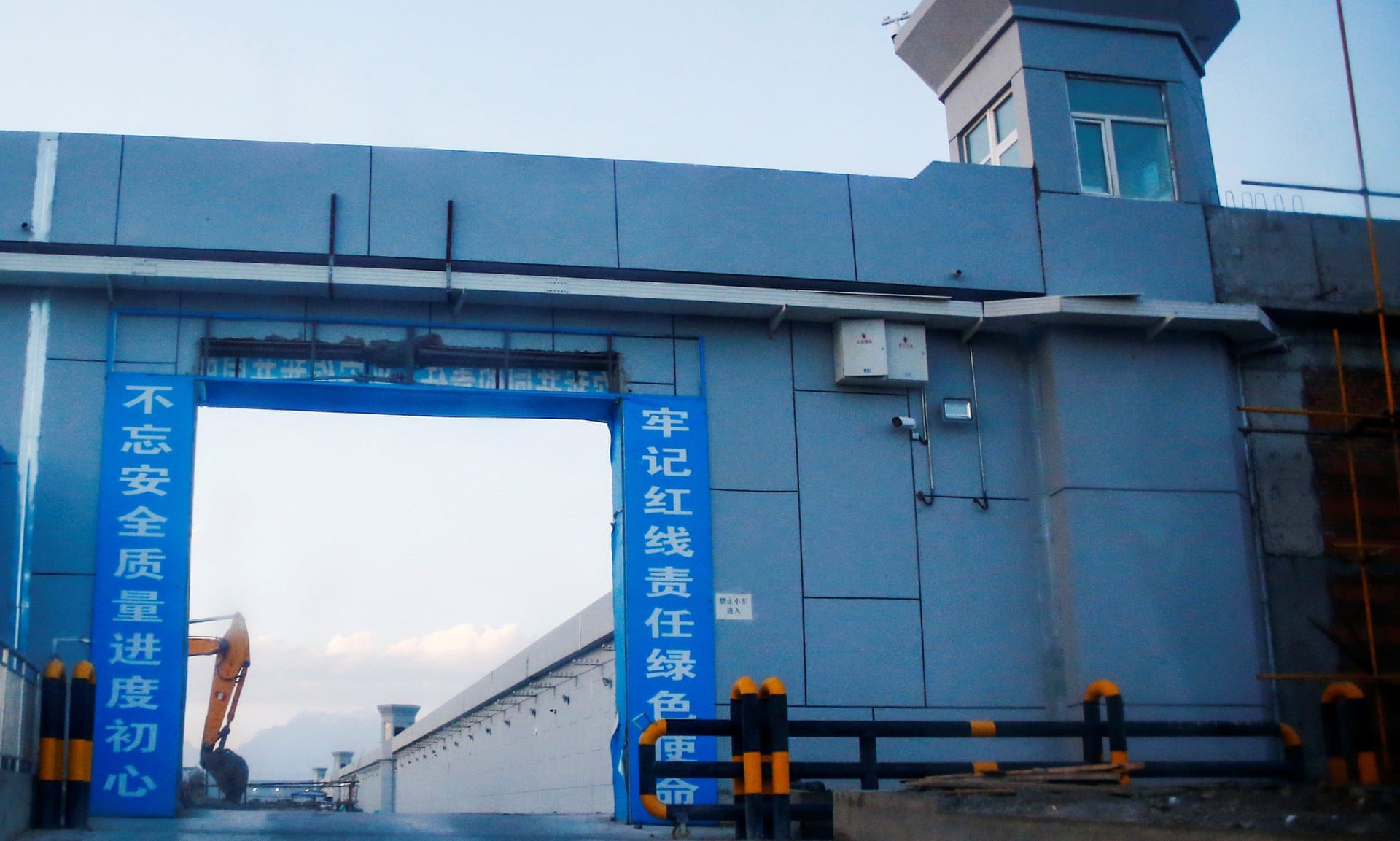 A gate of what is officially known as a ‘vocational skills education centre’ in Dabancheng, in East Turkestan