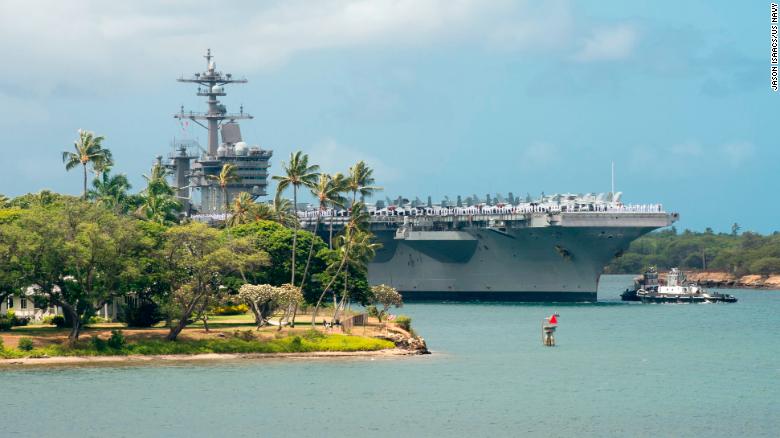
The aircraft carrier USS Carl Vinson (CVN 70) enters Pearl Harbor in preparation for Exercise Rim of the Pacific (RIMPAC) 2018. Twenty-five nations, more than 45 ships and submarines, about 200 aircraft, and 25,000 personnel are participating in RIMPAC from June 27 to Aug. 2 in and around the Hawaiian Islands and Southern California.
Washington -- A Chinese spy ship is currently spying on a major US-led military exercise off the coast of Hawaii, the same exercise it was disinvited from due to US opposition to Beijing's militarization of features in the South China Sea.
"The US Pacific Fleet has been monitoring a Chinese navy surveillance ship operating in the vicinity of Hawaii outside US territorial seas," US Navy Capt. Charles Brown, a spokesman for US Pacific Fleet, said in a statement.
"We expect this ship will remain outside of US territorial seas and not operate in a manner that disrupts the ongoing Rim of the Pacific maritime exercise."
China was disinvited from the exercise, known as RIMPAC, in May over what the Pentagon called China's "continued militarization of disputed features in the South China Sea," including the deployment of anti-ship missiles, surface-to-air missile systems and electronic jammers.
The spy ship arrived in the waters off Hawaii on July 11, and it has not entered the territorial seas of the United States, a US military official told CNN.
The Chinese ship's presence was also criticized by the exercise's combined forces maritime component commander, Chilean Commodore Pablo Nieman.
"It is very disappointing that the presence of a non-participating ship could disrupt the exercise," Nieman said in a statement.
China was disinvited from the exercise, known as RIMPAC, in May over what the Pentagon called China's "continued militarization of disputed features in the South China Sea," including the deployment of anti-ship missiles, surface-to-air missile systems and electronic jammers.
The spy ship arrived in the waters off Hawaii on July 11, and it has not entered the territorial seas of the United States, a US military official told CNN.
The Chinese ship's presence was also criticized by the exercise's combined forces maritime component commander, Chilean Commodore Pablo Nieman.
"It is very disappointing that the presence of a non-participating ship could disrupt the exercise," Nieman said in a statement.
"I hope and expect all seafarers to act professionally so we may continue to focus on the work at hand and building on the spirit of cooperation that gives purpose to this exercise."
A military official told CNN that a similar Russian spy ship was in the same area the last time RIMPAC took place in 2016.
A military official told CNN that a similar Russian spy ship was in the same area the last time RIMPAC took place in 2016.
China participated in the exercise that year.
China also sent spy ships, known as Auxiliary General Intelligence vessels, to monitor the exercise in 2014 and 2016.
Twenty-six countries, 47 ships, five submarines and more than 200 aircraft and 25,000 personnel were scheduled to participate in the exercise, according to the US Navy.
China also sent spy ships, known as Auxiliary General Intelligence vessels, to monitor the exercise in 2014 and 2016.
Twenty-six countries, 47 ships, five submarines and more than 200 aircraft and 25,000 personnel were scheduled to participate in the exercise, according to the US Navy.

