Affichage des articles dont le libellé est Russia. Afficher tous les articles

lundi 24 février 2020

Putin's Crusade Against Sick Men Of Asia

Moscow targets Chinese with raids amid Chinese virus terror
Russian authorities are going to significant lengths to keep the Chinese virus from surfacing in Moscow
By DARIA LITVINOVA and FRANCESCA EBEL
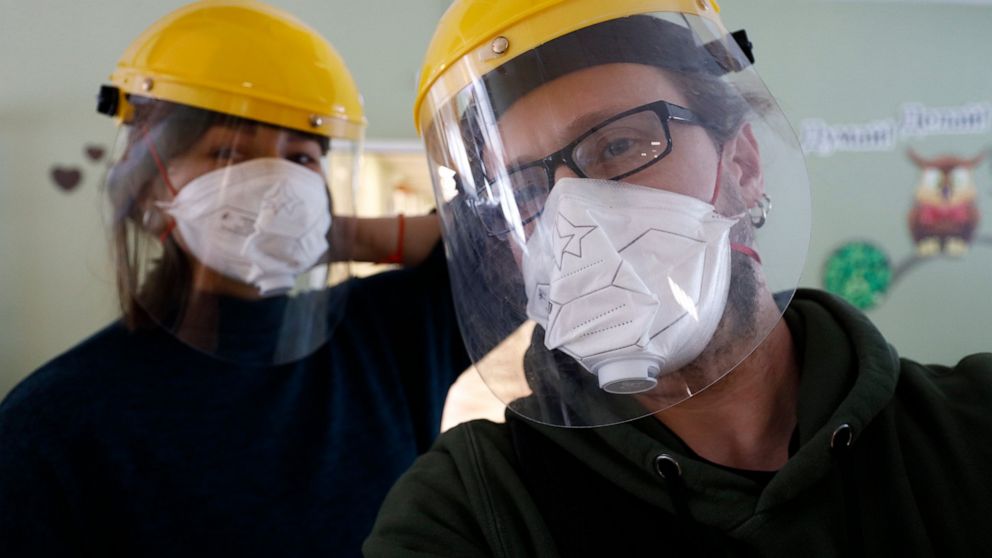
In this photo taken on Friday, Feb. 21, 2020, medical workers disinfect rooms in the sanatorium after quarantine period has ended in Bogandinsky in the Tyumen region, about 2150 kilometers (1344 miles) east of Moscow, Russia. 144 people who were evacuated from the epicenter of the Chinese coronavirus outbreak in Wuhan, China, and were released from a 14-day quarantine in western Siberia. None of them tested positive for the Chinese virus. Russian authorities are going to great lengths to prevent the Chinese coronavirus from spreading in the capital and elsewhere.

MOSCOW -- Bus drivers in Moscow kept their WhatsApp group chat buzzing with questions this week about what to do if they spotted passengers who might be from China riding with them in the Russian capital.
“Some Asian-looking (people) have just got on. Probably Chinese. Should I call (the police)?” one driver messaged his peers. 
“How do I figure out if they’re Chinese? Should I ask them?” a colleague wondered.
The befuddlement reflected in screenshots of the group exchanges seen by The Associated Press had a common source -- instructions from Moscow's public transit operator Wednesday for drivers to call a dispatcher if Chinese nationals boarded their buses, Russian media reported.
A leaked email that the media reports said was sent by the state-owned transportation company Mosgortrans told dispatchers who took such calls to notify the police. 
The email, which the company immediately described on Twitter as fake, carried a one-word subject line: coronavirus.
Since the outbreak of the Chinese virus that has infected more than 76,000 people and killed more than 2,300 in mainland China, Russia has reported two cases. 
Both patients, Chinese nationals hospitalized in Siberia, recovered quickly. 
Russian authorities nevertheless are going to significant lengths to keep the Chinese virus from resurfacing and spreading.
Moscow officials ordered police raids of hotels, dormitories, apartment buildings and businesses to track down the shrinking number of Chinese remaining in the city. 
They also authorized the use of facial recognition technology to find those suspected of evading a 14-day self-quarantine period upon their arrival in Russia.“Conducting raids is an unpleasant task, but it is necessary, for the potential carriers of the Chinese virus as well,” Moscow Mayor Sergei Sobyanin said in a statement outlining various methods to find and track Chinese the city approved as a Chinese virus prevention strategy.
The effort to identify Chinese on public transportation applies not only to buses, but underground trains and street trams in Moscow, Russian media reported Wednesday.
Metro workers were instructed to stop riders from China and ask them to fill out questionnaires asking why they were in Russia and whether they observed the two-week quarantine, the reports said. 
The forms also ask respondents for their health condition and the address of where they are were staying.
In Yekaterinburg, a city located 1,790 kilometers (1,112 miles) away from Moscow in the Urals Mountains, members of the local Chinese community also are under watch. 
Self-styled Cossack patrols in the city hand out medical masks along with strong recommendations to visit a health clinic to Chinese residents.
The containment measures in the capital came as the Russian government instituted an indefinite ban on Chinese entering the country that could block up to 90% of travelers coming to Russia from China.
Weeks before, Russia shut down the country's long land border with China, suspended all trains and most flights between the two countries.
An employee of a Moscow-based company that employs Chinese nationals told the AP on condition of anonymity that police officers came to their office on Thursday and asked a dozen Chinese staffers to stay home for two weeks. 
The visit took place a little more than two weeks after these staffers returned from China and went through health checks at the airport, the employee said.
The employee spoke on condition of anonymity because they were not authorized to speak publicly about what had happened.
The Moscow Metro confirmed to The Associated Press that the underground system was “actively monitoring the stations” and has a protocol in place for dealing with people who “have recently returned from China.”
“We ask to see their documents and to show us documents (proving) that if they have recently returned from the People’s Republic of China, they have undergone a two-week quarantine period,” Yulia Temnikova, Moscow Metro’s deputy chief of client and passenger services, said.
If an individual does not show proof of completing the quarantine, Metro workers ask the person to fill out the form and call an ambulance, Temnikova said.
Bus and tram drivers contacted their labor union about the instructions to look for Chinese and report them to the dispatch center. 
The drivers were outraged and didn’t know what to do, Public Transport Workers Union chairman Yuri Dashkov said.
“So he saw a Chinese, and then what?" Dashkov said. 
“How can he ascertain that he saw a Chinese, or a Vietnamese, or a Japanese, or (someone from the Russian region of) Yakutia?”
Dashkov showed the AP a photo of the email that officials at Mosgortrans were said to have sent out. He also showed three photos of on-bus electronic displays reading, “If Chinese nationals are discovered in the carriage, inform the dispatcher.”
The AP was unable to independently verify the authenticity of the email and the photos. 
Dashkov shared screenshots of what appeared to be a genuine bus drivers' group chat in WhatsApp.
While Moscow public transit operator Mosgortrans dismissed the email as phony on its official Twitter account Wednesday, the company told the AP in a statement two days later that it does “conduct monitoring” and “sends data to the medics when necessary.”
Mosgortrans referred additional questions to the detailed statement from Moscow's mayor, who on Friday acknowledged the sharp focus on Chinese in the city's Chinese virus-control plan.
Officials ordered everyone arriving from China to isolate themselves for two weeks, and those who skip the quarantine step will be identified through video surveillance and facial recognition technology, Sobyanin said. 
The systems give authorities the ability to “constantly control compliance with the protocol,” he said in the statement.
The mayor’s office did not respond to a request for comment on the city's containment approach.
Temnikova from the Moscow Metro rejected accusations of racial profiling. 
Subway workers “mainly look at the passenger’s (health) condition," she said, and approach “people who need help.”
Addressing identification questions like the ones that worried the bus drivers, Temnikova said it should be “clear who could have arrived from China” because “it is obvious.”
The Cossacks of Yekaterinburg -- men in conservative, often pro-Kremlin groups claiming to be successors of the proud guards who policed the Russian Empire's frontiers -- took fighting the virus into their own hands three weeks ago. 
They also have a system of sorts for deciding who needs a face mask and advice to see a medical professional.
Mainly we approach people from China because it is from them that the Chinese coronavirus came. They are the main source,” Igor Gorbunov, elder of the Ural Volunteer Cossack Corps, told the AP during one such patrol Friday.
“But not only them," Gorbunov continued. 
“There are different nationalities, there are many people of Asian appearance, and they seem to be vulnerable to this disease, the Chinese coronavirus, because it is them who are most often affected. Europeans are not yet affected much.”

lundi 10 février 2020

Run For Your Life

Countries evacuating nationals from Chinese coronavirus areas
Reuters

A growing number of countries around the world are evacuating or planning to evacuate diplomatic staff and citizens from parts of China hit by the new coronavirus.
Following are some countries’ evacuation plans, and how they aim to manage the health risk from those who are returning.
- Kazakhstan, which has previously evacuated 83 from Wuhan, will send two planes to China on Feb. 10 and Feb. 12 to evacuate its citizens. Out of 719 Kazakhs remaining in China, 391 have asked to be repatriated.
- A second evacuation flight is bringing back another 174 Singaporeans and their family members from Wuhan to the city-state on Feb. 9, Singapore’s foreign ministry said.
- Thirty Filipinos returned to the Philippines on Feb. 9 from Wuhan, the Department of Foreign Affairs said. The returning passengers and a 10-member government team will be quarantined for 14 days.
- Britain’s final evacuation flight from Wuhan, carrying more than 200 people, landed at a Royal Air Force base in central England on Feb. 9. A plane carrying 83 British and 27 European Union nationals from Wuhan landed in Britain last week.
- The 34 Brazilians evacuated from Wuhan landed in Brazil on Feb. 9, where they will begin 18 days of quarantine.
- Two planes with about 300 passengers, mostly U.S. citizens, took off from Wuhan on Feb. 6 bound for the United States -- the third group of evacuees from the heart of the coronavirus outbreak, the U.S. State Department said.
- Uzbekistan has evacuated 251 people from China and quarantined them on arrival in Tashkent, the Central Asian nation’s state airline said on Feb. 6.
- A plane load of New Zealanders, Australians and Pacific Islanders evacuated from Wuhan arrived in Auckland, New Zealand on Feb. 5, officials said.
- Taiwan has evacuated the first batch of an estimated 500 Taiwanese stranded in Wuhan.
- Italy flew back 56 nationals from Wuhan to Rome on Feb. 3. The group will spend two weeks in quarantine in a military hospital, the government said.
- Saudi Arabia has evacuated 10 students from Wuhan, Saudi state television reported on Feb. 2.
- Indonesia’s government flew 243 Indonesians from Hubei on Feb. 2 and placed them under quarantine at a military base on an island northwest of Borneo.
- South Korea flew 368 people home on a charter flight that arrived on Jan. 31. A second chartered flight departed Seoul for Wuhan on Jan. 31, with plans to evacuate around 350 more South Korean citizens.
- Japan chartered a third flight to repatriate Japanese people, which arrived from Wuhan on Jan. 31, bringing the number of repatriated nationals to 565.
- Spain’s government is working with China and the European Union to repatriate its nationals.
- Canada evacuated its first group of 176 citizens from Wuhan to an Ontario air force base early on Feb. 5, according to the Globe and Mail newspaper. The country’s foreign minister said a second group should arrive later on Feb. 5 after changing planes in Vancouver. All evacuees will be quarantined on the base for two weeks.
- Russia said it would begin moving its citizens out of China via its Far Eastern region on Feb. 1, regional authorities said. It plans to evacuate more than 600 Russian citizens currently in Hubei, Deputy Prime Minister Tatiana Golikova said. A first Russian military plane took off on Feb. 4 to evacuate Russian citizens from Wuhan, the RIA news agency reported.
- The Netherlands is preparing the voluntary evacuation of 20 Dutch nationals and their families from Hubei, Foreign Minister Stef Blok said. The Netherlands is finalising arrangements with EU partners and Chinese authorities.
- France has evacuated some nationals from Wuhan and said it would place the passengers in quarantine. It said it would first evacuate nationals without symptoms and then those showing symptoms at a later, unspecified date.
- Swiss authorities said they hope to have about 10 citizens join the French evacuation of nationals from China.
- A plane brought 138 Thai nationals home from Wuhan last week. They will spend two weeks in quarantine.

mardi 7 janvier 2020

Gang of Four

The American strike that killed the head of Iran’s terrorist Quds Force last week also may expose the emerging axis of aggression comprising China, North Korea, Russia and Iran.
Channeling Ronald Reagan’s condemnation of the Soviet Union as an “evil empire,”  George W. Bush’s 2002 State of the Union address labeled North Korea, Iraq and Iran an “axis of evil.” 
As with Reagan’s moral proclamation, Bush’s use of the term “evil” to describe recognized states scandalized some in the international community, although it accurately described the nature of those regimes.
 All three brutally mistreated their populations and were complicit in acts of terrorism and/or aggression.
But any suggestion that Pyongyang, Baghdad and Teheran were linked at that time in a coordinated strategy, similar to the original Berlin-Rome Axis pact in World War II, was a bit of an overstatement.
For one thing, Iraq and Iran had just fought a six-year war at the collective cost of up to a million dead.
Nor was there then credible evidence of Pyongyang colluding operationally with either Baghdad or Teheran against the West beyond harsh rhetoric and the occasional arms sales it routinely carried on with several Middle Eastern states.
Today, however, the four states named above that see themselves as implacable adversaries of the United States are, in fact, cooperating to oppose American interests whenever and wherever possible. 
They clearly adhere to the realpolitik principle that “the enemy of my enemy is my friend, or at least my ally of convenience.”
Those regimes are at odds with the United States because of divergent strategic interests, as well as fundamentally conflicting values.
But what differentiates them from other states which similar anti-U.S. interests and anti-Western values is their aggressive intentions to act on those differences — they are, in fact, aggressor states.
The National Defense Strategy (NDS) issued by the Department of Defense in 2018 declares that “China and Russia are now undermining the international order from within.”
But it noted that both powers also use traditional and nontraditional means to attack the system itself from without. 
“China is leveraging military modernization, influence operations, and predatory economics to coerce neighboring countries to reorder the Indo-Pacific region to [its] advantage.”
“Concurrently,” the NDS states, Russia has been making similar moves in its region.
“Russia seeks veto authority over nations on its periphery in terms of their governmental, economic and diplomatic decisions, to shatter the North Atlantic Treaty Organization and change European and Middle East security and economic structures to its favor.”
The threats to global security go beyond those from the major “revisionist” powers.
“Rogue regimes such as North Korea and Iran are destabilizing regions through their pursuit of nuclear weapons or sponsorship of terrorism.”
Compounding the menace each of these anti-Western sources poses individually, there is more than the semblance of a Beijing-Pyongyang-Moscow-Tehran axis.
The evidence of their coordination of efforts is right before our eyes.
Communist China has been formally allied with North Korea at least since the outbreak of the Korea War in June 1950, and it has propped up the Pyongyang regime economically ever since. 
Enabling and protecting its pursuit of nuclear weapons and ballistic missile systems to deliver them has encouraged North Korea’s defiance of both U.S. threats and inducements. 
At the same time, an alliance with North Korea has been strategically profitable for Beijing, making it the indispensable player in the growing nuclear and missile threat and providing it with enormous leverage over the West on other issues across the board.
Second only to China in its diplomatic protection of the Kim regime and its undermining of U.S. and international sanctions has been North Korea’s other giant neighbor, Russia.
 Like China, it also has extracted Western concessions for its illusory cooperation — formally supporting just enough sanctions to gain credibility in Western eyes, but never enough to bring the Kim regime into actual compliance.
Parallel with their tandem moves emboldening North Korean recalcitrance, China and Russia have deepened and broadened their bilateral strategic cooperation against U.S. security interests through a series of joint military exercises.
Over the past week, the two powers expanded their separate contributions to Iran’s military capabilities into a three-party arrangement.
China’s defense ministry announced that Russia and Iran will join the People’s Liberation Army Navy in joint naval drills in the Indian Ocean and Gulf of Oman just as regional tensions have increased with the growing U.S.-Iran confrontation. 
Beijing and Moscow leave no doubt as to whose side they are on.
Meanwhile, a potential crisis looms across the Taiwan Strait as Taiwan’s presidential election approaches and Beijing strives to influence voters to reject President Tsai Ing-wen and her refusal to yield to Chinese pressure and accept its claims over the island’s democratic sovereignty.
The death of Taiwan’s top general and other military officials in a helicopter crash last week, reportedly in an equipment-related accident, has only aroused concerns of a nefarious Chinese role in the political campaign.
American officials undoubtedly are on the alert for the likelihood of simultaneous crises erupting from members of the quartet of evil-doers.
In response to the U.S. strike that killed Iranian terrorist Qassem Soleimani, the head of Iran’s military described an “axis of resistance” among Iran’s terrorist proxies and partners in Lebanon, Iraq, and Syria.
But the China-Russia-North Korea-Iran linkages may be even more ominous and will require the sustained attention of America’s military and political leaders.
Joseph

vendredi 8 novembre 2019

Chinese Peril

Secretary of State Mike Pompeo attacks China in Berlin speech
BBC News

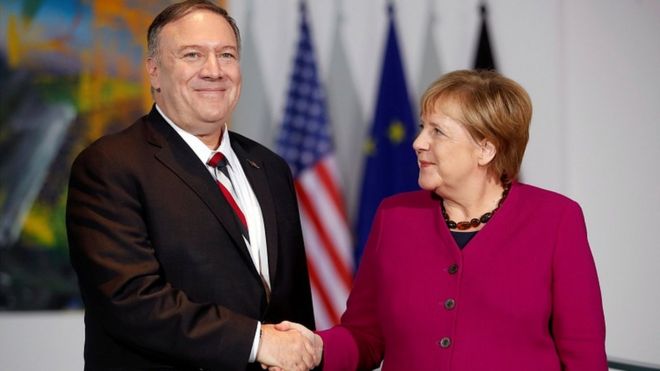
Mike Pompeo has held talks with German Chancellor Angela Merkel during his visit to Berlin.

US Secretary of State Mike Pompeo has warned of the dangers posed by Russia and China, and called on Nato to grow and confront "the challenges of today".
On a visit to Berlin, Mr Pompeo said methods used by China to suppress its own people would be "horrifyingly familiar" to East Germans.
And he accused Russia of invading its neighbours and crushing dissent.
He laughed off comments from French President Emmanuel Macron, who said recently that Nato was "brain dead".
But Mr Pompeo told reporters: "Seventy years on... it needs to grow and change. It needs to confront the realities of today and the challenges of today.
"If nations believe that they can get the security benefit without providing Nato the resources that it needs, if they don't live up to their commitments, there is a risk that Nato could become ineffective or obsolete."

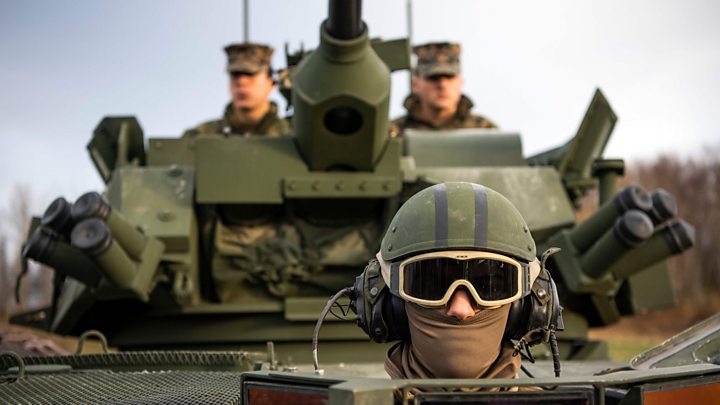
A Nato military exercise in 2018 -- the biggest since Cold War.

US President Donald Trump has frequently accused European Nato members of failing to provide their fair share of military spending and of relying too heavily on the US for their defence.
Nato celebrates its 70th anniversary at a summit in London next month.
What else did Mr Pompeo say?
He was speaking in Berlin a day before the 30th anniversary of the fall of the Berlin Wall.
Referring to that event, Mr Pompeo said "the West -- all of us -- lost our way in the afterglow of that proud moment".
He said the US and its allies should "defend what was so hard-won... in 1989" and "recognise we are in a competition of values with un-free nations".
"We thought we could divert our resources away from alliances, and our militaries. We were wrong," he said.
"Today, Russia -- led by a former KGB officer once stationed in Dresden [President Vladimir Putin] - invades its neighbours and slays political opponents."


A rallying cry - but not everyone agrees
In Berlin to remember the end of the first Cold War, US Secretary of State Mike Pompeo appeared to be declaring the outbreak of a second.
In insisting upon a "competition of values" between the "free nations" on the one hand, and Russia and China on the other, his was a message of ideological struggle.
He disparaged entirely the idea of Moscow being a partner for the West. 
Mr Pompeo clearly saw this speech as a rallying cry to the West. 
He struck a hawkish tone but many will wonder: What exactly is the fundamental US view?
Trump seems much less antagonistic towards Moscow and does not appear to share the strategic framework in which his secretary of state places relations between Moscow and Beijing, and the West.
It is clear that even many of Washington's allies do not fully share Mr Pompeo's analysis. 
And Moscow and Beijing are eager to exploit such tensions and divisions.
Relations between Washington and Moscow plummeted after Russia annexed the Crimean peninsula from neighbouring Ukraine in 2014.
Ties were further strained when US intelligence agencies concluded that the Kremlin had interfered in the 2016 presidential election.
Despite this, Trump and Putin have appeared to be on good terms personally. 
On Friday, Trump said he was considering attending the Victory Day celebrations in Moscow next May, after an invitation from the Russian leader.
Mr Pompeo accused the Chinese Communist Party of "shaping a new vision of authoritarianism" and warned the German government against using Chinese telecom giant Huawei to build its fifth-generation data network (5G).

What did Mr Macron say?
Interviewed by the Economist, the French president said he saw a waning commitment to the alliance by its main guarantor, the US.
He warned European members that they could no longer rely on the US to defend the alliance, established at the start of the Cold War to bolster Western European and North American security.

He cited the recent failure by Washington to consult Nato before pulling forces out of northern Syria.
Mr Macron also questioned whether Nato was still committed to collective defence.
Speaking on Thursday, German Chancellor Angela Merkel, a key ally, said she disagreed with Mr Macron's "drastic words".
Speaking in Berlin alongside visiting Nato Secretary-General Jens Stoltenberg, she acknowledged there were problems, but said she did not think "such sweeping judgements are necessary".

lundi 29 juillet 2019

Axis of Evil

Russia and China romance runs into friction in Central Asia
US strategists call for driving wedge between the traditional rivals

By HIROYUKI AKITA
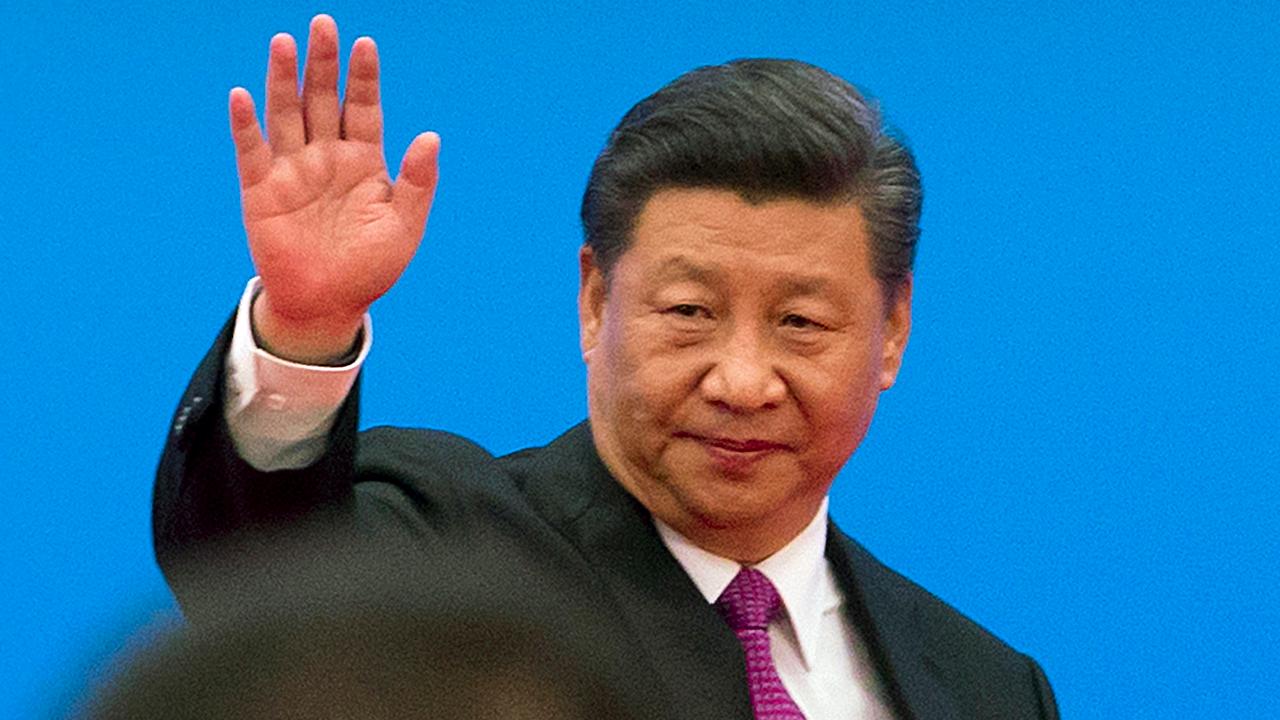
Russian President Vladimir Putin greets Xi Jinping in Saint Petersburg in June: Although the two leaders have found common cause in opposing Washington, their friendship has limits, experts say. 
 
TOKYO -- China and Russia are cozying up ever closer as they find a common enemy in Washington.
During Chinese dictator Xi Jinping's visit to Russia in early June, the two countries singed a joint statement pledging to deepen their ties, as well as around 30 economic agreements.
Xi's Russian counterpart, Vladimir Putin, has criticized the U.S. for leveling trade and technology sanctions against China and pledged to cooperate with it to resist U.S. pressure. 
The two countries are also pushing back against U.S. objectives regarding North Korea and Iran.
While analysts puzzle over whether the romance between China and Russia has peaked or will grow still more fervent, it seems clear they need each other more than ever.
Laboring under U.S. and European sanctions, Russia's economic growth is forecast to slow to around 1% this year. 
That will encourage it to lean more heavily on China. 
For Xi, Russia is a useful tool in countering Washington's increasingly hard-line policies against China.
But despite their growing closeness, China and Russia must deal with frictions.
Russia "is feeling a potential threat" from China, according to an expert on the Russian military. 
The difference the two countries' power continues to widen: China's gross domestic product is roughly eight times larger than Russia's and its population is 10 times larger. 
Russia is especially nervous about the possibility of Central Asia -- much of which was once part of the Soviet Union and is seen by Russians as their backyard -- falling under China's sway.
That is already happening economically. 
In 2018, China became the largest trading partner of three former Soviet republics: Uzbekistan, Turkmenistan and Kyrgyzstan. 
According to official data released by Kyrgyzstan and Tajikistan, China is the largest source of foreign direct investment in the two countries. 
China has also overtaken Russia as the fourth-largest investor in Kazakhstan.
Russia tolerates China's economic advance in Central Asia because its stands to benefit from infrastructure improvements and regional development that the flood of Chinese investment will bring. 
Security, however, is another matter. 
Moscow will not want China encroaching on its turf.
In Uzbekistan, in mid-June, cabinet ministers, senior officials and experts from the U.S., Europe and neighboring countries gathered to discuss the regional situation. 
China's activities loomed large during the meeting.

The strategic environment began shifting a few years ago as China began secretly deploying troops in Tajikistan, according to local experts. 
Although the Chinese Foreign Ministry has denied its troops are in the area, a person familiar with the matter said there are similar indication in Afghanistan.
China has, up to now, refrained from involving itself in regional security issues out of consideration for Russia. 
But its actions in Tajikistan, part of its effort to keep Islamist militants from entering the East Turkestan colony, indicate a change in Beijing's thinking.
In light of Tajikistan's lax border controls, China may have sent troops to help it shore up security, one expert said. 
China is likely to have received a green light to do so from Moscow. 
But local diplomats said Russia is growing concerned about China's military moves.
Russia's largest military base outside its borders is in Tajikistan. 
The base is scheduled to remain until 2042, under a bilateral agreement. 
Given that it has around 8,000 troops at the base, it is unthinkable that the Russian and Chinese forces will both stay in the country without friction over the long term, according to one security strategist in Central Asia.
Russian President Vladimir Putin meets Tajik President Emomali Rakhmon in Moscow in April. Russia's largest military base outside its borders is in Tajikistan.
China's objective is to play a larger security role in Central Asia as part of its counterterrorism strategy without irritating Russia. 
That is easier said than done. 
Russia also seems anxious about U.S. ambitions in the region.
Leaders of the five Central Asian countries had planned to hold their second summit meeting in March. 
But the conference was canceled due a sudden change in Kazakhstan's president. 
So far, no new meeting has been scheduled. 
Whatever the official reason given for calling off the summit, a local diplomatic source said the real reason was that the participants were worried about provoking a backlash from Russia.
"Many in Russia still maintain an empire mentality. They consider the former Soviet Union to be their own sphere of influence," said Dr. Farkhod Tolipov, a political scientist who heads Knowledge Caravan, an independent education and research institution in Tashkent. 
"Russia wrongly believes that if the Central Asia region integrates it will gradually lean toward the United States and eventually enter U.S. sphere," he said.
If a rift develops between China and Russia, the implications for global politics would be significant. A weakening of the Sino-Russian axis would be favorable to the West and Japan. 
It would also help the international community increase pressure on North Korea.
At a public-private strategic dialogue between the U.S. and Europe in the polish capital, Warsaw, in June, an idea was floated for how to drive a wedge between China and Russia to give the West an edge in its strategic competition with Beijing.
It may be impossible for Europe to reconcile with Putin, given Russia's annexation of Crimea, according to military strategists in Washington. 
But they argue the U.S. should try to ease tensions with Moscow after Putin's term of office ends in 2024 to encourage Russia to keep China at arm's length.
China and Russia share a border of more than 4,000 km. 
And although they are unlikely to repeat their military clashes of 1969, it also seems unlikely that their current love affair will last forever, given their historical geopolitical rivalry.

mardi 11 juin 2019

Xi Jinping's outreach to Russia is a desperate cry for help

By Brett Velicovich

China’s economy is reeling from President Trump’s strategic tariffs, and Beijing is getting desperate.
In a futile effort to compensate for China’s losses by developing economic ties with new global partners, Chinese dictator Xi Jinping recently met with Russian President Vladimir Putin
Both leaders touted the meeting in typically hyperbolic terms, presumably in the hope of deceiving American policymakers into believing that they had accomplished something significant.
Xi praised Putin with almost Trumpian exuberance, calling the Russian strongman “my best friend and colleague." 
Putin, who has encountered his own difficulties trying to stabilize the struggling Russian economy, boasted in turn that relations between the two countries had "reached an unprecedented level."
Putin and Xi negotiated numerous economic partnerships, such as agreeing to boost energy and technology cooperation in the coming years. 
Those agreements, however, are only papering over the cracks — China is facing monumental economic challenges, and is utterly unable to compete with the booming U.S. economy or cope with 25 percent tariffs on $250 billion worth of their exports into the vast consumer markets of America.
When President Trump first floated the idea of imposing tariffs on Chinese goods as retaliation for China’s long history of illegal trade practices, many so-called "experts" doubted that the president’s bold tactic would succeed. 
Skeptics in the mainstream media relentlessly warned that tariffs would only hurt the U.S. economy by stifling GDP growth and job creation, and the European Central Bank even predicted that China would emerge from the “trade war” unscathed.
The anti-Trump critics, as it turns out, vastly overestimated both the resilience of China’s economy and the vulnerability of America’s economy. 
Since President Trump first implemented the tariffs, the communist regime has been battered by economic uncertainty and faltering growth while the U.S. has enjoyed a level of prosperity not seen for a generation.
In 2018, for instance, China’s GDP grew at its slowest rate in 28 years, forcing Beijing to implement a massive stimulus to forestall economic collapse. 
While the stimulus appears to have succeeded in temporarily arresting the freefall, China’s authoritarian government has a habit of manipulating official economic data, and experts say there are signs that recent figures have been artificially inflated as companies “front-load” exports in anticipation of new tariffs.
The International Monetary Fund (IMF) also recently concluded that U.S. tariffs have had a “significant” impact on China, causing the IMF to lower its forecast for China’s future growth.
Unfortunately for Beijing, many of its domestic industries are beginning to crumble under the pressure of President Trump’s aggressive trade strategy, raising doubts about the country’s ability to endure a protracted stalemate in its ongoing trade negotiations with the U.S. 
Last month, for instance, the South China Morning Post reported that China’s dying Northeastern rust belt, once a main industrial hub, is “struggling to retain population as economic slowdown speeds up exodus.”
Tellingly, Xi refuses to acknowledge his country’s economic weakness, insisting that “China’s economy bears the supporting conditions for stable, healthy, and sustainable growth.” 
That heavily-qualified denial doesn’t convey much confidence, though, and the fact that Xi felt compelled to defend the strength of his country’s economy during an interview with Chinese and Russian media shortly before meeting with Putin only makes Xi’s braggadocio seem even more contrived.
In reality, China’s recent outreach to Russia is nothing but a desperate cry for help — the communist regime is incapable of keeping up with the booming U.S. economy or maintaining the sky-high GDP growth necessary to mollify its oppressed population while it struggles under American tariffs.
In the past, Russia’s relative economic impotence made it a relatively unattractive partner for Beijing — but today, the hard-pressed Chinese government simply has no other choice but to reach out for any lifeline it can find.
Nonetheless, Xi will find his next meeting with President Trump during the G20 summit in Japan later this month much more productive for his economy than his recent meeting with Putin — provided he’s ready to face reality and negotiate a new trade deal that’s finally fair for the United States.
Otherwise, Xi’s desperation will only increase as his economy continues to suffer.

mercredi 10 avril 2019

Han Peril: China’s Voracious Appetite for Timber Stokes Fury in Russia and Beyond

After sharply restricting logging in its own forests, China turned to imports, overwhelming even a country with abundant resources: Russia.
By Steven Lee Myers


Logs from Russia stacked outside Manzhouli, a Chinese border town, where the wood is processed and then shipped throughout the country and the world.

From the Altai Mountains to the Pacific Coast, logging is ravaging Russia’s vast forests, leaving behind swathes of scarred earth studded with dying stumps.
The culprit, to many Russians, is clear: China.
Since China began restricting commercial logging in its own natural forests two decades ago, it has increasingly turned to Russia, importing huge amounts of wood in 2017 to satisfy the voracious appetite of its construction companies and furniture manufacturers.
“In Siberia, people understand they need the forests to survive,” said Eugene Simonov, an environmentalist who has studied the impact of commercial logging in Russia’s Far East. 
And they know their forests are now being stolen.”
Russia has been a witting collaborator, too, selling Chinese companies logging rights at low cost and, critics say, turning a blind eye to logging beyond what is legally allowed.
Chinese demand is also stripping forests elsewhere — from Peru to Papua New Guinea, Mozambique to Myanmar.
More than 120 companies and factories have opened in Manzhouli to capitalize on the wood trade, which has skyrocketed since China restricted timber in its natural-growth forests.

In the Solomon Islands, the current pace of logging by Chinese companies could exhaust the country’s once pristine rain forests by 2036, according to Global Witness, an environmental group. 
In Indonesia, activists warn that illegal logging linked to a company with Chinese partners threatens one of the last strongholds for orangutans on the island of Borneo.
Environmentalists say China has simply shifted the harm of unbridled logging from home to abroad, even as it reaps the economic benefits. 
Some warn that the scale of logging today could deplete what unspoiled forests remain, contributing to global warming.
At the same time, China is protecting its own woodlands.
Two decades ago, concerns about denuded mountains, polluted rivers and devastating floods along the Yangtze River made worse by damaged watersheds prompted the Communist government to begin restricting commercial logging in the nation’s forests.
The country’s demand for wood did not diminish, however. 
Nor did the world’s demand for plywood and furniture, the main wood products that China makes and exports.
It is one thing for Chinese demand to overwhelm small, poor nations desperate for cash, but it is another for it to drain the resources of a far larger country, one that regards itself as a superpower and a strategic partner to China.
The trade has instead underscored Russia’s overreliance on natural resources and provoked a popular backlash that strains the otherwise warm relations between the countries’ two leaders, Vladimir Putin and Xi Jinping.
Protests have erupted in many cities. 
Members in Russia’s upper house of parliament have assailed officials for ignoring the environmental damage in Siberia and the Far East. 
Residents and environmentalists complain that logging is spoiling Russian watersheds and destroying the habitats of the endangered Siberian tiger and Amur leopard.
“What we are doing now in Siberia and the Far East is destroying what is left of the original intact forest landscapes,” said Nikolay M. Shmatkov, director of the forestry program for the World Wildlife Fund in Russia. 
The group has documented the destruction using satellite images over a period that coincides with the Chinese logging boom in the country.
“It’s not sustainable,” he said.

Matryoshka Square in Manzhouli, named after the Russian nesting dolls. The square contains hundreds of oversized dolls, called taowa in Chinese, including a 17-story hotel, center, that claims to be the world’s largest.

‘Nothing Will Be Left’
China’s economic transformation over the last four decades has driven its demand. 
It is now the world’s largest importer of wood. (The United States is second.) 
It is also the largest exporter — turning much of the wood it imports into products headed to Home Depots and Ikeas around the world.
The total value of China’s timber imports — rough logs, timber or wood pulp — has increased more than 10 times since China began restricting logging at home in 1998, reaching $23 billion in 2017, the highest ever, according to IHS Markit’s Global Trade Atlas.
The government extended a regional ban to the rest of the country at the end of 2016. 
It now allows commercial logging only in forests that have been replanted, a policy that environmentalists say other countries should emulate.
The problem is that many have not, and Chinese companies have pursued these opportunities.
More than 500 Chinese companies operate in Russia now, often with Russian partners, according to a report by Vita Spivak, a scholar on China for the Carnegie Moscow Center. 
Russia once delivered almost no wood to China; it now accounts for more than 20 percent of China’s imports by value.
“If the Chinese come, nothing will be left,” Marina Volobuyeva, a resident of the Zamensky region south of Lake Baikal, told a television channel after a Chinese company secured a 49-year lease to log in the area.
Russia sells such logging concessions at prices that vary by region and type of wood, but on average, they cost roughly $2 a hectare, or 80 cents an acre, per year, according to Mr. Shmatkov of the World Wildlife Fund. 
That is far below the cost in other countries.
In 2017, China imported nearly 200 million cubic meters of wood from Russia.
Artyom Lukin, a professor of international studies at the Far Eastern Federal University in Vladivostok, noted that government corruption, criminality and the lack of economic development in Siberia and the Far East have also made the crisis worse.
“In many rural areas of the Russian Far East and Siberia, there are few other ways to make money, or to make a living, than stripping natural resources of the vast surrounding forests,” he said.
The border crossing at Manzhouli, marked by two arches and divided on the Chinese side by a green wire fence that stretches for hundreds of miles. The Chinese side is a park that is closed to foreigners. The crossing has become China’s largest landlocked port for goods, including wood, coal and petrochemicals.

Transformed by Timber
For China, though, the trade has been a boon.
Much of the wood from Russia crosses the border in Manzhouli, a former nomadic settlement that became a junction in the Trans-Siberian Railway at the turn of the 20th century. 
The trade has transformed what was once a sleepy border town into one of China’s main hubs for wood processing and production.
In the last two decades, more than 120 mills and factories have sprung up. 
They process raw or rough-cut lumber into plywood, and manufacture veneer panels, laminated wood, doors, window frames and furniture.
The factories cover dozens of acres on the city’s edge and have created more than 10,000 jobs in a city of 300,000 people, according to a municipal official.
New construction has made the city an architectural homage to Russian culture. 
Many buildings have features like onion domes. 
There is even a replica of St. Basil’s Cathedral that is a children’s science museum, and a hotel in the shape of what officials claim is the world’s largest matryoshka, or nesting doll.
Zhu Xiuhua’s career has traced the arc of the Russian trade.
Now 50, Ms. Zhu moved to Manzhouli when China began restricting logging. 
She began brokering imports from Russia, then in 2002 began to seek the rights to log Russian forests directly. 
Four years later, she founded the company she owns today, the Inner Mongolia Kaisheng Group, one of the city’s biggest.
Ms. Zhu now oversees three factories in Manzhouli, as well as concessions to log 1.8 million acres of Russian forests near Bratsk, a city next to Lake Baikal, and to transport them to China. 
“We are growing every year,” she said.
When pressed, she declined to discuss her concessions in detail, but according to the company’s website, she had invested $20 million in Russia by 2015. 
China’s official Xinhua News Agency estimated the conglomerate’s assets at $150 million in 2017.
In Ms. Zhu’s view, the trade is a classic case of supply meeting demand. 
She described it, perhaps overconfidently, as enduring.
The next step will be to seek more concessions westward. 
“Krasnoyarsk,” she said, using first the Mandarin version of the name before pronouncing it in Russian. 
“You could not log all of it in 100 years,” she said.

Zhu Xiuhua built a conglomerate of companies based in Manzhouli that log, transport and process wood from Russia.


Laundering Logs
There are international protocols that seek to control where and what kinds of trees are logged, and the United States extended the Lacey Act in 2008 to ban the import of wood obtained illegally anywhere, but such regulations are difficult to enforce.
In some countries, like the United States and Canada, logging is strictly policed, but Chinese companies often exploit lax oversight elsewhere and log in protected forests, according to officials and environmentalists.
In Russia, logging commonly encroaches on areas outside the allotted boundaries and companies that export wood to China are known to falsify records.
Logging without contracts is also common, while arsonists are suspected of having set fires to forests, because scorched trees can be legally culled and sold.
In 2016, the United States Justice Department accused Lumber Liquidators of illegally importing hardwood flooring that was mostly made in China using timber illegally harvested in Russia’s Far East.
Accusations of corruption have stirred public anger in Russia. 
A question on the extent of illegal logging prompted an acerbic response from Putin in his annual news conference in December. 
He called Russia’s forestry industry “a very corrupt sector.”

The booming trade with Russia has transformed Manzhouli, which was once a sleepy border town. Much of the architecture has Russian features, while many shops and restaurants advertise in both languages, catering to tourists and traders.

‘Barbaric Deforestation’
Protests against logging — and Chinese logging in particular — have erupted across Siberia and the Russian Far East. 
They have stoked ethnic tensions along a border that extends over 2,600 miles between Russians and Chinese who had long had mutual suspicions shaped by political and cultural differences.
One protest last May in Ulan Ude, a regional capital near Lake Baikal, resulted in scuffles with the police and eight arrests. 
“Stop the barbaric deforestation,” a sign declared.
The issue has become so politically volatile that in January the head of Russia’s forestry service, Ivan Valentik, faced pointed questioning in the upper house of parliament, which does not usually challenge Putin’s government directly.
He defended the concessions, but also sought to shift blame to the Chinese companies for not fulfilling their contracts — by, for example, replanting forests. 
He suggested that Russia could be forced to end direct sales of timber to China.
In China, the State Forestry and Grassland Administration did not respond to written questions. Officials have previously pledged that Chinese companies would adhere to local laws and be mindful of the environmental impact.
Ms. Zhu initially said she did not worry about the protests inside Russia since everything her company did was done according to Russian laws. 
After the latest round of public hearings in Moscow, however, she sounded less sanguine.
“Russia is changing now,” she said by telephone, and then declined to answer any more questions.

mardi 4 décembre 2018

Chinese Espionage

MI6 chief questions China's role in UK tech sector
By Gordon Corera
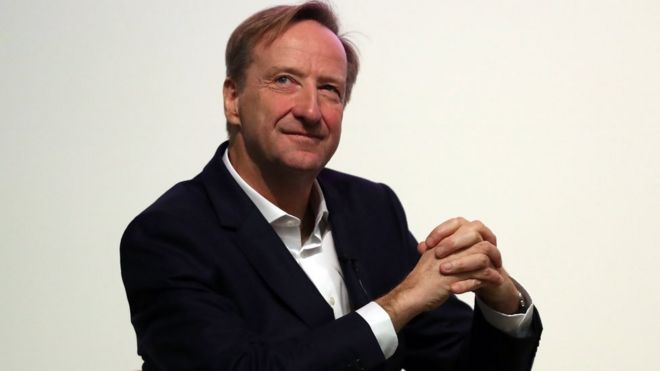
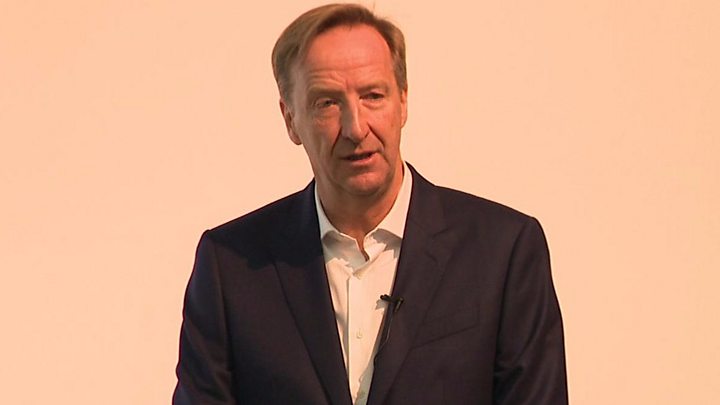
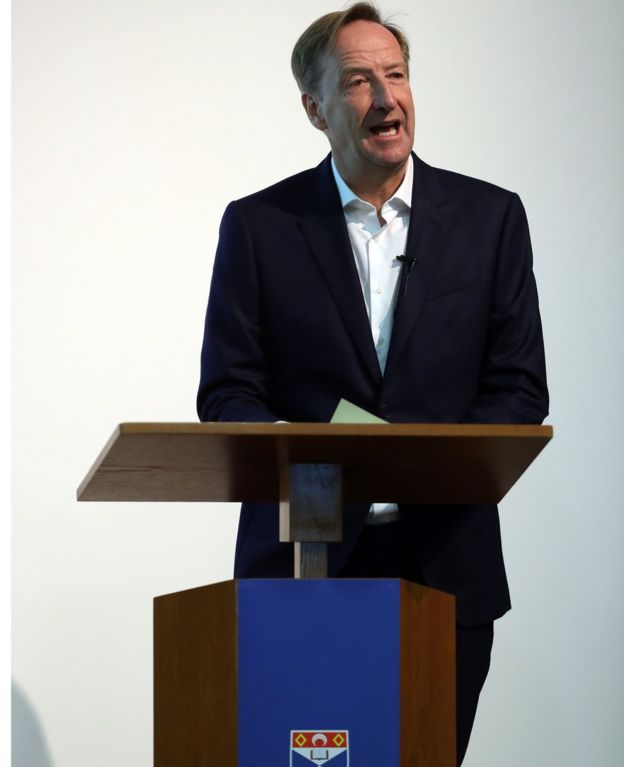
Alex Younger returned to St Andrews University - where he studied - for his second public speech in his four years as MI6 chief
The chief of MI6 has raised questions over Chinese technology companies being involved in the UK's communications infrastructure.
Australia has already blocked Chinese company Huawei from supplying equipment for its 5G mobile network, and New Zealand has said it will consult before a final decision.
MI6 boss Alex Younger said Britain needs to decide how comfortable it is "with Chinese ownership of these technologies".
In a rare speech, he also said British intelligence needs to innovate faster than its adversaries to cope with threats the country faces.
Russia posed a threat through hybrid warfare -- including cyber attacks, he said, but warned that Moscow should not underestimate the UK's capabilities.
MI6 will continue to strengthen ties in Europe, he said, and it had been involved in disrupting terrorist attacks against France and Germany.
In a wide-ranging speech and discussion, Mr Younger said the UK's adversaries had been probing its institutions and defences in ways that fall short of traditional warfare.
These adversaries regarded themselves as in "a state of perpetual confrontation" with the UK.

Russia 'must not underestimate us'
Russia's actions included the poisoning of Sergei Skripal with a nerve agent in Salisbury in March this year.
The former Russian spy had come to the UK in a spy swap after being pardoned by Russia. 
"To the extent that we assumed that had meaning, that is not an assumption we will make again," Mr Younger said.
The aim of the UK's response to that poisoning had been to make the Russian state conclude its activities were not worth the risk.

Alex Younger warned Russia "not to underestimate our determination and our capabilities"

The expulsion of Russian intelligence officers by the UK and allies had significantly degraded Russian intelligence capability, he said.
He urged Russia "not to underestimate our determination or capabilities, or those of our allies. We can do this to any opponent at any time."
He said that even though the Russian state sought to destabilise the UK, 'we do not seek to destabilise Russia.' 
If that country responds positively, then so would the UK. 
"We do not seek an escalation," he said.
Since his last speech two years ago, Mr Young said MI6 and its sister agencies disrupted multiple attack plans linked to so-called Islamic State (ISIS).
MI6 "will always work with our sister agencies to strengthen our indispensable security ties with Europe".
UK intelligence agencies, he said, have played "an important contribution" in helping European countries, particularly France and Germany, prevent terrorist attacks in their countries or against their citizens.
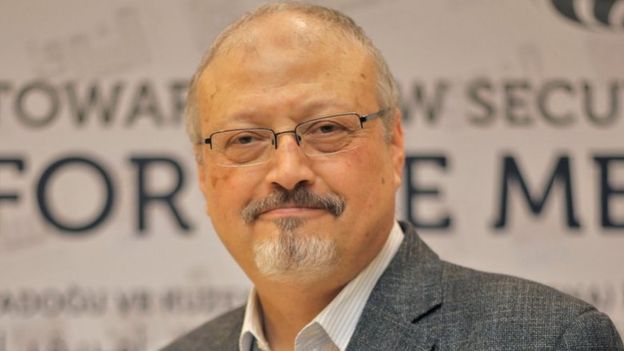
On the killing of Jamal Khashoggi Mr Younger said: "It was an appalling attack -- shocking.
"We have made it very clear to the Saudis that we expect to see a transparent effective investigation. And much will hang on the results of that investigation."
Jamal Khashoggi had gone to Istanbul to obtain a marriage document

The MI6 chief -- known as "C" -- was speaking at St Andrews University, where he studied economics and computer science as an undergraduate. 
It was only his second public lecture since he arrived.
In the speech, Mr Younger revealed details of his own career and background that had not been publicly known before.
After graduating from St Andrews he said he joined the Scots Guards Regiment and then MI6.
His first job was penetrating an organisation "intent on genocide" in the Balkans in the mid-1990s.
He said carrying out that mission involved traveling under a false identity and "many nights drinking obscure homemade alcohol" to create the relationships needed to provide intelligence.
Certain aspects of the intelligence world had not changed and would not change, he said, with MI6 still trying to understand the motivations, intentions and aspiration of people in other countries.
"Even in the era of artificial intelligence you need human intelligence," he said. 
But there had been significant changes.
Mr Younger is "perplexed" over why the UAE jailed British academic Matthew Hedges

The impact of technology was a major focus of his remarks. 
MI6 was "pioneering a fourth generation of espionage" to make sure technology worked to its advantage.
Data analytics has made the world more transparent with implications for spies. 
That was evident by the way that a non-governmental investigative group -- Bellingcat -- was able to expose the Russian military intelligence officers involved in the Salisbury attack.
That was a sign that the traditional "cover" used by spies -- traveling around the world under false identities -- does not stand up to scrutiny in a way it did in the past.
The data age posed a potentially "existential challenge" to traditional ways of operating. 
"Our task now is to master covert action in the data age," he said.

China's role in 5G

Mr Younger was asked about the role of China in building new 5G communications networks.
There have been concerns that this could open the way for intercepting of communications and sabotage.
New Zealand has just announced it would not allow the Chinese company Huawei to be involved.
Huawei has been involved in previous UK communications infrastructure projects.
"We have got some decisions to take here," Mr Younger said.
"We need to decide the extent to which we are going to be comfortable with Chinese ownership of these technologies and these platforms in an environment where some of our allies have taken a quite definite position.
"We need to have a conversation. It's not wholly straightforward."
Cyber was now the fastest growing directorate of MI6, he said, and the service was increasingly working with the private sector tech community.
Mr Younger stressed that a priority was ensuring the broadest possible range of people considered coming to work for MI6 including those who had never thought about it in the past.
"If you think you can spot an MI6 officer, you are mistaken".

vendredi 16 novembre 2018

Axis of Evil

China and Russia’s awkward romance
By Jonathan Hillman

Oriental despots: Xi Jinping hosted Vladimir Putin in Beijing to discuss increasing economic and military cooperation between their two countries. June 25, 2016. 

This week, Chinese dictator Xi Jinping and Russian President Vladimir Putin are capitalizing on President Trump’s absence from two major summits. 
Putin met with the Association of Southeast Asian Nations (ASEAN) in Singapore, and Xi will attend the Asia-Pacific Economic Cooperation (APEC) summit in Papua New Guinea. 
In Asia, where economics is strategy, Xi and Putin are not only showing up but claiming to champion a new approach to globalization.
Lately, Xi and Putin like calling for openness and inclusivity, appropriating Western language to fuel resentment in many of the places that have benefited from globalization the most. 
They even pledged to link their signature economic visions in 2015, a political act kept alive by endless joint statements and signing ceremonies, including those last week
China’s Belt and Road Initiative promises $1 trillion of new infrastructure, trade deals and stronger cultural ties with over 80 countries. 
The Eurasian Economic Union puts Russia at the center of a single market for goods, services, capital and labor.
The problem is not American ignorance of this threat but the absence of a coherent strategy in meeting it. 
“Moscow and Beijing share a common interest in weakening U.S. global influence and are actively cooperating in that regard,” the U.S. Defense Intelligence Agency concluded in a 2017 report
But unintentionally, the cumulative effect of U.S. sanctions against Russia and tariffs against China could hasten the very threat Washington seeks to avoid: an anti-Western authoritarian partnership between the world’s largest nuclear power and second-largest economy.
That nightmare can still be avoided. 
Thankfully, the Sino-Russian partnership still has an artificial flavor, supported more by leaders-on-high than organic developments on the ground. 
After each round of ceremonial signings and partnership promises, China still towers above Russia in economic and demographic terms. 
With a long history of invasions, Russia’s paranoia about foreign powers approaching its borders will not vanish overnight.
But Russian policymakers must be persuaded to take China’s economic power as seriously as the West’s military power. 
China’s grand ambitions run through Russia and its neighbors, but its investments and infrastructure projects have not yet triggered alarms in Moscow. 
Russia is the gatekeeper for China’s overland push westward, but Xi now holds the keys in the form of investment and respect that Putin, economically and diplomatically isolated from the West, craves.
Washington should highlight the risks of China’s Belt and Road in Russia’s backyard. 
Three of the eight countries with the highest debt risk from Chinese lending are Russia’s close neighbors: Tajikistan, Kyrgyzstan and Mongolia. 
China can exploit the weakness of small economies that borrow big, as it did when it wrote off a portion of Tajikistan’s debt in exchange for disputed territory in 2011. 
Inevitably, as China’s economic footprint grows, so will its security footprint. 
Sightings of Chinese military vehicles and construction in Afghanistan’s Wakhan Corridor suggest this expansion is already underway.
To take the air out of Xi and Putin’s globalization tale, Trump’s trade policy must be updated. Yesterday, a memorandum of understanding was signed to boost trade between ASEAN and the Eurasian Economic Union. 
China is backing the Regional Comprehensive Economic Partnership, a regional deal that gained momentum when Trump withdrew from the 12-nation Trans-Pacific Partnership. 
Easier said than done, but the United States urgently needs to get back into the game of offering regional alternatives rather than bilateral ultimatums.
Finally, a bit of old-fashioned diplomacy would go a long way. 
For now, the United States does not need to choose between Russia and China, as President Richard Nixon famously did over four decades ago. 
It would be wiser to work selectively with both sides, toning down the “with us or against us” rhetoric and noting areas of existing cooperation. 
Before reflexively approving the next round of sanctions, American policymakers should carefully evaluate their longer-term consequences, such as encouraging the rise of alternative payment systems, harm to the dollar, and pushing U.S. competitors closer.
With restraint and patience, the United States could reestablish itself as a natural wedge between Russia and China. 
At the very least, it must avoid becoming a bridge that unites them.

vendredi 21 septembre 2018

Axis of Evil

U.S. sanctions China for buying Russian fighter jets, missiles
By Lesley Wroughton, Patricia Zengerle

WASHINGTON -- The Trump administration imposed sanctions on the Chinese military on Thursday for buying fighter jets and missile systems from Russia, in breach of a sweeping U.S. sanctions law punishing Moscow for meddling in the 2016 U.S. election.
In Beijing, the Chinese government expressed anger and demanded the sanctions be withdrawn.
The U.S. State Department said it would immediately impose sanctions on China’s Equipment Development Department (EDD), the military branch responsible for weapons and equipment, and its director, Li Shangfu, for engaging in “significant transactions” with Rosoboronexport, Russia’s main arms exporter.
The sanctions are related to China’s purchase of 10 SU-35 combat aircraft in 2017 and S-400 surface-to-air missile system-related equipment in 2018, the State Department said.
They block the Chinese agency, and Li, from applying for export licenses and participating in the U.S. financial system.

It also adds them to the Treasury Department’s list of specially designated individuals with whom Americans are barred from doing business.
The U.S. also blacklisted another 33 people and entities associated with the Russian military and intelligence, adding them to a list under the 2017 law, known as the Countering America’s Adversaries Through Sanctions Act, or CAATSA.
CAATSA also seeks to punish Russia for its aggression in Ukraine and involvement in Syria’s civil war.
Doing significant business with anyone on the U.S. blacklist can trigger sanctions like those imposed on China.
Some of those added to the list, which now contains 72 names, were indicted in connection with Russian interference in the 2016 U.S. election, a U.S. official said.
President Donald Trump on Thursday issued an executive order intended to facilitate implementation of the sanctions.
A federal special counsel is leading a criminal investigation of Russian interference in the U.S. election, and any possible cooperation with Trump’s presidential campaign.
Trump has insisted there was no collusion with Russia. 


One U.S. administration official said the sanctions imposed on the Chinese agency were aimed at Moscow, not Beijing or its military, despite an escalating trade war between the United States and China.
“The ultimate target of these sanctions is Russia. CAATSA sanctions in this context are not intended to undermine the defense capabilities of any particular country,” the official told reporters on a conference call.
“They are instead aimed at imposing costs upon Russia in response to its malign activities,” the official said.
In Moscow, Russian member of parliament Franz Klintsevich said the sanctions would not affect the S-400 and SU-35 deals.
“I am sure that these contracts will be executed in line with the schedule,” Klintsevich was quoted as saying by Russia’s Interfax news agency. 
“The possession of this military equipment is very important for China.”
Security analysts in Asia said the move was largely symbolic.
“The imposition of U.S. sanctions will have zero impact on Russian arms sales to China,” said Ian Storey, of Singapore’s ISEAS Yusof Ishak Institute, adding that Moscow needed Chinese money and Beijing wanted advanced military technology.
Collin Koh, a security analyst at Singapore’s S Rajaratnam School of International Studies, said the sanctions would do little to counter the evolving research and development relationship between China and Russia.
China relies less on large big-ticket purchases from Russia, but Chinese defense industries are seeking expertise from Russia and former-Soviet states to plug knowledge gaps, he said.
The Trump administration is pursuing strategies to clamp down on China and faces growing pressure to respond strongly to U.S. intelligence agency reports that Russia is continuing to meddle in U.S. politics.

Russian servicemen drive S-400 missile air defence systems during the Victory Day parade, marking the 73rd anniversary of the victory over Nazi Germany in World War Two, at Red Square in Moscow, Russia May 9, 2018.

Members of Congress, including many of Trump’s fellow Republicans, who passed the sanctions bill nearly unanimously, have repeatedly called on the administration to take a harder line against Moscow.
Administration officials said they hoped the action against EDD would send a message to others considering buying the S-400.
U.S. officials have been discussing the issue particularly with NATO ally Turkey, which wants to buy the Russian-made S-400 surface-to-air missile batteries.
Washington has expressed concern that Turkey’s planned deployment of the S-400s could pose a risk to the security of some U.S.-made weapons and other technology used by Turkey, including the F-35 fighter jet.
U.S. officials have warned that Turkey’s purchase of the system could contravene CAATSA.
“We hope that at least this step will send a signal of our seriousness and perhaps encourage others to think twice about their own engagement with the Russian defense and intelligence sectors,” another U.S. official said.

jeudi 26 juillet 2018

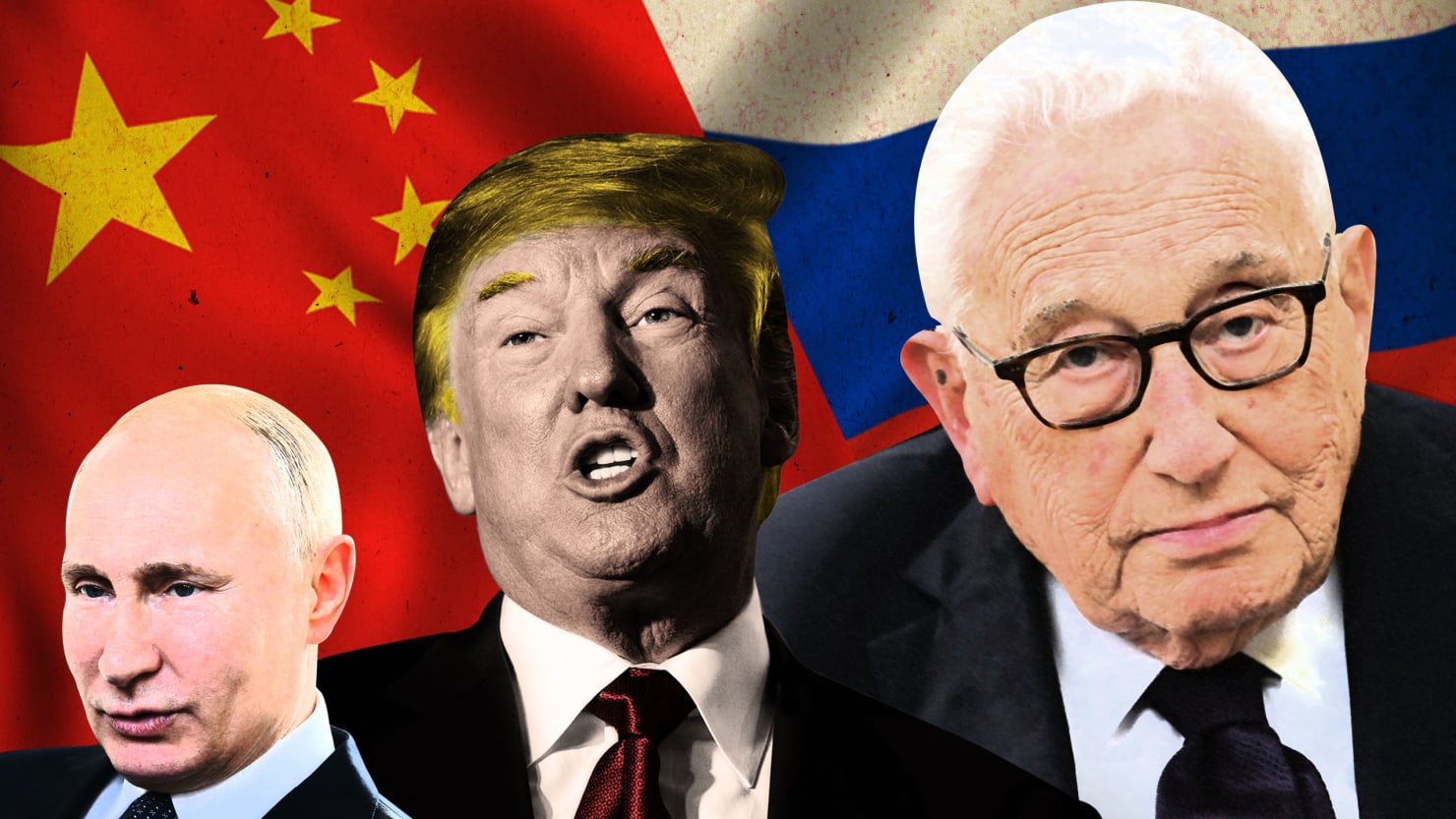
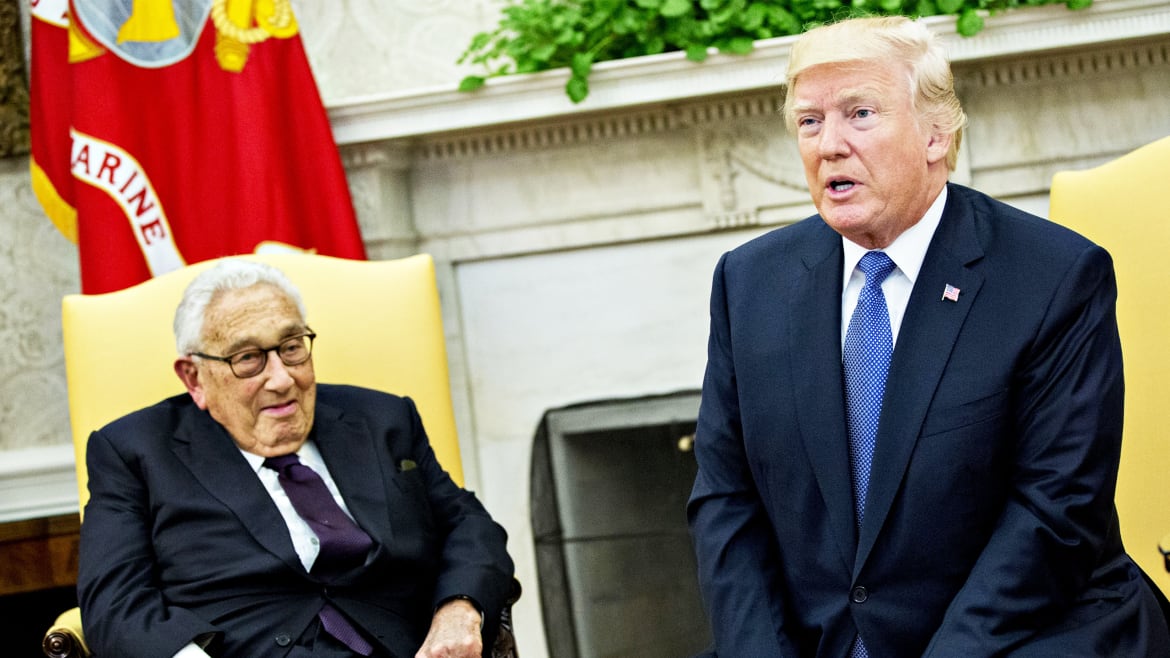
Henry Kissinger Pushed Trump to Work With Russia to Box In China

The former secretary of state pushed one president to use China to isolate the Soviet Union. These days, he’s counseling almost the reverse—and officials are listening.
By ASAWIN SUEBSAENG, ANDREW DESIDERIO, SAM STEIN and BETHANY ALLEN-EBRAHIMIAN


Henry Kissinger suggested to President Donald Trump that the United States should work with Russia to contain a rising China.
The former secretary of state—who famously engineered the tactic of establishing diplomatic relations with China in order to isolate the Soviet Union—pitched almost the inverse of that idea to Trump during a series of private meetings during the presidential transition, five people familiar with the matter told The Daily Beast. 
The potential strategy would use closer relations with Russia, along with other countries in the region, to box in China’s growing power and influence.
Kissinger also pitched the idea to Jared Kushner, the top White House adviser whose portfolio includes foreign-policy matters, one of the sources briefed on the discussions said.
Inside the administration, the proposal has found receptive ears, with some of Trump’s top advisers—in addition to officials in the State Department, Pentagon, and the National Security Council—also floating a strategy of using closer relations with Moscow to contain Beijing, according to White House and Capitol Hill insiders. 
But the idea has been complicated by the president’s deference to Russian President Vladimir Putin, which has caused countless domestic political headaches.
Both the White House and the National Security Council declined to comment. 
Kissinger's office did not return a request for comment.
The mere fact that Kissinger was given an audience to make his pitch—he’s met with President Trump at least three times since the 2016 campaign—is a testament to his tremendous staying power in top political circles, despite a controversial foreign policy track record that includes numerous accusations of war crimes
It also is a reflection of how dramatically geopolitical relations have changed during the course of his lifetime.

Kissinger isn’t viewed as a China hawk. 
It is well known in certain circles that he has a direct line to Chinese dictator Xi Jinping
And the discussions he had with President Trump appear, at least superficially, to run counter to his public pronouncements since 2017 that China’s signature Belt and Road Initiative—Xi’s vision for a China-centric world based on infrastructure and trade deals, and the object of growing Western alarm—would have a positive effect on Asia.
Kissinger is no Russophobe, either. 
He has met with Putin 17 times over the years. 
And Kissinger has repeatedly advocated for a better working relationship between Washington and Moscow. 
Of last week’s summit in Helsinki between President Trump and Putin, Kissinger said, “It was a meeting that had to take place. I have advocated it for several years.” 
He has also expressed doubt about the purpose of Russian interference in the election, and promoted a better balance of power among the world’s largest influencers.
His overall views seem to have made their way into explanations for President Trump’s affinity for Putin. 
One former Trump administration official referred to President Trump’s posture toward Putin during the Helsinki summit earlier this month as “the reverse of the Nixon-China play.”
“Russia and China are cozying up to each other and it’s a lethal combination if they’re together,” said the former official, who was familiar with the strategizing behind the summit.
During the 2016 presidential campaign, various figures in the Trump orbit—not just Kissinger—discussed a strategy of shoring up relations not only with Russia, but also with Japan, the Philippines, India, Middle Eastern countries, and others as a wide-ranging international counterweight to what was pitched as the dominant Chinese threat.
Since becoming president, Trump, those sources said, has shown varying signs of interest. 
But his actual posture toward China has remained difficult to define. 
The president has flattered the country’s political leadership, partnered with it on key foreign policy matters, and adopted a highly confrontational positions on trade. 
Anything resembling a large, cohesive “counterweight” policy has yet to gain serious traction. 
And one of the main economic levers that would be used to achieve this type of outcome—the trade deal known as the Trans Pacific Partnership—was abandoned by Trump even as Kissinger himself nominally supported it.
Internally, the fights over a China policy have been lengthy. 
Steve Bannon, Trump’s former chief strategist, has long railed against a rising threat from China, and he was present during the meeting between Trump and Kissinger that took place during the transition. 
Other Trump allies who share Bannon’s pragmatic disposition include trade adviser Peter Navarro, Sens. Marco Rubio (R-FL) and Tom Cotton (R-AR), and U.S. Trade Representative Robert Lighthizer.
Unlike Kissinger—who stressed that relations with Russia were not an end goal itself but part of a decades long approach to revamping continental power structures—these advisers argued that the threat from China needed to be confronted in the near term. 
A congressional source familiar with the strategy said Bannon often focused on “civilizational threats that face the U.S. emanating from Arab world and China.” 
Indeed, Bannon has backed populist, nationalist parties throughout Europe based in large part on appealing to identity politics and international threats. 
Those same parties have often embraced and praised Putin.
Among Capitol Hill foreign policy circles, the source added, the view is that Kissinger’s motivations for pursuing the reverse of his own policy from the 1970s are “more intellectually honest and honorable” than Bannon’s. 
Though a separate source familiar with the transition talks said the two individuals had a fair amount of overlap in terms of their world views.
“[Kissinger] did not advocate a partnership with Russia,” said the source. 
“But he was absolutely adamant that 17 years of the global war on terror had taken up too much time and focus. And he is a huge believer that this is a great power struggle [with China].”
The issue for lawmakers, as is often the case with Trump, has been trying to discern whether his attempts to cozy up to Russia are driven by broader concerns about Beijing’s growing influence, or by an affinity for Putin himself.
That certainly has been the case in the wake of the Helsinki summit, during which Trump sided with Putin’s denials of Russian election meddling over the assessment of his own intelligence agencies.
The episode prompted sharp criticism from lawmakers, including some who said that any talk of strategically working with Putin to combat China is merely a face-saving measure to explain away the president’s conduct. 
But according to Capitol Hill sources, it also left several lawmakers wondering whether the administration was attempting to make a larger move on China.
“I’m hesitant to characterize what is being legitimately discussed because this administration is such an incoherent dumpster fire it’s impossible to ascertain what’s legitimate discussion, what’s not legitimate, what’s being discussed in one part but may have no traction elsewhere,” a source on Capitol Hill said.
Trump advisers have considered the Kissinger-type approach to east Asia since the 2016 campaign. But a source close to the White House noted that the “key word is ‘considering’ as they know that any move to implement it would, at least currently, be met with a massive backlash, and rightly so.”
The source added that several senior White House officials believe that “Russia would be a ‘useful counterweight’ to China.” 
But not everyone buys into that theory.
It’s not just that Russia has played a largely counter-productive role vis-a-vis the United States, and much of the rest of the liberal world order, over the last few years. 
It’s that their points of leverage over China are limited largely to weapons, oil, and cyber intrusions.
“I understand the idea of a collective approach to boxing China in and trying to integrate it into an order consistent with our interests,” said Richard Haass, president of the Council on Foreign Relations. 
“I just don’t see Russia as currently oriented playing a role in that.”
Still, U.S. officials have become increasingly vocal in their warnings of the threat that China poses and the need for a comprehensive strategy to combat it. 
At the Aspen Security Forum last week, FBI Director Christopher Wray called China “the broadest, most challenging, most significant threat we face as a country,” and Michael Collins, deputy assistant director of the CIA’s East Asia mission, said that China is waging a “cold war” against the United States.
“It is clear the Trump administration views the rise of China—from issues of trade, its continued quest to dominate Asia and displace U.S. power to building a military that can challenge Washington’s most advanced weaponry—as its number one national security challenge,” said Harry Kazianis, director of defense studies at the Center for the National Interest. 
“I am not shocked that they would consider Russia a potential partner in containing China’s rise.”
In theory, the partner-with-Russia-to-combat-China strategy—regardless of its motivations—is not entirely without merit, experts say, if only to break up the partnership developing between Putin and Xi themselves.
“China and Russia have a very similar worldview right now and they're supporting each other pretty strongly. I don’t see a lot of cracks,” said Lyle Goldstein, a Russia and China expert at the U.S. Naval War College.
Russia and China often pursue complementary agendas and support each other at the United Nations Security Council, said Abigail Grace, who until recently worked on the Asia portfolio at the National Security Council. 
“I don’t think that the level of China-Russia collaboration is necessarily within U.S. interests,” Grace said.
But while Moscow and Beijing have cordial relations and share many strategic objectives, there are areas of relative distrust between them, including over Central Asia. 
China has made major economic and diplomatic inroads in the region with its Belt and Road Initiative, which includes Central Asian nations a key part of its strategy. 
But Russia views that region as within its traditional sphere of influence. 
While it hasn’t stood in the way of Xi’s overtures to countries like Kazakhstan and Uzbekistan, it has declined to join the initiative despite China’s invitation.
Beyond Central Asia, it’s also clear that with its enormous economy and rapidly expanding military ambitions, China is on a trajectory to greatly surpass Russia’s global heft—a trajectory that could compel Russia to seek partnerships (informal or otherwise) elsewhere.
Looking out over long term, there is a belief in the administration that Moscow will see Beijing as its greatest geopolitical foe—just like Washington does now—and that could set up a rapprochement with America,” said a source close to the White House. 
“But it is very far out into the future.”
But there’s a very good reason the “reverse Nixon” strategy hasn’t been implemented yet. 
It’s just not geopolitically realistic.
“China is the greater long term strategic challenge,” said John Rood, the Under secretary of Defense for Policy, at the Aspen Security Forum. 
“But in many ways, Russia is the larger near term threat because of the overwhelming lethality of its nuclear arsenal and also because of some the behavior that the Russian government has exhibited.”
Russia is at times a flamboyant foe of the European Union and the United States, seeking to sow disruption and division within and among Western allies. 
It also has been highly disruptive of U.S. politics making it an illogical partner for an ambitious attempt to help preserve the current international system.
“At the moment, with Russia having tried to attack our democratic institutions as well as still acting like a rogue state in Ukraine and Syria, the chances of a U.S.-Russia alliance to take on China are slim to none,” said Kazianis.
“But know this: time and circumstance can change minds and win hearts. I would not be shocked if in seven to 10 years this does indeed take place.”

mercredi 28 mars 2018

Axis of Evil: China and Russia are waging war on human rights at UN


They lobbied to cut funding for human rights monitors and for a senior post dedicated to human rights work
By Julian Borger in Washington

The UN Human Rights Up Front initiative was established in 2014, after a series of UN failures in preventing or sounding the alarm over atrocities. 
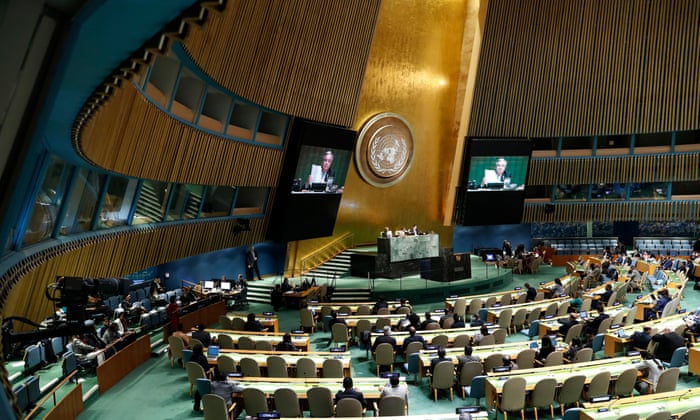
China and Russia are leading a stealthy and increasingly successful effort at the United Nations to weaken UN efforts to protect human rights around the world, according to diplomats and activists.
The two countries have used the UN budget panel, known as the fifth committee, to cut funding for human rights monitors and for a senior post in the secretary general’s office which is supposed to ensure that human rights – one of three pillars of the UN’s function – are not forgotten in its day-to-day work.
The UN Human Rights Up Front initiative was established in 2014, after a series of UN failures in preventing or sounding the alarm over atrocities, culminating in mass killings in Sri Lanka in 2009.
A senior official in the secretary general’s office was appointed to ensure that progress was made on the issue throughout the organisation, but funding for that post has been cut this year by the fifth committee, as a result of lobbying by China and Russia. 
The cut, first reported in Foreign Policy, means that the human rights work that was the responsibility of that official will be spread around other posts with other priorities.
The funding of the office of the high commissioner for human rights in Geneva has also been cut. 
The current high commissioner, Zeid Ra’ad Hussein, has announced that he will be stepping down this year and not seeking another term in the post, explaining to his staff that the lack of global support for protecting human rights made his job untenable.
Last week, Zeid was due to address the UN security council on plight of civilians in Syria but before he began, Russia called a procedural vote to stop him speaking on the grounds that the council was not the proper forum for discussing human rights.
“The fifth committee has become a battleground for human rights,” Louis Charbonneau, the UN director for Human Rights Watch, said. 
“Russia and China and others have launched a war on things that have human rights in their name.”
“You can get a mandate for human rights work in the security council, but then Russia and China go behind the scenes to defund it,” Charbonneau said. 
“And the countries that pay lip service to human rights are not pushing back. But the question is are we going to let them win?”
“China has real political momentum at the UN now,” Richard Gowan, a UN expert at the European Council for Foreign Relations, said. 
“It is now the second biggest contributor the UN budget after the US, and is increasingly confident in its efforts to roll back UN human rights activities. It is also pushing its own agenda – with an emphasis on ‘harmony’ rather than individual rights in UN forums. And a lot of countries like what they hear.”
A western diplomat at the UN conceded that human rights were losing ground at the UN, because China had become a more assertive voice, prepared to lead lobbying campaigns, and because Beijing is increasingly leveraging its vast and growing investments in the developing world to win votes for its agenda at the UN.
“The fifth committee is a very important battleground,” the diplomat said. 
“Our team is fighting in the trenches very hard on this. We want to get the best value for the taxpayer, but also to make sure that something as important and central as human rights in the work of the UN is not defunded.”