Affichage des articles dont le libellé est Anne-Marie Brady. Afficher tous les articles

lundi 12 août 2019

Chinese Peril

China’s influence on campus chills free speech in Australia, New Zealand
By A. Odysseus Patrick and Emanuel Stoakes


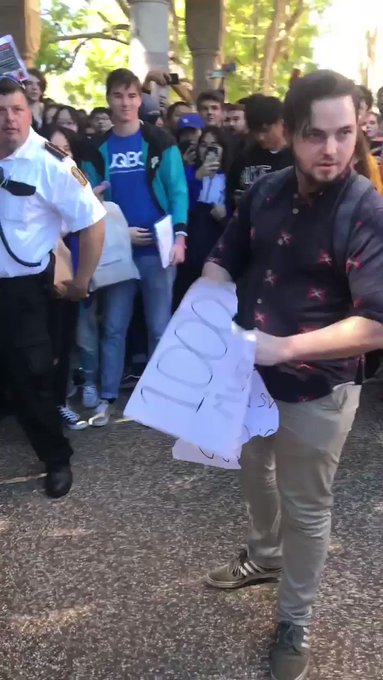
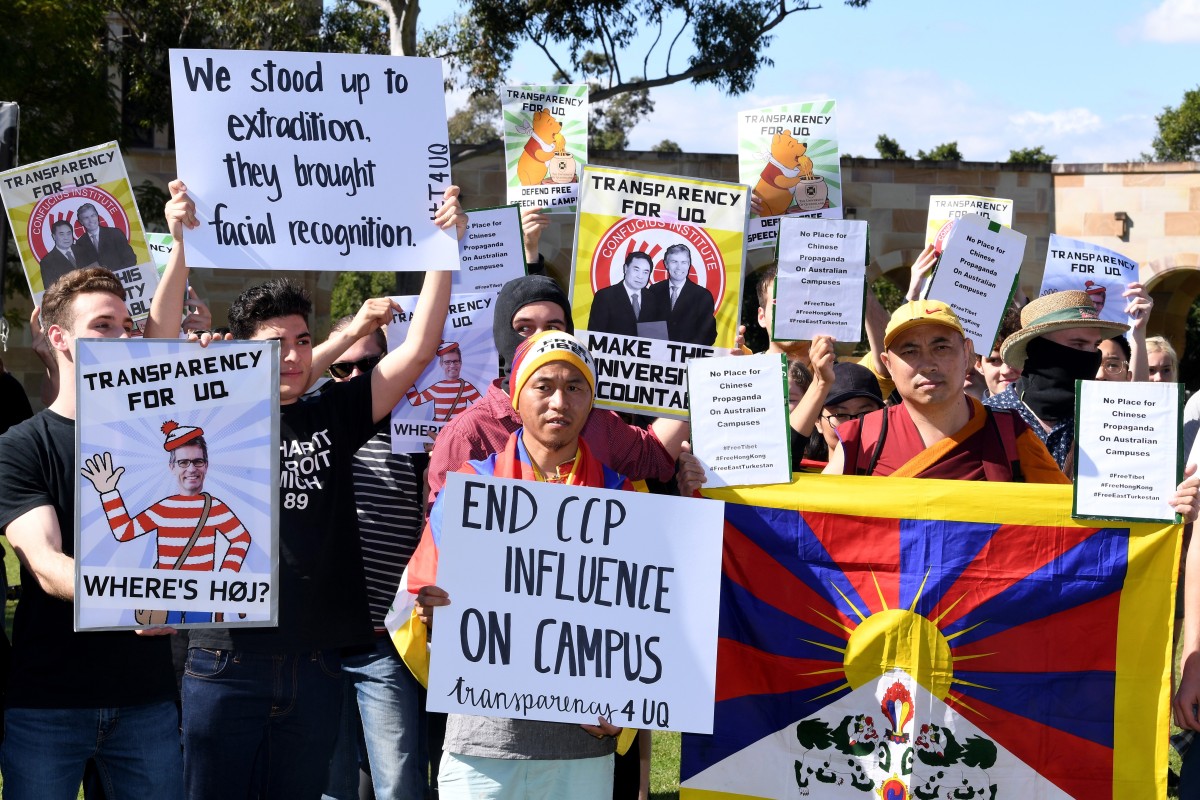
Students hold placards during a protest at the University of Queensland in Brisbane, Australia, on July 31. 

SYDNEY — Chinese students poured into Australia and New Zealand in their hundreds of thousands over the past 20 years, paying sticker prices for university degrees that made higher education among both countries’ top export earners.
Now, as a more-authoritarian China projects its influence deeper into the South Pacific, attempts by Chinese students and diplomats to interfere with anti-Beijing dissidents and stifle free speech on campus pose an uncomfortable challenge for both U.S. allies.
The immediate trigger for the flare-ups was mass protests in Hong Kong, which authorities in the semiautonomous Chinese territory are struggling to contain.
Protesters there have assailed what they say is the steady erosion in Hong Kong’s rule of law, aided and abetted by the city’s pro-Beijing leaders.
Students, academics and officials in Australia and New Zealand, two of the modern world’s older democracies, now find their natural sympathy for the Hong Kong protesters colliding with their nations’ economic dependency on Beijing — a weakness the Chinese Communist Party isn’t hesitating to exploit.
The most visible flash point is on campus.
Students who support and oppose the Chinese Community Party have spent recent days erecting, ripping down, and restoring walls covered with cards and Post-it notes calling for freedom in Hong Kong at universities in the Australian cities of Sydney, Melbourne, Brisbane and Hobart, and in New Zealand.
“Beijing’s influence on campuses is responsible for widespread self-censorship by universities and academics in Australia and New Zealand,” said Clive Hamilton, a professor of public ethics at Charles Sturt University in Canberra and author of “Silent Invasion: China’s Influence in Australia.”
“The events of the last couple of weeks on Australian campuses have proved to be a serious escalation of Beijing’s interference,” he said.
Every pro-democracy protest is countered by Beijing’s well-drilled student supporters.
When some University of Sydney students proposed a protest on Friday, which did not proceed, opponents shared notes on the Chinese WeChat platform about how to respond.
“The pro-Hong Kong independence demonstration on August 9 is planned by some forces of Sydney University,” one person wrote, according to an image taken by a student.
“We will not use force, but will absolutely not sit idly by and do nothing. [We] will fight the separatist forces to the end using legal means. Never make a concession!!”
The person, who could not be reached for comment, added in the message that they had “reported this to the education section” of the Chinese Consulate.
After years of feeling fortunate about their economic relationship with China, Australians are starting to worry about the cost.
On Thursday, a ruling-party lawmaker, Andrew Hastie, compared China’s expansion to the rise of Hitler's Nazi Germany before World War II and suggested it posed a direct military threat.
“Like the French, Australia has failed to see how mobile our authoritarian neighbor has become,” Hastie wrote in the Sydney Morning Herald.
Hastie’s comments ricocheted between Beijing and Canberra, where the Chinese Embassy condemned the former officer in Australia’s Special Air Service Regiment, an elite army special forces unit.
As the smallest members of the Five Eyes intelligence-sharing alliance that includes the United States, Britain and Canada, Australia and New Zealand are attractive targets for Chinese influence and espionage operations, analysts say.
Paul Buchanan, a strategic analyst based in Auckland, said that New Zealand is an “ideal liberal democratic lab rat” for China to experiment with ways to use “the very freedoms and transparency of democratic systems against them.”
Chinese diplomats in both Australia and New Zealand appear to be encouraging confrontations by praising counterprotesters.
On July 29, a student at New Zealand’s Auckland University was confronted by a group of men who objected to her involvement in adorning a protest site, known as a “Lennon Wall,” with messages of support for Hong Kong demonstrators.
Cellphone footage uploaded to social media showed one of the men moving aggressively toward the student, who fell to the ground.
Three days later, the Chinese Consulate in Auckland published a statement that supported the actions of the assailant and his companions, conveying its “appreciation to the students for their spontaneous patriotism,” while condemning unnamed individuals for “inciting anti-China sentiment.”
Protests and counterprotests have taken place since; participants say they have received threatening messages from unknown senders.
Defenders of free speech say the episodes are a wake-up call.
New Zealand Prime Minister Jacinda Ardern said this week that officials have reminded their Chinese counterparts that New Zealand “will uphold and maintain our freedom of expression.”
Standing up for such values comes at the cost of worsening relations with Beijing, the top trade partner of both countries and a lucrative source of funds for universities, which lack the big endowments of American colleges.
China’s purchases of iron ore, coal and dairy products have helped power Australia and New Zealand’s prosperity.
The University of Queensland, where punches were thrown at a Hong Kong sympathy protest two weeks ago, is so close to Chinese authorities that it appointed the Chinese consul general in Brisbane a visiting professor of language and culture last month.
The consulate then praised the “patriotic behavior” of 300 pro-Beijing students after the violent incident, prompting Australia’s defense minister to warn foreign diplomats against interfering in free speech.


Nilsson Jones@nilssonjones_

Chinese students clash with pro-Hong Kong protesters at UQ after peaceful sit in #uq #hongkong #china

1,632
5:27 AM - Jul 24, 2019
Twitter Ads info and privacy
1,462 people are talking about this


Among themselves, mainland Chinese students share advice on how attract sympathetic coverage in confrontations with the left-wing activists they call the “baizuo,” a pejorative term for Western liberals that translates as “white left.”
“UQ students please be calm, don’t resort to violence,” said a recent post on Weibo, China’s Twitter-like service.
“Try to learn from the tricks of those pro-Hong Kong independence activists. If you push me I will fall over. Fake tumble, cry and wail, call campus police. We are too strong, which won’t work in the world of baizuo.”
“It’s very tense,” said Drew Pavlou, one of the student organizers of the University of Queensland protest, in an interview.
“It doesn’t feel safe. I have had to have security walk me to some classes.”
In New Zealand, an event commemorating China’s 1989 suppression of pro-democracy protests at Tiananmen Square scheduled for June 3 was moved away from Auckland University of Technology following pressure from Chinese officials.
Emails obtained through freedom-of-information requests by online outlet Newsroom revealed that China’s vice consul met with the university’s president on May 31 to request that the event be scuttled. 
The university received emails from the consulate on the matter, too.
In Australia, officials are so concerned about Chinese influence that the attorney general has asked his department to examine why 14 Confucius Institutes — Chinese-funded education units within Australian universities — have not been registered as agents of foreign influence under a new law directed at Chinese espionage, influence and propaganda.
At the University of Canterbury in Christchurch, New Zealand, a Confucius Institute shares a building with the office of Anne-Marie Brady, a professor who has researched Chinese government influence.
Brady has complained of threats, break-ins at her home and attempted sabotage of her car. 
Police investigated but were unable to identify a culprit.
Reflecting a growing unease that Australia’s economic future depends on an unpredictable adversary, former prime minister John Howard said this week that unrest in Hong Kong “perhaps represents a glimpse of the future for Chinese society.”
“If you’ve been born into relative affluence and comfort you take that for granted and you resent being told how to run your life,” he said.
“Perhaps over the next 50 years we’re going to see just how all of that works out.”

mardi 29 janvier 2019

How China uses shadowy United Front as 'magic weapon' to try to extend its influence in Canada

Its activities include influencing the Chinese diaspora to back China, co-opting foreign political and economic elites and promoting Beijing’s agenda worldwide
By Tom Blackwell

The scene outside the offices of the Toronto public school board was raucous.
It was October 2014, and the board was planning to vote on a contract with the Confucius Institute, an organization affiliated with the education ministry of the government of China, which had offered its services to teach Mandarin to the city’s schoolchildren.
Critics decried the arrangement, calling the institute a propaganda or espionage arm of the Chinese state. 
But its supporters were out in force, scores of them, rallying noisily and waving Chinese flags in the heart of Canada’s biggest city.
“You are a damn traitor to China,” one of them shouted to an institute opponent of Chinese descent. “Down with traitors!”
The demonstration was no spontaneous occurrence. 
Three days earlier, as the Confederation of Toronto Chinese Canadian Associations hosted a farewell banquet for the departing Chinese vice-consul, Consul General Fang Li had urged locals to come out in support of the institute.
After a request for support from the local consul general of China, Chinese-Canadian backers of the Confucius Institute rally outside the Toronto school board offices in 2014. Subtitles were added by Falun Gong practitioners but the translation was independently verified by the National Post. 

The confederation, according to the local MingPao newspaper, echoed his call, predicting 500 would attend the rally.
While the Toronto trustees eventually voted to send the Institute packing, Confucius is now entrenched at three other school boards and on nine university and college campuses across Canada. 
And the Toronto dispute underscored Beijing’s sometimes surprising reach into Canada — the subject of renewed scrutiny amid the bitter diplomatic dispute sparked by Canada’s arrest of Meng Wanzhou, an executive with Chinese infotech giant Huawei, at the request of the United States.
China has long strived to influence and monitor Chinese-Canadians, Chinese citizens who study here and Canadian society as a whole — and done the same in many other countries. 
In recent years, however, that project appears to have surged in importance.
Since rising to prominence in 2012, the country’s paramount leader, Xi Jinping, has overseen what one leading academic expert calls a “massive expansion” in China’s use of soft power overseas, much of it under the auspices of the United Front Work Department, a shadowy offshoot of the Chinese communist party.
The United Front began in pre-revolutionary China, used by the party to co-opt non-communist groups into its struggle for power. 
In recent years, it has been increasingly deployed to win over overseas Chinese — and the broader societies around them.
“United Front work has taken on a level of significance not seen since the years before 1949,” Anne-Marie Brady, a political scientist at New Zealand’s University of Canterbury, told a U.S. conference last year. 
“(China) is increasingly able to use its soft-power ‘magic weapons’ to help influence the decision-making of foreign governments and societies.”
Working partly through officials in foreign missions, its activities include influencing the Chinese diaspora to back China, co-opting foreign political and economic elites, promoting Beijing’s agenda worldwide and forming a China-centred economic bloc, the political science professor says.
And doing “United Front work” is considered the duty of all party members — who now include a majority of Chinese corporate CEOs — not just the department itself, says Brady.
Xi himself has quoted Mao’s description of the United Front as one of the communists’ “magic weapons,” and has elevated the United Front’s role in the party, an expansion that has included adding 40,000 staff to the department and absorbing three government agencies, according to Gerry Groot, a China-studies lecturer at Australia’s University of Adelaide.
Last August, Xi made a direct appeal to ethnic Chinese residents of countries like Canada — what Beijing calls the “overseas Chinese” — urging them to “remember the call from the Party and the people, spread China’s voice, support the country’s development, safeguard national interests.”
The Huawei research and development centre at Dongguan, China. 

Charles Burton, a political scientist at Ontario’s Brock University who closely monitors China-related rights issues, says one of the United Front’s key goals is to soften opinions around issues like Chinese companies’ acquisition of Canadian natural resources and technology, or the looming decision Canada must make about Huawei’s involvement in building the country’s 5G telecom network. 
The company, considered to have close links to the Chinese state and having for years faced accusations of corporate espionage, was barred from taking part in 5G trials in the U.S., Great Britain, Australia and New Zealand — the four countries that with Canada comprise the Five Eyes intelligence-sharing alliance.
It’s difficult to map exactly how the United Front Work Department deploys its resources in places like Canada. 
But Burton argues its influence — helped by immigration in the last two decades made up increasingly of people raised under Communist rule on the Chinese mainland — has been tangible. 
A substantial portion of Chinese diplomatic staff in Canada are United Front operatives, interacting with Chinese-Canadian leaders, politicians, students and others.
And there are a lot of those staffers. 
Global Affairs Canada lists 211 accredited representatives of China, not much less than the 276 fielded by the U.S., Canada’s closest ally and neighbour. 
The U.K. has 38. 
The Chinese embassy did not respond to a request for comment.
Most of the Chinese-language media in Canada are now owned by businesses tied to Beijing, offering positive coverage of China, while Chinese-Canadian community groups have largely fallen under the sway of the “motherland.” 
In his own region, the Niagara Chinese Cultural Association was once dedicated to domestic causes and reaching out to the wider community, but now seems just as interested in cheering on a rising China, says Burton, a fluent Mandarin speaker. 
Both the Canadian and Chinese flags are raised at meetings today, and there was even discussion of adding the Chinese anthem, he says.
“An organization that once had another purpose has gradually been taken over to serve China’s national interest. Where United Front work becomes problematic is when it’s engaging persons of Chinese origin who have Canadian citizenship … to serve the interests of the motherland, when in fact the motherland should be Canada.”
One of the Niagara group’s leaders denies there has been any change in direction, or political thrust. “Our executive committee’s background is a combination of Canada, mainland China, Taiwan and Chinese from other Asian countries,” says Li Yu, the association’s former president. 
Yet Michel Juneau-Katsuya, former Asia-Pacific chief for the Canadian Security Intelligence Service, documented ties between the leaders of a number of Chinese-Canadian groups and China, arguing in a presentation to the Toronto school board the groups “are following Beijing’s request, not the Canadian constituents.”
The Confederation of Toronto Chinese Canadian Associations has joined forces with the local consulate on contentious issues other than just the Confucius Institute, while China’s Overseas Affairs Office — under Xi, now officially part of the United Front — heaped praise on the group in a recent online article, since removed, that cited its willingness to defend Chinese interests.
Confederation executives could not be reached for comment. 
Their website talks of building “a truly beautiful and wonderful homeland — Canada,” while pledging to also help strengthen both the bridge of friendship to China, and China’s economic development.
In August 2018, Chinese dictator Xi Jinping made a direct appeal to ethnic Chinese residents of countries such as Canada urging them to remember the call from the Party and the people, spread China's voice, support the country's development, safeguard national interests.

Even an Ottawa Chinese senior’s group was not immune. 
The Ontario Human Rights Tribunal ruled in 2006 the association had violated the law by throwing out a member who practiced Falun Gong. 
Asked to explain the decision, one group leader allegedly said the expelled senior was “against the Chinese government,” another that the organization had to “maintain unity and solidarity” with Beijing, the tribunal reported.
Not all experts are convinced that China’s attempts to shape opinion in Canada have borne much fruit.
“There is definitely an attempt to influence domestic public opinion here,” Lynette Ong, a University of Toronto professor and China expert, said in an interview. 
“But from what I see, the extent of success here is rather limited.”
And the Canadian government has been reluctant to do what Australia did earlier this year and implement laws geared to countering undue foreign influence. 
A spokesman for Foreign Affairs Minister Chrystia Freeland did not respond when asked whether Canada would now consider such legislation.
But politicians themselves have also been the target of Beijing’s influence campaigns.
In the Antipodes, where the issue has been most prominent, a New Zealand MP landed in hot water after his pre-immigration past as a member of Chinese military intelligence was revealed, while an Australian senator quit amid revelations that he had taken pro-China positions after getting donations from a Beijing-linked tycoon.
Ong argues that Beijing’s political influence in Canada has been negligible compared to what has happened in New Zealand or Australia, whose economies are far more dependent on China.
Yet a training manual for United Front cadres, obtained by the Financial Times newspaper, notes with approval that the number of politicians of Chinese descent elected in Toronto had almost doubled between 2003 and 2006.
Department officials should “aim to work with” those and other individuals who have prospects for advancement, the manual advises, while offering no details of what exactly that means.
It’s not just politicians of Chinese background who are targeted, although not necessarily by the United Front.
Huawei Technologies Chief Financial Officer Meng Wanzhou exits court following a bail hearing at British Columbia Superior Courts in Vancouver on Dec. 11, 2018. 

Prime Minister Trudeau was forced on the defensive in 2016 when it emerged that he took part in a private fundraiser attended by a Chinese billionaire with close ties to the Beijing leadership. 
A billionaire who then donated $250,000 to the charitable Pierre Elliot Trudeau Foundation and the raising of a Trudeau statue.
At least nine MPs have taken trips to China in recent years — usually flying business class — that were paid for by Chinese government agencies, indicate Ethics Commissioner records, which don’t include former members. 
The Canada-China Legislative Association meets regularly — and as recently as this month — with members of the Chinese People’s Congress. 
The Congress is an unelected body that rubber-stamps Communist Party decisions, not equivalent to Canada’s Parliament, Burton notes.
While a backbench MP, Canada’s current ambassador to China, John McCallum — who was forced to withdraw comments this week he made to a group of Chinese-Canadian stakeholders and media suggesting Meng had a strong case that her arrest was politically motivated — accepted $73,000 worth of trips to the country, paid for by both the Chinese government and pro-Beijing business groups, the Globe and Mail has reported.
Chinese-Canadian politicians, meanwhile, have to be cognizant that recent Chinese immigrants are mostly products of the mainland Communist regime, said Kenny Chiu, a losing 2015 federal Conservative candidate in B.C.
“That has a significant impact or influence on the view of China in the community,” Chiu said. “There are many immigrants coming to Canada who are actually very proud of the development that has occurred in the motherland.”
To encourage such leanings, the United Front’s tools include both the Confucius Institutes, and the less-well-known Chinese Students and Scholars Associations at post-secondary institutions across Canada — and in numerous other countries.
The associations are sometimes dispatched to counteract protests against visiting Chinese dignitaries, promote the homeland and monitor the activities of Chinese students, Burton says.
In an echo of the Toronto school board protest, shortly after Meng’s arrest a little-known Chinese women’s group held a news conference in Vancouver to call for her release — though they said they had no link to the People’s Republic — and another group rallied outside the courthouse in her support.
Meanwhile, a leaked video obtained and translated by the Falun Gong appears to show an embassy first secretary briefing students about a planned pro-China demonstration on Parliament Hill in 2010, promising them food and accommodation. 
The work was mandatory for any student funded by the Chinese government, he said.
It would be a “battle that relates to defending the reputation of our Motherland,” the diplomat says on the recording.
Chinese fifth column: People hold a sign at a B.C. courthouse prior to the bail hearing for Meng Wanzhou, Huawei’s chief financial officer on Monday, December 10, 2018. 

Students coached by embassy staff staked out an Ottawa hotel all night in 2016 to welcome visiting Chinese Premier Li Keqing the next afternoon — and try to drown out protesters, says Grace Wollensak, a Falun Gong spokeswoman who was there.
Lingdi Zhong, a Falun Gong practitioner and Chinese student, told the authors of an Amnesty International-led, confidential report on intimidation tactics by Beijing in Canada that the vice-president of the University of Ottawa association warned her in 2005 his group was under the guidance of the Chinese embassy and that she was being watched.
China’s actions may raise questions about the appropriate role of a foreign power in domestic affairs, but they are unlikely to be debated in Canada’s Chinese-language media.
With the exception of Falun Gong’s Epoch Times and one or two other newspapers, most toe Beijing’s line, says Cheuk Kwan, head of the Toronto Association for Democracy in China.
Journalists from such outlets have told him they sometimes even get calls from the consulate with advice on what to cover, and not cover.
Whether all this has an impact depends on the individual, when they immigrated and where they came from, adds Kwan.
“A lot of people don’t think of the long arm of influence of China in Canada, because they’re under the influence, to put it mildly,” he says. 
“Outsiders like me, who is a Hong Kong immigrant … we see very clearly that this is a United Front effort, a very subtle, soft-power kind of advance into Canadian society.”

No longer safe: Researcher harassed by China in her own country

By Peter Hartcher

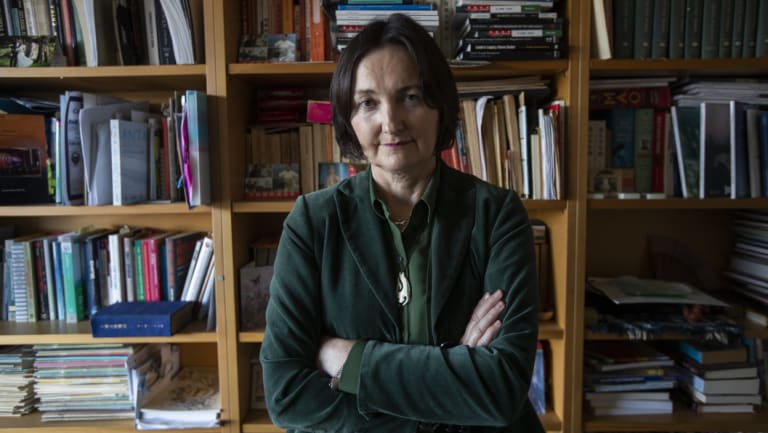
After a quarter-century of researching China, Anne-Marie Brady is a veteran of Chinese government spying and harassment. 
 "I was prepared for pressure in China," says the 52-year-old New Zealander, a well-regarded professor of political science at the University of Canterbury in Christchurch. 
"But I always felt safe in New Zealand. So that changed." 
Last week she wrote to Prime Minister Jacinda Ardern seeking police protection. 
It was her first direct appeal to Ardern, but her third in a series of pleas to escalating levels of officialdom.

China expert Anne-Marie Brady has been subject to ongoing harassment.

First came the pressure on her university. 
Chinese officials demanded that her immediate superior stop her research. 
It might have worked – the New Zealand Ministry of Foreign Affairs as well as the mayor of Christchurch backed them up in an effort to appease Beijing. 
 They failed when the university vice-chancellor intervened on behalf of academic freedom. 
But it was just the beginning.
Next, her office was broken into in December 2017. 
As far as she could tell, nothing was taken. 
"I think it was meant to scare me, to show me people could come into my office." 
If so, it worked: "I felt this great dread," after the intrusion. 
"I reported it to security and there was no follow-up."
If she had any doubt that she'd been targeted, she got a detailed warning letter from a concerned friend in the Chinese community to let her know that an official campaign of intimidation against her – and others – was under way.
Brady's home was next. 
While she was on the phone to the New Zealand Secret Intelligence Service negotiating to give them the letter, her husband called to say that someone had broken in. 
"Cash, pearls, jewellery, other electronics were ignored," Brady tells me. 
The only things missing were laptops, phones and an encrypted memory stick from her last trip to China. 
Other memory sticks were left behind. 
"It was very telling." 
 She immediately reported the break-in to the intelligence service and the police. 
Brady went to her office the next morning to discover that it had been broken into. 
Again. 
It was February 15 last year. 
Brady was scheduled to give testimony to Australia's Parliament that afternoon.
She gave evidence by video link to two committees keen to know about, among other things, her groundbreaking research into the Chinese Communist Party's activities in Antarctica in the course of producing her book China as a Polar Great Power. 
This is a vital interest for Australia, which has sovereignty over 42 per cent of the continent, as well as a vital area for New Zealand. 
And it turns out to be an area of very lively interest to China's military too, as Brady's research had unearthed. 
Her work uncovered, for instance, that the Chinese People's Liberation Army had built three military facilities on Australian Antarctic territory.

So when Australian Liberal MP Julian Leeser asked Brady whether she'd encountered any personal difficulties from Beijing over her work, she replied "yes", and summarised the various incidents. 
The Chinese government was deeply displeased that Brady had spoken out. 
"Soon after my testimony to the Australian parliamentary committees, some of my colleagues in Chinese universities were visited by the Ministry of State Security.
"They were very angry that I had spoken about the burglaries and break-ins. They were particularly upset that I had spoken it into Hansard," the official record of proceedings of the Parliament. 
Yet the New Zealand police didn't take the matter seriously. 
And the incidents continue. 
In November, Brady's car was tampered with. 
The New Zealand police treated the matter with familiar indifference and told the mechanic not to speak to the media.
When Brady and her family returned home this month after a Christmas holiday, their phone rang at 3am. 
The caller was silent. 
The number is unlisted.
It's not only her Antarctic research that Beijing wants to stop. 
She also unearthed the fact that a member of the New Zealand Parliament spent 15 years working for Chinese military intelligence but never disclosed it. 
 But the harassment in her own country seems to have been in angry response to her 2017 report in New Zealand, titled Magic Weapons: China's Political Influence Activities Under Xi Jinping.
The title is a reference to the fact that Xi named three "magic weapons" of Chinese Communist Party power – the People's Liberation Army, the party's program to strengthen and build itself, and the party's United Front Work Department that covertly spreads party influence through the overseas Chinese diaspora and elements of Chinese culture and business. 
This is the same Chinese Communist Party agenda that the Turnbull government sought to address with its foreign influence laws, which are just now about to take full effect.
The power of Brady's work is that she meticulously reads original Chinese documents in the original Chinese. 
It is her own "secret weapon". 
Australia's John Garnaut, a Mandarin-speaking former Beijing correspondent for this newspaper, says: "Professor Brady is a first-rate scholar who has led the global conversation and almost single-handedly woken up New Zealand." 
The chair of the Australian Parliament's security and intelligence committee, Andrew Hastie, says that after listening to her evidence and other conversations, "it appears that she's a target of interest for the Chinese Communist Party or apparatchiks of the Chinese state as a way of silencing her and intimidating her."

Unfortunately for Brady, her country's government is more interested in appeasing China's rulers than protecting her, or protecting New Zealand's democratic freedoms. 
"It's very clear," says Brady, "that my country's government wants this story to go away. The Chinese Ministry of State Security operates in our societies unhindered and our governments just watch. It's happening in Australia, too."
John Garnaut, who was commissioned by Malcolm Turnbull to write the classified report that informed his government's foreign interference laws, confirms: "It would be naive and also reckless to assume that similar activities are not happening here."
In the meantime Brady and her family are left to defend themselves. 
"It's an uneven contest," she says. 
"We are just an ordinary family facing down the Chinese Communist Party." 
She is continuing her work regardless: "I haven't changed. China's changed."

ADVERTISING CHINA'S THUGGISH SOCIALISM

Promoting China's communist regime to Australia's 1.2 million ethnic Chinese
By Andrew Bolt

Cinema advertisements espousing Chinese propaganda’ and socialism are airing in movie theatres across Sydney, including before children’s films such as the latest How To Train Your Dragon sequel.
A bizarre advertisement promoting “socialism with Chinese characteristics” and aimed at increasing China’s “soft power’’ over Australia has appeared on the silver screen in a string of theatres.
So who pays for this?
Chinese film distribution company TangRen... is behind the advertisement.
The Daily Telegraph yesterday asked TangRen owner Jiayin Yuan if the company was financially supported by the Chinese government and why it was promoting socialism in Australia.
She directed the questions to company director Li Tongliang who did not respond.
The company’s website states TangRen distributes two thirds of all the Chinese and Korean films shown in Australia and New Zealand.
“TangRen promotes Chinese political philosophy and cultural concepts of socialism with Chinese characteristics,” the advertisement states.
The propaganda is the carrot. 
Then there's the stick: a Chinese Australian critic of the regime gets arrested in China:
Yang Hengjun, the Australian-Chinese writer and democracy activist... was detained in China accused of spying.
He now has a friend release a letter:
In the letter, Mr Yang urges activists to "maintain belief in China's democratic future, and, when it doesn't put yourself or your family at risk, to use all your means to push China's democratic development to happen sooner... If I cannot come out or disappear again, remember my articles and let your children read them."
The 53-year-old had been living in New York as a visiting scholar at Columbia University, before leaving for Guangzhou on January 18.
Yang admits in that letter he was also arrested by China in 2011 and forced to lie about it:
On Monday, Australian professor Feng Chongyi published an apology that Yang wrote to his supporters on US-based ­Chinese alternative news website Boxun, detailing his regret over how he handled his previous detention in China in 2011...
Back then, when Yang was ­released, he denied it occurred and said his phone was turned off and there had been a misunderstanding. 
Chinese dissidents and critics of the Chinese government abroad were suspicious of his ­explanation, and accused him of being a spy for the Communist Party...
In the letter, Yang said he did not reveal that he was detained publicly in order to be able to ­return to China and continue his work writing about Chinese democracy...
“I choose to ‘lie’ and let myself be insulted (in order to continue to be) able to do the things which I think right. Can you forgive me?”...
Dr Feng, a University of Technology Sydney professor who is also a critic of the Chinese government and has been detained in China, said Yang asked him to release the letter if he was ever detained again.
Chinese Australians here get the message. 
Here's Jieh-Yung Lo in the Sydney Morning Herald:
Since the news about Chinese-Australian writer and blogger Yang Hengjun broke, I received a call from my mother urging me to stop writing and commentating on issues relating to China. 
She pointed out it doesn’t matter what I write or how I write it, it will cause “unnecessary complications” and make myself and my immediate family a target.
But it's not just Chinese Australia critics who should worry:
After a quarter-century of researching China, Anne-Marie Brady is a veteran of Chinese government spying and harassment. 
"I was prepared for pressure in China," says the 52-year-old New Zealander, a well-regarded professor of political science at the University of Canterbury in Christchurch. 
"But I always felt safe in New Zealand. So that changed." ...
First came the pressure on her university. 
Chinese officials demanded that her immediate superior stop her research...
Next, her office was broken into in December 2017.... 
If she had any doubt that she'd been targeted, she got a detailed warning letter from a concerned friend in the Chinese community to let her know that an official campaign of intimidation against her – and others – was under way.
Brady's home was next... 
The only things missing were laptops, phones and an encrypted memory stick from her last trip to China... 
Brady went to her office the next morning to discover that it had been broken into. 
Again. 
It was February 15 last year.
Brady was scheduled to give testimony to Australia's Parliament that afternoon... to two committees keen to know about, among other things, her groundbreaking research into the Chinese Communist Party's activities in Antarctica... 
Her work uncovered, for instance, that the Chinese People's Liberation Army had built three military facilities on Australian Antarctic territory...
The harassment in her own country seems to have been in angry response to her 2017 report in New Zealand, titled Magic Weapons: China's Political Influence Activities Under Xi Jinping.
The title is a reference to the fact that Xi named three "magic weapons" of Chinese Communist Party power – the People's Liberation Army, the party's program to strengthen and build itself, and the party's United Front Work Department that covertly spreads party influence through the overseas Chinese diaspora and elements of Chinese culture and business.
Given this growing Chinese authoritarianism, this seems very unwise:
Australia is playing a role in helping China develop its rival global positioning system that will be used for guiding missiles and other military technology, according to a leading expert.
New Zealand academic Anne-Marie Brady — who says she has faced a campaign of harassment and intimidation for her research on the Chinese Communist Party — said the "BeiDou" alternative to the American-controlled GPS carries significant benefits for the Chinese military.

mercredi 23 janvier 2019

China's State terrorism: Anne-Marie Brady living in fear of Beijing

Chinese intimidation tactics she has studied are now being used against her
By Eleanor Ainge Roy in Christchurch

Anne-Marie Brady, professor at the University of Canterbury. Chinese harassment has put a strain on her family life.

It’s just gone midday at Canterbury University and Professor Anne-Marie Brady is rock-hopping across a crystal clear stream.
The life-long academic takes an overgrown bush track to reach the Okeover community gardens, her eyes scanning the sky for native birds. 
It’s the height of summer in Christchurch and the garden is filled with rhubarb plants, clumps of chewy spinach and spring onions whose tips have turned white in the sun.
“I used to spend a lot of time here,” says Brady, 52, examining the beds, ploughed by academic staff and students wanting to unwind. 
“I don’t any more.”
Brady has spent more than 25 years researching the Chinese Communist party (CCP), using her base in New Zealand as a refuge to work on her books, cook elaborate meals for her family and tend her vegetable and flower gardens.
But since the publication of her 2017 paper Magic Weapons, which details the extent of Chinese influence in New Zealand, Brady’s life has been turned upside down, becoming the target of a campaign of intimidation and psy-ops directed by Beijing towards her and her family. 
The Chinese government has not responded to requests for comment.
Beginning in late 2017, Brady has had her home burgled and her office broken into twice. 
Her family car has been tampered with, she has received a threatening letter (“You are the next”) and answered numerous, anonymous phone calls in the middle of the night, despite having an unlisted number. 
The latest came at 3am on the day her family returned home after a Christmas break. 
“I’m being watched”, she says.
A self-described “stoic”, Brady has had to draw on her experience of PTSD after the 2010 Christchurch earthquakes to help her handle the harassment.
“I have already protected myself in terms of all my information, and the rest is a mind game. It is meant to scare me… to cause mental illness or inhibit the kinds of things I write on – to silence me,” says Brady, her voice quavering slightly. 
“So I win by not being afraid.”
Close associates of Brady’s have also been visited by the Ministry of State Security in China.
Brady’s employer, Canterbury University, recently hired a security consultant to protect her office. New locks were fitted, CCTV introduced, and encryption software installed.
Despite three requests for expert government assistance, Brady and her husband – an artist from Beijing – have had to learn on the hoof how to protect their home, a suburban spot where they raise three teenage children, whose unease about the situation occasionally “manifests”, Brady says.


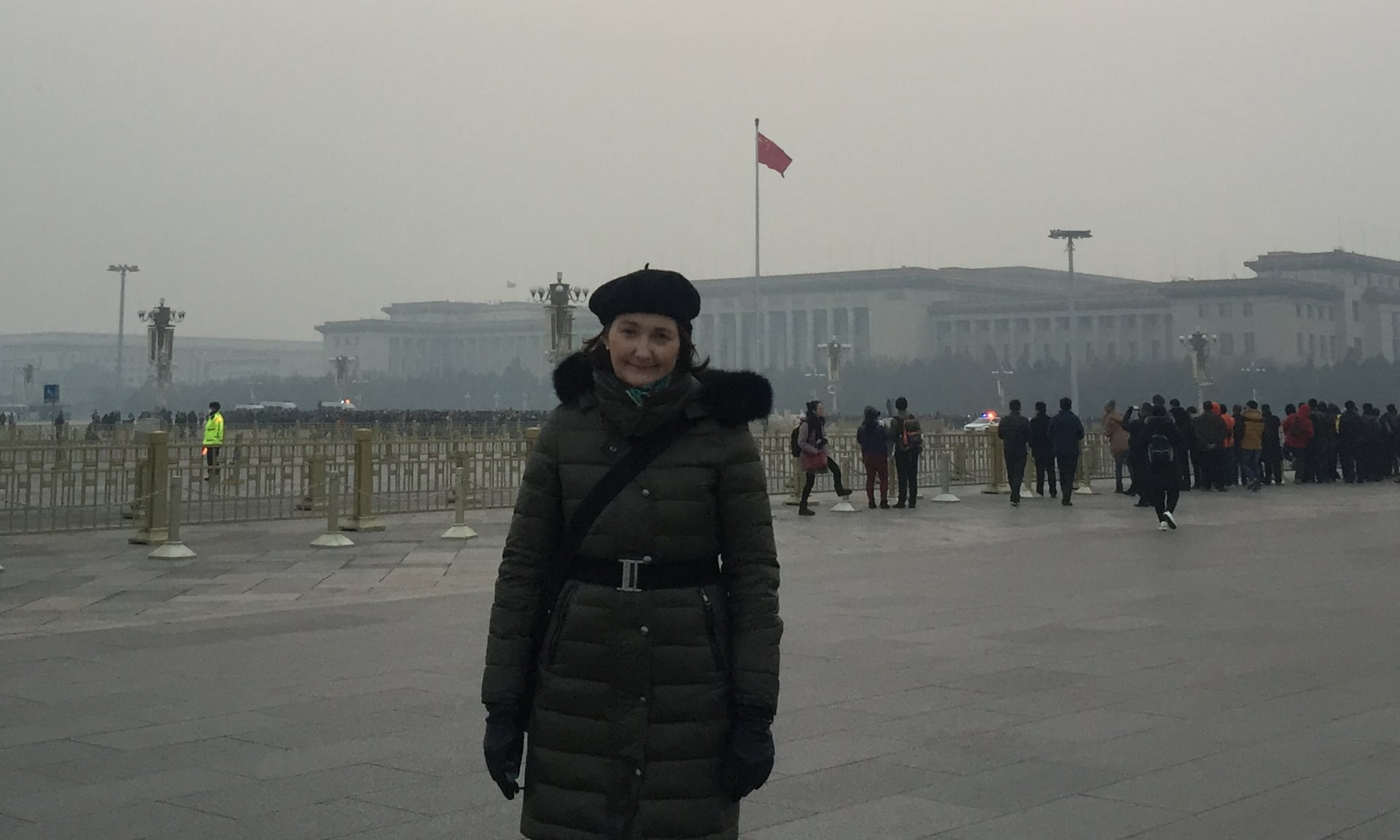
China scholar Anne-Marie Brady in Tiananmen Square, Beijing.

“New Zealanders have a deep sense of complacency about their security and feel that they’re very far away from the problems that we are seeing unfold in other parts of the world – that’s just not true any more,” says Brady, sitting on a bench in the gardens, where her interview with the Guardian cannot be overheard.
“We are part of the international environment too, and what happened to me – having my home and workplace invaded – is a wake-up call for people.”

Watcher becomes the watched
In the past few months Brady has begun using humour to counter the fear, has seen a counsellor on police advice, and consciously “lives in the moment”.
Brady has studied the Chinese government’s propaganda and intimidation tactics for decades, so there is a level of irony to seeing it in her own life. 
The watcher has become the watched.
Under Xi Jinping’s leadership, China academics around the world are experiencing increasing intimidation. 
Some refuse to speak publicly for fear of reprisals or being refused visas to China.
“Kill the chicken to scare the monkey” – Brady says, quoting a Chinese idiom.
Dr Kevin Carrico, a lecturer at Macquarie University, has had sensitive segments of his lectures in Australian classrooms reported back to Beijing, whose officials have then visited the China-based parents of some students.
“People have come to realise that there’s no longer any kind of great firewall between academic practice in China and academic practice outside of China,” Carrico told Inside Higher Ed.

China a ‘challenge to our sovereignty’
Brady and her husband rejected overseas job offers to stay in New Zealand and raise their children in a “high-trust society”. 
That belief is slowly souring.
“We are so proud that we punch above our weight internationally, that we have a moral authority on the world stage.But in the last year I have really wondered about that,” says Brady.
“Here is an actual challenge to our sovereignty – and a New Zealand family who have had their safety threatened – and our government is not defending them.”
New Zealand police say they continue to investigate the malicious acts against Brady and that the case remained of “strong interest”.
A spokesperson for prime minister Jacinda Ardern said she “has not received any reports that there is an issue attributable to China”.
Since the intimidation started, Brady has pinned an image of New Zealand world war two spy Nancy Wake above her desk, and sought courage in the writings of George Orwell.
“My main job is to look after myself and keep doing what I’m doing, because it must surely matter if so much attention has been directed at me” she says, chuckling.
Brady has repeatedly been encouraged by government insiders to keep reading, digging, and publishing. 
“I know the research I do is valued by our government, and my courage in speaking up is valued as well,” says Brady.
“But I am part of a changing geopolitical situation and my family is, too. And I have to handle that at the same time as be a mum, an academic, a colleague, a person who is at the supermarket … I have to be normal as well.” 

vendredi 7 décembre 2018

China Watchers Demand Action on Harassment of New Zealand Professor

By Charlotte Graham-McLay
Anne-Marie Brady, a professor at the University of Canterbury in Christchurch, New Zealand, had been harassed and intimidated for publishing research critical of the Chinese Communist Party.

WELLINGTON, New Zealand — More than 160 China experts from around the world have signed a letter urging New Zealand’s government to protect an academic who was the subject of harassment and intimidation for publishing research critical of the Chinese Communist Party.
The letter, published Thursday on the Czech website Sinopsis and signed by 169 scholars, researchers, journalists, commentators and human rights advocates, is the latest effort by scholars to ramp up pressure on Western governments to confront China’s political interference beyond its borders.
The New Zealand police and the country’s intelligence agency, along with Interpol, are investigating the case of Anne-Marie Brady, a professor at the University of Canterbury in the city of Christchurch. 
She had been subjected to a yearlong harassment campaign in which her home was burglarized, her office broken into twice and her car sabotaged.
The only items stolen from her home were electronic devices linked to her China scholarship, with the thief or thieves ignoring cash and newer electronics used by other family members.
The harassment began after she published a paper in 2017 titled Magic Weapons, which outlined China’s blueprint for spreading its influence in Western countries.
In Thursday’s letter, the signatories said they were “appalled and alarmed” by the “wave of intimidation” against Ms. Brady. 
An introduction written by Miguel Martin, an independent China researcher who writes under the pseudonym Jichang Lulu, said the number of “unprecedented attacks” on foreign scholars of China were escalating.
China’s intimidation of academics included harassment for their views and opinions, denial of visas, threatened or actual libel suits or detentions during research visits in mainland China.
Kevin Carrico, a lecturer in Chinese studies at Macquarie University in Sydney, Australia, and one of several Australian academics to sign the letter, said the harassment of Ms. Brady only confirms her research into Chinese meddling and risked silencing other China watchers.
“We’re facing a completely unacceptable and frankly insane situation in which a scholar focused on P.R.C. interference operations is falling victim to those same interference operations,” Mr. Carrico said, referring to the People’s Republic of China.
The letter writers accuse New Zealand’s government of being “slow to take action” and failing “to acknowledge that a problem exists.”
“The harassment campaign against Brady risks having a chilling effect on scholarly inquiry, allowing the C.C.P. to interfere in the politics of our societies unfettered by informed scrutiny,” the writers said, referring to the Chinese Communist Party.
Ms. Brady’s requests for additional protection for her and her family had gone unanswered. 
New Zealand’s prime minister, Jacinda Ardern, told reporters Thursday that she had to allow police officers to work independently of the government, but she would ask one of the lawmakers in her governing Labour Party to look into Ms. Brady’s situation.
“What I will do is have the police minister just seek an assurance that everything that can and should be done is being done, including for Ms. Brady’s own personal security,” Ms. Ardern told Radio New Zealand.
One scholar who signed the letter about Ms. Brady said that among the signatories were people who had previously doubted China’s reach in Australia.
“Whether you agree with Brady’s research is really a secondary issue,” said Adam Ni, a China researcher at the Australian National University in Canberra, the Australian capital, who signed the letter.
“She shouldn’t be intimidated for doing that research and giving her opinion,” he added.
While Australia has made moves to prevent foreign influence in its politics, New Zealand has been criticized by its Western allies in the Five Eyes intelligence sharing partnership for not doing enough.
As the government wrestles with the issue, New Zealand last month joined other nations in blocking Huawei, the Chinese telecommunications equipment maker, from supplying technology for a next-generation mobile data network because of fears it could prove a security threat.
Last September, one Chinese lawmaker admitted he had taught English to spies in China, and this October, another was accused of trying to hide a campaign contribution from a wealthy Chinese businessman with ties to China’s Communist Party.

jeudi 6 décembre 2018

The Kiwi Vassal

Campaign calling for New Zealand to protect China expert gathers pace
Anne-Marie Brady became a target after the release of a paper on Chinese foreign influence last year
By Eleanor Ainge Roy in Dunedin
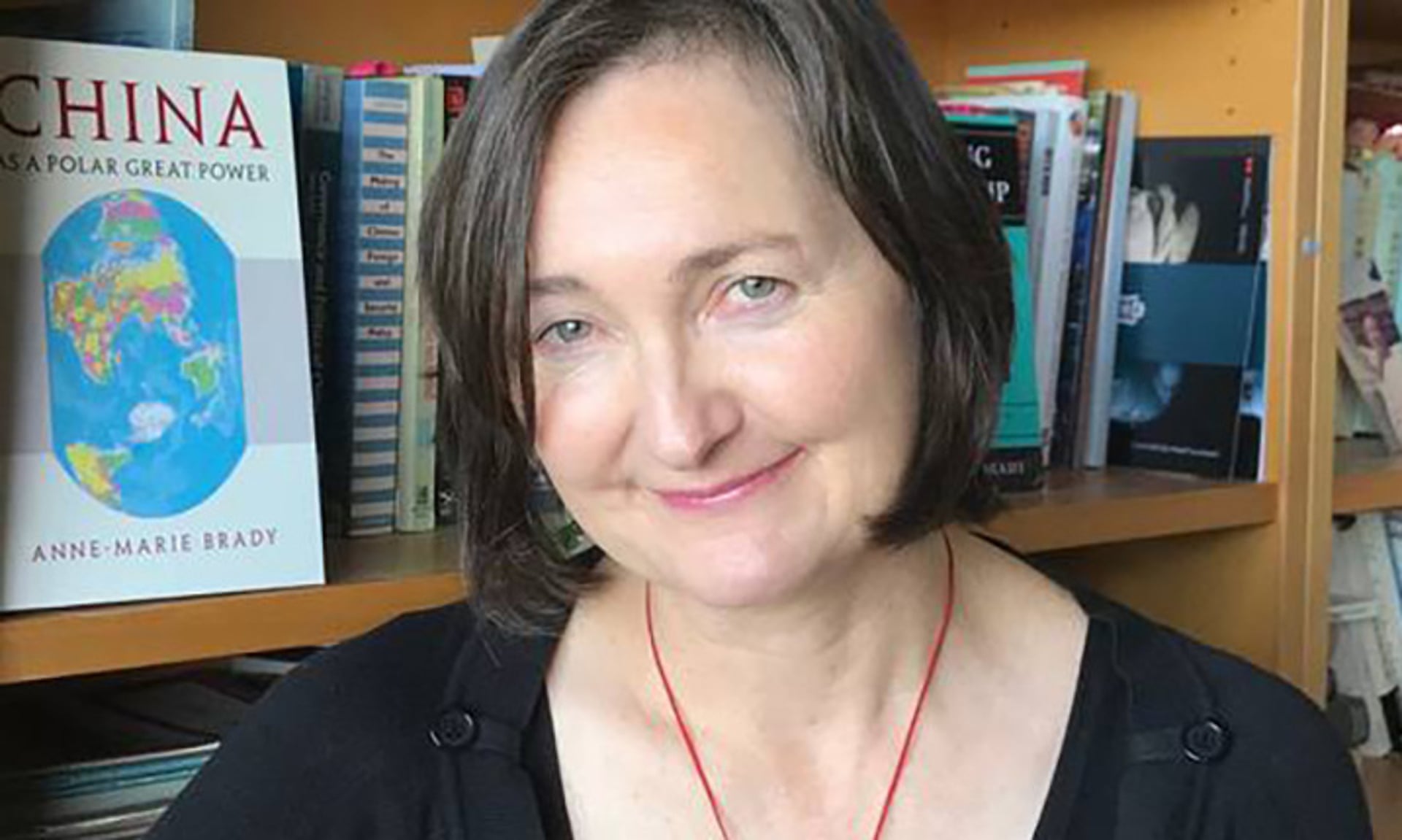
 Anne-Marie Brady, professor on China at the University of Canterbury.

More than 150 global China experts have added their voices to demands that the New Zealand government protect Professor Anne-Marie Brady, a China scholar who has been the victim of a year-long harassment campaign.
Brady, an expert in Chinese politics at the University of Canterbury in Christchurch, had her home and office burgled in February, and her car sabotaged last month.
Brady became a target after the release of a paper on Chinese foreign influence in 2017 and has asked the New Zealand’s government for extra security for herself and her family.
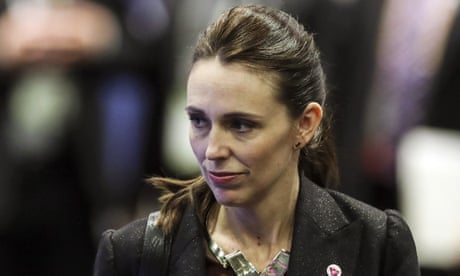

Jacinda Ardern urged to protect China critic after 'harassment'

After the government failed to respond, academics, human rights activists and journalists within New Zealand last week called on the prime minister, Jacinda Ardern, to step in and provide security for Brady.
Now 150 China experts from around the world have signed an open letter calling for action.
The letter states that under Xi Jinping’s rule domestic repression in China has increased, “as illustrated by the fate of hundreds of human rights lawyers and activists rounded up in 2015”, as well as the “re-education” camps in East Turkestan.
At the same time, the Chinese government targeted critics overseas, the letter states.
“Another form of this escalation are the unprecedented attacks on foreign scholars and researchers of contemporary China, be it in the form of Cultural Revolution-style in-class harassment for their views and opinions, denial of visas, threatened or actual libel suits or, in some cases, detentions during research visits in mainland China.”
“Brady has become the target of a series of incidents which, taken together with attacks from Party-directed media, are consistent with an intimidation campaign.
“New Zealand authorities have been less than forthcoming in their support for a prominent scholar targeted by a foreign power, even adopting a dismissive posture – an attitude appreciated by PRC state media.”
The 165 signatories include global China experts from 17 countries, including American author, journalist and social commentator Bill Bishop, Danielle Cave from the International Cyber Policy Centre and Swedish human rights activist Peter Dahlin.
Last week Brady told the Guardian she and her family had requested security assistance from the government but it was not forthcoming. 
“I am really concerned about the safety of my family. About four months ago we asked for more protection from the New Zealand security intelligence service … We haven’t had a reply,” Brady said.
“We are doing everything we can to improve security in our home. But New Zealand is a very open society... We’re just doing the best that we can by ourselves, but we’re not security specialists.”


Open letter
By Sinopsis and Jichang Lulu

Under Xi Jinping’s rule, the PRC Party-state has intensified domestic repression to levels not seen in decades, as illustrated by the fate of hundreds of human rights lawyers and activists rounded up in 2015, or most shockingly, the build-up of “re-education” detention centers in East Turkestan, holding hundreds of thousands, perhaps over a million Uyghurs, Kazakhs and other Muslim minorities.
The wave of domestic repression has been accompanied by increasing efforts to limit freedom of expression even beyond the PRC’s borders, both in overseas Chinese communities, where independent media have been largely taken over by entities connected with the CCP United Front and Propaganda systems, and even among foreign entities, such as academic publishers or commercial firms.
Another form of this escalation are the unprecedented attacks on foreign scholars and researchers of contemporary China, be it in the form of Cultural Revolution-style in-class harassment for their views and opinions, denial of visas, threatened or actual libel suits or, in some cases, detentions during research visits in Mainland China.
In New Zealand, Anne-Marie Brady, an academic who investigated the CCP’s influence in local politics has become the target of a series of incidents which, taken together with attacks from Party-directed media, are consistent with an intimidation campaign. 
New Zealand authorities have been less than forthcoming in their support for a prominent scholar targeted by a foreign power, even adopting a dismissive posture – an attitude appreciated by PRC state media.
In response, we have initiated an open letter in support of Brady and her research. 
The letter, to be published on the Sinopsis website on Thursday 6 December, will remain open for signatures for approximately one week. 
The initial 169 signatories include academics, think-tankers, journalists, human-rights activists, politicians and others, based in the Czech Republic, Slovakia, Poland, Belgium, France, Germany, Italy, the Netherlands, Norway, Spain, Sweden, the United Kingdom, Australia, China, Japan, Argentina, Canada and the United States.
We will continue to accept signatures for approximately a week after publication. 
The list of signatories will be regularly updated. 
To add your name to the list, please send your name and affiliation to open.letter.am.brady@gmail.com.

Open letter on harassment campaign against Anne-Marie Brady

We, the undersigned concerned scholars and others with an interest in China, have been alarmed and appalled by the recent wave of intimidation directed against our colleague, Professor Anne-Marie Brady, in apparent retaliation for her scholarly research on contemporary China.
Anne-Marie Brady, a scholar of Chinese politics affiliated with the University of Canterbury, has investigated the external propaganda and political influence mechanisms employed by the Chinese Communist Party (CCP) in New Zealand and beyond. 
Her 2017 paper Magic Weapons, based on extensive Chinese and English-language sources and previous scholarship on the PRC political system, described the CCP’s use of United Front tactics to control extra-Party forces, intensified at home and abroad under current CCP secretary general Xi Jinping. 
Professor Brady has accompanied her research with specific policy recommendations on how the New Zealand government can deal with the CCP’s political influence operations. 
These policy recommendations have attracted wide interest far beyond New Zealand.
Since the publication of her work on global United Front work, Brady’s home and office have been subjected to burglaries, during which no valuable items other than electronic devices were stolen. Most recently, her car was found to have been tampered with in ways consistent with intentional sabotage. 
According to media reports, Interpol and the New Zealand Security Intelligence Service (SIS) are involved in the investigation. 
In China, academics were interrogated by Ministry of State Security agents after their institutions hosted Brady. 
Brady has also been personally attacked in media under the direction of the CCP, both in the PRC and in New Zealand. 
Taken together, these circumstances make it likely that this harassment campaign constitutes a response to her research on the CCP’s influence, and an attempt to intimidate her into silence.
Despite the evidence of CCP interference provided in Brady’s research, of which the harassment campaign appears to be a further example, the New Zealand government has been slow to take action and failed to acknowledge that a problem exists. 
Professor Brady’s repeated requests for additional SIS and police protection have been ignored for four months.
Far from unique to New Zealand, the CCP’s global United Front tactics and other political influence operations have been documented in other locations, in Europe, Oceania, Asia and the Americas. Small nations are especially vulnerable to the PRC Party-state’s exploitation of asymmetries in economic power and relevant expertise to advance its political interests. 
Whether within or without the limits of the law of their target countries, these activities have considerable effects on their societies and merit evidence-based research and the attention of politicians and the media. 
The harassment campaign against Brady risks having a chilling effect on scholarly inquiry, allowing the CCP to interfere in the politics of our societies unfettered by informed scrutiny.
We urge the New Zealand authorities to grant Professor Brady the necessary protection to allow her to continue her research, sending a clear signal to fellow researchers that independent inquiry can be protected in democratic societies and conducted without fear of retribution.
We join other voices in support of Professor Brady, which have included statements by a New Zealand Chinese community organisation, some of her Canterbury University colleagues, New Zealand academics and two Australian Sinologists, as well as many others on social media.
We further hope decision makers and the public at large, in New Zealand and elsewhere, will engage with evidence-based research on the CCP’s United Front tactics, such as Brady’s Magic Weapons, and give due consideration to policy advice emanating from such research.

Signatories (169) as of 6pm, 5 Dec 2018 (CET)


Martin Hála, Charles University and Sinopsis.cz
Jichang Lulu, independent researcher
Filip Jirouš, Sinopsis.cz
Kateřina Procházková, Sinopsis.cz
Anna Zádrapová, Sinopsis.cz
Hernán Alberro, CADAL
Jamil Anderlini, journalist
Nathan Attrill, PhD Candidate, Australian National University
Ross Babbage, Chief Executive Officer, Strategic Forum
David L. Bandurski, Co-Director, China Media Project
Michael Barr, FAHA, Flinders University
Michael Beckley, professor, Tufts University
Jean-Philippe Béja, Research Professor Emeritus, CNRS
Bill Bishop
Joseph Bosco, former China Country Director, Office of the Secretary of Defense
Julia Bowie, Center for Advanced China Research
Hal Brands, Johns Hopkins SAIS
Sarah M Brooks, International Service for Human Rights
Dr. Douglas Brown, John Abbott College, Sainte Anne de Bellevue, Quebec
Charles Burton, Brock University
Reinhard Bütikofer MEP, Bündnis90/Die Grünen
Darren Byler, Department of Anthropology, University of Washington
Harald Bøckman, Visiting Senior Fellow, London School of Economics and Political Science / University of Oslo
Dag Inge Bøe, social anthropologist
Jean-Pierre Cabestan, Professor of Political Science, Hong Kong Baptist University
Alan Cantos, physical oceanographer and Director of the Spanish Tibet Support Committee (CAT)
Yaxue Cao, China Change
Kevin Carrico, Macquarie University
Danielle Cave, Deputy Head, International Cyber Policy Centre, The Australian Strategic Policy Institute (ASPI) and PhD Scholar, Coral Bell School of Asia Pacific Affairs, ANU
Lenka Cavojská, sinologist
Anita Chan (Prof.), Co-editor, The China Journal, Australian National University
Alvin Y.H. Cheung, Affiliated Scholar, US-Asia Law Institute, NYU School of Law
Jocelyn Chey, University of Sydney
Tarun Chhabra, policy analyst
Donald Clarke, Professor of Law and David A. Weaver Research Professor of Law, George Washington University Law School
Professor Jerome A. Cohen, NYU Law School
J Michael Cole, China Policy Institute (U Nott), Research Associate CEFC
Gabriel Collins, Rice University
Anders Corr, Corr Analytics
Demetrius Cox, independent researcher
Peter Dahlin, Director of Safeguard Defenders
June Teufel Dreyer, Professor, Department of Political Science, University of Miami
Mathieu Duchâtel, Deputy Director, Senior Fellow, Asia and China Programme, European Council on Foreign Relations
Ryan Dunch, Professor, History and Classics, Director, Program in Religious Studies, University of Alberta
Ian Easton, Research Fellow, Project 2049 Institute
Elizabeth C. Economy, Council on Foreign Relations
Charles Edel, United States Studies Centre, University of Sydney
Eric Edelman, Johns Hopkins SAIS
Kingsley Edney, University of Leeds
Johan Elverskog, Southern Methodist University
José Elías Esteve Moltó, Universitat de València
Feng Chongyi, University of Technology Sydney
Magnus Fiskesjö, Department of Anthropology, Cornell University
John Fitzgerald, Swinburne University of Technology
Martin Flaherty, Woodrow Wilson School of Public and International Affairs, Princeton University
Lindsey Ford, Director for Political-Security Affairs, Asia Society Policy Institute
Ivan Franceschini, Ca’ Foscari University of Venice and Australian National University
Vanessa Frangville, Université libre de Bruxelles
Aaron Friedberg, Professor of Politics and International Affairs, Princeton University
Edward Friedman, Professor Emeritus, Department of Political Science, University of Wisconsin, Madison
Dr Andreas Fulda, School of Politics and International Relations, University of Nottingham
Kateřina Gajdošová, Institute of Far Eastern Studies, Charles University
Ursula Gauthier, grand reporter, L’Obs
David Gitter, Center For Advanced China Research
Louisa Greve, Uyghur Human Rights Project
Gerry Groot, University of Adelaide
A.Tom Grunfeld, SUNY Distinguished Teaching Professor Emeritus
Guo Shan-yu, Charles University
Rosemary Haddon, (formerly) Massey University
Ian Hall, Professor of International Relations, Griffith University
Terry Halliday, Research Professor, American Bar Foundation, Honorary Professor, School of Regulation and Global Governance (RegNet), Australian National University, Adjunct Professor of Sociology, Northwestern University
Clive Hamilton, Professor of Public Ethics, Charles Sturt University, Canberra
Mette Halskov Hansen, University of Oslo
Mark Harrison, University of Tasmania
Jonathan Hassid, Iowa State University
Laurens Hemminga, City University of Hong Kong / Leiden University
Anne Henochowicz, Los Angeles Review of Books China Channel
Daniel Herman, former minister of culture, KDU-ČSL
Samantha Hoffman, analyst
Marie Holzman, Solidarité Chine, Paris
Leta Hong Fincher, independent sociologist
Charles Horner, Senior Fellow, Hudson Institute
Fraser Howie, author and independent China analyst
Carlos Iglesias, human rights lawyer
J. Bruce Jacobs, Emeritus Professor of Asian Languages and Studies, School of Languages, Literatures, Cultures and Linguistics, Monash University
Jakub Janda, Executive Director, Head of Kremlin Watch Program, European Values Think-tank
Rodney Jones, Wigram Capital Advisors (HK)
Alex Joske, Australian Strategic Policy Institute
Elsa B. Kania, Harvard University
Karina Kapounová, sinologist, Charles University, Prague
Thierry Kellner, Université libre de Bruxelles
Jeffrey C. Kinkley, Portland State University
Ondřej Klimeš, Czech Academy of Sciences
František Kopřiva, MP, Czech Pirate Party
Zuzana Košková, University of Freiburg
Adam Kozieł, Helsinki Foundation for Human Rights
Dr Mei-fen Kuo, The University of Queensland
Petr Kutílek, lecturer in transitional politics, Prague
Michael Laha, Program Officer at Asia Society’s Center on U.S.-China Relations
Françoise Lauwaert, Université libre de Bruxelles
Professor John Lee, Senior Fellow, Hudson Institute
James Leibold, La Trobe University
Steve Levine, Department of History, University of Montana, USA
Filip Lexa, Sinologist and Indonesia expert, Charles University, Prague
Jon R. Lindsay, Assistant Professor, Munk School of Global Affairs and Public Policy, Department of Political Science, University of Toronto
Perry Link, Princeton University
Olga Lomová, Charles University
Nicholas Loubere, Lund University
Julia Lovell, Birkbeck College, University of London
Maree Ma, Vision Times Media Corporation (Australia)
T M McClellan, PhD, Independent scholar, formerly Senior Lecturer (Chinese) in The University of Edinburgh
Barrett L. McCormick, Professor, Marquette University
Kevin McCready, former AusAID official, translator
Paul Macgregor, historian and heritage consultant, Victoria, Australia
Richard McGregor, Lowy Institute
Anne McLaren, Professor, Chinese Studies, FAHA, Asia Institute, University of Melbourne
Thomas G. Mahnken, Johns Hopkins SAIS
Victor H. Mair, Professor of Chinese Language and Literature, University of Pennsylvania
Maurizio Marinelli, University of Sussex
Peter Mattis, Research Fellow, China Studies, Victims of Communism Memorial Foundation
Rory Medcalf, Australian National University
Jonathan Mirsky, historian of China, former journalist in China and Tibet
Michelle S. Mood, Political Science and Asian Studies, Kenyon College
Zbyněk Mucha, indologist and tibetologist, Charles University
Luisetta Mudie, translator
Ian Mukherjee, independent analyst
Andrew J. Nathan, Columbia University
Adam Ni, Visiting Fellow, Strategic and Defence Studies Centre, Australian National University
Cassy O’Connor MP, Tasmanian Greens Leader
Mareike Ohlberg
Max Oidtmann, Georgetown University
Jojje Olsson, journalist and author
Charlie Parton, Associate Fellow, RUSI
Gaia Perini, University of Bologna
Eva Pils, Professor of Law, King’s College London
Sophie Richardson, PhD, China Director, Human Rights Watch
Sean Roberts, The George Washington University
Kaz Ross, School of Humanities, University of Tasmania
Fergus Ryan, Australian Strategic Policy Institute
Gabriel Salvia, Director General, CADAL
David Schak, Adjunct Associate Professor, Griffith Asia Institute
Matt Schrader, editor, Jamestown Foundation China Brief
Mark Selden, Emeritus Professor of Sociology, State University of New York at Binghamton
James D. Seymour, Columbia University
Victor Shih, associate professor, UC San Diego
Susan L. Shirk, Research Professor and Chair, 21st Century China Center, School of Global Policy and Strategy, UC-San Diego
Jan Sládek, Charles University Faculty of Arts, Department of Sociology, vice-dean for information resources
Prof. Martin Slobodník, Comenius University in Bratislava, Slovakia
Angela Stanzel, Senior Policy Fellow, Institut Montaigne
Janice Gross Stein, University of Toronto
Marina Svensson, Lund University
Josef Šlerka, Head of New Media Studies Department at Charles University
Hiroki Takeuchi, Southern Methodist University
Teng Biao, US-Asia Law Institute, New York University
Martin Thorley, University of Nottingham
Alan Tidwell, Director, Center for Australian, New Zealand and Pacific Studies, Edmund A. Walsh School of Foreign Service, Georgetown University
Rory Truex, Princeton University
Glenn Tiffert, Hoover Institution
Aki Tonami, University of Tsukuba
Steve Tsang, Professor of Chinese Studies, SOAS University of London
Professor Jonathan Unger, Political & Social Change Department, Australian National University
Professor Arthur Waldron, University of Pennsylvania
Gerrit van der Wees, George Mason University
Andréa Worden, independent researcher
David Curtis Wright, University of Calgary
Teresa Wright, Department of Political Science, California State University
Michael Yahuda, Emeritus Professor, LSE, Visiting Scholar, Sigur Center for Asia Studies, The Elliott School, George Washington University
Wai Ling Yeung, Western Australia Department of Education
Lukáš Zádrapa, Institute of Far Eastern Studies, Charles University Prague
lundi 3 décembre 2018

China's New Vassal

New Zealand particularly vulnerable to China: think tank report
By Matt Nippert
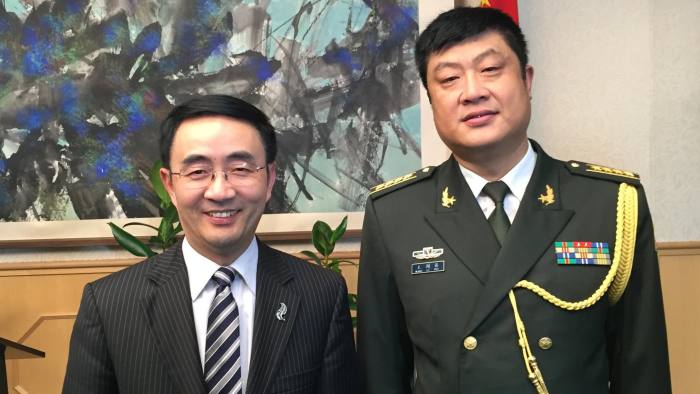
New Zealand's top Chinese mole: Jian Yang, left, with Senior Colonel Wang Liwei, defence attaché, at an event held at the Chinese embassy in Wellington to mark the 88th anniversary of the founding of the People's Liberation Army in 2015.

A US report into China's influence in New Zealand has highlighted concerns over government inaction and raised the possibility political considerations are blocking our intelligence agencies from investigating.
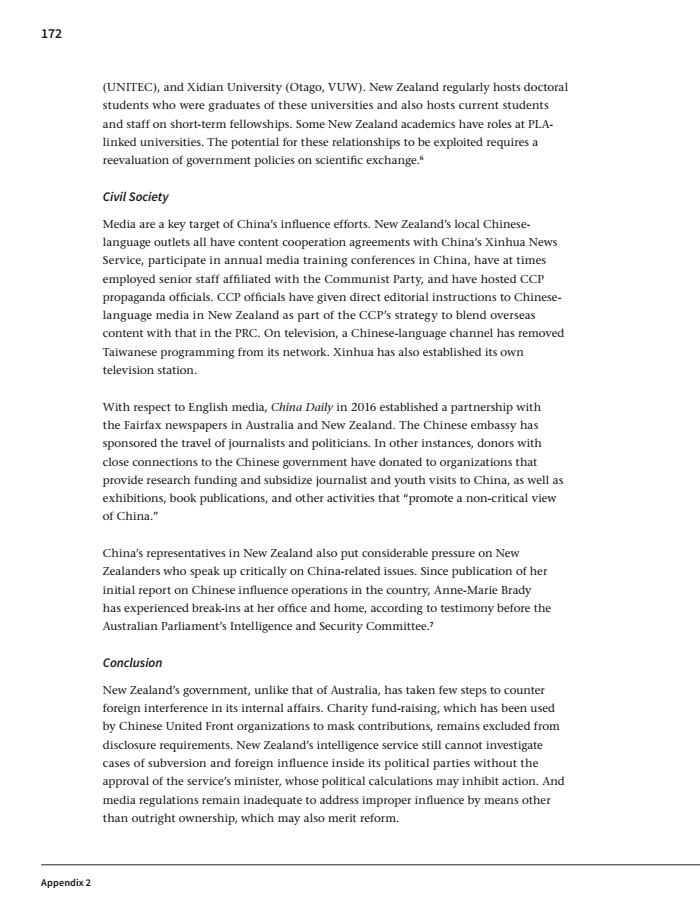
The Hoover Institution, a think-tank classed in the US as moderately conservative, released its "Chinese Influence & American Interest" report today with New Zealand presented as a case study.

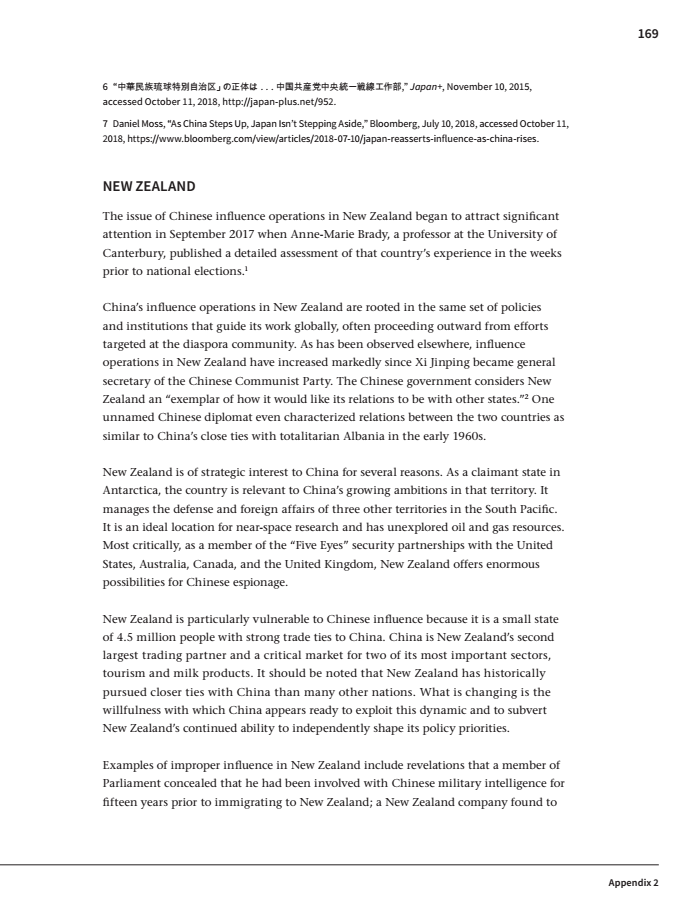
"NEW ZEALAND HAS HISTORICALLY PURSUED CLOSER TIES WITH CHINA THAN MANY OTHER NATIONS" (p. 182)

View the entire document with DocumentCloud

Although the report canvasses China's influence activities around the world, New Zealand is said to be particularly vulnerable due to its small size and China being a dominant market for dairy and tourism exports.
Drawing largely on research by University of Canterbury professor Anne-Marie Brady, the report said China's influence operations in New Zealand have ramped up since Xi Jinping became general secretary of the Chinese Communist Party in 2013.
Adverse contrast is drawn between the relatively low-key response of New Zealand with the legislative programme implemented in Australia -- although the report appears to have been prepared prior to the last week's announcement that the GCSB had used national security grounds to block Chinese firm Huawei from building the latest generation of mobile phone infrastructure.
The continuing saga of National Party MP Yang Jian comes in for particularly scrutiny. 
The Herald, Newsroom and the Financial Times have reported on his selective disclosure when applying for jobs, residency, citizenship and National Party candidacy of his 15-year working relationship with China's military intelligence agencies.
Foreign Affairs Minister Winston Peters called for an investigation into Yang in late 2017, and in an interview with NPR earlier this year said concerns from traditional allies about the affair would shortly be addressed.
"One would be naive to think that a response would not be forthcoming," Peters said.

THE CASE OF YANG JIAN (p. 183)

View the entire document with DocumentCloud

Peters' cryptic comments aside, the Hoover report raised the possibility political oversight of NZSIS investigations into "sensitive individuals" may be preventing local authorities from looking into matters of national security concern.
"New Zealand's intelligence service still cannot investigate cases of subversion and foreign influence inside its political parties without the approval of the service's minister, whose political calculations inhibit action," the report said.
The report said New Zealand's Chinese diaspora -- now 200,000 strong -- had maintained neutrality and independence during the Cold War, but in recent times local NGOs and Chinese-language newspapers had been drawn into China's orbit.
"Now, few activities are noticeably independent of Beijing," the report said, noting "the complete domination of local Chinese-language media by pro-PRC outlets."
The report said these local publishers all had co-operation agreements with the state-run Xinhua News Service, and "Chinese Communist Party officials have given direct editorial instruction to Chinese-language media in New Zealand".
The ongoing police and NZSIS investigation into an apparent campaign of criminal harassment directed at Brady is also reported as an example of how "China's representatives also put considerable pressure on New Zealanders who speak up critically on China-related issues".

lundi 26 novembre 2018

Chinese State Terrorism

Academics write in support of Anne-Marie Brady, urge PM to take action on China
By Anusha Bradley 

Canterbury University politics professor Anne-Marie Brady

The prime minister is being told she must make it clear to China that attempts to intimidate and silence academics here will not be tolerated.
Twenty-nine academics, researchers and human rights advocates have written an open letter to Jacinda Ardern in support of China critic and Canterbury University politics professor Anne-Marie Brady.
"We have been shocked and disturbed by the reports of intimidation and harassment suffered by Professor Anne-Marie Brady," the letter said.
"Attempts to intimidate and harass one academic in New Zealand have implications for freedoms of all the others -- and indeed, for the freedoms of all who live here."
The group also urged the prime minister to "make a clear statement in defence of academic freedom" in light of the case and to be "very clear that any intimidation and threats aimed at silencing academic voices in this country will not be tolerated".
It was revealed that Prof Brady had been burgled in February and the police, Interpol and the Security Intelligence Service were investigating the involvement of Chinese spies.
The investigation widened two weeks ago when, in a new twist, Prof Brady's mechanic discovered during a WOF examination, that two of her tyres had also been tampered with.
One of the 29 signatories to the letter, published today, was sociologist and commentator Tze Ming Mok, who said the prime minister was not doing enough to send a clear message to the Chinese government.
"The silence is very conspicuous."
"There is never a bad time to signal really clearly to all our trading partners that we are a particular kind of country, we have particular kinds of standards, and there are some things we will not stand for."
Prof Brady's experiences have already had a chilling effect amongst China-focused experts in this country with many unwilling to comment on the saga publicly, she said.
Margaret Taylor, a spokesperson for Amnesty International, which also signed the letter, said it was not only academics but the Chinese community in New Zealand who feared being targeted by their former government.
"People who have spoken to us, and they are very brave for doing so, are terrified that if they do speak out they will come under the attention of the Chinese authorities.
"Many of them don't speak to their family members, they're too scared to contact anybody at home."

Prof Brady said she felt "humbled" by the support, not only from her peers who signed the letter but from the wider public since the story about the burglaries broke.
But she was just doing her job, she said.
"The Education Act requires all political leaders and government agencies to protect and defend our academic freedom and uphold the critic and conscience role of the academic.
"So I do my job, and I expect the government to do their job."

A spokesperson for the prime minister said she supported and defended the legal right to academic freedom, as set out in law.
"The matters contained in this letter are under investigation by the police and it is not appropriate to comment on them before the investigation is finished."
But Prof Brady said the investigation was over, and the issue was now in the government's hands.
"The police have done a really great job and a thorough investigation has been completed. The next step now is the political will that needs to have the guts to face up to the situation."

vendredi 16 novembre 2018

China's New Vassal State


New Zealand police investigate after prominent China critic's car sabotaged
By Eleanor Ainge Roy in Dunedin


New Zealand police are investigating claims that Anne-Marie Brady, a prominent academic and critic of China’s influence abroad, has been targeted again, this time having her car sabotaged.
Brady, an expert in Chinese politics at the University of Canterbury in Christchurch, had her home and office burgled in February, with computers, mobile phones and USB sticks targeted.
Prime Minister Jacinda Ardern said at the time the government would be “be taking stock and taking action”.

Chinese interference in New Zealand at 'critical' stage, says Canada spy report

Now, police are widening their investigation after someone intentionally tampered with her car, too.
On Thursday the mechanic who regularly services Brady’s car in Christchurch discovered a series of unusual defects during a routine inspection, and phoned Brady “very agitated”, expressing concern that her car had been deliberately sabotaged.
Air had been let out of two front tyres, he said, and both tyres were also missing valve caps, making steering and breaking more difficult and increasing the chance of an accident.
Brady says she became a target after the release of a paper on Chinese foreign influence last year.
She told the Guardian: “I don’t know who has done it, but whoever has done it has been able to get into my garage and access the car, so essentially it is another break-in.”
“I am really concerned about the safety of my family. About four months ago we asked for more protection from the New Zealand security intelligence service … we haven’t had a reply.”
“We are doing everything we can to improve security in our home. But New Zealand is a very open society … we’re just doing the best that we can by ourselves, but we’re not security specialists.”
A police spokesperson confirmed the investigation was ongoing and they were examining “all lines of inquiry”.
“We can confirm that concerns have been raised in regard to the victim’s vehicle and we are investigating these,” the spokesperson said.
Despite Ardern expressing her concern, Brady said she felt the government’s response had been slow and that the issue wasn’t a priority.
She said: “If a proud, independent democracy like New Zealand can’t deal with Chinese political interference activities, this is a really bad sign to the rest of the world of the way things are going.”
“Other countries are worried about New Zealand, and the apparent silence on the issue from our government ... New Zealand is the canary in the coal mine, if we can’t deal with it, who can?”