Affichage des articles dont le libellé est religious repression. Afficher tous les articles

mardi 7 mai 2019

China vs. Islam: China's mission to raze the mosques of East Turkestan

Guardian and Bellingcat investigation finds more than two dozen Islamic religious sites completely demolished since 2016
By Lily Kuo in Beijing
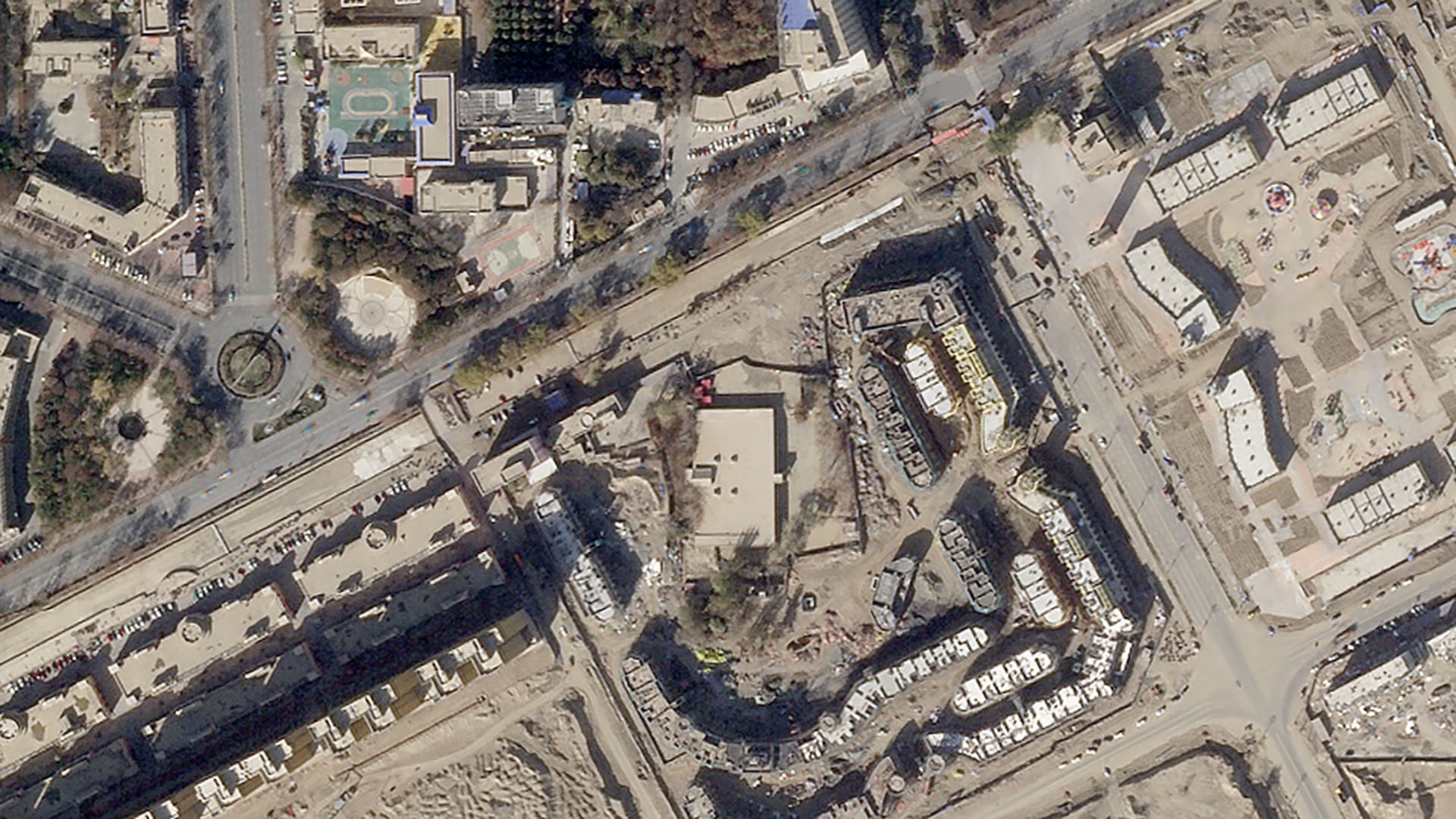
Keriya Aitika mosque in November 2018. The gatehouse and dome have been removed, part of China’s destruction of mosques in East Turkestan. 

Around this time of the year, the edge of the Taklamakan desert in far western China should be overflowing with people.
For decades, every spring thousands of Uighur Muslims would converge on the Imam Asim shrine, a group of buildings and fences surrounding a small mud tomb believed to contain the remains of a holy warrior from the eighth century.
Pilgrims from across the Hotan oasis would come seeking healing, fertility, and absolution, trekking through the sand in the footsteps of those ahead of them. It was one of the largest shrine festivals in the region.
People left offerings and tied pieces of cloth to branches, markers of their prayers.
Visiting a sacred shrine three times, it was believed, was as good as completing the hajj, a journey many in underdeveloped southern East Turkestan could not afford.
But this year, the Imam Asim shrine is empty.
Its mosque, khaniqah, a place for Sufi rituals, and other buildings have been torn down, leaving only the tomb.
The offerings and flags have disappeared.
Pilgrims no longer visit.
It is one of more than two dozen Islamic religious sites that have been completely demolished in East Turkestan since 2016, according to an investigation by the Guardian and open-source journalism site Bellingcat that offers new evidence of large-scale mosque razing in the Chinese colony where Muslim minorities suffer severe religious repression.
Using satellite imagery, the Guardian and Bellingcat open-source analyst Nick Waters checked the locations of 100 mosques and shrines identified by former residents, researchers, and crowdsourced mapping tools.
Out of 91 sites analysed, 31 mosques and two major shrines, including the Imam Asim complex and another site, suffered significant structural damage between 2016 and 2018.
Of those, 15 mosques and both shrines appear to have been completely or almost completely razed. The rest of the damaged mosques had gatehouses, domes, and minarets removed.
A further nine locations identified by former East Turkestan residents as mosques, but where buildings did not have obvious indicators of being a mosque such as minarets or domes, also appeared to have been destroyed.
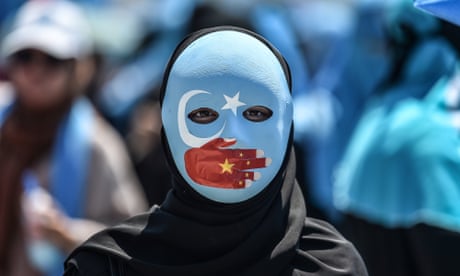
China’s is waging hi-tech war on its Muslim minority 

Uprooted, broken, desecrated
In the name of containing religious extremism, China has overseen an intensifying state campaign of mass surveillance and policing of Muslim minorities — many of them Uighurs, a Turkic-speaking group that often have more in common with their Central Asian neighbours than their Han Chinese compatriots.
As many as 1.5 million Uighurs and other Muslims have been sent to concentration camps.
Authorities have bulldozed hundreds, possibly thousands of mosques as part of the campaign. 
But a lack of records of these sites — many are small village mosques and shrines — difficulties police give journalists and researchers traveling independently in East Turkestan, and widespread surveillance of residents have made it difficult to confirm reports of their destruction.
The locations found by the Guardian and Bellingcat corroborate previous reports as well as signal a new escalation in the current security clampdown: the razing of shrines. 
While closed years ago, major shrines have not been previously reported as demolished.
The destruction of shrines that were once sites of mass pilgrimages, a key practice for Uighur Muslims, represent a new form of assault on their culture.
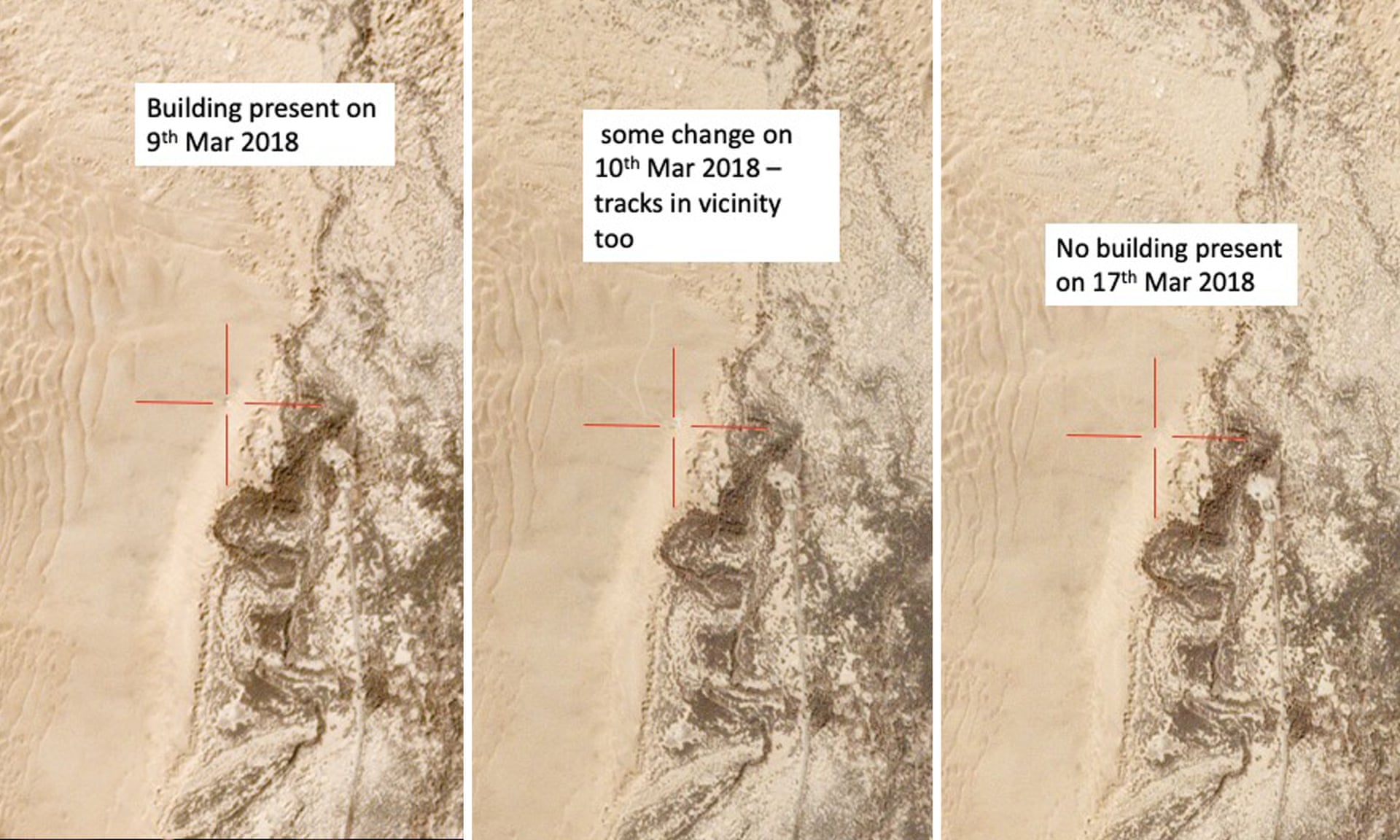


Three-way composite of Jafari Sadiq shrine.

“The images of Imam Asim in ruins are quite shocking. For the more devoted pilgrims, they would be heartbreaking,” said Rian Thum, a historian of Islam at the University of Nottingham.
Before the crackdown, pilgrims also trekked 70km into the desert to reach the Jafari Sadiq shrine, honouring Jafari Sadiq, a holy warrior whose spirit was believed to have travelled to East Turkestan to help bring Islam to the region.
The tomb, on a precipice in the desert, appears to have been torn down in March 2018.
Buildings for housing the pilgrims in a nearby complex are also gone, according to satellite imagery captured this month.
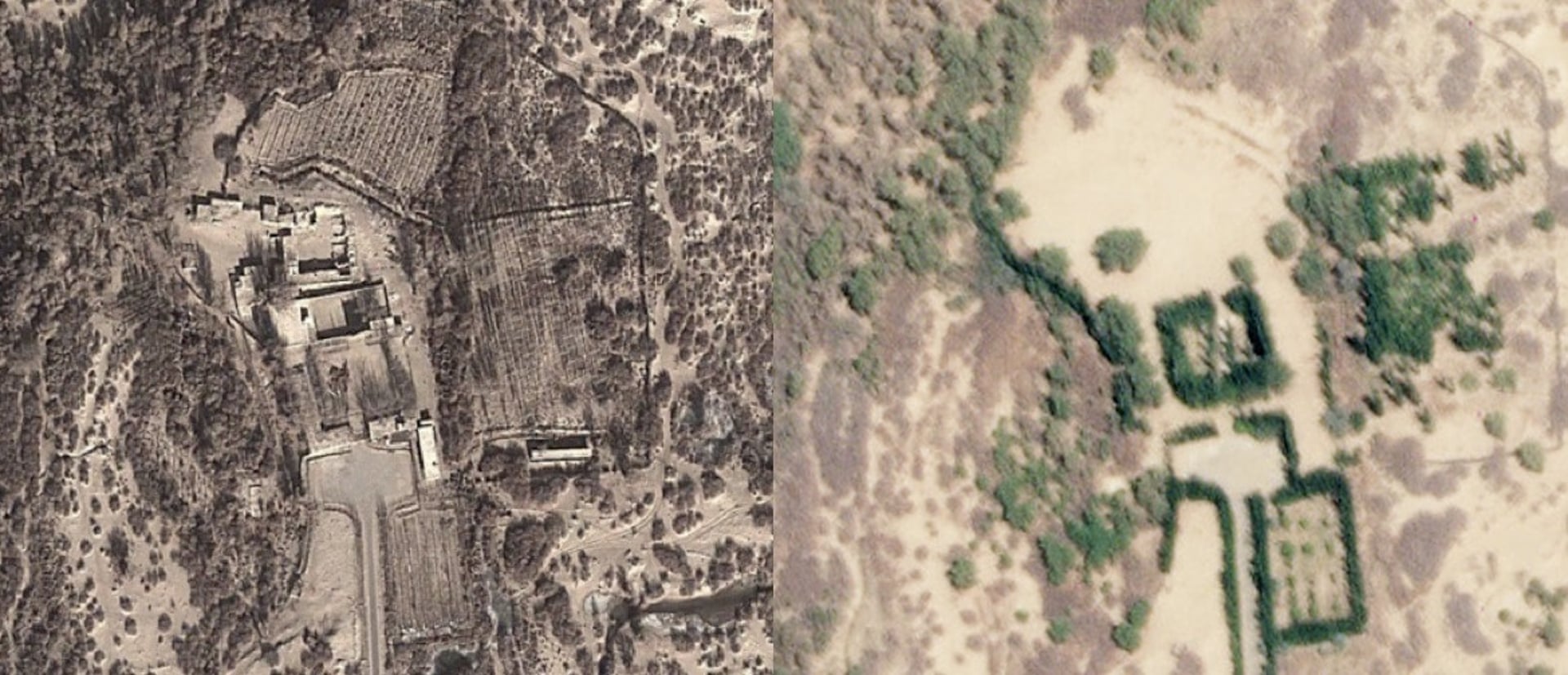


Before and after imagery of the Jafari Sadiq shrine. L-R Dec 10 2013, April 20, 2019. 

“Nothing could say more clearly to the Uighurs that the Chinese state wants to uproot their culture and break their connection to the land than the desecration of their ancestors’ graves, the sacred shrines that are the landmarks of Uighur history,” said Thum.

‘When they grow up, this will be foreign to them’
The Kargilik mosque, at the centre of the old town of Kargilik in southern East Turkestan, was the largest mosque in the area.
People from various villages gathered there every week.
Visitors remember its tall towers, impressive entryway, and flowers and trees that formed an indoor garden.
The mosque, previously identified by online activist Shawn Zhang, appears to have been almost completely razed at some point in 2018, with its gatehouse and other buildings removed, according to satellite images analysed by the Guardian and Bellingcat.
Three locals, staff at nearby restaurants and a hotel, told the Guardian that the mosque had been torn down within the last half year.
“It is gone. It was the biggest in Kargilik,” one restaurant worker said.
Another major community mosque, the Yutian Aitika mosque near Hotan, appears to have been removed in March of last year.
As the largest in its district, locals would gather here on Islamic festivals.
The mosque’s history dates back to 1200.
Despite being included on a list of national historical and cultural sites, its gatehouse and other buildings were removed in late 2018, according to satellite images analysed by Zhang and confirmed by Waters.
The demolished buildings were likely structures that had been renovated in the 1990s.
Two local residents who worked near the mosque, the owner of a hotel and a restaurant employee, told the Guardian the mosque had been torn down.
One resident said she had heard the mosque would be rebuilt but smaller, to make room for new shops.
“Many mosques are gone. In the past, in every village like in Yutian county would have had one,” said a Han Chinese restaurant owner in Yutian, who estimated that as much as 80% had been torn down.
“Before, mosques were places for Muslims to pray, have social gatherings. In recent years, they were all cancelled. It’s not only in Yutian, but the whole Hotan area, It’s all the same … it’s all been corrected,” he said.
The destruction of these historical sites is a way to assimilate the next generation of Uighurs. 
According to former residents, most Uighurs in East Turkestan had already stopped going to mosques, which are often equipped with surveillance systems.
Most require visitors to register their IDs.
Mass shrine festivals like the one at Imam Asim had been stopped for years.
Removing the structures, critics said, would make it harder for young Uighurs growing up in China to remember their distinctive background.
“If the current generation, you take away their parents and on the other hand you destroy the cultural heritage that reminds them of their origin... when they grow up, this will be foreign to them,” said a former resident of Hotan, referring to the number of Uighurs believed detained in camps, many of them separated from their families for months, sometimes years.
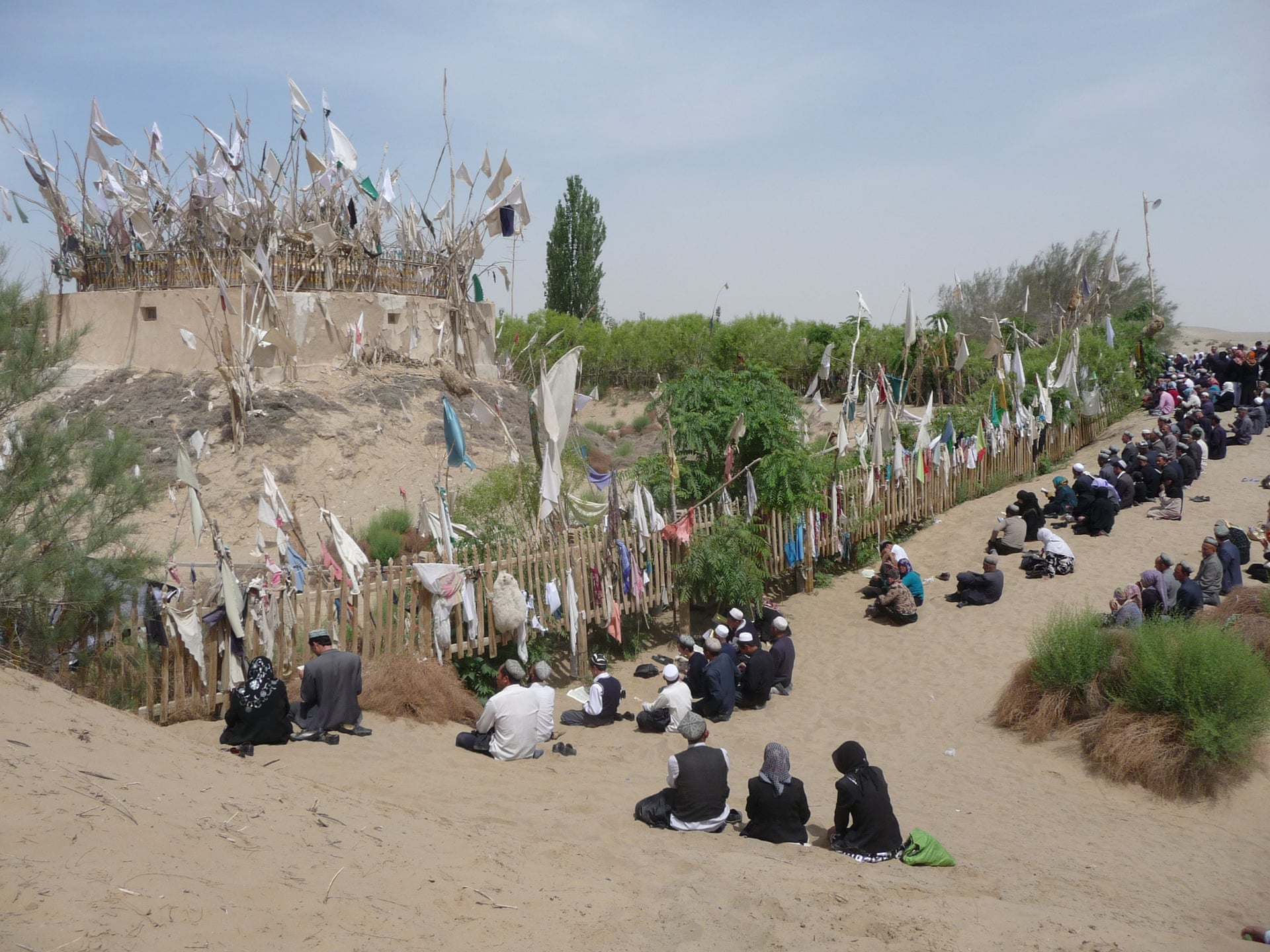

Imam Asim shrine festival 2010. 

“Mosques being torn down is one of the few things we can see physically. What other things are happening that are hidden, that we don’t know about? That is what is scary,” he said.

The ‘sinicisation’ of Islam
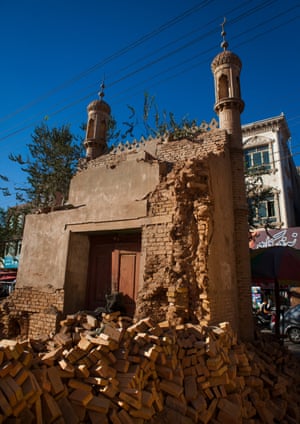
A demolished mosque in the old town of Kashgar, East Turkestan. 

Beijing is open about its goal of “sinicising” religions like Islam and Christianity to better fit China’s “national conditions”.
In January, China passed a five-year plan to “guide Islam to be compatible with socialism”.
In a speech in late March, party secretary Chen Quanguo who has overseen the crackdown since 2016 said the government in East Turkestan must “improve the conditions of religious places to guide “religion and socialism to adapt to each other”.
Removing Islamic buildings or features is one way of doing that.
“The Islamic architecture of East Turkestan, closely related to Indian and Central Asian styles, puts on public display the region’s links to the wider Islamic world,” said David Brophy, a historian of East Turkestan at the University of Sydney.
“Destroying this architecture serves to smooth the path for efforts to shape a new ‘sinicised’ Uighur Islam.”
The razing of religious sites marks a return to extreme practices not seen since the Cultural Revolution when mosques and shrines were burned, or in the 1950s when major shrines were turned into museums as a way to desacralise them.
Today, officials describe any changes to mosques as an effort to “improve” them.
In East Turkestan, various policies to update the mosques include adding electricity, roads, news broadcasts, radios and televisions, “cultural bookstores,” and toilets.
Another includes equipping mosques with computers, air conditioning units, and lockers.
“That is code to allow them to demolish places that they deem to be in the way of progress or unsafe, to progressively yet steadily try to eradicate many of the places of worship for Uighurs and Muslim minorities,” said James Leibold, an associate professor at La Trobe University focusing on ethnic relations.
Authorities are trying to remove even the history of the shrines.
Rahile Dawut, a prominent Uighur academic who documented shrines across East Turkestan, disappeared in 2017.
Her former colleagues and relatives believe she has been detained because of her work preserving Uighur traditions.
Dawut said in an interview in 2012: “If one were to remove these … shrines, the Uighur people would lose contact with earth. They would no longer have a personal, cultural, and spiritual history. After a few years we would not have a memory of why we live here or where we belong.”

lundi 10 septembre 2018

China's Crimes: Massive Crackdown in Muslim Region

Mass Arbitrary Detention, Religious Repression, Surveillance in East Turkestan
Human Rights Watch

The Chinese government is conducting a mass, systematic campaign of human rights violations against Turkic Muslims in East Turkestan.
The 117-page report, “‘Eradicating Ideological Viruses’: China’s Campaign of Repression Against Xinjiang’s Muslims,” presents new evidence of the Chinese government’s mass arbitrary detention, torture, and mistreatment, and the increasingly pervasive controls on daily life. 
Throughout the region, the Turkic Muslim population of 13 million is subjected to forced political indoctrination, collective punishment, restrictions on movement and communications, heightened religious restrictions, and mass surveillance in violation of international human rights law.

Chinazism: Crackdown on Turkic Muslims

“The Chinese government is committing human rights abuses in East Turkestan on a scale unseen in the country in decades,” said Sophie Richardson, China director at Human Rights Watch. 
“The campaign of repression in East Turkestan is key test of whether the United Nations and concerned governments will sanction an increasingly powerful China to end this abuse.”
The report is primarily based on interviews with 58 former residents of East Turkestan, including 5 former detainees and 38 relatives of detainees. 
Nineteen of those interviewed have left East Turkestan within the past year and a half.
The Chinese government’s “Strike Hard Campaign against Violent Extremism” began in East Turkestan in 2014. 
The level of repression increased dramatically after Communist Party Secretary Chen Quanguo relocated from the Tibet Autonomous Region to assume leadership of East Turkestan in late 2016.
Since then, the authorities have stepped up mass arbitrary detention, including in pretrial detention centers and prisons, both of which are formal facilities, and in political education camps, which have no basis under Chinese law. 
Credible estimates indicate that 1 million people are being held in the camps, where Turkic Muslims are being forced to learn Mandarin Chinese, sing praises of the Chinese Communist Party, and memorize rules applicable primarily to Turkic Muslims. 
Those who resist or are deemed to have failed to “learn” are punished.
The detainees in political education camps are held without any due process rights – neither charged nor put on trial – and have no access to lawyers and family. 
They are held for having links with foreign countries, particularly those on an official list of “26 sensitive countries,” and for using foreign communication tools such as WhatsApp, as well as for peacefully expressing their identity and religion, none of which constitute crimes.
A man who spent months in political education camps, told Human Rights Watch: “I asked [the authorities] if I can hire a lawyer and they said, ‘No, you shouldn’t need a lawyer because you’re not convicted. There’s no need to defend you against anything. You’re in a political education camp – all you have to do is just study.’”
Outside these detention facilities, the Chinese authorities in East Turkestan subject Turkic Muslims to such extraordinary restrictions on personal life that, in many ways, their experiences resemble those of the people detained. 
A combination of administrative measures, checkpoints, and passport controls arbitrarily restrict their movements. 
They are subjected to persistent political indoctrination, including compulsory flag-raising ceremonies, political or denunciation meetings, and Mandarin “night schools.” 
With unprecedented levels of control over religious practices, the Chinese authorities have effectively outlawed Islam in the region.
They have also subjected people in East Turkestan to pervasive and constant surveillance. 
The authorities encourage neighbors to spy on each other. 
And they have mobilized over a million officials and police officers to monitor people, including through intrusive programs in which the monitors are assigned to regularly stay in people’s homes.
The campaign has divided families, with some family members in East Turkestan and others abroad caught unexpectedly by the tightening of passport controls and border crossings. 
Children have at times been trapped in one country without their parents. 
The government has barred Turkic Muslims from contacting people abroad. 
The government has also pressured some ethnic Uyghurs and Kazakhs living outside the country to return to China, while requiring others to provide detailed personal information about their lives abroad.
The United Nations Committee on the Elimination of Racial Discrimination (CERD) reviewed the situation in China in mid-August and described East Turkestan as a “no rights zone.” 
The Chinese delegation disputed this portrayal of the region, as well as its characterization of political education camps, calling them “vocational education centers.”
It is evident that China does not foresee a significant political cost to its abusive East Turkestan campaign, partly due to its influence within the UN system, Human Rights Watch said. 
In the face of overwhelming evidence of grave abuses in East Turkestan, foreign governments should pursue a range of multilateral and unilateral actions. 
They should also pursue joint actions at the UN Human Rights Council, creating a coalition to gather and assess evidence of abuses in East Turkestan, and imposing targeted sanctions on Party Secretary Chen Quanguo and other senior officials responsible.
“The pain and anguish of families torn apart, with no knowledge of what’s happened to their loved ones stands in stark contrast to Beijing’s claims that Turkic Muslims are ‘happy’ and ‘grateful,’” Richardson said. 
“A failure to urgently press for an end to these abuses will only embolden Beijing.”

Selected accounts
The names and identifying details of people interviewed have been withheld to protect their safety. All names of detainees are pseudonyms.

On political education camps:
Nobody can move because they watch you through the video cameras, and after a while a voice came from the speakers telling you that now you can relax for a few minutes. That voice also tells you off for moving…we were watched, even in the toilet. In political education camp, we were always under stress.              –Rustam, a former detainee who spent months in political education camps, May 2018

I resisted their measures…They put me in a small solitary confinement cell…In a space of about 2x2 meters I was not given any food or drink, my hands were handcuffed in the back, and I had to stand for 24 hours without sleep.             –Nur, a former detainee in a political education camp, March 2018

Everyday controls in East Turkestan:
A total of five officials…took turns to watch over me [at home]. And they had to document that they’d checked on me… The photos show them reading political propaganda together [with me] or show me moving a pillow on a bed to prepare for them to stay overnight; or them lying down on the sofa.                                                        –Aynur, a woman who left East Turkestan in 2017, May 2018

Since early 2017, twice a week, officials came. Some people even stayed for a night. The authorities came in advance and made a list and assigned new “relatives” to you. … [The officially-assigned “relatives”] talked to my son, my grandkids, they took pictures, they sat at the table, they asked, “Where’s your husband, where did he go?” I was really frightened, and I pretended to be busy looking after my grandkids. I was worried that if I spoke I’d let slip that my husband had gone [abroad]. So, I stayed silent.
–Ainagul, 52, who left East Turkestan in 2017 and whose son is in a political education camp, May 2018

International impact of the Strike Hard Campaign:
First, the village police called, and then a higher-level police bureau called. Their numbers were hidden – they didn’t show where they were calling from…. The police told me, “If you don’t come, we’ll come get you.”
–Dastan, 44, who lives outside China and whose wife is in a political education camp, May 2018

They give a signal, that even if you’re in a foreign country, they can “manage” you. … I’m scared... I didn’t join any terrorist or any organization against China. I didn’t join any demonstrations. I didn’t carry any East Turkestan flag. I have no criminal record in China…why are they doing stuff like that [to me]?
–Murat, a 37-year-old student living outside China and whose sister is in a political education camp, June 2018

samedi 16 juin 2018

The Final Solution to the Uyghur Question

Half of East Turkestan Village’s Residents Sent to Political Re-Education Camps
By Shohret Hoshur

A security officer holding a shield and baton guards a security post leading into a center believed to be used for re-education in Korla, Nov. 2, 2017.

Authorities in Qaraqash county, in northwest East Turkestan, have detained nearly half of the population of a village in “political re-education camps,” according to a local official.
Beginning in April 2017, Uyghurs accused of harboring “strong religious views” and “politically incorrect” views have been jailed or detained in re-education camps throughout East Turkestan, where members of the ethnic group have long complained of pervasive discrimination, religious repression, and cultural suppression under Chinese rule.
A duty officer with the Chinibagh township police station in Qaraqash recently told RFA’s Uyghur Service that in his home village of Yengisheher, almost all of the adult males from the area’s more than 1,700 households had been placed in camps, leaving few people behind to farm the local fields.
“Overall, 40 percent of the population in our village is currently in re-education camps,” said the officer, who spoke to RFA on condition of anonymity.
The officer acknowledged that village authorities were following an official directive previously reported by RFA which brands Uyghurs born in the 1980s and 1990s as “members of an unreliable and untrustworthy generation” and targets them for re-education because they are considered “susceptible” to influence by dangerous elements.
He said that “only children and old people” remain in the village, and that the local labor force had been decimated by the sweep.
“If the husband is taken away, his wife must take over his work, and where there are young children in a family … they must help in the fields,” the officer said.
For families with no remaining able-bodied members, “the village cadres have made arrangements for their fields to be cultivated by other people,” he added.
The officer, who said he helps to question detainees, said none of his siblings had been placed in the camps because his grandfather had taught them to “refrain from anything which would get us into trouble, and to always be loyal and give a good impression to the authorities.”
“From a very young age, we followed the call of the [ruling Chinese Communist] party.”
When asked how many residents of Chinibagh township have been detained in the camps, the officer said he was unsure, and referred questions to his supervisor.
The officer’s claim comes after the party secretary of Qaraqash’s Aqsaray township told RFA at the end of last year that he and other township officials had received an order from county-level authorities to target 40 percent of the population for re-education.
At the time, RFA found that around 5,000 of Qaraqash’s population of 34,000 people—or nearly 15 percent of the county’s residents—had already been taken away to re-education camps.
Reports suggest similar orders for “quotas” have been given in other areas of East Turkestan, and that authorities are detaining as many Uyghurs as possible in re-education camps and jail, regardless of their age, prior service to the Communist Party, or the severity of the accusations against them.

Camp network

China's central government authorities have not publicly acknowledged the existence of re-education camps in East Turkestan, and the number of inmates kept in each facility remains a closely guarded secret, but local officials in many parts of the region have in RFA telephone interviews forthrightly described sending significant numbers of Uyghurs to the camps and even described overcrowding in some facilities.
Citing credible reports, lawmakers Marco Rubio and Chris Smith, who head the bipartisan Congressional-Executive Commission on China, said recently that as many as 500,000 to a million people are or have been detained in the reeducation camps, calling it ”the largest mass incarceration of a minority population in the world today.”
Adrian Zenz, a lecturer in social research methods at the Germany-based European School of Culture and Theology, said the number “could be closer to 1.1 million, which equates to 10-11 percent of the adult Muslim population of the region."
China regularly conducts “strike hard” campaigns in East Turkestan, including police raids on Uyghur households, restrictions on Islamic practices, and curbs on the culture and language of the Uyghur people, including videos and other material.
While China blames Uyghurs for "terrorist" attacks, experts outside China say Beijing has exaggerated the threat from the Uyghurs and that repressive domestic policies are responsible for an upsurge in violence there that has left hundreds dead since 2009.