China reports that Chinese virus cases are declining, but the data are surely tied to party propaganda.
BY JAMES PALMER

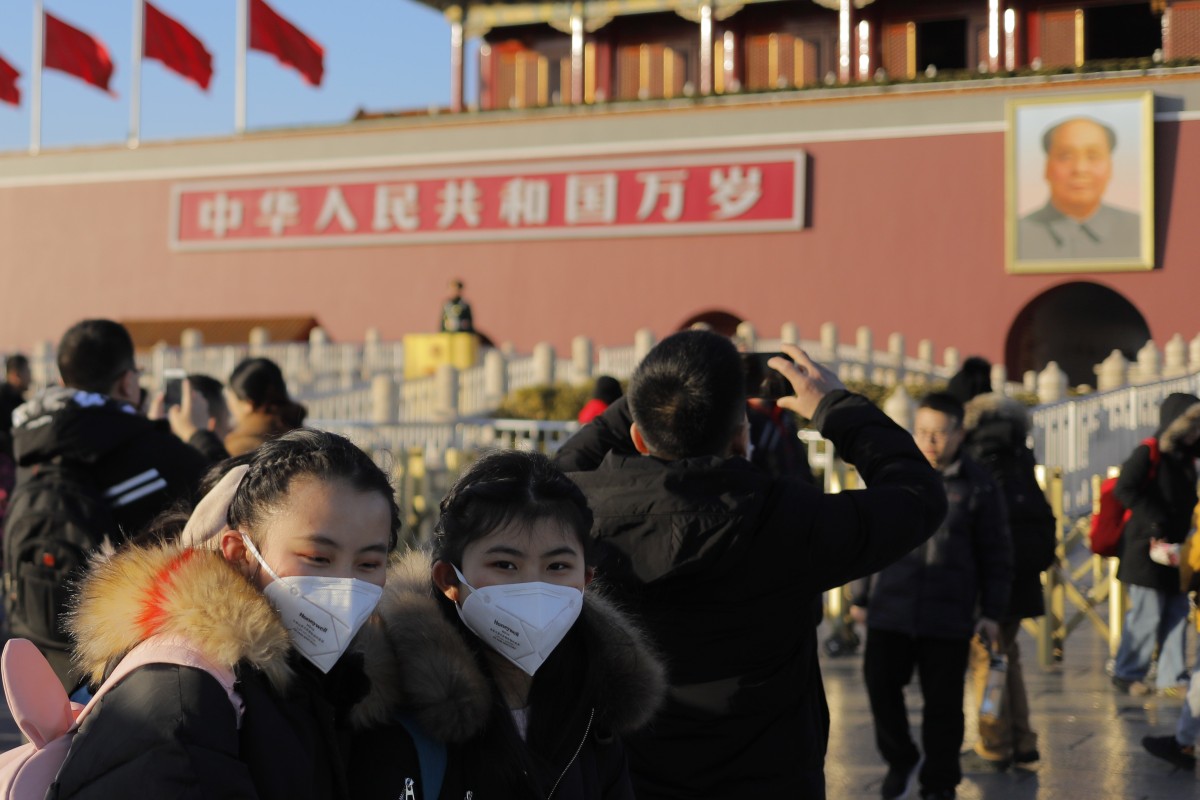
Members of a neighborhood committee wear protective masks as they control the entrance to a narrow street on Feb. 19 in Beijing.
Pathological Lying: China Reports Decline in Virus Cases
In China, the death toll from the Chinese coronavirus has now topped 2,000, with over 70,000 cases confirmed.
In China, the death toll from the Chinese coronavirus has now topped 2,000, with over 70,000 cases confirmed.
But if you follow Chinese state media, the tone is increasingly optimistic: Victory in the people’s war against the virus, led by President Xi Jinping, is coming!
The official figures seem to bear this out: New infections outside of Hubei province, the Chinese virus epicenter, have dropped for more than 10 days straight, and the number of new cases inside Hubei has slowed to under 2,000 per day.

Most of Hubei remains under lockdown, with residents unable to leave their homes without special permission.
Most of Hubei remains under lockdown, with residents unable to leave their homes without special permission.
Travel restrictions of varying severity have been imposed across China, from monitored movement to total quarantine.
Taken at face value, the government’s containment strategy appears to be working.
But that raises the question: How reliable are China’s official numbers?
Party politics.
One suspicious element is how consistent the drop in new virus cases has been.
While there was a jump in numbers last Thursday, it was the result of changes in testing standards in Hubei—moving nearly 15,000 cases from “suspected” to “confirmed.”
The announcement came as Hubei’s top officials were removed from their jobs—and Xi’s close ally Ying Yong, the former mayor of Shanghai, installed as the province’s party boss.
As often happens, the new boss wanted to blame the bad news on the old one.
Meanwhile, the central government is pushing for reopening businesses, but there is a conflict emerging.
Meanwhile, the central government is pushing for reopening businesses, but there is a conflict emerging.
Local officials don’t want to be scapegoated if an outbreak emerges in their domain, and their fear is outweighing the economic damage of the virus.
But there are reports from Zhejiang and Guangdong of lockdowns being lifted, with a monitored surveillance system that allows people to leave the house in areas previously under heavy restrictions.
Downward trend.
The straight decline in new cases of the virus could be good news, or it could be statistical manipulation.
Outside of Hubei, diagnostic test kits are in short supply, and other provinces haven’t switched to using the symptomatic diagnosis now accepted in Hubei.
The kits are only being used to test people who came from Hubei and not for cases of transmission, so it’s unsurprising the numbers are dropping.
Chinese doctors report that dozens of other hospital patients are being quarantined and treated but not officially diagnosed.
U.S.-China media wars.
The United States made a strong move against China yesterday, reclassifying five state-run media outlets—Xinhua News Agency, the China Global Television Network, China Daily, China Radio, and People’s Daily—as operatives of Beijing.
The designation makes their operations inside the United States subject to tighter control.
Chinese reporters at home and abroad have always been tasked with producing neican—internal reports for the party—and effectively used for espionage on an ad hoc basis.
, the outlets’ reporters could be subject to the same travel restrictions the United States has imposed on Chinese diplomats.
, the outlets’ reporters could be subject to the same travel restrictions the United States has imposed on Chinese diplomats.
In China, Western reporters already face a system of monitoring and control that limits their visas, sees them harassed by police, and prevents them from living outside certain cities.
The U.S. move prompted immediate retaliation from Beijing, which expelled three Wall Street Journal reporters on Wednesday. (The excuse was an opinion headline that described China as “the real sick man of Asia,” a phrase that prompted state-backed outrage from the Chinese.)
The U.S. move prompted immediate retaliation from Beijing, which expelled three Wall Street Journal reporters on Wednesday. (The excuse was an opinion headline that described China as “the real sick man of Asia,” a phrase that prompted state-backed outrage from the Chinese.)
Notably, all of the expelled reporters were of Chinese descent, part of a pattern of China treating nonwhite foreign reporters—and especially those with Chinese ancestry—with more suspicion.
Missing coronavirus cases
While most of China’s southern and eastern neighbors have reported coronavirus cases, the countries along its northern border such as Russia, Mongolia, and Kazakhstan have seen minimal numbers, with Russia only just reporting its first two cases.
The pattern of cases may just represent the direction of travel before the Lunar New Year holiday at the start of the outbreak: Migrant workers would be returning to China from the north, while middle-class vacationers headed south.
What about North Korea?
Meanwhile, North Korea says it doesn’t have any coronavirus cases, but the country has gone under total lockdown and cut off all transport ties to the outside world.
North Korean state media, meanwhile, has broadcasted information about hygiene methods and protective masks.
If the nation was suffering an outbreak, would we know?
Restaurant crisis.
The restaurant business has been devastated by the coronavirus outbreak, despite the hardworking delivery people doing their best to keep the sector alive.
The loss of Lunar New Year business and the closure of public spaces has devastated an industry already teetering on the edge.
In Beijing, which is not fully locked down, only 13 percent of restaurants have stayed open throughout the outbreak.
Jim Boyce, a longtime food and wine correspondent, has written about how badly the global wine trade will be hit.
Back to work?
The government is trying to encourage people to return to work, but between travel restrictions and local lockdowns it is proving effectively impossible.
In China’s north, factory owners say they are still paying above-average wages to get staff and that the vast majority of workers still haven’t returned to the job.
Companies that can are allowing remote work.
Chinese schools, which look unlikely to reopen before April, have switched to online classes.
Pension burden.
With business hurting from both the shutdowns and the government-mandated requirement to keep paying employees,
Chinese authorities have announced that companies won’t have to pay some pension contributions and insurance fees to state-run funds for several months.
That’s a smart move, but it raises the threat of the oncoming pension crisis.
A Moment in History: The Asian flu, 1957 and 1968The first post-World War II pandemic—the result of the mixing of avian and human influenza strains—was first detected in Singapore in 1957 but may have originated in China.
A Moment in History: The Asian flu, 1957 and 1968The first post-World War II pandemic—the result of the mixing of avian and human influenza strains—was first detected in Singapore in 1957 but may have originated in China.
While less lethal than the 1918 Spanish flu, the “Asian flu” pandemic killed perhaps 1 million to 2 million people worldwide.
A decade later, it mutated into the “Hong Kong” flu: Again, it was first detected in the British colony but possibly originated in China.
Maoist China had high levels of deforestation and food insecurity, which caused people to eat previously untouched species, as well as a dire lack of medical resources.
Maoist China had high levels of deforestation and food insecurity, which caused people to eat previously untouched species, as well as a dire lack of medical resources.
It was perhaps only the country’s isolation and limited freedom of movement that prevented outbreaks on the scale of SARS in 2003 or the 2020 coronavirus outbreak.
It’s also possible that such outbreaks did occur and went unnoticed among the deaths of the era.