By Steven Mufson

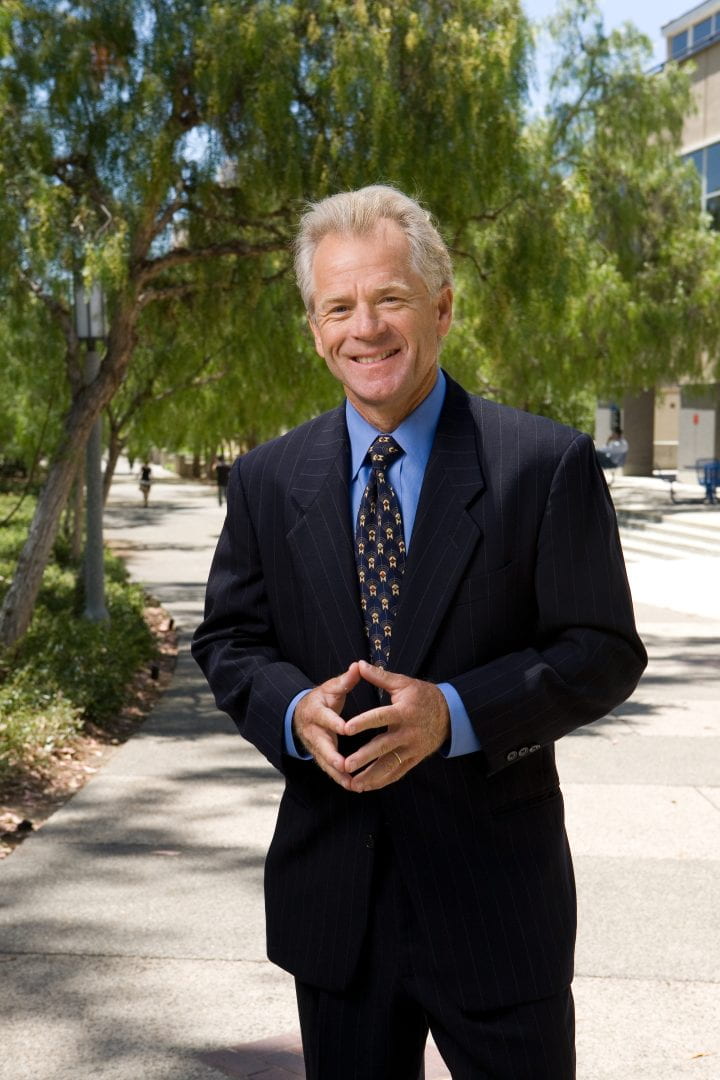
Peter Navarro attends the "Death By China" screening at the Quad Cinema in New York City in August. He wrote, produced and directed the film.
If President Trump were to make a movie encapsulating his feelings about China, it might look a lot like this:
A red, white and blue ball with the word “jobs” appears on the screen.
It rolls under the portrait of Mao Zedong through an animated Gate of Heavenly Peace, the iconic entrance in Beijing.
There, where the ancient Forbidden City should be, belching smokestacks jut skyward.
Words then roll against a black background, saying that 57,000 American factories have disappeared since China joined the World Trade Organization and “began flooding American markets with illegally subsidized exports.”
Words then roll against a black background, saying that 57,000 American factories have disappeared since China joined the World Trade Organization and “began flooding American markets with illegally subsidized exports.”
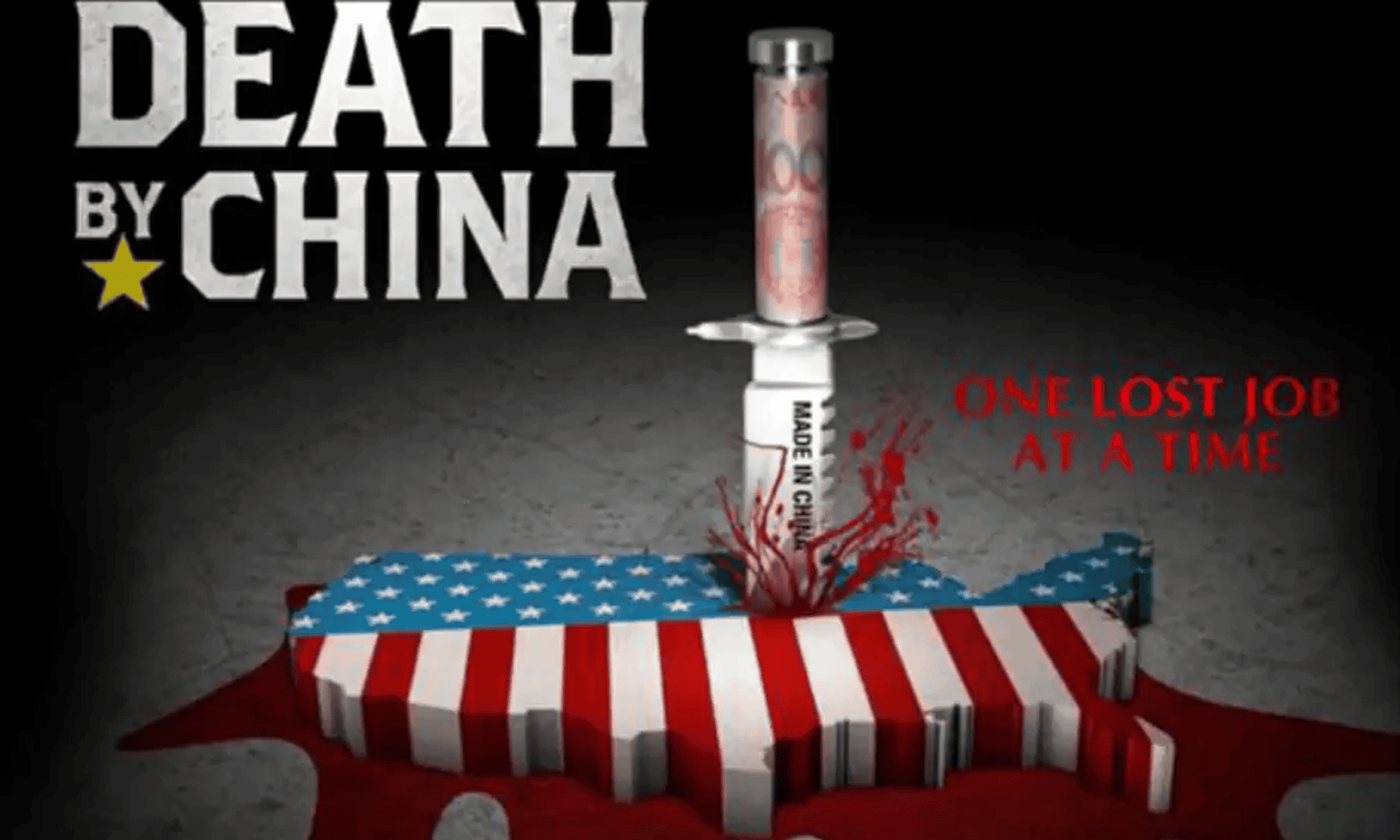
Next, a bread knife with the words “Made in China” is plunged into a map of the United States and animated blood runs out, trickling into the title: “Death by China.”
The movie actually exists, and it was written, produced and directed by Peter K. Navarro, a 67-year-old professor in the University of California at Irvine’s business school who is the head of the new White House National Trade Council.
The movie actually exists, and it was written, produced and directed by Peter K. Navarro, a 67-year-old professor in the University of California at Irvine’s business school who is the head of the new White House National Trade Council.
His task: to help rewrite the rules of global trade, from Mexico to China to Britain, and to bring back American manufacturing and jobs.
“The best jobs program is trade reform with China,” Navarro says in the movie, which is narrated by Martin Sheen, who starred in “Apocalypse Now” and as liberal hero President Josiah Bartlet in the TV series “West Wing.”
“The best jobs program is trade reform with China,” Navarro says in the movie, which is narrated by Martin Sheen, who starred in “Apocalypse Now” and as liberal hero President Josiah Bartlet in the TV series “West Wing.”
Mr Navarro has struck such a chord with Trump that he could end up playing an outsize role in the administration’s economic policy.
The president’s announcement of his appointment called him “a visionary economist.”
“I read one of Peter’s books on America’s trade problems years ago and was impressed by the clarity of his arguments and thoroughness of his research,” Trump said in a statement.
“I read one of Peter’s books on America’s trade problems years ago and was impressed by the clarity of his arguments and thoroughness of his research,” Trump said in a statement.
“He has presciently documented the harms inflicted by globalism on American workers, and laid out a path forward to restore our middle class.”

National Trade Council adviser Peter Navarro, right, and White House Chief of Staff Reince Priebus, center, wait for President Trump to sign three executive orders on his first Monday in office.
National Trade Council adviser Peter Navarro, right, and White House Chief of Staff Reince Priebus, center, wait for President Trump to sign three executive orders on his first Monday in office.
Putting nations on notice
Few of the people Trump has brought into the White House seem to be so in tune with the president. And for the moment at least, he has filled a policy vacuum by being visible while other Cabinet nominees struggle with confirmation.
Navarro has been one of just a handful of White House officials at Trump’s side for the signing of executive orders, such as withdrawing the United States from the Trans-Pacific Partnership and blocking federal funds for groups that provide abortions or abortion counseling.
In early February he attended a White House meeting about trade that included Trump and the Hill’s “big four” — Senate Finance Committee Chairman Orrin G. Hatch (R-Utah) and ranking Democrat Ron Wyden (Ore.), House Ways and Means Committee Chairman Kevin Brady (R-Tex.) and ranking Democrat Richard E. Neal (Mass.).
On Feb. 14 and 15, he briefed Senate Finance Committee members.
According to people there, Navarro laid out principles — free and fair trade; bilateral deals, not multilateral ones; a reduced trade deficit; a strengthened defense industrial base; and automatic triggers for renegotiation when trade deficits occur.
Although he didn’t describe any mechanisms, Navarro also listed about a dozen more specific trade goals, including boosting the number of U.S. parts in imported finished goods; developing tools to punish currency manipulation; cracking down on intellectual property theft that Navarro said cost $300 billion a year and “steals the seeds of innovation for the future”; and restricting heavily subsidized, state-owned enterprises.
He also said that World Trade Organization decisions had been “unfair” to the United States and that Chapter 19 of the North American Free Trade Agreement had allowed Canadian softwood lumber exporters to avoid duties.
Navarro said that the Canadians “have played us.”
And like Trump, Navarro has put other countries on notice that the United States would confront its major trading partners even when they are close allies.
And like Trump, Navarro has put other countries on notice that the United States would confront its major trading partners even when they are close allies.
In a Jan. 31 interview with the Financial Times, Navarro sent shock waves through Europe when he said that Germany was getting an unfair competitive advantage by manipulating the euro to lower its value and make its exports cheaper.

In 1996, Peter Navarro, then a Democrat, hoped that the backlash against the “Republican Revolution” led by House Speaker Newt Gingrich would sweep Democrats into office. Navarro used this flier in his unsuccessful campaign to unseat Rep. Brian Bilbray (R-Calif.).
‘The one that got away’
Navarro got his start in politics at the local level — as a Democrat.
He ran unsuccessfully for mayor of San Diego in 1992, city council in 1993, county supervisor in 1994 and Congress in 1996.
“My citizen activism is a direct outgrowth of a classical and fiscally conservative training in economics at Harvard,” he wrote in “San Diego Confidential,” a revealing, cutting and readable memoir of his years in politics there.
“My citizen activism is a direct outgrowth of a classical and fiscally conservative training in economics at Harvard,” he wrote in “San Diego Confidential,” a revealing, cutting and readable memoir of his years in politics there.
“It is a perspective rooted in one of the most important concepts in economics — the need for government intervention in the presence of a market failure.”
Initially he became active in a popular local group called Prevent Los Angelization Now (PLAN) opposing developers.
“A city should decide where it doesn’t want to develop,” he wrote, “saving at least some of the canyons and hillsides and wetlands from the bulldozer’s blade.”
But instead of running for county supervisor, a race he might have won, Navarro jumped into the San Diego mayor’s race.
His opponent, Susan Golding, launched three negative ads and he responded with an ad attacking Golding, whose ex-husband was convicted of laundering illegal drug money.
Ahead in the polls going into the last weekend of the race, Navarro attacked her again in a televised debate.
In tears, she called the attacks on her family unfair; Navarro accused her of rehearsing the response and came off as dismissive.
He lost.
Years later, he wrote that he still thought about “the one that got away.”
“He was almost the mayor,” said Larry Remer, a political consultant who worked on three of Navarro’s campaigns after that one.
Years later, he wrote that he still thought about “the one that got away.”
“He was almost the mayor,” said Larry Remer, a political consultant who worked on three of Navarro’s campaigns after that one.
“He flubbed it, is what really happened.”
Remer said Navarro was a hard-working candidate who “realized the need to stay on a clear, concise message, a lot like ‘make America great again.’ Nothing could appeal to people in San Diego more than saying ‘not L.A.’ ”
But, he added, what undid Navarro as a candidate was his personality.
Remer said Navarro was a hard-working candidate who “realized the need to stay on a clear, concise message, a lot like ‘make America great again.’ Nothing could appeal to people in San Diego more than saying ‘not L.A.’ ”
But, he added, what undid Navarro as a candidate was his personality.
“He would just burn through volunteers,” Remer said.
“He’s not quite as prickly as Trump, but he has the same ego issues.”
In 1996, Navarro took on then-U.S. Rep. Brian Bilbray (R-Calif.), hoping that the backlash to the Newt Gingrich revolution would sweep a Democrat into the House.
“He’s not quite as prickly as Trump, but he has the same ego issues.”
In 1996, Navarro took on then-U.S. Rep. Brian Bilbray (R-Calif.), hoping that the backlash to the Newt Gingrich revolution would sweep a Democrat into the House.
He later wrote that Bilbray “was as much of an idiot as he was when he first ran” for Congress “but this time he was an idiot with a record — a bad one.”
Nonetheless, heavily outspent, Navarro lost soundly.
Discouraged, divorced and in debt, he moved on.
 In the mid-2000s, Navarro latched onto the issue of China’s growing global ambitions.
Discouraged, divorced and in debt, he moved on.
In the mid-2000s, Navarro latched onto the issue of China’s growing global ambitions.
A ‘decent trade deal’
Navarro resurrected his public persona by turning to writing, doing a set of online basic economics books and a how-to investing book titled “If It’s Raining in Brazil, Buy Starbucks.”
In the mid-2000s Navarro latched onto the issue of China’s growing global ambitions, writing “The Coming China Wars,” “Death by China” and “Crouching Tiger; What China’s Militarism Means for the World.”
According to the New Yorker, Navarro in 2011 read that Trump told the Chinese state news agency Xinhua that he liked Navarro’s first book on China.
They communicated after that but met in person only during the presidential campaign, when Navarro was one of the few economists to take Trump seriously.
At times, Navarro sounds moderate.
At times, Navarro sounds moderate.
“The last thing a Trump administration plans is a trade war,” he said at a Tax Policy Center event in October.
“The issue simply is getting a decent trade deal with each of the major trading partners.”
And many of the issues he raises about China are real: Chinese companies steal intellectual property, receive cheap credit from Chinese banks, pay lower wages, and cough up more pollution and pay less for pollution controls.
And many of the issues he raises about China are real: Chinese companies steal intellectual property, receive cheap credit from Chinese banks, pay lower wages, and cough up more pollution and pay less for pollution controls.
Navarro estimated in 2006 that unfair trade practices accounted for 41 percent of China’s competitive advantage over U.S. firms.
But the film, in which Navarro attempts to be toward China what Michael Moore is to the automobile industry, is hyperbolic in tone.
But the film, in which Navarro attempts to be toward China what Michael Moore is to the automobile industry, is hyperbolic in tone.
It includes comments by AFL-CIO leader Richard L. Trumka, ordinary shoppers and Navarro himself, who fires salvos at American corporations that do business in China.
The narrator says that “no company has been happier” to move its capital offshore than General Electric.
The narrator says that “no company has been happier” to move its capital offshore than General Electric.
Then Navarro appears and interjects.
“When I go out and do speeches to corporate audiences on China, they want me to talk about strategy,” he says.
“It’s like, ‘Hey, you’re going over to China. You’re giving them your avionics so you can participate in a regional jet game in China, and two or three or five years from now you’re going to try to sell your regional jets in Europe — and your biggest competitor is going to be that China guy. How stupid is that?’ ”

Peter Navarro, a University of California at Irvine business professor and economist, seen in August, is one of President Trump’s most visible advisers on the economy.
Peter Navarro, a University of California at Irvine business professor and economist, seen in August, is one of President Trump’s most visible advisers on the economy.
Navarro’s toughest audience has been his fellow economists.
Now, as a key Trump adviser, Navarro has run into more flak.
In a paper he wrote last year with now-Commerce Secretary Wilbur Ross, Navarro said that Trump could impose tariffs and encourage changes in consumer buying habits to erase the huge U.S. trade deficit.
That would go hand in hand with greater investment in the U.S. economy.
Navarro and Ross say that getting rid of the trade deficit and boosting investment would also spur faster economic growth, which would bring in $1.74 trillion in tax revenue over a decade.
But if the United States erects tariff barriers to China, factories might go to other lower-cost countries such as Vietnam, Bangladesh or India.
Furman said that “if you’re trying to intimidate companies about moving operations or yell at them over supply chains, that’s not the way to make America a more attractive place. The way to do that is to build infrastructure, train workers and invest in technology, not to just beat up on other countries.”
Navarro’s close relationship with Ross could serve him well when Cabinet members arrive and leadership on issues grows more fractured, potentially creating rivalries with more savvy infighters such as National Economic Council head Gary Cohn.
Yet for now, Navarro and Ross appear to be in sync with the president and his threats on trade.
That position is one that Navarro has held for at least a decade.
That position is one that Navarro has held for at least a decade.
His “Death by China” film takes a video of Obama speaking in the White House briefing room and splices in a Chinese soldier who removes the White House insignia behind Obama and puts up a Chinese flag.
The film also shows an empty factory with broken windows and unemployment lines, and juxtaposes that with Chinese container ships and busy Chinese factory workers.
The film also shows an empty factory with broken windows and unemployment lines, and juxtaposes that with Chinese container ships and busy Chinese factory workers.
In the end, the credits roll to the tune of a glum, folky song whose lyrics Navarro helped write.
“Look around, tell me what you see.
Every day more people in the street.
I used to work in a factory.
By now I’d work for anything
It’s not me, it’s my family I wish to feed.
Not much, we got simple needs.
Too bad they sent our jobs away.
In China they’re not workers, they’re just slaves.
People, wait, it’s a world of trade and greed.
And the CEOs get richer, and our jobs all move offshore.”
It could be an ode describing the plight of Trump’s supporters.
And it struck a chord with one crucial viewer, who said in a blurb on the film’s Web page: “Death by China” is right on. This important documentary depicts our problem with China with facts, figures and insight. I urge you to see it.”
The reviewer: Donald Trump.
The reviewer: Donald Trump.