Affichage des articles dont le libellé est Beijing’s propaganda machine. Afficher tous les articles

lundi 6 janvier 2020

Chinazism

Prague security services say China poses major threat as Czech billionaire's loan firm launches propaganda campaign to burnish Beijing’s image
By Robert Tait


  Liberal Prague mayor Zdeněk Hřib, who refused to abide by Beijing’s One China policy, which recognises China’s claim to Taiwan. 

The Czech Republic’s richest man is at the centre of a foreign influence campaign by the Chinese government after one of his businesses financed an attempt to boost China’s image in the central European country.
In a development that has taken even seasoned sinologists aback, Home Credit – a domestic loans company owned by Petr Kellner that has lent an estimated £10bn to Chinese consumers – paid a PR firm to place articles in the local media giving a more positive picture of a country widely associated with political repression and human rights abuses.
Home Credit also funded a newly formed thinktank – headed by a translator for the Czech Republic’s pro-Chinese president, Miloš Zeman – to counteract the more sceptical line taken by a longer-established China-watching body, Sinopsis, linked with Prague’s Charles University, one of Europe’s oldest seats of learning.
Experts say the moves, revealed in an investigation by the Czech news site Aktualne, bear the hallmarks of a foreign influence campaign by China that highlights its aggressive attempts to gain access to former communist central and eastern European countries through its ambitious “belt and road” initiative, under which it offers to fund infrastructure projects in those states.
According to analysts, the Czech Republic has been more open to Chinese influence than most other European countries, a situation that has coincided with the burgeoning commercial relationship between China and Kellner’s sprawling PPF group, which boasts an estimated £40bn in assets, including Home Credit.
PPF began accumulating its vast wealth in the mass privatisation of state assets that followed the fall of communism in the former Czechoslovakia in 1989.
Home Credit is currying favour with the Chinese regime in an effort to protect its interests after a series of political disputes between China and the Czechs that cooled previously warm bilateral relations.
Home Credit has acknowledged paying the PR firm, C&B Reputation Management, and backing Sinoskop, the thinktank, to try to bring “greater balance” to debate about China.
“Discussion of China in the Czech Republic had become one-sided, relentlessly negative and poorly informed,” Home Credit’s spokesman, Milan Tomanek, told the Observer.
Martin Hala, a lecturer at Charles University’s Sinology department and director of Sinopsis, said: “The bottom line is that Home Credit hired this company not to defend their own corporate interests per se, but rather to promote the narrative coming from the People’s Republic of China and the Chinese communist party.
“The first goal is to normalise China, presenting it not as a dictatorship but as a country, like any other, that is opening up to reforms. I don’t think that’s an accurate picture.” 
The revelations coincide with a recent warning by the Czech intelligence service, BIS, that Chinese influence campaigns pose a greater threat to national security than meddling by the Russian government of Vladimir Putin.
“The BIS considers primarily the increase in the activities of Chinese intelligence officers as the fundamental security problem,” the report says.
“These activities can be clearly assessed as searching for and contacting potential cooperators and agents among Czech citizens.”
Czech ties with Beijing grew closer after 2014 when the regime granted Home Credit a nationwide licence to offer domestic loans, the first foreign company to be given the right.
This would only have happened on the understanding that Home Credit would work to ensure favourable coverage of China in the Czech media and political discourse. 
It heralded several trips to China by Zeman, who is close to Kellner, and culminated in a state visit in 2016 by the Chinese dictator Xi Jinping to Prague.
The rapprochement – which also saw the purchase of a Czech brewery, television station and Slavia Prague football club by a Chinese energy company, CEFC – reversed the policy adopted by the late Václav Havel, the Czech Republic’s first post-communist president who had championed human rights, and the Dalai Lama, the exiled spiritual leader of Tibet.
But relations began to sour last year when the Czech government of prime minister Andrej Babiš, acting on advice from the country’s cybersecurity agency, banned Huawei phones from ministerial buildings, prompting Chinese protests and a rebuke from Zeman, who accused the security services of “dirty tricks”.
They took a further turn for the worse when Prague’s liberal mayor, Zdeněk Hřib, refused to abide by the One China policy – recognising China’s territorial claim to Taiwan – accepted by his predecessor as part of a twinning arrangement between the Czech capital and Beijing.
In retaliation, China scrapped the agreement and cancelled a planned tour of the country by the Prague Philharmonia.
Amid the rows, criticism began to appear in Chinese state media of Home Credit’s lending practices, accompanied by several failures in court to fully recover unpaid debts.
That has fuelled speculation that the company began to fear for the future of its interests in China.
When Sinopsis reported the Chinese media criticism on its website, it received a “cease and desist” legal warning from Home Credit which threatened to sue unless in the absence of an apology.
The company accuses Sinopsis of failing to correct “misleading or incorrect statements”.
Home Credit had earlier abandoned a £50,000 sponsorship deal with Charles University – which foreswore each institution from damaging the other’s good name – after a backlash from academics, who feared it would muzzle any criticism of China.
Now critics see a new threat, from PPF’s recent £1.62bn purchase from AT&T of Central European Media Enterprises (CME), a company which includes the Czech Republic’s most-watched commercial TV station, Nova, as well as channels in neighbouring countries.
PPF has dismissed warnings about potential political interference in the station’s output but some are sceptical.
“PPF negotiated this deal saying that they would never meddle in politics,” said Petr Kutilek, a Czech political analyst and human rights activist.
“But from the Home Credit affair, you actually see them meddling in politics.”

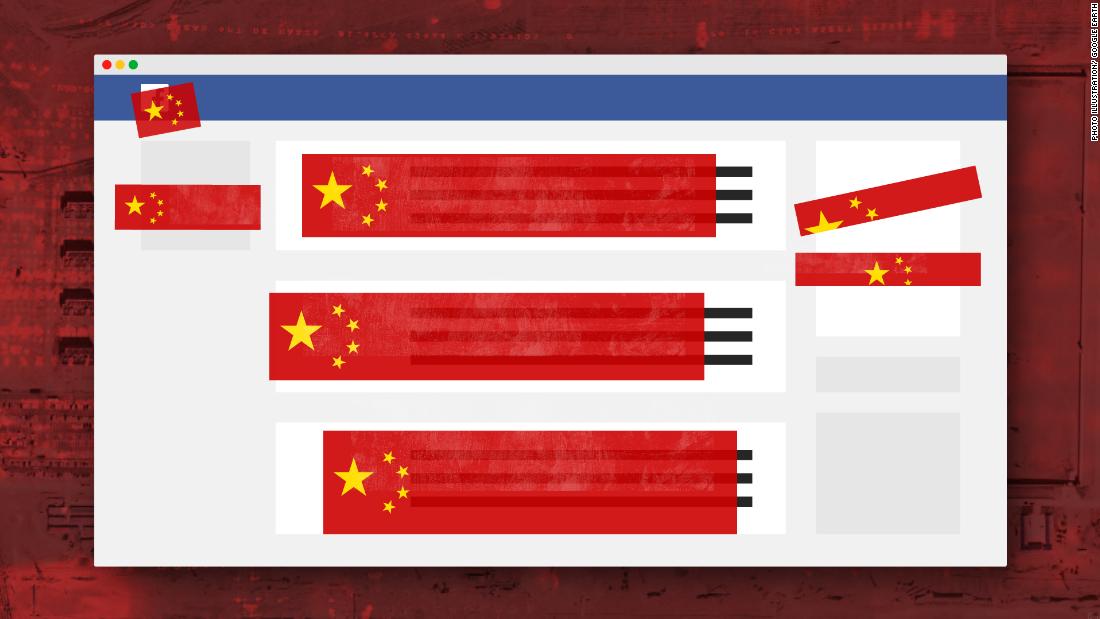
vendredi 19 avril 2019

How Chinese go after Beijing's critics overseas

By James Griffiths
Hong Kong -- Arslan Hidayat was at work when the Chinese attacked.
"My phone was going 'bring, bring, bring,'" said the 31-year-old English teacher.
"I was like, What the hell's going on?"
A Facebook page he helps run which focuses on the Uyghur ethnic minority was being flooded by thousands of comments in a targeted attack by the Chinese.
Australian-born Hidayat lives with his wife and children in Istanbul, Turkey, which is home to a large Uyghur diaspora. 
Their relatives in China have been swept up by the Communist Party's crackdown on the largely Muslim minority group in the country's far-western colony of East Turkestan.
Hidayat has just such a story. 
He has not heard from his father-in-law, Adil Mijit, a popular comedian and entertainer, for over five months. 
The family fears he is among the more than one million Uyghurs detained in a vast system of concentration camps established in East Turkestan.
China's Ministry of Foreign Affairs did not respond to questions about Adil Mijit's whereabouts.
Hidayat has publicized this story, and many others like it, on a Facebook page, Talk to East Turkestan (TET), to thousands of followers. 
Facebook is banned in China, as are Twitter and Reddit — accessing them requires jumping the Great Firewall, the country's vast censorship and surveillance apparatus.
Despite this, these sites appear to be becoming a key battleground of Chinese influence, as a growing army of Chinese assemble on forums and in Facebook groups to attack voices hostile to Beijing's interests.

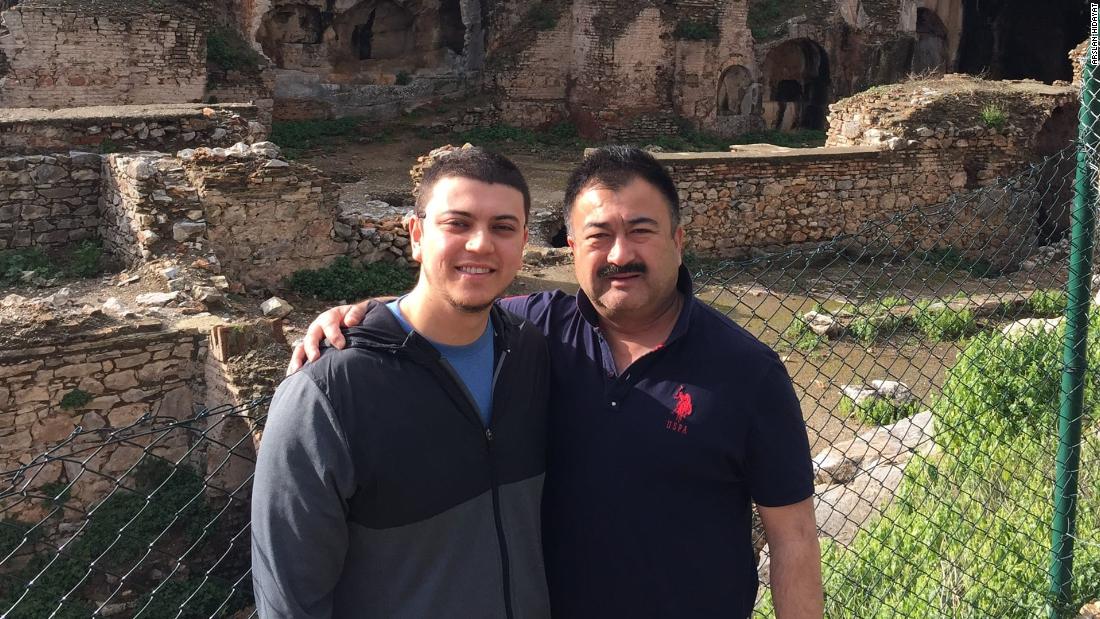
Arslan Hidayat (left) seen with his father-in-law, Uyghur comedian Adil Mijit, who the family say they have not heard from since November 2018.

The raid on Hidayat's page began at 8 p.m. in China. 
Photos and quotes at the ready, the Chinese began posting.
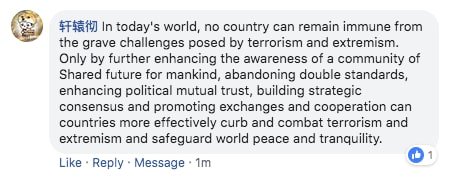
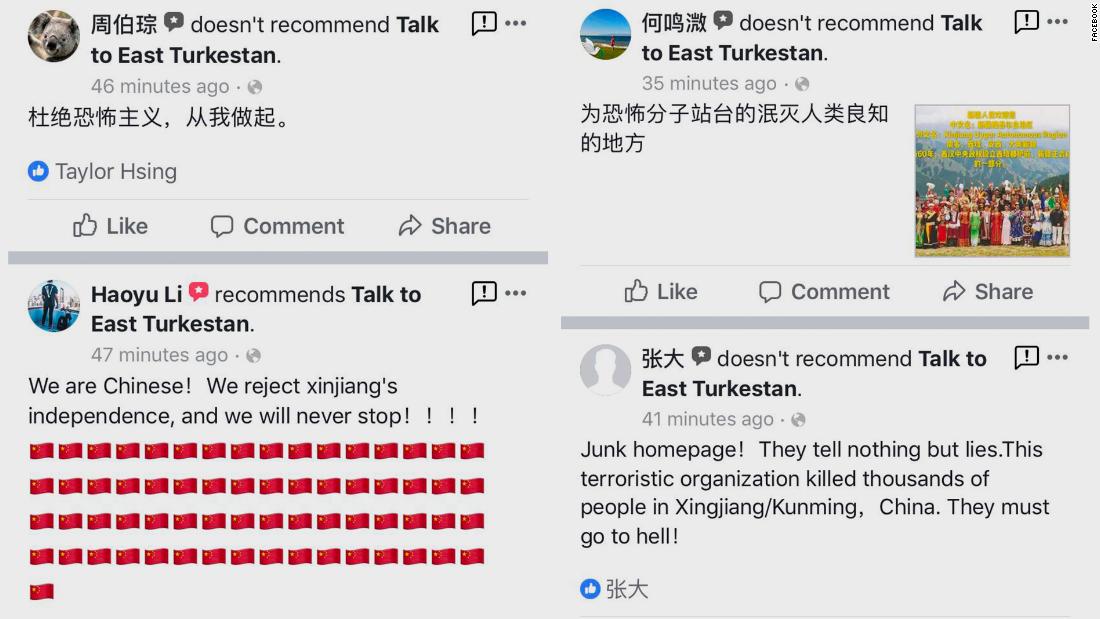
"We are Chinese! We reject East Turkestan's independence, and we will never stop!" read one message in English.
"East Turkestan has been China's territory since ancient times," said another.
(The colony's relationship with Beijing has changed considerably over time, and in the modern era it has been the subject of particular dispute. In the last century, following the collapse of the Qing Dynasty, Uyghurs twice declared independence and created their own republics before the CCP took control of East Turkestan and declared it Chinese territory.)
The comments flooded the Facebook pages of TET and the Munich-based World Uyghur Congress (WUC), an exile group that receives funding from the National Endowment for Democracy, a Washington-linked group. 
Photos posted alongside comments by the Chinese showed smiling Uyghurs, many in ethnic dress, with captions in Chinese and English such as "We live very well" or "East Turkestan sheep and cattle fat, we live well every day." 
Other posts just quoted large blocks of text taken from speeches by Chinese dictator Xi Jinping or a Chinese white paper on the situation in East Turkestan.

The Chinese raid lasted for two hours — according to timestamps on posts and an announcement by organizers — with dozens of comments posted per minute in the busiest period, according to page administrators, who could do little but flag the posts to Facebook via automated tools.
"There was not much you could do in the middle of it except watch and try to alert people that it was happening," said Pete Irwin, a WUC researcher and an administrator of its Facebook page. 
"In the middle of it, comments were coming constantly."
Locating those responsible for the raid was not hard.
Many of the photos and comments referenced Diba, a popular online bulletin board akin to China's version of 4Chan, the notorious meme factory.
Photos featured Diba's logo, and many of those commenting changed their profile pictures to represent the forum.

Comments left on the Facebook page of Talk to East Turkestan during a raid by users of the Diba forum. 

Football forum
Diba is a sub-forum of a Reddit-style offshoot of Baidu, China's biggest search engine.
The forum began as a place for fans of footballer Li Yi to hang out, but has since evolved into a sprawling, generalist forum of more than 31 million users, according to stats on the official Diba page.
That size has given Diba a huge influence on Chinese internet culture, experts say.
Any large groups organizing inside China are often liable to censorship or deletion by the CCP.
As Diba grew, it risked facing this type of control, but for the foresight of its moderators: In around 2014, according to a study of the forum, moderators worked to transform Diba into a pro-government forum, reducing some of its controversial content in favor of more nationalist topics and tighter standards.
Diba began to go after Beijing's enemies overseas, adopting a trolling tactic called brigading.
Known in Mandarin as baoba, or "bursting the board," in China, brigading is when members of one forum flood another with irrelevant or abusive posts with the aim of shutting the board down.
The tactic is popular with trolls on 4Chan and Reddit.
The latter has listed it as one of just three "prohibited behaviors."
Diba's first major international raid — or "expedition," as participants referred to it — was in January 2016, after the election of Taiwanese President Tsai Ing-wen.
Tsai's Democratic Progressive Party is traditionally supportive of Taiwanese independence, and her election came amid heightened tensions between China and Taiwan, which the Communists view as a renegade province, to be reclaimed by force if necessary.
At 7 p.m. China time on January 20, thousands of comments against Taiwanese independence began flooding Tsai's Facebook page, as well as those of pro-Taiwanese news outlets Apple Daily and Sanlih News.
While many posts followed organizers' guidance to be "positive" in their trolling, there were plenty of posts during the raid insulting Tsai and Taiwan, telling Taiwanese people they "belonged to China" and warning them not to "talk back to your father."

Uyghur expedition
In many ways, according to admins and a study of the forum, the people behind the raid on the Facebook pages of Tsai Ing-wen and Hidayat are much like the Uyghur activist: tech savvy, highly-educated millennials.
But when it comes to their beliefs and values they are diametrically opposed.
Those involved in the raid believe the TET Facebook account is spreading lies, maligning China's reputation overseas and promoting separatism and even terrorism.
And they are determined to stop it.
But contrary to most stereotypes about internet trolls, they are committed to doing so without profanity or insults, for the most part.
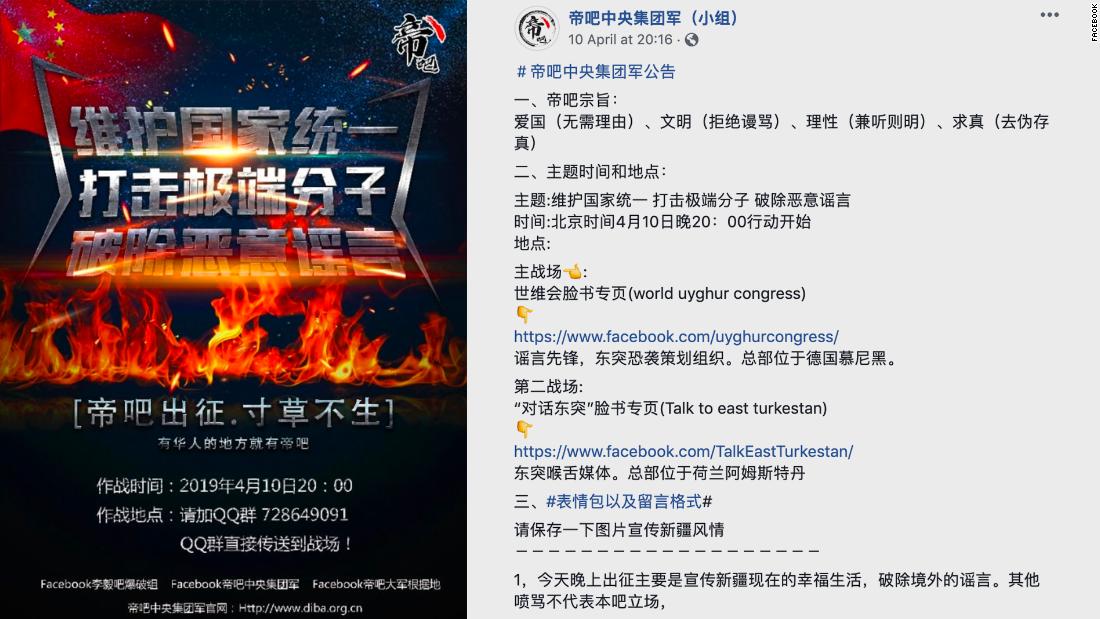
On Diba, Chinese social media site Weibo, and a handful of Facebook pages and groups, the instructions organizers posted for the raid included behavioral guidelines.
Guidelines given to Diba users listed the forum's four key principles: be patriotic, don't curse, be reasonable and maintain truth above all else.
Organizers appeared to be conscious that the raid would attract a global audience.

A poster and instructions for a raid organized against two Facebook pages by members of Diba, a Chinese forum. 

"There will be media screenshots of the process, don't lose face for yourself and your country," they said.
"We are only anti-extremist, not anti-religion or ethnicity, and everyone has their own freedom of belief. Please do not attack people or religion, and do not publish extreme rhetoric. Our purpose is national harmony and equality for all."
Speaking via instant messenger, an admin of one of the Facebook groups coordinating the raid said it had two primary purposes.
"The first one is to refute all the rumors about East Turkestan colony spread by the East Turkistan separatists," said the admin, who gave her name as Vicky.
The admin said while she was based in China, others involved in the campaign were overseas Chinese.
Even though most of the comments have since been deleted by page admins, Vicky felt it was a successful operation.
"I think we got our foot in the door," she said.
The Facebook raid comes amid what appears to be heightened concern within China over how the country is portrayed on Western social media.
In China, Twitter users critical of the government have reportedly been visited by the police and ordered to delete posts or their entire accounts.
Accounts of Chinese dissidents, and even non-political researchers, have gone silent without explanation.
Reddit administrators have also noticed a surge in threads relating to topics critical of China being downvoted and those maligning it being buried, according to BuzzFeed News.
The Cyberspace Administration of China did not respond to requests for comment for this article.
In a statement, China's Ministry of Foreign Affairs said that "as a principle, we don't normally comment on social media activities and opinions."
"Nowadays, the overall social situation of East Turkestan is stable and the momentum for economic development is good. All ethnic groups get along well," the foreign ministry said in its statement. "The sense of security and fulfillment from a stable society have improved greatly."
A Facebook spokeswoman told CNN the company was working "in a variety of ways to find and disrupt this kind of abuse and to provide people with the tools that help people control the content they see."
"In this case, we have removed content and accounts that violate our policies, and will continue to investigate and take action on any abusive behavior we find," she said.
"I think it speaks to a paranoia or anxiety" over how the East Turkestan issue is reflecting on China, Irwin said of the recent raid on the WUC Facebook page.
Hidayat agreed: "For them to go out of their way to attack in this manner, we felt very proud. It shows they're taking notice."
But he was also worried that the content used in the campaign, such as quotes from allegedly happy Uyghurs, could undermine the claims made by his organization.
"For those newbies just catching up to this issue ... the claims that we make and some of the stuff that is written looks far-fetched — people not being able to pray or fast — but it's true," he says.
Even in Turkey, with its large community of Uyghurs there are people who "don't even know what East Turkestan and the Uyghurs are," he says.
"But if East Turkestan was really (as) stable as they say it is then they wouldn't have gone out of their way to attack such a small page," Hidayat says.
As of this publication, his page has fewer than 20,000 followers.
In the wake of the attack, the TET Facebook page saw a spike in followers thanks to the extra media attention, adding around a thousand.
"It's all positive from our side," he says.
"I would like to thank the CCP for promoting our Facebook."

mardi 29 janvier 2019

ADVERTISING CHINA'S THUGGISH SOCIALISM

Promoting China's communist regime to Australia's 1.2 million ethnic Chinese
By Andrew Bolt

Cinema advertisements espousing Chinese propaganda’ and socialism are airing in movie theatres across Sydney, including before children’s films such as the latest How To Train Your Dragon sequel.
A bizarre advertisement promoting “socialism with Chinese characteristics” and aimed at increasing China’s “soft power’’ over Australia has appeared on the silver screen in a string of theatres.
So who pays for this?
Chinese film distribution company TangRen... is behind the advertisement.
The Daily Telegraph yesterday asked TangRen owner Jiayin Yuan if the company was financially supported by the Chinese government and why it was promoting socialism in Australia.
She directed the questions to company director Li Tongliang who did not respond.
The company’s website states TangRen distributes two thirds of all the Chinese and Korean films shown in Australia and New Zealand.
“TangRen promotes Chinese political philosophy and cultural concepts of socialism with Chinese characteristics,” the advertisement states.
The propaganda is the carrot. 
Then there's the stick: a Chinese Australian critic of the regime gets arrested in China:
Yang Hengjun, the Australian-Chinese writer and democracy activist... was detained in China accused of spying.
He now has a friend release a letter:
In the letter, Mr Yang urges activists to "maintain belief in China's democratic future, and, when it doesn't put yourself or your family at risk, to use all your means to push China's democratic development to happen sooner... If I cannot come out or disappear again, remember my articles and let your children read them."
The 53-year-old had been living in New York as a visiting scholar at Columbia University, before leaving for Guangzhou on January 18.
Yang admits in that letter he was also arrested by China in 2011 and forced to lie about it:
On Monday, Australian professor Feng Chongyi published an apology that Yang wrote to his supporters on US-based ­Chinese alternative news website Boxun, detailing his regret over how he handled his previous detention in China in 2011...
Back then, when Yang was ­released, he denied it occurred and said his phone was turned off and there had been a misunderstanding. 
Chinese dissidents and critics of the Chinese government abroad were suspicious of his ­explanation, and accused him of being a spy for the Communist Party...
In the letter, Yang said he did not reveal that he was detained publicly in order to be able to ­return to China and continue his work writing about Chinese democracy...
“I choose to ‘lie’ and let myself be insulted (in order to continue to be) able to do the things which I think right. Can you forgive me?”...
Dr Feng, a University of Technology Sydney professor who is also a critic of the Chinese government and has been detained in China, said Yang asked him to release the letter if he was ever detained again.
Chinese Australians here get the message. 
Here's Jieh-Yung Lo in the Sydney Morning Herald:
Since the news about Chinese-Australian writer and blogger Yang Hengjun broke, I received a call from my mother urging me to stop writing and commentating on issues relating to China. 
She pointed out it doesn’t matter what I write or how I write it, it will cause “unnecessary complications” and make myself and my immediate family a target.
But it's not just Chinese Australia critics who should worry:
After a quarter-century of researching China, Anne-Marie Brady is a veteran of Chinese government spying and harassment. 
"I was prepared for pressure in China," says the 52-year-old New Zealander, a well-regarded professor of political science at the University of Canterbury in Christchurch. 
"But I always felt safe in New Zealand. So that changed." ...
First came the pressure on her university. 
Chinese officials demanded that her immediate superior stop her research...
Next, her office was broken into in December 2017.... 
If she had any doubt that she'd been targeted, she got a detailed warning letter from a concerned friend in the Chinese community to let her know that an official campaign of intimidation against her – and others – was under way.
Brady's home was next... 
The only things missing were laptops, phones and an encrypted memory stick from her last trip to China... 
Brady went to her office the next morning to discover that it had been broken into. 
Again. 
It was February 15 last year.
Brady was scheduled to give testimony to Australia's Parliament that afternoon... to two committees keen to know about, among other things, her groundbreaking research into the Chinese Communist Party's activities in Antarctica... 
Her work uncovered, for instance, that the Chinese People's Liberation Army had built three military facilities on Australian Antarctic territory...
The harassment in her own country seems to have been in angry response to her 2017 report in New Zealand, titled Magic Weapons: China's Political Influence Activities Under Xi Jinping.
The title is a reference to the fact that Xi named three "magic weapons" of Chinese Communist Party power – the People's Liberation Army, the party's program to strengthen and build itself, and the party's United Front Work Department that covertly spreads party influence through the overseas Chinese diaspora and elements of Chinese culture and business.
Given this growing Chinese authoritarianism, this seems very unwise:
Australia is playing a role in helping China develop its rival global positioning system that will be used for guiding missiles and other military technology, according to a leading expert.
New Zealand academic Anne-Marie Brady — who says she has faced a campaign of harassment and intimidation for her research on the Chinese Communist Party — said the "BeiDou" alternative to the American-controlled GPS carries significant benefits for the Chinese military.

jeudi 17 janvier 2019

Chinese Peril

Why U.S. universities are shutting down China-funded Confucius Institutes
By Samuel Brazys and Alexander Dukalskis

The Chinese Communist Party (CCP) has made a huge effort to promote China’s image as a global leader. 
In a Jan. 2 speech, Chinese dictator Xi Jinping reiterated the theme of China’s “great rejuvenation,” a view that emphasizes the “Chinese Dream,” a return to the nation’s former glory as a global powerhouse.
But do these efforts actually work? 
In October, Vice President Pence complained that the “Chinese Communist Party is spending billions of dollars on propaganda outlets in the United States, as well as other countries.” 
This week, reports emerged that at least 10 U.S. universities had closed their Confucius Institutes (CIs), saying a polite “no thanks” to these Chinese-funded language and cultural programs on college campuses.
What’s the story on China’s big PR drive and the ensuing pushback — and how do CIs fit in? 
Here’s what you need to know.

China looks to tighten control of its image
The CCP and Xi have launched a full-fledged campaign to “tell China’s story well,” spending billions of dollars on propaganda efforts — including the purchase of paid supplements in major news outlets like the Economist and The Washington Post. 
Yet while an authoritarian state like China can control political discussion at home, it is more difficult to craft a message of benevolent paternalism abroad. 
China’s efforts to improve its image overseas at times have been ham-handed and the subject of parody, or sometimes ignored.
Nevertheless, the CCP continues to try. 
In recent years it has grown increasingly concerned with what it calls “China Threat Theory,” and has looked for ways to counter foreign claims that China is a military and economic danger. 
The CIs are a part of the government’s response to reframe the country in positive terms.

Confucius Institutes are part of this grass roots effort
China is working actively to improve its image abroad from the ground up. 
CIs are arrangements on university campuses across the globe to host Chinese "culture" and language instructors. 
The Chinese Language Council International, or Hanban, oversees these institutes. 
This effort falls under the Ministry of Education, which ultimately is supervised by the CCP’s Central Propaganda Department.
The proliferation of Confucius Institutes since the first one opened in South Korea in 2004 is remarkable — there are more than 500 CIs operating on every continent, in locations ranging from Anchorage to Mauritius in the Indian Ocean. 

What impact do these CIs have?
While the expansion of Confucius Institutes is impressive, it remains unclear what impact they have on promoting China’s image abroad. 
AidData recently investigated the impact of China’s public diplomacy efforts in East Asia and the Pacific, and the Pew Research Center has periodically checked public opinion on China at various locations across the globe — but there are few consistent and comparable surveys of local-level attitudes toward China over time. 
This lack of data has made it challenging to assess the extent to which China’s more localized overseas image management strategies have been successful.
Our research in a new AidData working paper addresses this issue by using data from the Global Database on Events, Language and Tone (GDELT), which algorithmically captures the tone of hundreds of thousands of media reports at thousands of locations across the world. 
In other words, it measures how positive or negative a story about China is. 
While the database has received some criticism over the accuracy of its algorithms, with careful analysis it can still be used to extract useful information, particularly about media tone.
Using geospatial techniques, our research evaluates how tone about China changes in media reports regarding events near a Confucius Institute before and after the CI opens. 
We find the opening of a CI subsequently enhances tone in stories about China relevant to that geographical area by about 6 percent — a small, but meaningful improvement.
Two examples illustrate how a seemingly small tone change may make a big difference to the reader. A 2014 Reuters story about protests in Hong Kong, coded by the GDELT algorithm at a score very near the average tone, used relatively neutral language like “leaving the two sides far apart in a dispute over how much political control China should have over Hong Kong.” 
In contrast, a 2016 story from Pakistan’s Express Tribune, which was scored 6 percent more positively by the GDELT algorithm, uses noticeably more upbeat language including phrases like “projects had taken the two countries’ friendship to a new height.” 

Winning the battle, losing the war?
While our research suggests Confucius Institutes help facilitate an improved portrayal of China abroad, the gains may be overtaken by broader trends. 
In fact, despite the opening of hundreds of Confucius Institutes from 2005 to 2017, the GDELT data indicates overall global media tone about China has become markedly more negative over that time, with particular downturns from 2012 to 2013 and from 2014 to 2015. 
CIs might be swimming against the tide.
Indeed, high-profile scuffles in the South China Sea, accusations of debt-trap diplomacy along China’s Belt and Road countries, and China’s repression of ethnic minorities or Nobel Peace Prize winners (and even their families) may offset any modest gains from CIs and other public diplomacy initiatives.
Despite its best efforts, China may still find molding public perception abroad of the CCP-run state is much more difficult than at home. 
Xi’s Chinese Dream ideal, for now, may struggle in the glare of a global spotlight. 
But we can be sure the CCP will continue its attempts to soften its image overseas and make adjustments when necessary.

vendredi 5 octobre 2018

Rogue Nation

Chinese Leaders Leverage Media To Shape How The World Perceives China
By ANTHONY KUHN


The front page of the Communist Party's flagship newspaper the People's Daily (center) and other papers are seen one day after the unveiling of the new Politburo Standing Committee in Beijing last year.

"A thousand newspapers with the same front page" is how the Chinese have for decades described the enforced uniformity of the country's state-controlled media.
Now, one face increasingly dominates those front pages. 
It belongs to Chinese dictator Xi Jinping, who has gone to extraordinary lengths to control the narrative about China.
"The party controls the media, and of course, that means it controls the message," says University of Hong Kong media expert David Bandurski. 
"And basically, Xi Jinping is the message."
That message has gotten mixed results. 
Often, it's what China says, not what it does, that makes the deepest impression. 
Nevertheless, it is a prime example of how shaping the world's perceptions of their country has climbed toward the top of the Chinese leadership's agenda.
The trend is evident, for example, at the China Daily, the country's top English-language newspaper, by circulation.
"Our motto used to be, 'Let China go out into the world; let the world understand China,' " says Bridget, a China Daily journalist. 
"Now it's: 'Report on China; influence the world.'"
Bridget is one of several of the paper's journalists who spoke on the condition that they be identified only by their English first names, because they weren't authorized to speak to foreign reporters.
Another, named Gary, explains that no matter what's going on, Xi is always at the top of the news.
In fact, he says, that's a rule at the government's mobile news app, which China Daily runs.
"News of Xi Jinping always comes first, and Li Keqiang always comes second," he says. 
"That's not to say that they make news every day. But even if they don't, their news stays in the top two positions."
Another journalist, Miranda, says news about Xi is edited with extreme caution.
"If we can possibly avoid using his name, we do," she says, "because an error in an article related to Xi would have very serious consequences."
For the past two decades, Xi's predecessors appeared as stiff and colorless apparatchiks, aloof from the common folk. 
By contrast, Xi has cultivated a more three-dimensional image — of a forceful, visionary leader, who is also a down-to-earth man of the people.
One minute, state media trumpet Xi's achievements in building China into an economic powerhouse. The next, they show him holding an umbrella for his wife, Peng Liyuan. 
Coverage goes into intimate detail about Xi's youth in the hardscrabble northwest of the country.
Some of Xi's earthy aphorisms have flooded social media and become popular mantras in Chinese society, such as: "We've gotta just roll up our sleeves and get down to work."
China Daily journalist Miranda says some of it seems to work on a domestic audience.
"The elder generation in my family and my classmates all have pictures of Xi and Peng on their walls," she observes.
But behind the celebrity-style coverage and crafting of Internet memes, Xi's use of the media has helped him to consolidate his political power to a degree not seen in China for decades.
Xi has "used social media accounts under his control to create a collective, subliminal message," argues independent analyst Wu Qiang.
The narrative conveyed through state media, Wu continues, presented the public with a fait accompli: that Xi had succeeded in erasing presidential term limits from the constitution, allowing him, in theory at least, to rule indefinitely. 
Censors then scrubbed any trace of opposition to Xi's move from the Internet.
The University of Hong Kong's Bandurski contends that the media's obsessive focus on Xi, meanwhile, is displacing or erasing other important news, contributing to an information vacuum about China, just when the world can least afford it.
But, Liu Xiaoying, a media scholar at Communication University of China in Beijing, argues that China needs to focus on a main character to tell its story effectively and that Xi is that character.
China began taking its image-building very seriously well before Xi became president. 
Liu traces it back to the 2008 Beijing Olympics.
He says that many Chinese felt that foreign media criticism of their pollution and human rights record spoiled their moment in the world spotlight.
"We felt our ability to transmit our views was inadequate," Liu explains. "We were unable to speak up."
Since then, China has poured billions of dollars into its state-run media, hiring journalists and public relations firms.
For example, the official Xinhua News Agency expanded its overseas bureaus from 100 a decade ago to about 180 as of 2015.
State broadcaster China Radio International, meanwhile, has grown to include coverage in 61 languages and puts out 2,700 hours of programming a day, according to the CRI website.
The message to these audiences, says Bandurski, is that China's rise is a boon to all nations.
The state-run media portray the country as a provider of public services and solutions to global problems.
"This is all about China's position in the world, in a sense, China's rightful position in the world, a kind of return to centrality for China," Bandurski says. 
"And this is all tied up with this important foreign policy of the Belt and Road."
More than 70 countries have signed on to participate in Xi's signature policy, aimed at building infrastructure, ports and roads linking the world to China.
Of course, China is hardly alone in its focus on its leader and his policies.
Maria Repnikova, a media expert at Georgia State University, says Xi has a lot in common with other leaders, from Russia's Vladimir Putin to Turkey's Recep Tayyip Erdogan.
All of them, she says, use media to portray themselves as political strongmen and to put out nationalist and populist messages.
"There's kind of the highlight on the leader himself," Repnikova notes, "his style, his personality, humor, and the communication through various channels," including personal social media accounts.
This summer, though, Xi's messaging seemed to run into resistance. 
This became apparent when authorities temporarily pulled a triumphal-sounding documentary called Amazing China. 
The film credited Xi with transforming China into a global leader in technology.
But critics took to state media to blast the movie for exaggerating China's technical prowess, when in fact, they pointed out, China remains highly reliant on the United States for high-tech products.
Analyst Wu says such propaganda may have made Chinese officials overconfident that they could win a trade war against the U.S.
"China's leaders exaggerated the country's soft power so much so that they believed their own propaganda," he scoffs. 
"It took the trade war with the U.S. to poke a hole in their illusion."
Repnikova argues that China's story, and its example of high-speed economic growth, has found more receptive audiences in many developing countries.
"We should think about the broader picture, that many countries would still probably continue to see China as this strong global actor, and potential partner and investor," she says.
But Wu notes that China is having a harder time coming up with ideas that appeal to Western audiences.
That's partly because, Wu says, the Communist Party has publicly rejected universal values, which it argues don't fit China.
Xi "publicly opposes everything from civil society to freedom and democracy. That gives him very little room to express himself," he adds.
If China has alternatives to what the West considers universal values, it hasn't been clear about what they are. 
China's centuries of political and philosophical traditions might contain some answers, but Beijing hasn't bothered to revive or explain them.
Western governments, meanwhile, have recently become more vigilant of Chinese state media as extensions of Beijing's political influence.
The U.S. Justice Department last month ordered Xinhua and the China Global Television Network to register as foreign agents.

lundi 3 septembre 2018

How Beijing’s propaganda dents China’s image, rather than burnishes it

The inconsistencies in messaging confuse others about China’s intent, while the strict censorship and jingoistic tone invite questions about the government’s credibility, both at home and abroad
By Chauncey Jung

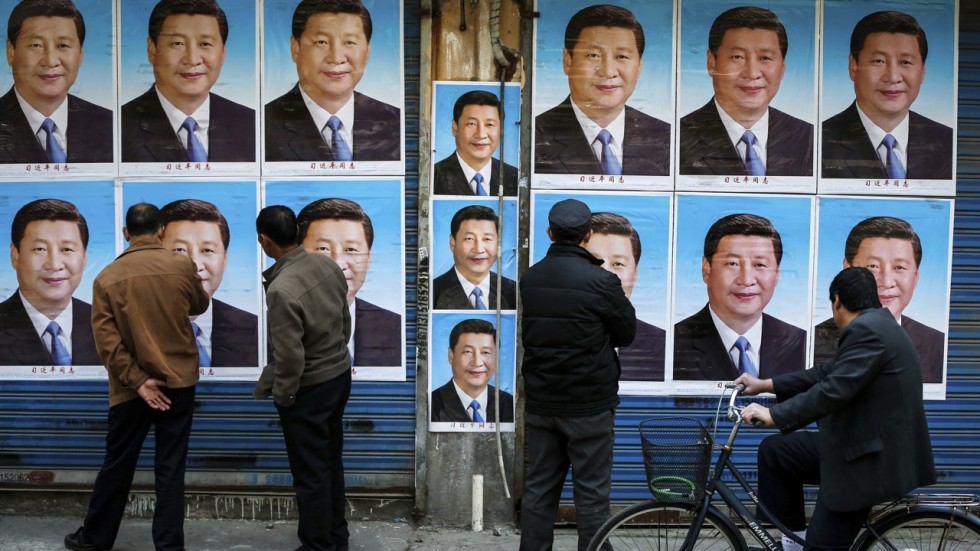
Posters of Chinese dictator Xi Jinping are plastered on a wall in Shanghai in March 2016. 

Anyone who follows Chinese state media coverage can see that Chinese propaganda is inconsistent. From the changing strategy on Xi Jinping’s image to its stance on patriotic films, Chinese propaganda does not follow a consistent guideline. 
Chinese officials seemingly decide in an arbitrary and random fashion how the nation is presented, both to a domestic audience and to the outside world.
The Chinese government’s public communication appears aimed only at meeting short-term goals. But contradictions arise without a coherent strategy. 
There have been occasions when Chinese propaganda has adversely affected the country’s image, or triggered reactions that were opposite to what the regime intended.
Without a clear, modern and consistent strategy, Chinese propaganda will only hurt the nation’s image.
Take for example the propaganda effort surrounding Xi. 
In his earlier public appearances, the Chinese president was portrayed as an amicable leader whom the people could easily relate to. 
In 2013, he showed up at a Beijing steamed bun shop to order food alongside ordinary Chinese. 
In 2014, Chinese propaganda officials created the term “Uncle Xi” (Xi Dada) and “Auntie Peng”, for first lady Peng Liyuan. 
In these early years, propaganda officials set the tone for Xi’s persona as a caring leader who is close to the people.
However, his image has changed dramatically. 
The propaganda apparatus today lionises Xi as a leader second in stature only to Mao Zedong. 
It has encouraged the growth of a personality cult surrounding “Xi Dada”, and named him the undisputed “core” leader of party and country. 
Out goes the personable uncle, and in comes the strongman leader.
Inevitably, censors are deployed to scrub out propaganda associated with Xi the caring leader, including articles on his visit to the steamed bun shop and interviews claiming he carried 100kg of wheat as a youngster.
Such inconsistencies – driven by a propaganda strategy that is increasingly at odds with the more educated and more globally aware Chinese population today – create significant problems in controlling and managing public opinion. 
Every time propaganda officials change their tune, people see the contradictions and question the regime’s credibility.
Xi’s changing personas, for example, have made people more aware that the government has turned more authoritarian in the past five years, and have became fodder for critics to signal their discontent. Thus, when the government amended the constitution earlier this year to abolish presidential term limits, thereby allowing Xi to potentially rule for life, Chinese internet users turned the propaganda term Xi Dada into memes in protest.
Instead of stabilising the regime, as intended, the propaganda campaign is undermining it.
The government’s propaganda effort aimed at a foreign audience is similarly flailing. 
Since Xi came to power in 2013, China has promoted its “Chinese dream” of national rejuvenation, built on the foundation of the “Four Self-confidences” (faith in its own system, path, theory and culture). 
This became the basis for its resistance to Western ideology, and its assertiveness, even aggression, towards perceived enemies.
Its goals were twofold: to show the world a unified, strong and modern China, and to showcase the confidence of the government by bashing countries with which it has disputes. 
But this strategy has backfired.
By allowing the production of such videos as the Seven Sins of India, published last year by New China TV, the official YouTube channel of Xinhua News Agency, at the height of China’s border stand-off with India, Beijing has only created a negative image of itself. 
By using racist and disrespectful language and tone in such blatant propaganda, the Chinese government showed its ignorance of the social conventions that bind the international community.
China’s propaganda strategy in its trade war with the US has also been a mess, with official statements alternately threatening a fight to the end with US hegemony and seeking cooperation to advance the global interest. 
This confuses others about China’s true intent.
Without a clear strategy, Chinese strategic intent seems equivocal and lacks focus. 
Recently, for example, China revelled in the release of Amazing China, a jingoistic documentary film celebrating the country’s achievements over the past five years. 
Yet now, to minimise the impact of the trade war, the regime even began to play down its “Made in China 2025” policy, a key plank for advancing the nation’s technological reach.
Unlike China’s tightly controlled internet, the free flow of information in other, more democratic, parts of the world means people can easily track Beijing’s inconsistencies, making its propaganda efforts futile in shaping international public opinion.
This only shows that Chinese officials have little understanding of how journalism works in countries with freedom of speech. 
They appear to assume that the world operates the way China does; they believe that deleting content and stopping journalists from publishing stories is a more effective way to support the regime’s actions than crafting a reasonable argument to convince and persuade critics.
China spends billions of dollars to ensure the country has a positive image. 
But unless it updates its style of public engagement, it will be extremely difficult for the country to achieve its goal of making the world see beyond the regime’s abuses of human rights, freedom of speech, and other undemocratic practices.
The problem is that China does not believe in constructive criticism. 
Rather, the regime bets on silencing and repressing those who are eager to speak.