By Damien Cave and Jamie Tarabay

Chinese tourists taking photographs outside Parliament House in Canberra, Australia, in January.
CANBERRA, Australia — A Chinese defector to Australia who detailed political interference by Beijing.
A businessman found dead after telling the authorities about a Chinese plot to install him in Parliament.
Suspicious men following critics of Beijing in major Australian cities.
For a country that just wants calm commerce with China — the propellant behind 28 years of steady growth — the revelations of the past week have delivered a jolt.
Fears of Chinese interference once seemed to hover indistinctly over Australia.
For a country that just wants calm commerce with China — the propellant behind 28 years of steady growth — the revelations of the past week have delivered a jolt.
Fears of Chinese interference once seemed to hover indistinctly over Australia.
Now, Beijing’s political ambitions, and the espionage operations that further them, suddenly feel local, concrete and ever-present.“It’s become the inescapable issue,” said Hugh White, a former intelligence official who teaches strategic studies at the Australian National University.
“We’ve underestimated how quickly China’s power has grown along with its ambition to use that power.”
American officials often describe Australia as a test case, the ally close enough to Beijing to see what could be coming for others.
In public and in private, they’ve pushed Australia’s leaders to confront China more directly — pressure that may only grow after President Trump signed legislation to impose sanctions on Chinese and Hong Kong officials over human rights abuses in Hong Kong.
A rally last month in Hong Kong in support of a bill in the American Congress.
Even as it confronts the specter of brazen espionage, Australia’s government has yet to draw clear boundaries for an autocratic giant that is both an economic partner and a threat to freedom — a conundrum faced by many countries, but more acutely by Australia.
Prime Minister Scott Morrison continues to insist that Australia need not choose between China and the United States.
Prime Minister Scott Morrison continues to insist that Australia need not choose between China and the United States.
A new foreign interference law has barely been enforced, and secrecy is so ingrained that even lawmakers and experts lack the in-depth information they need.
As a result, the country’s intelligence agencies have raised alarms about China in ways that most Australian politicians avoid.
As a result, the country’s intelligence agencies have raised alarms about China in ways that most Australian politicians avoid.
The agencies have never been flush with expertise on China, including Chinese speakers, yet they are now in charge of disentangling complex claims of Chinese nefarious deeds.
In the most troubling recent case, first reported by The Sydney Morning Herald and The Age, the Australian authorities have confirmed that they are investigating accusations made by Nick Zhao, an Australian businessman who told intelligence officials that he had been the target of a plot to install him in Parliament as a Chinese agent.
In the most troubling recent case, first reported by The Sydney Morning Herald and The Age, the Australian authorities have confirmed that they are investigating accusations made by Nick Zhao, an Australian businessman who told intelligence officials that he had been the target of a plot to install him in Parliament as a Chinese agent.
Mr. Zhao, a 32-year-old luxury car dealer, was a member of his local Liberal Party branch.
He was a “perfect target for cultivation,” according to Andrew Hastie, a federal lawmaker and tough critic of Beijing who was briefed on the case.
He told The Age that Mr. Zhao was “a bit of a high-roller in Melbourne, living beyond his means.”
Another businessman with ties to the Chinese government, Mr. Zhao said, offered to provide a million Australian dollars ($677,000) to finance his election campaign for Parliament.
Another businessman with ties to the Chinese government, Mr. Zhao said, offered to provide a million Australian dollars ($677,000) to finance his election campaign for Parliament.
But a few months later, in March, Mr. Zhao was found dead in a hotel room.
The state’s coroner is investigating the cause of death.
In a rare statement, Mike Burgess, the head of Australia’s domestic spy agency, said on Monday that his organization was aware of Mr. Zhao’s case and was taking it very seriously.
In a rare statement, Mike Burgess, the head of Australia’s domestic spy agency, said on Monday that his organization was aware of Mr. Zhao’s case and was taking it very seriously.
Last week, a young asylum seeker named Wang Liqiang presented himself to the Australian authorities as an important intelligence asset — an assistant to a Hong Kong businessman who is responsible for spying, propaganda and disinformation campaigns aimed at quashing dissent in Hong Kong and undermining democracy in Taiwan.
Xiang Xin, the man Mr. Wang identified as his former boss, has denied having anything to do with him, or even knowing him.
The challenge of the case is just beginning.
The challenge of the case is just beginning.
The detailed 17-page account that Mr. Wang gave to the authorities as part of an asylum application is being taken seriously by law enforcement agencies worldwide.
Taiwan’s Ministry of Justice detained Xiang and another executive with the company Mr. Wang said he worked for, China Innovation Investment Limited.
Investigators in Taiwan are looking into assertions that their business acted on behalf of Chinese intelligence agencies.
Other details in Mr. Wang’s account — about the kidnapping of booksellers in Hong Kong, spying on Hong Kong university students, and the theft of military technology from the United States — are still being examined by Australian officials.
“Australia’s peak intelligence agencies are being put to the test,” said John Fitzgerald, a China specialist at Swinburne University of Technology in Melbourne.
“It’s a tough call, and they cannot afford to get it wrong.”

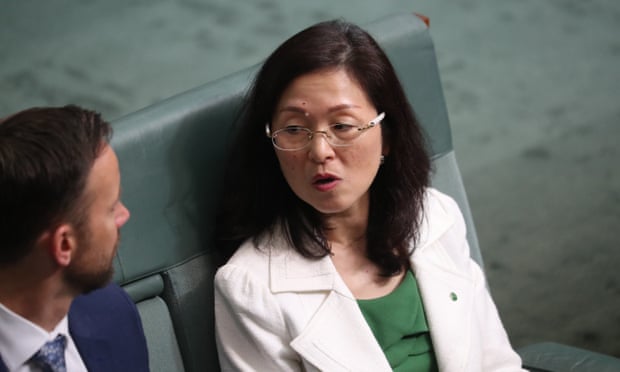
Chinese mole: Questions of loyalty continue to swirl around a Liberal Party member of Parliament, Gladys Liu.
Chinese mole: Questions of loyalty continue to swirl around a Liberal Party member of Parliament, Gladys Liu.
What’s clear, though, is that they are helping to push the public away from supporting cozy relations. Polls showed a hardening of Australian attitudes about China even before the past week.
Now Mr. Hastie, the Liberal Party lawmaker who chairs Parliament’s joint intelligence committee, says his office has been overwhelmed by people across the country who have emailed, called and even sent handwritten letters expressing outrage and anxiety about China’s actions in Australia.
Questions of loyalty continue to swirl around another Liberal Party member of Parliament, Gladys Liu, who fumbled responses to questions in September about her membership in various groups linked to the Chinese Communist Party.

Massive Chinese fifth column: Chinese student-spies shouting at pro-Hong Kong protesters outside the University of South Australia in Adelaide in August.
Now Mr. Hastie, the Liberal Party lawmaker who chairs Parliament’s joint intelligence committee, says his office has been overwhelmed by people across the country who have emailed, called and even sent handwritten letters expressing outrage and anxiety about China’s actions in Australia.
Questions of loyalty continue to swirl around another Liberal Party member of Parliament, Gladys Liu, who fumbled responses to questions in September about her membership in various groups linked to the Chinese Communist Party.
Massive Chinese fifth column: Chinese student-spies shouting at pro-Hong Kong protesters outside the University of South Australia in Adelaide in August.
The espionage cases also follow several months of rising tensions at Australian universities, where protests by students from Hong Kong have been disrupted with violence by opponents from the Chinese mainland.
Several student activists have told the authorities that they have been followed or photographed by people associated with the Chinese Consulate.
It’s even happened to at least one high-profile former official, John Garnaut.
Several student activists have told the authorities that they have been followed or photographed by people associated with the Chinese Consulate.
It’s even happened to at least one high-profile former official, John Garnaut.
A longtime journalist who produced a classified report on Chinese interference for former Prime Minister Malcolm Turnbull in 2017, he recently acknowledged publicly that he had been stalked by people who appeared to be Chinese agents — in some cases when he was with his family.
These actions of apparent aggression point to a version of China that Australians hardly know.
These actions of apparent aggression point to a version of China that Australians hardly know.
For decades, Australia has based its relations with Beijing on a simple idea: Let’s get rich together.
And the mining companies that are especially close to Mr. Morrison’s conservative government have been the biggest winners.
But now more than ever, the country is seeing that for the Communist Party under Xi Jinping, it’s no longer just about wealth and trade.
“The transactions aren’t satisfying them enough; they want more,” said John Blaxland, a professor of international security and intelligence studies at the Australian National University.
“They want to gain influence over decisions about the further involvement of the United States, about further protestations to Chinese actions in the South China Sea, in the South Pacific, in Taiwan.”
Mr. Blaxland, along with American officials, often points out that Australia’s biggest export to China, iron ore, is hard to obtain elsewhere reliably and at the prices Australia’s companies charge.
Mr. Blaxland, along with American officials, often points out that Australia’s biggest export to China, iron ore, is hard to obtain elsewhere reliably and at the prices Australia’s companies charge.
That suggests that the country has more leverage than its leaders might think.Mr. Hastie, who was recently denied a visa to travel to China as part of a study group that included other members of Parliament, agreed.
In an interview, he said the recent revelations were “the first time the Australian public has a concrete example of what we are facing.”
Now, he added, it’s time to adapt.
Now, he added, it’s time to adapt.