Affichage des articles dont le libellé est The Just War. Afficher tous les articles

mercredi 8 février 2017

The Just War

Five Reasons US and China Will Go To War
By Harry J. Kazianis

While thankfully the chances of all-out war are remote, the possibility remains, as history has taught us all too well. 
Here we will explore five ways Washington and Beijing could find themselves in open conflict. While this essay for reasons of time and space won’t ponder over the consequences of such a conflict, you can be sure of one thing: if tensions were to escalate beyond just a minor, isolated clash, there is the distinct possibility a third and possibly atomic world war would be in the offing.
Over the last few years, I have undertaken what most would consider a depressing assignment: debating and thinking through the possibility of a great-power war [3] in today’s chaotic international environment. 
And for good reason [4]. 
As Washington attempts to transition away from counterinsurgency operations and the nightmare that has become the Middle East, new challenges—many from revisionist great powers—seem to be popping up around the globe. 
The crisis in Ukraine—with many now openly calling the state of U.S.-Russian relations “Cold War 2.0 [5]”—serves as perhaps the best example of such a chilling possibility.
Yet, despite whatever the crisis of the day is, when it comes to challenges Washington must face in the years to come, none is as important as the challenge presented by China. 
Beijing—now empowered by an economy [6] and military that is only second to America [7]—is bent on remaking the international order in the Asia-Pacific and the wider Indo-Pacific [8] in its own image. 
From the East China Sea to the wide expanses of the Indian Ocean, China has clearly made its intentions known that the current international order is open to revisions on its terms. 
Over the last several years, various clashes over the very meaning of the maritime commons [9], natural resources below the sea bed [10], air-defense identification zones [11] and various near collisions in the near seas and in the sky have set off alarm bells in capitals around Asia. 
While Washington has declared its own “pivot” or “rebalance” towards Asia, destabilizing and what some have called “coercive actions [12]” by China have continued unabated.
So where does all of this end up? 
Would the United States be sucked in?
While thankfully the chances of all-out war are remote, the possibility remains, as history has taught us all too well. 
Here we will explore five ways Washington and Beijing could find themselves in open conflict. While this essay for reasons of time and space won’t ponder over the consequences of such a conflict [14], you can be sure of one thing: if tensions were to escalate beyond just a minor, isolated clash, there is the distinct possibility a third and possibly atomic world war would be in the offing.

1. A Crisis in the East China Sea
One way a U.S.-China war could commence is by Washington getting sucked into a regional war in Asia. 
Looking beyond a straight-up U.S.-Chinese great-power war there is another clash in Asia that could be almost as terrifying—and would draw in America: a China-Japan war in the East China Sea [15].
Over at the Lowy Interpreter [16], I explored a hypothetical scenario that is all too possible—where the number-two and -three economies on the planet come to blows over some obscure rocks inhabited by goats:
Two Chinese SU-27 fighters come within 25 feet of a Japanese P-3 Orion surveillance plane just 10 miles west of the Senkakus. 
The Japanese pilot gets nervous. A slight tweak at the controls and the Japanese plane collides with one of the Chinese fighters. 
Both aircraft crash into the ocean, with no survivors.
... Beijing accuses the Japanese pilots of violating Chinese sovereign airspace...
Japan claims the Chinese pilots acted recklessly, flying so close...
Just 72 hours later, a group of twenty Chinese nationals land on one of Japan's Senkaku islands under the cover of darkness...
A Japanese naval task force carrying a small detachment of soldiers is dispatched. 
Their goal: remove the only residents of the five-island chain.
...As Japanese naval forces come within 20 miles of the islands a Chinese J-10 fighter jet buzzes the task force. 
On its second pass it comes dangerously close to a Japanese destroyer. 
In a perceived act of self-defence, the destroyer shoots down the aircraft.
Hours later...Beijing fires a warning shot, a DF-21D or “carrier-killer” missile which hits the ocean just 10 miles away from the Japanese task force. 
Undeterred, Japanese forces press ahead. 
Domestic pressure on Chinese leaders becomes intense. 
They feel they have no choice but to escalate, launching a massive saturation strike with ballistic and cruise missiles against the Japanese task force...
Prime Minister Abe urgently phones President Trump formally requesting America's help... 
Whatever the scenario, as long as China and Japan are at each others throats in the East China Sea and America continues to assert that since the Senkaku Islands are Japanese—meaning that they fall under the protective umbrella of the U.S.-Japan alliance—the possibility of conflict between Beijing and Washington is real. 
In fact, if China and Japan were to come to blows, there are many situations in which Washington would be compelled to act and back its treaty ally by waging a kinetic struggle against Beijing.

2. A Crisis in the South China Sea
Accurately dubbed by frequent [17] TNI [17] contributor Robert Kaplan [17] “Asia’s Cauldron [18],” the South China Sea continues to present what amounts to an open wound for U.S.-Chinese ties—a wound that could ooze with blood at any moment. 
With Beijing declaring its nine- or (sometimes referred to as) ten-dash line, which effectively declares the area a massive Chinese lake [19], there is always the possibility a clash could spark a greater crisis in which America would feel compelled to intervene.
Why China continues to press its claims in the area of the South China Sea makes sense once one realizes the stakes involved. 
Trillions of dollars worth of goods pass through this vital body of water. 
Trillions more might be under the water in the form of oil, natural gas and precious minerals. 
With multiple overlapping territorial claims, we just might be lucky that we have not yet had a major crisis spin out of control.
In the South China Sea, the risks are quite obvious: if a U.S. ally, specifically the Philippines, were to become engaged in a major kinetic clash with China (it was entirely possible at Scarborough Reef back in 2012 [20]), the U.S.-Philippines alliance [21] could set off a chain reaction of events. 
While Washington has been rightly vague about what types of scenarios it would back Manila in if open conflict were to arise, you can bet the United States would clearly be involved in some capacity—increasing dramatically the possibility of a Washington-Beijing clash.
3. An Incident at Sea
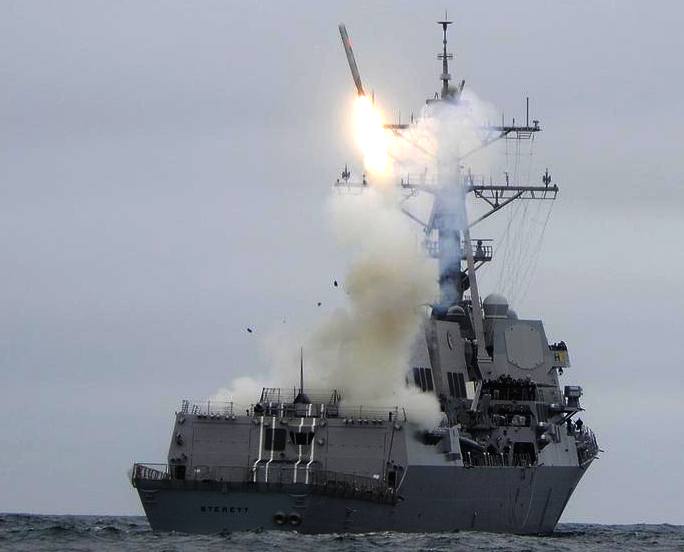
A clash at sea where Chinese or American sailors lose their lives could certainly be the spark for increased tensions or a deadly conflict.
Consider the December 5, 2013 incident where a U.S. naval vessel and a Chinese warship came close to colliding. 
According to a statement by the U.S. Pacific Fleet [22], “While lawfully operating in international waters in the South China Sea, USS Cowpens (CG 63) and a PLA Navy vessel had an encounter that required maneuvering to avoid a collision.” 
It went on to explain that “this incident underscores the need to ensure the highest standards of professional seamanship, including communications between vessels, to mitigate the risk of an unintended incident or mishap..” 
Considering this is not the only incident of a near-fatal collision at sea [23], we must weigh the possibility that an American and Chinese vessel could very well collide in the near future.
While it seems remote that a war could spark from just one possible clash of ships, if the loss of life were severe, and the incident was recorded and beamed all over the world (thanks to social media and a relentless 24-hour news cycle), you can bet U.S.-Chinese relations would be headed towards a crisis. 
And that would certainly increase the risk of a situation where other pressure points—whether in the East or South China Seas and even some sort of cyber retaliation (official or unofficial)—could set up a series of events where one side felt compelled to act decisively if they felt conflict was becoming inevitable.

4. An Incident in the Air
Chilling as it is, this has already happened once. 
In 2001, a U.S. P-3 Orion collided with a Chinese fighter jet, setting off a crisis in U.S.-Chinese relations not seen since the darkest days of the Cold War. 
There was talk in Washington at the time of a possible change in approach towards China—something much more hardline.
Chinese leaders were concerned that the two nations were [24] “headed for a confrontation as China emerges as an economic and military power in Asia.” 
While the course seemed to be set for greater tensions in the near term, the events of 9/11 would intervene to shift America’s focus away from Asia and back to the Middle East.
Sadly, the possibility of a U.S.-China clash in the air is still a real possibility. 
Back in August of last year, a Chinese jet passed dangerously close to a U.S. P-8 Poseidon surveillance plane. 
U.S. officials at the time explained that [25] “the Chinese jet … passed the nose of the P-8 at 90 degrees with its belly toward the P-8 Poseidon, we believe to make a point of showing its weapons load out... ” 
Officials also noted that the Chinese “flew directly under and alongside the P-8, bringing their wingtips … to within 20 feet and then conducted a roll over the P-8, passing within 45 feet.” 
What if such an incident had turned deadly?

5. Finally... Taiwan
While tensions between the PRC and the ROC have certainly dropped considerably since 2008, there is no guarantee that Beijing may begin to exert pressure seeking the return of its so-called “renegade province.” 
In fact, Xi Jinping alluded to such a possibility, stating [26], “the issue of political disagreements that exist between the two sides must reach a final resolution, step by step, and these issues cannot be passed on from generation to generation.”
So how does Taiwan play into the possibility of a U.S.-China war? 
Simple. 
As a recent report from the always-smart D.C.-based Center for Strategic and Budgetary Analysis (CSBA) explains [27], the dynamics of PRC-ROC tensions have not changed:
Despite atmospheric improvements in cross-strait ties... the fundamental nature of the dispute has not changed. 
Beijing still refuses to renounce the use of force as a means of reunification, and China’s steady, methodical build up of missile and air assets aimed at Taiwan serves as a constant and sobering reminder...
At the same time, a series of polls indicate that a vast majority of the Taiwanese population continues to reject unification. 
While both sides’ official positions remain unaltered, the cross-strait military balance has moved decisively in China’s favor....
Two decades of annual double-digit growth in Chinese military expenditures have resulted in Beijing acquiring a wide margin of conventional superiority over Taiwan, leading to growing concerns that it may no longer be able to withstand a large-scale PRC assault against its territory and raising the specter of a forcible annexation before U.S. forces could intervene.
One could easily see Beijing begin to raise the stakes with Taipei—pushing for the resolution of what it has stated many times as one of its most important “core interests.” 
Clearly, Washington would be concerned over such a trend that could quickly create a crisis in U.S.-Chinese relations. 
If China were to forcibly attempt to reunite with Taiwan using kinetic force or an outright invasion, it seems some form of a U.S.-China conflict would be all but guaranteed.
Conclusion
Nothing consumes my intellectual bandwidth more than the possibility of a U.S.-China war. 
While the idea of such a clash seems remote, the number of pressure points that could spark such a conflict are too many to outright rule out such a possibility. 
In November of 2014, the United States and China signed two memorandums of understanding (MOUs) that should help at least with regard to near incidents in the air and sea. 
As Peter Dutton neatly explained in these pages [28], the “MOUs help reduce the risk of crisis...” However, Dutton also notes “they will not eliminate it, because they do not eliminate the divergent security interests that are at the root of the crises. And even as they improve understanding, such insight is no replacement for respect for power.”
And, as Graham Allison explained in these very pages [30], “when a rapidly rising power rivals an established ruling power, trouble ensues. In 11 of 15 cases in which this has occurred in the past 500 years, the result was war.” 
World War III Casualties
2016 PopulationKilledSurvivors
CHINA1 373 541 2781 057 119 68977%316 421 589
UNITED STATES323 995 52819 089 7836%304 905 745
EUROPEAN UNION513 949 445371 356 95872%142 592 487
RUSSIA142 355 41530 924 81622%111 430 599
INDIA1 266 883 5981 158 499 17491%108 384 424
PAKISTAN201 995 540175 747 47387%26 248 067
JAPAN126 702 133114 241 88990%12 460 244
VIETNAM95 261 02184 340 68889%10 920 333
PHILIPPINES102 624 20992 732 90290%9 891 307
KOREA, NORTH25 115 31121 141 05084%3 974 261
KOREA, SOUTH50 924 17247 636 30294%3 287 870
TAIWAN23 464 78722 278 49095%1 186 297
4 246 812 4373 195 109 21475%1 051 703 223

vendredi 3 février 2017

The Just War

Steve Bannon is right, a war could break out in the South China Sea.
By Sean O’Grady

Here’s a strategy game we can all play: guess where the next major war will break out.
Or, more apposite; where will Donald Trump start his first war? 
Not a thermonuclear one with Russia, obviously.
But he seems a man permanently looking for a fight. 
Although Paddy Power and William Hill have the good taste not to run a book on such things, if it were possible to do so then obviously the smart money would be on Iran, now “on notice” from the Trump White House; or perhaps Korea. 
The Ukraine (round two) and the Baltics (those Russians again) seem unlikely given the whole Putin-Trump thing, though you never know.
But what about the Spratly Islands? 
Or Paracels? 
The Scarborough Reef? 
Nothing to do with the North Riding of Yorkshire, by the way, these are just a few of the tiny collections of islets and rocks that spatter the South China Sea. 
Virtually none are inhabited, in any meaningful sense, but the various conflicting and overlapping national claims on these micro-territories are the most dangerous set of conflicts in the world today. No less an authority than Steve Bannon, now President Trump’s senior adviser, said so some months ago during radio broadcasts for the Breitbart website, well known for its nationalist sympathies. 
Just because it was on Breitbart doesn’t make it wrong, though; and because Bannon is now ensconced in the White House it makes this important.
Here’s what he said last spring: We’re going to war in the South China Sea in the next five to 10 years... There’s no doubt about that. They’re taking their sandbars and making basically stationary aircraft carriers and putting missiles on those. They come here to the United States in front of our face – and you understand how important face is – and say it’s an ancient territorial sea.” 
“They” in this case being China, perceived by many countries as dangerously expansionist and increasingly militarised and aggressive. 
Alongside their other crimes, such as undercutting US industry and currency manipulation, this idea of a resurgent China is something of a theme in Trumpist circles. 
It is one reason why the rapprochement with Russia is given such importance. 
Thinking geopolitically, if they do, the Americans now want to work with Russia in order to push China towards deals on economics and defence. 
This is in fact an analogy to the Nixon opening to China in 1971-72; on that occasion the idea was to pressure the Russians to do a deal on strategic nuclear weapons limitation and pursue détente more widely. 
That time it worked.
Will it work this time? 
China’s foreign policy is growing more assertive.
For decades Beijing has made territorial claims in the East China and the South China Seas. 
But now Beijing is defending those claims; Chinese-flagged vessels increasingly enter disputed waters, extracting resources and harassing other claimants’ ships. 
In addition, China is constructing and militarizing artificial islands, and asserting maritime rights there beyond what international law allows. 
While these actions have provoked anger among China’s neighbors, so far Beijing’s assertive turn has been largely successful.
China’s neighbors are not balancing against its encroachments. 
Most of the targets of China’s recent moves – e.g., the small ASEAN nations -- have modest economies and tiny defense budgets. 
They are understandably reluctant to confront China, a growing military power, and an important economic partner. 
The Philippines has resisted China more than others, but principally in the courtroom, not at sea. Japan is the only regional actor with the latent power to balance Beijing. 
China believes that the South China Sea is its own paddling pool, and the artificial “islands” and reefs it has set up reinforce the point. 
Each of these obscure archipelagos has their own tale, but they usually involve territorial claims by, in various combinations and in varying degrees of viciousness, Vietnam, the Philippines, the two Koreas, Malaysia, Indonesia and Brunei. 
And, of course, China.
Each is about more than who holds dominion over the bemused and who claims sovereignty over sea turtles and albatrosses that mostly comprise their populations. 
It is about more, even, than the possible rights to oil and minerals and the safety of some of the world’s most busy shipping lanes. 
It is about national pride, above all.
The bizarre notion that America might go to war on behalf of what was once “Communist North Vietnam” is no longer quite so strange.
So Bannon is right in his analysis.
Like the disputes in the Balkans before the great War broke out in 1914, these disputes are impossible to comprehend, both in in the sense that they are so trivial and yet so important in terms of the emotions they provoke. 
No one, pretty much, in Britain, Russia, France or Germany could find Sarajevo on a map in 1914, but that didn’t stop Europe being bled to death for four years. 
Maybe we should all have a look-see where the Spratly Islands are
At least, we will know where the US-China war will break out.

jeudi 2 février 2017

The Just War

Steve Bannon: 'We're going to war in the South China Sea ... no doubt' 
By Benjamin Haas In Hong Kong
Steve Bannon: ‘We’re going to war in the South China Sea in five to 10 years. There’s no doubt about that.’

The United States and China will fight a war within the next 10 years over islands in the South China Sea, and “there’s no doubt about that”.
At the same time, the US will be in another “major” war in the Middle East.
Those are the views of one of the most powerful men in Donald Trump’s administration, Steve Bannon, the former head of news website Breitbart who is now chief strategist at the White House.
In the first weeks of Trump’s presidency, Bannon has emerged as a central figure.
He was appointed to the “principals committee” of the National Security Council in an unusual move and was influential in the recent travel ban on citizens from seven Muslim-majority countries, overruling Department of Homeland Security officials who felt the order did not apply to green card holders.
While many in Trump’s team are outspoken critics of China, in radio shows Bannon hosted for Breitbart he makes plain the two largest threats to America: China and Islam.
“We’re going to war in the South China Sea in five to 10 years,” he said in March 2016.
“There’s no doubt about that. They’re taking their sandbars and making basically stationary aircraft carriers and putting missiles on those. They come here to the United States in front of our face – and you understand how important face is – and say it’s an ancient territorial sea.”
China says the entire South China Sea falls within its territory, with half a dozen other countries maintaining partially overlapping claims.
China has built a series of artificial islands on reefs and rocks in attempt to bolster its position, complete with military-length airstrips and anti-aircraft weapons.
Bannon’s sentiments and his position in Trump’s inner circle insure a military confrontation with China, after secretary of state Rex Tillerson said that the US would deny China access to the seven artificial islands
Bannon is clearly wary of China’s growing clout in Asia and beyond, framing the relationship as entirely adversarial, predicting a global culture clash in the coming years.
You have an expansionist Islam and you have an expansionist China. Right? They are motivated. They’re arrogant. They’re on the march. And they think the Judeo-Christian west is on the retreat,” Bannon said during a February 2016 radio show.
On the day Trump was inaugurated, China’s military warned that war between the two countries was a real possibility.
“A ‘war within the president’s term’ or ‘war breaking out tonight’ are not just slogans, they are becoming a practical reality,” an official wrote on the website of the People’s Liberation Army.
Aside from conflict between armies, Bannon focused on his perception that Christianity around the world is under threat.
In one radio show, Bannon focused heavily on China’s oppression of Christian groups.
“The one thing the Chinese fear more than America … they fear Christianity more than anything,” he said.

lundi 30 janvier 2017

The Just War

Can Xi Jinping Survive a Nuclear Strike?
By Anthony Capaccio

U.S. intelligence agencies and the Pentagon’s Strategic Command are working on a new evaluation of whether the Russian and Chinese leadership could survive a nuclear strike and keep operating.
The new study, ordered by Congress before Trump took office, drew bipartisan support from members who harbor deep concern about China’s increasing military boldness and distrust of Russian President Vladimir Putin’s intentions.
While Trump has pledged to “greatly strengthen and expand” U.S. nuclear capabilities, he also has predicted he can make deals with Putin that may include reducing U.S. sanctions in return for future cuts in nuclear arsenals. 
The two leaders talked by phone for about an hour on Saturday.
Under the little-noticed provision in this year’s defense authorization measure, the Office of the Director of National Intelligence and the U.S. Strategic Command -- which plans and would execute nuclear strikes -- will evaluate the post-attack capabilities of the two nuclear powers. 
The law mandates a report on Russian and Chinese “leadership survivability, command and control and continuity of government programs.”
The review is to include “the location and description of above and underground facilities important to the political and military” leadership and which facilities various senior leaders “are expected to operate out of during crisis and wartime.”

U.S.’s Own Plans

The Strategic Command is also directed to “provide a detailed description” for “how leadership survivability” and “command and control” in Russia and China are factored into the U.S.’s own nuclear war planning. 
The directive was championed by Republican Representative Michael Turner of Ohio, a member of the House Armed Service Committee’s Strategic Forces panel.
“Our experts are drafting an appropriate response,” Navy Captain Brook DeWalt, a spokesman for the Strategic Command, said in an e-mail. 
While “it’s premature to pass along any details at this point, we can update you further at a later date.”
Trump has signaled support for upgrading the U.S. nuclear arsenal. 
In a memorandum on Friday, he ordered Defense Secretary James Mattis to “initiate a new Nuclear Posture Review to ensure that the United States nuclear deterrent is modern, robust, flexible, resilient, ready, and appropriately tailored to deter 21st-century threats and reassure our allies.”
The government already was planning what arms control advocates say may be a trillion-dollar modernization of the air-sea-land triad over 30 years starring in the mid-2020s when operations and support are included. 
Those plans were approved under Barack Obama.
“The United States must greatly strengthen and expand its nuclear capability until such time as the world comes to its senses regarding nukes,” Trump wrote in a Dec. 22 Twitter posting. 
Also in December, Mika Brzezinski, co-host of MSNBC’s ‘Morning Joe’ show, said Trump told her in a phone call: “Let it be an arms race. We will outmatch them at every pass and outlast them all.”
In addition, Trump and his national security team have vowed to confront China on issues from trade to its territorial claims in the South China Sea.

‘Doomsday Clock’
Last week, the Bulletin of the Atomic Scientists cited “nuclear volatility” along with climate change as reasons it has moved up its symbolic “Doomsday Clock” by 30 seconds to two and a half minutes to midnight, the closest to a potential global disaster since 1953.
Representative Turner said in an e-mail that the U.S. “must understand how China and Russia intend to fight a war and how their leadership will command and control a potential conflict. This knowledge is pivotal to our ability to deter the threat.”
Russia and China “have invested considerable effort and resources into understanding how we fight, including how to interfere with our leadership’s communication capabilities,” he said. 
“We must not ignore gaps in our understanding of key adversary capabilities.”
Targeting “leadership and relocation locations is part of long-standing U.S. strategy to make clear that potential enemy leaders understand they cannot win a nuclear war,” Franklin Miller, a former senior Pentagon official who served under seven defense secretaries and as the National Security Council’s senior director for defense policy and arms control, said in an interview.

Command Bunkers

Because such issues have been part of U.S. nuclear planning for decades, Turner is probably raising more specific issues he can’t talk about publicly, Hans Kristensen, director of the Nuclear Information Project at the Federation of American Scientists, said in an e-mail.
Nuclear leaders in Russia and China “plan to direct nuclear forces from inside command bunkers buried deeply beneath the earth or deeply inside mountains,” said Bruce Blair, a Princeton University research scholar on nuclear security policy and co-founder of Global Zero, a group devoted to eliminating nuclear weapons.
Turner’s statement implies that “deterring them requires U.S. strategic cruise missiles that can maneuver around the mountains to strike the bunkers from any angle,” Blair said.

dimanche 29 janvier 2017

The Just and Necessary War: How War Against China Is Justified

  • China’s actions threaten international stability and the rule of international law.
  • China is increasingly powerful and takes an explicit position against values like democracy and universal human rights
By Anders Corr

This aerial photo taken through a glass window of a military plane on May 11, 2015 shows China's alleged on-going reclamation of Mischief Reef in the Spratly Islands in the South China Sea. China’s campaign of island building in the South China Sea might soon quadruple the number of airstrips available to the People’s Liberation Army in the highly contested and strategically vital region. That is bad news for other regional contenders, especially the U.S., the Philippines and Vietnam.

There is increasing talk of U.S. military options against China in military, economic, academic, and government venues. 
This discussion follows chiefly from China’s incrementalist military tactics of territorial acquisition in places like the South China Sea, East China Sea, and the Arunachal Pradesh region of India. 
It also stems from China's support of North Korea, which increasingly threatens the U.S., South Korea, and Japan with provocative statements and nuclear weapons development. 
Because China is increasingly powerful and takes an explicit position against values like democracy and universal human rightsChina threatens foundational enlightenment principles, including as instituted in European and American forms of government.
Defensive military options short of war, such as naval blockades and acquisition of nuclear weapons by Japan and South Korea, entail risk of uncontrollable escalation into military confrontation. 
So, states considering these risky steps should consider whether such risk of war is justified.
Just war theory finds that states have a responsibility to protect the territory of their citizens, uphold international law, and defend justice. 
Wars should have a just cause, be the last resort, have right intentions, possess a reasonable chance of success, and have a means proportional to the end.
Consider one example -- China’s continued occupation of Mischief Reef, which is in the Philippine exclusive economic zone (EEZ) as recognized by the United Nations Convention on the Law of the Sea (UNCLOS). 
The Philippines has an obligation to defend the territory of its citizens, such as maritime territory, so should do that to the best of its ability, including by requesting assistance from the U.S., its treaty ally. 
This satisfies just war theory’s recognition of the responsibility of the state to protect its citizens and territory.
Defense of an ally upholds international law, defends justice, and has right intentions. 
The Philippines is a U.S. treaty ally per the Mutual Defense Treaty of 1951
China occupied Mischief Reef in the Spratly Islands in 1995. 
In compliance with the UNCLOS dispute resolution process, the Philippines brought China to the Permanent Court of Arbitration in the Hague in 2013. 
This satisfies the last resort requirement of just war theory, as well as the requirement of the Mutual Defense Treaty (Article 1) that “The Parties undertake, as set forth in the Charter of the United Nations, to settle any international disputes in which they may be involved by peaceful means in such a manner that international peace and security and justice are not endangered and to refrain in their international relations from the threat or use of force in any manner inconsistent with the purposes of the United Nations.”
Contrary to what many commentators said in the "liberal" press, China can not reasonably claim the U.S.-Philippine blockade, quarantine, or other denial of access of Mischief Reef as an act of war, tantamount to war, or a casus belli (cause for war). 
The Hague’s Permanent Court of Arbitration confirmed Philippine sovereignty over the feature in the 2016 findings when it states: “Having found that Mischief Reef, Second Thomas Shoal and Reed Bank are submerged at high tide, form part of the exclusive economic zone and continental shelf of the Philippines, and are not overlapped by any possible entitlement of China, the Tribunal concluded that the Convention is clear in allocating sovereign rights to the Philippines with respect to sea areas in its exclusive economic zone.”
China refused to recognize or abide by the 2016 international court ruling that its Mischief Reef occupation violated Philippine sovereignty. 
Following a pattern that stretches back to at least the earliest days of the Chinese Communist state, China is the first and only aggressor here. 
The Philippine state, having exhausted all means through the courts, now has a duty to its citizens to pursue other means, including activation of the 1951 U.S. Mutual Defense Treaty.
A U.S.-Philippine blockade would be a minimum means through which to satisfy state responsibilities to defend territories and uphold alliance commitments. 
To argue that such a blockade would be an "act of war" by the U.S. and Philippines and therefore unjustifiable makes no normative sense given China’s aggressor status. 
Economic sanctions against China would be another minimum means, should be pursued simultaneously, and would be justified by a similar line of argumentation.
War is by no means inevitable. 
That a U.S. blockade would cause armed clashes is a very small probability. 
Given armed clashes, the probability of a significant escalation, much less a broader war, is small still. 
The probability that a blockade escalates to a major war is therefore minuscule. 
China has had near-continuous modern border disputes, with just a few becoming violent. 
Militarized border disputes with Russia (1969) and Vietnam (1979), for example, did not escalate into nuclear war, despite China and Russia being nuclear powers, and an alliance between Russia and Vietnam.
If military action did take place, China would seek to de-escalate quickly, because U.S. nuclear technology dominates the upper rungs of the escalation ladder. 
Herman Kahn’s theory of escalation dominance predicts that in war, a clearly weaker party backs down first and early. 
That there is a low probability of a blockade escalating into a war satisfies, for a blockade, that the means is proportional to the end and that there is a reasonable chance of success. 
All major requirements of a just war, in the case of a blockade, are therefore fulfilled.
Xi Jinping tries to project a tough image, and China's lethality is not in question. 
Five of the ten most lethal wars began in China. 
But the U.S. and its allies in the E.U. are now far more powerful economically, diplomatically, and militarily than China. 
China’s nuclear weapons deficit is particularly stark, so China is unlikely to risk significant military escalation. 
That could change in the next five to ten years, which is why it is important to preempt China’s aggressiveness now through relatively peaceful means such as economic sanctions, and if necessary, a naval blockade.
Dr. Gerrit van der Wees, a former Netherlands diplomat and Professor at George Mason University, said in an email that, "From my contacts with diplomats from [Southeast] Asian nations ... I know that they are deeply concerned about the [People’s Republic of China] moves, and quietly welcome a more pronounced verbal and military US presence in the region." 
My experience with East and Southeast Asian diplomats over the last four years has been the same.
China is acting like a bully in Asia, which is seeking a stronger U.S. military presence and counterweight to hedge against China’s expansionism. 
It would be strategic to start with less risky, and probably more persuasive, economic sanctions. 
Similar logic can be applied to disputes that China has picked with Japan, South Korea, India, and Vietnam.