Affichage des articles dont le libellé est brainwashing. Afficher tous les articles

lundi 25 novembre 2019

China's Final Solution: China Didn’t Want Us to Know. Now Its Own Files Are Doing the Talking.

More disclosures reveal the full impact of the Chinese repression of ethnic minorities — well beyond concentration camps.
By Adrian Zenz

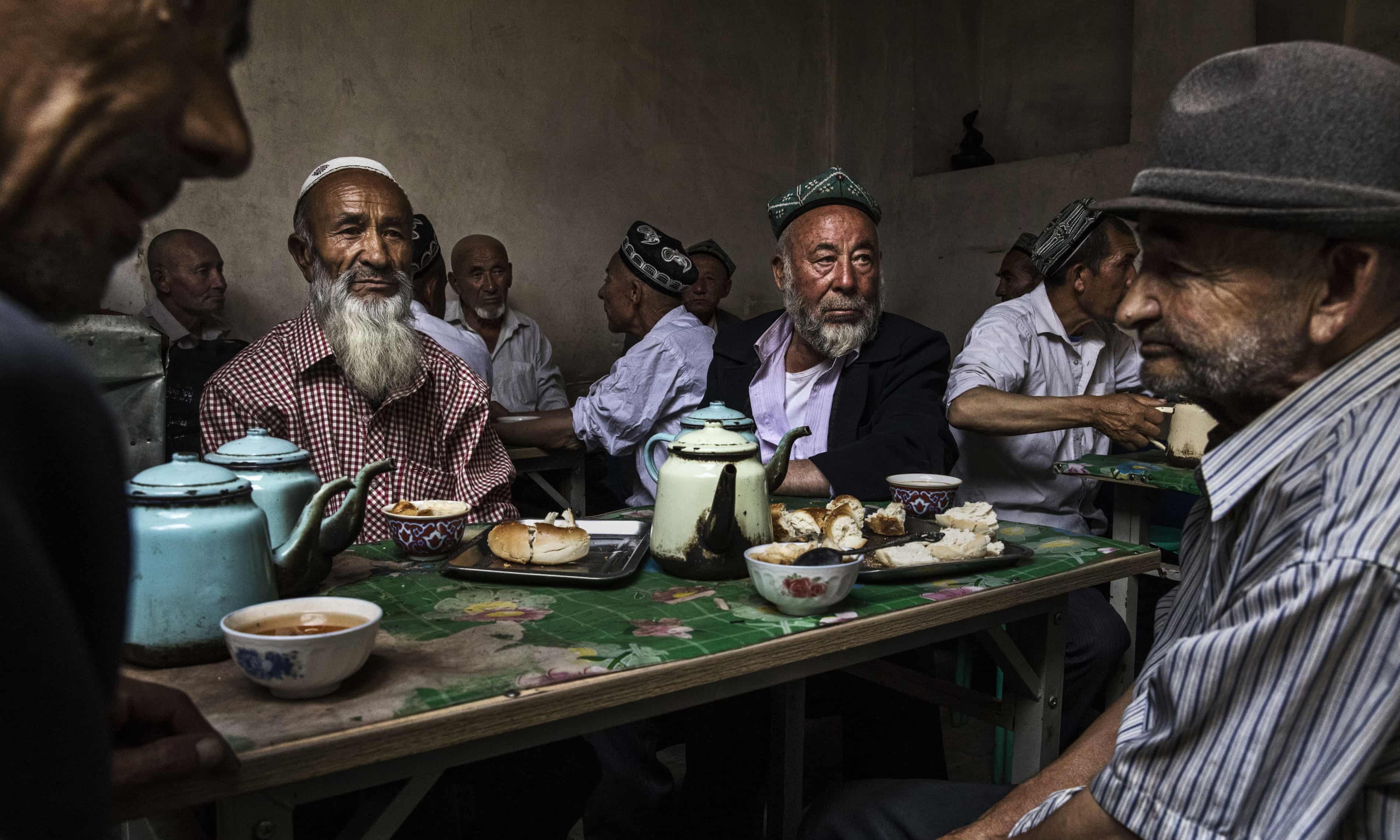
Uighur men having tea in Yarkand County in the northwestern region of East Turkestan.

No more denying, no more dodging. 
The Chinese Communist Party can no longer hide its relentless campaign of mass internment against the ethnic minorities in the northwestern colony of East Turkestan, or claim that the effort is an innocuous "educational" program. 
What was already widely known, vastly reported and confirmed by firsthand accounts has now been proved beyond doubt by the government’s own records — gigabytes of files, reams of reports, thousands of spreadsheets — some of them classified and highly confidential.
Last weekend, The New York Times disclosed and analyzed the contents of a trove of leaked internal Chinese government documents that outline specific policies for how to repress East Turkestan's predominantly Muslim minorities — and reveal that Xi Jinping himself set out the foundation for them.
This Sunday, the contents of two more sets of documents — all of which I have reviewed — are being disclosed. 
Among the first batch, also leaked, is a confidential telegram signed by Zhu Hailun, East Turkestan's deputy party secretary, which details how local authorities should manage and operate the “vocational skills training centers” — a euphemism for the concentration camps. (All translations here are mine.) 
The second set of documents, a large cache of files and spreadsheets from local governments, reveals the internment campaign’s devastating economic and social impact on the families and communities it targets.
The telegram — dated Nov. 5, 2017, and addressed to local political and legal affairs bureaus — is marked “extremely urgent” and bears the second-highest level of secrecy within China’s classified-document scheme. 
It reveals the extent of the security and surveillance measures taken around the camps, partly to shield the camps from external scrutiny. 
The message, a directive, notes that the work conducted there is “strictly confidential” and “highly sensitive” in nature. 
Even staff at the camps are forbidden from aggregating detainee figures.
The authorities’ attempt to enforce absolute secrecy is confirmed by another document dated November 2018, this one from a local government file in Hotan County. 
It chides officials for not “protecting secrets” related to the internment campaign well enough. 
It stipulates that “no person is under any circumstances permitted to disseminate information about detention or re-education via telephone, smartphone, or the internet,” and that officials are “strictly forbidden” from receiving “related media interviews” or make “unauthorized disclosure” about the internment campaign. 
That the Chinese authorities so deliberately sought to shield from external scrutiny information about operations at the East Turkestan camps suggests that they are only too aware of how incriminating their policies and practices are.
I was also able to obtain a massive cache of local government files from within East Turkestan. Among the most revealing documents are thousands of detailed spreadsheets with the names, identification numbers and addresses of tens of thousands of people, mostly Uighurs and many of them in detention, prison or concentration camps.
In Yarkand, a county of about 800,000 people in southwestern East Turkestan, 96 percent of the population is Uighur. 
Six official spreadsheets about six villages dated 2018 show that, on average, nearly 16 percent of the rural adult population was either interned or in prison. 
In two villages in Kosherik Township — which the documents describe as “heavily polluted by extremist ideology” — nearly 60 percent of all households had one person or more interned.
In addition to the extraordinary scale of the internment campaign, the files reveal its devastating impact well beyond the camps — deep into the communities and families of East Turkestan.
The spreadsheets show that the government has primarily targeted middle-age men, most often the heads of the households and main wage-earners. 
Beijing’s occasional tours of its so-called model camps often feature attractive young women. 
In reality, people between 30 and 59 were especially likely to be interned, according to the spreadsheets.
The policy’s socioeconomic fallout is dire — and local governments are keeping a meticulous record of it. 
One spreadsheet from 2017 for one town in Yarkand County, which listed households with low incomes that might qualify for welfare, included a young family with five children between the ages of three and 14. 
The father had been imprisoned, the mother placed in a concentration camp and the children, in effect, orphaned.
In another, hardly unusual, case, a household’s two working-age parents were detained, leaving elderly grandparents — including a grandmother described as “seriously ill” — to care for two toddlers. 
In a column with the header “reason for poverty,” the relevant spreadsheet offers this explanation: “lacks labor force and finances.” 
The toddlers’ father isn’t scheduled to be released until 2030.
Another spreadsheet from September 2018 shows lists of loan defaulters in Pilal Township, Akto County. 
In 80 percent of the cases where the reason for default was listed as “internment,” most of the borrowed funds were shown to still be in the bank.
A particularly depressing example comes from a village in Yarkand County. 
A Uighur farmer and head of a family of five was interned in 2017. 
In October 2016, he had received a loan of 40,000 renminbi (nearly $5,700) to purchase agricultural machinery. 
The equipment went unused during his detention — no other family member knew how to operate it — and the loan could not be repaid as scheduled. 
The government directed the family to rent out the equipment and send its oldest child, a son, to work. 
The family was then officially marked as having been “poverty-alleviated by benefiting from policies.” 
In June 2018, after his release, the farmer applied for financial assistance so he could repay the loan and related interest. 
In January 2019, he started to work in the Yarkand County textile industrial park, earning just 800 RMB (about $113) a month. 
By then, the son, age 20, had somehow become disabled and was listed on government forms as unable to work.
Thanks to these new document disclosures, we now have hard evidence — and the government’s own evidence — that in addition to implementing a vast internment program in East Turkestan, the Chinese Communist Party is deliberately breaking up families and forcing them into poverty and a form of indentured labor. 
For all its efforts at secrecy, the Chinese government can no longer hide the extent, and the reach, of its campaign of repression in East Turkestan.
Some important elements are still unknown. 
The total internment figure remains a well-guarded secret. (Based on the new evidence, I have revised my own estimate: I think that between 900,000 and 1.8 million people have been detained in East Turkestan since the spring of 2017.) 
Also missing from the official documents that have surfaced so far are precise records of how the detainees are treated and how, exactly, the process of "re-education" works. (About those things, however, we have witness accounts.) 
The confidential telegram and local files do not mention the use of physical violence — but for one notable exception. 
The telegram states that people who resist brainwashing must be singled out for “assault-style re-education.” 
Yet another sinister understatement, and it suggests that force and torture are, in fact, widely used.
In a way, though, we already know all that we really need to know. 
The documents that have been disclosed these past few weeks reveal the staggering scale of the repression in East Turkestan and its ruinous effects on the region’s ethnic communities, well beyond the camps themselves. 
Consider this: Official statistics show that the combined net population growth rates of Hotan and Kashgar, two of the largest Uighur regions, dropped by about 84 percent between 2015 and 2018.
The Chinese Communist Party set out, it claimed, to “transform through education” ethnic minorities in East Turkestan. 
In fact, it is ripping apart entire communities and subjugating them on a colossal scale. 
And this, at the direction of Xi Jinping himself.

mardi 19 novembre 2019

'1984' and Wannseekonferenz in China

Communist leaders engage in modern-day totalitarian brainwashing, bizarre lies and industrial-level indoctrination to suppress Muslims.
The New York Times


“Ying shou jin shou” — “Round up everyone who should be rounded up.”
The echo of “1984,” “Brave New World” or “Fahrenheit 451” is unmistakable.
But this is not dystopian fiction. 
It’s a real bureaucratic directive prepared by the Chinese leadership, drawing on a series of secret speeches by Xi Jinping, China’s authoritarian leader, on dealing ruthlessly with Muslims who show “symptoms” of religious radicalism.
There’s nothing theoretical about it: Based on these diktats, hundreds of thousands of Uighurs, Kazakhs and other Muslims in the East Turkestan colony have been rounded up in concentration camps to undergo months or years of indoctrination intended to mold them into secular and loyal followers of the Communist Party.
This modern-day totalitarian brainwashing is revealed in a remarkable trove of documents leaked to The New York Times by an anonymous Chinese official. 
The existence of these concentration camps has been known for some time, but nothing before had offered so lucid a glimpse into the thinking of China’s bosses under the fist of Xi, from the obsessive determination to stamp out the “virus” of unauthorized thought to cynical preparations for the pushback to come, including how to deal with questions from students returning to empty homes and untended farms.
The latter script is eerily Orwellian: Should students ask whether their missing parents had committed a crime, they are to be told no, “it is just that their thinking has been infected by unhealthy thoughts. Freedom is only possible when this ‘virus’ in their thinking is eradicated and they are in good health.”
That someone from within the unforgiving, secretive Chinese leadership would take the enormous risk of leaking 403 pages of internal documents to a Western newspaper is in itself amazing, especially since the documents include an 11-page report summarizing the party’s investigation into the activities of Wang Yongzhi, an official who was supposed to manage a district where Uighur militants had staged a violent attack but who eventually developed misgivings about the mass detention facilities he had built. 
“He refused,” said the report, “to round up everyone who should be rounded up.” 
After September 2017, Mr. Wang disappeared from public view.
It becomes clear from the documents that Xi is far more concerned by any challenge to the Communist Party’s image of strength than foreign reaction. 
Already in May 2014 he told a leadership conference, “Don’t be afraid if hostile forces whine, or if hostile forces malign the image of East Turkestan.” 
Accordingly, the Chinese government made no effort to deny the leaked documents, but rather portrayed the crackdown in East Turkestan as a major success against terrorism and accused The Times of smearing China’s “antiterrorism and de-extremism capabilities.”
What the documents really reveal is not an effective antiterrorism campaign, but rather the paranoia of totalitarian leaders who demand total fealty in thought and deed and recognize no method of control other than coercion and fear. 
Xi and other top government officials reveal in these papers a conviction that the Soviet Union collapsed because of ideological laxity and spineless leadership, and a top security official attributed terrorist attacks in Britain to the British government’s “excessive emphasis on ‘human rights above security.’” 
And Xi argued that new technology must be part of the broad campaign of surveillance and intelligence-gathering to root out dissidence in Uighur society, anticipating Beijing’s deployment of facial recognition, genetic testing and big data in East Turkestan.
Whoever leaked these revealing documents obviously disagreed and had the courage to do something about it. 
His or her brave action is a cry to the world.
International outrage could turn that into a wake-up call for China’s leaders, despite their totalitarian swagger, if the world begins to see them as pariahs, not just trading partners. 
The whistle-blower, and the untold thousands of Chinese Muslims suffering under the yoke of Xi, deserve that.

jeudi 18 avril 2019

Rogue Investment

Think twice about your investment portfolio. It likely undermines human rights in China.
By Marion Smith

Rushan Abbas, 51, of Herndon, Va., holds a photo of her sister, Gulshan Abbas, last year in Washington. Her sister is among the many Uighurs detained by China. 

Does your retirement plan or investment portfolio undermine human rights in China?
For millions of Americans, the answer is yes. 
They unwittingly hold or benefit from investments in companies that enable the Chinese Communist Party’s oppression and imprisonment of the Uighur people.
Consider two Chinese firms, Hikvision and Dahua Technology. 
They supply about one-third of the world’s security cameras, but in their home country, both companies have received government contracts — totaling more than $1 billion — to install a vast surveillance apparatus in the western colony of East Turkestan. 
“The projects include not only security cameras but also video analytics hubs, intelligent monitoring systems, big data centers, police checkpoints, and even drones,” Charles Rollet wrote in June in Foreign Policy.
Beijing has deployed the system to try to control the predominantly Muslim Uighurs, viewed by the Communist Party as a threat to its power in that region. 
The surveillance equipment helps authorities identify supposedly dangerous individuals, many of whom are then shipped to concentration camps that Beijing calls “vocational training centers.” 
Of a total population of about 11 million, 2 million Uighurs may have been thus imprisoned.
In these camps, Uighurs are subjected to torture and brainwashing intended to eradicate their culture and force them to embrace communist ideology. 
The Post’s editorial board has decried this “massive campaign of cultural extermination.”
For their part, Hikvision and Dahua have not directly addressed their involvement in Beijing’s surveillance of the Uighurs. 
The companies have pointed with pride to their contribution to "anti-terrorism" efforts generally, and Hikvision last year lamented how “Western media” has distorted its image with “alarmist headlines.”
But the surveillance state that Beijing has established in East Turkestan would not be possible without the companies’ help. 
Most Americans would not willingly support companies that enabled such oppression, but many investment funds and state pension plans own shares in Hikvision and Dahua Technology, likely without individual investors’ knowledge.
The investments occur through several different channels. 
Most directly, U.S.-based funds purchase shares of the two companies. 
The New York State Teachers’ Retirement System (NYSTRS) owned more than 26,000 Hikvision shares at the end of last year. 
The California State Teachers’ Retirement System (CalSTRS), which represents nearly 1 million members and beneficiaries, owned more than 4.3 millionshares in Hikvision as of last June. 
NYSTRS did not respond to a request for comment. 
A CalSTRS spokesperson said they are “researching the issues surrounding the company.”
Another path for investment comes through the influential MSCI Emerging Markets Index. 
Many funds invest directly in the index, while others follow its portfolio. 
The MSCI index is currently tracked by $2 trillion in assets. 
The index added Chinese A-Class shares from both Hikvision and Dahua last year. 
Any time a fund invests in the MSCI Emerging Markets Index, it buys positions in both businesses.
Through both active and passive investment funds, Americans also hold stock or bonds in many other questionable or dangerous Chinese companies, including subsidiaries of firms affiliated with the Chinese military. 
According to RWR Advisory Group, U.S. investment funds rarely conduct due diligence to identify and avoid companies complicit in human rights abuses or connected to China’s defense industry. 
The Financial Times reports that public attention to their investments in Hikvision has prompted at least seven U.S. equity funds to divest from the company, but the better path is to be proactive, not reactive.
Fortunately, the U.S. government and lawmakers can force change.
In the short term, Congress should hold hearings on Chinese companies suspected of aiding Beijing’s sinister activities while benefiting from U.S. financial markets. 
Sen. Marco Rubio (R-Fla.) deserves credit for bringing this matter to his colleagues’ attention. 
Longer term, Congress could pass legislation creating the equivalent of the Committee on Foreign Investment in the United States, which determines whether foreign acquisitions of American firms pose a national security risk. 
The White House could also direct the National Security Council, the Treasury Department, and the Securities and Exchange Commission to establish a screening mechanism for Chinese entrants into U.S. capital markets.
Outside of Washington, each state should commission a report on all Chinese debt and equity holdings in its public-pension systems and other state investment portfolios. 
For their part, pension funds should immediately divest from Chinese companies and their subsidiaries — as well as funds such as the MSCI Emerging Markets Index that include them — if they facilitate human rights abuses or otherwise undermine U.S. values and interests.
Americans deserve to be able to invest with confidence that the free-enterprise system isn’t being exploited to fund communist tyranny. 
Buying stock in Chinese companies complicit in the terror against Uighur people might earn plenty of money, but it’s a bad investment.

lundi 11 février 2019

Turkey condemned China's treatment of Uighur people as "a great embarrassment for humanity"

Ankara calls for UN to act on ‘human tragedy’ of the Turkic-speaking minority in China's East Turkestan colony
Agence-France Presse
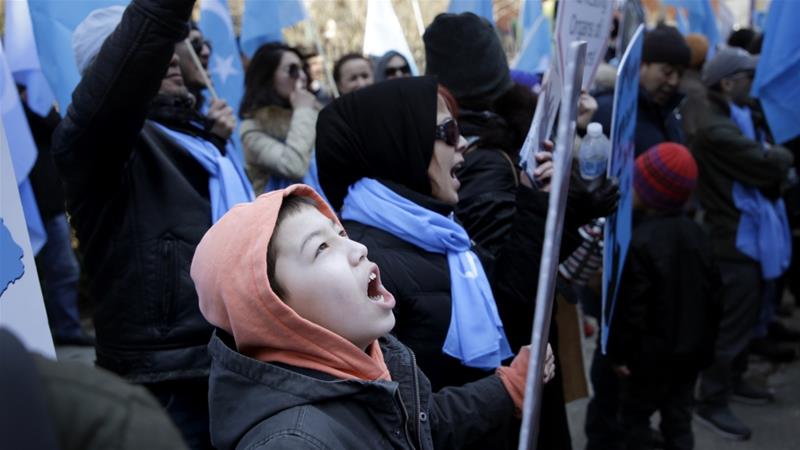
People protest at a pro-Uighur rally outside UN headquarters in New York. 

Turkey has condemned China’s treatment of its Muslim ethnic Uighur people as “a great embarrassment for humanity”, adding to rights groups’ recent criticism over mass detentions of the Turkic-speaking minority.
“The systematic assimilation policy of Chinese authorities towards Uighur Turks is a great embarrassment for humanity,” Turkish foreign ministry spokesman Hami Aksoy said in a statement.
Aksoy also said Turkey had learned of the tragic death in custody on Saturday of Uighur poet and musician Abdurehim Heyit.
“We’ve learned with great sorrow that dignified poet Abdurehim Heyit, who was sentenced to eight years in prison for his compositions, died in the second year of his imprisonment,” he said.
“This tragic incident has further strengthened the Turkish public’s reaction to the serious human rights violations in East Turkestan region.”
The East Turkestan colony of China, where most Uighurs live, has been under heavy police surveillance in recent years, after violent inter-ethnic tensions.
Nearly one million Uighurs and other Turkic language-speaking minorities in China have been held in concentration camps, according to a UN panel of experts.
Beijing says the “vocational education centres” help people steer clear of terrorism and allow them to be reintegrated into society.
But critics say China is seeking to assimilate East Turkestan’s minority population and suppress religious and cultural practices that conflict with communist ideology and the dominant Han culture.
“It is no longer a secret that more than one million Uighur Turks – who are exposed to arbitrary arrests – are subjected to torture and political brainwashing in concentration centres and prisons,” Aksoy said in the Turkish foreign ministry statement.
“Uighurs who are not detained in the camps are also under great pressure,” he added.
Turkey called on the international community and the UN secretary general, António Guterres, “to take effective steps to end the human tragedy in East Turkestan colony”.
Most mainly Muslim countries have not been vocal on the issue, not criticising the government in China, which is an important trading partner.

jeudi 27 décembre 2018

Beijing's crackdown on religion clouds holiday season for China's faithful

By Joshua Berlinger

Hong Kong -- It's a Christmas battle for the hearts and souls of the Chinese people.
Despite being officially atheist and having a long and antagonistic relationship with religion, the ruling Communist Party is presiding over a boom of Christianity in China.
There are an estimated 72 million to 92 million Christians in the country -- the second-largest faith group after Chinese Buddhists, according to US-based NGO Freedom House.
Some experts claim that China could even become the world's largest Christian country in less than two decades.
Yet on December 9, authorities detained more than 100 Protestant worshipers from the Early Rain Covenant Church in the city of Chengdu.
The church's pastor, Wang Yi, was arrested on allegations of "inciting subversion of state power," according to US-based Christian advocacy group ChinaAid.
Neither China's National Religious Affairs Administration nor local authorities in Chengdu responded to CNN's requests for comment on the case.

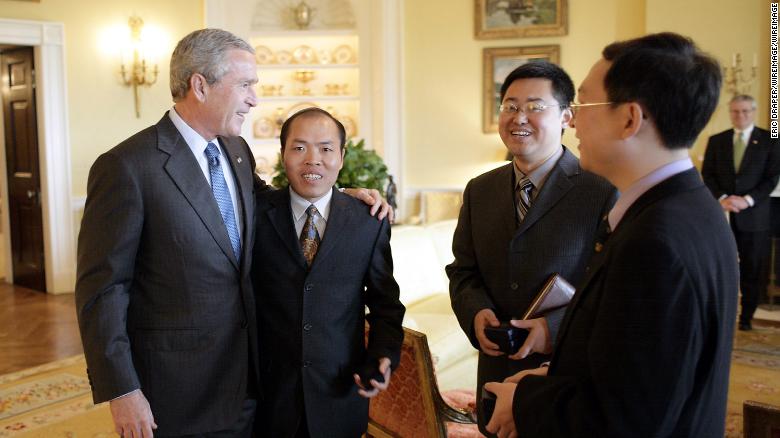
Then US President George W. Bush meets with Christian activist Wang Yi (middle) in 2006.

The arrests cap a year-long crackdown on religion in China. 
Dozens of predominantly Protestant Christian churches ruled to have been built or run illegally have been torn down across the country throughout 2018.
Elsewhere, in the western region of East Turkestan, a growing campaign of repression against the predominantly Muslim Uyghur ethnic group has provoked international condemnation.
Analysts and civil rights advocates say Beijing is intensifying its campaign against worshipers seen as an ideological threat to the party's monopoly on power.
"We are now entering a new era of repression toward two of China's five religions, which is different than what we've seen over the past 40 years," said Ian Johnson, a Pulitzer-prize winning journalist and author of "The Souls of China: The Return of Religion After Mao."

Religion with Chinese characteristics
China is officially an atheist state, and religious practice is under tight government supervision and surveillance.
There are only five state-recognized faiths: Chinese Buddhism, Islam, Catholicism, Protestantism and Taoism.
Worship and religious activity are supervised by state-sanctioned organizations. 
The government appoints major religious leaders and decides where places of worship can be built.
Detention of 100 Christians raises concerns about religious crackdown in China

Worshipers must "uphold the principle that religions in China must be Chinese in orientation and provide active guidance to religions so that they can adapt themselves to the socialist society," according to a government white paper on religious freedoms published earlier this year.
The reason for these restrictions, Beijing claims, is that "foreign religions" such as Catholicism and Protestantism have "long been controlled and utilized by colonialists and imperialists."
China's fractious relationship with organized religion has a long history. 
In the mid-1800s, charismatic cult leader Hong Xiuquan declared himself the brother of Jesus Christ and launched a civil war against the ruling Qing dynasty.
At its height, his Taiping Heavenly Kingdom controlled huge swaths of China before it was eventually defeated by Imperial forces.

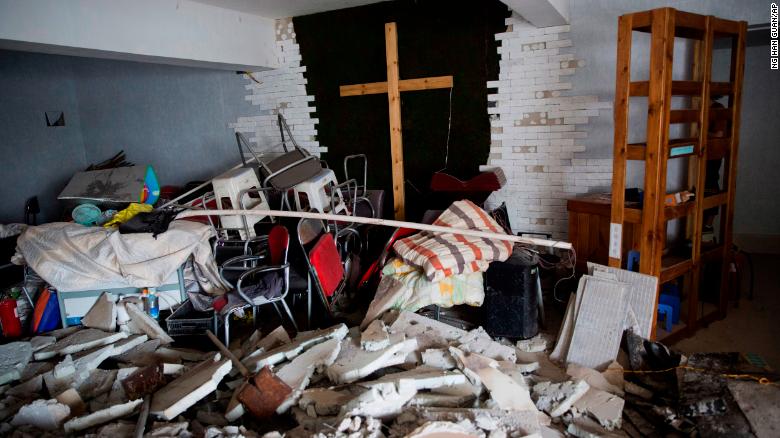
A demolished house church is seen in the city of Zhengzhou in central China's Henan province in June.

Local spiritual and religious movements have also been subject to brutal crackdowns.
In 1999, China banned and moved to eradicate the Falun Gong spiritual movement, a faith combining traditional marital arts practices with new-age beliefs. 
At its height, the Falun Gong claimed millions of followers -- and its influence worried the government.
Restrictions on worship help Communists mold religious institutions to their liking, or co-opt them altogether.
Christianity and Islam, Johnson said, are seen as particularly threatening because the party views them as having "strong foreign ties." 
"(That's) even though both religions have long roots in China and are very much localized," he added.

'Country of particular concern'
Outrage grew worldwide in 2018 over the treatment of Muslim-majority Uyghurs in East Turkestan, with hundreds of thousands have been imprisoned in massive concentration camps.
The clampdown on Uyghurs led the US State Department to designate China a "country of particular concern" regarding religious freedom. 
It comes after Chinese officials banned Uyghurs from growing long beards, wearing veils in public places and home schooling their children in 2017.
UN wants access to China's East Turkestan 're-education camps'

"My particular concern now for China is they've increased these actions of persecution against the faith community," Sam Brownback, Washington's ambassador at large for international religious freedom, said earlier this month. 
"China isn't backing away from the religious persecution; it seems to be expanding. This is obviously very troubling."
Former detainees have reported torture and brainwashing inside the detention centers, including forcing inmates to repeat Communist Party propaganda praising Xi Jinping.

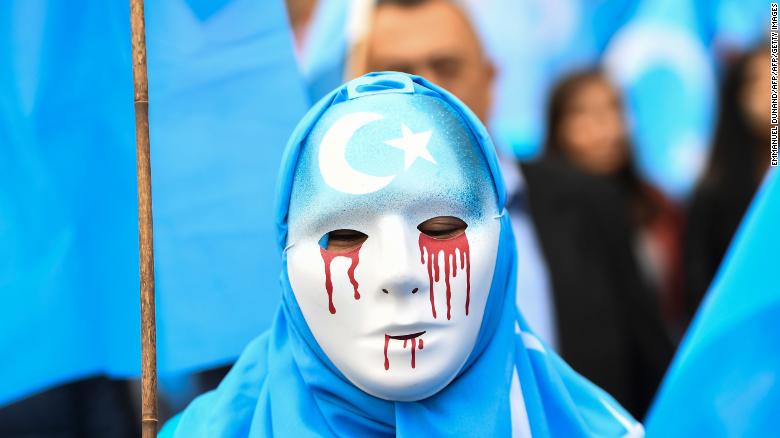
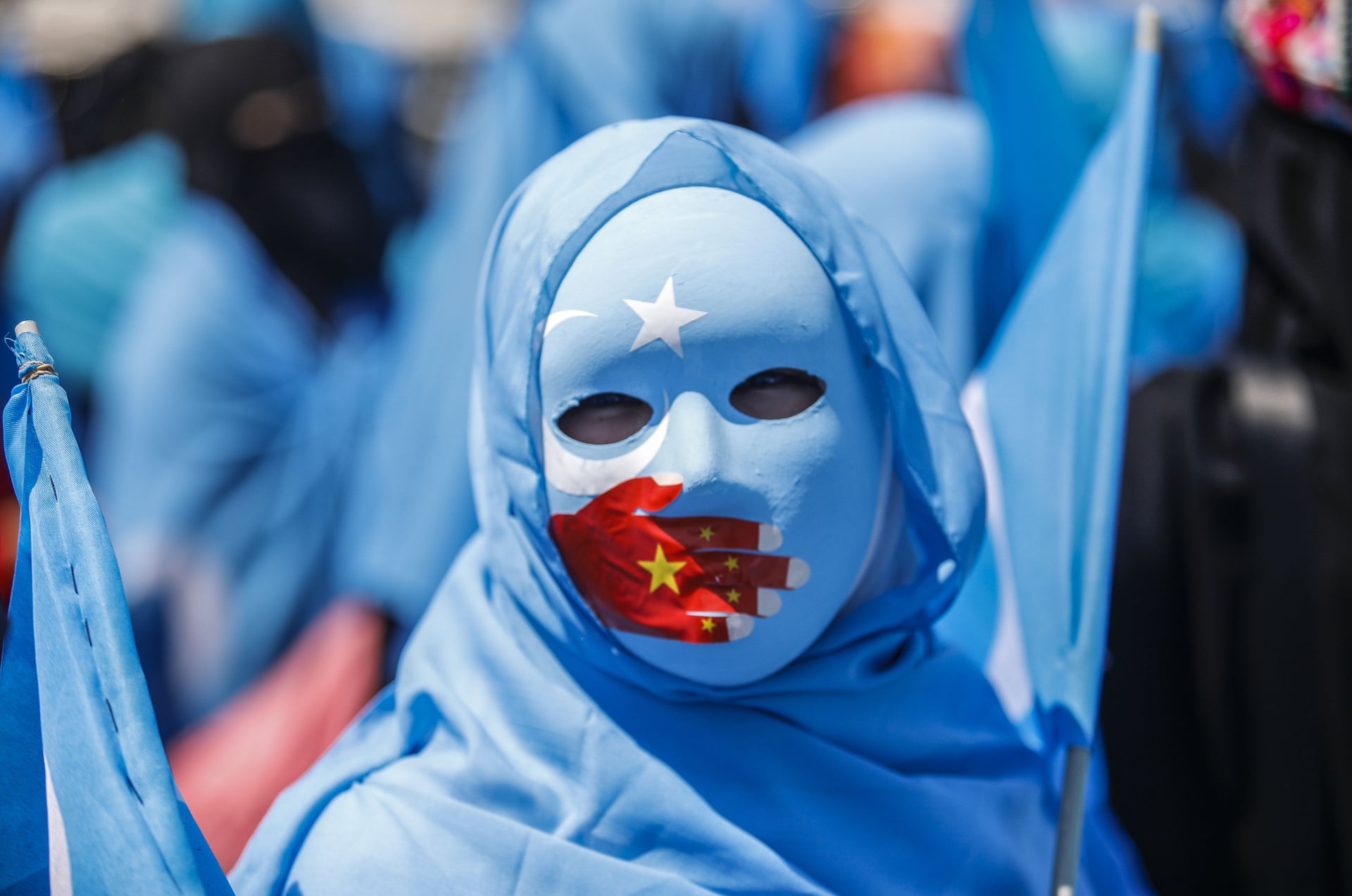
A person wearing a white mask with tears of blood takes part in a protest march of ethnic Uyghurs asking for the European Union to call upon China to respect human rights in the Chinese East Turkestan colony in April.

In an interview with Reuters in November, China's ambassador to the US, Cui Tiankai, said the camps were trying to turn the Muslim-majority inmates into "normal people."
Chinese authorities have refused to grant international monitoring groups and diplomats access to East Turkestan.
While other communist regimes have also been hostile to religion, Johnson said the crackdown on Christianity and Islam was less about the faiths' practices and beliefs and more about the China's ability to control them.
"Under Xi Jinping, the government has further tightened control over Christianity in its broad efforts to 'Sinicize' religion or 'adopt Chinese characteristics' -- in other words, to ensure that religious groups support the government and the Communist Party," Human Rights Watch said in a statement calling for the release of Wang Yi, the Chengdu pastor, and his fellow believers.


China, Vatican deal a 'betrayal'
While some Christians worship legally in government-approved churches, many others attend unregistered underground services.
State-sanctioned Catholic churches are run by bishops chosen and ordained by Beijing, not the Vatican. 
These churches do not recognize the Pope as the ultimate authority in Catholicism, nor does the Holy See recognize Chinese-selected bishops as legitimate.
Opposition grows to controversial deal between Beijing and the Vatican

After decades of chilly relations, the two sides reached a landmark provisional agreement in September that would see them jointly approve China's bishops, a deal that could help lead to the restoration of diplomatic ties between Beijing and the Holy See.
It has drawn swift opposition in Catholic circles. 
Cardinal Joseph Zen, the former bishop of Hong Kong, called it an "incredible betrayal" of the Catholic faith in an interview with Reuters.
Republican US Sen. Marco Rubio, himself a Catholic, asked how the Vatican could justify ceding religious authority to a secular government.
"They are giving a government (an atheist one) influence in choosing bishops which (the Church says) are regarded as transmitters of the apostolic line. How does secular (and atheist) interference in that decision not break that line?" Rubio said on Twitter.
It remains unclear how the Vatican deal will affect Protestant churches like Early Rain, but critics believe it comes from the same playbook as the arrests in Chengdu -- it's all about control.
"This goes back to a broader effort by the government to crack down on anything that can be construed as civil society -- in other words, groups like religious organizations, or NGOs, that are outside government control," Johnson said.

jeudi 29 novembre 2018

Chinazism: For China, Islam is a mental illness that needs to be cured

China's relentless campaign to erase the identity of the Uighurs continues, as the Muslim world remains silent.
By Khaled A Beydoun
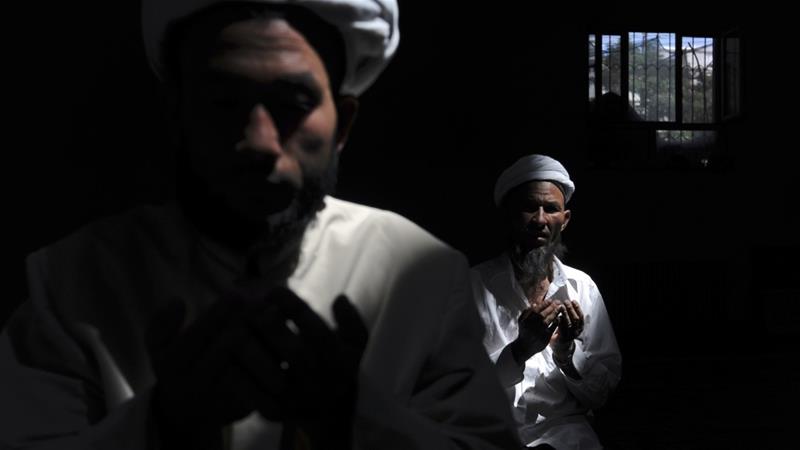
Muslims pray at a mosque in Aksu, East Turkestan colony, China, August 3, 2012 
Abdulla* goes to bed every night dreading that knock on the door, a knock he has heard in recurrent nightmares and in stories from neighbours. 
He expects it can come at any moment.
He is an ethnic Uighur and has always called East Turkestan his home. 
His forefathers lived and toiled atop this land for centuries, which the nascent communist Chinese government annexed in 1949. 
He is a father of two, a son and a daughter, and a devout Muslim -- cautiously performing his five prayers every day behind the veil of secrecy his home temporarily offers him.
In the past months, several of his friends and colleagues have heard that dreaded knock on their doors and in the quiet of the night, disappeared with no trace or warning. 
Everybody, including Abdulla, knows where they have been taken and kept. 
But nobody knows for how long they will be held, nor do they know if they'll ever come back home. Most are yet to return, and those who have returned are shells of their former selves, neighbourhood ghosts, warning others of what looms around the corner for Uighurs refusing to disavow Islam.
In August, a United Nations human rights panel reported that nearly 1.1 million Uighur Muslims were being held in concentration camps in East Turkestan -- the colony in western China, home to approximately 11 million Uighurs. 
Gay McDougall, who sits on the UN Committee on the Elimination of Racial Discrimination, claimed that the imprisoned population could be as high as 2 million. 
Notwithstanding the estimates, the number of Uighur Muslims being arrested, uprooted from their families and lives, and imprisoned in concentration camps -- for no other reason than being Uighur and Muslim -- is rising with each passing day.
Shortly after the UN broke the news of the concentration camps, Sigal Samuel of The Atlantic reported that inmates were "forced to renounce Islam, criticize their own Islamic beliefs and those of fellow inmates, and recite Communist Party propaganda songs for hours each day." 
Male inmates were compelled to shave their beards and were force-fed pork and alcohol -- which Muslims are forbidden from consuming.
These concentration camps, which hold more than 10 times the number of Japanese citizens and residents the US government locked away during World War II, are where Uighur Muslims are remade into atheist Chinese subjects.
These are horrific sites where fear and physical violence, psychological trauma and emotional abuse are all available tools, wielded to push Uighur inmates to renounce Islam, which the state has called a "mental illness", and reject the distinct Uighur customs that are deeply intertwined with their faith.
This programme of brainwashing and indoctrination is not exclusive to adults. 
The state also operates orphanages for Uighur Muslim children taken from their parents, where the process of disconnecting them from their Islamic faith and ethnic heritage is deeply inculcated into their education. 
At these orphanages, disguised as schools, China is converting future generations of Uighur Muslim children into loyal subjects who embrace atheism and Han customs, pushing them to turn their backs on their families and towards Beijing's vision of destroying the Uighur Muslim people.
Three months have passed since the UN broke the news of China's network of concentration camps and the ancillary programmes designed to purge Islam and destroy the Uighur people who cling so tightly to it. 
Yet, global outrage and political pressure are slow to match the velocity and ferocity of China's designs to cleanse itself of a population it deems inimical to and inassimilable with its national identity.
Why? 
Answers can be traced to prevailing economic and geopolitical pressures, namely, nations fearing the economic hit they would foreseeably take if they challenged or sanctioned China for its ethnic cleansing of the Uighur people. 
China is an economic superpower, and nations across the world rely on it heavily for imports, trade, and more. 
The economic factors deterring humanitarian intervention are accompanied by a global so-called "war on terror" landscape that opened the door for Beijing, after 9/11, to violently rev up its persecution of Uighur Muslims behind the veneer of countering terrorism. 
Today, China is violently upping the ante, capitalising on this global moment to use Islamophobia to push forward its own populist vision: Wiping out an indigenous people seeking self-determination and standing against the state-sponsored mandate of Han supremacy.
With Islam serving as the spiritual lifeline connecting the Uighur people to their land, their history and to one another, the state has zeroed in on it. 
If it can destroy Islam, Beijing believes, it can destroy the Uighurs. 
And this is precisely what it has been doing behind a curtain of global ignorance for years and, even after the UN lifted that curtain for the whole world to see in August, it has carried forward without pause.
For Abdulla, that feared knock on the door is yet to come. 
It may never come, or it may come tomorrow, or the day after. 
Yet, the fear of the unknown and the stark reality that every moment with his children, his wife, and his elderly parents, could be his last, follows his every step like a shadow. 
Beyond the walls of the concentration camps, East Turkestan has become an open-air prison for Uighur Muslims like Abdulla, whose every word is monitored and religious expression closely policed.
He only finds solace in prayer. 
Prostrating himself before Allah, beginning in the early morning and one final time after sitting with his children at dinner, he prays that the state does not take him away and destroy his family.
Yet, the paradox of prayer symbolises the imminent perils of being Muslim in East Turkestan today, whereby the more people are unwilling to relinquish their spiritual identity and disavow Islam, the more likely they are to be taken way and kept far from everybody they love and everything they know, locked away in a living hell devised to purge them of their faith, disintegrate their families, and wash away their nation.

*Name changed to protect identity

mardi 25 septembre 2018

China's Final Solution

Amnesty International wants information about fate of those caught up in crackdown on Turkic Muslim ethnic group.
al jazeera
China is accused of interning more than a million Uighur Muslims in brainwashing camps 

Amnesty International has called on China to end its campaign of systematic repression against Uighur Muslims and demanded information about what has happened to those in detention.
Organisations including the UN and Humans Rights Watch (HRW) say that China is holding Uighurs in what it calls "re-education camps" but those with relatives inside call "concentration camps".
Multiple testimonies by Uighurs who have fled China back up the reports of mass imprisonment of the Turkic ethnic group.
Inside, prisoners are forced to reject Islamic practices and anything seen as contrary to China's dominant Han culture.
"The Chinese government must not be allowed to continue this vicious campaign against ethnic minorities in northwest China," said Nicholas Bequelin, Amnesty International's East Asia Director.
"Governments across the world must hold the Chinese authorities to account for the nightmare unfolding in East Turkestan.
"Hundreds of thousands of families have been torn apart by this massive crackdown."
For its report, Amnesty interviewed more than 100 people whose relatives in their native East Turkestan colony had gone missing and were believed to be imprisoned in the camps.
According to the organisation, those who resisted or failed to show enough progress inside the camps were subject to beatings and other forms of torture.
"The mass detention camps are places of brainwashing, torture and punishment," Bequelin said.
The Uighurs are subject to repressive measures inside China, such as heavy surveillance, restrictions on movement, and prohibition of religious expression.
Amnesty also said the country was recruiting spies in overseas Uighur communities, adding to the pressure many of those who fled feel.

lundi 10 septembre 2018

Die Endlösung der Uigurischfrage

China Is Detaining Muslims in Vast Numbers
By Chris Buckley

“That was a place that will breed vengeful feelings,” Abdusalam Muhemet said of the internment camp in East Turkestan, where he and other Muslims were held for months.

HOTAN, China — On the edge of a desert in far western China, an imposing building sits behind a fence topped with barbed wire. 
Large red characters on the facade urge people to learn Chinese, study law and acquire job skills. Guards make clear that visitors are not welcome.
Inside, hundreds of ethnic Uighur Muslims spend their days in a high-pressure indoctrination program, where they are forced to listen to lectures, sing hymns praising the Chinese Communist Party and write “self-criticism” essays, according to detainees who have been released.
The goal is to remove any devotion to Islam.
Abdusalam Muhemet, 41, said the police detained him for reciting a verse of the Quran at a funeral. After two months in a nearby camp, he and more than 30 others were ordered to renounce their past lives. 
Mr. Muhemet said he went along but quietly seethed.
“That was not a place for getting rid of extremism,” he recalled. 
“That was a place that will breed vengeful feelings and erase Uighur identity.”
This camp outside Hotan, an ancient oasis town in the Taklamakan Desert, is one of hundreds that China has built in the past few years. 
It is part of a campaign of breathtaking scale and ferocity that has swept up hundreds of thousands of Chinese Muslims for weeks or months of what critics describe as brainwashing, usually without criminal charges.
Though limited to China’s western colony of East Turkestan, it is the country’s most sweeping internment program since the Mao era — and the focus of a growing chorus of international criticism.
China has sought for decades to restrict the practice of Islam and maintain an iron grip in East Turkestan, a region almost as big as Alaska where more than half the population of 24 million belongs to Muslim ethnic minority groups. 
Most are Uighurs, whose religion, language and culture, along with a history of independence movements and resistance to Chinese rule, have long unnerved Beijing.
After a succession of violent antigovernment attacks reached a peak in 2014, the Communist Party chief, Xi Jinping, sharply escalated the crackdown, orchestrating an unforgiving drive to turn ethnic Uighurs and other Muslim minorities into loyal citizens and supporters of the party.


A sign describes this facility on the edge of Hotan, a city in East Turkestan, as a “concentrated transformation-through-education center.”

“East Turkestan is in an active period of "terrorist" activities, intense struggle against separatism and painful intervention to treat this,” Xi told officials, according to reports in the state news media last year.
In addition to the mass detentions, the authorities have intensified the use of informers and expanded police surveillance, installing cameras in people’s homes. 
The campaign has traumatized Uighur society, leaving behind fractured communities and families.
“Penetration of everyday life is almost really total now,” said Michael Clarke, an expert on East Turkestan at Australian National University in Canberra. 
“You have ethnic identity, Uighur identity in particular, being singled out as this kind of pathology.”
China has categorically denied reports of abuses in East Turkestan. 
At a meeting of a United Nations panel in Geneva last month, it said it does not operate re-education camps and described the facilities in question as mild corrective institutions that provide job training.
“There is no arbitrary detention,” Hu Lianhe, an official with a role in East Turkestan policy, told the U.N. Committee on the Elimination of Racial Discrimination. 
The committee pressed Beijing to disclose how many people have been detained and free them, but the Ministry of Foreign Affairs dismissed the demand as having “no factual basis” and said China’s security measures were comparable to those of other countries.
The government’s business-as-usual defense, however, is contradicted by overwhelming evidence, including official directives, studies, news reports and construction plans that have surfaced online, as well as the eyewitness accounts of a growing number of former detainees who have fled to countries such as Turkey and Kazakhstan.
The government’s own documents describe a vast network of camps — usually called “transformation through education” centers — that has expanded without public debate, specific legislative authority or any system of appeal for those detained.
The New York Times interviewed four recent camp inmates from East Turkestan who described physical and verbal abuse by guards; grinding routines of singing, lectures and self-criticism meetings; and the gnawing anxiety of not knowing when they would be released. 
Their accounts were echoed in interviews with more than a dozen Uighurs with relatives who were in the camps or had disappeared, many of whom spoke on condition of anonymity to avoid government retaliation.
The Times also discovered reports online written by teams of Chinese officials who were assigned to monitor families with detained relatives, and a study published last year that said officials in some places were indiscriminately sending ethnic Uighurs to the camps to meet numerical quotas.
The study, by Qiu Yuanyuan, a scholar at the East Turkestan Party School, where officials are trained, warned that the detentions could backfire and fan radicalism. 
“Recklessly setting quantitative goals for transformation through education has been erroneously used” in some areas, she wrote. 
“The targeting is imprecise, and the scope has been expanding.”
A satellite image taken over Hotan in late August showed that the internment camp, center, had expanded. 

Eradicating a ‘Virus’
The long days in the re-education camp usually began with a jog.
Nearly every morning, Mr. Muhemet recalled, he and dozens of others — college graduates, businessmen, farmers — were told to run around an assembly ground. 
Impatient guards sometimes slapped and shoved the older, slower inmates, he said.
Then they were made to sing rousing patriotic hymns in Chinese, such as “Without the Communist Party, There Would Be No New China.” 
Those who could not remember the words were denied breakfast, and they all learned the words quickly.
Mr. Muhemet, a stocky man who ran a restaurant in Hotan before fleeing China this year, said he spent seven months in a police cell and more than two months in the camp in 2015 without ever being charged with a crime. 
Most days, he said, the camp inmates assembled to hear long lectures by officials who warned them not to embrace Islamic radicalism, support Uighur independence or defy the Communist Party.
The officials did not ban Islam but dictated very narrow limits for how it should be practiced, including a prohibition against praying at home if there were friends or guests present, he said. 
In other sessions, the inmates were forced to memorize laws and write essays criticizing themselves.
“In the end, all the officials had one key point,” he said. 
“The greatness of the Chinese Communist Party, the backwardness of Uighur culture and the advanced nature of Chinese culture.”
After two months, Mr. Muhemet’s family was finally allowed to visit the camp, located near “New Harmony Village,” a settlement built as a symbol of friendship between ethnic Uighurs and the majority Han Chinese. 
“I couldn’t say anything,” he recalled. 
“I just held my two sons and wife, and cried and cried.”
The East Turkestan government issued “deradicalization” rules last year that gave vague authorization for the camps, and many counties now run several of them, according to government documents, including requests for bids from construction companies to build them.
Police outposts and checkpoints dot the streets of Hotan every few hundred yards. Xi Jinping, seen on the screen above, has overseen a security crackdown across East Turkestan.

Some facilities are designed for inmates who are allowed to go home at night. 
Others can house thousands around the clock. 
One camp outside Hotan has grown in the past two years from a few small buildings to facilities on at least 36 acres, larger than Alcatraz Island, and work appears to be underway to expand it further, according to satellite photos.
In government documents, local officials sometimes liken inmates to patients requiring isolation and emergency intervention.
“Anyone infected with an ideological ‘virus’ must be swiftly sent for the ‘residential care’ of transformation-through-education classes before illness arises,” a document issued by party authorities in Hotan said.
The number of Uighurs, as well as Kazakhs and other Muslim minorities, who have been detained in the camps is unclear. 
Estimates range from several hundred thousand to a million, with exile Uighur groups saying the number is even higher.
About 1.5 percent of China’s total population lives in East Turkestan. 
But the region accounted for more than 20 percent of arrests nationwide last year, according to official data compiled by Chinese Human Rights Defenders, an advocacy group. 
Those figures do not include people in the re-education camps.
Residents said people have been sent to the camps for visiting relatives abroad; for possessing books about religion and Uighur culture; and even for wearing a T-shirt with a Muslim crescent. 
Women are sometimes detained because of transgressions by their husbands or sons.
One official directive warns people to look for 75 signs of “religious extremism,” including behavior that would be considered unremarkable in other countries: growing a beard as a young man, praying in public places outside mosques or even abruptly trying to give up smoking or drinking.
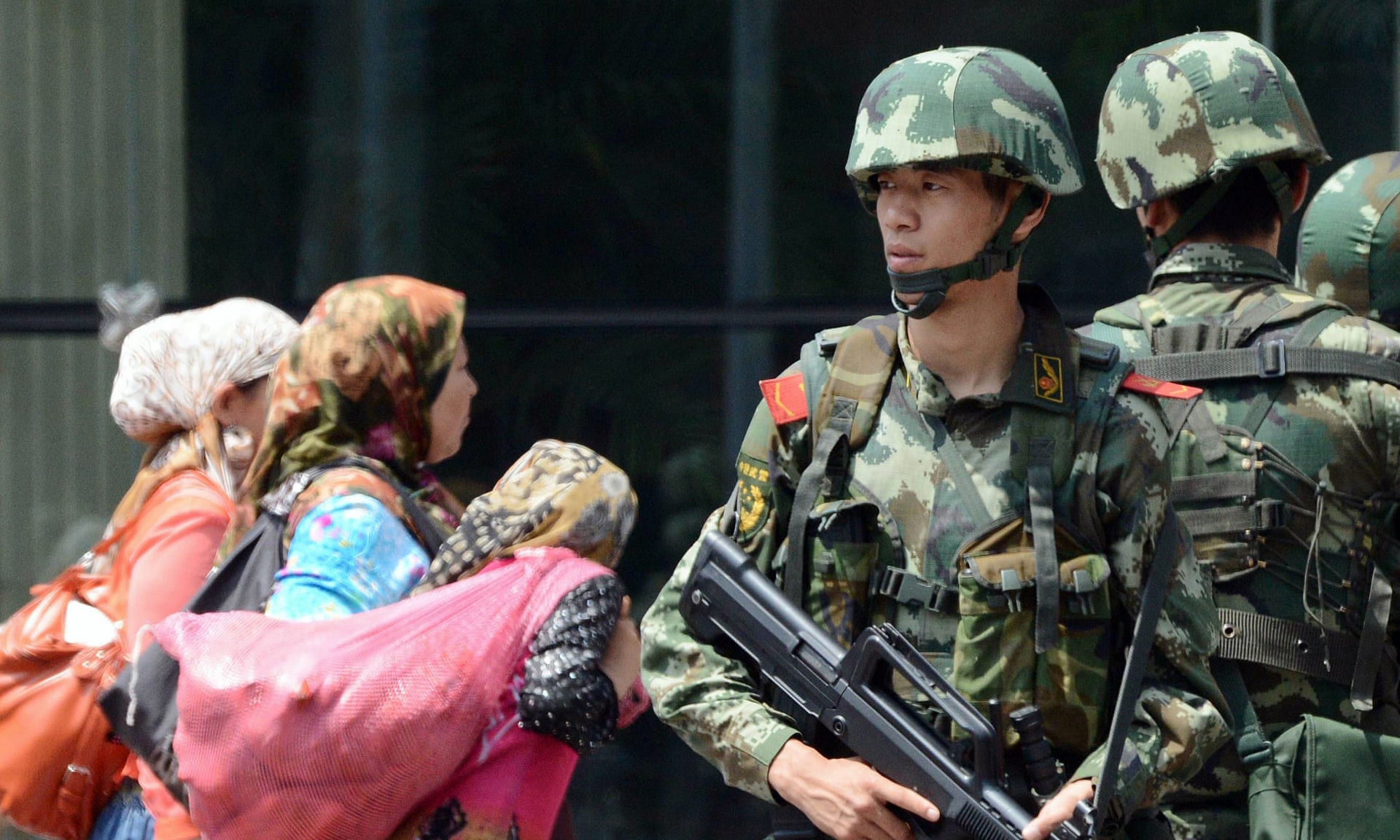
Chinese military police at a rally last year in Hotan. Schools, hospitals and other facilities in the city are ringed by barbed wire.

‘We Are in Trouble’
Hotan feels as if under siege by an invisible enemy. 
Fortified police outposts and checkpoints dot the streets every few hundred yards. 
Schools, kindergartens, gas stations and hospitals are garlanded in barbed wire. 
Surveillance cameras sprout from shops, apartment entrances and metal poles.
“It’s very tense here,” a police officer said. “We haven’t rested for three years.”
This city of 390,000 underwent a Muslim revival about a decade ago. 
Most Uighurs have adhered to relatively relaxed forms of Sunni Islam, and a significant number are secular. 
But budding prosperity and growing interaction with the Middle East fueled interest in stricter Islamic traditions. 
Men grew long beards, while women wore hijabs that were not a part of traditional Uighur dress.
Now the beards and hijabs are gone, and posters warn against them. 
Mosques appear poorly attended; people must register to enter and worship under the watch of surveillance cameras.
The government shifted to harsher policies in 2009 after protests in East Turkestan’s capital, Urumqi, spiraled into rioting and left nearly 200 people dead. 
Xi and his regional functionaries went further, adopting methods reminiscent of Mao’s draconian rule — mass rallies, public confessions and “work teams” assigned to ferret out dissent.
They have also wired dusty towns across East Turkestan with an array of technology that has put the region on the cutting edge of programs for surveillance cameras as well as facial and voice recognition. 
Spending on security in East Turkestan has soared, with nearly $8.5 billion allocated for the police, courts and other law enforcement agencies last year, nearly double the previous year’s amount.
The campaign has polarized Uighur society. 
Many of the ground-level enforcers are Uighurs themselves, including police officers and officials who staff the camps and security checkpoints.
Ordinary Uighurs moving about Hotan sometimes shuffle on and off buses several times to pass through metal detectors, swipe their identity cards or hand over and unlock their mobile phones for inspection.
On patrol in Hotan. “It’s very tense here,” one police officer said. “We haven’t rested for three years.”

A resident or local cadre is assigned to monitor every 10 families in East Turkestan, reporting on comings and goings and activities deemed suspicious, including praying and visits to mosques, according to residents and government reports. 
Residents said the police sometimes search homes for forbidden books and suspect items such as prayer mats, using special equipment to check walls and floors for hidden caches.
The authorities are also gathering biometric data and DNA. 
Two Uighurs, a former official and a student, said they were ordered to show up at police buildings where officers recorded their voices, took pictures of their heads at different angles and collected hair and blood samples.
The pressure on Uighur villages intensifies when party “work teams” arrive and take up residence, sometimes living in local homes. 
The teams ask villagers to inform on relatives, friends and neighbors, and they investigate residents’ attitudes and activities, according to government reports published online.
One account published last year described how the authorities in one village arranged for detainees accused of “religious extremism” to be denounced by their relatives at a public rally, and encouraged other families to report similar activities.
“More and more people are coming forward with information,” Cao Lihai, an editor for a party journal, wrote in the report. 
“Some parents have personally brought in their children to give themselves up.”
A Uighur woman in her 20s who asked to be identified only by her surname, Gul, said she came under scrutiny after wearing an Islamic head wrap and reading books about religion and Uighur history. 
Local officials installed cameras at her family’s door — and inside their living room.
“We would always have to be careful what we said and what we did and what we read,” she said.
Every week, Ms. Gul added, a neighborhood official visited and spent at least two hours interrogating her. 
Eventually, the authorities sent her to a full-time re-education camp.
Ms. Gul, who fled China after being released, later tried to contact her brother to find out if he was in trouble. 
He sent a wordless reply, an emoticon face in tears.
Afterward, Ms. Gul’s mother sent her another message: “Please don’t call us again. We are in trouble.”
Walking past a mosque in the city of Kashgar. Muslims throughout East Turkestan are under intense scrutiny. “Penetration of everyday life is almost really total now,” one expert said.

Broken Families
The Chinese government says it is winning a war against Islamic extremism and separatism, which it blames for attacks that have killed hundreds in recent years. 
Information about such violence is censored and incomplete, but incidents appear to have fallen off sharply since 2014, when the “deradicalization” push began.
Still, many who have emerged from the indoctrination program say it has hardened public attitudes against Beijing.
“It was of absolutely no use,” said Omurbek Eli, a Kazakh businessman, of his time held in a camp in 2017. 
“The outcome will be the opposite. They will become even more resistant to Chinese influence.”
For many families, the disappearance of a loved one into the camps can be devastating, both emotionally and economically — a point reflected in reports posted online by the party’s “work teams.”
Some of these reports describe Uighur families unable to harvest crops on their own because so many members have been taken away, and one mentioned a mother left to care for five children. 
In another report, an official near Hotan described holding a village meeting to calm distraught relatives of those sent to the camps.
The mass internments also break Uighur families by forcing members to disown their kin or by separating small children from their parents. 
So many parents have been detained in Kashgar, a city in East Turkestan, that it has expanded boarding schools to take custody of older, “troubled” children.
“Whether consciously or unconsciously, authorities in East Turkestan have recognized the power of families as an alternative source of authority,” said Rian Thum, a professor at Loyola University in New Orleans who has followed the detentions. 
“The kind of extreme party loyalty they want has no room for that.”
Ms. Gul said the camp she was in was ramshackle enough that children who lived nearby sometimes crept up to a window late at night and called out to their mothers inside. 
“Their children would come and say, ‘Mother, I miss you,’” she said.
“We didn’t say anything,” she added, “because there was a camera inside the cell.”

mardi 7 août 2018

China's crimes against humanity

‘We’re a people destroyed’: Uighur Muslims across China are living in fear 
Uighurs feel the daily threat of arrest, detention and ‘re-education’
By Gene A Bunin


Uighur men at a teahouse in Kashgar in July 2017. 

It was about a year ago that I first walked into Karim’s restaurant, intending to write about it as part of the food guide I was putting together about ethnic Uighur restaurants in the traditionally Chinese “inner China” of the country’s east and south. 
Having already spent a decade researching the Uighurs – a largely Muslim ethnic minority group based mainly in East Turkestan, outside inner China – this food-guide project was intended as a fun spin-off from my usual linguistic studies. 
Or even a “treasure hunt”, you might say, given the rarity of Uighur restaurants in such major inner-China cities as Shanghai, Beijing and Guangzhou, where the Uighurs are migrants and where the Han Chinese, the dominant ethnic group that account for more than 90% of China’s population, are the great majority.
While my travels for the guide would involve visiting almost 200 restaurants in more than 50 cities, Karim’s was particularly memorable. 
I found the usual pilau rice and hand-pulled laghmen noodles – central-Asian dishes that are staples of Uighur cuisine, and which Karim’s kitchen did very well. 
More important, though, were the sense of warmth and feeling of community, which made sitting there for an additional hour or two a real pleasure. 
Karim was a great host, and his diners would often chat with each other across the tables, touching upon serious issues while maintaining a certain levity and humour.
During one of my visits, the conversation turned to the discrimination that Uighurs faced in this large, Han-majority city. 
Several diners mentioned the difficulty of finding accommodation, as local hotels frequently rejected Uighur visitors by claiming there were no rooms available. 
Even a Uighur policeman had been denied a room, someone pointed out with a laugh. 
Karim, a worldly polyglot who could have easily passed for a Middle Easterner, mentioned how he would sometimes go to a hotel and speak to the front-desk staff in English. 
Mistaking him for a foreigner, they would tell him that there were rooms available, and then backtrack after asking him for his documents and seeing the word Uighur on his Chinese identification card.


A rally of suport for the Uighurs in Istanbul, Turkey. 

As would soon become clear, however, such “mild” discrimination was to be the least of the Uighurs’ problems. 
While the regulars at Karim’s were having this discussion in the spring of 2017, their home region of East Turkestan – home to more than 10 million ethnic Uighurs – was already being subjected to what the Chinese state described as an “all-out offensive” against religious extremism and "terrorism". 
The hard-line policies started shortly after the appointment of Chen Quanguo as East Turkestan’s party secretary, a strongman who had previously pursued similar policies in Tibet. 
While the government has justified its use of force as a response to a number of violent incidents, the measures are aimed at destroying Uighur identity.
Things would worsen considerably over the coming year, as East Turkestan was turned into an Orwellian police state and hundreds of thousands of Uighurs were gradually locked away in concentration camps for what the state calls “transformation through education”. 
Others have been thrown in prison or “disappeared”. 
Witness reports of life inside the camps and detention centres have told not only of unhealthy living conditions, but also of regular violence, torture and brainwashing. 
Writing in the New York Times in February, James A Millward, a scholar who has researched East Turkestan for three decades, argued that the “state repression in East Turkestan has never been as severe as it has become since early 2017”.
For many, last spring would mark the start of a period of great loss – the loss of rights, livelihoods and identities. 
Some would also lose their lives. 
Karim was particularly vulnerable, as Uighurs like him, who have lived abroad in Muslim-majority countries, have been especially targeted in the government crackdown. 
When I returned to the neighbourhood earlier this year, I was told that Karim had been handcuffed, taken away and jailed – and that he had “died after prolonged heavy labour”.
At least, that’s the politically proper way of putting it. 
You could also say that he was murdered by the state.
The state, for its part, has shut down all criticism of its actions in East Turkestan. 
Earlier this year, the foreign ministry spokeswoman, Hua Chunying, declared that concerns about the mistreatment of the Uighurs were “unjustified” and criticism amounted to “interference in China’s internal affairs”. 
In a memorable statement last summer, East Turkestan’s deputy foreign publicity director, Ailiti Saliyev, went so far as to suggest that “the happiest Muslims in the world live in East Turkestan”.
While it is probably best to let the Uighurs speak for themselves regarding their happiness, hearing their voices has been difficult, given the state’s determined efforts to turn East Turkestan into an information vacuum. 
Journalists, in particular, have been under very heavy scrutiny, with anyone they have managed to interview often too scared to speak honestly. 
The risks and retributions have been significantly higher for Uighur journalists abroad. 
In February, four Uighurs working for Radio Free Asia in the US learned that some of their close relatives in East Turkestan had been detained. 
It was, wrote the Washington Post, “an apparent attempt to intimidate or punish them for their coverage”.
Many foreign tourists I have spoken to in East Turkestan this year have reported being interrogated on the train into the region, as well as at checkpoints between cities. 
Two academic scholars told me stories of being denied entry or transportation to towns that have traditionally been accessible, without being provided with any real reason. 
While residing in East Turkestan’s westernmost city of Kashgar, an oasis town not far from the borders with Kyrgyzstan, Tajikistan and Pakistan, I was effectively chased out: the hostel where I was staying was suddenly closed for “fire safety” reasons, and I found myself blacklisted at every other place that could have offered me accommodation. 
After leaving East Turkestan, I spent a month in Yiwu, an international trade hub about 5,000km to the east, not far from Shanghai, but even here, my daily contact with the city’s Uighur population attracted special attention. 
On two occasions, the local police warned me to “obey Chinese law” and to “not go hanging out with any bad East Turkestan people” – a euphemism for Uighurs.
But nevertheless, between my linguistic research and the food guide, I spent the best part of 18 months precisely among those “bad East Turkestan people”, both in East Turkestan itself, and in inner China. 
During that time, I spoke to hundreds of Uighurs, the majority of them male restaurant workers, businessmen, small-time traders and street-food cooks, as well as their families. 
In the vast majority of cases, we did not talk about politics. 
Even so, almost everyone I talked to was affected by the repression in East Turkestan, and sometimes the only alternative to talking about it would have been not talking at all – and so we talked.
In synthesising what I have observed, I realise that I ultimately cannot speak for the Uighurs – that task should of course be left to the Uighurs themselves, in an environment that is free of fear. 
Still, I hope the image I present will allow the reader a glimpse of how the Uighurs in East Turkestan and the rest of China are reacting to the present situation.
On a certain alley in East Turkestan stands a diner I particularly like, popular for its pigeon shish kebab and milk tea. 
I would always try to stop there when I was in the neighbourhood. 
The last time I did, I came with apologies, having not visited for a long time. 
But, far from being angry, the owner was just surprised that I was still in the region. 
“I was sure that you had gone back to your country,” he told me.
Almost a year had passed since our previous meeting, and a lot had changed. 
Most of his staff, about 10 of them in all, had been forced to return to their hometowns in southern East Turkestan, either for “re-education” or for “hometown arrest”. 
Gone were the shish kebabs and the tea, together with most of the clientele. 
Uighur kitchen staff were extremely scarce now, the owner said, and it was almost impossible to find substitutes.
I asked him about his nephew – another old friend – but was told that he was in jail for having previously spent a year in a Middle Eastern country. 
“Our mood is shattered,” the owner admitted to me.
This sense of gloom was also evident in the frank negativity I started to notice in many Uighur business-owners. 
While Uighurs generally consider it bad etiquette to complain when asked how they are doing, more and more often in recent times, I heard people telling me that things were “not that great” because “business was horrible”. 
When I ran into a tour guide acquaintance last year, I remarked to him that he had got really thin since I had last seen him. 
“We’ve all got really thin this past year,” he told me.


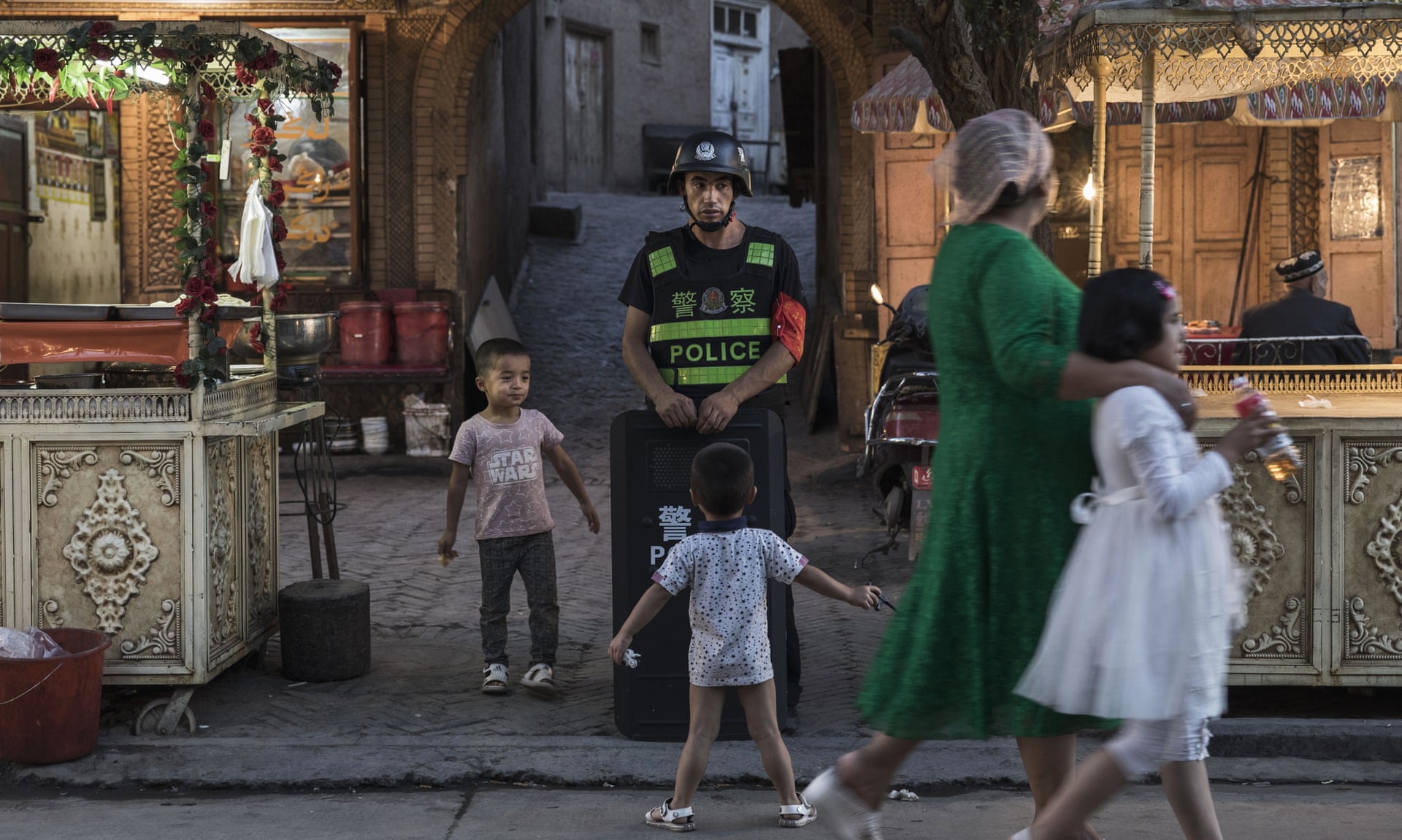
 Uighur children taunt a local police officer in Kashgar. 

Equally pervasive was the constant sense of fear. 
On one evening in Kashgar, I watched five or six police snatch a drunken man off the streets just for waving his arms, without asking any questions, and even though he was with his wife and son. 
In inner China, young restaurant workers could seem relaxed one day and then visibly worried the next: it would emerge that the police had given them orders to go back to their hometowns in East Turkestan immediately – a three- or four-day train journey for most.
There was also the fear of always being watched. 
Once I sat down with a manager of a restaurant in eastern China and, unable to avoid the topic, spoke to him about how oppressive things had become in East Turkestan, telling him about a friend who had been sentenced to a decade in jail for owning the “wrong” books. 
No sooner did I say the word “jail” than the manager’s head began to twitch in the direction of the table behind ours. 
“There’s a policeman here!” he whispered, before standing up and walking away.
Concerned for their safety, many Uighurs have deleted all foreign contacts on China’s (highly monitored) WeChat app. 
At one point last year, I made an effort to see a friend in East Turkestan who had deleted me, by first getting in touch through a proxy, and then meeting in person. 
In retrospect, I almost wish I hadn’t. 
Our lunch together was silent and awkward. 
There was so much to say, but everything felt taboo, and there were whole minutes when we just sat there in silence. 
It didn’t seem like anyone was monitoring us, but my friend looked worried all the same. 
When I passed him samples of a book I was working on, he cast them a glance but didn’t flip through the pages. 
When I asked him if a mutual acquaintance of ours was still around, he told me that he “didn’t know” that person anymore, before adding: “Right now, I don’t even know you.”
When talking about the situation in East Turkestan, it is standard to use euphemisms. 
The most common by far is the word yoq, which means “gone” or “not around”. 
“Do you get what I’m saying?” a friend asked me once, as I tried to figure out what had happened to a person he was telling me about. 
“That guy is yoq. He’s got another home now.”
The phrase adem yoq (“everybody’s gone”) is the one I’ve heard the most this past year. 
It has been used to describe the absence of staff, clients and people in general. 
When referring to people who have been forced to return to their hometowns (for hometown arrest, camp or worse), it is typical to say that they “went back home”.
The concentration camps are not referred to as “concentration camps”, naturally. 
Instead, the people there are said to be occupied with “studying” (oqushta/öginishte) or “education” (terbiyileshte), or sometimes may be said to be “at school” (mektepte).
Likewise, people do not use words like “oppression” when talking about the overall situation in East Turkestan. 
Rather, they tend to say “weziyet yaxshi emes” (“the situation isn’t good”), or describe East Turkestan as being very “ching”(“strict”, “tight”).
Despite the euphemisms, there is no getting away from what is actually happening. 
It hit me just how unavoidable the topic was when, while chatting with an old friend in inner China, I made a genuine effort to avoid politics and talk about more normal or even mundane things. 
It proved impossible. 
When I asked him what he had done earlier that day, he brought up a political meeting that all the Uighurs in that city had to attend. 
When I asked him if he still tried to read books in his spare time, he told me that the police had cracked down on that, too, and that reading any book would invite unwanted attention. 
When I asked him about his aspirations for the future, he told me that, ideally, he would love to become a chef of Turkish food and open up his own restaurant, but, unfortunately, that act alone would get him jailed in East Turkestan, as the state continues to discourage and destroy all contact between the Uighurs and other Turkic and Muslim peoples abroad.


 Chinese occupation forces in East Turkestan capital Urumqi. 

On a few occasions, I encountered people who seemed to have reached a degree of desperation, and just wanted to let everything out. 
The first such time was in Kashgar, in autumn last year, when a uniformed public-security worker – the mostly Uighur, lowest-rank uniformed authority in southern East Turkestan – invited me to sit across from him at a table in a teahouse. 
He was off duty that afternoon, having just returned from a medical checkup.
The conversation that followed was tense. 
He asked me what I knew of Uighur history, and then asked me what I thought of the Uighurs as a people. 
The latter question is one I have been asked several times during my years in East Turkestan, and has often struck me as a way of searching for some sort of outside verification of Uighurs’ identity. Unsure of how to reply, I tried to be noncommittal: “The Uighurs are a people like any other, with their good and bad.”
“You’re hiding what you really think,” he confronted me. 
“Just look all around you. You’ve seen it yourself [here in Kashgar]. We’re a people destroyed.”
Given my general distrust of uniformed people in China, I wasn’t ready to share any political views at the time, but have since come to see our conversation as a true moment of desperation. 
His words, I believe, were genuine. 
His post was close to Kashgar’s night market, but as of a few days after our meeting, I never saw him there, or anywhere else, ever again.
The other conversation that will always stay with me took place in inner China, while visiting a restaurant I had been to a few times before. 
With the exception of a single waiter, all of the old staff were gone. 
As soon as that waiter saw me, he dropped everything to sit down and chat. 
My telling him that I had been kicked out of Kashgar seemed to trigger him, and he would go on to say many things about the situation there, virtually all of them taboo.
“Millions of Uighurs” were being held in camps, he told me, where they were being fed 15-year-old leftover rice and subjected to beatings. (Precise numbers are hard to verify, but witness testimonies have confirmed both poor nutrition and violence in the camps.) 
He said that the Uighurs in this inner-China city now had to attend political meetings, and that they might soon have to take a test on political subjects such as the 19th party congress. 
Those who didn’t pass would be sent back to East Turkestan.
“When the police talk to us,” he said, “they are suspicious about everything: ‘Do you smoke? Do you drink?’ If you don’t, they’ll ask you why not. They’ll ask you if you pray. They’ll ask you if you want to go abroad, or if you’ve previously applied for or had a passport. If you look at the policeman, he’ll ask you what you’re looking at him for; if you look down at the floor, he’ll ask you why you’re looking down at the floor. Whenever we take a train, there’s always a separate room that we have to go through before we’re allowed to leave the station, where they check our documents and question us.”
I worried about him talking to me so openly, but it seemed he understood the risks, or perhaps had already concluded that he was going to be taken soon anyway. 
When another crackdown came a week later, sweeping a good chunk of the city’s Uighur youth with it, he would be among those forced to leave. 
“Back to his hometown.”
Occasionally, I did encounter people who had more positive things to say about the situation. 
At the risk of passing off my subjectivity as fact, the vast majority of these comments struck me as marked by a mix of cognitive dissonance, Stockholm syndrome and self-delusion – often evidenced by self-contradiction and an apparent lack of conviction behind the words.
At a time when I was still absorbing East Turkestan’s new reality, one of the hardest “rude awakening” moments came while catching up with a Uighur friend who worked in East Turkestan’s tourism industry. 
After chatting for a bit, I remarked on the city’s increasingly intense security procedures, in a manner that suggested that I found it all over the top. 
He, too, had his complaints about the new system, saying how he would be forced to stop and have his ID checked seven times while travelling just 2-3km on his electric scooter. 
Still, he was quick to add: “But the people all feel really safe now. Before, I used to worry about letting my daughter go to school alone, but now I don’t have to worry.”
Those words – which almost sounded prepared – stunned me, given that we were just speaking one-on-one. 
He then went on to say that this was all to protect the people from "terrorism", and that as soon as Russia and the US hurried up and defeated Isis, all of this would be over. 
However, when I said that I didn’t think that "terrorism" could be defeated with force like this, he was quick to agree with that as well.
Another friend in another city complained to me about the arbitrary inspections that the local police carried out with regard to the Uighurs. 
I still remember how angry he got as he talked – saying that the individual policemen acted like they were the law – but nevertheless added that the upper layers of the government were good.


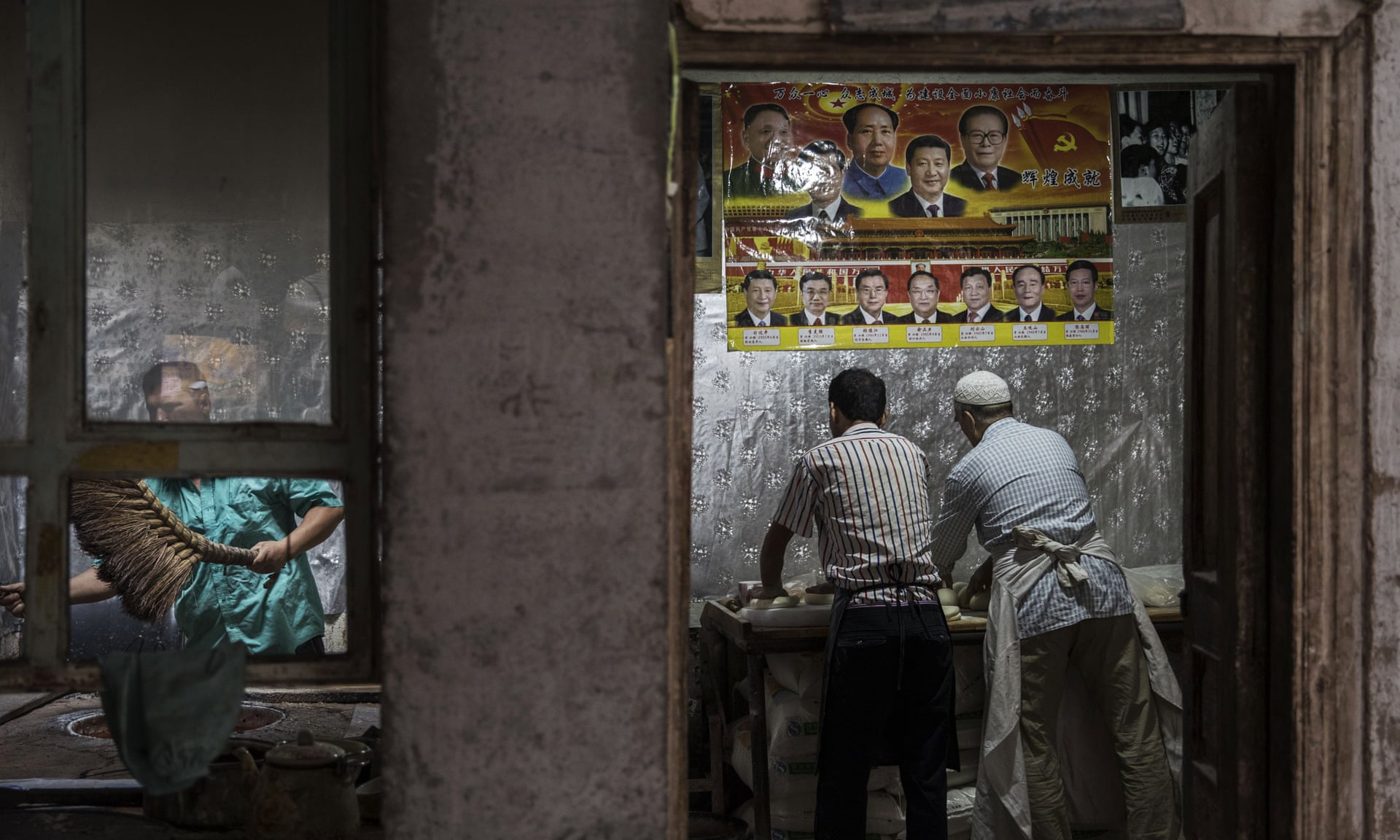
 Uighur bakers in Kashgar, under a poster of Chinese leaders including Mao Zedong and Xi Jinping. 

A curious phenomenon took place online at the time of the 19th party congress last October, when Uighur friends who hardly spoke any Mandarin suddenly started posting long messages in fluent Mandarin praising Xi Jinping and the congress. 
A few months later, I heard about a WeChat app that allowed users to “fasheng liangjian” (“to clearly demonstrate one’s stance” or, literally, “to speak forth and flash one’s sword”), by plugging their name into a prepared Mandarin- or Uighur-language statement. 
The statement pledged their loyalty to the Communist party and its leaders, and expressed, among other things, their determination in upholding “ethnic harmony” and standing opposed to "terrorism". The generated image file could then be readily posted on their social network of choice as a show of loyalty.
In many of the inner-China restaurants I visited, this loyalty was much more visual than verbal. 
As a rule, Uighur restaurants would be the only ones on their street covered with Chinese flags and, occasionally, red banners proclaiming a determined struggle against "terrorism". 
Sometimes, the interiors too would have little flags, as well as photos of Xi or plates bearing his image, or “ethnic harmony” slogans such as those calling for all of China’s ethnic groups to be “as tight as seeds in a pomegranate”. 
Some restaurants even had Uighur-language books about Xi and the party at the front counter. 
I never asked if such demonstrations were voluntary or mandated by the law, but suspect that, like China’s censorship in general, they were a mix of the two – some being anticipatory, some being forced.
Obedience and appeasement appear to have saved some people from the camps and prisons. 
Other factors – money, connections, Han-Chinese spouses and a formal Chinese education – although never an ironclad guarantee, appear to help also. 
Beyond that, bribing police or officials to avoid having one’s passport confiscated or being sent back to one’s hometown is an option that several people I spoke to had taken – a crack in a system that often feels hopelessly inescapable.
For the majority, however, the detentions and the fear of detention have become an unavoidable fact of daily life. 
Most, I would say, cope by simply enduring and “plodding along”. 
Despite the missing relatives, the financial losses and the fear that one day soon it could be their turn to go, many of my friends and acquaintances have done their best to focus on how they earn their livelihood, and to continue doing just that. 
For many, what seems most important now is their children’s future. 
Those without children are focusing on simpler and more concrete goals, such as graduating from university, finding a job or buying an apartment.
One friend manages a small shop in inner China where local police have recently confiscated entire shelves of import products for “not having Chinese labels”. 
He was able to stop them from confiscating more, he says, by telling them that he wasn’t feeling well and had to close the shop. 
With half the shelves empty and business having seen a sharp decline, he believes that it won’t be long now before the store is closed.
But, even as he describes how the state has started to target young Uighur men indiscriminately, he says he is not afraid. 
“I’ve already experienced a lot in life. So if they come and arrest me – fine. Whatever happens, happens.”
When talking of the situation in general, he takes a broader, grander view. 
“This is a trial for the Muslim world right now,” he says. 
“If you look at what’s happening in Syria, or in other places, the Muslim world as a whole is undergoing a test. But Allah knows everything that’s happening. We just have to get through this.” 
With praying all but forbidden for the Uighurs, he has found ways that the authorities won’t notice, such as praying covertly while sitting in a chair, or praying under one of the trees that line the sidewalk.
For others, hope exists simply by necessity, and many Uighurs have told me that “things will get better soon” without offering any reason for believing this. 
Some seem to think that a friend or relative will be released in the near future “because they’ve been held for so many months already”. 
Others seem to think that the situation will revert to normal “once terrorism is defeated”. 
In some of the conversations I have had in inner China’s Uighur restaurants – which, again, have lost huge portions of their staff – I have been told that the staff would “come back soon after finishing their education”.
But time has been cruel to these optimistic voices. 
As the months have turned into a year, and more, the people interned are still interned, the restaurants are losing ever more staff and clients, and the situation only continues to worsen.