Affichage des articles dont le libellé est Philipp Roesler. Afficher tous les articles

jeudi 5 juillet 2018

Europe's Seven Quislings: The European Politicians in Beijing’s Orbit

Fifth column: Former leaders from France, U.K., Germany, France boost Chinese interests
By Alan Crawford and Patricia Suzara
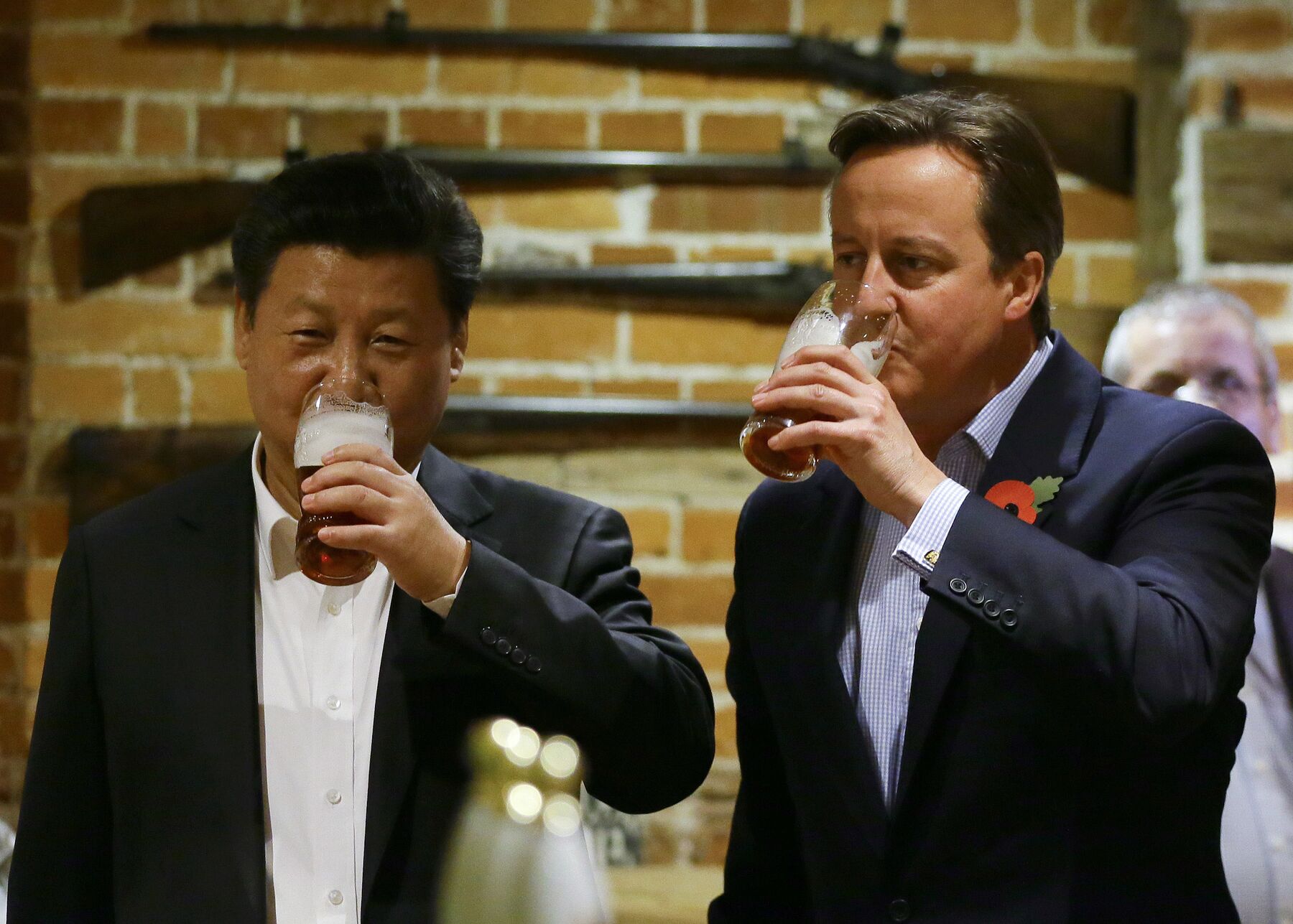
Xi Jinping and David Cameron.

David Cameron and Romano Prodi come from opposite ends of Europe’s political spectrum, but they have much in common. 
Both have left high office, boast an extensive network of connections, and now work in some capacity for China.
The former British and Italian prime ministers are far from alone: Across Europe, politicians past and present are taking positions on China’s growing global reach.
Some such as Anders Fogh Rasmussen, the former Danish premier and head of NATO, warn that Europe must gird itself against China’s rise. 
Far more are riding the wave and helping China’s onward march. 
It’s a dilemma likely to feature at an EU-China summit this month.
Following are a selection of Europe’s more prominent China advocates.

China’s Allure
European politicians turn to China after leaving office

David Cameron
Cameron, who was U.K. prime minister from 2010 until his resignation in 2016 after losing the Brexit referendum, made China a focus of his premiership. 
He announced a “golden era” of British-China relations aimed at boosting bilateral trade and investment, and approved a controversial deal allowing Chinese involvement in the Hinkley Point nuclear development. 
In October 2015, during a visit to the U.K., Xi Jinping posed for a selfie with Cameron at Manchester City soccer ground. 
Two years later and no longer in office, Cameron was made the head of a $1 billion China-U.K. fund supporting China’s massive Belt and Road Initiative infrastructure plan.

Dominique de Villepin
As France’s foreign minister, De Villepin came to global prominence in 2003 when he argued the case against the U.S.-led war in Iraq at the United Nations in New York. 
He went on to serve as France’s prime minister under President Jacques Chirac
He’s since become a regular commentator on Chinese affairs and advises Chinese companies on their international expansion plans through his consultancy Villepin International.

"Le traître français"
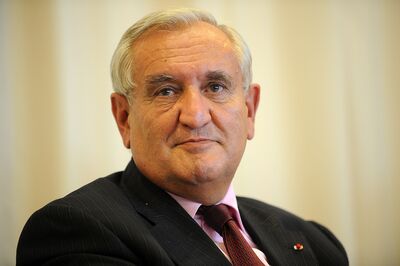
Jean-Pierre Raffarin
Another former French prime minister, Raffarin sits on the board of the Bo'ao Forum for Asia (BFA), an annual showcase for world leaders that is China’s answer to Davos. 
Xi Jinping chose this year’s Bo'ao Forum to deliver his message of a “new phase of opening up.” 
A prominent China advocate, Raffarin is also a member of the strategic committee of the France China Foundation, a body which brings together French and Chinese leaders and whose backers include Bank of China.

Romano Prodi
Prodi served two terms as Italy’s prime minister a decade apart, with a five-year stretch as president of the European Commission -- the European Union’s executive body -- in between. 
An economist and former Goldman Sachs adviser, Prodi sits on the board of the Bo'ao Forum. 
He was cited in the China Daily as welcoming Xi’s speech to the forum in April, praising the president’s “strong determination in safeguarding globalization, free trade and open economy.” 
Prodi is also a member of the board of the China Europe International Business School.

Danny Alexander
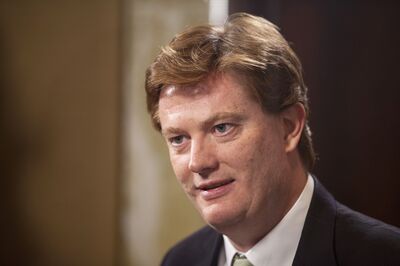
Alexander was Chief Secretary to the U.K. Treasury from 2010 to 2015, during David Cameron’s first-term coalition government with the Liberal Democrats. 
As such he was part of the administration that announced the golden era of ties with China. 
In an interview with China’s Xinhua news agency, Alexander later said that within government he had “advocated strongly that the U.K. should join the AIIB,” as the Asian Infrastructure Investment Bank is known. 
Knighted after losing his parliamentary seat at the 2015 election, Sir Danny was appointed vice president of the AIIB in February 2016.

Philipp Roesler
Roesler endured turbulent times during his spell as junior coalition partner in Chancellor Angela Merkel’s second-term coalition cabinet, first as minister for health and then German economy minister and vice chancellor. 
After losing his seat in the 2013 election along with all his Free Democratic Party lawmakers, Roesler retired from politics and joined the managing board of the World Economic Forum. 
In December, he was made CEO of HNA Group Co.’s New York-based charity, Hainan Cihang Charity Foundation Inc. 
The nonprofit holds 29.5 percent of HNA, which had about $180 billion in assets at the time of Roesler’s appointment.

Rudolf Scharping

Scharping was German defense minister from 1998 to 2002 under Social Democratic Chancellor Gerhard Schroeder
During his watch, the German army took part in the NATO-led attack on Yugoslavia, its first combat mission since World War II. 
His consultancy, Rudolf Scharping Strategie Beratung Kommunikation AG (RSBK), boasts of its “long years of contact with Chinese and German decision makers” and specializes in business development for companies and institutions in China. 
RSBK is involved in a German-Chinese Economic Conference, to be held in Frankfurt in November, focused on the Belt and Road Initiative.

vendredi 16 février 2018

Europe needs to step up vigilance on China’s influence

Beijing’s authoritarian brand presents a direct challenge to liberal traditions 
By Thorsten Benner and Kristin Shi-Kupfer


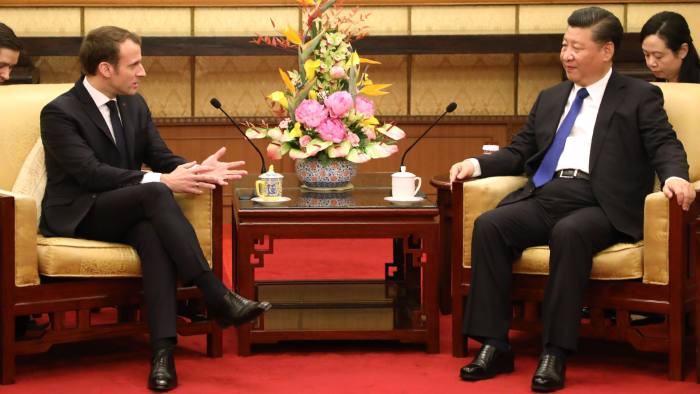
Complacency with Chinese tyranny: French President Emmanuel Macron with Xi Jinping in Beijing in January

Mike Pompeo, the director of the US Central Intelligence Agency, said last month that Beijing’s efforts to exert influence in liberal democracies are just as concerning as those of Moscow, citing China’s “much bigger footprint”.
Indeed, China’s rapidly increasing political influencing efforts and the self-confident promotion of its authoritarian ideals present a fundamental challenge to western democracies. 
 Drawing on its economic strength and a Communist Party of China apparatus that is geared towards strategically building stocks of influence across the globe, Beijing’s efforts are bound to be much more consequential in the medium to long term than those of the Kremlin. 
Nowhere is the gap between the scale of China’s efforts and public awareness of the problem larger than in Europe.
EU member states urgently need to devise a strategy to counter China’s authoritarian advance. 
 As we detail in a new report, Beijing pursues three related goals.

  • First, it seeks to weaken western unity within Europe and across the Atlantic. One aim of this is to prevent Europe from challenging China’s human rights record and its hegemonic ambitions in the South and East China seas. 
  •  Second, it aims to build European support on specific issues such as market economy status and a free pass for Chinese investments. 
  •  Third, Beijing pushes hard to create a more positive global perception of China’s political and economic system as a viable alternative to liberal democracies. 

To further these goals, China commands a comprehensive and flexible influencing toolset in Europe, ranging from the overt to the covert and strategically deployed across three arenas: political and economic elites, media and civil society & academia. 
 Beijing uses investments in infrastructure and public utilities to create political leverage in Europe’s periphery. 
In Greece, for example, it controls the port of Piraeus, leading the government in Athens to torpedo a joint EU resolution on human rights in China in the Human Rights Council. 
In the Czech Republic, it placed an adviser in the president’s office. 
Across Europe, it buys the services of former politicians such as Philipp Roesler, the former German vice-chancellor who was hired by HNA, the Chinese conglomerate, and David Cameron, the former UK prime minister, who has signed up to lead a joint UK-China investment fund. 
Many smaller eastern and southern EU members align with China in fits of “pre-emptive obedience”. 
They try to curry favour with China and lure investment by supporting China’s political positions. 
Some illiberal governments, such as that of Viktor Orban in Hungary, do so all too happily.
They see China’s authoritarian model as attractive and a convenient source of leverage against Brussels and western EU members pushing back against their illiberalism. 
Orban has already played the China card to put pressure his EU partners who are considering reducing structural funds in response to his authoritarianism and a post-Brexit recalibration of the EU budget. 
“Central Europe needs capital to build new roads and pipelines. If the EU is unable to provide enough capital, we will just collect it in China,” Orban said in Berlin this year.
To sweeten the deal for China, Orban is gladly working to prevent a strong EU stance on China’s territorial advances in the South China Sea. 
In parallel, Beijing has invested in shaping the narrative on China.
Across central and eastern Europe, China-supported Confucius Institutes, as well as China-linked think-tanks and university scholars dominate discussions, while an increasing number of journalists go through training programmes designed and funded by the Chinese Communist party. 
In Brussels and other capitals, China funds think-tanks and pays lobbyists to project a favourable image. 
It spreads Chinese official views and creates subtle dependencies by paying for inserts in European quality newspapers. 
It uses the lure of the Chinese market to encourage self-censorship in film, art, and academic publishing. 
Springer Nature, the German group that publishes Scientific American, has removed content in China that was deemed politically sensitive by the party. 
China even went as far as demanding that Germany ensure that its visiting football teams are not met by protests about Tibet during paid friendly games on German soil. 
In part, China uses covert methods, such targeting German lawmakers and government employees via fake social media profiles. 

But most influencing comes through the front door.
Beijing takes advantage of the EU’s one-sided openness. 
Europe’s gates are wide open whereas China seeks to tightly restrict access of foreign ideas, actors and capital. 
Beijing profits from willing enablers among European political and professional classes who are happy to promote Chinese values and interests. 
They do so mostly for financial or other advantages but at times also out of genuine political conviction or convenience.
Rather than only China trying to actively build up political capital, there is also much influence courting on the part of those political elites in EU member states.
China has already made significant progress toward a more fragmented and pliant Europe that better serves its authoritarian interests. 
If Europe intends to stop the momentum of Chinese influencing efforts, it needs to act swiftly and decisively.
In responding to China’s advance, European governments need to make sure that the liberal DNA of their countries’ political and economic systems stays intact.
 Some restrictions will be necessary, but Europe should not copy China’s illiberalism.
While staying as open as possible, Europe needs to address critical vulnerabilities to Chinese authoritarian influencing through a multi-pronged strategy that integrates different branches of government, businesses, media, civil society, culture/arts as well as academia. 
 To better leverage the collective weight of EU member states, larger member states, such as Germany and France, need to take serious steps towards putting their privileged bilateral relations with China in the service of common European interests.
Complaining about the 16+1 format China uses to interact with smaller EU members in central and eastern Europe while engaging in 1+1 formats with Beijing undermines a common EU response to challenges from China. 
In addition, European governments need to invest in high-calibre, independent China expertise. Raising awareness about and responding to China’s political influencing efforts in Europe can succeed only if there is sufficient impartial expertise on China in think-tanks, universities, NGOs and media across Europe. 
 Furthermore, the EU needs to continue providing alternatives to the promises of Chinese investments in European countries.
It also needs to enable EU members and third countries in the neighbourhood to properly evaluate, monitor and prepare large-scale infrastructure projects, including those financed by China.
 The EU and its members must be able to stop state-driven takeovers of companies that are of significant public interest.
In addition to high-tech sectors as well as key parts of public infrastructure, this notably includes the media, as an institution of critical importance to liberal democracies.
 Foreign funding of political parties from outside Europe, not least from China, should be banned across the EU. 
European intelligence services urgently need to enhance co-operation on Chinese activities to arrive at a common understanding of the threat and to deliver joint responses. 
 EU members should put additional awareness-building measures in place sensitise potential targets of Chinese intelligence activities. 
In particular, decision makers and scholars should be briefed more systematically about common patterns of contact-building and approaches by Chinese intelligence agencies or related actors.
 For the wider public to get a full picture of authoritarian influencing, liberal democracies need to leverage one of the key assets of open societies: the power of critical public debate.
Implementing transparency requirements concerning collaboration with Chinese actors for media agencies, universities and think-tanks, among others, would help raise awareness of the various influencing mechanisms Chinese state actors employ. 
 “Vigilance is wise; confidence a useful adjunct,” the Economist counselled recently in a piece on China’s influence in Europe.
With the necessary defensive mechanisms in place, confidence should come more easily.