by FRANCES MARTEL
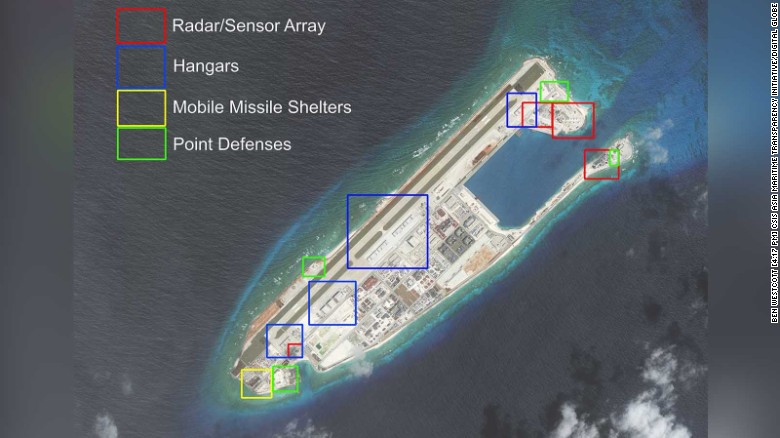
Fiery Cross Reef, South China Sea
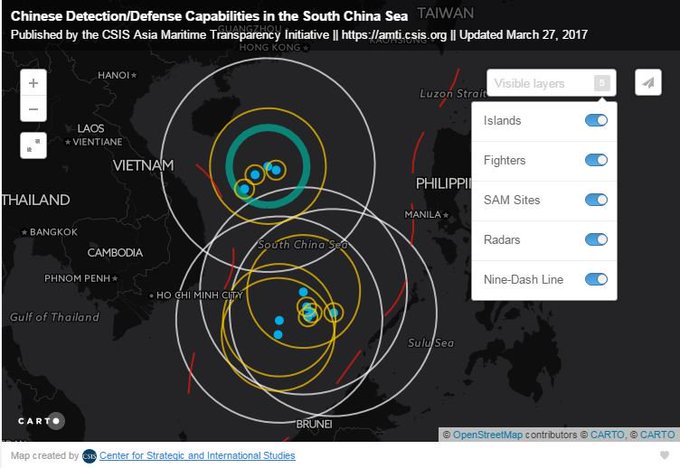
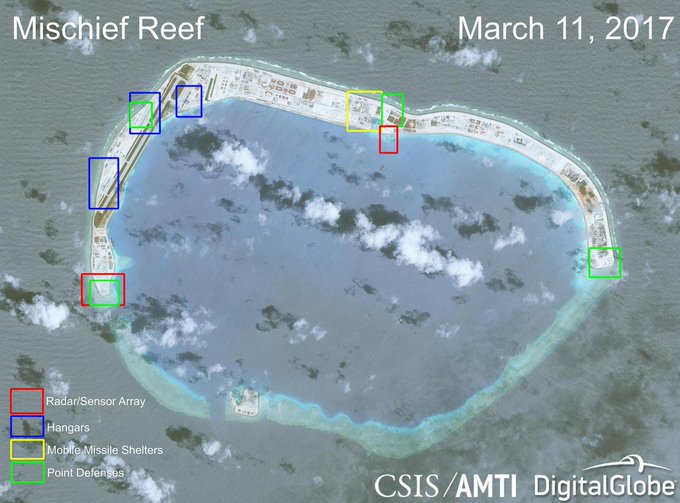
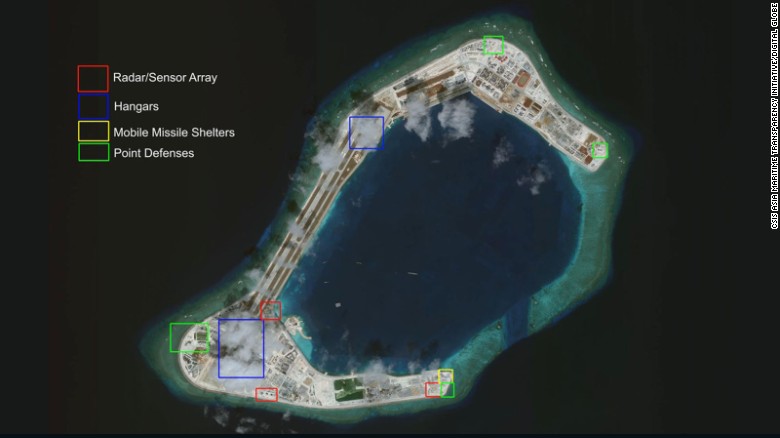
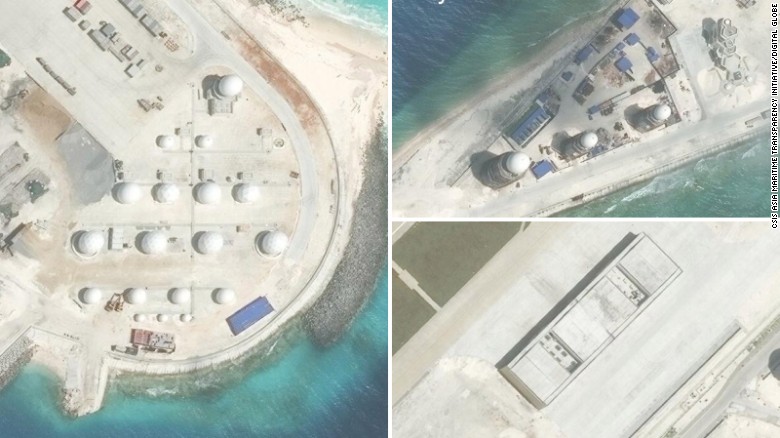
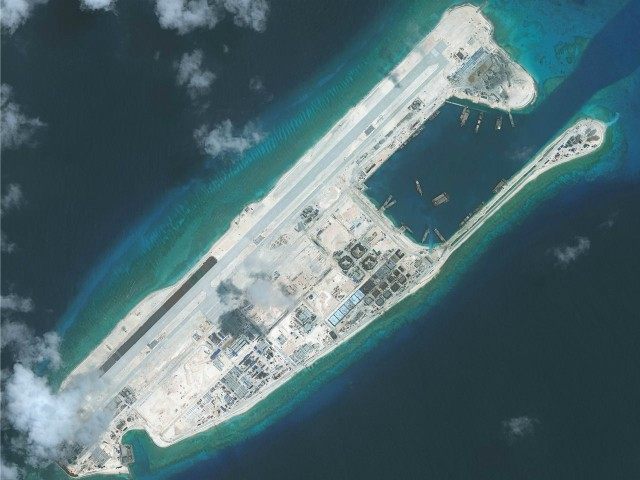
The images show completed “naval, air, radar, and defensive facilities” in the Spratly Island chain, particularly on three reefs China has invested in turning into artificial islands capable of holding combat aircraft and surveillance technology, according to the Asia Maritime Transparency Initiative of the Center for Strategic and International Studies (CSIS).
The three most developed locations, according to the CSIS report, are Subi, Mischief, and Fiery Cross Reefs in the Spratly Islands.
“Beijing can now deploy military assets, including combat aircraft and mobile missile launchers, to the Spratly Islands at any time,” the report notes.
Among the most notable developments since the last such report is the completion of hangar construction on Fiery Cross Reef, which allows China to “accommodate 24 combat aircraft and four larger planes (such as ISR, transport, refueling, or bomber aircraft).”
The CSIS publishes such satellite images and reports periodically.
The CSIS publishes such satellite images and reports periodically.
In February, it warned that Woody Island, the largest of the Paracel Islands, was home to “an airstrip, hangars, and a deployment of HQ-9 surface-to-air missile batteries,” as well as the beginnings of seven new harbors.
China claims most of the South China Sea in a region within what China calls the “nine-dash line,” a drawing Chinese officials argue proves their ownership of the region.
China claims most of the South China Sea in a region within what China calls the “nine-dash line,” a drawing Chinese officials argue proves their ownership of the region.
Both the Paracel and Spratly Island chains, as well as other notable formations like the Benham Rise and Scarborough Shoal, fall within China’s “nine-dash line” border.
This border violates the territorial integrity of Vietnam, the Philippines, Brunei, and Malaysia.
This border violates the territorial integrity of Vietnam, the Philippines, Brunei, and Malaysia.
Last year, the Permanent Court of Arbitration at the Hague ruled that China’s claims were unfounded and it must cease its constructions in the region immediately.
China responded by calling the ruling a joint U.S.-Japanese conspiracy and refusing to abide by it.

Responding to the CSIS report on Tuesday, Chinese Foreign Ministry spokeswoman Hua Chunying repeated the false claims to the South China Sea the Hague debunked last year.
Responding to the CSIS report on Tuesday, Chinese Foreign Ministry spokeswoman Hua Chunying repeated the false claims to the South China Sea the Hague debunked last year.
“China has stated many times that the Spratly Islands are its inherent territory,” she said.
A week ago, Li Keqiang insisted that China’s use of the region was not an attempt at colonization. “China’s facilities, Chinese islands and reefs, are primarily for civilian purposes and, even if there is a certain amount of defense equipment or facilities, it is for maintaining the freedom of navigation,” he said, responding to concerns of expansionism.
The Philippines, which arguably has the most territory to lose between the Spratly Islands and the Scarborough Shoal, has taken a demure approach to addressing the situation since President Rodrigo Duterte took office in June 2016.
“There’s nothing we can do,” he said.
“What do you want me to do? Declare war against China?” Duterte asked in frustration this week, responding to critics that he has responded to China’s growing presence in the region too slowly.
Duterte has also chastised the United States for not doing enough to keep China from developing assets in the Philippine territory, contradicting his own demands to see the United States reduce its military presence in the Philippines.
The Philippine Inquirer lamented Duterte’s attitude, calling it “disheartening” and a “puzzling display of defeatism” in an opinion piece this week.
Duterte’s government nonetheless appears to have accepted the delivery of two Japanese surveillance aircraft on Tuesday, meant to patrol the South China Sea.
According to the Agence-France Presse, the two are part of a five-part package of Beechcraft TC-90 planes, which Japanese officials deemed a responsible move to curbing China’s expansion in the region.
Duterte has also called for the construction of “structures” in Philippine territory in the South China Sea, though Manila has not clarified what the president meant by this.