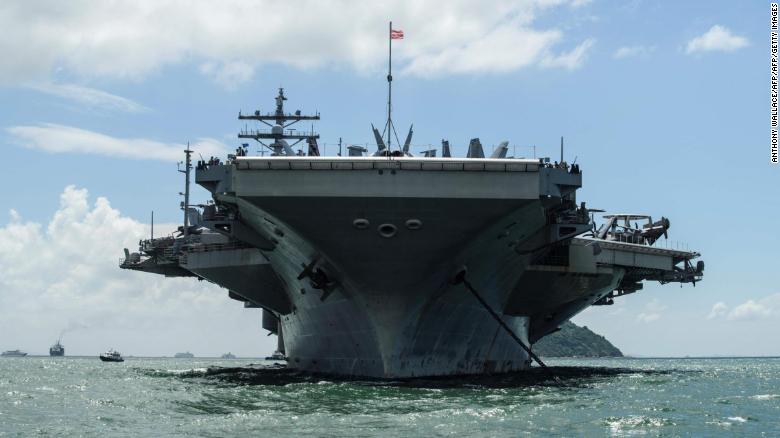
The US announced Wednesday that it would rebrand the command responsible for overseeing US military operations in Asia, a move that comes amid heightened tensions with China over the militarization of the South China Sea.
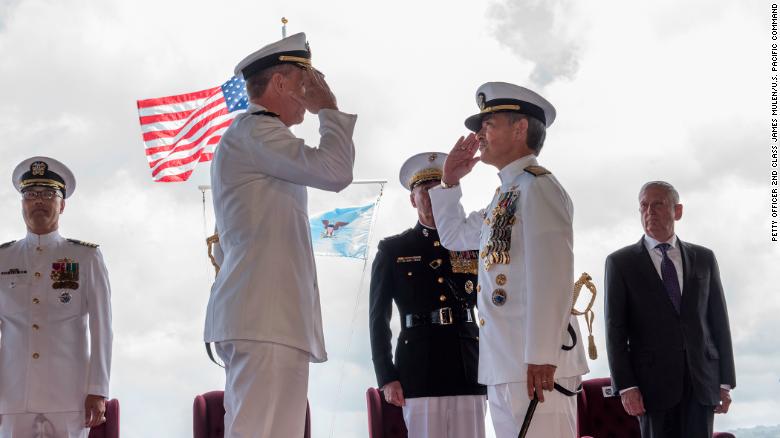
US Pacific Command will now be called US Indo-Pacific Command, Secretary of Defense James Mattis said while speaking at a change of command ceremony in Hawaii, where the command's headquarters is located.
"In recognition of the increasing connectivity of the Indian and Pacific Oceans today we rename the US Pacific Command to US Indo-Pacific Command," Mattis said.
"It is our primary combatant command, it's standing watch and intimately engaged with over half of the earth's surface and its diverse populations, from Hollywood, to Bollywood, from polar bears to penguins," Mattis said of the command.
Adm. Harry Harris, who oversaw US military operations in the region until Wednesday, has been tapped by President Donald Trump to serve as the US ambassador to South Korea.
Adm. Phillip Davidson will now lead the Indo-Pacific Command, which oversees some 375,000 US military and civilian personnel.
US officials say the name change is meant to better reflect the command's areas of responsibility, which includes 36 nations as well as both the Pacific and Indian Oceans.
The US has increased cooperation with India in a range of areas, including defense cooperation, and both Washington and New Delhi have voiced concerns about what they see as an increased assertiveness by China's military.
The rebranding comes in the wake of a series of actions by both the Chinese and US militaries that have raised tensions in the South China Sea.
US officials say the name change is meant to better reflect the command's areas of responsibility, which includes 36 nations as well as both the Pacific and Indian Oceans.
The US has increased cooperation with India in a range of areas, including defense cooperation, and both Washington and New Delhi have voiced concerns about what they see as an increased assertiveness by China's military.
The rebranding comes in the wake of a series of actions by both the Chinese and US militaries that have raised tensions in the South China Sea.
The US and the majority of the international community reject Beijing's claims of ownership of the area.
In recent months US officials have said that the Chinese military has deployed anti-ship missiles, surface-to-air missile systems, and electronic jammers to contested features in the Spratly Islands region of the South China Sea.
China also recently landed a nuclear-capable H-6K bomber aircraft on Woody Island for the first time.
Those actions led the US to disinvite China from participating in the Rim of the Pacific (RIMPAC) Exercise, which the US Navy calls "the world's largest international maritime exercise," and involves some 26 nations including India and countries like Vietnam and the Philippines which actively contest China's claims to the South China Sea.
"China's continued militarization of disputed features in the South China Sea only serve to raise tensions and destabilize the region. As an initial response to China's continued militarization of the South China Sea we have disinvited the PLA Navy from the 2018 Rim of the Pacific (RIMPAC) Exercise," Pentagon spokesman Lt. Col. Chris Logan told CNN last week.
"We have called on China to remove the military systems immediately and to reverse course on the militarization of disputed South China Sea features," he added.
The US Navy also sailed two warships Sunday past a handful of disputed islands in the South China Sea, including Woody Island where the Chinese bomber landed, a move that drew the immediate ire of Beijing.
Two US defense officials told CNN that the guided-missile destroyer USS Higgins and the cruiser USS Antietam sailed within 12 miles of four of the Paracel Islands in what the US Navy calls a "freedom of navigation operation," which are meant to enforce the right of free passage in international waters.
Two US officials said that during the freedom of navigation exercise a Chinese naval vessel shadowed the US warships, coming close enough to the US ships that the encounter was considered unprofessional but safe.
"It's international waters, and a lot of nations want to see freedom of navigation," Mattis told reporters Tuesday while en route to the change of command ceremony.
In recent months US officials have said that the Chinese military has deployed anti-ship missiles, surface-to-air missile systems, and electronic jammers to contested features in the Spratly Islands region of the South China Sea.
China also recently landed a nuclear-capable H-6K bomber aircraft on Woody Island for the first time.
Those actions led the US to disinvite China from participating in the Rim of the Pacific (RIMPAC) Exercise, which the US Navy calls "the world's largest international maritime exercise," and involves some 26 nations including India and countries like Vietnam and the Philippines which actively contest China's claims to the South China Sea.
"China's continued militarization of disputed features in the South China Sea only serve to raise tensions and destabilize the region. As an initial response to China's continued militarization of the South China Sea we have disinvited the PLA Navy from the 2018 Rim of the Pacific (RIMPAC) Exercise," Pentagon spokesman Lt. Col. Chris Logan told CNN last week.
"We have called on China to remove the military systems immediately and to reverse course on the militarization of disputed South China Sea features," he added.
The US Navy also sailed two warships Sunday past a handful of disputed islands in the South China Sea, including Woody Island where the Chinese bomber landed, a move that drew the immediate ire of Beijing.
Two US defense officials told CNN that the guided-missile destroyer USS Higgins and the cruiser USS Antietam sailed within 12 miles of four of the Paracel Islands in what the US Navy calls a "freedom of navigation operation," which are meant to enforce the right of free passage in international waters.
Two US officials said that during the freedom of navigation exercise a Chinese naval vessel shadowed the US warships, coming close enough to the US ships that the encounter was considered unprofessional but safe.
"It's international waters, and a lot of nations want to see freedom of navigation," Mattis told reporters Tuesday while en route to the change of command ceremony.

 US plans 'steady drumbeat' of exercises in South China Sea, Mattis says