Affichage des articles dont le libellé est Chinese imperialism. Afficher tous les articles

vendredi 10 août 2018

Axis of Evil

Pakistan is the next victim of Chinese imperialism
By Ishaan Tharoor

It’s been barely more than two weeks since Imran Khan’s electoral victory in Pakistan, but the country’s next prime minister is already facing a geopolitical crisis. 
Pakistan’s current-account deficit is perilously high, its foreign-currency reserves perilously low. 
Its external debt has ballooned after accepting some $62 billion in Chinese financing, part of an ambitious regional infrastructure project that has yet to boost Pakistan’s economy. 
Khan’s first major act as prime minister may be asking the International Monetary Fund for a new bailout.
But that’s where the trouble begins. 
Critics at home lament Pakistan’s addiction to the fund — it has spent 22 of the past 30 years laboring under the terms of more than a dozen successive IMF bailouts. 
The austerity measures the IMF demands, they argue, have shackled growth and prevented Pakistan from making substantive reforms. 
Pakistan could instead turn to China for fresh loans, but that could make Islamabad even more beholden to Beijing than it already is.
In that regard, Pakistan is becoming the latest testing ground of a key plank in China’s global strategy. 
Its sweeping One Belt, One Road initiative — a vast $1 trillion infrastructure and development plan that has led to Chinese companies investing in bridges, airports, dams, railroads and other ventures in dozens of countries — is Beijing’s signature global project. 
But it has prompted accusations that it fuels corruption and autocratic behavior in vulnerable countries. 
From Malaysia to Colombia, the opacity surrounding Chinese-backed endeavors has led to allegations of graft, mismanagement and, in the case of at least one mega-dam project, possibly triggered a devastating landslide.
Moreover, the initiative has pushed some countries into a morass of debt. 
The starkest example so far has been Sri Lanka, whose government was unable to repay $6 billion in loans used to build an expensive Chinese-led port and airport project in Hambantota, a once-sleepy but strategically located backwater. 
As a result, Sri Lankan authorities ceded control of the port and some 15,000 acres of land around it to Beijing on a 99-year lease. 
The move led to accusations that China is engaging in a 21st century style of “creditor imperialism."

Fishermen stand on a boat outside Gwadar Port, operated by China Overseas Ports Holding Co., in Gwadar, Balochistan, Pakistan, on Tuesday, July 4, 2018. What used to be a small fishing town on the southwestern corner of Pakistan is giving way for construction of roads and buildings to house banks, insurance and clearing agents. China Overseas Port Holdings, Gwadar Port’s operator, has separately spent $250 million to add five new cranes, construct a building in less than six months by importing ready made parts and create space for a free zone. 

“States caught in debt bondage to China risk losing both their most valuable natural assets and their very sovereignty,” warned Indian commentator Brahma Chellaney. 
“The new imperial giant’s velvet glove cloaks an iron fist — one with the strength to squeeze the vitality out of smaller countries.”
At a Tuesday panel in Washington, Husain Haqqani, a former Pakistani ambassador to Washington, quipped that the Chinese-Pakistan Economic Corridor (CPEC)— the formal name for a complex $62 billion infrastructure-development plan — actually should be called “Colonizing Pakistan to Enrich China.”
In recent years, China has stepped up its involvement in various sectors of the Pakistani economy, from its nuclear-energy industry to the establishment of a host of special economic zones to a costly port project in the city of Gwadar on the Arabian Sea.
“Pakistan does need China’s help, as it faces a slew of economic challenges, including a backward industrial supply chain, weak foreign trade and a huge portion of its population still living in poverty and without proper education,” noted an editorial in China’s state-run Global Times, urging Beijing officials to “ignore the noise and step up its investment in Pakistan.”
Khan, meanwhile, is a fiery nationalist and economic populist. 
He has repeatedly gestured to the “China model” as something Pakistan should emulate. 
But it’s not yet clear what any of that means in practice, and the enthusiasm for his rhetoric may simply reflects widespread frustration with Pakistan’s systemic corruption and long-standing habit of turning to the IMF and accepting its diktats.
“The pattern is always the same,” wrote Nadeem Ul Haque, a former IMF official and former deputy chairman of the Pakistani government’s Planning Commission. 
“With the Fund’s blessing, the government goes on a shopping spree, taking out costly loans for expensive projects, thus building up even more debt and adding new inefficiencies. After a few years, another crisis ensues, and it is met by another IMF program.”
Khan doesn’t look set to break that tradition. 
But the Trump administration may force him to. 
“Make no mistake. We will be watching what the IMF does,” said Secretary of State Mike Pompeo at the end of last month, arguing that he didn’t want the U.S. to indirectly refinance Pakistani loans to China. 
“There’s no rationale for IMF tax dollars — and, associated with that, American dollars that are part of the IMF funding — for those to go to bail out Chinese bondholders or China itself."
As tensions flare between China and the United States over trade, that outlook is only gaining support. 
In Washington, lawmakers are increasingly wary about China’s opportunistic maneuvering across Asia, Africa and Latin America.
“The goal for the [Belt and Road Initiative] is the creation of an economic world order ultimately dominated by China,” read a recent letter from a bipartisan group of senators to Pompeo and Treasury Secretary Steven T. Mnuchin. 
“It is imperative that the United States counters China’s attempts to hold other countries financially hostage and force ransoms that further its geostrategic goals.”
For Pakistan, caught between China’s ambition and Washington’s concern, there are few good choices.
“These are our two masters,” said Turab Hussain, an economics professor at the Lahore University of Management Sciences, told the New York Times. 
“How do you serve both?”

mardi 13 mars 2018

China's Paranoia Gives Its Neighbors Nightmares

From Russia to Central Asia, Beijing's Belt and Road Initiative triggers bad memories of Chinese imperialism.
BY ROBERT DALY, MATTHEW ROJANSKY
Vladimir Putin, Xi Jinping, and President of Kazakhstan Nursultan Nazarbayev on May 9, 2015 in Moscow, Russia. 

In 1904, Halford Mackinder theorized that whichever nation ruled the “World-Island” of Africa, Asia, and Europe would “command the world.”
One hundred and nine years later, in Astana, Kazakhstan, Xi Jinping made his move, declaring himself the prophet and China the engine of Afro-Eurasian integration. 
The era of China’s Belt and Road Initiative (BRI) diplomacy had begun.
The World-Island quickly proved too small for Xi’s vision. 
One month after the Astana speech, Xi went to Jakarta to announce that China would “strengthen maritime cooperation with ASEAN countries … and vigorously develop maritime partnership in a joint effort to build the Maritime Silk Road.” 
In January, Foreign Minister Wang Yi invited more than 30 Latin American and Caribbean nations to join the BRI. 
Days later, the State Council issued a white paper on China’s Arctic strategy whose final sentence encouraged Arctic Council members — which, unlike China, actually border the Arctic — to work with China to “participate in the governance of the Arctic, and advance Arctic-related cooperation under the Belt and Road Initiative.”
From South America to the North Pole, the BRI posits China as the overlord of global integration. But Beijing’s neighbors are rather more skeptical.
The authors recently visited Beijing, Astana, and Moscow to gauge how Xi’s vision jibes with those of Eurasian neighbors whose cooperation is essential to the BRI’s success. 
We found an eagerness to participate in projects that support national development, but deep resistance to any westward or northern expansion of China’s practices, ideas, or population. 
As the region’s newest capital, Astana might be expected to showcase Eurasian ambitions, but with the exception of a Chinese-built hotel, there is not a trace of Sinophilia in the city. 
Storefronts and skyscrapers are ablaze with Cyrillic and English; there is barely a Chinese character in sight. 
Russia remains determinedly Slavic and European; its stylistic and ideological orientations are wholly occidental. 
Neither country hopes that China’s power will increase with its investments.

China’s strategic logic

Xi Jinping either hasn’t noticed or doesn’t care. 
While Mackinder thought any World-Island hegemon must first rule Eastern Europe, Xi is confident that history proves the key to continental control lies in China. 
In September 2013, he told the Kazakhs that “more than 2,100 years ago … imperial envoy Zhang Qian was sent to Central Asia twice to open the door to friendly contacts between China and Central Asian countries as well as the transcontinental Silk Road linking East and West.” 
That October, Xi said in his address to the Indonesian parliament that “Southeast Asia has since ancient times been an important hub along the ancient Maritime Silk Road.”
The implication was that premodern Eurasian and Southeast Asian trade was driven by China, a distinctly revisionist view. 
The term “Silk Road” was coined in 1877 by a German geographer to connote the historic phenomenon of Eurasian trade rather than a particular route.
The Silk Road was not Sinocentric, nor was it a road. 
Xi’s mythologizing of the Silk Road also elides the fact that soldiers as well as salesmen moved along the storied routes. 
Zhang Qian’s true mission was not to establish a free trade regime — Eurasian economic exchange began millennia before he was born — but to convince nomad peoples to ally with China in a war against Turkic tribes in what is now East Turkestan and Central Asia. 
Xi’s paeans to Eurasian integration may skip China’s violent expansion, but that history has not been forgotten by China’s neighbors.
Xi’s historical references elide the deeper strategy of motivating China’s present-day BRI campaign. China is in the midst of what it calls a “period of strategic opportunity” resulting from its rapid rise and the slow growth of the West since 2008. 
For Beijing, the financial crisis ended China’s 30-year economic apprenticeship to the United States and put the lie to the universalist claims of American values and the American-led world order. 
Xi and his colleagues believe their strategic opportunity has been extended by the decline in American prestige since the 2016 election and by Trump’s withdrawal from the Trans-Pacific Partnership. 
They see the epicenter of global power shifting East.
It’s hard to argue the point. 
While the United States is an obstacle on China’s maritime borders, it barely registers as an annoyance when China looks west, across Central Asia, to Europe. 
There, China hopes to employ its foreign exchange reserves, which are the largest in the world, its construction expertise, the lending power of its state-run banks, and its excess (and world-leading) capacity in steel, aluminum, and concrete production, to integrate not only infrastructure but information flows, financial systems, and customs clearance practices as well, winning deference in the process.
Beijing doesn’t disguise the self-interest woven into the BRI. 
In China’s telling, the BRI will be good for everyone, but especially good for China. 
As a People’s Daily “manifesto” published in early 2018 put it: “The world needs China … That creates broad strategic room for our efforts to uphold peace and development and gain an advantage” (emphasis added). 
At a private meeting held in Washington in February, a Beijing-based scholar twice confided that the true purpose of the BRI was to internationalize China’s currency, the renminbi. 
By making the renminbi the official currency of BRI transactions, the scholar explained, China would challenge the U.S. dollar’s status as the premier mode of global exchange even though the renminbi is tightly managed by Beijing. 
China will require participants in BRI projects to accept Chinese standards of justice as well as its currency. 
In an underreported story, China is setting up new courts in Beijing, Xian, and Shenzhen to adjudicate BRI disputes.
The praise lavished on Xi and the BRI by China’s party-media, furthermore, suggest the BRI is less about benefitting China’s partners than strengthening domestic support for China’s Communist Party. 
Chinese enthusiasm for Xi’s vision is reaching absurd heights. 
At a Beijing conference which the authors attended in late 2017, a Chinese foreign-policy analyst claimed that Xi’s vision could not only guide the peaceful development of the human race, but would benefit non-human animal species and plants as well. 
There is reason to think such fulsome nonsense, now as during the Mao era, serves to mask Chinese doubts about the wisdom of the BRI.
Nonetheless, China’s framing of Eurasian integration now drives policy discussions worldwide; it is the BRI, not Russia’s Eurasian Economic Union or the United States’ all-but-forgotten New Silk Road initiative that captures imaginations and headlines. 
No one can accuse Xi of thinking small. 
Eurasia and Africa, which remain the short-term focus of the BRI, comprise 57 percent of the world’s landmass, 86 percent of its population, and 65 percent of its GDP. 
The BRI vision — the economic integration of these regions through infrastructure — would be a historic achievement. 
It is already accepted as commonplace that existing regional transportation networks cannot be connected, nor can new ones be built, unless China plays a major role in the financing and construction of highways, rail systems, pipelines, and ports.
But Xi’s BRI plan is as vague as its promised $1 trillion in investments is enticing. 
Despite Xi’s lofty promises, China’s total foreign direct investments have grown along the same trajectory established before the BRI was announced, and actually fell in BRI nations in 2016. 
And though it’s early days for the BRI, the program has so far generated few smashing successes and experts remain skeptical that Eurasian rail networks can ever compete with the low costs of ocean transport. 
Nor is it clear that China’s branding, cash, and ambition can overcome the uneven development, political and cultural diversity, age-old hatreds, and daunting geography of the World-Island.
Accordingly, reactions to China’s proffered largesse have been mixed. 
Russia, Kazakhstan, and even Pakistan harbor deep suspicions despite official enthusiasm. 
The G-7 nations, India, and Japan have declined to endorse the initiative despite China’s constant pleading, primarily because they see the BRI as China’s bid for global dominance. 
Despite doubts about the feasibility and revisionist tendencies of the BRI, however, Xi’s signature program is winning support from Thailand to Tajikistan to Greece. 
Seventy-one countries have “joined” the initiative, although it is not clear what joining entails.
But while Xi speaks in certainties, China’s Russian and Kazakh partners are more circumspect. 
They welcome Chinese investment when it suits them, but do not embrace Xi’s calls for a “community of common future” overseen by a "benevolent" China. 
Such doubts need not be fatal to Eurasian infrastructure integration, but widespread unease over China’s growing power indicates that many of China’s neighbors will not march under Beijing’s banner, even if they benefit from its wealth.

Moscow’s Eurasian pivot

In the aftermath of its annexation of Crimea, Moscow can hardly reproach Beijing for advancing expansive territorial ambitions by creating facts on the ground. 
Both Russia and China regularly trumpet the primacy of sovereignty in international relations, yet neither shows much deference to the sovereignty of smaller neighbors. 
Such attitudes have strained China’s ties with the West, and have utterly upended Russia’s relations with the United States and Europe, and thus driven Russia’s own “pivot” toward China and the Asia-Pacific. 
For Moscow, China’s enthusiasm for enhanced Eurasian connectivity comes just in time, as Russia finds itself increasingly cut off from Western markets.
Of course, Russians are not only looking eastward out of pique or desperation. 
Russian officials and experts talk explicitly about China’s “return to its natural place in East Asia” and insist that they cannot miss the opportunity to be a part of China’s and Asia’s rise. 
At the same time, Russians recognize that their relatively small demographic and economic presence in East Asia will not alone secure them a leadership role in the resurgent, realigned region. 
They hope to compensate for these limitations by capitalizing on their strength as a security and geopolitical actor in the region, and on warm personal ties between the Russian and Chinese leaders. It is against this backdrop that Vladimir Putin proposed a “greater Eurasian partnership,” also dubbed the “integration of integrations,” as a path to connecting the Russian-led Eurasian Economic Union with China’s Belt and Road.
The Russian-Chinese strategic partnership announced in 2012 was hardly a conceptual breakthrough. Moscow and Beijing signed partnership agreements in 1994 and 1996 and concluded a Treaty of Friendship and Cooperation in 2001. 
For years, they have sought to coordinate positions in the Shanghai Cooperation Organisation, BRICS, the G-20, and of course, the U.N. Security Council. 
When asked about his most important foreign-policy achievement at the end of his second presidential term in 2008, Putin cited the settlement of a long-simmering border dispute with China. In case there was any doubt about warming relations, in 2006 and 2007 the two countries declared reciprocal years of Russia and China to celebrate trade and cultural and political ties.
Yet Russians recognize that China’s growing weight and ambition will test the durability of their own position in East Asia. 
Like their Western counterparts, Russians are watching Chinese investments in Eurasian infrastructure closely, and say they will assess the significance of the Belt and Road based neither on fears nor promises, but on real-world results. 
One such outcome was described to us by a Russian businessman who cautioned that while Chinese business partners would never make overt political demands, transactions with them would eventually be conducted entirely in renminbi, and supply chains would be reoriented entirely toward Chinese manufacturers. 
As one Russian official put it to us, “Chinese culture does not orient to domination — they simply see themselves as the center of the world.”
Russia’s enthusiasm for increased Eurasian economic connectivity is partly an expression of its frustration with Europe and the United States. 
It is not only that Western sanctions are damaging to Russia’s economy — they are, though that has not changed the Kremlin’s policies in Ukraine or Syria — but rather that they are marks of continuing disregard for what Russia sees as its rightful stature. 
Some Russians still think in terms of a geopolitical “triangle,” with the United States, Russia, and China at the corners, while others are convinced that a new Cold War looms between Washington and Beijing.
Either way, many Russians consider China’s rise the leading indicator of the West’s decline, and they expect this fact to force concessions from Washington and Brussels over time, including the end of economic and political punishments imposed on Russia after 2014. 
For Russians who share this view, pursuing economic integration with the East is, ironically, largely about securing better relations with the West. 
But Russians may be mixing metaphors in their conjuring of the BRI as a counterweight to Western pressure and isolation. 
After all, Russia matters most of all for China as a potential land corridor to Europe, whose half-billion wealthy consumers are the largest single market for Chinese goods.

Kazakhstan: the buckle in the belt?

Kazakhstan is landlocked and sparsely populated, though rich in energy and other natural resources. Hemmed in by the behemoths, Russia and China, and saddled with the legacies of rule from Moscow during the tsarist and Soviet periods, Kazakhstan has no shortage of geopolitical challenges. 
So Kazakh officials are justifiably proud of having secured their country’s sovereignty, built a relatively stable, prosperous economy, and forged a distinctive but still pluralistic national identity over the past three decades. 
A sense of that determination and pride comes across when Kazakhstan’s leaders refer to their nation as the “buckle” in China’s BRI.
Kazakhstan’s geography makes it central to the belt. 
The most efficient land route from Western China to Eastern Europe passes through Kazakhstan en route to Russia. 
The rail journey from China to Europe over this route now takes about 14 days, but Kazakh officials aim to bring that down to 10 through physical infrastructure enhancements and streamlining border crossings. 
Kazakhstan’s participation as a core member of the Eurasian Economic Union with Russia and Belarus means that customs are standardized across all three former Soviet states, so that — at least in theory — shipments should be held for inspection only once at each end of the route, where trains must shuttle between standard (European and Chinese) and wider (Russian and Kazakh) gauges. Climate-controlled rail cars moving swiftly from Chinese factories to European markets in less than two weeks promise to revolutionize trade in high value-added products such as advanced electronics. European producers aim to fill returning rail cars with food and luxury items that find eager buyers in China.
Kazakhstan, while hardly a poor country, is acutely aware of the need for new sources of growth and a development vision that looks beyond energy exports. 
Connecting Eurasia may offer the opportunity not only to boost Kazakhstan’s own trade with China and Europe, but to extract transit fees provided rail volumes continue growing as they have over the past decade, from 1,200 containers in 2011 to over 200,000 in 2017. 
Moreover, Kazakh leaders argue that the construction of transportation infrastructure connecting the country’s own eastern and western regions has particular value for a country that has historically been focused on north-south linkages. 
This is why, according to officials, Kazakhstan invested $5 billion of its own sovereign wealth in BRI infrastructure projects, including construction of what is meant to be the world’s largest dry port facility at Khorgos. 
“When China proposed the [BRI] idea,” one Kazakh expert explained, “they found a very motivated partner.”
So much for the attraction of the BRI for Kazakhstan. 
What about the risks? 
For now, Kazakh officials insist they have relations with both Russia and China well in hand. 
They are confident in their ability to keep trade and investment separate from politics and security. Whereas Moscow’s pivot eastward was a largely political decision, they argue, for Astana it’s just good business, with no political component. 
Yet while Kazakhstan has paid for its share of infrastructure construction the Chinese have invested nearly $30 billion across more than 50 projects as well. 
In fact, China is now the leading foreign investor in all five of the former Soviet Central Asian republics, Kazakh students are increasingly studying abroad in China (some 40,000 to date), and Chinese workers have flocked to attractive jobs in pipeline, rail and other construction projects, especially in Western Kazakhstan.
How close is too close for comfort? 
Although Kazakhs embrace their status as a “truly Eurasian” country, they have absorbed Eurocentric views about China from their long association with Russia, while channeling insecurities and prejudices of their own. 
Kazakh-Chinese projects to connect Eurasia may be all business for both sides, but they are hardly equal partnerships. 
As one Kazakh expert queried, “how could we integrate with 1.5 billion people?” 
In 2016, thousands of Kazakhs protested over a proposed land reform that critics argued would result in Chinese buying up too much Kazakh soil. 
Arms-length business ties may suit Kazakhstan, but China will almost inevitably seek more respect, and much more control, as its investment in the region continues to grow. 
“Remember,” cautioned one well-placed international observer in Astana, “that the biggest central Asian country is western China.”
Like most of China’s neighbors, Kazakhstan and Russia judge China’s intentions not by China’s dubious historiography and lofty rhetoric, but in light of their own experience, interests, and vulnerabilities. 
They are enticed by China’s deep pockets, but unconvinced of its good will. 
Considering the sensitivities of its neighbors, Beijing may be wise to keep its BRI vision vague and to let the program evolve gradually. 
It runs the risk, however, that this lack of specificity will be read as a cover for Chinese self-interest. China’s prospective partners across Central Asia and Eastern Europe, after all, are no strangers to imperialist plots and bristle at any hint of cultural condescension, economic exploitation, or encroachment on their sovereignty.
Despite Xi Jinping’s difficulty in translating his vision to foreign and domestic skeptics, the BRI has become a global force, both symbolically and as an engine for real investment. 
As Eurasian integration evolves, and if China continues to adjust its practices as a world power, the BRI may achieve many of its goals. 
It is unlikely, however, that the nations of the World-Island, many of which are proud civilization-states, will embrace Chinese leadership. 
Even if the BRI helps to forge a Eurasian logistical network, its anxious beneficiaries are not likely to give China the deference it seeks.
China’s response to that disappointment will be the true measure of its Eurasian dreams.

mercredi 29 novembre 2017

Chinese Peril

China has a plan to rule the world
By David Ignatius

The Chinese dictator and the American moron.

The friendly words exchanged between Trump and Xi Jinping this month softened the edge of a Chinese economic and military buildup that a recent study commissioned by the Pentagon described as “perhaps the most ambitious grand strategy undertaken by a single nation-state in modern times.”
At the Beijing summit on Nov. 9, Xi repeated his usual congenial injunction for “win-win cooperation,” and Trump responded in kind, calling Xi “a very special man.”
Trump also complained about the Chinese trade surplus, but the visit was mostly a serenade to Sino-American cooperation.
What caught my ear was Xi’s hint of China’s big ambitions in his toast that night. 
He quoted a Chinese proverb that “no distance, not even remote mountains and vast oceans, can ever prevent people with perseverance from reaching their destination.” 
Xi then cited an adage from Benjamin Franklin: “He who can have patience, can have what he will.” 
That’s an apt summary of China’s quiet but relentless pursuit of becoming a global superpower.
China’s rise has been so rapid that it’s easy to miss how fast Beijing has expanded its ability to project power. 
The mesmerizing go-slow style of the pre-Xi years, summarized in the Chinese slogan “hide and bide,” has been replaced by what U.S. analysts now see as an open power play.
Trump’s “America first” strategy has facilitated China’s buildup, unintentionally. 
The administration’s rhetoric on fair trade has been strong, but the actual gains have been modest. Meanwhile, Trump has shredded the Trans-Pacific Partnership and stepped back from other U.S.-led alliances — opening the way for China’s new network of global institutions, including the “One Belt, One Road” (OBOR) plan for Eurasian trade and the Asian Infrastructure Investment Bank to finance Chinese-led projects.
The scope of China’s challenge to the American-led order is described in two unpublished and unclassified studies commissioned by the Air Force.
One study argues that China’s Eurasian reach is beyond that of the 1947 Marshall Plan, which cemented American power in postwar Europe. 
The report estimates that the OBOR framework would provide up to $1 trillion in Chinese support for more than 64 countries, while the Marshall Plan provided about $150 billion in current dollars, mostly to six countries. 
The report describes OBOR as “a program of unprecedented size and scope with the strategic intent of constructing a Chinese-led regional order in Eurasia.”
China is building the infrastructure of power. 
The study describes, for example, how Beijing is financing a string of ports in the Indian Ocean region, including in Sri Lanka, Malaysia, Pakistan, Burma, Djibouti, Kenya and the United Arab Emirates. 
The proposed investment is nearly $250 billion.
China has also invested $13.6 billion in Greece, buying control of the port of Piraeus and big shares of Greek utilities and fiber-optics companies. 
“Greece serves as a strategic beachhead for China into Europe,” notes the report.
The Asian infrastructure bank, meanwhile, has approved $16 billion in projects in 10 countries, including long-standing U.S. allies such as Egypt, India and Oman. 
And the Chinese are building rail lines to Europe and every part of Asia, allowing them to bypass U.S.-controlled sea lanes. 
China already has 40 rail routes to nine European countries.
American dominance has been built partly on the primacy of our scientific and technological laboratories, which have drawn the best and brightest from around the world. 
But the Chinese are challenging here, too. 
China is building at least 50 joint-venture science and technology labs with OBOR countries and plans over the next five years to train up to 5,000 foreign scientists, engineers and managers, the study notes.
As foreign scientists pull back from some U.S. labs because of visa and government-grant worries, the Chinese are doubling down. 
According to the second Air Force study, China surpasses the United States in annual patent applications, is now No. 2 in peer-reviewed research articles and in 2014 awarded more than twice as many degrees in science, technology, engineering and math.
China is mobilizing its best tech talent for this global empire. 
China Telecom plans to lay a 150,000-kilometer fiber-optic network covering 48 African nations. IZP, a big-data company, plans to expand soon to 120 countries. 
BeiDou, a government agency, is building a GPS-like satellite navigation system for all Eurasia.
There’s an eerie sense in today’s world that China is racing to capture the commanding heights of technology and trade. 
Meanwhile, under the banner of “America first,” the Trump administration is protecting coal-mining jobs and questioning climate science.
Sorry, friends, but this is how empires rise and fall.

jeudi 23 novembre 2017

Chinese Peril: China’s New Greater East Asia Co-Prosperity Sphere

China is following the same path to regional hegemony that Japan did in the 1930s. 
By VICTOR DAVIS HANSON

A few weeks ago, Xi Jinping offered a Soviet-style five-year plan for China’s progress at the Communist Party congress in Beijing. 
Despite his talk of global cooperation, the themes were familiar socialist boilerplate about Chinese economic and military superiority to come. 
Implicit in the 205-minute harangue were echoes of the themes of the 1930s: A rising new Asian power would protect the region and replace declining Western influence. 
Xi promised that the Chinese patronage offered a new option for his neighbors “to speed up their development while preserving their independence.” 
Sound familiar? 
In the 1930s, Imperial Japan tried to square the same circle of importing Western technology while deriding the West. 
It deplored Western influence in Asia while claiming that its own influence in the region was more authentic. 
Only about 60 years after the so-called Meiji Restoration, Japan shocked the West by becoming one of the great industrial and military powers of the world. 
Depressed by the superior technology and wealth of Western visitors, late-19th-century Japan entered a breakneck race to create entire new industries — mining, energy, steel — out of nothing. 
It soon sent tens of thousands of students to European (and, to a lesser extent, American) universities and military colleges. 
They mastered Western military organization firsthand. Japanese engineering students returned home with world-class expertise in aviation, nautical architecture, and ballistics — and a disdain for the supposed “decadence” of their mentors. 
The Japanese model was to first inspect and assess the latest European and American military technology: single-wing fighters, aircraft carriers, naval torpedo and dive bombers, and battleships. Then they copied the most promising designs but applied trademark Japanese craftsmanship and government support to make even bigger, sometimes better, and often more numerous weapons. China’s miraculous transformation from a peasant subsistence culture is even more impressive than was Japan’s. 
By 1941, Japanese super-battleships, fleet carriers, and fighter planes looked almost identical to British and American models. 
Often they were just as good, if not better. Japan also felt that it had persuasive propaganda to win over its Asian clients. 
It reminded its Pacific neighbors that Japan’s new industries were even more efficient than those of their supposedly more sophisticated European rivals. 
Tokyo offered greater wealth for Asian clients willing to submit to the Japanese patronage. 
Old European powers such as Great Britain and France, Japanese warlords insisted, were spent. 
They certainly had no moral business assuming the Pacific as their own. 
After Japan invaded Manchuria and, later, mainland China, Tokyo seemed to assume that conquered Asian peoples resented not imperialism in general as much as Western imperialism. 
Supposedly, 
Asian neighbors would see Japanese exploitation as at least being in the family of the wider Asian community. 
Haughty, complacent Americans and British at first scoffed at the idea that previously backward Japan could ever achieve parity with the West. 
They wrongly conflated Japanese eagerness for copying all things Western with Japan’s permanent inferiority. 
The Japanese Greater East Asia Co-prosperity Sphere was officially born in June 1940, to mask Japanese aggression in Manchuria and mainland China, to take over French Indochina a few months later, and to plan a preemptive war against Britain and the United States. 
Planning to have control over the oil riches of the Dutch East Indies (modern Indonesia), the rubber of Malaysia, and the mineral wealth of China and Burma, Japan sought complete independence from the West with a so-called “yen bloc” of subservient states. 
Satellite Asian clients were expected to overlook Japanese bullying and imperialism in exchange for the advantages of trickle-down wealth from a rising Japanese economy and the paternalistic security offered by the Imperial Japanese Navy and ground forces. 
In truth, Japan’s Asian subjects soon hated Tokyo even more than they did London or Washington. They made concessions to Japan only because Western appeasement and isolationism precluded active resistance to Japan’s rising sun — at least until Pearl Harbor. 
China is currently following the Japanese model of the 1930s and early 1940s. 

All the parallels are there: claims of Western decline, appeals to pan-Asian solidarity, the bullying of neighbors, visions of a Chinese-led trading and currency bloc, new westernized Chinese weapons, and boasts that Beijing has combined the best of both Western technology and superior Asian discipline to become the superpower of the future. 
China’s transformation from a peasant subsistence culture is even more impressive than was Japan’s — given that in 2017, China is a nation of more than 1.3 billion people, as opposed to Japan’s pre-war population of about 70 million. 
In our arrogance and complacency, we once scoffed at the Japanese and their idea of the first Greater East Asia Co-prosperity Sphere — and then suffered what followed. 
Are we doing the same thing some 75 years later? 

samedi 11 novembre 2017

China Has Donald Trump Just Where It Wants Him

Trump does not really have ideas. He has impulses.By Roger Cohen

Trump with Xi Jinping in Beijing on Thursday. 

YANGON, Myanmar — Trump is incidental to China’s ambitions, a mere blip on a 33-year plan. 
In a speech last month, Xi Jinping set out the objectives with great clarity. 
By 2035 China will be a “global leader in innovation,” showing “solid progress” toward “prosperity for everyone.” 
By 2050, China will be a “global leader in terms of composite national strength” and a “great, modern socialist country.”
Xi gave Trump a warm welcome this week, said the Pacific was big enough for both nations and offered business agreements. 
Trump made nice and suggested that China and the United States could solve “almost all” of the world’s problems, “and probably all of them.” 
This was the noise. 
The real story is growing Chinese strength, steady Chinese purpose aimed at midcentury dominance and erratic American outbursts suggestive of a petulant great power’s retreat.
China is busy. 
It has the reserves, the surpluses and the growth to shape the world. 
More important, it has the pride and the confidence to think long term. 
America First, Trump’s ugly slogan, reeks of retrenchment. 
By contrast, Xi’s One Belt, One Road initiative is an enormous infrastructure project designed to use Chinese money and technology to reconnect the old Silk Road and tie nations to China. 
In scope and value it dwarfs the Marshall Plan, the postwar reconstruction program for Europe that was a farsighted expression of American confidence almost 70 years ago.
Xi’s speech to the 19th National Congress of the Communist Party of China marked his apotheosis. He has joined the pantheon along with Mao Zedong and Deng Xiaoping. 
His thought is now dogma. 
His China has entered a different phase. 
Having grown independent and then rich, it is now “becoming strong.”
To what end will the strength be used? 
China, Xi said, “offers a new option for other countries and nations who want to speed up their development while preserving their independence.” 
A new era has begun “that sees China moving closer to center stage.”
There could scarcely be a more explicit offer of China as an alternative, single-party, authoritarian model to the liberal democratic system of the United States (of which Trump has been such a feeble advocate). 
China is now “actively pursuing an ideological competition with the United States,” said Yun Sun, a senior associate at the Stimson Center. 
Xi’s speech was “a declaration of the Chinese saying that we have won this game, we are winning this game.”
They are, for now. 
The Chinese gambit — in the past, China has been reticent about offering itself as a global paradigm — comes at a moment of American democratic fracture. 
It’s a good moment for Beijing to talk of arriving “center stage.” 
Trump does not really have ideas. 
He has impulses.
On his Asian swing, the president spoke of pursuing a “free and open Indo-Pacific region” built around democracies including India, Japan and Australia. 
This was the right thing to say to counter China. 
Hundreds of millions of Asians outside China don’t want to find themselves obliged to study Xi Jinping Thought. 
They prefer liberalism to Leninism.
Xi Jinping Thought calls for building the Chinese military into “world-class forces that obey the party’s command, can fight and win.” 
It portrays the leadership of the Communist Party as “the defining feature” of Chinese society.
So Trump’s commitment to Indo-Pacific freedom is significant. 
It’s also dubious. 
Trump likes surpluses, hates deficits. 
It’s not clear whether any Trump strategy can get beyond such zero-sum rabble-rousing.
Around Asia, the last thing countries want is to have to choose between China and the United States. From Singapore to Myanmar, they know that America is the only possible balance to China. 
If China is money and investment, the United States is security and freedom. 
The Chinese-American relationship is what the regional order depends on.
Those Chinese targets for 2035 and 2050 presuppose one essential thing: regional stability. 
That’s the headline, not Trump’s machinations. 
A second Korean War would be a nuclear war. 
This is the last thing China wants.
The second-to-last thing is the end of the North Korean regime and a united Korean Peninsula at its border, allied to the United States. 
China’s rise to dominance is predicated on stability until that dominance is achieved. 
Kim Jong-un, the North Korean leader, must be managed in this context.
Therefore, China will try to squeeze Kim, not to the point of denuclearization (let alone collapse) but to the point where he does not further provoke the United States or Japan. 
The question is whether Kim is controllable.
The other question is whether Trump is controllable. 
Xi projects the image of a reliable partner committed to an open, stable trading system. 
Trump, meanwhile, goes on walkabout with the Saudis.
For now, a conventional Saudi-backed war in Lebanon against Iranian-backed Hezbollah is more likely than nuclear war with Pyongyang. 
These things happen when an America-First American president can’t think beyond next week (or money).

lundi 4 septembre 2017

Chinazism: We should be worried about China's new Silk Road

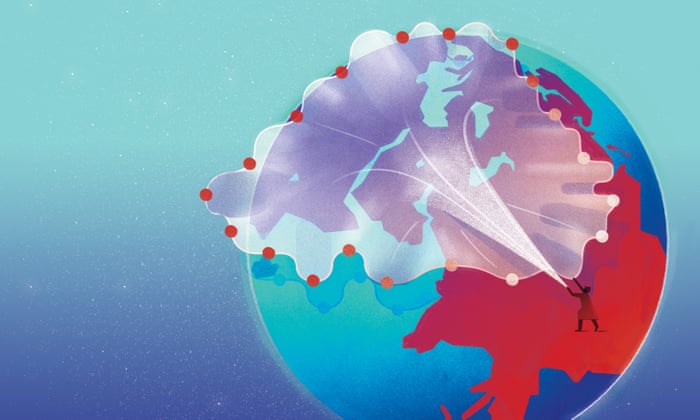
Xi Jinping’s global infrastructure investment programme threatens the west with more than economic dominance. He’s playing a serious political game.
By Tom Miller

Illustration by Thomas Pullin
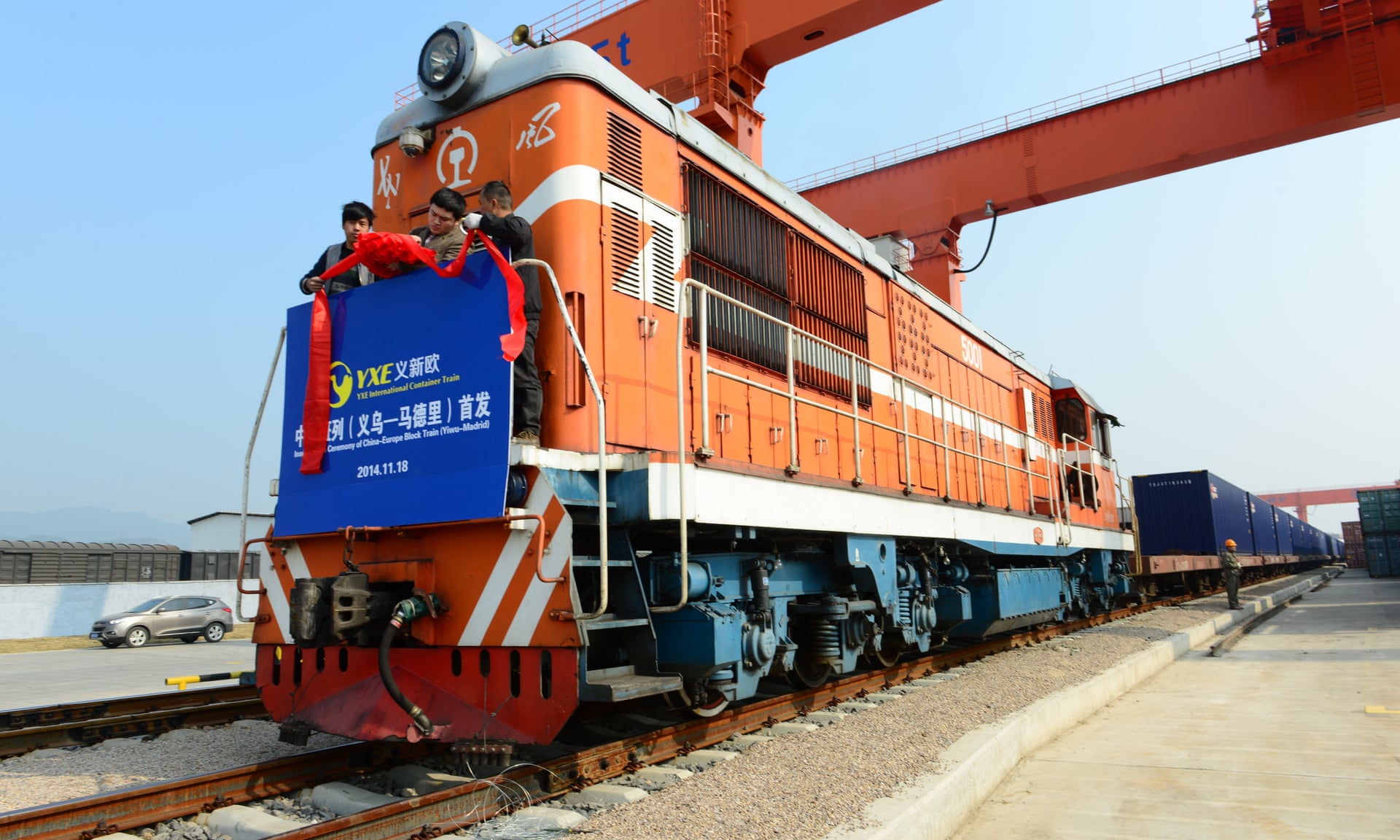
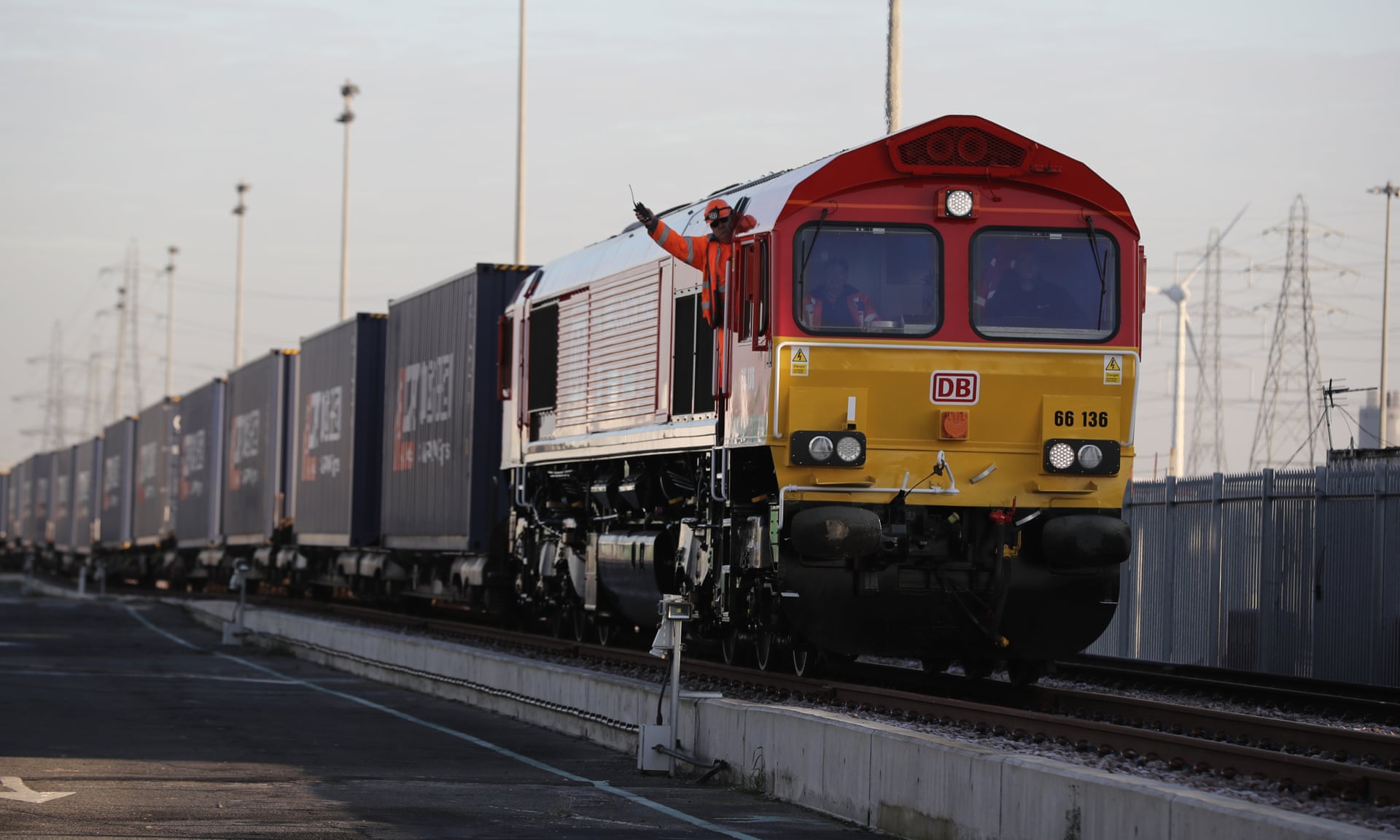
Earlier this year the first direct freight train from China to the UK arrived at a depot in Barking, east London, carrying containers loaded with consumer goods. 
Named East Wind, it took 16 days to travel 7,500 miles across eight countries, halving the time it would have taken by sea. 
A few months later the train made its first return journey, delivering Scotch whisky, pharmaceuticals and baby products to the gargantuan wholesale markets of Yiwu, on China’s east coast. 
Last year 1,702 freight trains from China arrived in Europe, double the total in 2015, and more services are being added.

China train rolls into London
The train is named after some famous words of Mao Zedong. 
“Either the east wind prevails over the west wind or the west wind prevails over the east wind,” Mao declared in 1957. 
Sixty years on, China’s current leaders are doing their best to ensure the east wind prevails. 
The trains trundling their way across Eurasia are part of their attempt to build a new Silk Road, inspired by the ancient caravan routes that once crisscrossed the remote desert and steppe of central Asia. 
They are motivated today by the quest for economic power and national glory. 
By building and financing highways, railways and ports, China’s leaders literally want all roads to lead to Beijing.
The new Silk Road is broader in both geographical and economic scope than its ancient namesake, which was mainly land-based and all about trade and commerce. 
On land, it involves building new transport infrastructure and industrial corridors stretching across Central Asia to the Middle East and Europe. 
On water, it encompasses new ports and trade routes across the South China Sea into the South Pacific, and through the Indian Ocean all the way to the Mediterranean. 
Beijing talks of 65 or so countries belonging to the initiative, but there is no definitive list. 
It is diplomatic shorthand describing Chinese financing, investment and construction across much of the developing world.
The initiative is being pushed hard by Xi Jinping, who has spent five years trying to bolster China’s international clout. 
It is central to his “Chinese dream”, unveiled in his first public act as Communist party chief, when he visited the National Museum of China in Tiananmen Square. 
Emerging from an exhibition that detailed how six decades of Communist rule had brought prosperity to China after a “century of national humiliation”, Xi vowed “to realise the great rejuvenation of the Chinese people”. 
Communist-speak for “make China great again”.
Leaders will meet at the 19th party congress next month to determine who will rule China for the next five years and beyond. 
Already anointed China’s “core” leader, Xi looks set to tighten his grip on power. 
Under his leadership, China has become a more fearful and repressive place – but Xi can claim that his nation is both stronger than it was when he took command. 
Emboldened by the weakening position of the United States under Donald Trump, he is using China’s economic brawn to restore its historical position as the region’s dominant power.
The new Silk Road is at the heart of Xi’s nationalistic vision, as Beijing flexes its economic muscles for strategic ends.
By funding and building transport infrastructure, pipelines and power grids, it aims to weave a web of economic dependency and draw other countries ever tighter into its embrace. 
China’s interests clearly come first, but few underdeveloped states feel they can ignore its promise to deliver much-needed infrastructure. 
The one exception is North Korea, where China’s economic leverage as the hermit kingdom’s biggest trade partner by far appears no match at the moment against Kim Jong-un’s nuclear threat and autarkic ambitions.
East Wind freight carriages arrive in Barking in January. 

Key pieces of the new Silk Road, such as the overland freight routes from China to Europe, are already in place. 
Direct investment along the road was $30bn in 2015-16, according to Beijing’s records, while Chinese firms signed construction contracts worth $189bn and earned $145bn in 60-odd countries. But there are doubts over its security and commercial feasibility. 
Pakistan has reportedly deployed 14,500 security personnel to ensure the safety of some 7,000 Chinese nationals working on the economic corridor. 
The danger was evident in May, when two Chinese language teachers were kidnapped and killed by armed men in Quetta, a remote but important section of the corridor. 
Freight trains from China to Europe may not prove profitable, however much time they save. 
Countries with a history of enmity with China, such as Vietnam and India, fear the strategic implications of China’s expanding tentacles. 
New Delhi has condemned China’s port-building in the Indian Ocean, especially in Sri Lanka and Pakistan, as a platform for military expansionism – a “string of pearls” around the neck of Mother India. 
This summer’s military standoff with China along the contested border in the Himalayas has only added to India’s concerns.
The threat of conflict between Asia’s giants has overshadowed the ninth annual summit of the five Brics countries – Brazil, Russia, India, China and South Africa – starting in the Chinese port city of Xiamen on Sunday. 
The meeting between Xi and India’s prime minister, Narendra Modi, may ease tensions, but the strategic competition will remain.
In other parts of Asia, China’s infrastructure diplomacy is paying dividends in the Philippines – whose president Rodrigo Duterte returned home from Beijing late last year with an investment and trade package worth $24bn after announcing his country’s “separation” from the United States – and Malaysia , whose prime minister Najib Razak declared himself a “true friend” of China after securing deals worth $34bn. 
And small countries such as Cambodia and Tajikistan are also heavily reliant on China to provide vital public goods.
China’s geopolitical leverage is growing. 
Since the end of the second world war, the US has been the dominant power in the Asia-Pacific – but Trump’s diplomatic missteps are playing into China’s hands. 
His decision to bin the Trans-Pacific Partnership, a 12-nation trade pact that pointedly did not include China, has diminished Washington’s regional clout. 
TPP was designed by the Obama administration to anchor the US’s economic and diplomatic presence in Asia at the expense of China. 
Instead, Beijing is pushing for an alternative deal that includes China but not the US.

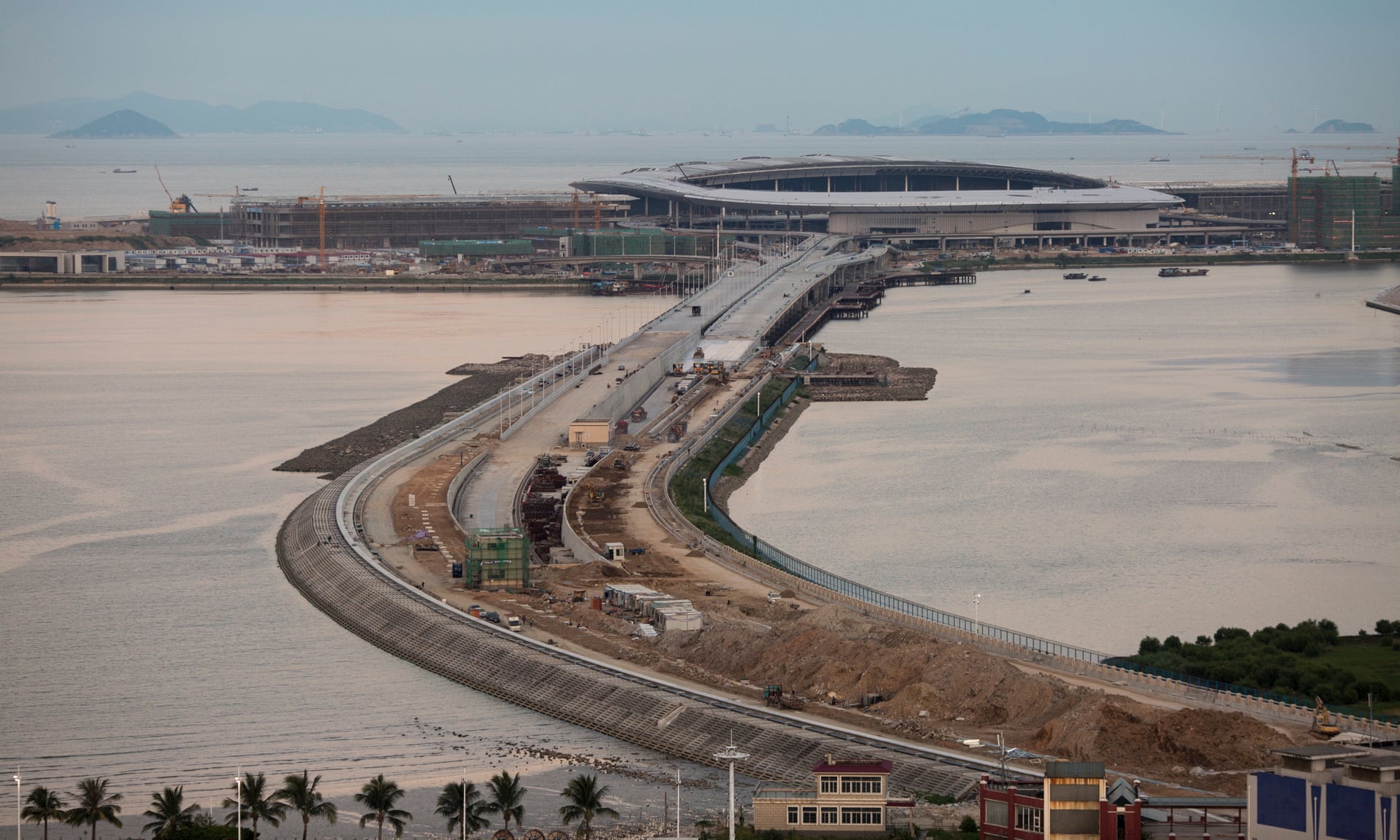
Construction on the Zhuhai-Macau border last week. 

As the US under Trump turns inwards, a newly self-confident China is attempting to replace it. Earlier this year, Xi urged delegates at a forum about the new Silk Road in Beijing to reject protectionism and embrace a version of global trade that China’s publicity machine is spinning as “Globalisation 2.0”. 
Much of this is bluster, but Xi is playing a serious diplomatic game. 
Thirty heads of state attended the forum – not as many as Beijing hoped for, but a sufficient showing for Xi to present himself as an international statesman of substance.
China’s leaders know there is still much diplomatic work to be done, as few countries yet buy its diplomatic mantra about delivering “mutual benefits”. 
Simply put, it is not trusted. 
But its hard-headed economic diplomacy is far bolder, more forward-looking and more practical than any of the alternatives. 
Under Trump, the US does not have a coherent Asia policy and is no longer viewed as a reliable partner, even by its regional allies. 
Japan is still a big source of investment in Asia, but its economy is dwarfed by China’s and it cannot compete as a financier.
From a British perspective, China’s Asian power play looks remote. 
If the new Silk Road delivers a few extra containers of cheap consumer goods, so much to the good. 
But it matters to us all if China’s economic diplomacy succeeds. 
As the outcry this summer over Cambridge University Press’s decision to uphold Beijing’s request to delete 300 politically sensitive articles shows only too clearly, economic leverage buys political power. 
Only an international outcry forced Britain’s oldest academic press to backtrack on its decision. 
The economic pressure on the west to comply with illiberal demands from Beijing will intensify.
In Asia and beyond, China’s rise will bring many economic opportunities, but it could have politically devastating consequences. 
Mao predicted that the east wind would eventually prevail over the west wind. 
If he is proved correct, we will all feel its force.

vendredi 4 août 2017

Vietnam, Yielding to Beijing, Backs Off South China Sea Drilling

By MIKE IVES

Vietnamese Coast Guard ships in Da Nang last year. Vietnam may have halted drilling in the South China Sea this summer for fear of its vessels being overwhelmed by Chinese warships, one analyst said.

HONG KONG — Vietnam appears to have retreated in a high-stakes maritime gambit against China, suspending a gas-drilling project that it had approved in the South China Sea but that was said to have irritated Beijing.
The drilling, by a subsidiary of the Spanish energy company Repsol, had started in June off the southern Vietnamese coast, analysts said.
The offshore block where the drilling was occurring straddles the border of Vietnam’s 200-nautical-mile exclusive economic zone but is challenged by China, Vietnam’s hulking northern neighbor, which is building artificial islands in the sea for its military.
Analysts say the project’s suspension, which Repsol confirmed to Reuters on Wednesday, appears to be another strategic victory for China at a time when the Trump administration is distracted by turmoil at home. 
They say it also highlights the difficulty that Vietnam faces as it mounts long-shot challenges to Beijing’s claims to the South China Sea — without much help from its neighbors in Southeast Asia or from Washington.
Vietnam’s leaders “can try their best to deter the Chinese” in the South China Sea, said Gregory B. Poling, a fellow in the Southeast Asia program at the Center for Strategic and International Studies in Washington. 
“But when the Chinese push back hard, like they just did, the Vietnamese are out on a limb all by themselves.”
In an emailed response to questions about the Repsol project and Vietnam’s strategic priorities in the South China Sea, Le Thi Thu Hang, a spokeswoman for the Foreign Ministry, said that Vietnam supported the settlement of any disputes in the sea by peaceful means and according to international law.
“Vietnam calls on relevant parties to respect the legitimate rights and interests of Vietnam and make positive and practical contributions to peace and cooperation in the East Sea,” she said, using the Vietnamese term for the South China Sea. 
Repsol did not respond to a request for comment.
Unlike the Philippines and Japan, Vietnam is not a treaty ally of the United States, meaning Washington is not legally obligated to protect it in the event of an attack. 
Mr. Poling said that Hanoi found itself isolated on South China Sea policy in part because it was unsure how the Trump administration would react if a conflict escalated there.
“I think it’s fair to say the Vietnamese are still not entirely confident” that the administration cares about the South China Sea in the way that the Obama administration did, he said.
Vietnam’s strategic isolation has worsened as the Philippines, another major territorial claimant in the South China Sea, has warmed to China since Rodrigo Duterte came to power in June 2016.
Last July, the Philippines won a landmark case when an international tribunal ruled that Beijing’s claim to sovereignty over most of the sea had no legal basis. 
Vietnam saw the ruling as a giant step toward its decades-long goal of creating a unified diplomatic front against Chinese territorial encroachment in the South China Sea.
But Duterte appeared to undercut the victory last year by saying that he favored direct talks with China over territorial disputes. 
Eufracia Taylor, a political analyst based in Singapore at the British risk consultancy Verisk Maplecroft, said that while Vietnam and the Philippines were once “in the same boat” on South China Sea policy under Duterte’s predecessor, President Benigno S. Aquino III, bilateral relations had deteriorated since Duterte took office.

The Vietnamese-occupied Southwest Cay, part of the Spratly Islands, in the South China Sea.

It hardly helps that other Southeast Asian countries, which have less of a direct stake in South China Sea disputes and are mostly eager to woo state-backed Chinese investment, are reluctant to publicly discuss Beijing’s island building or the arbitration ruling, said Collin Koh Swee Lean, a research fellow at the S. Rajaratnam School of International Studies in Singapore.
“This is not surprising because Asean would not want to spoil the atmosphere” as it tries to negotiate with China about establishing a so-called code of conduct in the sea, he said, referring to the Association of Southeast Asian Nations.
Vietnam’s South China Sea strategy may also be constrained by domestic concerns.
When a state-owned Chinese company defiantly towed an oil rig into disputed waters near the Vietnamese coast in 2014, it provoked a tense maritime standoff as well as anti-Chinese riots in Vietnam that destroyed foreign-invested factories and led to the deaths of a few Chinese workers.
Analysts say Vietnam’s top leaders worry that another such standoff could again inflame a lingering popular sentiment that the ruling Communist Party is not standing up to China, and therefore damage the party’s legitimacy in the eyes of the country’s 93 million people.
Alexander L. Vuving, a Vietnam specialist at the Daniel K. Inouye Asia-Pacific Center for Security Studies in Hawaii, said that concern appeared to explain why Vietnam did not publicize the Spanish drilling project. 
“This time they were more aware of the threat from their own population,” he said.
Then there are naval considerations.
Dr. Vuving said that Vietnam may have ordered Repsol to stop drilling in the South China Sea this summer because it feared its Coast Guard could be overwhelmed by a potential riposte from the Chinese Navy.
By Dr. Vuving’s calculations, Vietnam roughly doubled the size of its Coast Guard, in terms of tonnage, from 2013 to 2017. 
That buildup has been widely seen as a response to the 2014 crisis, in which large Chinese Coast Guard vessels encircled wooden Vietnamese fishing boats near the controversial oil rig, embarrassing Hanoi.
Analysts and defense officials said in interviews that Vietnam was also investing in maritime surveillance capabilities, conducting limited reclamation work on islands that its military controlled in the South China Sea and training crews to operate its six new Russian-built attack submarines.
Mr. Poling said Vietnam’s overall aim was to deter Chinese aggression in the sea by developing the ability to at least give China a “bloody nose” in a hypothetical military conflict.
“Vietnam’s building up its naval power in order to efficiently and effectively protect its sovereignty and defend its security” against China, said Nguyen Hung Cuong, a South China Sea expert at Vietnam National University in Hanoi.
Ms. Taylor, the Verisk Maplecroft analyst, said that she expected Vietnam to continue exploring offshore energy resources with foreign partners, in part because the government was eager to have energy security that could help power brisk economic growth.
She noted that Vietnam had so far “held the line” on a separate plan to drill for gas in another area of the sea in partnership with Exxon Mobil.
Ms. Taylor said that Vietnam’s uncertainty over the United States’ commitment in the South China Sea under the Trump administration was significant, but also a familiar feeling across Southeast Asia for decades.
Even the Obama administration’s so-called strategic pivot to Asia, she said, had been “a little late — maybe better than never, but not enough to assure people.”

mercredi 2 août 2017

Le Golem chinois

By Dang Phuong-Nghi
Les pays occidentaux dont principalement les Etats-Unis (en 1971) qui, à la suite de la France gaulliste (en 1964), nouèrent des relations diplomatiques avec la Chine populaire et lui donnèrent un brevet de respectabilité au point de l’admettre à l’ONU au détriment de Taiwan, avec en plus un poste permanent au Conseil de sécurité (octobre 1971), et donc un droit de veto sur toutes les résolutions de l’ONU, ont-ils conscience d’avoir pactisé avec un prédateur auquel ils offrent l’immunité tout en se liant les mains ? 
Ce n’était pas faute d’avertissements de la part de personnes lucides rejetées comme rétrogrades, tel John Foster Dulles qui ne pouvait concevoir que la paix mondiale puisse être protégée par « une nation qui a été convaincue d’agression et qui continue à encourager l’emploi de la force en violation des principes de l’ONU ».   
Dans les années 1960-1970, les exactions du pouvoir communiste chinois étaient bien connus, commis aussi bien contre les peuples étrangers tombés sous ses griffes (comme le génocide du peuple tibétain) que contre ses propres citoyens (par exemple lors du Grand bond en avant, de la campagne des Cent fleurs qui causèrent de 40 à 60 millions de morts), mais les esprits sensibles qui vitupéraient alors contre l’impérialisme américain ne trouvèrent rien à redire contre la reconnaissance en fanfare d’un régime déjà deux fois plus criminel que celui des Nazis, qui continue d’ailleurs sans état d’âme  de tricher, de piller, d’opprimer et de tuer selon ses besoins.
Pire encore, depuis l’admission de la Chine dans le concert des nations, les capitalistes des pays libres, appâtés par une main-d’œuvre à bas prix et un marché potentiel d’1,37 milliard de consommateurs (comme si le milliard d’esclaves sur lesquels repose le capitalisme communiste peut et veut se payer les produits occidentaux !) y ont délocalisé à tout va leurs usines, quitte à transférer aux Chinois leur savoir-faire, résultat de dizaines d’années de recherche et d’investissement, que Pékin sut exiger d’eux en contrepartie de leur présence sur son sol. 
Alors que pour n’importe quel pays voulant se développer, l’accumulation du capital est le facteur le plus dur à réaliser, sans se fatiguer des années durant, la Chine disposa d’un coup d’une manne de milliards de dollars apportée volontairement par les capitalistes étrangers, manne qu’elle sut utiliser pour prendre son essor et devenir au bout de trente ans une puissance économique et militaire de premier plan.
Dans les années 1980-1990, les entreprises délocalisatrices justifiaient la fermeture de leurs usines au profit des Chinois en déclarant ne déléguer la production à l’étranger que pour mieux se concentrer sur la matière grise c’est-à-dire la recherche et le développement. 
Mais avec le temps elles se sont aperçues que les améliorations des produits ne pouvaient se détacher du processus de production, et la pression chinoise aidant, nombre d’entre elles ont fini par délocaliser même leur service de recherche en Chine (selon le China science and technology statistics de juillet 2004, on y comptait « 128 institutions de R&D créées par 63 entreprises multinationales » dont 44 d’origine américaine et 43 européenne), condamnant à terme leur pays d’origine à la désindustrialisation et au chômage de masse, pour le plus grand bénéfice des Chinois qu’ils contribuent à enrichir et à former au détriment de leurs compatriotes (pour autant que le mot patrie ait un sens quelconque pour les dirigeants des multinationales !). 
L’ironie est que ces managers qui se ruent en Chine en vue d’écouler leurs produits sur un immense marché n’ont fait qu’ouvrir leurs pays à l’envahissement de produits chinois. 
Quant à vendre leurs produits en Chine, ils y arrivent certes au début, mais dès que les Chinois ont assimilé leur technologie, les facilités d’installation disparaissent et les barrières s’élèvent et l’entreprise « cocue » finit par se retirer du pays (cas par exemple de Yahoo, Sullair, Zodiac…), mais pour une relocalisation, vingt d’autres continuent à succomber au miroir aux alouettes chinois. 
Et plus les Chinois s’enrichissent en même temps que les Occidentaux se dépouillent, plus ces derniers s’aplatissent devant l’arrogance chinoise au point de se constituer en lobby pour faire capoter toute mesure défavorable à la Chine.
Dans la logique du libéralisme, mondialisation et libre-échange ne peuvent qu’être bénéfiques pour tous. 
Il en est ainsi si les participants sont de bonne foi et appliquent la même règle du jeu. 
Or, de tous les pays, la Chine est actuellement le partenaire le plus malfaisant, irrespectueux des règles et normes internationales, brutal et corrupteur, au régime politique le plus barbare, prompt à liquider toutes les têtes même pas dissidentes mais simplement différentes, capable de faire broyer sous les chars de jeunes manifestants à Tiananmen, d’éventrer des millions de Falun Gong pour prélever leurs organes destinés à leur trafic infâme mais rentable (cf. Marianne,19/8/2016, https://www.marianne.net/monde/la-chine-championne-du-trafic-dorganes-sur-, deprisonniers-recoit-le-congres-de-la-transplantation), de projeter l’extermination des peuples entiers comme le peuple tibétain et actuellement le peuple vietnamien, allié des pires Etats de la planète qu’il protège par son veto contre toute sanction de l’ONU (cas de l’Iran des mollahs et du Soudan massacreur du Darfour).
Alors que la Chine engrange milliards sur milliards USD et étend son influence sur le monde entier, l’OMC sous influence du lobby chinois continue de lui accorder le statut de pays en voie de développement avec des dérogations en matière commerciale et monétaire qui pénalisent les pays libres. 
Heureusement qu’avec les procédures anti-dumping l’Union européenne ne lui reconnaît pas (encore) le statut d’économie de marché à la différence de plus de 80 autres pays (dont la Suisse et l’Australie) peu enclins à mécontenter le mastodonte chinois qu’ils savent pourtant dirigiste et tricheur. 
Avec les produits chinois qui déferleront encore plus chez eux, leurs citoyens pourront certes consommer à plus bas prix, mais s’exposeront aussi à des dangers mortels. 
Car la malhonnêteté règne dans l’entreprenariat chinois, où pour augmenter leurs profits, producteurs et marchands n’hésitent pas à recourir à des produits chimiques interdits et cancérigènes à très forte dose, empoisonnant jusqu’aux produits alimentaires (cf. http://www.ladepeche.fr/article/2008/11/27/ 499554-les-produits-alimentaires-chinois-qui-font-peur.html,  http://www.epochtimes.fr/des-produits-chimiques-toxiques-trouves-dans-des-vetements-pour-enfants-fabriques-en-chine-, http://www.alnas.fr/actualite/alimentation-sante/article/sante-10-aliments-en-provenance-de. D’après un rapport de la Commission européenne en 2016, 62% des produits dangereux arrivés en Europe viennent de Chine. Les contrôles, quand ils existent, sont difficiles et ne peuvent être systématiques).
Au lieu d’utiliser ses 3000 milliards de réserves de devises (chiffre de 2/2017) pour réparer les dégâts environnementaux et soulager la vie des centaines de millions de victimes résultant de leur politique d’industrialisation à marche forcée, les dirigeants chinois, remplis de suffisance et d’appétit de puissance, préfèrent s’en servir pour réaliser leur ambition d’hégémonie mondiale. 
Conscients de leur retard scientifique par rapport aux pays avancés, ils rachètent les entreprises occidentales en difficulté et les actions des entreprises florissantes pour s’emparer de leurs savoir-faire (cf. la mise en garde de la chancelière Merkel le29/6/2017 http://www.lefigaro.fr/flash-eco/2017/06/29/97002-20170629FILWWW00089-merkel-met-en-garde-contre-l-expansionnisme-ec). 
Quand ils n’y arrivent pas, ils n’hésitent pas à pratiquer la ruse et le vol (cf. http://www.vanityfair.fr/actualites/international/articles/comment-la-chine-vole-nos-secrets/15833 ). Pour approvisionner leurs usines et si possible s’assurer un monopole, la Chine cherche à faire main basse sur toutes les ressources naturelles de la planète grâce à son portefeuille bien garni et à la complicité de gouvernants et individus avides et corrompus de tous les pays. 
Dans la foulée elle achète des millions d’hectares de terres cultivables sur les cinq continents (même en France où 1700 ha du département de l’Indre sont devenues chinoises) http://www.leparisien.fr/ espace-premium/fait-du-jour/10-millions-d-hectares-de-terres-cultivees-hors-de-leurs-frontieres-30-06-2016-5926767.php, non pas pour nourrir ses habitants en manque de provisions comme le répètent à l’envie les media, mais pour produire des aliments relativement sains pour les 400 millions de cadres et d’affidés du régime, le milliard d’esclaves devant se contenter des aliments empoisonnés produits en Chine même, l’excédent étant exporté (à se rappeler que la Chine est depuis 2015 le 1er pays exportateur de produits agricoles) aux dépens des diables et barbares (qualificatifs communément usités) étrangers.
Avec les pays développés ou démocratiques, les acquisitions chinoises restent discrètes dans la mesure où, pour exploiter les ressources et entreprises achetées, les nouveaux propriétaires chinois emploient de la main d’œuvre locale et gardent une partie de l’ancien personnel ; mais dans les pays où règne la corruption, ils ne se gênent pas pour pratiquer la colonisation de peuplement en faisant venir la main-d’œuvre directement de Chine au lieu de donner de l’emploi aux autochtones (ex. du Congo http://www.demainlenouveaucongobrazzaville.org/article-26660609.html). 
Ces millions de travailleurs Chinois et leur famille non comptabilisés comme immigrants puisqu’ils sont en principe résidents temporaires le deviendront de fait avec le temps et viendront s’ajouter à la diaspora chinoise dont Pékin veut multiplier le nombre autant pour lever la pression démographique en Chine que pour disposer d’une cinquième colonne plus considérable à l’étranger.
Forte de sa puissance économique, pour contrer l’influence des Etats-Unis, la Chine bâtit depuis 2013 une « diplomatie de la route de la soie » appelée « une ceinture, une route » qui consiste à rendre dépendants d’elle 68 pays se trouvant sur une ligne la reliant par voie de terre et de mer à l’Europe (https://benillouche.blogspot.fr/2017/02/la-route-de-la-soie-par-dov-zerah.html). 
A la fois intimidés et séduits par la perspective de gros investissements, certains de ces pays sont déjà tombés dans son giron (comme le Pakistan  alléché depuis 2015 par les avantages éventuels d’un investissement de 46 milliards pour la construction d’un corridor sino-pakistanais qui permettra aux Chinois de rallier directement l’océan indien, ou la Somalie qui vient de céder à la Chine 364 km2 à Djibouti pour y installer sa première base militaire hors d’Asie) ou se montrent au moins conciliants comme l’Australie qui s’est sentie obligée de lui accorder des privilèges excessifs pour les entreprises chinoises sur son territoire.
A l’expansion économique correspond un essor militaire sans précédent. En quelques décennies la Chine s’est hissée au rang de 2e puissance militaire avec le plus grand nombre d’effectifs (plus de 2 millions) et un budget (actuellement de 140 milliards d’euros) qui ne cesse d’augmenter. 
Prête à un affrontement avec les Etats-Unis, elle met en place un plan quinquennal (2016-2020) de modernisation de l’armée pour la doter des armes et d’équipements les plus sophistiqués. 
Assurée de la supériorité de ses forces terrestres (qui possèdent la plus grande quantité de chars et de pièces d’artillerie), à défaut d’égaler l’aviation américaine, elle se dote d’un nombre impressionnant de missiles (avec de 1600 à 1800 têtes nucléaires selon le général russe Victor Iessine), profitant du fait qu’elle n’a pas signé les accords Salt de limitation des armes stratégiques que Russes et Américains doivent respecter.
Parmi les missiles, deux modèles ont été conçus exprès pour attaquer navires et porte-avions, le CM 302 présenté en 2016 et le DF21D lancé en 2015. 
Avec eux, la Chine peut, malgré son infériorité actuelle dans le domaine maritime, menacer la flotte américaine et repousser les Etats-Unis hors de la Mer orientale dont elle prétend faire sa chasse gardée. 
Car dans l’esprit des dirigeants chinois, l’hégémonie mondiale passe d’abord par la maîtrise des mers, c’est-à-dire le contrôle des voies maritimes et puisque la Chine est en Asie, il lui faut absolument exercer la domination sur la principale liaison entre l’Occident et l’Asie qui passe par le sud de la mer orientale. 
Et c’est là qu’intervient le Vietnam, à la fois verrou et porte d’accès à la suprématie.
Car le Vietnam, outre ses richesses naturelles qui n’ont cessé d’exciter la convoitise chinoise depuis des millénaires, occupe de par sa géographie une position stratégique unique qui amplifie le désir de Pékin de s’emparer du pays. 
C’est au large des îles Paracel et Spratly sises sur le plateau continental vietnamien et gouvernées officiellement par le Vietnam depuis le 18e siècle que passent tous les navires venant de l’Europe, l’Afrique et le Moyen-Orient en direction de l’Asie de l’Est et vice-versa. 
Asseoir sa souveraineté sur les deux archipels c’est pouvoir contrôler une voie maritime par où transitent des marchandises estimées à 5000 milliards euros/an, sans compter que ces îles sont entourées d’eaux très poissonneuses et abritent sous elles d’énormes gisements d’hydrocarbures (de 1% à 25% des réserves mondiales selon les estimations). 
Profitant de l’affaiblissement du Vietnam pendant la guerre civile nord-sud et pendant la guerre avec elle-même, la Chine s’empara en 1974 des Paracels qu’elle occupa entièrement et en 1988 des Spratly dont elle occupa une grande partie. 
Sachant ces occupations illégales, elle cherche à imposer une ligne de délimitation de ses eaux territoriales englobant les deux archipels appelée ligne des neuf points ou ligne U que contestent tous ses voisins. 
Depuis 2014 elle fait construire des îles artificielles dans les Spratly pour relier les petites îles ensemble et y installer une base militaire avec piste d’aviation et logements.
De facto la Chine fait déjà la loi en mer orientale, les pays de la région n’étant pas de taille à s’opposer à ses manigances. 
Ce qu’elle vise c’est d’en être le souverain de jure. 
Et pour cela il lui faut la reconnaissance de sa souveraineté sur les archipels par le seul pays qui peut y prétendre à bon droit, à savoir le Vietnam. 
En 1958, elle a déjà obtenu de Hồ Chí Minh une cession implicite des Paracels et Spratly via une lettre diplomatique reconnaissant la délimitation des eaux fixée par la Chine signée par son premier ministre Phạm Văn Đồng. 
Le problème est qu’il ne s’agit que d’une cession implicite rédigée en plus en termes plutôt vagues, et surtout le document n’a aucune valeur juridique car à l’époque Hanoi n’avait aucun droit sur ces archipels qui relevaient du pouvoir de Saigon. 
En 1990, la chute de l’URSS et la pression militaire chinoise poussèrent les dirigeants de Hanoi à se rendre pieds et poings liés à Pékin au point de signer des accords secrets (par peur des réactions du peuple vietnamien) pour une annexion progressive du Vietnam à la Chine devant être effective en 2020. 
C’est ainsi que depuis lors, avec l’appui du pouvoir de Hanoi, les Chinois se sont appropriés au fil des temps de toutes les ressources du Vietnam et de ses meilleures terres, en premier des Paracels et Spratly dont ils interdisent l’approche aux pêcheurs Vietnamiens. 
Vis-à-vis de la population tenue dans l’ignorance et abêtie par la propagande, le pouvoir se contente de nier ou minimiser la situation, tout en se livrant à une féroce répression des patriotes opposés à la Chine. 
Bien qu’ils soient entièrement inféodés à Pékin, tant qu’ils sont au pouvoir, pour l’opinion nationale et internationale, les dictateurs de Hanoi rechignent à déclarer publiquement leur soumission à la Chine, en particularité la transmission de souveraineté sur les îles à l’empire, au grand mécontentement de ce dernier.
Cette réticence de Hanoi joue en faveur du monde libre, mais elle ne durera pas car 2020 approche et Pékin a déjà avancé tous ses pions pour faire du Vietnam une province chinoise. 
Le seul moyen pour tous les pays qui refusent l’hégémonie du Golem qu’ils ont eux-mêmes engendré est d’empêcher cette annexion programmée, c’est-à-dire d’aider le peuple vietnamien à se soulever contre le régime communiste pour instaurer un nouveau pouvoir nationaliste qui saura dénoncer les accords illicites et lutter contre vents et marées pour son indépendance. 
La Chine sera obligée de recourir à sa force armée, mais elle aura montré son réel visage et l’opinion internationale alertée se mettra derrière les gouvernements prêts à abattre le Golem.


Un exemple de manipulation chinoise pour s’emparer des terres d’un pays développé :    http://www.web-agri.fr/observatoire_marches/article/comment-la-chine-manipule-le-cours-mondial-du-lait-1929-119608.html