A Chinese invasion of Taiwan would be a bloody, logistical nightmare
By Ben Westcott Taiwan -- Roaring out of the sky, an F-16V fighter jet lands smoothly to rearm and refuel on an unremarkable freeway in rural Taiwan, surrounded by rice paddies.
In different circumstances, this could be alarming sight.
Taiwan's fighter pilots are trained to land on freeways between sorties in case all of the island's airports have been occupied or destroyed by an invasion.
Luckily, this was a training exercise.
There's only really one enemy that Taiwan's armed forces are preparing to resist -- China's People's Liberation Army (PLA).
Luckily, this was a training exercise.
There's only really one enemy that Taiwan's armed forces are preparing to resist -- China's People's Liberation Army (PLA).
And as China's reputation as an economic and military superpower has grown in recent years, so too has that threat of invasion, according to security experts.
Taiwan has been self-governed since separating from China at the end of a brutal civil war in 1949, but Beijing has never given up hope of reuniting with what it considers a renegade province.
At a regional security conference in June, Chinese Defense Minister Wei Fenghe said: "If anyone dares to split Taiwan from China, the Chinese military has no choice but to fight at all costs for national unity."
In some shops in mainland China, you can buy postcards and T-shirts emblazoned with patriotic emblems promoting the retaking of Taiwan.
But for seven decades, China has resisted attacking Taiwan partly for political reasons, including the prospect of a US intervention and the potential heavy human toll.
But for seven decades, China has resisted attacking Taiwan partly for political reasons, including the prospect of a US intervention and the potential heavy human toll.
But the practical realities of a full-blown invasion are also daunting for the PLA, according to experts.
Ferrying hundreds of thousands of troops across the narrow Taiwan Strait to a handful of reliable landing beaches, in the face of fierce resistance, is a harrowing prospect.
Ferrying hundreds of thousands of troops across the narrow Taiwan Strait to a handful of reliable landing beaches, in the face of fierce resistance, is a harrowing prospect.
Troops would then have a long slog over Taiwan's western mudflats and mountains to reach the capital, Taipei.
Not only that, but China would face an opponent who has been preparing for war for almost 70 years.
At mass anti-invasion drills in May, Taiwan military spokesman Maj. Gen. Chen Chung-Chi said the island knew it had to always be "combat-ready."
"Of course, we don't want war, but only by gaining our own strength can we defend ourselves," he said.
"If China wants to take any action against us, it has to consider paying a painful price."
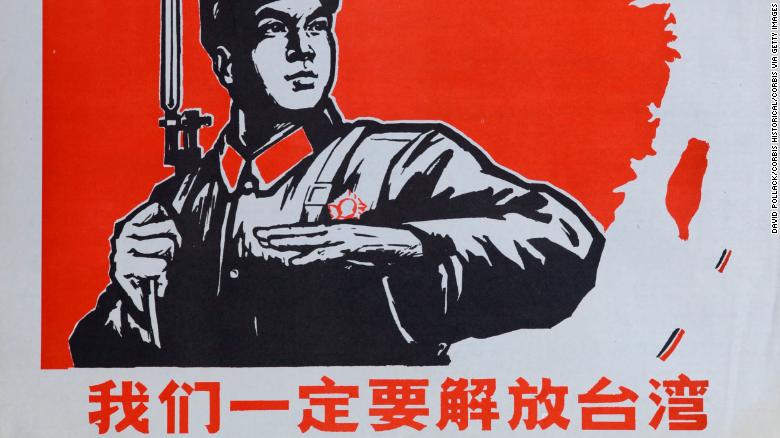
A Chinese Cultural Revolution poster showing a Chinese soldier and the island of Taiwan. "We must liberate Taiwan," the caption says.
Difficult and bloody
It could be easy to assume that any invasion of Taiwan by Beijing would be brief and devastating for Taipei: a David and Goliath fight between a tiny island and the mainland's military might, population and wealth.
With nearly 1.4 billion people, the People's Republic of China has the largest population in the world. Taiwan has fewer than 24 million people -- a similar number to Australia.
China has the fifth largest territory in the world, while Taiwan is the size of Denmark or the US state of Maryland.
And Beijing runs an economy that is second only to the United States, while Taiwan's doesn't rank in the world's top 20.
But perhaps most pertinently, China has been building and modernizing its military at an unprecedented rate, while Taiwan relies on moderate US arms sales.
In sheer size, the PLA simply dwarfs Taiwan's military.
China has an estimated 1 million troops, almost 6,000 tanks, 1,500 fighter jets and 33 navy destroyers, according to the latest US Defense Department report.
Taiwan's ground force troops barely number 150,000 and are backed by 800 tanks and about 350 fighter aircraft, the report found, while its navy fields only four destroyer-class ships.
Under Chinese dictator Xi Jinping, the PLA has rapidly modernized, buoyed by rises in military spending and crackdowns on corruption in the army's leadership.
"China's leaders hope that possessing these military capabilities will deter pro-independence moves by Taiwan or, should deterrence fail, will permit a range of tailored military options against Taiwan and potential third-party military intervention," according to a 2019 US Defense Intelligence Agency report on China's military.
Yet while China hawks in the media might beat the drum of invasion, an internal China military study, seen by CNN, revealed that the PLA considers an invasion of Taiwan to be extremely difficult.
"Taiwan has a professional military, with a strong core of American-trained experts," said Ian Easton, author of "The Chinese Invasion Threat" and research fellow at the Project 2049 Institute, as well as "highly defensible" terrain.
In his book he described an invasion by China as "the most difficult and bloody mission facing the Chinese military."
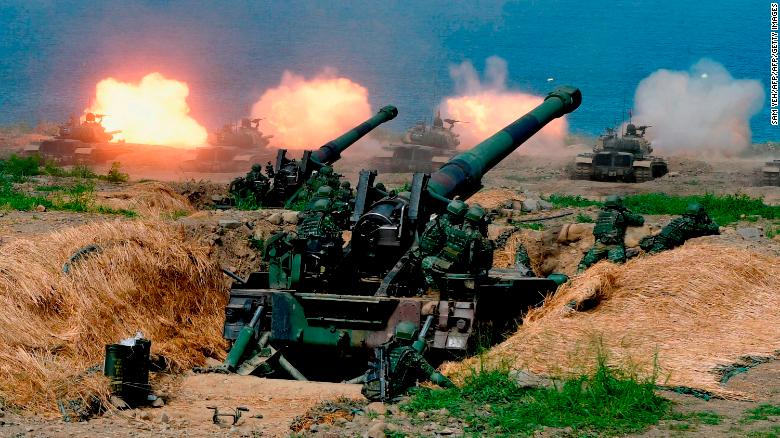
US-made CM-11 tanks are fired in front of two 8-inch self-propelled artillery guns during military drills in southern Taiwan on May 30.
The plan to take Taiwan
China's Taiwan invasion plan, known internally as the "Joint Island Attack Campaign," would begin with a mass, coordinated bombing of Taiwan's vital infrastructure -- ports and airfields -- to cripple the island's military ahead of an amphibious invasion, according to both Easton and Sidharth Kaushal, a research fellow at the Royal United Services Institute for Defense and Security Studies.
At the same time, the Chinese air force would fly over the Taiwan Strait and try to dominate the island's air space.
Under Chinese dictator Xi Jinping, the PLA has rapidly modernized, buoyed by rises in military spending and crackdowns on corruption in the army's leadership.
"China's leaders hope that possessing these military capabilities will deter pro-independence moves by Taiwan or, should deterrence fail, will permit a range of tailored military options against Taiwan and potential third-party military intervention," according to a 2019 US Defense Intelligence Agency report on China's military.
Yet while China hawks in the media might beat the drum of invasion, an internal China military study, seen by CNN, revealed that the PLA considers an invasion of Taiwan to be extremely difficult.
"Taiwan has a professional military, with a strong core of American-trained experts," said Ian Easton, author of "The Chinese Invasion Threat" and research fellow at the Project 2049 Institute, as well as "highly defensible" terrain.
In his book he described an invasion by China as "the most difficult and bloody mission facing the Chinese military."
US-made CM-11 tanks are fired in front of two 8-inch self-propelled artillery guns during military drills in southern Taiwan on May 30.
The plan to take Taiwan
China's Taiwan invasion plan, known internally as the "Joint Island Attack Campaign," would begin with a mass, coordinated bombing of Taiwan's vital infrastructure -- ports and airfields -- to cripple the island's military ahead of an amphibious invasion, according to both Easton and Sidharth Kaushal, a research fellow at the Royal United Services Institute for Defense and Security Studies.
At the same time, the Chinese air force would fly over the Taiwan Strait and try to dominate the island's air space.
Once the PLA was satisfied it had suitably disabled Taiwan's air and naval forces, Kaushal said soldiers would begin to invade on the west coast of the island.
The island's rocky, mountainous east coast is considered too inhospitable and far from mainland China.
The amphibious invasion needed to put troops on Taiwan, however, could be the biggest hurdle facing the PLA.
In its 2019 report to Congress, the US Department of Defense said China -- which has one of the largest navies in Asia -- had at its command 37 amphibious transport docks and 22 smaller landing ships, as well as any civilian vessels Beijing could enlist.
That might be enough to occupy smaller islands, such as those in the South China Sea, but an amphibious assault on Taiwan would likely require a bigger arsenal -- and there is "no indication China is significantly expanding its landing ship force," the report said.
That makes it vital for Beijing to neutralize Taiwan's navy and air force in the early stages of an attack, Kaushal said.
"The Taiwanese air force would have to sink around 40% of the amphibious landing forces of the PLA in order to render this sort of mission infeasible," he said.
Essentially, that's only about 10 to 15 ships, he added.
If they did make it across the strait, the PLA would still need to find a decent landing spot for its ships.
China's military would be looking for a landing site both close to the mainland, and a strategic city, such as Taipei, with nearby port and airport facilities.
That leaves just 14 potential beaches, Easton said -- and it's not only the PLA that knows it. Taiwanese engineers have spent decades digging tunnels and bunkers in potential landing zones along the coast.
Furthermore, the backbone of Taiwan's defense is a fleet of vessels capable of launching anti-ship cruise missiles, on top of an array of ground-based missiles, and substantial mines and artillery on the coastline.
"Taiwan's entire national defense strategy, including its war plans, are specifically targeted at defeating a PLA invasion," Easton said.
Chinese troops could be dropped in from the air, but a lack of paratroopers in the PLA makes it unlikely.
If the PLA held a position on Taiwan, and could reinforce with troops from the mainland to face off about 150,000 Taiwan troops, as well as more than 2.5 million reservists, it would have to push through the island's western mud flats and mountains, with only narrow roads to assist them, towards Taipei.
Finally, the mobilization of amphibious landing vessels, ballistic missile launchers, fighters and bombers, as well as hundreds of thousands of troops, would give Taiwan plenty of advance warning of any attack, Kaushal said.
"It's extremely unlikely that the invasion could come as a bolt from the blue," Kaushal added.
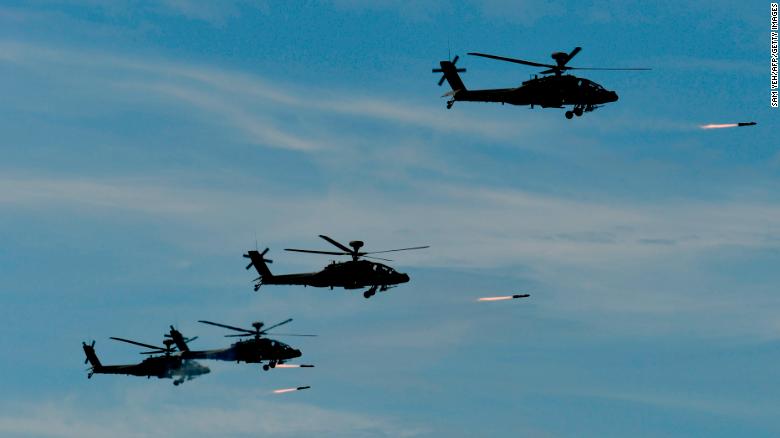
Four US-made Apache attack helicopters launch missiles during the 35th "Han Kuang" military drill in southern Taiwan on May 30.
The bad guy in the neighborhood
There is, of course, one final deterrent to any PLA invasion of Taiwan.
It isn't clear whether or not such an attack by China would spark an intervention by the United States on Taipei's behalf.
Washington has been a longtime ally of the island, selling weapons to the Taiwan government and providing military protection from Beijing.

Facing an aggressive Beijing, Taiwan's president issues a warning to the world
"The Taiwanese air force would have to sink around 40% of the amphibious landing forces of the PLA in order to render this sort of mission infeasible," he said.
Essentially, that's only about 10 to 15 ships, he added.
If they did make it across the strait, the PLA would still need to find a decent landing spot for its ships.
China's military would be looking for a landing site both close to the mainland, and a strategic city, such as Taipei, with nearby port and airport facilities.
That leaves just 14 potential beaches, Easton said -- and it's not only the PLA that knows it. Taiwanese engineers have spent decades digging tunnels and bunkers in potential landing zones along the coast.
Furthermore, the backbone of Taiwan's defense is a fleet of vessels capable of launching anti-ship cruise missiles, on top of an array of ground-based missiles, and substantial mines and artillery on the coastline.
"Taiwan's entire national defense strategy, including its war plans, are specifically targeted at defeating a PLA invasion," Easton said.
Chinese troops could be dropped in from the air, but a lack of paratroopers in the PLA makes it unlikely.
If the PLA held a position on Taiwan, and could reinforce with troops from the mainland to face off about 150,000 Taiwan troops, as well as more than 2.5 million reservists, it would have to push through the island's western mud flats and mountains, with only narrow roads to assist them, towards Taipei.
Finally, the mobilization of amphibious landing vessels, ballistic missile launchers, fighters and bombers, as well as hundreds of thousands of troops, would give Taiwan plenty of advance warning of any attack, Kaushal said.
"It's extremely unlikely that the invasion could come as a bolt from the blue," Kaushal added.
Four US-made Apache attack helicopters launch missiles during the 35th "Han Kuang" military drill in southern Taiwan on May 30.
The bad guy in the neighborhood
There is, of course, one final deterrent to any PLA invasion of Taiwan.
It isn't clear whether or not such an attack by China would spark an intervention by the United States on Taipei's behalf.
Washington has been a longtime ally of the island, selling weapons to the Taiwan government and providing military protection from Beijing.
Facing an aggressive Beijing, Taiwan's president issues a warning to the world
Easton said that, at present, the US would likely intervene in Taiwan's favor, both to protect investment by US companies on the island and reassure American allies in the region, who are also facing down a resurgent PLA in the East and South China seas.
Collin Koh Swee Lean, research fellow at the S. Rajaratnam School of International Studies' Maritime Security Program in Singapore, said there would also be "immense political consequences" from taking over Taiwan, in the event of a successful China invasion.
"It will likely mean that China will be seen as the bad guy in the neighborhood, who uses force," he said.
"It will alienate regional partners and the good will which China has been trying to build over the years will evaporate. And it will set China on a collision course with the US."
But Taipei isn't taking anything for granted.
On the sidelines of the massive Han Guang drills, Taiwan's Maj. Gen. Chen pointed out the hundreds of spectators who had come out to watch and support the island's military.
"These exercises let people know the national army of the Republic of China is ready," he said.
Taiwan is taking no chances.

