Affichage des articles dont le libellé est U.S. Consulate. Afficher tous les articles

lundi 9 septembre 2019

Hong Kong Democratic and Human Rights Act

Hong Kong protesters beg Trump: "Liberate our city"
By Eileen Ng and Alice Fung
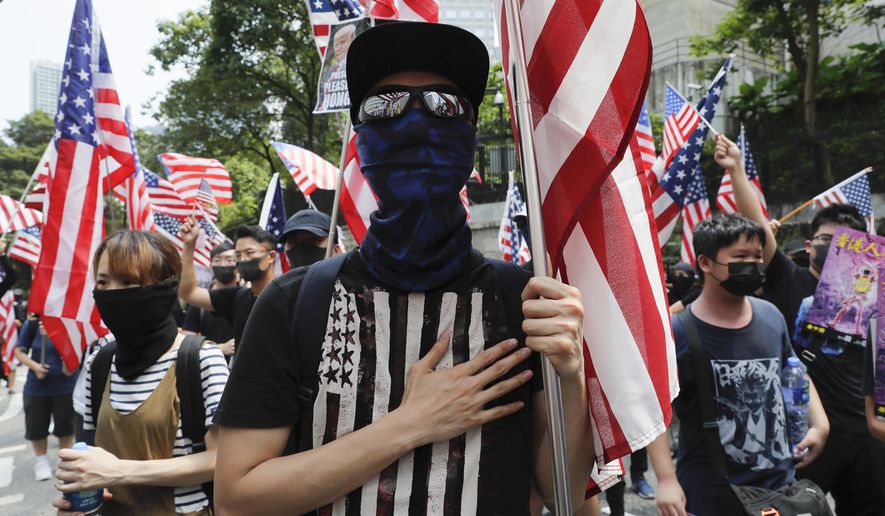
Protesters shout slogans during a protest in Hong Kong, Sunday, Sept. 8, 2019. Demonstrators in Hong Kong march to the U.S. Consulate on Sunday to drum up international support for their protest movement, a day after attempts to disrupt transportation to the airport were thwarted by police. 

HONG KONG — Thousands of demonstrators in Hong Kong urged President Donald Trump to “liberate” the semiautonomous Chinese territory during a peaceful march to the U.S. Consulate on Sunday, but violence broke out later in the business and retail district after protesters vandalized subway stations, set fires and blocked traffic.
Protesters flooded a park in central Hong Kong, chanting “Resist Beijing, Liberate Hong Kong” and “Stand with Hong Kong, fight for freedom.” 
Many of them, clad in black shirts and wearing masks, waved American flags and carried posters that read “President Trump, please liberate Hong Kong” as they marched to the U.S. Consulate nearby.
“Hong Kong is at the forefront of the battle against the totalitarian regime of China,” said Panzer Chan, one of the organizers of the march. 
“Please support us in our fight.”
Hong Kong has been rocked by three months of unrest sparked by a proposed law that would have allowed criminal suspects to be sent to mainland China for trial. 
Many saw the extradition bill as a glaring example of the erosion of civil liberties and rights promised under a “one country, two systems” framework when the former British colony returned to Chinese rule in 1997.
Hong Kong’s government promised this past week to formally withdraw the bill, but that failed to appease the demonstrators, who have widened their demands to include calls for direct elections for the city’s leaders and an independent probe into thuggish police brutality against protesters.
The unrest has become the biggest challenge to Beijing’s rule since Hong Kong’s return from Britain. Beijing and the entirely state-controlled media have portrayed the protests as an effort by "criminals" to split the territory from China, backed by "hostile foreigners".
Protesters on Sunday urged Washington to pass a bill, known as the Hong Kong Democratic and Human Rights Act, to support their cause. 
The bill proposes sanctions against Hong Kong and Chinese officials found to suppress democracy and human rights in the city, and could also affect Hong Kong’s preferential trade status with the U.S.
A group of protesters sang “The Star-Spangled Banner” before handing over an appeal letter to a U.S. Consulate official.
Just before the rally ended, violence broke out after riot police detained several people and chased protesters out of the nearby Central subway station. 
Angry protesters smashed glass windows and sprayed graffiti at the station’s exits.
Protesters burned cardboard boxes and other debris to start a fire at one of the exits. 
A barricade was set on fire at a nearby street, but firefighters quickly snuffed it out.
The government said some protesters also blocked traffic at a major thoroughfare near City Hall in the area, paralyzing traffic. 
Riot police chased groups of protesters down several roads as night fell, searching dozens of young people on the street and at the next two subway stations after Central.
The U.S. State Department said in a travel advisory Friday that Beijing has undertaken a propaganda campaign “falsely accusing the United States of fomenting unrest in Hong Kong.” 
It said U.S. citizens and embassy staff have been the target of the propaganda and urged them to exercise increased caution.
American legislators are pressing Trump to take a tougher stand on Hong Kong. 
But Trump has said little in public since recommending on Twitter in mid-August that Chinese dictator Xi Jinping “meet directly and personally” with the protesters.
Political analysts suggest Trump’s response has been muted because he doesn’t want to disrupt talks with Xi’s government over their tariff war.
The Senate majority leader, Mitch McConnell, said last week that he would recommend Trump take “more forceful action” if Chinese authorities crush the demonstrations. 
The protests are an embarrassment to China’s ruling Communist Party less than one month before the Oct. 1 celebration of its 70th anniversary in power.
Sunday’s rally followed violent clashes the previous two nights between protesters and police at several subway stations.
Separately, well-known activist Joshua Wong said in a statement through his lawyer that he was detained at the airport early Friday for breaching bail conditions. 
Wong, a leader of Hong Kong’s 2014 pro-democracy protest movement, was among several people detained last month and was charged with inciting people to join a protest in June.
Wong, who just returned from Taiwan, where he gave speeches on Hong Kong’s protests, and is due to visit Germany and the U.S., said the court had approved his overseas trips.
He described his detention as a procedural hiccup and said he expected to be released Monday. 
His prosecution comes less than two months after his release from prison for a two-month sentence related to the 2014 protests.

The Battle of Hong Kong

‘The whole system is rotten. We want to tear it down’: Hong Kong protests blaze on
By ALICE SU, RYAN HO KILPATRICK

Fire set by protesters blocks the entrance to the MTR Central station stop in Hong Kong on Sept. 8, 2019.

HONG KONG — It took Hong Kong Chief Executive Carrie Lam 13 weeks to withdraw the extradition bill that sparked the city’s summer of unrest. 
But her announcement failed to stop the protests for even one night.
Demonstrators have continued to rally, march, clash with police and, on Sunday, wave American flags while singing the U.S. national anthem in an appeal for help from Washington.
“Resist Beijing, liberate Hong Kong! Sanction China, now or never! Pray for U.S., pray for us!” chanted tens of thousands of protesters who marched to the U.S. Consulate on Sunday afternoon in a call for Congress to pass legislation that would strengthen U.S. support for democratization and human rights in Hong Kong.
What began as peaceful protests over a bill that would allow people in the semiautonomous territory to be deported to mainland China for trial has become a fight for liberal versus authoritarian values.
Hong Kong is “at the front line of an expansionist China,” said Leung, 25, who, like most other protesters, asked that his full name be withheld to protect his safety. 
He wore a full suit in a sign of respect for what he said the United States represented.
“It’s not just about fighting back against one country but against the spread of communism and authoritarianism,” Leung said. 
“It’s Hong Kong and Xinjiang today, but where will be next?”

Local residents join in and hurl insults at the Hong Kong police officers as protests continue in Hong Kong.

House Speaker Nancy Pelosi said in a statement Wednesday that the people of Hong Kong deserved “justice, real autonomy and freedom of fear” and that Congress looked forward to “swiftly advancing” legislation.
Trump, on the other hand, has expressed confidence in Chinese dictator Xi Jinping, calling him a “great leader” who can “quickly and humanely solve the Hong Kong problem.”
Trump also — perhaps inadvertently — echoed Chinese rhetoric on Hong Kong protests by calling them “riots” and affirming that Hong Kong is a domestic Chinese problem.
"Hong Kong is a part of China; they’ll have to deal with that themselves,” he said to reporters in August.
The Hong Kong protest movement, pushed forward largely by people in their teens and 20s with no identifiable leader, has adopted more aggressive tactics while reiterating demands for the investigation of police brutality, amnesty for more than 1,000 arrested protesters, and electoral reform.
Xi has responded negatively. 
In a recent speech, he exhorted Communist Party cadres to “struggle” harder against challenges to China’s sovereignty and party interests, singling out Hong Kong as a key area of struggle.
With Beijing doubling down, Hong Kongers have increasingly lost trust in government, the police force and long-standing institutions.
Tens of thousands of students and workers went on strike in recent days as the new school year began. 
At one secondary school’s back-to-school opening ceremony, students sang “Do You Hear the People Sing?” — the revolutionary song from “Les Miserables” — above the Chinese national anthem.

Hong Kong police officers in riot gear push back protesters and journalists as they make arrests near Victoria Park.

At the Chinese University of Hong Kong, students hung a banner over the side of a building: “I’d rather speak up and die than remain silent and live.”
At 10 o’clock each night, residents lean out of their windows in neighborhoods across the city to scream anti-government slogans and their core demands. 
“Reclaim Hong Kong, revolution of our times!” they yell, some in anger at police tactics, others in resistance to Beijing’s background control.
Rumors of police having killed protesters inside a subway station on Aug. 31 have sparked spontaneous protests at the station and nightly clashes with police.
Hong Kong’s government has denied that any protesters died during police clashes at Prince Edward Station. 
But a wall of flowers fills the subway exit.
Protesters knelt inside the subway station for hours last week, begging the transportation authority to release CCTV video of the hours when police were inside.
Later, protests turned into clashes with police, who destroy the memorial each night only to see new white flowers and incense return each day.

Protesters set up road blocks on Nathan Road, a busy main street, outside the Mong Kok police station.

“A debt of blood must be paid in blood,” reads a sign above the subway entrance.
Cassie, 19, a protester wearing jean shorts and a surgical mask, laid fresh flowers at the subway station as police charged at protesters nearby Sunday night.
“I believe people were beaten to death by police on Aug. 31. Because they refuse to release the CCTV footage,” she said. 
“They have something to hide.”
Other protesters vandalized the interior of Hong Kong’s Central subway station, smashing glass windows at its entrances and setting a barricade on fire.
Tony, 30, a resident, said he disagreed with setting fires or attacking police — especially on a day when Hong Kongers were appealing for help from the United States.

A demonstrator chants "five demands, not one less," as he cheers on other demonstrators at a pro-democracy rally near the United States Consulate in Hong Kong.

But he also criticized the police, saying their aggression had shattered residents’ sense of safety.
“There’s just no trust in them left,” he said. 
“They act above the law now, surrounding and beating people even after they’re subdued. They think they are the court and the prison. You’re guilty until proven innocent.”
A series of surveys conducted by the Chinese University of Hong Kong’s Center for Communication and Public Opinion have found that more and more protesters have become comfortable with radical tactics as the crisis continues.
The percentage of protesters who agreed that radical tactics were understandable if the government refused to listen rose to 90% from 70% between June and August.
The protesters Sunday were urging passage in Washington of the Hong Kong Human Rights and Democracy Act, a bipartisan bill that would freeze assets of Hong Kong officials who harm civic freedoms and deny them entry to the United States.
The bill also would require an annual certification of Hong Kong’s autonomy from the secretary of State.
Some protesters also appealed directly to Trump, hoisting signs that read, “President Trump, please liberate Hong Kong.”
Whether he or others in Washington listen, Hong Kong’s protests are not ending anytime soon.
“It’s about more than the bill now,” said Eric, 28, a protester who spoke to the Los Angeles Times just after he’d changed from all-black to ordinary clothes, trying to escape police charging at demonstrators during the night. 
“After all the bloodshed by the police, they need to pay for it.
“The whole system in Hong Kong is rotten, from top to bottom. We want to tear it down and start fresh.”

Hong Kong police officers in riot gear march up Nathan Road to catch up to protesters, but did not find many, as most disappear into the night.