Affichage des articles dont le libellé est CSIS. Afficher tous les articles

vendredi 1 juin 2018

How the West Is Losing New Zealand to China

Chinese interference in New Zealand at critical stage, says Canada spy report
By Eleanor Ainge Roy

The Chinese Reichskommissar and the Quisling: New Zealand’s business and political elite had all been targeted by China’s Communist party.

A report released by Canada’s spy agency has warned that New Zealand, one of its closest allies, has been influenced at every level of society by the Chinese government, and that the situation has reached a “critical” stage.
The report states that New Zealand is viewed as “the soft underbelly” of its western big brothers such as the UK and US.
New Zealand's Five Eyes membership called into question over 'China links'

“Xi Jinping is driving a multi-dimensional strategy to lift China to global dominance,” it stated, and New Zealand was a key pawn in its strategy, with the government regarding its relations with the island nation as “an exemplar” of how it would like to steer future relations with other states.
The report was published by the Canadian Security Intelligence Service (CSIS) and was based on reports to CSIS during an academic workshop.
The report claimed New Zealand’s business, political and intellectual elite had all been targeted by the Chinese Communist party, and that business tie-ups with companies, universities and research centres had been used to “influence activities and to provide access to military technology, commercial secrets and other strategic information”.
“Massive efforts” had also been made to bring Chinese-language media and Chinese community groups under the party’s control, and political donations have been made, it said.
“New Zealand provides a vivid case study of China’s willingness to use economic ties to interfere with the political life of a partner country,” the report stated, warning that smaller states were “particularly vulnerable” to Chinese influence. 
New Zealand is home to just 4.7 million people.
“An aggressive strategy has sought to influence political decision-making, pursue unfair advantages in trade and business, suppress criticism of China, facilitate espionage opportunities, and influence overseas Chinese communities.”
New Zealand appealed to China as a strategic ally for numerous reasons, the report said. 
New Zealand administers the defence and foreign affairs of the neighbouring Pacific Island territories of Niue, Tokelau, and the Cook Islands, which means “four potential votes for China at international forums”.
Legislative change in 2011 has also made New Zealand “a hotspot for global money laundering”, a reputation shared by its territories, and the country is also a claimant in Antarctica and geographically one of the closest countries to it.
New Zealand has “cheap arable land and a sparse population”, a thriving dairy sector in which China is the largest foreign investor, a burgeoning space programme allowing rockets to be launched from the Mahia peninsula, unexplored petroleum reserves as well as expertise in multilateral trade negotiations, Pacific affairs, Antarctic science, and horticultural science which is “useful” for China.
The country’s membership of the Five Eyes (an intelligence sharing network between Australia, the US, England, Canada and New Zealand) as well as Nato and other important military partnerships is also appealing.
“New Zealand’s economic, political and military relationship with the PRC [People’s Republic of China] is seen by Beijing as a model for relations with Australia, the small island nations in the south Pacific, and more broadly other western states” the report said.
“Some of these activities endanger New Zealand’s national security directly, while others have a more long-term corrosive effect.”
New Zealand’s prime minister, Jacinda Ardern, said New Zealand had a “very strong” relationship with Canada, particularly with its prime minister, Justin Trudeau. 
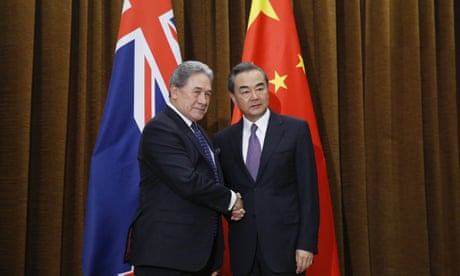
Last week, New Zealand’s foreign affairs minister travelled to China for a three-day visit, and met “high-ranking Chinese officials” including foreign minister Wang Yi, Politburo member and former minister of foreign affairs Yang Jiechi and the head of the Communist party’s international department, Song Tao.
“Our discussions were wide-ranging, covering all aspects of our bilateral relationship,” said Peters in a statement, including expansion of trade and economic ties, upcoming FTA discussions, and peace and security in the Asia-Pacific.

mercredi 29 mars 2017

China Lake: One of China’s Reef Constructions Can Hold 24 Combat Aircraft

China has completed the construction of a variety of military assets in the Vietnamese East Sea, assets that allow it to deploy fighter jets and missile launchers at a moment’s notice and provide it expanded surveillance capabilities.
by FRANCES MARTEL

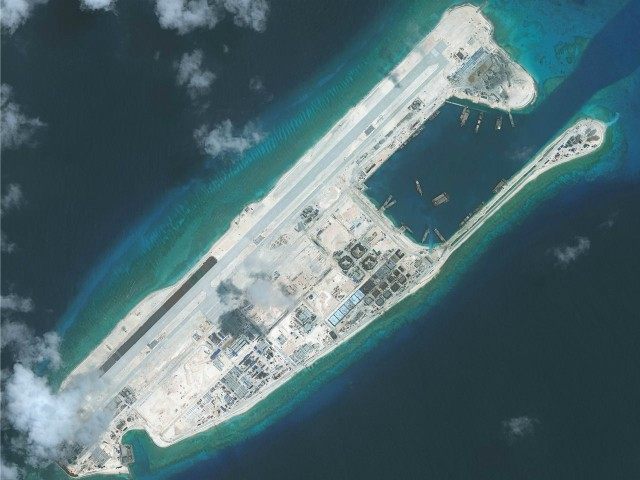
Fiery Cross Reef, South China Sea
The images show completed “naval, air, radar, and defensive facilities” in the Spratly Island chain, particularly on three reefs China has invested in turning into artificial islands capable of holding combat aircraft and surveillance technology, according to the Asia Maritime Transparency Initiative of the Center for Strategic and International Studies (CSIS).
The three most developed locations, according to the CSIS report, are Subi, Mischief, and Fiery Cross Reefs in the Spratly Islands. 
“Beijing can now deploy military assets, including combat aircraft and mobile missile launchers, to the Spratly Islands at any time,” the report notes. 
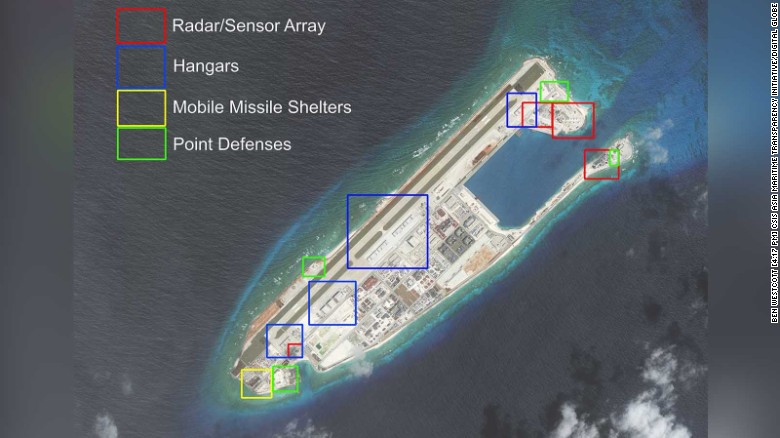
Among the most notable developments since the last such report is the completion of hangar construction on Fiery Cross Reef, which allows China to “accommodate 24 combat aircraft and four larger planes (such as ISR, transport, refueling, or bomber aircraft).”
The CSIS publishes such satellite images and reports periodically. 
In February, it warned that Woody Island, the largest of the Paracel Islands, was home to “an airstrip, hangars, and a deployment of HQ-9 surface-to-air missile batteries,” as well as the beginnings of seven new harbors.
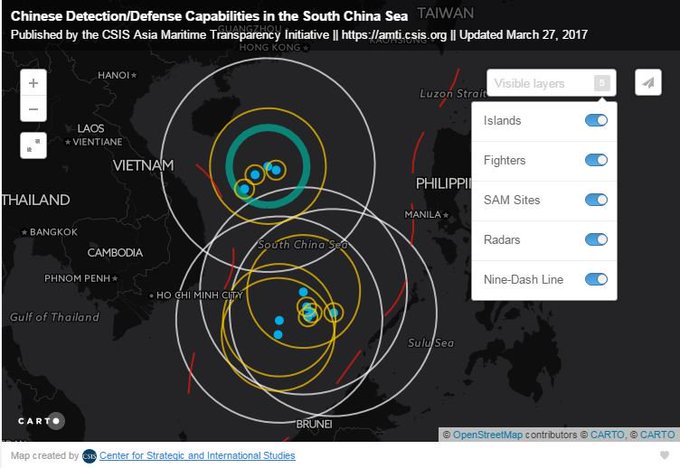
China claims most of the South China Sea in a region within what China calls the “nine-dash line,” a drawing Chinese officials argue proves their ownership of the region. 
Both the Paracel and Spratly Island chains, as well as other notable formations like the Benham Rise and Scarborough Shoal, fall within China’s “nine-dash line” border.
This border violates the territorial integrity of Vietnam, the Philippines, Brunei, and Malaysia. 
Last year, the Permanent Court of Arbitration at the Hague ruled that China’s claims were unfounded and it must cease its constructions in the region immediately. 
China responded by calling the ruling a joint U.S.-Japanese conspiracy and refusing to abide by it.

Responding to the CSIS report on Tuesday, Chinese Foreign Ministry spokeswoman Hua Chunying repeated the false claims to the South China Sea the Hague debunked last year. 
“China has stated many times that the Spratly Islands are its inherent territory,” she said.
A week ago, Li Keqiang insisted that China’s use of the region was not an attempt at colonization. “China’s facilities, Chinese islands and reefs, are primarily for civilian purposes and, even if there is a certain amount of defense equipment or facilities, it is for maintaining the freedom of navigation,” he said, responding to concerns of expansionism.
The Philippines, which arguably has the most territory to lose between the Spratly Islands and the Scarborough Shoal, has taken a demure approach to addressing the situation since President Rodrigo Duterte took office in June 2016. 
“There’s nothing we can do,” he said. 
“What do you want me to do? Declare war against China?” Duterte asked in frustration this week, responding to critics that he has responded to China’s growing presence in the region too slowly.
Duterte has also chastised the United States for not doing enough to keep China from developing assets in the Philippine territory, contradicting his own demands to see the United States reduce its military presence in the Philippines.
The Philippine Inquirer lamented Duterte’s attitude, calling it “disheartening” and a “puzzling display of defeatism” in an opinion piece this week.
Duterte’s government nonetheless appears to have accepted the delivery of two Japanese surveillance aircraft on Tuesday, meant to patrol the South China Sea. 
According to the Agence-France Presse, the two are part of a five-part package of Beechcraft TC-90 planes, which Japanese officials deemed a responsible move to curbing China’s expansion in the region. 
Duterte has also called for the construction of “structures” in Philippine territory in the South China Sea, though Manila has not clarified what the president meant by this.

China Lake

Aircraft hangars, radar installed on artificial islands
  • Hangars can accommodate combat aircraft or surveillance planes
  • Militarization will help China establish an Air Defense Zone
By Ben Westcott

Dozens of aircraft hangars and high-end radar capabilities on China's man-made islands in the South China Sea are almost operational, according to new satellite imagery released by a US-based think tank.
The new facilities will further establish China's military dominance over the highly contested region, experts told CNN, and could help China establish a controversial Air Defense Identification Zone in the area.
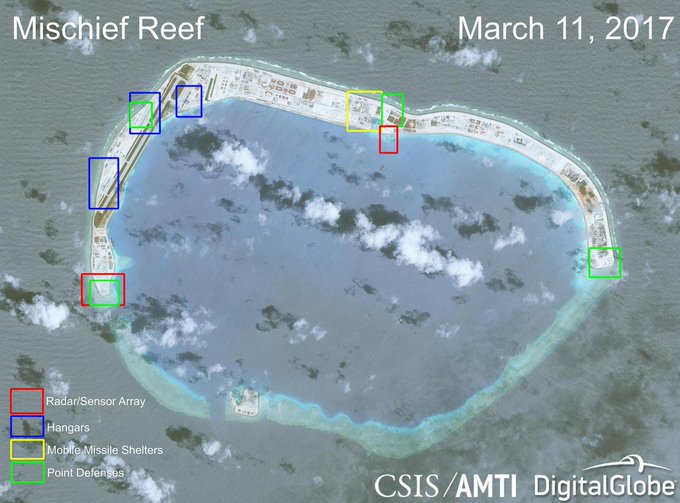
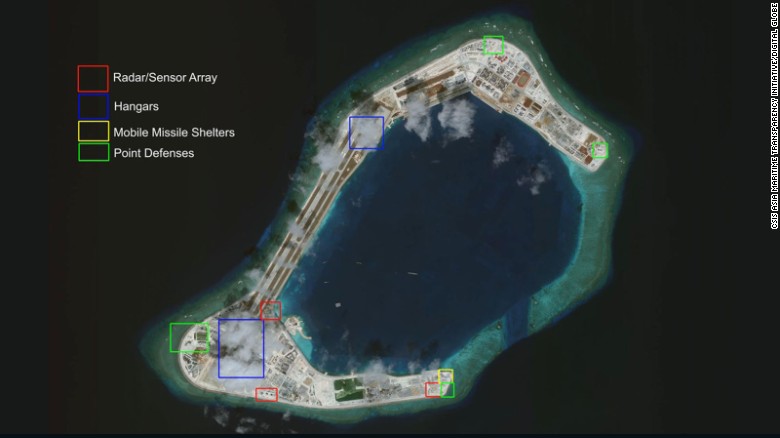
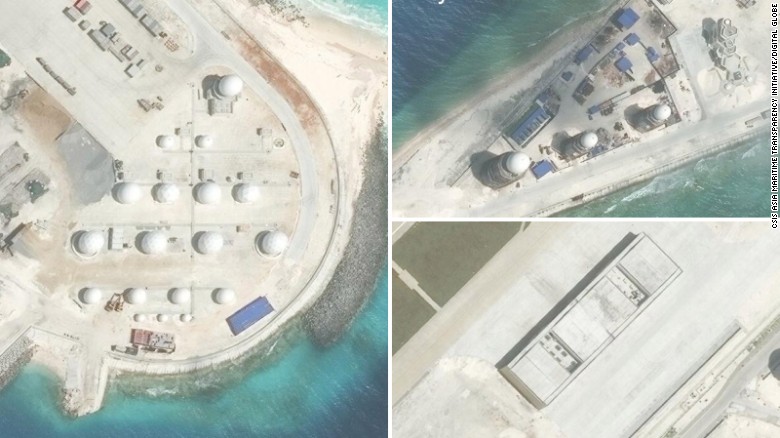
Images released by the Asia Maritime Transparency Initiative, AMTI, taken in early March, show nearly completed defense infrastructure on three of China's largest artificial islands in the disputed Spratly chain: Fiery Cross, Mischief and Subi reefs.
Each of the islands has new aircraft hangers, capable of holding 24 military aircraft, as well as several larger hangars that can hold bombers or surveillance planes.
Though completion of these facilities in early 2017 was expected, the question remains: Where does China go from here?
"I mean, you don't build facilities like that and then not use them," Ian Storey, a senior fellow at the Institute of Southeast Asian Studies Yusof Ishak Institute, told CNN.
A Chinese Ministry of Foreign Affairs spokeswoman said Tuesday she wasn't aware of the report's details but reiterated the Spratly Islands were Chinese territory.
"Whether we decide to deploy or not deploy relevant military equipment, it is within our scope of sovereignty. It's our right to self-defense and self-preservation as recognized by international law," Hua Chunying said.

A satellite photo of China's artificial island on Fiery Cross Reef, taken on March 9, and highlighted by AMTI.

New hangers, radar almost complete
Fiery Cross, Mischief and Subi reefs are the largest of seven artificial islands built by China in the Spratlys.
China claims the majority of the South China Sea as its territory, despite overlapping claims by a number of other Southeast Asian countries, including the Philippines and Vietnam.


Four bigger hangars have already been completed on Subi Reef, AMTI said, as well as another four on Fiery Cross Reef. 
Hangars to accommodate five larger planes, such as bombers, were in the final stages of construction on Mischief Reef.
"China's three military bases in the Spratlys and another on Woody Island in the Paracels will allow Chinese military aircraft to operate over nearly the entire South China Sea," AMTI said in a statement.
In addition to the hangars, new radar domes are in various stages of construction on each artificial island, about three arrays on each reef. 
Fiery Cross, Subi and Mischief reefs now all also have shelters for mobile missiles launchers, according to AMTI.

Subi Reef, taken on March 14, with new Chinese military infrastructure highlighted, courtesy of AMTI.

Air Defense Zone planned
The establishment of an Air Defense Identification Zone, dubbed ADIZ, in the South China Sea has long been considered a possibility by analysts, especially in the wake of July's international court decision against China's maritime claims.
China declared its East China Sea ADIZ in November 2013, antagonizing Japan and the United States, who both said they didn't recognize it.
A similar zone in the South China Sea could rapidly increase tensions in the region, experts said.

New radar arrays and an aircraft hanger freshly completed at China's artificial island on Fiery Cross Reef, according to AMTI

"The worry has to be that if China bases its military aircraft (in the South China Sea), they could fly up and challenge anyone's military aircraft or civilian aircraft if they wanted to," said Carl Thayer, regional security analyst and emeritus professor at the University of New South Wales.
China had very rarely enforced its previous ADIZ, and any new zone in the south sea would start out as mostly "symbolic," Storey said.
"And the US will ignore it as it did with the East China Sea ADIZ," he said. 
"The interesting question is really how the Southeast Asian states will respond."

Planes yet to arrive

Though the infrastructure is almost completed, no military aircraft has been deployed to the islands yet, Thayer and Storey said.
China's next step would be to very slowly deploy planes to the artificial islands to gauge the local and US response, Thayer said.
"What China's going to do is habituate," he said. 
"You land one there, and then you fly it out, report it in the state media and see what the reaction is."
"Then you add two or three or four, land one and repair it, see what the response is," he said.
South China Sea tensions generally had waned in the past nine months, since Philippines President Rodrigo Duterte took power and sought a closer relationship with China, Storey said.
If China deploys aircraft, "there will be pro forma protests from certain countries, Vietnam in particular. There will be grumbling from certain ASEAN members," he said, referring to the Association of Southeast Asian Nations. 
"Then, over a period of time, this will become the norm."

Chinese Aggressions

China's man-made South China Sea islands nearly complete
By Christopher Bodeen
China ready to deploy fighter jets on South China Sea artificial islands: US Report
BEIJING — A report from a U.S. think tank says China has nearly completed construction work on three man-made islands in the South China Sea, giving it the ability to deploy combat aircraft and other military assets to the disputed region.
The Washington-based Center for Strategic and International Studies analyzed recent satellite photos and concluded that runways, aircraft hangers, radar sites and hardened surface-to-air missile shelters have either been finished or are nearing completion.
The report, released Monday, appears to be the most conclusive indication yet that China is using its island-building project to give teeth to its claim over almost the entire South China Sea and its islands and reefs.
The islands in the study — Subi, Mischief and Fiery Cross reefs — are part of the Spratly chain, which is claimed in whole or in part by China, the Philippines, Vietnam, Malaysia  and Brunei.
On each of the islands, China has constructed enough concrete hangers for 24 fighter jets and four or five larger planes such as bombers or early warning aircraft, CSIS reported.
China already uses an existing airfield on Woody Island in the similarly disputed Paracel chain, located to the north, where it has maintained mobile HQ-9 surface-to-air missiles for more than a year and deployed anti-ship cruise missiles on at least one occasion, CSIS said.
The airfields and advanced surveillance and early warning radars will allow China's military to operate over virtually the entire South China Sea.
"Beijing can now deploy military assets, including combat aircraft and mobile missile launchers, to the Spratly Islands at any time," the report said.
China's creation of seven man-made islands in the South China Sea has drawn strong criticism from the U.S. and others, who accuse Beijing of further militarizing the region and altering geography to bolster its claims.
China says its island construction is mainly for civilian purposes, particularly to increase safety for ships that carry an estimated $5 trillion worth of goods through the waterway each year. 
It has also provided reassurances that it will not interfere with freedom of navigation or overflight, although questions remain as to whether that includes military ships and aircraft.
Commenting on the report, a senior Philippine defense official said the construction China has carried out on the islands "belies a clearly military purpose contrary to Chinese public pronouncements that it is civilian in nature."
That raises the likelihood of further militarization and restrictions on air and sea traffic, posing a "clear and present danger to the present regional security balance," said the official, who requested anonymity because he was not authorized to speak to reporters on the matter.
China has refused to confirm speculation over whether it plans to declare an air defense identification zone over the South China Sea as it has done already over international airspace in the East China Sea. 
The U.S. has refused to recognize the East China Sea zone, which requires aircraft to declare their flight plans, identify themselves to Chinese traffic monitors and follow their instructions. 

samedi 28 janvier 2017

Giving Chinese second chance at tech firm 'dangerously naive'

Canada's national security is not for sale
By Amanda Connolly


Conservative leader Rona Ambrose says the decision by the Liberal government to give a second chance to a Chinese company’s rejected bid to take over a Montreal tech firm is “dangerously naive.”
“The fact that the Trudeau Liberals are paving the way for foreign interests and foreign powers to take over Canadian companies shows they are just trying to curry favour with China,” Ambrose said in a speech Thursday from Quebec City, where the Conservatives held a caucus retreat. 
“When Justin Trudeau holds cash-for-access fundraisers, surrounded by Chinese flags and influential communist officials, and then weeks later reopens national security reviews, Canadians rightly wonder, is our national security for sale?”
The deal in question concerns the acquisition of ITF Technologies of Montreal by O-Net Communications, which is based on Hong Kong but is viewed by national security officials as being under the control of the Chinese government.
Adding to the concerns is the fact that ITF Technologies has sold technology to the Department of National Defence and participated in research with CSIS, Canada’s spy agency.
Both CSIS and defence officials have raised serious concerns about the deal, noting that the risk cannot be mitigated and that allowing it to proceed would jeopardize military advantages held by Canada and its allies because of the type of military-grade laser technology produced by the firm.
“If the technology is transferred, China would be able to domestically-produce advanced-military laser technology to Western standards sooner than would otherwise be the case, which diminishes Canadian and allied military advantages,” says a 2015 national security assessment given to the Canadian cabinet in 2015 by security and defence officials and obtained by the Globe and Mail.
Ambrose said the Conservatives, who were in government when the deal was rejected the first time, will not let the deal float under the radar.
“We will be giving these issues the attention they need,” she said. 
“That’s what Canadians expect of their Conservative opposition.”