Affichage des articles dont le libellé est 1984. Afficher tous les articles

mardi 19 novembre 2019

'1984' and Wannseekonferenz in China

Communist leaders engage in modern-day totalitarian brainwashing, bizarre lies and industrial-level indoctrination to suppress Muslims.
The New York Times


“Ying shou jin shou” — “Round up everyone who should be rounded up.”
The echo of “1984,” “Brave New World” or “Fahrenheit 451” is unmistakable.
But this is not dystopian fiction. 
It’s a real bureaucratic directive prepared by the Chinese leadership, drawing on a series of secret speeches by Xi Jinping, China’s authoritarian leader, on dealing ruthlessly with Muslims who show “symptoms” of religious radicalism.
There’s nothing theoretical about it: Based on these diktats, hundreds of thousands of Uighurs, Kazakhs and other Muslims in the East Turkestan colony have been rounded up in concentration camps to undergo months or years of indoctrination intended to mold them into secular and loyal followers of the Communist Party.
This modern-day totalitarian brainwashing is revealed in a remarkable trove of documents leaked to The New York Times by an anonymous Chinese official. 
The existence of these concentration camps has been known for some time, but nothing before had offered so lucid a glimpse into the thinking of China’s bosses under the fist of Xi, from the obsessive determination to stamp out the “virus” of unauthorized thought to cynical preparations for the pushback to come, including how to deal with questions from students returning to empty homes and untended farms.
The latter script is eerily Orwellian: Should students ask whether their missing parents had committed a crime, they are to be told no, “it is just that their thinking has been infected by unhealthy thoughts. Freedom is only possible when this ‘virus’ in their thinking is eradicated and they are in good health.”
That someone from within the unforgiving, secretive Chinese leadership would take the enormous risk of leaking 403 pages of internal documents to a Western newspaper is in itself amazing, especially since the documents include an 11-page report summarizing the party’s investigation into the activities of Wang Yongzhi, an official who was supposed to manage a district where Uighur militants had staged a violent attack but who eventually developed misgivings about the mass detention facilities he had built. 
“He refused,” said the report, “to round up everyone who should be rounded up.” 
After September 2017, Mr. Wang disappeared from public view.
It becomes clear from the documents that Xi is far more concerned by any challenge to the Communist Party’s image of strength than foreign reaction. 
Already in May 2014 he told a leadership conference, “Don’t be afraid if hostile forces whine, or if hostile forces malign the image of East Turkestan.” 
Accordingly, the Chinese government made no effort to deny the leaked documents, but rather portrayed the crackdown in East Turkestan as a major success against terrorism and accused The Times of smearing China’s “antiterrorism and de-extremism capabilities.”
What the documents really reveal is not an effective antiterrorism campaign, but rather the paranoia of totalitarian leaders who demand total fealty in thought and deed and recognize no method of control other than coercion and fear. 
Xi and other top government officials reveal in these papers a conviction that the Soviet Union collapsed because of ideological laxity and spineless leadership, and a top security official attributed terrorist attacks in Britain to the British government’s “excessive emphasis on ‘human rights above security.’” 
And Xi argued that new technology must be part of the broad campaign of surveillance and intelligence-gathering to root out dissidence in Uighur society, anticipating Beijing’s deployment of facial recognition, genetic testing and big data in East Turkestan.
Whoever leaked these revealing documents obviously disagreed and had the courage to do something about it. 
His or her brave action is a cry to the world.
International outrage could turn that into a wake-up call for China’s leaders, despite their totalitarian swagger, if the world begins to see them as pariahs, not just trading partners. 
The whistle-blower, and the untold thousands of Chinese Muslims suffering under the yoke of Xi, deserve that.

vendredi 7 juin 2019

WeChat and the Surveillance State

WeChat is the most powerful weapon of social control for the Chinese government.
By Stephen McDonell

China's WeChat is a site for social interaction, a form of currency, a dating app, a tool for sporting teams and deliverer of news: Twitter, Facebook, Googlemaps, Tinder and Apple Pay all rolled into one. 
But it is also an ever more powerful weapon of social control for the Chinese government.
I've just been locked out of WeChat (or Weixin 微信 as it is known in Chinese) and, to get back on, have had to pass through some pretty Orwellian steps -- steps which have led others to question why I went along with it.
One reason is that life in Beijing would be extremely difficult without WeChat. 
The other is that I could not have written this piece without experiencing the stages which have now clearly put my image, and even my voice, on some sort of biometric database of troublemakers.
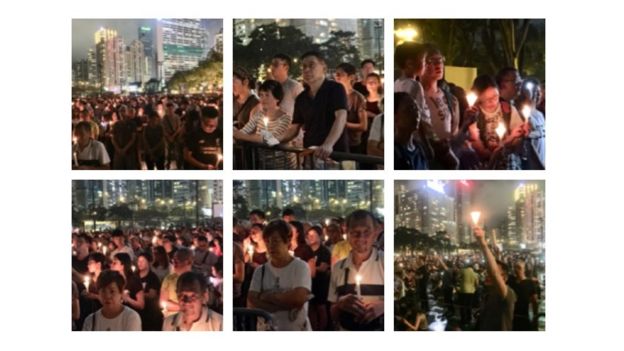
I was in Hong Kong to cover the enormous candlelight vigil marking 30 years since the People's Liberation Army was ordered to open fire on its own people to remove the mostly student protesters who'd been gathering in and around Tiananmen Square for months in June 1989.
This moment in history has been all but erased from public discourse on mainland China but in Hong Kong, with its special status in the Chinese-speaking world, people turn out every year to remember the bloody crackdown.
This time round the crowd was particularly huge, with estimates ranging up to 180,000.
Naturally I took photos of the sea of people holding candles and singing, and posted some of these on my WeChat "moments".

Tiananmen's tank man: The image that China forgot

The post contained no words -- just photos.
Chinese friends started asking on WeChat what the event was? 
Why were people gathering? 
Where was it?
That such questions were coming from young professionals here shows the extent to which knowledge of Tiananmen 1989 has been made to disappear in China.
I answered a few of them, rather cryptically, then suddenly I was locked out of WeChat.
"Your login has been declined due to account exceptions. Try to log in again and proceed as instructed," came the message on the screen.
Then, when I tried to log back in, a new message appeared: "This WeChat account has been suspected of spreading malicious rumours and has been temporarily blocked…"
It means posting photos of an actual event taking place, without commentary, amounts to "spreading malicious rumours" in China.
I was given time to try and log in again the next day after my penalty had been served.
When I did I had to push "agree and unblock" under the stated reason of "spread malicious rumours".
So this rumour-monger clicked on "agree".
Then came a stage I was not prepared for. 
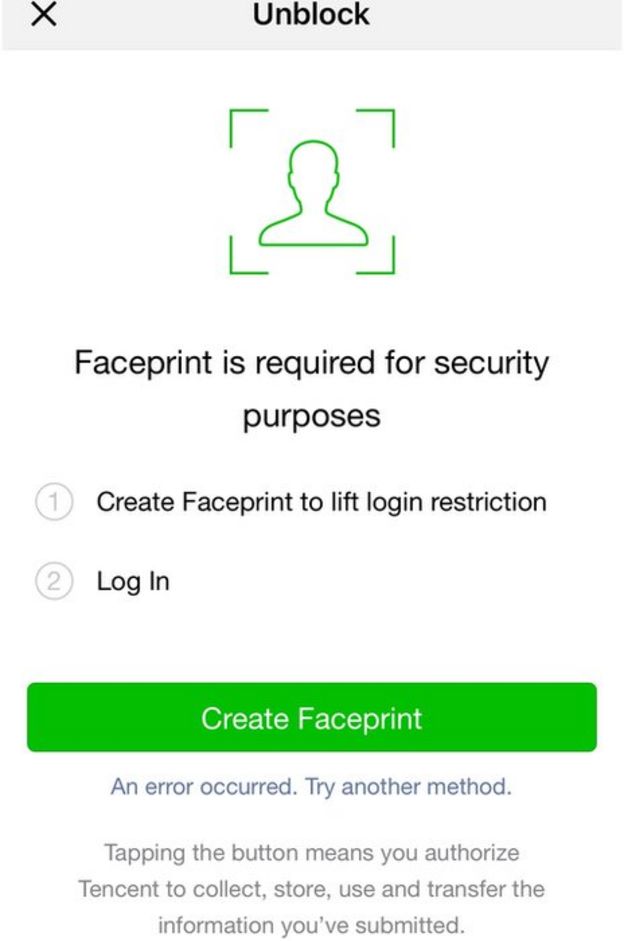
"Faceprint is required for security purposes," it said.
I was instructed to hold my phone up -- to "face front camera straight on" -- looking directly at the image of a human head. 
Then told to "Read numbers aloud in Mandarin Chinese".
My voice was captured by the App at the same time it scanned my face.
Afterwards a big green tick: "Approved"
Apart from being creepy you can only imagine the potential use of this type of data.
No doubt I have now joined some list of suspicious individuals in the hands of goodness knows which Chinese government agencies.
In China pretty much everyone has WeChat. 
I don't know a single person without it. 
Developed by tech giant Tencent it is an incredible app. 
It's convenient. It works. It's fun. 
It was ahead of the game on the global stage and it has found its way into all corners of people's existence.
It delivers to the Communist Party a life map of pretty much everybody in this country, citizens and foreigners alike.
Capturing the face and voice image of everyone who was suspended for mentioning the Tiananmen crackdown anniversary in recent days would be considered very useful for those who want to monitor anyone who might potentially cause problems.
When I placed details of this entire process on Twitter others were asking: why cave in to such a Big Brother intrusion on your privacy?
They've probably not lived in China.
It is hard to imagine a life here without it.
When you meet somebody in a work context they don't give you a name card any more, they share their WeChat; if you play for a football team training details are on WeChat; children's school arrangements, WeChat; Tinder-style dates, WeChat; movie tickets, WeChat; news stream, WeChat; restaurant locations, WeChat; paying for absolutely everything from a bowl of noodles to clothes to a dining room table… WeChat.
People wouldn't be able to speak to their friends or family without it.
So the censors who can lock you out of Wechat hold real power over you.
The app -- the least secure of its type in the world -- has essentially got you over a barrel.
If you want to have a normal life in China, you had better not say anything controversial about the Communist Party and especially not about its dictator, Xi Jinping.
This is China 2019.

jeudi 3 janvier 2019

Orwellian China

Thousands of low-wage workers in “censorship factories” trawl the online world for forbidden content, where even a photo of an empty chair could cause big trouble.
By Li Yuan

Li Chengzhi had a lot to learn when he first got a job as a professional censor.
Like many young people in China, the 24-year-old recent college graduate knew little about the 1989 Tiananmen Square massacre.
He had never heard of China’s most famous dissident, Liu Xiaobo, the Nobel Peace Prize laureate who died in custody two years ago.
Now, after training, he knows what to look for — and what to block. 
He spends his hours scanning online content on behalf of Chinese media companies looking for anything that will provoke the government’s wrath. 
He knows how to spot code words that obliquely refer to Chinese leaders and scandals, or the memes that touch on subjects the Chinese government doesn’t want people to read about.
Li, who still has traces of youthful acne on his face, takes his job seriously. 
“It helps cleanse the online environment,” he said.
For Chinese companies, staying on the safe side of government censors is a matter of life and death. Adding to the burden, the authorities demand that companies censor themselves, spurring them to hire thousands of people to police content.
That in turn has created a growing and lucrative new industry: censorship factories.
Mr. Li works for Beyondsoft, a Beijing-based tech services company that, among other businesses, takes on the censorship burden for other companies. 
He works in its office in the city of Chengdu. 
In the heart of a high-tech industrial area, the space is bright and new enough that it resembles the offices of well-funded start-ups in tech centers like Beijing and Shenzhen. 
It recently moved to the space because customers complained that its previous office was too cramped to allow employees to do their best work.
“Missing one beat could cause a serious political mistake,” said Yang Xiao, head of Beyondsoft’s internet service business, including content reviewing. (Beyondsoft declined to disclose which Chinese media or online companies it works for, citing confidentiality.)
China has built the world’s most extensive and sophisticated online censorship system. 
It grew even stronger under Xi Jinping, who wants the internet to play a greater role in strengthening the Communist Party’s hold on society. 
More content is considered sensitive. 
Punishments are getting more severe.
Once circumspect about its controls, China now preaches a vision of a government-supervised internet that has surprising resonance in other countries. 
Even traditional bastions of free expression like Western Europe and the United States are considering their own digital limits. 
Platforms like Facebook and YouTube have said that they would hire thousands more people to better keep a handle on their content.
Workers like Li show the extremes of that approach — one that controls what more than 800 million internet users in China see every day.
Beyondsoft employs over 4,000 workers like Li at its content reviewing factories. 
That is up from about 200 in 2016. 
They review and censor content day and night.
“We’re the Foxconn in the data industry,” said Yang, comparing his firm to the biggest contract manufacturer that makes iPhones and other products for Apple.
Many online media companies have their own internal content review teams, sometimes numbering in the thousands.
They are exploring ways to get artificial intelligence to do the work.
The head of the A.I. lab at a major online media company, who asked for anonymity because the subject is sensitive, said the company had 120 machine learning models.
But success is spotty.
Users can easily fool algorithms.
“The A.I. machines are intelligent, but they aren’t as clever as human brains,” Mr. Li said.
“They miss a lot of things when reviewing content.”
Beyondsoft has a team of 160 people in Chengdu working four shifts a day to review potentially politically sensitive content on a news aggregating app.
For the same app, Beyondsoft has another team in the western city of Xi’an reviewing potentially vulgar or profane content.
Like the rest of the world, China’s internet is rife with pornography and other material that many users might find offensive.
In the Chengdu office, workers must put their smartphones in hallway lockers.
They can’t take screenshots or send any information from their computers.
The workers are almost all college graduates in their 20s. They are often unaware of, or indifferent to, politics. 
In China, many parents and teachers tell the young that caring about politics leads only to trouble.
To overcome that, Yang and his colleagues developed a sophisticated training system.
New hires start with weeklong “theory” training, during which senior employees teach them the sensitive information that they didn’t know before.
“My office is next to the big training room,” Mr. Yang said.
“I often hear the surprised sounds of ‘Ah, ah, ah.’”
“They didn’t know things like June 4,” he added, referring to the 1989 Tiananmen Square massacre. 
“They really didn’t know.”
Beyondsoft has developed an extensive database based on such information that Yang calls one of its “core competencies.”
It also uses anti-censorship software to regularly visit what it calls anti-revolutionary websites that are blocked by the Chinese government.
It then updates the database.
New employees study the database much like preparing for college entrance exams.
After two weeks, they have to pass a test.
The screen saver on each computer is the same: photos and names of current and past members of the Politburo Standing Committee, the Communist Party’s top leadership.
Workers must memorize those faces: Only government-owned websites and specially approved political blogs — a group on what’s called a whitelist — are allowed to post photos of top leaders.
Workers are briefed at the beginning of their shift on the newest censoring instructions sent by clients, which the clients themselves receive from government censors. 
Workers then must answer about 10 questions designed to test their memory.
The results of the exam affect the workers’ pay.
One question on a recent Friday: Which one of the following names is the daughter of Li Peng, China’s former premier?
The correct answer is Li Xiaolin, a longtime target of online ridicule for her expensive fashion taste and for being one of many children of senior officials who come into high positions or wealth.
That’s a relatively easy one.
A tougher test is parsing the roundabout ways that China’s internet users evade stringent censorship to talk about current affairs.
Take, for example, a Hong Kong news site’s 2017 commentary that compared the six Chinese leaders since Mao Zedong to emperors during the Han dynasty.
Some Chinese users started using the emperors’ names when referring to the leaders.
Beyondsoft’s workers have to know which emperor’s name is associated with which leader.
Then there are the photos of an empty chair. 
They refer to Mr. Liu, the Nobel laureate, who wasn’t allowed to leave China to attend the award ceremony and was represented by an empty chair.
References to George Orwell’s novel “1984” are also forbidden.
Beyondsoft’s software trawls through web pages and marks potentially offensive words in different colors.
If a page is full of color-coded words, it usually requires a closer look, according to the executives.
If there are only one or two, it’s pretty safe to let it pass.
According to Beyondsoft’s website, its content monitoring service, called Rainbow Shield, has compiled over 100,000 basic sensitive words and over three million derivative words.
Politically sensitive words make up one-third of the total, followed by words related to pornography, prostitution, gambling and knives.
Workers like Li make $350 to $500 a month, about average pay in Chengdu.
Each worker is expected to review 1,000 to 2,000 articles during a shift.
Articles uploaded to the news app must be approved or rejected within an hour.
Unlike Foxconn workers, they don’t work much overtime because longer hours could hurt accuracy, said Yang, the executive.
It’s easy to make mistakes.
One article about Peng Liyuan, China’s first lady, mistakenly used the photo of a famous singer rumored to be linked to another leader.
It was caught by someone else before it went out, Yang said.
Li, the young censor, said the worst mistakes were almost all related to senior leaders.
He once missed a tiny photo of Xi on a website not on the whitelist because he was tired.
He still kicks himself for it.
When asked whether he had shared with family and friends what he learned at work, such as the Tiananmen massacre, Li vehemently said no.
“This information is not for people outside to know,” he said.
“Once many people know about it, it could generate rumors.”
But the massacre was history.
It wasn’t a rumor.
How would he reconcile that?
“For certain things,” he said, “one just has to obey the rules.”

lundi 18 décembre 2017

Prison-state

China’s intrusive, ubiquitous, scary surveillance technology
The Washington Post

A worker installs a security camera pointed at a pedestrian walk way in Beijing on Dec. 11.

STEP BY STEP, China has been rolling out surveillance technology that is remarkably intrusive, comprehensive and ubiquitous. 
Eager to exploit gains in technology, Beijing seems little concerned about human rights or privacy violations.
On Dec. 10, the BBC reported that China seeks to build the world’s largest camera surveillance network, with 170 million closed-circuit cameras installed and an estimated 400 million new ones coming in the next three years. 
In the city of Guiyang in southwest China, correspondent John Sudworth agreed to add a photograph of his face to the database of the local public security bureau and have it flagged as a “suspect” in an experiment to see how long he could walk freely on the streets before the police could find him. 
He got out of his car close to the city center and walked toward a bus station. 
The exercise took just seven minutes.
Meanwhile, Human Rights Watch reported on Dec. 13 that Chinese authorities have been collecting DNA samples, blood types, fingerprints and iris scans, without informing people, from a large swath of the population in the restive East Turkestan in far northwestern China. 
Ethnic Uighurs in East Turkestan have long complained about repression and discrimination at the hands of the Chinese government; resentment has sometimes turned violent. 
According to Human Rights Watch, in a procedure rolled out this year, the authorities there are collecting the DNA and blood-type information under the cover of a “free annual physical exams program called Physicals for All.”
It wasn’t clear that people were giving their consent or even knew that the DNA data was being taken, the group said. 
Although the government had sold the idea of amassing biodata in terms of poverty alleviation, better delivery of health services and “social stability,” Human Rights Watch noted that such widespread collection of intimate data as DNA is a serious human rights and privacy violation.
For several years now, China has been building out a system known as the social credit score, which collects information on the behavior of individuals from data such as financial transactions, shopping habits, social media and interactions with friends, as well as other indicators such as traffic tickets and unpaid bills, and computes a single loyalty or “trust” score for each individual. 
The authorities plan to make the system mandatory for the whole country by 2020. 
It is not hard to imagine the social credit system quickly turning into a Big Brother of the digital age, used to punish those who express dissent and to reward obedience to the Communist Party. 
The magazine Wired described this as a shift from the old regimen of trying to enforce obedience with truncheons and top-down fear; instead, “the government is attempting to make obedience feel like gaming. It is a method of social control dressed up in some points-reward system.”
China promotes itself as a rising power, but a state that lords over its people with hidden cameras, secret databases and intrusive algorithms sounds more like prison.

mardi 10 janvier 2017

Apple aids and abets Big Brother in China

Lack of transparency in pulling New York Times app adds to Orwellian nature of move 
By Tom Mitchell in Beijing

Most people old enough to have watched the 1984 Super Bowl will not remember the two American football teams that played in it.
They will probably remember “The Commercial”.
In the annals of the NFL playoffs, it is almost as famous as “The Catch” — an improbable end zone grab by the San Francisco 49ers’ Dwight Clark in the 1982 NFC Championship game.
During a break in the third quarter of Super Bowl XVIII, as the Los Angeles Raiders were running up the score on the Washington Redskins, CBS broadcast an Apple advertisement for its new Macintosh computer.
Directed by Ridley Scott, the 60-second spot featured an athlete hurling a sledgehammer into a giant screen on which Big Brother was hypnotising the masses.
The screen explodes, symbolising Apple’s assault on what it regarded as the bland conformity of the emerging personal computer industry. 
Titled “1984” in honour of George Orwell’s novel of the same name, it is today regarded as one of the best television commercials of all time.
It is also sadly ironic in light of recent events in China, where Apple has decided to aid and abet Big Brother. 
Last week, Apple confirmed it had pulled the New York Times app from its online store in China, where the newspaper’s website has been blocked by censors since 2012.
The app was the only way China-based readers could access New York Times content, including articles translated into Mandarin, without having to use special software that is expensive for the average Chinese internet user and often unreliable.
At first glance, Apple had no choice but to comply with the Chinese government’s directive.
China’s smartphone market, the world’s largest, accounted for 20 per cent of its sales — or $8.8bn — in the third quarter of last year.
The California company’s supply chain is also deeply rooted in China.
When running at full tilt, an iPhone manufacturing facility operated by Foxconn in Zhengzhou, Henan province, can produce 1m handsets every two days.
The Chinese government’s leverage over Apple is enormous.
But so is Apple’s leverage over the Chinese government, should it be brave — and wise — enough to use it. 
At a time when Beijing is simultaneously attempting to spur slowing economic growth and halt capital outflows, it badly needs foreign investment and the jobs it creates. 
The iPhone manufacturing facility in Zhengzhou is a high-tech jewel in a relatively poor, inland province, otherwise blighted by twilight heavy industries and chronic pollution.
Foxconn also recently announced it would spend $8.8bn on a flat-panel display factory in the southern city of Guangzhou.
It may well be that Apple quietly fought the good fight before yielding to the authorities’ demand to pull an app that was allegedly “in violation of local regulations”.
But in confirming the decision, Apple could have at least specified what regulations the New York Times app had supposedly violated.
It did not and the lack of transparency surrounding the affair has only added to the Orwellian nature of Apple’s surrender. 
It is a disappointing outcome for a company whose remarkable run, from 1980s iconoclastic outsider to the world’s most valuable company 30 years later, began with such a bold statement.

mardi 29 novembre 2016

China’s New Tool for Social Control: A Credit Rating for Everything

Beijing wants to give every citizen a score based on behavior such as spending habits, turnstile violations and filial piety, which can blacklist citizens from loans, jobs, air travel.
By JOSH CHIN and GILLIAN WONG

HANGZHOU, China—Swiping her son’s half-fare student card through the turnstile here one Monday afternoon, Chen Li earned herself a $6 fine and a reprimand from a subway-station inspector for not paying the adult fare.
A notice on a post nearby suggested more-dire consequences.
It warned that infractors could be docked points in the city’s “personal credit information system.”
A decline in Ms. Chen’s credit score, according to official pronouncements, could affect her daily life, including securing loans, jobs and her son’s school admission.
“I’m sure if it comes up, I can explain,“ Ms. Chen said, saying she picked up the card accidentally.
“It was unintentional.”
Hangzhou’s local government is piloting a “social credit” system the Communist Party has said it wants to roll out nationwide by 2020, a digital reboot of the methods of social control the regime uses to avert threats to its legitimacy.
More than three dozen local governments across China are beginning to compile digital records of social and financial behavior to rate creditworthiness.
A person can incur black marks for infractions such as fare cheating, jaywalking and violating family-planning rules.
The effort echoes the dang’an, a system of dossiers the Communist party keeps on urban workers’ behavior.
In time, Beijing expects to draw on bigger, combined data pools, including a person’s internet activity, according to interviews with some architects of the system and a review of government documents.
Algorithms would use a range of data to calculate a citizen’s rating, which would then be used to determine all manner of activities, such as who gets loans, or faster treatment at government offices or access to luxury hotels.


The endeavor reinforces Xi Jinping’s campaign to tighten his grip on the country and dictate morality at a time of economic uncertainty that threatens to undermine the party.
Xi in October called for innovation in “social governance” that would “heighten the capacity to forecast and prevent all manner of risks.”
The national social-credit system’s aim, according to a slogan repeated in planning documents, is to “allow the trustworthy to roam everywhere under heaven while making it hard for the discredited to take a single step.”
Thus far, the pilot data-collecting systems aren’t yet tied together into what Beijing envisions as a sweeping system, which would assign each citizen a rating.
It isn’t clear that Ms. Chen’s ticket infraction made it into any central system, although the notice warned that fare-dodgers risked being marked down starting Jan. 1; a station agent said only repeat offenders are reported.

Some Shanghai districts such as this one are rolling out early versions of a ‘social credit’ program that aims to rank citizens based on various behaviors.

Zan Aizong, a Hangzhou human-rights activist, sees the system, once it’s fully operational, as an Orwellian exercise to keep closer tabs on a populace already lacking basic liberties such as freedom of speech.
“Tracking everyone that way,” Mr. Zan said, “it’s just like ‘1984.’ ”

Blacklisted
China’s judiciary already has already created a blacklisting system that would tie into the national social-credit operation.
Zhuang Daohe, a Hangzhou legal scholar, cites the example of a client, part-owner of a travel company, who now can’t buy tickets for planes or high-speed trains because a Hangzhou court put him on a blacklist after he lost a dispute with a landlord.
“This has had a huge impact on the business,” said the client’s wife. “He can’t travel with clients anymore.”
Added Mr. Zhuang: “What happens when it punishes the wrong person?”
Hangzhou officials didn’t respond to inquiries.
Another government system blacklists badly behaved tourists.
Driving the social-credit system are the State Council—China’s cabinet—and the central national-planning agency.
A blueprint the cabinet published in 2014 stated it aimed to “build sincerity” in economic, social and political activity.
It stressed the need for fair and clean government and for punishing polluting factories and bribe-takers.
Blacklists will expose offenders and restrict them from certain activities, while well-behaved citizens will earn access to “green lanes” that provide faster government services, the blueprint said.
Citizens in jobs deemed sensitive—lawyers, accountants, teachers, journalists—will be subject to enhanced scrutiny, it said.

Flags promote a 'Sincerity Management Model Street' in a cafe in Shanghai, where ‘sincerity displays’ at some restaurants show video feeds from kitchens.

The State Council and national-planning agency didn’t respond to requests for comment.
China’s government must overcome technological and bureaucratic obstacles to build a system that can monitor 1.4 billion people.
Government departments often guard their information, undermining efforts to build a unified database, and their systems often aren’t compatible, said Meng Tianguang, a political scientist at Beijing’s Tsinghua University who advises the government on applying “big data” to governance issues but isn’t directly involved in the social-credit system.
“Whether we can actually pull this off, we’re in a state of uncertainty at the moment,” Mr. Meng said. “Either way, it’s better than the traditional era,” until recently, he said, “when we had no data and policy was based on the judgment of individuals.”
The Shanghai government on an official website has identified scores of violations that can incur credit penalties in its pilot system, including falling behind on bills and breaking traffic rules.
State-media reports list penalties for not being filial to one’s parents. (Under Chinese law, parents over 60 may sue children for not visiting regularly or not ensuring they have enough food.)
Penalties for low scorers will include higher barriers to obtaining loans and bans on indulgences such as luxury hotels, according to state-media reports.
The Shanghai system appears to still be in an early phase.
Residents can check their social-credit records, but records reviewed by The Wall Street Journal did’t show any nonfinancial data.
Shanghai city officials didn’t respond to inquiries.
Despite official-media warnings and propaganda promoting sincerity, dozens of people interviewed in Shanghai weren’t aware of the social-credit plan.
Many agreed more should be done to enforce higher moral standards, bemoaning habits such as spitting, cutting in line and being cold to strangers in need.
Research by Yang Wang, a Syracuse University expert on internet behavior, has shown Chinese internet users, accustomed to the idea of government snooping, are less concerned with online privacy than Americans.
The most common word for privacy, yinsi, didn’t appear in popular Chinese dictionaries until the mid-1990s, he notes.

Behavior reports
In the tree-lined Yangjing neighborhood, subdistrict authorities maintain a database that gives a hint as to what elements of a broader social-credit system might look like.
The database collects reports on locals’ behavior from residential committees, said Yuan Jianming, the head of the Yangjing Sincerity Construction Office.

Slogans promote sincerity along a Shanghai road.

Since mid-2015, the office has published a monthly “red list” of exemplary residents.
Zhu Shengjun, 28, a high-school teacher, was named on a September red list.
He said he didn’t know why.
While he supported efforts to encourage better behavior, he hesitated at the idea of linking that with financial consequences, saying “it seems like too much of a stretch.”
The office also maintains a “gray list” of people behaving badly—throwing garbage out of windows, say—but the office hasn’t decided whether to publicize it, Mr. Yuan said.
In an area with a population of roughly 170,000, only around 120 have made Yangjing’s red list. Officials there complained to Chinese media this year that limited data sharing between departments was hampering efforts to rate people.
Businesses, too, get surveillance in pilot cities, where anyone can look up records on registered companies, though the records are sometimes incomplete.
One objective: turning around what leaders see as a crippling lack of trust among citizens from decades of corruption and bare-knuckle competition.
So the social-credit system aims not just to collect data on individuals for official use, it seeks data on the behavior of businesses to analyze and show the results to consumers.
One example is food safety, a major issue since anger erupted over melamine-tainted milk powder that killed six infants in 2008.
Subsequent scandals, including the sale of waste oil scooped up from gutters for reuse in restaurants, have continued to fuel mistrust.
Yangjing officials offer a solution: touch-screen displays they installed this summer in some restaurants.
The screens, part of a local social-credit pilot system, offer an unusual level of transparency for China.
Lit up with slogans—“Join heart to hand, be a model of sincerity” reads one—they display information about where ingredients came from and when waste oil was last picked up.
Customers can watch videos on a mobile app showing chefs working, and the system displays the eatery’s health-department rating.

Diners eat near a restaurant 'sincerity display' showing a video feed from kitchen, health ratings and other information.

One recent Monday at Jujube Tree, a vegetarian restaurant, the food-safety console was partially obscured by poster board.
Manager Wang Dacheng said it was because the system had erroneously downgraded the restaurant’s health rating, and local officials couldn’t fix it.
“We have a lot of return customers. What if they come in and see that?” Mr. Wang said.
He said he supported the system but was wary of its being applied without better controls.
Yangjing officials didn't respond to inquiries.
For initial social-credit efforts, local officials are relying on information collected by government departments, such as court records and loan and tax data.
More-extensive logging of everyday habits, such as social-media use and online shopping, lies with China’s internet companies, including e-commerce giant Alibaba Group Holding Ltd.
A credit-scoring service by Alibaba affiliate Ant Financial Services—one of eight companies approved to pilot commercial experiments with social-credit scoring—assigns ratings based on information such as when customers shop online, what they buy and what phone they use.
If users opt in, the score can also consider education levels and legal records.
Perks in the past for getting high marks have included express security screening at the Beijing airport, part of an Ant agreement with the airport.
“Especially for young people, your online behavior goes towards building up your online credit profile,” said Joe Tsai, Alibaba’s executive vice chairman, “and we want people to be aware of that so they know to behave themselves better.”
Alibaba shares aggregate data about online sales with China’s statistics bureau but doesn’t divulge personal data unless required to by law, for example in criminal investigations, Mr. Tsai said.
The local-government trials aren’t known to be tapping private-sector data, although the social-credit system blueprint designates internet data as a “strategic national resource” and calls for internet companies to contribute data, without getting into specifics.
Whether private and public data systems will be combined is still being hammered out, said Zhu Wei, a China University of Politics and Law scholar who has advised the government on social-credit efforts.
In an October speech screened to 1.5 million officials, Alibaba Chairman Jack Ma urged law-enforcement agencies to use internet data as a tool to identify criminals, according to posts on a Communist Party social-media feed.
He didn’t mention sharing Alibaba’s user data.
His comments raised eyebrows for broaching the notion that internet companies share data with government agencies. 
Alibaba declined to make Ma available for comment.
“We believe the application of machine learning and data analytics for the purpose of crime prevention is consistent with our core values: solving society’s problems,” the company said.
In an interview Nov. 1 with state media, a deputy head of China’s central-planning agency, Lian Weiliang, noted that much of the government’s credit-related data were stuck on “isolated islands” and said a central data platform had been established to encourage information sharing.
He said the platform had collected 640 million pieces of credit information from 37 central-government departments and various local governments.
The agency said the government has stopped untrustworthy people, identified by the court system, from buying airline tickets 4.9 million times.
Some advisers to the government, such as Mr. Zhu and Mr. Meng, said they were skeptical the system would meet the 2020 deadline because of the immense task of integrating data and keeping information secure.
In Hangzhou, where Ms. Chen used her son’s pass, residents can check their social-credit records at a government-services center.
Records the Journal viewed showed only whether people had kept up with health-insurance and social-security payments—a far cry from the central government’s goals.

mardi 8 novembre 2016

This is the beginning of the end of Hong Kong

The ‘one country, two systems’ principle and the Sino-British Joint Declaration are now completely shattered and irrelevant
By Claudia Mo

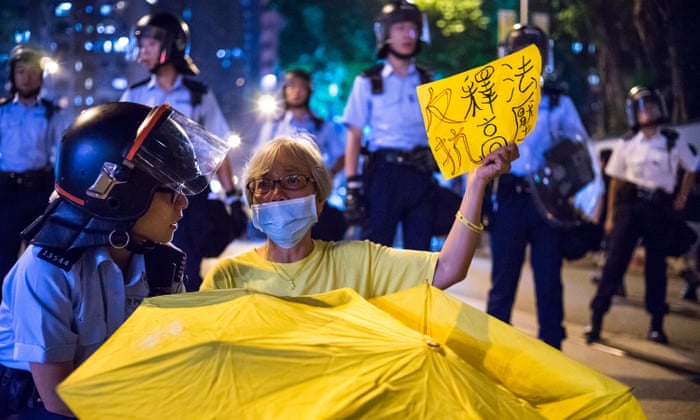
Protesters clash with police at China Liaison Office, where they occupied the road and were pepper sprayed. 

The Chinese government’s decision to bar two elected lawmakers from taking up their seats marks the beginning of the end of Hong Kong.
Samuel Johnson once said, “Patriotism is the last refuge of the scoundrel”. 
And today China has said that in Hong Kong, patriotism is so vital that it trumps freedom of speech, freedom of expression and freedom of thought, which are all now completely irrelevant.
By preventing the two pro-independence politicians from taking office, the Chinese government has opened the door to disqualify anyone from Hong Kong’s government if they are determined to not be loyal to Beijing.
This sets a very, very dangerous precedent because China has now started to form a habit of ruling Hong Kong by decree. 
Rule of law has become nonexistent in Hong Kong and there is no telling how that’s going to affect the confidence of foreign investors. 
We have to plug the dyke, but there’s nothing Hong Kong people can do and that explains all the fear, anger, resentment and frustration you now see in the city.

Of course, according to the Basic Law, Hong Kong’s mini-constitution, the power of interpretation is vested in Beijing, but that sort of power should not be used lightly. 
Every policeman has the power to stop you in the street and haul you off to the station if you’re acting suspiciously, but no one expects every policemen to do that lightly. 
Beijing is abusing its power.
Beijing loyalists in Hong Kong’s legislature will say, ‘We need to protect the integrity of the motherland, you’re not allowed to say things like ‘Hong Kong is not China.’’ 
They worry these sentiments will spread to places like Tibet and Xinjiang, western Chinese provinces with large populations of ethnic minorities and a history of chafing under Beijing’s yoke.
The Chinese government never promised “one country, two systems” to Tibet or Xinjiang, but that promise was made to Hong Kong. 
However, that and the Sino-British Joint Declaration, which sought to safeguard freedoms in the former colony, is now completely shattered and has become irrelevant. 
China’s mandarins now behave exactly like the Big Brother in George Orwell’s 1984. 
Whatever and whenever they find something politically incorrect, they will just change it and make it bend to their will.
The oath-taking saga is merely an excuse to make sure Hong Kong will be reined in. 
Chinese officials needed an issue and pounced at the first opportunity, because in Beijing’s eyes Hong Kong has become uncontrollable and disobedient, especially after the umbrella movement.
This is a very frightening trend that shows Beijing will interpret Hong Kong laws any time it wants. Anytime they feel parts of the Basic Law are not up to their current standards of political correctness, they will change it and tell Hong Kong courts to obey.
This move is not only a blow to our legislature, but also local courts as well. 
What are our judges for if Beijing steps in whenever it wants?
Today Beijing talks about anti-independence, tomorrow it talks about anti-self-determination and the day after it can talk about anti-democracy altogether.
While I have met some young people who have foreign passports who want to stay and fight for Hong Kong, they have a safety net and can leave whenever they want. 
I’m very worried about the young who can’t afford to leave and have no choice but to fight on against extremely difficult odds.
But we still need to fight, because if we don’t, we will definitely never get what we want.