Affichage des articles dont le libellé est exit bans. Afficher tous les articles

vendredi 4 janvier 2019

Terra Non Grata

U.S. Renews Travel Advisory for China, Warning of Arbitrary Detention
By Liam Stack

Secretary of State Mike Pompeo criticized exit bans during a visit to China in October. He again mentioned detained Americans at a meeting in Washington with a Chinese foreign policy official, Yang Jiechi, left, in November.

The United States renewed a travel advisory for China on Thursday that warned American citizens could face arbitrary detention there, a move that came amid tense relations between the countries dominated by trade disputes and the recent American-requested arrest of a high-profile Chinese executive in Canada.
The rights of foreign nationals in China have received renewed focus because of public concern over the fate of an American family barred from leaving the country, Sandra Han and her two adult children, Victor and Cynthia Liu. 
The arrest in Vancouver last month of Meng Wanzhou, an executive of the Chinese tech giant Huawei, has also raised the specter of retaliatory arrests of Americans or Canadians in China.
The travel advisory issued by the State Department on Thursday was a routine renewal of a similar warning issued in January 2018. 
It urged Americans to exercise increased caution in China because of so-called “exit bans,” an illegal tool the authorities there use to bar a person from leaving the country.
People subjected to a ban typically learn of its existence only when they try to leave China, and no method exists for them to determine when the ban has been lifted, the State Department said.
The advisory warned that United States citizens under a ban have been harassed and threatened and “detained without access to U.S. consular services or information about their alleged crime.” 
They also face prolonged interrogations and extended detention for reasons related to ‘state security.’
Canada’s leading newspaper, The Globe and Mail, reported Thursday that China had detained 13 Canadians since Meng’s arrest, a higher number than the three Canadians previously reported to have been detained after her arrest on Dec. 1.
But a spokesman for Canada’s foreign ministry said it "did not have reason" to believe that the arrests were retaliatory, although the spokesman said two of the Canadians — Michael Kovrig and Michael Spavor — were arrested for unspecified reasons of national security.
The State Department said China had used exit bans to compel foreign nationals to resolve civil disputes or to cooperate with police investigations. 
Exit bans have also been used to turn foreigners into bait meant to lure other people, like fugitives, to the country.
That appears to have been the motive behind the exit ban applied since last June to Han and her children, whose father, Liu Changming, is a former executive at a state-owned bank and accused of participation in a $1.4 billion fraud case. 
The children have said their father severed ties with the family in 2012.
Some people subjected to an exit ban have been imprisoned, including Han, a naturalized American citizen who was arrested and sent to a secret prison days after the family arrived in China in June to visit a sick relative.
Others, including her children, Liu, an American-born undergraduate at Georgetown University, and Liu, a naturalized American employed by the consulting firm McKinsey & Company in New York, are allowed to move freely within China. 
But they are forbidden to leave the country.
The Liu family’s case has drawn the attention of American officials, including Secretary of State Mike Pompeo, who criticized the practice of exit bans during a visit to China in October and mentioned the family to a Chinese foreign policy official, Yang Jiechi, at a meeting in Washington in November.
In a letter sent in August to John R. Bolton, the national security adviser, Ms. Liu said she and her brother were being used as pawns in China’s investigation into her estranged father.
“The investigative officers have made abundantly clear that neither my brother nor I am under any form of investigation,” Liu wrote. 
“We are being held here as a crude form of human collateral to induce someone with whom I have no contact to return to China for reasons with which I am entirely unfamiliar.”

mardi 19 juin 2018

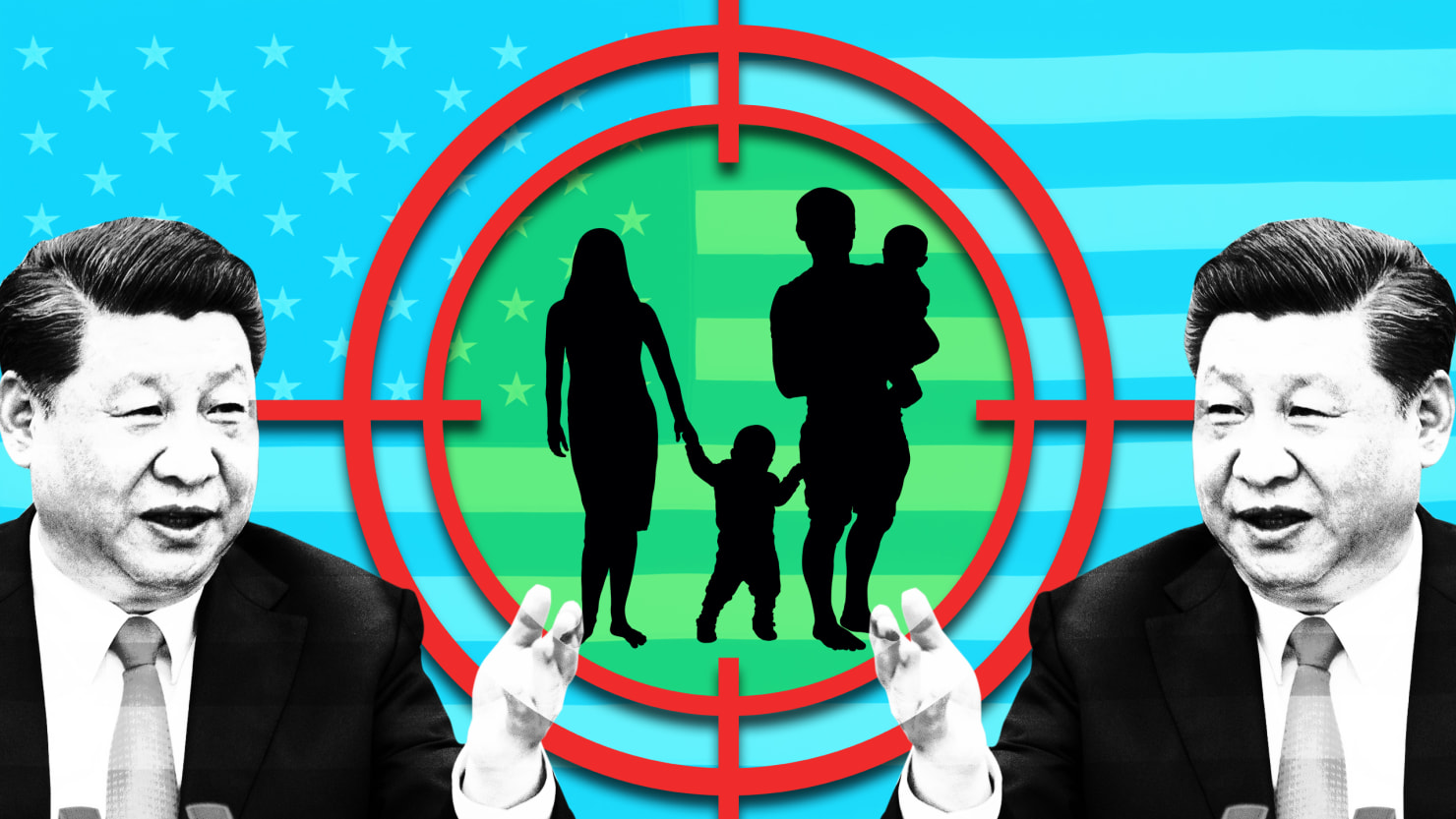
Beijing Is Holding Sino-Americans Hostage in China

Exit bans are a new tool in China’s global coercion campaign.
By BETHANY ALLEN-EBRAHIMIAN

In its ongoing campaign to extend its reach beyond its borders, the Chinese government has found a new form of leverage: Sino-Americans in China.
Last year, Beijing prevented several Sino-Americans from leaving China, including a pregnant woman, according to email correspondence obtained by The Daily Beast. 
The total number of so-called exit bans placed on Sino-Americans in China is unknown, but at least two dozen cases have occurred within the past two years, according to one analyst’s estimate.
Chinese authorities typically target U.S. citizens of Chinese heritage for exit bans, usually in connection with an investigation. 
Sometimes, Beijing uses Sino-Americans to try to coerce family members residing in the United States to return to China or to cooperate with Chinese authorities in investigations.
Chinese dictator Xi Jinping has championed a sweeping anti-corruption campaign with an international element, known as “Operation Fox Hunt,” aimed at pursuing Chinese citizens who have fled abroad after allegedly committing economic crimes. 
The United States does not have an extradition treaty with China and in the past has rarely cooperated with Chinese demands to repatriate Chinese citizens whom Beijing considers to be fugitives. 
Beijing has previously deployed undercover agents to the United States to coerce targets into returning to China, violating U.S. visa laws and prompting U.S. government indignation.
Now the People’s Republic seems to have found another lever of pressure. 
If one of Beijing’s targets living in the United States has relatives in China, Chinese authorities aren’t shy about applying pressure to those relatives, even if they are U.S. citizens. 
Exit bans are a “pretty new tool in the Chinese toolbox” for exerting such pressure, said John Kamm, founder of the U.S. nonprofit Dui Hua Foundation, which works on sensitive human rights cases in China.
“That individual might be treated as a material witness,” said Kamm. 
“Or that individual might be in effect being held as a hostage in an effort to get the people back.”
The Trump administration has pushed back quietly but firmly against exit bans. 
For example, in the lead-up to the first U.S.-China Law Enforcement and Cybersecurity Dialogue, held in Washington, D.C., in October 2017, Attorney General Jeff Sessions pushed for China to allow the free travel of three Sino-Americans who had been prevented from leaving China, including a pregnant woman, according to emails reviewed by The Daily Beast.
“Both sides will continue to cooperate to prevent each country from becoming a safe haven for fugitives and will identify viable fugitive cases for cooperation,” reads the U.S.-China joint statement released on Oct. 6, after the dialogue concluded. 
“Both sides commit to take actions involving fugitives only on the basis of respect for each other’s sovereignty and laws.”
It’s a delicate balancing act for an administration that also wishes to deport Chinese citizens who are in the United States illegally. 
In the past, China has often refused to accept deportations, leaving the United States with a large number of Chinese asylum seekers with final deportation orders. 
In 2015, Beijing’s refusal to accept deportees began to coincide with its push to repatriate fugitives it claimed were guilty of corruption. 
The Obama administration signed a memorandum of understanding with China to help expedite the deportation process, but remained reluctant to agree to Chinese demands to extradite fugitives.
Human rights groups have warned that fugitives may face torture or death back in China, also expressing concerns that Beijing might use trumped-up corruption charges to get their hands on troublesome political dissidents abroad.
The Department of Justice did not respond to emailed questions. 
The National Security Council did not respond to a request for comment.
The State Department declined to comment regarding the fate of those three U.S. citizens, citing privacy concerns, but a State Department spokesperson said that the U.S. government had not agreed to repatriate any Chinese citizen due to pressure from exit bans.
However, in January, the State Department warned Sino-Americans that going to China could be risky.
“Exit bans have been imposed to compel Sino-Americans to resolve business disputes, force settlement of court orders, or facilitate government investigations,” states the travel advisory for U.S. citizens traveling to China, particularly U.S.-China dual nationals. 
“Individuals not involved in legal proceedings or suspected of wrongdoing have also be subjected to lengthy exit bans in order to compel their family members or colleagues to cooperate with Chinese courts or investigators.”
It’s difficult to know exactly how many Sino-Americans have been affected. 
The State Department declined to confirm the number of cases, citing privacy concerns, but Kamm said he knows of about two dozen cases over the past year and half alone.
“One of the problems with exit bans is that you don’t know that there is an exit ban on you until you actually get to the airport,” said Kamm. 
“There may be people in the country who have exit bans on them and they don’t know it.”
Exit bans have also been applied to ethnic Chinese of other nationalities. 
Swedish bookseller Gui Minhai was subject to an exit ban after he was kidnapped from Thailand and taken into custody in mainland China. 
The Swedish government has objected to his treatment there. 
Australian academic Feng Chongyi was interrogated by security officials while visiting China in 2017 then prevented from leaving the country. 
He was permitted to return to Australia a week later amid international media attention.
China has frequently used exit bans on its own citizens, most notably in 2010, when it prevented Chinese artist Ai Weiwei and others from traveling to Norway for Chinese activist Liu Xiaobo’s Nobel Peace Prize ceremony. 
Chinese authorities have also revoked the passports of many Uighurs, a Turkic-speaking ethnic minority in China’s northwest, as part of a massive repression campaign.
Exit bans violate United Nations human rights precepts. 
Article 13 of the Universal Declaration of Human Rights states that “everyone has the right to leave any country, including his own, and to return to his country.” 
The State Department declined to say whether or not China’s actions violated U.S. or international law; the Justice Department did not respond to request for comment.
“A lot of people simply don’t know that they can be stopped for leaving China,” said Kamm.
It’s well-known that China blacklists people from entering, denying visas to academics and journalists who are critical of Beijing.
But, Kamm said, “even worse is if you get into the country and they won’t let you out.”