Affichage des articles dont le libellé est Jiang Tianyong. Afficher tous les articles

vendredi 1 février 2019

Rogue Nation

China’s massive attack on human rights and the rule of law continues
The Washington Post

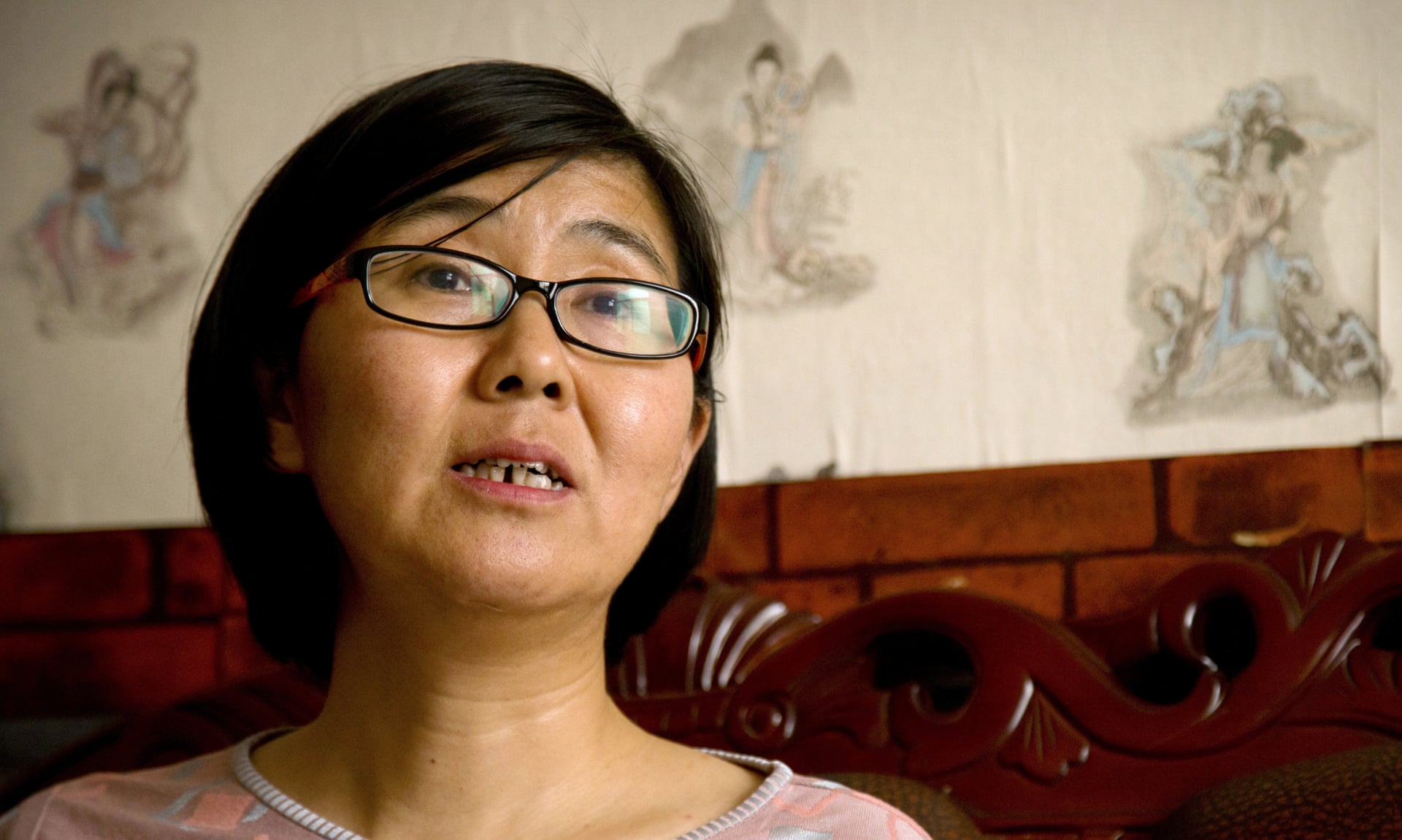
Li Wenzu, the wife of imprisoned lawyer Wang Quanzhang, reacts before an interview at her home in Beijing on Monday. 

ON JULY 9, 2015, China launched its war on lawyers. 
Over the course of a few weeks, some 300 lawyers, legal assistants and other advocates for the rule of law were rounded up
One of the most prominent, Wang Quanzhang, disappeared into secret detention on Aug. 3, 2015; after being held incommunicado for nearly 3½ years, he was the last to go on trial. 
On Monday, he was sentenced to 4½ years in prison on charges of subversion, putting a punctuation mark on one of the principal means of repression used by Xi Jinping to consolidate power.
Since taking office six years ago, Xi has employed corruption investigations to purge rivals in the Communist Party; stepped up censorship of social media; and conducted a massive campaign against Muslims in the East Turkestan colony, hundreds of thousands of whom have been confined to concentration camps and forced to undergo “reeducation.” 
Meanwhile, he has sought to stifle dissent by targeting the lawyers who defend human rights activists and religious believers or bring cases against local authorities for corruption.
Most of the lawyers and activists detained in what became known (for its July 9 date) as the 709 campaign were held for a few weeks; a number were later stripped of their licenses or driven out of business. 
But at least four besides Mr. Wang have been sentenced to prison. 
In August 2016, lawyer Zhou Shifeng and activist Hu Shigen were given terms of seven and 7½ years, respectively; in November 2017, lawyer Jiang Tianyong was sentenced to two years. 
The next month, human rights activist Wu Gan was handed an eight-year term.
Mr. Wang’s trial may have come last because of his refusal to buckle under pressure — including physical torture. 
While some lawyers signed confessions or publicly confessed to plotting against the government, Mr. Wang resisted to the end. 
When his closed trial was held on Dec. 26, he threw a wrench into the proceedings by firing his government-appointed lawyer.
His wife, Li Wenzu, bravely advocated on his behalf, speaking out about his treatment and shaving her head in protest of judges’ refusal to uphold Mr. Wang’s rights under Chinese law. 
She was prevented from attending his trial and denied visitation rights, along with seven lawyers appointed by the family. 
One of those lawyers, Yu Wensheng, has himself been detained incommunicado for more than a year, according to the group Chinese Human Rights Defenders.
The crackdown on lawyers has attracted some international attention and protests; the U.N. Working Group on Arbitrary Detention found that Mr. Wang was being held arbitrarily and called for his release. 
For the most part, the Trump administration has been silent, as it is on most human rights issues involving China.
But the State Department issued a statement Tuesday calling for Mr. Wang’s release and expressing concern about “the deteriorating situation for the rule of law, human rights, and fundamental freedoms in China.” 
While that’s not likely to influence Xi, the United States should be heard on cases such as this. 
The courageous Chinese lawyers still attempting to enforce the rule of law deserve the support of the democratic world.

vendredi 23 mars 2018

U.N. rights experts urge China to provide care for rights lawyer

By REUTERS

GENEVA – United Nations experts called on China on Friday to provide medical care to Jiang Tianyong, a prominent human rights lawyer jailed for inciting “subversion”, amid reports of his deteriorating health.
In a rare joint statement on China, six independent human rights experts voiced deep concern at the condition of Jiang, sentenced to two years jail last November after being found guilty of inciting subversion of state power.
“Mr. Jiang’s health has apparently deteriorated dramatically in recent months. He is reportedly weak and suffers from severe memory loss, and it is suspected that he may have been drugged,” the experts said. 
“This raises fears of torture or ill-treatment in detention, without access to adequate medical care.”
Xi Jingping has overseen a sweeping crackdown on human rights activism in China since 2015 that has seen hundreds of rights lawyers and activists detained, dozens arrested and some handed lengthy prison sentences.
Jiang, who provided legal defence for some of the lawyers arrested in the crackdown, had already been disbarred in 2009 and disappeared in November 2016. 
He was held in secret detention for more than nine months, the experts said.
Many of the nearly 250 lawyers and defenders arrested remain in detention and are “often held incommunicado”, they added.
“We appeal to the Chinese government to provide the detainees at a minimum with access to their families, lawyers of their own choosing and adequate health care,” they said.
The U.N. experts included Philip Alston, special rapporteur on extreme poverty and human rights, who met Jiang during an official visit to China in August 2016. 
Alston has voiced concern at the Human Rights Council that Jiang’s subsequent disappearance and arrest may be in part a reprisal for that contact, calling it “the equivalent of a legal sledgehammer”.

vendredi 24 novembre 2017

Rogue Nation: The disappeared

Accounts from inside China's secret prisons
By Chieu Luu and Matt Rivers

Sui Muqing says he was forced to stay awake while he was interrogated for more than four days.
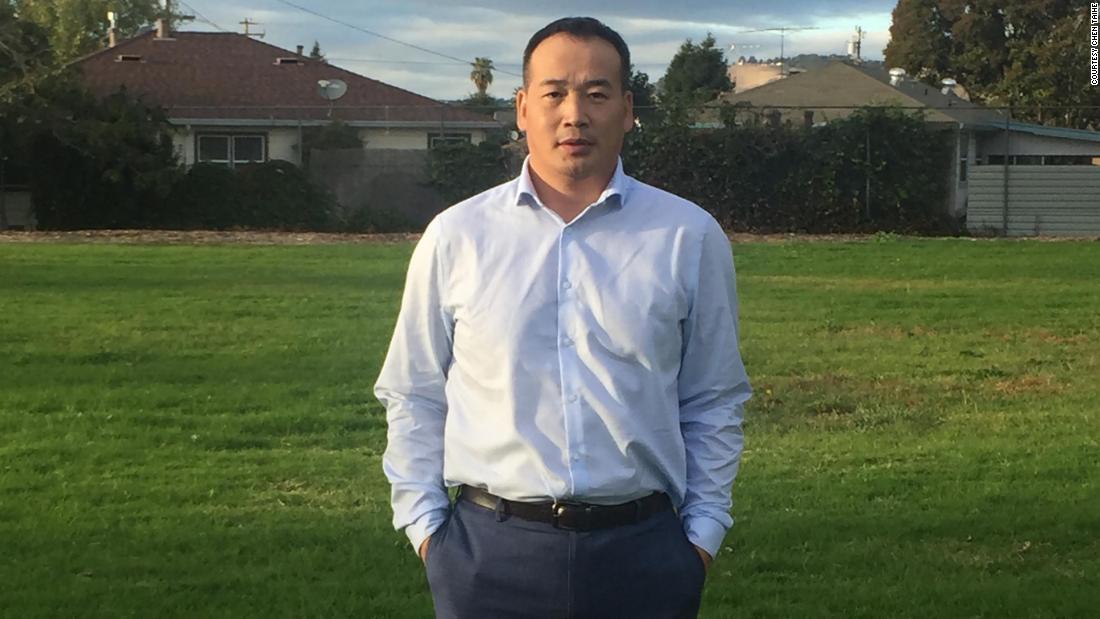
Chen Taihe describes being held in a jail cell so crowded he couldn't relieve himself.
And Peter Dahlin was left so traumatized by his experience, he slept with a knife next to his bed.
Three men, in three different parts of China.
They didn't know each other, but all had one thing in common: They advocated for human rights and became caught up in what activists say is the Chinese government's brutal crackdown on dissent.
Xi Jinping's wide-reaching sweep on perceived threats to both his rule and the Chinese Communist Party has led to the arrests of dozens of activists, bloggers, feminists, artists and lawyers.
The men, who CNN spoke to in detail over the course of the last 12 months, describe being forcibly taken from their homes, detained for weeks, sometimes months, in secret prisons, denied communication with family and legal representation, strong-armed into making videotaped confessions, and ultimately released without being convicted of a single crime.
Sui, Chen and Dahlin all say they were explicitly told not to talk about what happened to them, but have decided to speak out anyway. 
They say they want to shed light on the lengths to which China's government will go to silence anyone it deems a threat.
CNN reached out to the Chinese government for comment on each of the cases in this story, but received no response. 
Beijing has said regularly in the past that it does not torture prisoners and maintains these lawyers and activists are criminals dealt with under the law.

The 709 crackdown

While being a human rights lawyer has never been an easy path in Communist China, forced disappearances of lawyers were rare before 2015.
But on July 9 of that year, prominent Beijing rights lawyer Wang Yu disappeared, along with her husband, also a lawyer, and their teenage son.
The following day, police raided Wang's law firm and detained seven of her colleagues. 
Seven other rights lawyers were also detained or reported missing, according to the Hong-Kong based China Human Rights Lawyers Concern Group, which has meticulously documented the cases. It became known as the "709 crackdown" -- a reference to the date the first arrests occurred.
Sui was among them. 
He'd earlier in the day spoken to two foreign media outlets to raise concern about Wang's disappearance.
That night, a security guard called up to Sui's apartment and said his car had been scratched in an accident and when he stepped outside, a group of police quickly whisked him away, said Sui. 
He wasn't seen again for nearly five months.
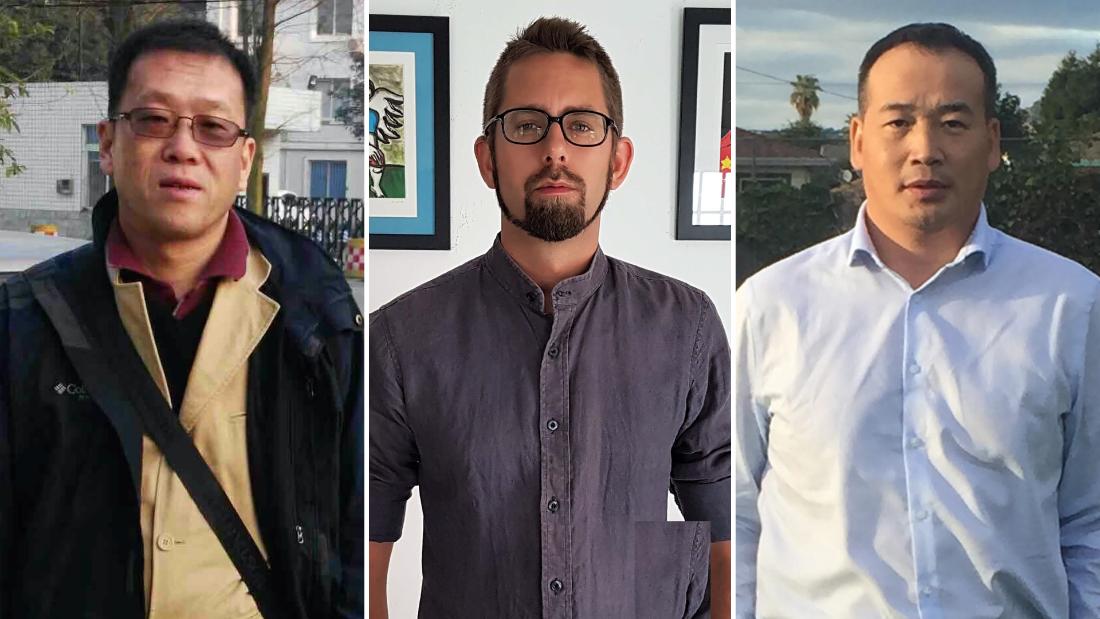
From left to right: Sui Minqing, Peter Dahlin and Chen Taihe.

Two days later, on July 12, the same thing happened to Chen. 
He said police asked him to come down from his apartment to answer a few questions. 
"I intentionally left my cell phone upstairs in my apartment because I thought I'd be back in a few minutes." 
He didn't return for six weeks.
During a period of less than a week, at least 146 lawyers and their families were detained in a nationwide swoop.
The roots of the crackdown on lawyers can be traced back to an editorial in the overseas edition of state-run People's Daily in July 2012, which warned the United States would use five categories of people to destabilize the Communist Party's near seven-decade rule. 
Rights advocates and lawyers were at the top of the list.
Dahlin, a Swedish national who co-founded a Beijing-based NGO that provided legal aid and training to Chinese lawyers, wasn't caught up in the first wave of detentions, and assumed his status as a foreigner might offer him some protection.
In early January 2016, however, he got tipped off authorities might be after him. 
He was about to depart for Beijing airport when 20 police officers turned up at his apartment.
They detained him and his girlfriend and they ransacked his home, he says, seizing computers and documents.
Dahlin says he was accused of masterminding a plan to smuggle the son of Wang Yu, the first lawyer to be detained in the swoop, into Myanmar, in an effort to evade authorities in October 2015.
He said investigators realized early on he had nothing to do with it, but instead of letting him go, quickly turned their attention to his NGO -- Chinese Urgent Action Working Group -- pressing him to give up information about his colleagues and other activists his group worked with.
Authorities said that Dahlin worked for an illegal organization that sponsored activities that jeopardized China's national security. 
The NGO said it "undertakes rapid response assistance for rights defenders in need."
By October 2017, some 321 lawyers, rights activists, their family members and staff had been caught up in the 709 crackdown.

How lawyers disappear
A key tool in the crackdown has been a relatively new form of detention. 
In 2012, China introduced "residential surveillance at a designated location" (RSDL) into the Criminal Procedural Law.
It appeared to legalize a long-used practice of "black jails" -- a means of temporarily detaining people outside the Chinese legal system who could not be immediately charged with a crime.
The government denied black jails existed in 2009
But in 2011 Chinese state media reported on a campaign by the Beijing Municipal Public Security Bureau to crack down on them.
The amended law says residential surveillance shouldn't exceed six months but requires detainees' families be notified within 24 hours, unless they can't be reached, and guarantees all suspects the right to a lawyer, with whom a meeting should be granted within 48 hours of a request.
The new system gives arbitrary detention a legal gloss and normalizes enforced disappearances. 
Earlier this year, 11 countries called on China to end the practice and investigate reports of torture against human rights lawyers. 
The UN High Commission on Human Rights has also called on China to halt the detention of lawyers.

Chen Taihe, a blogger, was detained in Guilin. He now lives in the US.

Although they were held at opposite ends of the country, Sui, Chen and Dahlin all describe similar conditions: Sparsely furnished rooms with black-out curtains on the windows and fluorescent lights kept on 24-hours a day.
They say they slept on a single bed, and were not allowed any reading or writing materials. 
Guards were always in the room watching their every move, even when they used the bathroom.
"There's nothing to look at except some very beige-looking suicide padding on the wall," said Dahlin.
He described being so bored he almost looked forward to the daily interrogations, "because at least you're taken out to another room ... and have some kind of interaction with people."
The interrogators used methods which Dahlin said reminded him of "bad American movies."
"They would have lots of people rush into your cell at night surrounding your bed just trying to scare you," he said.
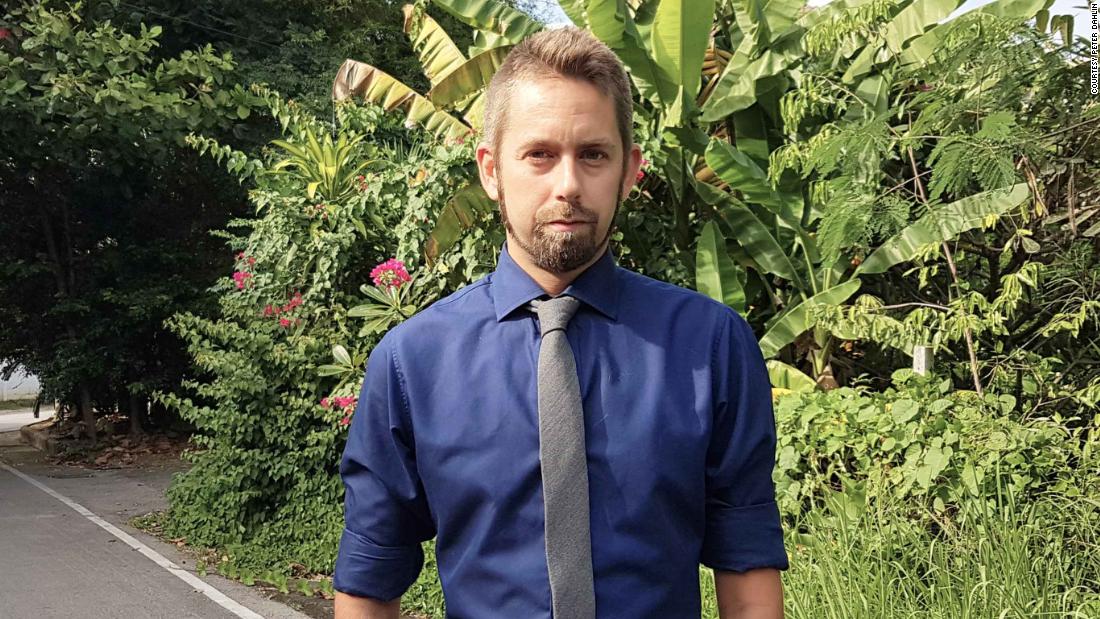
Peter Dahlin, a Swedish national, was detained in China on January 4, 2016 and held for three weeks.

Just months earlier, Sui says he was held at a police training facility in Guangzhou, the free-wheeling hub of China's manufacturing heartland where he worked as a human rights lawyer defending a number of high-profile activists.
He says interrogators accused him of inciting subversion and pressed him to give them details ranging from his personal life and finances, to his work, clients, and all of his contacts.
Initially he refused to answer the questions, but his resistance only made his interrogators push harder. 
"They wouldn't let me sleep for four days and nights. By the fifth day, I felt like I was going to die," he said.
Sui said it was the sleep deprivation plus threats of torture which ultimately broke his will and made him cooperate. 
He said investigators threatened to shackle his hands, hang him from the ceiling and shine a flashlight directly into his eyes.
"I knew someone who had a heart attack due to deprivation of sleep in jail, so I was a bit frightened my life could be at risk if I continued to fight back," he said.
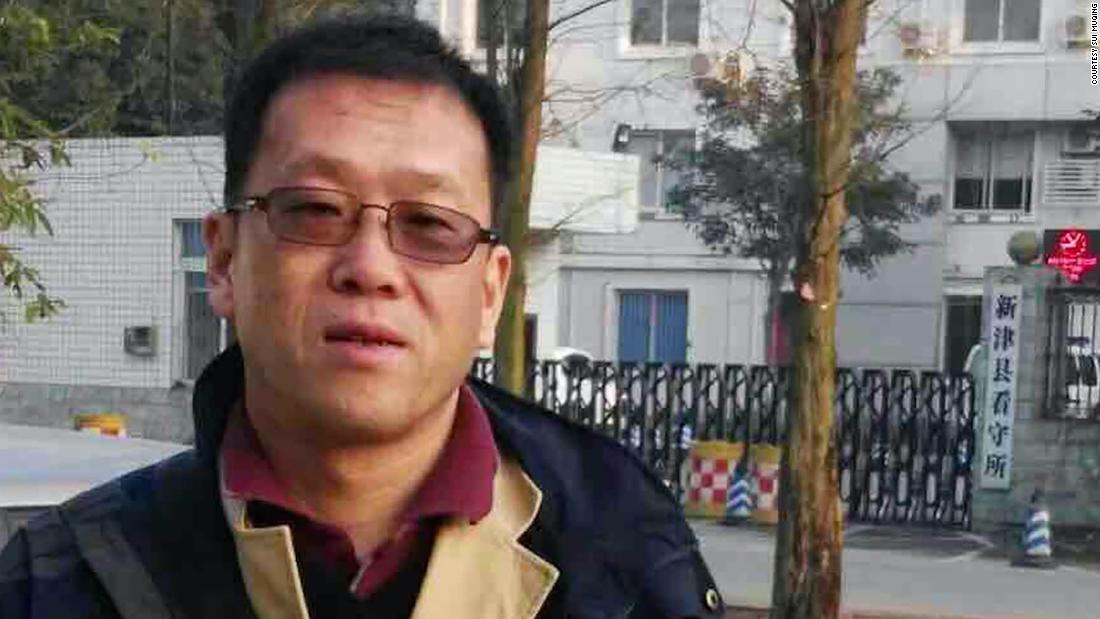
Sui Muqing, a lawyer, was detained from July 10, 2015 until January 6, 2016.

Chen, a professor who advocated for a US-style jury system in China on his blog, was first accused of "picking quarrels and provoking troubles," -- a vague charge often used by Chinese authorities that can carry a 10-year prison sentence. 
He told CNN he refused to admit any wrongdoing during a 20-hour interrogation, but then found himself sharing a jail cell with inmates accused of crimes ranging from petty theft to murder.
"The cell was so crammed I had to ask other prisoners to make room so I could urinate and defecate," he said. 
"I didn't have a spoon or chopsticks to eat with. We'd get one scoop of rice and would have to eat it with our hands."
After a month, Chen said he was told to collect his belongings. 
He thought he was going home -- but instead was driven to what appeared to be an abandoned hotel and held for another 10 days.
Earlier this year, CNN visited the nondescript building where Chen said he was held in Guilin, a southern city famed for its stunning landscape of karst mountains. 
Signs posted around the area in Chinese and English marked it as military property, but it otherwise appeared open and accessible.
Local officials denied that the building was used as a secret detention center.
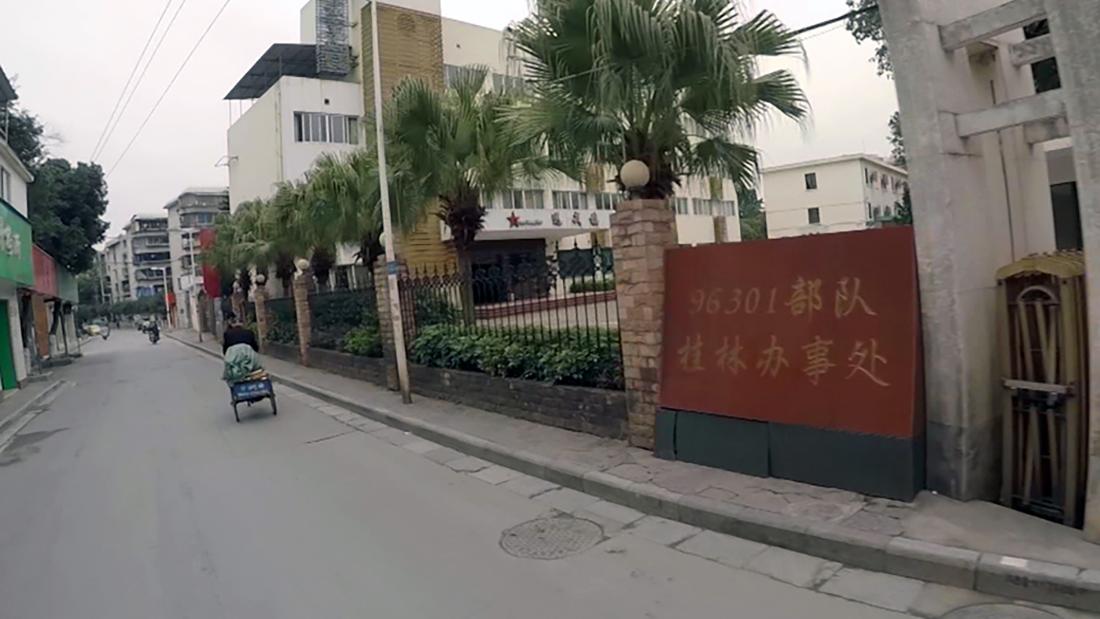
The building in Guilin where Chen Taihe was held.

'You have to confess'
The rights activists held captive weren't just concerned about their own well being. 
Their loved ones were also threatened.
Dahlin's interrogators made it clear that they'd keep his girlfriend, a Chinese national, in custody for as long as it took to resolve his case.
"She was taken hostage just to put pressure on me," he said. 
Dahlin asked about his girlfriend every day but got limited answers.
"They said she was being treated quite well. That she was being given yoghurt and fruit and things like that. She was allowed to make a few drawings and do yoga in her room," he said. 
"They knew she had nothing to give them."
Finally, after more than three weeks, Dahlin was told he was going to be released -- but he had to do one thing: confess on camera.
He said he knew what authorities were really going to do with it. 
But wanting to speed up his release -- and that of his girlfriend -- Dahlin agreed to play his part.
Dahlin 'confesses' on state TV

He was taken into a room where a woman from state broadcaster China Central Television (CCTV) was sitting with a cameraman. 
Dahlin was handed a piece of paper with the questions that she would ask and the answers he would give.
"I have caused harm to the Chinese government. I have hurt the feelings of the Chinese people. I apologize sincerely for this," Dahlin said in the confession broadcast nationwide and splashed across state-run newspapers.
Immediately after its broadcast activists denounced it as a forced confession -- one of many that have been shown on CCTV in the years since Xi came to power.
Sui and Chen said they had to make similar "confessions." 
All three men now maintain their innocence, but they said they had no choice but to do as authorities wanted.
Sui says he admitted to charges of inciting subversion. 
Chen told CNN he confessed to charges of picking quarrels and provoking troubles, inciting subversion and embezzlement.
"You have to confess," Chen said. 
"Otherwise they won't let you go."

No end in sight
The crackdown on lawyers is still taking place.
On Tuesday, a court in Changsha, central China sentenced human rights lawyer Jiang Tianyong to two years in prison after convicting him of inciting subversion against the state.
In August, he had confessed in a trial that was streamed live online and watched by his wife Jin Bianling in California.
"He used to tell me, if I ever admit to a crime like this, it means I've been tortured," Jin said.
Jiang was a prominent human rights lawyer who had represented some of his colleagues targeted in the 709 crackdown, and was an outspoken critic of the government. 
He disappeared in November 2016, en route to catching a train from the central city of Changsha to Beijing. 
Months went by before the authorities confirmed he had been detained.
"Please give me another chance to be a human being ... and to make up for my wrongdoings," Jiang told a panel of three judges at his August trial.
Albert Ho, a Hong Kong-based activist with the China Human Rights Lawyer Concern Group, said Jiang, like other lawyers his group has spoken to, likely admitted to the charges in order to live to fight another day.
"Only an idiot would believe that he is truly speaking from his heart," Ho said.

Sleeping with a knife
Six days after his "confession" was broadcast on CCTV, Dahlin was released and expelled from China. 
His girlfriend was also released without charge.
Dahlin is now based in Thailand, but has trouble forgetting his time in detention.
"Early on it was quite extreme. Every little noise at night would wake me up. I'd sleep with a knife next to my bed, ready to stab the first Chinese person who comes into my gate," he said.
Wang Yu poses during an interview in Hong Kong on March 20, 2014.

Wang Yu, the first lawyer detained in the 709 crackdown, was charged with subversion, while her husband was charged with inciting subversion. 
They were both released on bail after more than a year in custody, after Wang's taped confession was aired on CCTV.
In it, Wang renounced her legal work and blamed "foreign forces" for using her law firm to undermine and discredit the government. 
Their son, who was detained along with them, was released soon afterward, but his movements have been heavily restricted.
Authorities never aired Chen's statement. 
He was released a day after recording it and the charges against him were dropped.
"I have no criminal record, but they can still use the video to discredit me," he said.
Chen and his family now live in US, where he's a visiting scholar at the University of California's Hastings Law School and studies the US jury system. 
He said he won't return to China until it becomes more democratic.
Sui was released on bail after his "confession," which was also never broadcast. 
He continues to practice law in Guangzhou, but said his movements have been restricted and fears the worst may still be yet to come.
"It's increasingly difficult to maintain a harmonious society through brainwashing," Sui said.
"The only resort left is violence. For anyone who's not submissive, a brutal crackdown is on the way."

jeudi 23 novembre 2017

France Should Spotlight China's Rights Crisis

Foreign Minister Le Drian Should Call for Releases, Announce Policy Review
Human Rights Watch

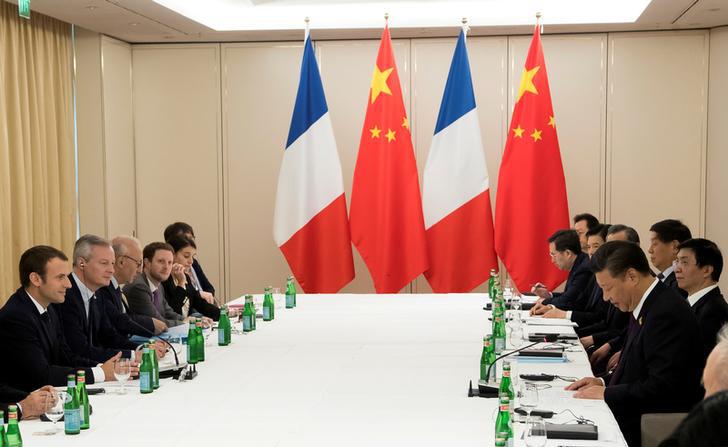
French President Emmanuel Macron and Xi Jinping attend a bilateral meeting in Hamburg, Germany, July 8, 2017. 

French Foreign Minister Jean-Yves Le Drian should publicly urge respect for human rights in meetings with China’s new leadership, Human Rights Watch said today in a letter to the foreign minister
Le Drian is visiting China for the first time as foreign minister from November 24 to 27, 2017.
“French President Emmanuel Macron has explicitly committed to promoting human rights in China along with diplomatic and economic concerns,” said Bénédicte Jeannerod, France director. “Minister Le Drian’s visit is an important opportunity to publicly challenge the Chinese leadership over its rampant human rights violations.”
Human Rights Watch urged Le Drian to:
“France has long been a defender of fundamental rights and liberties worldwide,” Jeannerod said. 
“In the face of an unreceptive Chinese leadership, Minister Le Drian’s visit will be a test of France’s commitment.”

mardi 21 novembre 2017

Rogue Nation

China jails yet another human rights lawyer in ongoing crackdown on dissent
By Emily Rauhala and Simon Denyer

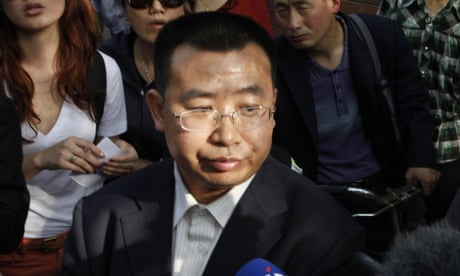
Jiang Tianyong in 2012.

BEIJING — A Chinese court on Tuesday convicted a prominent human rights lawyer of “inciting subversion of state power,” a vague charge often used to jail critics of the Chinese Communist Party, and sentenced him to two years in prison.
Jiang Tianyong, 46, is the latest lawyer known for defending government critics to be jailed. 
More than 200 have been detained over the last two years in the ongoing crackdown on criticism in China.
The court in the central Chinese city of Changsha said Jiang tried to “overthrow the socialist system” by publishing articles on the Internet, accepting interviews from overseas media, smearing the government and over-publicizing certain cases.
His defenders maintain these are all normal activities of his job as a lawyer.
The trial and sentencing are seen by human rights experts as an attack on what remains of the country’s legal activist community and on liberal politics in general, as Xi Jinping moves to bolster the Communist Party and purge its critics.
This case has been an absolute travesty from the beginning, sustained by nothing other than pure political persecution, not facts or broken laws,” said Sophie Richardson, China director of Human Rights Watch. “By putting Jiang Tianyong behind bars, China does him, his family and itself irrevocable harm.”
Jiang Tianyong’s trial was a total sham,” William Nee, China researcher at Amnesty International, said in a statement.
“Even with the most rudimentary examination of the facts, the case against him crumbles,” he continued. 
“His so-called confession and apology, extracted under duress, were nothing more than an act of political theater directed by the authorities.”
Jiang is one of more than 200 lawyers, legal assistants and activists detained in what is known as the “709 crackdown” for the day the purge started — July 9, 2015.
Some were released, but a number of leading lawyers have been charged with subversion, smeared in the party-controlled press, then subjected to what critics call political show trials, where they inevitably confess, on camera, to whatever charges they face.
In recent weeks, Chinese authorities stopped the child of another human rights lawyer who was targeted, Wang Yu, from traveling abroad to study. 
Wang’s lawyer, Li Yuhan, was detained in October.
Jiang was known for his robust defense of those criticizing the Chinese government.
Xie Yanyi, a Chinese rights lawyer, called him in a statement the “soul of the 709 rescue effort” for his determination to help colleagues in trouble. 
Jiang “spared no effort” when it came to defending China’s most vulnerable groups, Xie said.
Jiang disappeared into state custody in November 2016 as he traveled from Beijing to Changsha to advise another human rights lawyer, Xie Yang, who had been detained.
In January, Xie’s attorneys published a transcript of their client describing the torture he endured in custody. 
But at his trial in May, Xie denied his own account. 
At his own trial in August, Jiang told the court that he had helped Xie invent the account.
Experts see the turnarounds in Xie and Jiang’s testimonies as further evidence that “709” lawyers are being tortured while in custody. 
At his August trial, Jiang, looking defeated, confessed to the court — and the cameras — that he did everything prosecutors claimed and then asked, meekly, for mercy.
“We are concerned that throughout the proceedings Jiang Tianyong has not been allowed access to lawyers of his own choosing and that he was obviously prejudged through a ‘confession’ aired by Chinese TV before his trial had even begun,” German Ambassador Michael Clauss said in statement released at the time of trial. 
“Under these circumstances, a fair trial is impossible.”
Jiang’s wife, Jin Bianling, who lives in Los Angeles, has already written to Matt Potinger, an adviser to Trump, asking for help with her husband’s case. 
“I am entreating you to save my husband,” she wrote in a letter dated. Aug. 24.
Jin said she was able to briefly speak with Jiang after the sentencing. 
She said she told him she will wait for him and that she hopes she will one day see him again.
“He said he misses us,” she said.

mercredi 6 septembre 2017

Rogue Nation

China’s Rights Crackdown Is Called ‘Most Severe’ Since Tiananmen Square
By NICK CUMMING-BRUCE

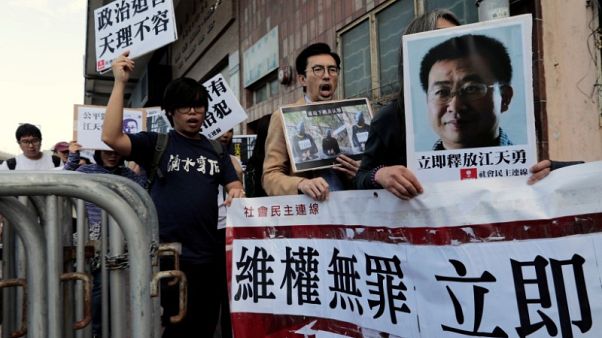
Pro-democracy activists held portraits of the detained Chinese human rights lawyers Jiang Tianyong, background left, and Wang Quanzhang at a protest in Hong Kong this summer.

GENEVA — China is systematically undermining international human rights groups in a bid to silence critics of its crackdown on such rights at home, a watchdog organization said on Tuesday. 
The group also faulted the United Nations for failing to prevent the effort, and being complicit in it.
“China’s crackdown on human rights activists is the most severe since the Tiananmen Square democracy movement 25 years ago,” Kenneth Roth, the director of the agency, Human Rights Watch, said in Geneva on Tuesday at the introduction of a report that he described as an international “wake-up call.” 
“What’s less appreciated is the lengths to which China goes to prevent criticism of that record of oppression by people outside China, particularly those at the United Nations.”
“The stakes are not simply human rights for the one-sixth of the world’s population who live in China,” Mr. Roth added, “but also the survival and effectiveness of the U.N. human rights system for everyone around the globe.”
The report highlights China’s measures to prevent activists from leaving the country to attend meetings at the United Nations, its harassment of those who do manage to attend and the risk of reprisals when they return or if they interact with United Nations investigators inside or outside China.
The report also noted barriers placed by Chinese officials to visits by United Nations human rights officials. 
Beijing has not allowed a visit by the agency’s High Commissioner for human rights since 2005, and continues to delay 15 requests for visits by special rapporteurs working on political and civil rights issues.
China allowed visits by four rapporteurs since 2005 on issues like poverty, debt and the status of women. 
But it carefully choreographed those visits, and contacts not sanctioned by the state posed risks to those involved. 
The United Nations has expressed concern that the detention of Jiang Tianyong, a prominent human rights lawyer, resulted from a 2016 meeting in Beijing with the United Nations special rapporteur on poverty, Philip Alston.
Mr. Jiang disappeared for several months and was later charged with subversion.
The report also documents China’s diplomacy in the United Nations Human Rights Council in Geneva, where China aligns with an informal collection of states, including Algeria, Cuba, Egypt and Venezuela, that discretely coordinate their positions to deflect scrutiny of their records and consistently challenge the council’s ability to look into accusations of abuse in other states without their consent.
It’s becoming a mutual defense society among odious dictators in which everybody understands the need to deflect criticism of you today because they may criticize us tomorrow,” Mr. Roth said.
“And China is an active, willing partner in that effort.”
Moreover, China has withheld information requested by United Nations bodies that monitor issues like torture, treatment of the disabled and children’s rights, and has tried to stop the filming and online posting of their proceedings, Human Rights Watch said.
The report also accused China of using its position on a United Nations committee that accredits nongovernment organizations to obstruct applications by civil society groups.
Individual measures by China could be passed over as unremarkable, Mr. Roth said, “but when you put it all together, what it represents is a frontal assault on the U.N. human rights system.”
Human Rights Watch delivered a copy of its report to China but received no substantive response, he said.
The effect of China’s behavior on human rights is like “death by a thousand cuts,” Mr. Roth said, but he also pointed to the dangers of “a thousand acts of acquiescence” by the United Nations and states that support human rights.
Human Rights Watch presented a copy of its report to the United Nations secretary general, Antonio Guterres, Mr. Roth said, but Mr. Guterres’s response did not mention China by name.
“That illustrates what needs to change,” Mr. Roth said.
A request for comment from Mr. Guterres’s office was not immediately returned.
The report cited the United Nations’ treatment of the Uighur rights activist Dolkun Isa, who had received United Nations accreditation to attend meetings in its New York headquarters but was escorted off the premises by security officers without explanation.
It also cited the exceptional treatment that the United Nations accorded Chinese dictator Xi Jinping when he visited its Geneva headquarters in January: It sent home many staff members early, refused access to nongovernment organizations and granted access to only a handful of journalists.
Its handling of the occasion “was an utter embarrassment for the U.N.,” Mr. Roth said.
“It became actively complicit in Xi Jinping’s terror of any criticism. It was an utter abandonment of the principles the U.N. should abide by. It was a shameful moment.”

mardi 5 septembre 2017

Rogue Nation: China seeks to silence critics at U.N. forums

"China is systematically trying to undermine the U.N.’s ability to defend human rights, certainly in China but also globally as well." -- Kenneth Roth
By Stephanie Nebehay
Security cameras are attached to a pole in front of the giant portrait of  Chinese dictator Mao Zedong on Beijing's Tiananmen Square, near the Great Hall of the People where the 18th National Party Congress (NPC) is currently being held, November 11, 2012.

GENEVA -- Beijing is waging a campaign of harassment against Chinese activists who seek to testify at the United Nations about repression, while the world body turns a blind eye or is complicit, Human Rights Watch said.
In a report released on Tuesday, the group said China restricts travel of activists, or photographs or films them if they do come to the U.N. in Geneva to cooperate with human rights watchdogs scrutinizing its record.
What we found is that China is systematically trying to undermine the U.N.’s ability to defend human rights, certainly in China but also globally as well,” Kenneth Roth, executive director of Human Rights Watch, told Reuters.
“This comes at a point where domestically China’s repression is the worst it has been since the Tiananmen Square democracy movement (in 1989). So there is much to hide and China clearly attaches enormous importance to muting criticism of its increasingly abysmal human rights record.”
Asked about the report at a regular briefing on Tuesday, Chinese foreign ministry spokesman Geng Shuang dismissed its accusations as “groundless”.
The U.N. system offers one of the few remaining channels for Chinese activists to express their views, the New York-based group said.
Its report, “The Costs of International Advocacy: China’s Interference in United Nations Human Rights Mechanisms,” is based on 55 interviews.

“NIP-IT-IN-THE-BUD STRATEGY”

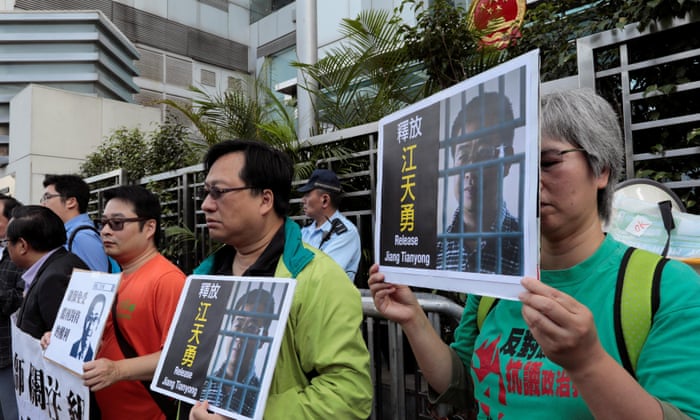
Pro-democracy demonstrators hold up portraits of Chinese disbarred lawyer Jiang Tianyong, demanding his release, during a demonstration outside the Chinese liaison office in Hong Kong, China December 23, 2016. 

Xi Jinping seems to have adopted a ‘nip it in the bud’ strategy with respect to activism at home, but increasingly abroad. That’s one of our messages, China’s repression isn’t stopping at its borders these days,” Roth said.
In China, activists have “decreasing space safe” from intimidation, arbitrary detention, and a legal system controlled by the Communist Party, the report said, decrying a crackdown on activists and lawyers since 2015.
Some activists who have attended U.N. reviews of China’s record have been punished on their return, it said. 
Others have their passports confiscated or are arrested before departure.
When Xi addressed the U.N. in Geneva in January, the U.N. barred non-governmental organizations (NGOs) from attending, Human Rights Watch said.

Dolkun Isa, executive chairman of the World Uyghur Congress, speaks on his phone at the organization’s Munich office July 6, 2015. 

Dolkun Isa, an ethnic Uighur rights activist originally from China, was attending a U.N. event in New York in April when U.N. security guards ejected him without explanation, despite his accreditation, it added.
Jiang Tianyong, a prominent human rights lawyer, disappeared last November, months after meeting in Beijing with U.N. special rapporteur on poverty Philip Alston who has called for his release.
Jiang, after being held incommunicado for six months, was charged with subversion. 
At his trial last month he confessed, saying that he had been inspired to overthrow China’s political system by workshops he had attended overseas.
“It illustrates the lengths to which China will go to ensure that even when it admits a U.N. investigator, the investigator only hears the government’s side of the story,” Roth said.
”When a rare activist is able to break through the ‘cordon sanitaire’, they are arrested.
“So the signal is clear -- don’t you dare present an independent perspective to a U.N. investigator.”

vendredi 25 août 2017

China's human rights abuses

Germany says Chinese rights activist won't get fair hearing
Reuters

Pro-democracy demonstrators hold up portraits of Chinese disbarred lawyer Jiang Tianyong, demanding his release, during a demonstration outside the Chinese liaison office in Hong Kong, China December 23, 2016.

BEIJING -- Germany’s ambassador to China said on Friday it was “impossible” that a prominent Chinese former rights lawyer who admitted to subversion during a trial this week would get a fair hearing.
Jiang Tianyong, 46, said in court on Tuesday he was inspired to overthrow China’s political system by workshops he had attended overseas, according to videos of him reading a statement released by the court.
Jiang’s wife and activists said the hearing was a show trial designed to discredit him and Jiang was coerced into confessing. 
A date for the verdict has not been released.
We are concerned that throughout the proceedings Jiang Tianyong has not been allowed access to lawyers of his own choosing and that he was obviously prejudged through a ’confession’ aired by Chinese TV before his trial had even begun,” German Ambassador Michael Clauss said in a statement released on the embassy’s website.
Under these circumstances, a fair trial is impossible,” Clauss said, adding that Germany had raised Jiang’s case with Chinese officials since last November.
Western diplomats regularly meet Chinese rights activists and lawyers, but embassies only publicly speak out in cases they consider especially troubling or in instances where private discussion with China has been ineffective.
Germany has been particularly outspoken about a crackdown in recent years on rights activists.
China’s foreign ministry did not immediately respond to a faxed request for comment.
China has said about similar cases in the past that other countries should not meddle in its internal affairs and that all citizens of China are equal before Chinese law.
Jiang, who was disbarred in 2009 after taking on cases related to sensitive issues such as the banned spiritual movement Falun Gong, had criticized a crackdown on dissent that has been ongoing since the summer of 2015.
Jiang went missing in November 2016 while visiting the family of another detained lawyer, Xie Yang
He was charged with subversion of state power more than six months later.
The U.N. Special Rapporteur on human rights and extreme poverty, Philip Alton, met Jiang during a visit to China last year and has expressed concern that his disappearance was in part reprisal for their meeting.

mardi 22 août 2017

Chinese activist Jiang Tianyong's subversion trial dismissed as sham

Rights campaigners reject reported ‘admission of guilt’ by lawyer accused of trying to topple China’s one-party state
By Tom Phillips in Beijing

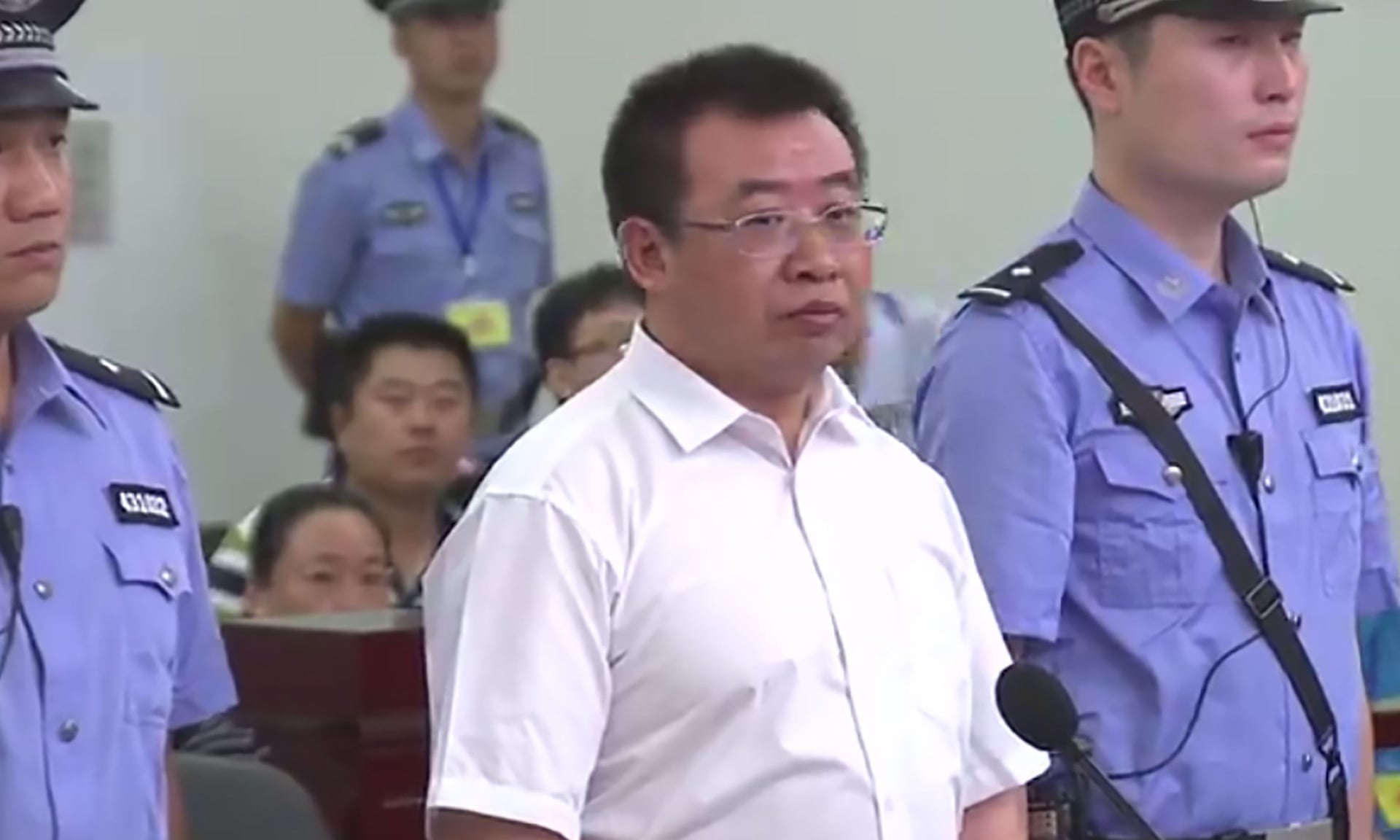
Jiang Tianyong appearing in court in Changsha. He is the latest in a string of prominent human rights lawyers to stand trial for political crimes. 

Human rights activists have denounced as a sham the trial of a leading Chinese civil rights lawyer who authorities claim tried to topple China’s one-party state.
Jiang Tianyong, 46, was put on trial in the central city of Changsha on Tuesday morning having vanished into the custody of security services last November during a crackdown on lawyers described as China’s “war on law”.
China’s Communist party-controlled media claimed Jiang – whose past clients include activists such as the exiled dissident lawyer Chen Guangcheng – had confessed to the crime of “inciting subversion of state power”.
“I’m ashamed of it,” Jiang told the court, according to the English-language China Daily, which sent a correspondent to cover proceedings in a sign of Beijing’s determination to shape the narrative around the prosecution.
According to the state-run broadsheet, Jiang admitted to attending overseas training sessions where he was encouraged to reject China’s political system and ruling party. 
“So I wanted to make a change,” he reportedly said.
In an apparently mistranslated statement, published by the state-run Global Times and later deleted, Jiang added: “I wish to convey to the public my dissatisfaction toward the Communist party of China, the government, the police and the judicial system … in order to achieve the goal of change in the current system and overthrow the party.”
In an online video released by the court, Jiang appears asking for clemency: “Please give me another chance to be a human being … and to make up for my wrongdoings … Once I am free I will never return to my old ways … I sincerely ask the court to set me on a path towards the sunshine.”

Human rights lawyer Jiang Tianyong
The Chinese Human Rights Defenders group rejected Jiang’s claimed admission of guilt. 
“Any confession likely the result of torture,” it said on Twitter.
Jiang is the latest in a string of prominent human rights lawyers to stand trial for political crimes. Since Xi Jinping became China’s top leader almost five years ago, the human rights community has faced a severe crackdown that diplomats and observers say is the worst in almost three decades.
China’s heavily controlled media, however, paints a contrasting picture of the developments that have taken place under Xi. 
In a front-page story, apparently timed to coincide with Tuesday’s trial, the China Daily quoted Chinese academics who heaped praise on the “transformative changes” witnessed since Xi became leader in late 2012. 
“China has made great progress in advancing the rule of law,” claimed Jiang Guohua, a law professor.
The China Daily added: “The president has attached great importance to promoting the rule of law and has pledged on numerous occasions to build a law-based socialist country.”
William Nee, a Hong Kong-based activist with Amnesty International, said that despite attempts to portray Jiang’s trial as open and fair, it was in reality a stage-managed farce.
A guilty verdict was a foregone conclusion, he said. 
The authorities should end these sorts of sham trials and support lawyers and legal advocates like Jiang Tianyong rather than suppressing them.”
Jiang’s wife, Jin Bianling, who lives in the US, told Reuters she considered the trial and the videos a “show” by authorities to make Jiang appear guilty.
The court said on social media that it had adjourned, without giving a timeline for the release of the verdict or further hearings.

vendredi 17 février 2017

China eliminating civil society by targeting human rights activists

Report details use of torture by Chinese security agencies – including beatings, stress positions and sleep deprivation – to force activists to confess ‘crimes’
By Benjamin Haas In Hong Kong
Since coming to power in 2012, Xi Jinping has overseen a sweeping crackdown on civil society. 

China’s human rights situation further deteriorated last year as police systematically tortured activists and forcibly disappeared government critics while state TV continued to broadcast forced confessions, a new report shows.
A creeping security state also attempted to codify much of its existing behaviour on paper, giving the police legal authority to criminalise a host of NGOs deemed politically sensitive by the authorities, according to the report by the Network of Chinese Human Rights Defenders (CHRD).
“The Chinese government seems intent on eliminating civil society through a combination of new legislation restricting the funding and operations of NGOs, and the criminalisation of human rights activities as a so-called threat to national security,” Frances Eve, a researcher at CHRD, told the Guardian.
What stands out is the institutionalised use of torture to force defenders to confess that their legitimate and peaceful human rights work is somehow a ‘crime’.”
Since coming to power in 2012, Xi Jinping has overseen a sweeping crackdown on civil society. 
In 2015, police targeted almost 250 rights lawyers and activists in a war on law, and the effects of that campaign continued to be felt throughout last year.
Reports of torture while in detention in 2016 were rampant, with methods including beatings, attacks by fellow inmates on the orders of prison guards, stress positions, deprivation of food, water and sleep, inhumane conditions and deprivation of medical treatment.
In some cases, human rights activists were prevented from receiving medical care even once they were released.
Huang Yan, who was detained in November 2015, was suffering from ovarian cancer and diabetes. Police confiscated her diabetes medication, and despite an exam done at a detention facility in April 2016 showing the cancer had spread, she was not treated and was denied medical bail.
When she was finally released, Huang was scheduled to undergo surgery last November to treat her cancer, but the authorities pressured the hospital and the team of surgeons declined to treat her.

Torture also took more overt forms. 
Last year reports also emerged that rights lawyer Xie Yang was subject to beatings and stress positions in detention, with interrogators warning him: “We’ll torture you to death just like an ant”.
In November 2016, Jiang Tianyong, a respected Christian attorney, disappeared while about to board a train and police waited weeks to confirm he had been detained. 
Jiang’s whereabouts are still a mystery nearly three months later.
In a rare strongly-worded statement, the European Union called for his immediate release along with several other lawyers.
China also continued the practice of airing confessions on state television, a move that is reminiscent of internal Communist party political purges.
In one of the most prominent cases, Swedish NGO worker Peter Dahlin was paraded on the national broadcaster after three weeks in detention, declaring: “I have violated Chinese law through my activities here. I have caused harm to the Chinese government. I have hurt the feelings of the Chinese people.”
The confessions air before detainees ever see the inside of a courtroom, and in Dahlin’s case he was promptly deported.
For those activists that do go to trial, in at least 15 cases last year police attempted to pressure activists into accepting government-appointed lawyers. 
In cases where state-appointed lawyers represented human rights activists, little defence was mounted and the accused pleaded guilty and promised not to appeal their cases.
The report also outlined two laws passed in 2016 that are likely to curb civil society: legislation regulating charitable giving and a law on foreign NGOs. 
The charity law, while not explicitly requiring all NGOs to register with the government, makes it difficult for unregistered organisations to raise funds domestically.
The foreign NGO regulations require overseas groups that give money to Chinese organisations to be registered with the police.
“Together, these laws will hamper the development of Chinese civil society by restricting their funding,” the CHRD report said.
“There are no more ‘grey areas’,” an unnamed human rights activist said in the report. 
“To advocate for human rights in China today, you must be willing to accept the reality that the government views your work as ‘illegal’.”

jeudi 16 février 2017

Rogue Nation

Human rights lawyers in China beaten, arrested
By NOMAAN MERCHANT

Lawyers who defend human rights activists and dissidents targeted by China's communist government have increasingly themselves become subject to political prosecutions, violence and other means of suppression, according to a report released Thursday.
The Network of Chinese Human Rights Defenders, a coalition of groups working within and outside China, identified six occasions last year that lawyers were beaten by plaintiffs, police officers or assailants hired by authorities
In more than a dozen cases, the report found, detainees were pressured to fire their own lawyers and accept government-supplied attorneys.
"The government is trying to give this impression that it's abiding by the rule of law," said Frances Eve, a researcher for the network. 
"In fact, it's just legalizing repressive measures."
Under Xi Jinping, China has widely suppressed independent organizations and dissenters, as well as lawyers defending people caught in its crackdown. 
The report says 22 people have been convicted since 2014 of subversion or other crimes against state security, including 16 last year alone.
Dozens of lawyers have been questioned or detained in an ongoing campaign against dissident lawyers known as the 709 crackdown launched in July 2015.

Wang Quanzhang, who defended members of the Falun Gong meditation sect banned by China, was charged with subversion of state power in January 2016 after previously being beaten and detained. His wife, Li Wenzu, told The Associated Press on Wednesday that Wang is now under indictment and being held without access to family or lawyers.
"We have to wait until the sentencing to see him in jail," she said.
Four people associated with Wang's law firm, Fengrui, were convicted in August of charges that they incited protests and took funding from foreign groups.
China last year also passed a law tightening controls over foreign non-governmental organizations by subjecting them to close police supervision, a move critics called a new attempt by authorities to clamp down on perceived threats to the ruling Communist Party's control.
NGOs can be blacklisted if they commit violations ranging from illegally obtaining unspecified state secrets to "spreading rumors, slandering or otherwise expressing or disseminating harmful information that endangers state security."
Ordinary Chinese who share audio or video of a protest or other news event may be detained, and authorities can shut down phone and Web networks in response to perceived threats to "national security" and "social order".
Chinese Internet censors already exercise tight control with the so-called "Great Firewall" that blocks many foreign news sites and social media platforms.
Prominent activists have frequently been taken into custody without notice to their family or legal teams. 
One was Liu Feiyue, the founder of a website that detailed local corruption cases, veterans' issues, and allegations that perceived troublemakers were being detained in mental hospitals
After his disappearance in November, Liu's family was told he was charged with subversion.
Despite its well-publicized record, China was re-elected last year to the United Nations' Human Rights Council. 
But even as China reported its membership on the council through state media, it refused to let banned activists attend United Nations events, the report said.
When Philip Alston, the UN's special rapporteur for human rights, visited China in August, authorities forbade him from meeting several activists and tightly controlled his schedule. 
One activist who did meet with him, lawyer Jiang Tianyong, was arrested three months later and charged with inciting subversion of state power.
Eve, the researcher for Chinese Human Rights Defenders, said some activists believed after Xi became president in 2013 that they might find common cause over his stated goals of rooting out government corruption. 
But those limited hopes have not come to fruition, she said.
"It's gone completely the opposite direction," she said. 
"And it's a tragedy, because those are the kinds of alliances that can make real impact."
The Chinese foreign ministry did not respond to faxed questions.

dimanche 29 janvier 2017

EU demands China investigate torture of lawyer and release political prisoners

Rare statement cites China’s own laws that prohibit torture in condemnation of mistreatment of detained rights lawyer Xie Yang and others.
By Benjamin Haas in Hong Kong

Lawyer Xie Yang who has been detained by Chinese authorities as part of a crack down on human rights. 

China must investigate a harrowing account of torture by a detained lawyer and release several political prisoners, the European Union has demanded in a rare statement amid a deteriorating human rights situation under Xi Jinping.
Detained rights lawyer Xie Yang detailed his treatment in detention last week, where he was beaten, forced into stress positions, denied medical care and deprived food, drink and sleep by police. 
Interrogators threatened him repeatedly, allegedly saying: “We’ll torture you to death just like an ant”.
Separate reports have said two other civil rights attorneys, Li Heping and Wang Quanzhang, have also been tortured while in custody.
“If verified, this mistreatment would amount to torture,” the European Union’s foreign affairs spokesperson said in a statement
“All necessary measures to ensure the safety and wellbeing of these individuals need to be taken.”
“If the accounts of mistreatment or torture are confirmed, this should result in the punishment of the responsible persons,” the statement added, citing China’s own laws that prohibit torture.
All three were detained in July 2015, part of an unprecedented nation-wide crackdown on human rights lawyers, legal assistants and activists. 
Nearly 250 people were targeted during the campaign, with some still held by police without trial over 18 months later.
“We reiterate our call for the release of the lawyers and human rights defenders who remain in detention, including Jiang Tianyong,” the EU statement said, referring to another lawyer who disappeared into police detention in November.
The EU applauded the release of two other rights defenders, Xie Yanyi and Li Chunfu, but for relatives there is little cause for celebration.
Li, who’s brother is Li Heping, was granted bail earlier this month and returned home. 
But relatives claim nearly 17 months of severe abuse have transformed the 44-year-old lawyer into a shadow of his former self.
“His mind is shattered,” his wife, Bi Liping, was quoted as saying in one online account of the lawyer’s ordeal
A local hospital offered a preliminary diagnosis of schizophrenia.
The EU statement comes just days after a group of leading lawyers and judges writing in The Guardian expressed “grave concern” over the detention of legal professionals.
“In order to vindicate its claim to be a responsible stakeholder in the international community and to be a respected global superpower, it is imperative that China honour its international commitments to international conventions and human rights,” the letter said.

mardi 24 janvier 2017

China must respect lawyers’ human rights

"By detaining and disappearing these lawyers and law firm staff, China is in breach of its international obligations as well as Chinese domestic criminal law and constitutional principles. 
"It is also violating the UN basic principles on the role of lawyers, the UN declaration on human rights defenders and the UN body of principles for the protection of all persons under any form of detention or imprisonment."

Wang Yu, a prominent Chinese human rights lawyer, pictured in April 2015. She and her husband Bao Longjun were arrested on subversion charges. Her son Bao Zhuoxuan has also disappeared. 
On 18 January 2016, senior lawyers, judges and jurists from many countries and international organisations wrote a letter to the Guardian to express our deep concern about the unprecedented crackdown on criminal defence and human rights lawyers that began on the night of 9 July 2015 with the enforced disappearance of lawyers Wang Yu and Bao Longjun, and their 16-year-old son, and has most recently included the emergence of lawyer Li Chunfu from over 500 days of incommunicado detention with signs of serious mental illness, as well as physical suffering.
From 9 July 2015 to the present, hundreds of lawyers, law firm staff, and family members have been subject to intimidation, interrogation, detention as criminal suspects, wrongful criminal convictions and forced disappearance.
We, the undersigned lawyers, judges and jurists, now write again to express our continued grave concern over subsequent developments in China, in particular the treatment of the lawyers and legal assistants named in our 18 January 2016 letter, as well as some of their close colleagues, supporters and family members.
We observe the following developments with concern:
The authorities have continued to deny several of the detainees, who have been held incommunicado and are facing trial, access to their appointed lawyers (in cases including those of, Li Heping, Wang Quanzhang, and until recently Xie Yang and Li Chunfu.
• Detainees are reported to have suffered physical violence at the hands of prison guards: lawyer Xie Yang in January 2017 testified to torture methods including beatings; stress positions; several guards simultaneously blowing cigarette smoke in his face; food, drink and sleep deprivation; denial of medical care; denial of basic personal hygiene; death threats; and excessive questioning at the hands of the authorities. On 23 January 2017, lawyers Li Heping and Wang Quanzhang were reported to have been tortured with electric shocks that made them faint.
• Detainees are feared to have been inappropriately medicated (documented in the case of Li Chunfu, who was given pills for “high blood pressure” even though his blood pressure according to independent diagnosis is normal).
• The authorities have claimed that lawyers chosen by the detainees or their family members have been “dismissed” and replaced by lawyers chosen by the authorities (for example, in the case of Li Heping).
• Some detainees have suffered judicial persecution through implausible criminal charges and convictions including “subversion of state power”, “inciting subversion of state power” and other crimes against national security and public order (for example, in August 2016, Zhou Shifeng was sentenced to seven years in prison).
• Some detainees, including Wang Yu and her husband Bao Longjun and legal assistant Zhao Wei, are claimed to have been “released” from detention centres into private homes, and yet they are closely monitored and wholly isolated from friends and colleagues.
• Written, oral and video statements of self-incrimination and self-renunciation by the detainees, apparently induced by the authorities, have been released through official media channels (for example, lawyer Zhang Kai was induced to make such a statement, which he later retracted).
The authorities have put pressure on detainees’ spouses, siblings, children and parents to persuade the detainees to confess and admit guilt (for example, video-recorded statements by the parents of lawyers Li Chunfu and Li Heping were obtained by means of false representations).
Detainees’ families have suffered further persecution: for example, the wives of Li Heping, Wang Quanzhang, Xie Yang and Xie Yanyi have been subjected to police monitoring and harassment; the children of Li Heping and Wang Quanzhang have been denied enrolment at state schools due to police pressure; and the authorities have put pressure on the landlords of Wang Quanzhang’s and Xie Yanyi’s families to evict them from their homes.
• Detainees have been defamed through media reports, officially released video-clips and similar materials similar materials portraying them as criminals and enemies of their country.
Further, human rights lawyer Jiang Tianyong is being held on charges of inciting subversion of state power, after having been disappeared on 21 November 2016. 
A colleague and friend of several of the original detainees, lawyer Jiang Tianyong has been forcibly disappeared and on at least two occasions tortured in the past; and his health remains frail, partly as a result of previous torture. 
There is grave concern that his rights to personal liberty, the right not to be tortured, and right to a fair trial have been violated yet again.
We continue to be particularly concerned about people who have been detained and/or disappeared and tortured on past occasions of forced disappearance or criminal detention. 
These include Li Heping, his brother Li Chunfu, Wang Quanzhang and Jiang Tianyong, as well as Zhang Kai, who retracted his self-renunciation statement in late August 2016.
Xi Jinping has repeatedly stated that “China is a country ruled by law” and that “every individual [Communist] party organisation and party member must abide by the country’s constitution and laws and must not take the party’s leadership as a privilege to violate them”. 
Yet the events just described appear to move farther and farther away from those commitments.
China has signed and ratified the UN convention against torture and signed the international covenant on civil and political rights. 
By detaining and disappearing these lawyers and law firm staff, China is in breach of its international obligations as well as Chinese domestic criminal law and constitutional principles. 
It is also violating the UN basic principles on the role of lawyers, the UN declaration on human rights defenders and the UN body of principles for the protection of all persons under any form of detention or imprisonment.
In order to vindicate its claim to be a responsible stakeholder in the international community and to be a respected global superpower, it is imperative that China honour its international commitments to international conventions and human rights. 
Therefore, we respectfully urge China to:
• Ensure the release of the detained or arrested lawyers and others held with them without legal basis.
• Ensure access to counsel for all those detained, arrested or otherwise held as a criminal suspect.
• Confirm the whereabouts of those forcibly disappeared.
• Ensure that the rights of those detained, including their right to adequate medical treatment, are safeguarded.
• Ensure that those detained and their colleagues will be protected from any future control measures such as: tracking and following, violent attacks, soft detention, being “travelled”, being asked to have “chats”, criminal, administrative, judicial detention, forced disappearance, torture and psychiatric incarceration.
We will continue to monitor the fate of the lawyers and staff concerned closely.


Dominique Attias
Vice-president of the Paris bar, general secretary of the International Observatory of Lawyers in Danger, France
Robert Badinter Former French minister of justice and former president of the French Constitutional Council, France
Gill H Boehringer Coordinator of the International Association of People’s Lawyers, former dean of the Macquarie University Law School, Australia
Laurence Bory President of the International Association of Lawyers (IAL)
Edgar Boydens Dormer president of the Dutch Brussels Ba, president of Lawyers with Borders (Belgium)
Kirsty Brimelow QC Chair of the Bar Human Rights Committee of England and Wales (BHRC), UK
Jean-Pierre Buyle President of the French and German speaking bar of Belgium
Reed Brody Counsel and spokesperson for Human Rights Watch, United States
David Collins President, American Bar Foundation (2014-2016), United States
Alexandre Couyoumdjian and Virginie Dusen Co-chair, Association of Armenian Lawyers and Jurists, France
Elizabeth Evatt Companion of the Order of Australia; former president, Australian Law Reform Commission, and member of the UN Human Rights Committee; currently, commissioner, International Commission of Jurists, Australia
Pascal Eydoux President of the French National Bar Council; president of the International Observatory for Lawyers in Danger, France
Carlos Fuentenebro President of the Bizkaia Bar Association, Spain
Ruthven Gemmell President of the Council of Bars and Law Societies of Europe
Sonia Gumpert President of the Madrid Bar Association, Spain
Patrick Henry President of the Human Rights Committee of the Council of Bars and Law Societies of Europe (CCBE) and vice-president of Lawyers without Borders, Belgium
Asma Jahangir Jurist, president of the Supreme Court Bar Association of Pakistan, founding member of the Human Rights Commission of Pakistan
Grégoire Mangeat President of the Geneva Bar Association, Switzerland
Michael Mansfield QC Barrister and professor at law, City University, London, UK
Andrea Mascherin President of the Italian National Bar Council, Italy
Juan E Mendez Professor of human rights law, former UN special rapporteur on torture, 2010-2016, Argentina
Marcus Mollnau President of the Berlin bar (Rechtsanwaltskammer Berlin), Germany
Manfred Nowak Professor of international law and human rights at Vienna University, Austria
Victoria Ortega Benito President of the Spanish National Bar Council, Spain
Christophe Pettiti General secretary of the Paris Bar Human Rights Institute, France
Stuart Russell Former administrative judge, Australia
Clive Adrian Stafford Smith Human rights lawyer, UK
David J Scheffer Former US ambassador at large for war crimes issues; Mayer Brown/Robert B Helman professor of law and director, Center for International Human Rights, Northwestern University Pritzker School of Law, USA
Rechtsanwalt und Notar Ulrich Schellenberg President of the German Bar Association (Deutscher Anwaltverein), Germany

dimanche 25 décembre 2016

Why Christmas time in China means jail for human rights activists

Beijing brings campaigners to trial when foreign observers are least likely to be paying attention.
By Benjamin Haas in Hong Kong

Pro-democracy demonstrators demand the release of mainland Christian rights lawyer Jiang Tianyong in a protest in Hong Kong on Friday. 

As people celebrate around the world, a new Christmas tradition is increasingly popular in China: jailing political prisoners, hoping the distraction of the holiday season will lead to less attention.
This year is no different. 
Three human rights activists will come to trial in the next few days when many foreign diplomats, journalists and NGO observers are away from their desks.
When the most prominent human rights activists are put on trial during the Christmas period, that’s definitely deliberate,” said William Nee, a Chinaresearcher at Amnesty International. 
“The government doesn’t want international attention and they don’t want foreign observers, so they go to extreme lengths to avoid international scrutiny of these show trials.”

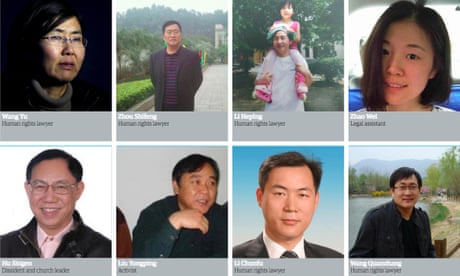
The disappeared: faces of human rights activists China wants to silence

Chen Yunfei will be tried on Boxing Day, after already languishing in police detention for the past 21 months. 
Charged with “picking quarrels and provoking trouble”, Chen organised a memorial for victims of the 1989 Tiananmen Square massacre during the holiday in which Chinese traditionally pay respects to the dead.
On the Friday 23 December police confirmed they were investigating prominent Christian rights lawyer Jiang Tianyong on suspicion of “inciting subversion of state power”. 
He had been missing since November 21 and his family still does not know where he is being held.
Jiang’s wife, Jin Bianling, said the couple had been unable to celebrate Christmas since 2012 because of harassment from the police. 
Jin moved to the United States three years ago, but this is the first Christmas she has not been able to speak to her husband.
“He used to call and send photos every year and tell me how much he missed me, he didn’t want me to feel alone on Christmas,” Jin said, choking back tears. 
“But this year we don’t even know where he is, and we fear he may spend Christmas being tortured.”
A United Nations human rights panel shared her fears in a statement earlier this month: “We fear that Jiang’s disappearance may be directly linked to his advocacy and he may be at risk of torture.”
On 21 December it emerged that Xie Yang, another rights lawyer, had his case transferred to the prosecutor’s office in preparation for him to be tried on charges of “inciting subversion of state power” and “disrupting court order”.
Xie has been held since July 2015, part of a nationwide sweep that saw more than 300 lawyers and activist detained in what some have called a “war on law”.
In the most famous case, Nobel peace prize winner Liu Xiaobo was sentenced to 11 years in prison on Christmas Day 2009. 
Last year, free speech champion Pu Zhiqiang was given a three year suspended sentence on December 22 and Yang Maodong and Sun Desheng were both convicted during an all-night trial at the time of the American Thanksgiving holiday in November 2015.
“The Chinese government tries to give the impression that they don’t care about the world’s opinion,” Nee said. 
“In fact the government is very concerned about international public opinion and how people see the rule of law in China developing.”
Xi Jinping has made strengthening the “rule of law” a hallmark of his regime since coming to power in 2012. 
But for politically sensitive cases, the law is used as a tool to jail rights lawyers and activists with legal procedures often ignored.
In a sign that Chinese authorities are increasingly concerned about public opinion, both at home and abroad, a series of propaganda videos have circulated on social media.


One video titled “A Notice to Foreign Forces: We’ve Captured Jiang Tianyong!”was posted by the Communist youth league central committee just days before police officially announced they were investigating him.
The video uses cartoons, photos and even a scene from a Mr Bean film, describing Jiang as a “malefactor” who colluded and received money from unnamed “foreign forces”. 
Jiang’s detention is a reprisal for meeting with United Nations experts, according to Philip Alston, the UN special rapporteur on extreme poverty and human rights.
“These videos are very significant because they are aggressively sending a message to the rights defense and human rights lawyers community,” Nee said. 
“It’s to frighten these people and say ‘If you stand up for Jiang Tianyong and sign petitions on his behalf, you could be next.’”

dimanche 18 décembre 2016

Missing Chinese Legal Activist Is at Risk of Torture, Says U.N.

State police claim that Jiang Tianyong has been released from detention, but his family and lawyer fear that he has been 'disappeared.'
By Reuters
Richard Gere (R) called Chen Guangcheng (L) a "kind and gentle troublemaker, a man that China should be proud of instead of arresting and torturing."
Jiang Tianyong in Beijing in 2012

The family of prominent Chinese legal activist Jiang Tianyong is unable to locate him despite police saying that he had been released on December 1 after spending nine days in detention, his family's lawyer said on Friday.
Disbarred lawyer Jiang, 45, has spoken out about a government crackdown on legal defenders and has been involved in high-profile cases of dissidents who have angered authorities, including blind activist Chen Guangcheng, who left China after he fled to the U.S. Embassy in 2012.
Jiang's wife, Jin Bianling, told Reuters in November that she and his friends had been unable to contact him since Nov. 21 after he traveled to Changsha in Hunan province to visit relatives of an arrested human rights lawyer, Xie Yang.
Philip Alston, the U.N. Special Rapporteur on extreme poverty and human rights, said in a statement last week that he feared Jiang's disappearance was in part a reprisal for a meeting the two had during Alston's August visit to China.
Jiang may be at risk of torture, the United Nations said.
When asked about Jiang at a daily briefing on Friday, foreign ministry spokesman Geng Shuang said he "did not understand the situation."
Officers at a police station in Changsha told Jiang's parents on Thursday they had released Jiang on December 1 after nine days of detention, according to family lawyer Qin Chengshou.
"The local station did not provide any form of written proof of his detention or his release, and as we still cannot contact him, we suspect that he has either not been released or has been transferred to another police station," Qin said.
Qin said police told him that Jiang was detained for nine days after attempting to use an identification card that was not his to buy train tickets.
"At this time, we have no way of confirming whether what they said is correct," Qin said.
An officer at the police station who answered the telephone on Friday said the issue had "nothing to do with us". 
He did not elaborate.
Since 2015, dozens of people linked to a Beijing law firm have been detained or prosecuted by the authorities in a crackdown on dissent.
China consistently rejects criticism of its human rights record and says it is a country ruled by "law".