By REIHAN SALAM
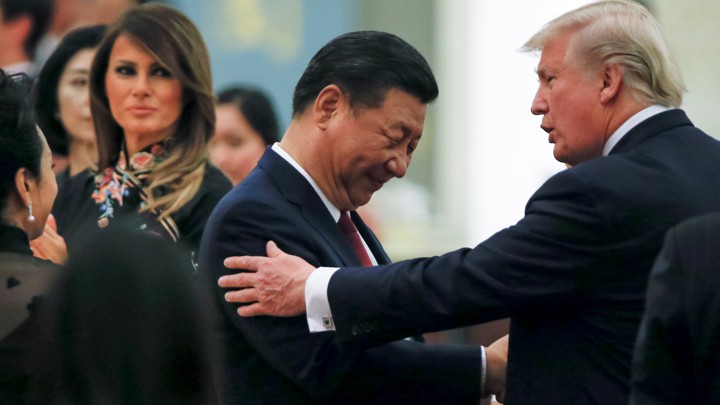 Chinese dictatorXi Jinping and Trump shake hands, on November 9, 2017.
In 2000, Congress made the fateful decision to extend “permanent normal trade relations,” or PNTR, to China.
As the economists Justin Pierce and Peter Schott have argued, the permanence of PNTR status made an enormous difference: Without PNTR, there was always a danger that China’s favorable access to the U.S. market would be revoked, which in turn deterred U.S. firms from increasing their reliance on Chinese suppliers.
With PNTR in hand, the floodgates of investment were opened, and U.S. multinationals worked hand in glove with Beijing to create new China-centric supply chains.
The age of “Chimerica” had begun.
PNTR was a euphemism designed to get around the fact that the traditional term for “normal trade relations” was “most-favored-nation” (MFN) tariff status, which basically meant a plain-vanilla relationship.
PNTR was a euphemism designed to get around the fact that the traditional term for “normal trade relations” was “most-favored-nation” (MFN) tariff status, which basically meant a plain-vanilla relationship.
A country could enter into a preferential trade agreement such as NAFTA, the accord between the United States, Mexico, and Canada—say, plain vanilla with chocolate sprinkles on top.
But short of that, MFN status meant imports would be treated as favorably as those arriving from “the most favored nation.”
Absurd as it might sound, this linguistic convention had meaningful political consequences.
To argue that we ought to have normal trade relations with China was one thing.
Sure, why not?
To make the case that China ought to be treated as our most favored nation was a more vexing PR challenge, not least in the wake of the brutal crackdown that followed the Tiananmen Square protests in 1989.
Under the Trade Act of 1974, China was designated, alongside the Soviet Union and other socialist states, a non-market economy.
Under the Trade Act of 1974, China was designated, alongside the Soviet Union and other socialist states, a non-market economy.
As such, it could only be granted MFN status under certain preconditions.
In 1980, as relations between the two countries thawed, the U.S. conditionally granted China MFN status.
That status, however, had to be renewed annually, which gave China’s critics in Congress an annual opportunity to question the wisdom of doing so.
Throughout the 1980s and 1990s, an alliance of economic nationalists, human-rights activists, and anti-communists sought to deny China MFN status every year.
And every year that alliance was defeated by those who insisted that by opening the American economy to Chinese imports, the United States would gently nudge Beijing towards economic liberalism, multiparty democracy, and a rejection of hegemonic designs—predictions that haven’t been borne out.
One could argue that the final defeat for China trade hawks came not in 2000, when Congress actually passed PNTR for China, but in 1998, when lawmakers decreed that most-favored-nation status would henceforth be known as “normal trade relations.”
One could argue that the final defeat for China trade hawks came not in 2000, when Congress actually passed PNTR for China, but in 1998, when lawmakers decreed that most-favored-nation status would henceforth be known as “normal trade relations.”
Once China finally secured its anodyne-sounding PNTR status, which in turn greased the wheels for its accession to the World Trade Organization, it wasn’t long before its economy became irrevocably intertwined with that of the U.S.
Never let it be said that language doesn’t matter.
I thought of the old PNTR debate in light of two recent developments.
I thought of the old PNTR debate in light of two recent developments.
The first, of course, is Donald Trump’s ongoing effort to strong-arm the Chinese government into importing more U.S. goods and services, with an eye towards reducing America’s bilateral trade deficit.
For now, I’ll simply say that if Trump’s aim has been to discredit the cause of combating Chinese mercantilism, a cause to which I am favorably disposed, he couldn’t have done a better job.
But in fairness to the president, his economic diplomacy has been greatly complicated by the legacy of PNTR.
U.S. multinationals have invested billions of dollars in the expectation that trans-Pacific trade will never face serious disruption.
So while China’s corporate sector is invested in Beijing’s success in its latest round of brinksmanship, corporate America’s loyalties are divided.
Even if Trump were pursuing a perfectly-crafted strategy for compelling China to end its trade abuses, that would be a difficult obstacle to overcome.
The second development, which has garnered far less attention, is the spate of recent reports on China’s intensifying repression of its Uighur minority.
The second development, which has garnered far less attention, is the spate of recent reports on China’s intensifying repression of its Uighur minority.
For decades, China’s central government has sought to strengthen its hold on its western territories by, among other things, encouraging the large-scale settlement of members of its Han ethnic majority in East Turkestan, homeland of the mostly Muslim Uighurs, and Tibet, with its distinctive ethno-religious heritage.
While the fate of Tibet was once a cause célèbre, that of the Uighurs has never garnered much attention in the wider world.
This partly reflects the extraordinary success of China’s repressive apparatus, which layers mass surveillance, mass incarceration, outright censorship, and artful media manipulation to greatly limit the flow of news and information out of East Turkestan.
Yet it is also an indirect product of PNTR.
Yet it is also an indirect product of PNTR.
The annual battles over whether or not China merited MFN status naturally brought human rights issues to the fore, and gave voice to champions of the Tibetans and other marginalized, and savagely brutalized, minorities.
The deepening of economic ties that followed PNTR had the opposite effect—rather than draw attention to all the reasons the U.S. might want to be wary of further entanglement with China, it greatly enriched those who profited from that entanglement.
Soon research universities across the U.S. were receiving large infusions of capital from investors and entrepreneurs who were deeply interested in preserving amicable relations with China, not to mention a steady and lucrative stream of fee-paying students, many of whom were the scions of China’s nouveau-riche.
Aspirational mothers and fathers are keen to teach their kids Mandarin, so certain are they that it is the language of the future.
The Free Tibet T-shirts that were ubiquitous on college campuses in the 1990s, when debates over PNTR were especially fierce, are now nowhere to be seen.
That the Uighur cause has attracted little American interest is par for the course.
Calling for a boycott of Israel is, for campus activists of a certain stripe, practically de rigeur.
Boycotting China, in contrast, verges on the unthinkable.
For one, it would require feats of self-denial that no red-blooded American consumer could hope to endure.
What might the world have looked like had the U.S. never granted PNTR to China?
What might the world have looked like had the U.S. never granted PNTR to China?
One possibility is that China would have pursued an economic strategy built around fostering indigenous entrepreneurship and bettering the lives of its own workers, as it did in the 1980s.
Instead, Beijing chose to transfer wealth from ordinary Chinese citizens to its politically powerful export sector, a path made possible by PNTR.
China might very well have become just as rich by embracing a more balanced and humane approach to development.
Doing so, however, would have required that its central government surrender a measure of control to its citizens.
Rather than foster liberalism and openness in China, PNTR did exactly the opposite—creating the conditions for China’s central government to exert tighter control over the Chinese populace.
The United States, meanwhile, would have entered the age of globalization under markedly different terms: Instead of offshoring much of its industrial base to an often-hostile authoritarian power, perhaps it would have deepened its economic ties to democratizing states in Latin America, Asia, and the wider world.
The United States, meanwhile, would have entered the age of globalization under markedly different terms: Instead of offshoring much of its industrial base to an often-hostile authoritarian power, perhaps it would have deepened its economic ties to democratizing states in Latin America, Asia, and the wider world.
Trade with China would have proceeded apace, to be sure, but U.S. multinationals wouldn’t have felt quite as secure in locating production facilities in one of the world’s last remaining communist dictatorships, which sees economic development as a weapon in its struggle for power and influence.
There is no going back.
There is no going back.
We can’t rewrite history.
A bipartisan coalition promised Americans that granting China PNTR would help ensure our prosperity and that China would soon be transformed from foe to friend, and we were foolish enough to believe them.
The question is what we should do now.
For starters, I propose admitting that we made a fatal mistake.

