Affichage des articles dont le libellé est Ren Zhengfei. Afficher tous les articles

mercredi 29 mai 2019

Criminal Company

How Huawei became America’s enemy No. 1
By Tripti Lahiri & Mary Hui
Since it was founded by former People’s Liberation Army engineer Ren Zhengfei in 1987, Huawei has grown to become the world’s top provider of telecom equipment, with over $100 billion in revenue and 180,000 global employees. 
That extraordinary success has come with barely a footprint in the US market, where the company has been a target for anxiety about Chinese hacking since the 2000s. 
Today, Huawei is the poster child for that anxiety, and finds itself in the eye of a global storm.
Huawei’s troubles in the US started early: It was met with with suspicion not long after it started competing with US router firms in the aughts, and kept hitting snags after that. 
In 2003, networking firm Cisco accused Huawei of intellectual property theft
In 2008, a deal with 3Com collapsed over concerns about Huawei’s ties in China. 
In 2014, T-Mobile sued Huawei for stealing, among other technology, part of a robot’s arm.
But in 2017, US president Donald Trump took office, and since then actions against Huawei have come fast and furious. 
On May 15, Trump signed an executive order that effectively bans Huawei from accessing US supply chains, his strongest action yet against the company. 
Less than a week later, Google pulled Huawei’s Android license—after a grace period allowed by the Trump administration for current users, the company’s future phones will be cut off from the most widely used operating system in the world and the Google universe. 
Suppliers from Britain, such as chip maker ARM, are set to follow Google’s lead.
Trump’s endgame is still unclear. 
Is the only safe Huawei a “dead” Huawei? 
Or is this another gambit in his ongoing trade negotiations with China? 
It may be too soon to tell: On May 23, Trump called Huawei “very dangerous” but also said the dispute might be resolved a trade deal.
What is clear is that this showdown has been a long time coming.

2001
Huawei, then a 14-year-old company with sales of $3 billion, sets up offices in the US (pdf). It also opens its first office in Britain.

2003
January: Router-maker Cisco sues Huawei for copyright violations, alleging its source code turned up in Huawei products. It later drops the suit.
November: Huawei’s joint venture with California-based networking company 3Com to make and sell routers and switches begins operations.

2005
The idea that Huawei is linked to the Chinese military surfaces prominently in a Rand Corporation report commissioned by the US Air Force. 
The think tank notes that major IT players like Huawei appear to be private-sector actors (pdf, pages 217-8), but “many of these electronics companies are the public face for, sprang from, or are significantly engaged in joint research with state research institutes.” 
It adds:
Huawei maintains deep ties with the Chinese military, which serves a multi-faceted role as an important customer, as well as Huawei’s political patron and research and development partner.
The report also says sales linked to the Chinese military could be anywhere from less than 1% of Huawei’s revenues to as high at 6%. 

2007
In July, the FBI interviews Huawei’s founder, Ren, in relation to violations of US trade sanctions on Iran.

2008
Huawei’s efforts to take a 16% stake in 3Com collapse amid lawmakers concerns (paywall) about Huawei’s ties to the Chinese military, forcing Huawei and its partner in the acquisition to abandon the bid. 
3Com was a provider of anti-hacking software for the US military, among other contracts. Lawmakers cited the 2005 Rand report.
2009
February: At Barcelona’s Mobile World Congress, Huawei releases its first Android smartphone, under license from Google.
October: Huawei hires an American, Matt Bross, from British Telecom to be its CTO, and to help it make a real foray into the US market. 
Bross apparently runs operations from his basement in St. Louis
“I am looking to create an environment where we can grow trust,” he tells Bloomberg in 2011. 
“The fact of the matter is that Huawei is here to stay.” (He leaves Huawei in 2012.)
November: Huawei signs a lease in Plano, Texas, for 100,000 square feet of office space for its North America sales and marketing headquarters. 
“We are honored that Huawei will grow and prosper in Plano for years to come,” the town’s mayor says in a statement.
2010
July: Phone-maker Motorola files a lawsuit accusing Huawei of corporate espionage, but later settles with the company.
November: Citing security concerns, Sprint excludes Huawei (paywall), as well as Chinese telecom ZTE, from bidding for a contract worth hundreds of millions of dollars to modernize its network. Huawei had been hoping this would be its first major US equipment contract win.
2011
February: The Committee on Foreign Investment in the United States tells Huawei to sell (paywall) the assets of bankrupt startup 3Leaf Systems, which it had acquired the previous year. 
Huawei says it didn’t flag the deal to CFIUS because it had only bought some of 3Leaf’s assets, but the panel decides to engage in a retroactive review.
April: Huawei opens a 200,000-square-foot R&D facility in Silicon Valley. 
It continues to grow revenue from equipment sales to mid-tier telecoms in remote areas of the US.
2012
October: A House committee issues a 52-page report (pdf) warning against using equipment from Huawei and ZTE. 
The report states:
In sum, the Committee finds that the companies failed to provide evidence that would satisfy any fair and full investigation. 
Although this alone does not prove wrongdoing, it factors into the Committee’s conclusions below.
Further, this report contains a classified annex, which also adds to the Committee’s concerns about the risk to the United States. 
The investigation concludes that the risks associated with Huawei’s and ZTE’s provision of equipment to U.S. critical infrastructure could undermine core U.S. national-security interests.


2013
Reuters reports that a Hong Kong-based company that tried to sell US computer equipment to Iran’s largest cellphone carrier, in violation of US trade sanctions, is closely linked to Huawei
The story says that Ren Zhengfei’s daughter Meng Wanzhou, “a rising star” at Huawei, served on the board of the Hong Kong firm, among other links.
2014
March: The New York Times reports (paywall) that the NSA infiltrated the servers in Huawei’s Shenzhen headquarters, obtaining sensitive information about its giant routers and complex digital switches, and monitoring the communications of top executives.
September: T-Mobile files a lawsuit against Huawei, accusing it of stealing technology, including part of a robot’s arm, from its headquarters. 
Huawei workers spied on and stole part of Tappy, a robot developed by T-Mobile in 2006 to test smartphones. 
Huawei admits that two of its employees had acted "inappropriately".
2015
January: Speaking at the World Economic Forum in Davos, Switzerland, Huawei founder Ren seeks to play down his connection with the Chinese army, saying it was “quite by chance” that he entered the military. 
“We are a Chinese company,” Ren says. 
“Of course we support the Chinese Communist Party and love our country. We comply with the laws of every country we operate in.”
September: Huawei and Google join forces (paywall) to make the Nexus 6p phone.

2016
June: The US Commerce department issues a subpoena (paywall) to Huawei as part of a probe into whether the company violated US export controls on the export or re-export of American technology to Cuba, North Korea, Syria, and Sudan over the previous five years.
December: The Treasury department gets involved with the investigation (paywall) and issues its own subpoena. 
The subpoena comes shortly after the US government restricts sales of American technology to ZTE, saying the Chinese phone-maker violated sanctions against Iran. 
US officials also release internal ZTE documents detailing how the company managed to do business with Iran, and how it modeled its approach off of a rival’s efforts in that country. 
The rival company is not named in the documents, but its description matches Huawei (paywall).
2017
A Seattle jury rules in favor of T-Mobile in its case against Huawei, determining that the latter misappropriated T-Mobile’s trade secrets, and breached a handset-supply contract between the two companies that stipulated each would protect secrets learned through their partnership. 
The jury awards T-Mobile $4.8 million in damages for the breach of contract, but does not award damages for T-Mobile’s trade-secrets claim.
2018
January: AT&T, America’s second-largest wireless carrier, is on the verge of becoming the first carrier in the US to offer Huawei’s handsets, which would be a major breakthrough. 
But it abandons the plan after lawmakers and federal regulators lobby against the idea
Concerns around Huawei deepen as the rollout of next-generation wireless technology approaches; a leaked White House memo on 5G names the company a strategic threat
Lawmakers want AT&T to cut all commercial ties with Huawei, ending their collaboration on 5G network standards.
April: Huawei lets go of several US staff (paywall), including its vice president of external affairs, William Plummer, a Nokia veteran who joined Huawei in 2010. 
Plummer goes on to detail the company’s (and some of his own) PR missteps in a memoir called Huidu.
May: The Pentagon bans the sale of Huawei and ZTE phones in stores on military bases over concerns that the Chinese government could order the companies to track soldiers’ movements or spy on their communications.
August: The National Defense Authorization Act, which includes language barring government agencies from buying equipment or services from Huawei and ZTE, goes into effect.
October: Two leading US lawmakers—Mark Warner, a Virginia Democrat, and Marco Rubio, a Florida Republican—urge Canadian prime minister Justin Trudeau to bar Huawei from helping build its 5G networks, saying it could pose dangers for US networks. 
The call is part of a broader US effort to get foreign allies to shun Huawei, the Wall Street Journal later reports (paywall), warning the UK, for example, it could be forced to cut off intelligence sharing
In November, New Zealand bans Huawei from supplying technology to the country’s 5G rollout, following in the steps of Australia earlier in the year.
December: Huawei’s chief financial officer and the daughter of its founder, Meng Wanzhou, is arrested in Canada at the request of US law enforcement on suspicion of violating trade sanctions on Iran. 
The arrest is seen as a serious escalation of US action against Huawei. 
Trump is criticized for suggesting he could intervene in the Justice Department case against her if it would help secure a trade deal from China. 

2019
January: The US files criminal charges against Huawei, slamming it with two dozen allegations that include conspiring to evade US trade sanctions and steal trade secrets, and also formally seeks Meng’s extradition from Canada. 
Meanwhile, Poland arrests a Huawei employee on allegations of spying for China. 
May 15: Trump signs an executive order banning US telecommunications firms from using the equipment of “foreign adversaries.” 
The order does not name Huawei, but effectively blacklists the company and cuts it off from US supply chains. 
Days later, Google makes a shock announcement that it will terminate Huawei’s license to the Android OS, which powers 86% of the world’s phones and all of the phones sold by Huawei. 
Huawei says it’s developing its own OS, but being cut off from Google’s email and app universe would drastically reduce its appeal overseas. 
Already, mobile carriers are holding off on Huawei 5G phone sales (paywall).
May 20: The restrictions are temporarily eased: The Commerce Department says it will allow Huawei to buy US goods through Aug. 19. 
But that same day, top US chip companies including Intel and Qualcomm cut off vital Huawei supplies, while Microsoft is also said to have stopped taking software orders from the firm.
This month’s moves present the most serious threats yet to Huawei’s future.

mercredi 23 janvier 2019

Rogue Company

U.S. Will Ask Canada to Extradite Huawei Executive
By Edward Wong, Katie Benner and Alan Rappeport

Meng Wanzhou, the chief financial officer of Huawei, arriving last month at a parole office in Vancouver. American officials are expected to ask Canada within a week to extradite Meng to the United States to face charges related to violating Iran sanctions.

WASHINGTON — The United States plans to formally request within a week that Canada extradite a top Huawei executive to stand trial for charges related to violating American sanctions on Iran.
American officials say they will seek to have Meng Wanzhou, the chief financial officer of the Chinese telecom firm Huawei who was detained in Canada on Dec. 1, sent to the United States. 
They have until Jan. 30 to make the request.
“We will continue to pursue the extradition of defendant Meng Wanzhou, and will meet all deadlines set by the U.S.-Canada Extradition Treaty,” Marc Raimondi, a Justice Department spokesman, said in a statement. 
“We greatly appreciate Canada’s continuing support in our mutual efforts to enforce the rule of law.”
The United States’ request would come as American and Chinese officials kick off a critical round of trade talks next week aimed at resolving a dispute that is causing great economic damage in China.
The talks are expected to begin Jan. 30 in Washington, when a delegation led by Liu He, China’s top trade negotiator, meets with Treasury Secretary Steven Mnuchin and Robert Lighthizer, the United States trade representative.
American and Chinese officials have tried to portray the arrest of Meng as separate from the trade talks, which are taking place against a March 2 deadline set by President Trump and Xi Jinping.
But the Trump administration has increasingly mixed talk of national security concerns related to Chinese businesses with its positions on trade. 
And American officials have tried to crack down on certain activities by Chinese telecom firms like Huawei, which is aiming to build next-generation cellular and data networks in countries worldwide.
China has already expressed alarm about the detention of Meng, a Chinese citizen and a daughter of the founder of Huawei, whose arrest set off a diplomatic crisis involving the United States, Canada and China. 
Meng is currently living with her family at one of her homes in Vancouver. 
In December, a Canadian court ruled that Meng would not have to be held in jail, but said that the authorities could closely monitor her, and that certain parts of Vancouver were off limits.
A senior official with Global Affairs, the Canadian Foreign Ministry, said the Canadian government expects the United States to proceed with the request to have her brought to the United States to face charges that she lied to American banks about Huawei’s efforts to evade Iran sanctions. 
Meng was arrested Dec. 1 in a Vancouver airport as she was stopping over between China and Latin America, and the treaty says the United States must make a formal extradition request within 60 days of an arrest.
Once Canada gets the request, the process would move to the Canadian courts, which would determine whether Meng could be extradited. 
If they say yes, the minister of justice makes the final determination. 
The Canadian official said the process could take months or years because the first decision by a court can be appealed to a higher court.
A spokesman for Canada’s Justice Department said Tuesday night that the British Columbia Supreme Court had scheduled a hearing for Feb. 6 to confirm that the United States had made a formal extradition request by the deadline.
The Chinese Ministry of Foreign Affairs indicated Tuesday that Meng’s fate would be taken into consideration as the trade talks proceed. 
While American officials insist that Meng’s case is not a consideration in the trade negotiations, Trump suggested in December that he could intervene in the matter if it would help close a trade deal.
Trump administration officials have increasingly cautioned that a resolution to the tit-for-tat trade war will be hard to reach.
“I acknowledge the degree of difficulty,” Larry Kudlow, the director of the White House National Economic Council, said on Tuesday, referring to the magnitude of the structural changes that the United States is demanding from China. 
“At the end of the day, it has to be in America’s interest.”
Members of the United States national security community say there is a risk that Meng’s fate becomes entangled with trade considerations.
“Given previous reporting, at any moment, the administration could decide that extracting a trade concession is more important to U.S. national interests than the prosecution of this individual,” said David Laufman, a Washington lawyer who served as chief of the Justice Department’s counterintelligence and export control section. 
Laufman declined to comment on the specifics of the case.
The arrest of Meng followed a yearslong investigation by Justice Department officials in Brooklyn looking at whether a company tied to Huawei did business in Iran in a way that violated sanctions, and whether Meng lied to American banks about Huawei’s connections to the smaller company, Skycom
Justice Department officials aim to charge Meng with fraud.
Chinese officials say the arrest of Meng was based on political motivations and are linked to a broader Trump administration campaign against Huawei.
The United States has been urging other countries to prevent Huawei from building their networks, citing security concerns that the company poses. 
American officials frequently point out that the founder of Huawei and Meng’s father, Ren Zhengfei, was a soldier decades ago in the People’s Liberation Army. 
Some American allies, foremost among them Australia, have voiced similar security warnings about Huawei.
Days after Meng’s arrest, Chinese security officers separately detained two Canadian men, Michael Kovrig and Michael Spavor, in northern China. 
Mr. Kovrig is a diplomat on leave and a researcher for the International Crisis Group, and Mr. Spavor is an entrepreneur who has organized tours to North Korea. 
Chinese officials have said security officers are investigating the men on potential national security charges. 
Canada has said the arrests were arbitrary, and analysts say it is clear the men were detained as hostages to trade for Meng.
On Monday, more than 100 academics and former diplomats issued an open letter calling on China to free the men immediately.
Last week, a Chinese court sentenced to death Robert Lloyd Schellenberg, a Canadian man convicted of drug smuggling, further raising tensions.
On Monday, The Globe and Mail, a newspaper in Toronto, published an article in which David MacNaughton, the Canadian ambassador to the United States, said American officials would proceed with the extradition request.
Chrystia Freeland, the foreign minister of Canada, has said repeatedly that Canadian courts would make decisions based purely on legal considerations and not on politics. 
Ms. Freeland stressed that approach after Trump told Reuters in an interview in December that he could stop the extradition of Meng if China offered sufficient concessions in continuing negotiations aimed at ending a costly trade war between the United States and China that has dragged on since Mr. Trump started it last summer.

mercredi 19 décembre 2018

The Fate of Huawei Foreshadows the Fate of China

Both the United States and the European Union have introduced new policies aimed at keeping high-tech know-how out of evil Chinese hands
By MICHAEL SCHUMAN
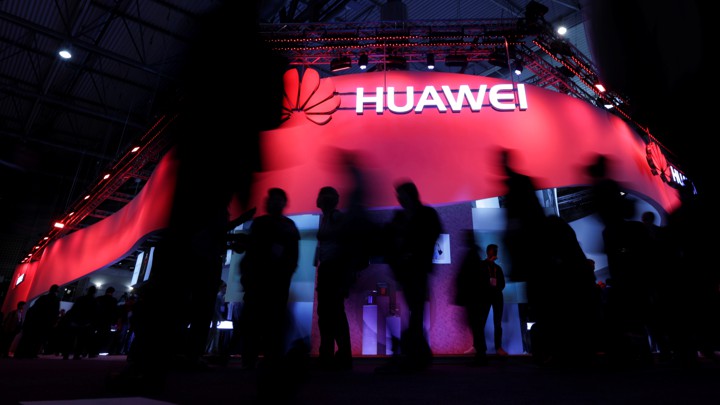
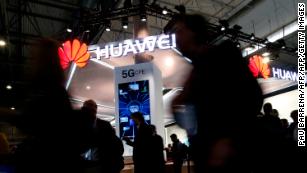
Visitors walk past a Huawei stand at the 2017 Mobile World Congress in Barcelona, Spain.
As Ken Hu, the “rotating” chairman at Huawei Technologies, made the case during a briefing in southern China that his company’s telecom equipment was trustworthy and above board, he did something mundane for many global executives, yet remarkable for the embattled Chinese giant: He took questions from foreign journalists.
Hu’s press conference on Tuesday was an all-too-rare attempt by Huawei’s top brass to engage with the world—and it comes at a critical moment. 
This month, Hu’s colleague and the company’s chief financial officer, Meng Wanzhou, was arrested in Canada, accused of misleading financial institutions to break U.S. sanctions on Iran
Meng’s arrest is the latest front in a multipronged standoff between Washington and Beijing, one that encompasses disputes over trade, intellectual property, naval lanes, and much else.
In that broader context, focusing on Huawei may appear, at first glance, to be a narrow lens. 
After all, the company makes telecom gear that its critics can buy elsewhere. 
But what happens to Huawei matters—for China and the world. 
One of Beijing’s top goals is transforming China into a technology powerhouse able to innovate and control the vital know-how powering future industries, and to free itself from, and then challenge, the United States. 
Huawei, as one of China’s most prominent global enterprises, will be a key part of that quest. 
Hence, its problems are China’s problems, and the fate of the company could foreshadow the fate of the country.
Huawei has always insisted that it has never had ties to the Chinese government or military. 
Still, its critics remain unconvinced. 
The suspicion that Huawei is a threat to American national security has become indelibly marked on the minds of many Americans. 
Sales of its major equipment in the United States have been stymied, its acquisitions of American assets have been blocked, and President Donald Trump’s administration, determined to defend American technology, has taken an especially hostile position on the company.
All of that, to a degree, is Huawei’s own fault. 
The problem starts with its mysterious corporate culture, which has left policy makers and security experts hazy about its background and intentions.
Huawei markets itself as a miracle of modern entrepreneurship, a rags-to-riches fairy tale of a regular guy who launched a business empire on hard work and chutzpah. 
In the company’s narrative, its founder, Ren Zhengfei, was a mere soldier-engineer who, after leaving the military, started Huawei in 1987 with no government connections, state aid, personal wealth, or experience in telecommunications. 
Somehow, despite this lack of expertise and resources, Ren managed to bring a complex technical system to market in a mere handful of years, an impressive achievement in what was then a decidedly low-tech China. 
Officially, the company is owned by its employees, who vote in their own management team. 
Ren, whom the company calls its “natural person shareholder,” controls only 1.4 percent of Huawei but has served as its chief executive for 30 years, and his daughter, the arrested Meng, now helps him run the company.
But Ren has done a miserable job of selling this extravagant myth.
As Huawei has risen to worldwide fame, he remains an enigma. 
Rarely appearing in public, he has made little effort to refute his critics or build confidence in himself and his company. 
Though other Huawei executives reach out to an international audience here and there—as Hu did on Tuesday—Ren mostly delegates the talking to lobbyists and public-relations officers.
On the rare occasions he has personally tried to influence public opinion, he seems to only reinforce his persona. 
In 2012, Ren met with members of a U.S. congressional committee, but they came away frustrated with incomplete answers and information. 
Based on how he responded to questions during a public interview at the World Economic Forum in 2015, it’s not hard to see why. 
Asked point-blank if his company had links to the Chinese government or military, Ren never offered the requisite, emphatic “No,” and broke into a roundabout response, saying: “There’s no need to exert ourselves to explain who we are.”
Eric Harwit, an Asian-studies professor at the University of Hawaii at Manoa and the author of the book China’s Telecommunications Revolution, argues that Huawei’s fortunes have been damaged by Ren’s inability to schmooze and sell.
“You need a Jack Ma who can stand up with Trump and shake hands, and Trump can say you’re a great guy,” Harwit said, referring to the effusive founder of the Chinese e-commerce firm Alibaba. “They don’t have a Jack Ma.”
Compounding Huawei’s woes is a history of suspicious behavior. 
American companies, including Cisco Systems, have accused Huawei of pilfering their intellectual property. 
Now comes the Meng case, which, according to Harwit, “puts Huawei in the headlines.”
“You jump from sanctions violations to what kind of company is Huawei overall,” he said. 
“Are they some kind of evil company that is doing the bidding of the Chinese government no matter what?”
With nearly $93 billion in revenues in 2017, Huawei has done business successfully with a wide range of countries. 
Yet distrust of Huawei is spreading. 
New Zealand and Australia recently barred it from providing the equipment for cutting-edge 5G cellular networks.
This widening concern about Huawei is representative of increasing wariness of China. 
The more assertive Beijing has become in pressing its diplomatic and economic goals—from its state-led ambitions to conquer world manufacturing to the sizable expansion of its military capabilities—the more threatening a rising China has appeared
Foreign governments are, in response, standing in China’s path. 
Both the United States and the European Union have introduced new policies to more carefully scrutinize foreign investments, an effort clearly aimed at keeping high-tech know-how out of Chinese hands. 
In Malaysia, Prime Minister Mahathir Mohamad recently halted high-profile infrastructure projects backed by Beijing while warning of a new “colonialism.”
In the Huawei case, American security experts fret that in China, where the distinction between state and society is, at best, blurred, intelligence services could and would exploit the company’s equipment, no matter what its executives promise. 
“Most of it is a China problem, and it’s gotten worse,” William Reinsch, a senior adviser in international business at the Center for Strategic and International Studies in Washington, D.C., said of Huawei’s issues. 
“If Huawei was an Indian company, I think that the attitude toward it would be very different.”
Thus China and Huawei are in a reinforcing loop of escalating distrust. 
The difficulties the company is facing in the United States and elsewhere should be a signal to Beijing’s top leadership that it needs to do more to ease fears about its ascent and ambitions. 
If not, both could find doors closing that they badly need open.
At the two-hour-long press conference at the company’s campus in Dongguan, Hu declined to comment on Meng’s legal situation, instead arguing that Huawei’s sales figures offered proof of how much its customers trusted it. 
Still, even at the briefing, the company could stomach only so much openness. 
Though television correspondents were invited, their cameras were not.
It was probably too little, too late anyway.
“They made a huge foray a while back to try to change their image here and it didn’t work,” Reinsch noted, referring to a past Huawei public-relations effort. 
Now, he added, “I don’t think it is possible.”

jeudi 6 décembre 2018

Pariah Company

Huawei CFO Meng Wanzhou arrested in Canada, faces extradition to United States
By Julia Horowitz
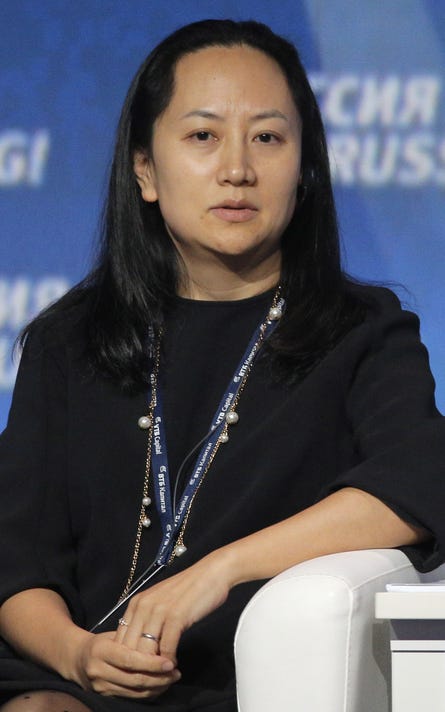
Meng Wanzhou, CFO of Huawei

New York -- The chief financial officer of Chinese tech giant Huawei has been arrested in Canada. 
She faces extradition to the United States.
Meng Wanzhou, also known as Sabrina Meng and Cathy Meng, was apprehended in Vancouver on December 1, according to Canadian Justice Department spokesman Ian McLeod
In addition to her role as CFO, Meng serves as deputy chairwoman of Huawei's board. 
She's the daughter of Huawei founder Ren Zhengfei.
Meng "is sought for extradition by the United States, and a bail hearing has been set for Friday," McLeod said in a statement, which was first reported by The Globe and Mail.
McLeod said the Canadian Justice Department can't share details of the case. 
Meng was granted a publication ban after a judge agreed to bar both police and prosecutors from releasing information about the case.
A Huawei spokesperson said Meng was detained by Canadian authorities on behalf of the United States when she was transferring flights in Canada. 
Huawei said she faces unspecified charges in the Eastern District of New York. 
The Wall Street Journal reported in April that the US Justice Department was investigating whether Huawei violated US sanctions on Iran.
The US Justice Department declined to comment Wednesday.
China's Ministry of Foreign Affairs on Thursday called for Meng to be released and urged the United States and Canada to explain why she had been detained.
The Chinese company, which sells smartphones and telecommunications equipment around the world, has been facing increased scrutiny in the United States and other countries, where officials have warned of national security risks from using Huawei products. 
The United States is concerned that the Chinese government is using Huawei's networking technology to spy on Americans.
Huawei's 5G ambitions suffer another big setback

Senator Ben Sasse, a Republican from Nebraska, said Americans are grateful to Canadian authorities for arresting Meng.
"Chinese aggression is explicitly state-sponsored and sometimes it's laundered through many of Beijing's so-called 'private' sector entities that are in bed with Xi's communist party," he said.
Senator Chris Van Hollen — a Democrat from Maryland — said Chinese telecommunications companies represent a fundamental risk to American national security.
"We need a comprehensive plan to hold the Chinese and their state-sponsored entities accountable for gross violations of the law and threats to our security," he said.
The Pentagon in May ordered stores on American military bases to stop selling smartphones made by Huawei and Chinese rival ZTE. 
And in February, top officials from the CIA, NSA, FBI and the Defense Intelligence Agency told a Senate committee that those firms' smartphones posed a security threat to American customers.
New Zealand prevents mobile carrier from buying Huawei 5G tech over security fears

The Trump administration launched an extraordinary campaign, urging America's allies to stop using Huawei telecommunications equipment because the Chinese company poses a security threat, according to the Wall Street Journal
Over the past several weeks, New Zealand and Australia have prevented telecommunications companies from using Huawei equipment for their 5G mobile networks.
UK telecom company BT (BT) said Wednesday that it would not buy equipment from the Chinese tech company for the core of its next generation wireless network. 
The company also said it would remove existing Huawei technology from the heart of its 4G network within two years.
China's ZTE also faced accusations of illegal dealings with Iran. 
In April, the United States blocked ZTE from buying US parts because ZTE had lied to US officials about punishing employees who violated US sanctions against North Korea and Iran. 
But the Trump administration lifted the export ban on ZTE in July after striking a deal with the company.

Rogue Company

The Trouble With Huawei Will Spread
By Jacky Wong


Rogue female: Huawei's Meng Wanzhou

Just when Chinese were hoping to take a breather following the weekend’s trade truce between the U.S. and China, the arrest of Chinese telecom-equipment company Huawei’s chief financial officer at the behest of the American authorities has served a warning that they shouldn’t get too complacent.
Sabrina Meng Wanzhou, who is also the daughter and successor of Huawei’s founder Ren Zhengfei, was arrested Saturday in Canada in connection with the company’s violation of Iran sanctions
It is unclear whether Washington plans to take further action against Huawei. 
But the U.S. has effectively barred major carriers from using Huawei and has launched a campaign to persuade its allies to do the same
Australia, New Zealand and Britain’s BT Group have heeded the call so far.

Huawei’s headquarters in Shenzhen. 

What happened to ZTE, Huawei’s Chinese peer, could offer a taste of what comes next. 
The Trump administration banned American companies from selling to ZTE in April due to its violations of sanctions against Iran and North Korea, a move that could have killed the company given the difficulty of sourcing crucial components from elsewhere. 
The U.S. later lifted the restriction, but ZTE’s Hong Kong-listed stock is still around 40% lower than where it traded before the ban. 
Huawei isn’t listed, but its suppliers in Asia are already taking a hit: Lens-maker Sunny Optical dropped 5% Thursday while optical-component manufacturer Accelink Technologies fell 8%, with investors assuming more moves against rogue Huawei are coming.
The bad news could now spread to small American suppliers to Huawei
Optical component maker Neophotonics, for example, generates almost half its revenue from the Chinese company, according to Goldman Sachs. 
Other U.S.-listed companies such as Lumentum, Oclaro, Qorvo and Finisar have around 10% of their revenue tied to Huawei, the bank estimates.
Bigger players could get hit too. 
Chip makers Qualcomm and Broadcom , which are already grappling with the global smartphone sales slowdown, are the most likely victims
While both generate only around 5%-6% of annual revenue from Huawei directly, that number rises to over 50% when broadened to all Chinese companies.
No matter which country wins the technological battle in the end, those companies that have hitherto benefited from rogue Chinese companies will be the biggest losers.

lundi 4 décembre 2017

Tech Quisling

Cook Kisses the Ring
By Tim Culpan

Tim Cook is desperate to hold onto any remaining scraps of the China market. 
That's a boon for the country's model for the internet, and the local players who dominate.
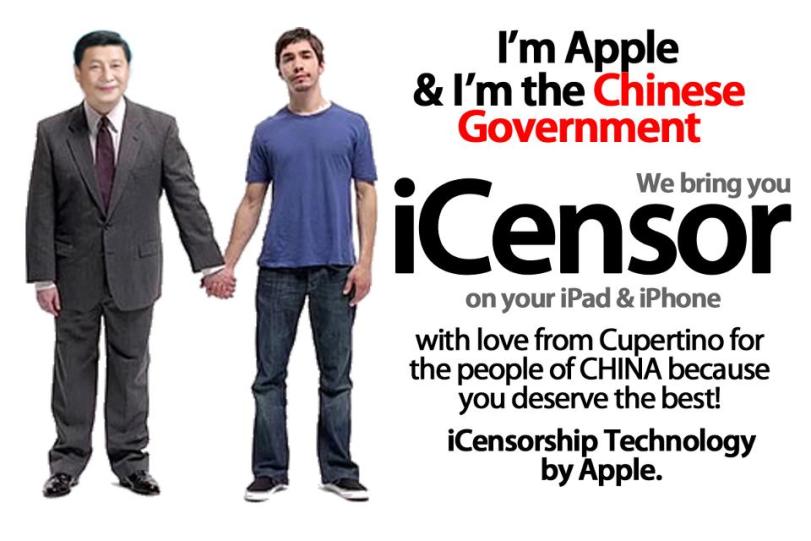
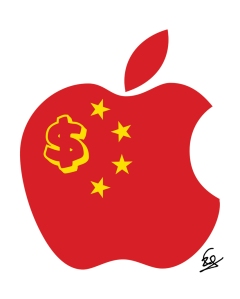
The Apple Inc. CEO, who last year stood up to the U.S. Federal Bureau of Investigation, took to the stage at China's annual internet conference this past weekend to kiss the ring and give his seal of approval for the way the government there tightly controls the flow of information.
“The theme of this conference -- developing a digital economy for openness and shared benefits -- is a vision we at Apple share,” Cook said. 
“We are proud to have worked alongside many of our partners in China to help build a community that will join a common future in cyberspace."
Ren Zhengfei, Robin Li and Pony Ma ought to have been grinning like Cheshire cats. 
The chiefs of Huawei Technologies Co.1 , Baidu Inc. and Tencent Holdings Ltd. have been great beneficiaries of Chinese censorship. 
Restricting the flow of information, you see, has worked out to be a handy little tool of trade protectionism.


The three Chinese companies have not only embraced domestic rules but actively assisted in enforcing them. 
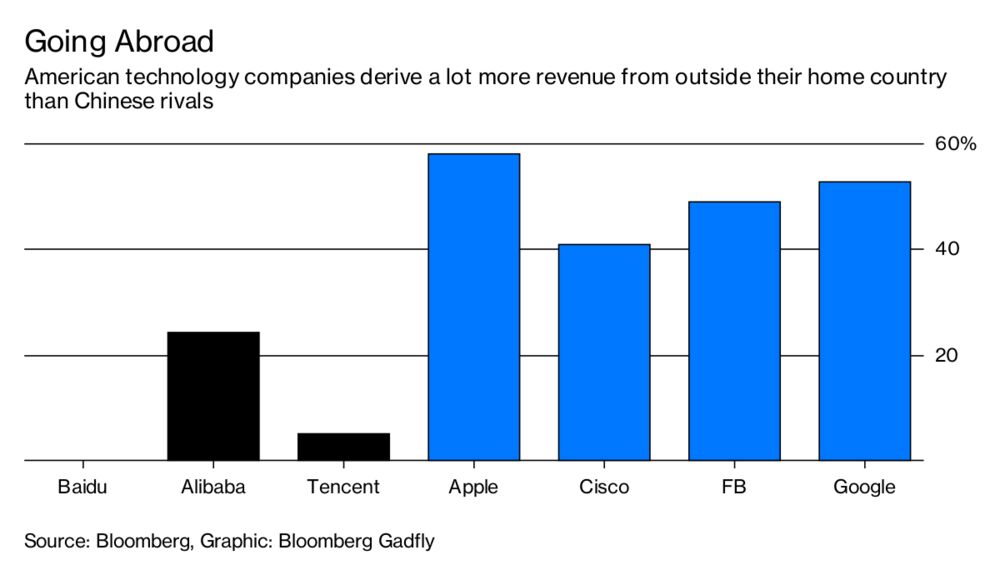
Google Inc., on the other hand, famously withdrew from China after it decided not to comply with censorship rules, Facebook Inc. has been restricted from the start, while Apple has faced formidable headwinds from government and semi-government agencies.
Openness, shared benefits, common future? Huh?
I wasn't at the speech, but footage does not show Cook's tongue in his cheek. 
It's irrelevant whether he believes the words that he spoke. 
What matters is that landing major overseas CEOs -- including Google's Sundar Pichai and Cisco Systems Inc.'s Chuck Robbins -- not only gave legitimacy to authorities, but sent a signal to domestic rivals that their turf is safe. 
There's no sign that Facebook founder Mark Zuckerberg attended the conference, but his embrace of The Chinese Way is well documented.

Take Baidu. 
Revenue and profit have rebounded this year despite its search business model facing existential threats ranging from regulation to changing user behavior. 
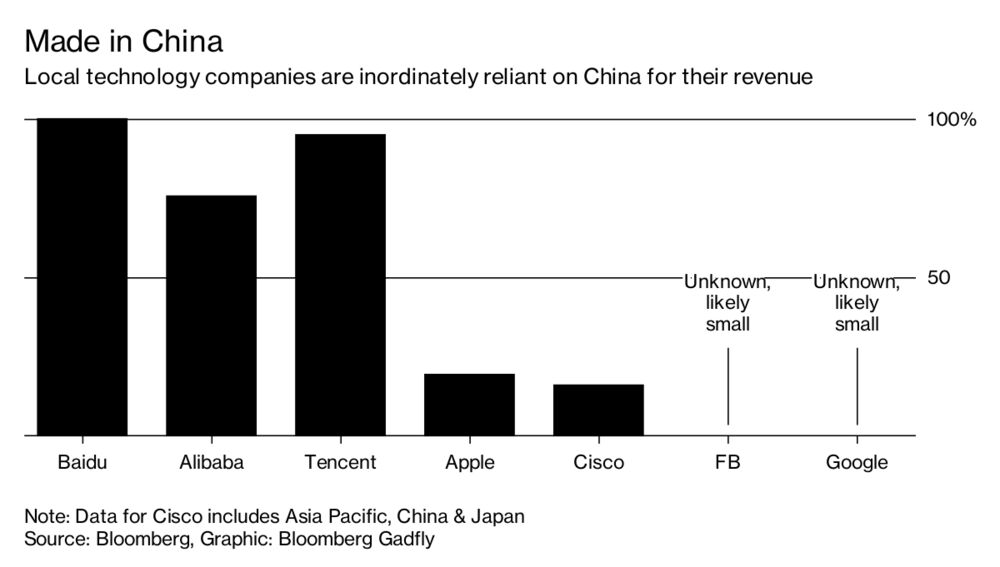
That's because Baidu faces no credible competition in China, and derives negligible revenue from overseas.
Huawei, whose Western competitors ought to include Apple and Cisco, not only has home ground advantage in China but gets favorable treatment from government-backed telcos for its equipment and handsets, and is probably a recipient of Chinese foreign aid that's channeled back into network infrastructure built by the company.
The greatest winner of all is Tencent. 
The social media giant has its tentacles throughout all aspects of Chinese culture, yet barely exists outside of the Great Firewall. 
And why should it? 
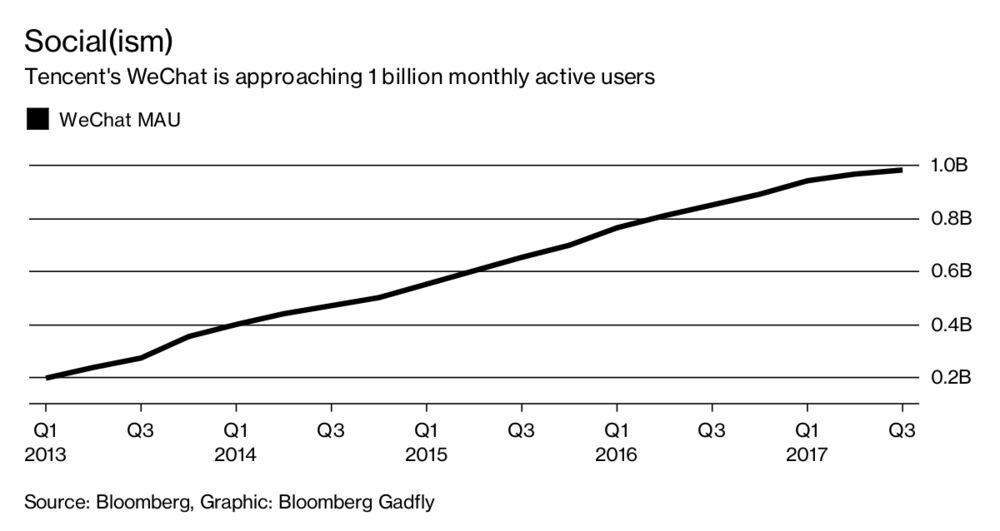
Although China may soon reach peak WeChat, the company is leveraging its user base by adding more services such as payments and ads -- safe in the knowledge that neither Facebook nor Google are coming anytime soon.

Google, Facebook and even Cisco could thrive even if they didn't bother too much with the world's second-largest economy. 
But Cook's Apple is a little different. 
Huawei is coming for it, and so too is ZTE Corp., not just in the U.S. but globally. 
Apple derives almost 60 percent of its revenue from outside its home country, including close to 20 percent from China.
That's why it's so notable that the chief of a U.S. devices maker agreed to deliver a keynote speech at a Chinese internet conference: Information may be restricted, but hardware still roams free. 
For now.

Note
1. While Ren's current title is deputy chairman of Huawei, he is the founder and probably still calls the shots.