Affichage des articles dont le libellé est prostitution. Afficher tous les articles

lundi 27 mai 2019

China's Human Trafficking

She Thought She’d Married a Rich Chinese Farmer. She Hadn’t.
By Salman Masood and Amy Qin
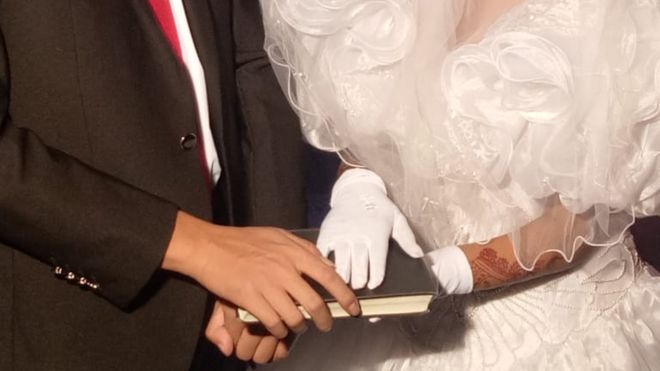
Rabia Kanwal and Zhang Shuchen were married in Islamabad in January. Eight days after they went to his home in China, she left to return to Pakistan.

ISLAMABAD, Pakistan — Rabia Kanwal’s parents were sure her marriage to a wealthy Chinese Muslim she had just met would give her a comfortable future, far from the hardships of their lives in Pakistan. 
But she had a premonition.
“I was not excited,” said Ms. Kanwal, 22, who lives in a poor neighborhood in the city of Gujranwala, in the eastern province of Punjab. 
“I felt something bad was going to happen.”
Arranged marriages are common in Pakistan, but this one was unusual. 
The groom, who said he was a rich poultry farmer, met Ms. Kanwal’s family during a monthslong stay on a tourist visa. 
He had to use a Chinese-Urdu translation app to communicate with them, but over all, he made a favorable impression.
Ms. Kanwal went through with the wedding. 
But upon moving to China with her new husband in February, she said, she was disappointed by what she found: He was a poor farmer, not a wealthy one. 
Far worse, he was not a Muslim. 
Within days, with the help of the Pakistani Embassy, she was back home and pursuing a divorce.
Hers was a relatively happy ending, though. 
In recent weeks, Pakistan has been rocked by charges that at least 150 women were brought to China as brides under false pretenses — not only lied to, but in some cases forced into prostitution. 
Others said they were made to work in bars and clubs, an unacceptable practice in Pakistan’s conservative Muslim culture.
At the same time, Ms. Kanwal’s story is not uncommon in China.
China has one of the most heavily skewed gender ratios in the world, with 106.3 men for every 100 women as of 2017, according to the World Bank. 
That tilt is a product of nearly three decades of strict enforcement of China’s one-child policy and a preference for boys over girls — a combination that caused an untold number of forced abortions and female infanticides.
But the long-term human costs of this gender imbalance have only recently come into view — and they are having an impact far beyond China’s borders.
As the boys of the one-child policy era have begun to reach marriage age, the demand for foreign brides like Ms. Kanwal has surged, even as the Chinese government has loosened birth restrictions.
The allegations of trafficking are a disturbing aspect of China’s growing presence in Pakistan, a longtime ally drawn closer lately by expanding economic ties — including China’s Belt and Road infrastructure project.
More Chinese are coming to Pakistan as laborers and investors. 
In the capital, Islamabad, shops and other businesses have begun catering specifically to them.
The Pakistani government has cracked down on brokers said to have arranged the marriages, arresting at least two dozen Chinese citizens and Pakistanis and charging them with human trafficking.
The Chinese Embassy denied that Pakistani brides were being mistreated in China.
But Human Rights Watch said last month that the trafficking allegations were “disturbingly similar” to past patterns in which women from other poor Asian countries — North Korea, Myanmar, Cambodia, Laos and Vietnam — were brought to China as brides and subjected to abuse.
“Both Pakistan and China should take seriously increasing evidence that Pakistani women and girls are at risk of sexual slavery,” the rights group’s China director, Sophie Richardson, wrote on its website.
Pakistani investigators said men in China paid the brokers to arrange marriages with local women, staying in rented houses in Pakistan until the weddings were performed. 
The men covered the costs of the ceremonies, and in some cases they paid the women’s families the equivalent of thousands of dollars, investigators said.
None of that is illegal in Pakistan. 
The human trafficking charges come from the allegations that women were forced into prostitution or brought to China under false pretenses. 
In some cases, investigators say, the men were provided with forged documents indicating that they were Muslim.
Other men sought out wives from Pakistan’s Christian minority, many of whom are impoverished and subjected to discrimination, investigators said. 
But virtually all of the women, Christian and Muslim alike, were drawn by the hope of better economic prospects.
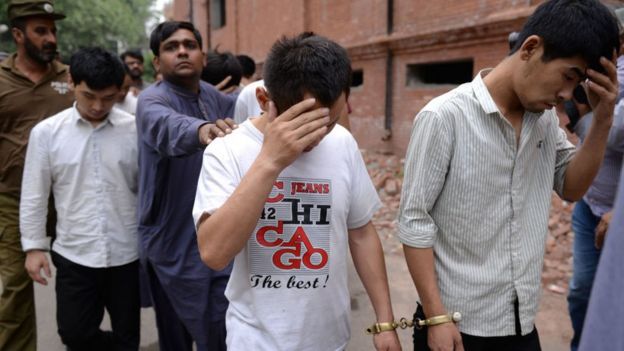
Chinese men arriving at a courthouse this month in Islamabad, after being charged with trafficking women to China.

“My parents said that our neighbor’s girls were happy in China, so I would be, too,” Ms. Kanwal said.
She said she met her husband at the marriage broker’s office in Islamabad, where there were many other Chinese men and Pakistani women. 
According to Ms. Kanwal, he told her family that he was Muslim and recited the first tenet of the Muslim faith, which every follower must know: “There is no God but God, and Muhammad is his prophet.”
But Ms. Kanwal never saw him pray, even when they visited the famous Faisal Mosque in Islamabad.
In February after the wedding, they flew to Urumqi, capital of the East Turkestan colony in western China. 
After a brief stopover there, they flew on to Henan Province in central China.
Then, after a four-hour drive past fields of wheat and corn, they arrived at Dongzhang village in Shandong Province, where she saw her husband’s duck farm. 
It was not the sprawling operation of a wealthy man that she had envisioned, but a modest family farm where he lived with his parents and two brothers.
“They were not even Muslim and he had faked it all along,” she said. 
“There weren’t even proper washrooms in their house. I got agitated and started crying.”
Her husband, Zhang Shuchen, 33, tells a different story.
Over a meal of cold-tossed pig liver and stir-fried tomato and egg near his family home in Dongzhang, the boyish farmer acknowledged that he had traveled to Pakistan late last year and paid around $14,500 to a Chinese broker in the hopes of bringing home a Pakistani bride.
It was his first visit to Pakistan, he said, and the poverty there reminded him of China in the 1980s and ’90s. 
When he first met Ms. Kanwal, he said, he liked her. 
But he said he was upfront with her that while he had converted to Islam on paper, he was not a true believer.
“I told her I wasn’t a Muslim,” Mr. Zhang said in an interview. 
He added that Ms. Kanwal had taught him the first principle of the Muslim faith.

Ms. Kanwal back in Gujranwala, her hometown. She said her stay in China was “horrible and beyond words.”

Ms. Kanwal later stood by her insistence that she did not know Mr. Zhang was not Muslim, and denied she had taught him the first principle.
Previously a logistics warehouse worker in southern China, Mr. Zhang said he now earned about $2,900 a month farming ducks, far more than the $180 or so that the average Chinese farmer made per month in 2018, according to China’s National Bureau of Statistics.
The New York Times was unable to independently verify Mr. Zhang’s income. 
But on a recent visit to the Zhang family home, a Times reporter found a newly built housing compound with multiple bedrooms and shiny tile floors.
Outside the family home, Mr. Zhang’s mother, who is in her 60s, recalled being puzzled by Ms. Kanwal’s reactions.
“She is religious, so when she came here I went out of my way not to give her any pork,” she said, as a small guard dog barked nearby. 
“I stir-fried chicken and made egg omelets for her. But no matter what I served her, she just refused to eat.”
Ms. Kanwal said the family locked her in a room for two days, trying to pressure her to stay. (Mr. Zhang denied the accusation.) 
She managed to email the Pakistani Embassy, whose staff connected her through to the Chinese police, who took her away and made arrangements with the embassy for her return to Pakistan.
Her stay in China lasted eight days. 
She said it was “horrible and beyond words.”
“I prayed daily for hours, asking God to take me safely back to my country, to my people,” Ms. Kanwal said. 
This month, she filed for divorce at a family court in Gujranwala, saying in her application that Mr. Zhang forced her into “immoral activities” and that she “would prefer to die instead of living with him.”
After news outlets in Pakistan reported the raids and the trafficking charges, the Chinese Embassy there said it supported the government’s efforts to combat crime. 
But it denied that Pakistani wives in China had been forced into prostitution or that their organs had been harvested.
Around the same time that Ms. Kanwal returned to Pakistan, the local marriage agency that many local men in the Dongzhang area had consulted for help in finding Pakistani wives was shuttered. 
But according to Mr. Zhang and other villagers in Dongzhang, there are still a number of Pakistani women in the area. 
Two Pakistani wives in a neighboring village are said to be pregnant.
“There are no girls here,” said Mr. Zhang’s mother, when asked why so many local men had gone to Pakistan to find wives. 
“We weren’t allowed to have more children, so everyone wanted boys.”

mercredi 15 mai 2019

China's human trafficking

The Pakistani women being trafficked to China
By Saher Baloch
Sophia (right) married a Chinese man after her pastor made introductions

The marriage between a local Christian woman and a Chinese Christian man six months ago in the eastern Pakistani city of Faisalabad had all the signs of a perfect match.
She was 19, he was 21.
She was a trained beautician, he a businessman selling cosmetics.
Her family didn't have much money but the groom generously offered to pay all the wedding expenses.
The proceedings took place in strict accordance with Pakistani customs. 
This pleased her parents, who felt that their daughter's new Chinese husband respected local traditions.
There was a formal proposal, followed by a henna ceremony, and finally the "baraat", where a procession arrives at the bride's house, vows are exchanged and the bride leaves to start a new life with her husband.
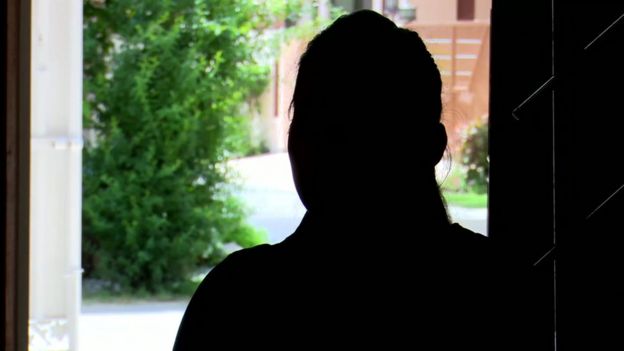
But within a month, the woman, who only wants to be known as Sophia to protect her identity, would be back at her parents' home. 
She escaped what she now believes was a racket to traffic Pakistani women into a life of sexual servitude in China.
Saleem Iqbal, a Christian human rights activist who has been tracking such marriages, said he believed at least 700 women, mostly Christian, had wed Chinese men in just over a year. 
What happens to many of these women is unknown but Human Rights Watch says they are "at risk of sexual slavery".
In recent weeks, more than two dozen Chinese nationals and local Pakistani middlemen, including at least one Catholic priest, were arrested in connection with sham marriages.
Pakistan's Federal Investigation Agency (FIA) told the BBC that "gangs of Chinese criminals are trafficking Pakistani women in the garb of marriage into the sex trade". 
It said one gang posed as engineers working on a power project while arranging weddings and sending women to China for fees ranging from $12,000 to $25,000 per woman.
Christian women -- who come from a mostly poor and marginalised community -- are seen to be particularly targeted by traffickers, who pay their parents hundreds or thousands of dollars.There are about 2.5 million Christians in Pakistan -- less than 2% of the population

China has denied that Pakistani women are being trafficked into prostitution.
But it admitted this week that there had been a surge in Pakistani brides applying for visas this year -- with 140 applications in the year to date, a similar amount to all of 2018. 
A official from the Chinese embassy in Islamabad told local media it had blocked at least 90 applications.

'Imbalanced society'
A rise in cases of suspected bride trafficking from Pakistan to China has come amid an unprecedented influx of tens of thousands of Chinese nationals into the country. 
China is investing billions of dollars in the China-Pakistan Economic Corridor (CPEC), a network of ports, roads, railways and energy projects.
The two countries are close allies and a visa-on-arrival policy for Chinese nationals has also encouraged entrepreneurs and professionals not directly linked to CPEC to flood into Pakistan.
Some are making the journey to find a bride. 
The legacy of China's decades-long one-child policy and accompanying social preference for boys has been to create an imbalanced society where millions of men are unable to find wives.
For years this has fuelled bride trafficking from several poor Asian countries, including Vietnam, Myanmar and Cambodia -- where activists say many women are promised jobs in China but then sold into marriage. 
Easy access to Pakistan has created a new trafficking hotspot.More than two dozen Chinese nationals accused of luring girls into fake marriages have recently been arrested
The FIA's investigations and BBC interviews with activists and victims suggest that some Pakistani clergy are playing a role in identifying local brides and certifying the religious credentials of the Chinese suitors.
After the weddings, the couples take up residence in a number of bungalows rented by suspected traffickers in Lahore and other cities. 
From there, they are sent to China.

A house in Lahore
Sophia began to feel uncomfortable about her marriage before it had even happened. 
She was made to undergo medical tests ahead of the formal proposal and the broker then pushed for the wedding to happen immediately.
"My family felt uncomfortable with this haste, but he said the Chinese would pay for all of our wedding expenses," she says. 
The family gave in.Sophia only managed to escape after her parents came to Lahore to rescue her

A week later she found herself at a house in Lahore with several other newly-wed couples who were waiting for their travel documents to be processed. 
The Pakistani women spent most of their time learning Chinese.
It was at this point she learned that her husband was not a Christian, nor was he interested in committing himself to her. 
They could barely communicate due to the language barrier but he repeatedly demanded sex.
She decided to leave after speaking to a friend who had moved to China for marriage. 
She told Sophia she was being forced to have sex with her husband's friends.
But when Sophia confided in the marriage broker, he was furious. 
He said her parents would have to pay back the cost of the wedding, including fees paid to a local pastor for arranging the match and conducting the ceremony.
Her parents refused to pay and travelled to Lahore to rescue her. 
Her handler eventually relented.Chinese companies are investing billions in Pakistan - and thousands of workers have arrived in recent years
Although recent police raids have focused attention on the trafficking of poor Christian girls, the BBC has found that Muslim communities are also affected.
A Muslim woman from a poor Lahore neighbourhood who went to China with her husband in March says she had to put up with repeated physical abuse because she refused to sleep with his "drunk visitors".
"My family is quite religious, so they had agreed to the proposal because it was brought by the cleric of a seminary which is located in our neighbourhood," the woman, who wanted to be known as Meena, said.
"But once in China, I discovered that my husband was not a Muslim. In fact he did not adhere to any religion. He made fun of me when I prayed."
When she refused to have sex with men on his orders, she was beaten up and threatened.
"He said he had bought me with money and I had no choice but to do what he asked me to do; and that if I didn't do it, then he would kill me and sell my organs to recover his money."
Meena was rescued in early May by Chinese authorities on the request of Pakistan embassy officials who had been alerted by her family.
A senior FIA official in Faisalabad, Jameel Ahmed Mayo, told the BBC that women deemed not "good enough" for the sex trade were at risk of organ harvesting.

mercredi 13 mars 2019

Chinese Fifth Column

Republican Donor Cindy Li Yang Linked to Chinese Influence Machine
BY BETHANY ALLEN-EBRAHIMIAN, ZACH DORFMAN
A group of China supporters wave flags as they wait for the arrival of Chinese dictator Xi Jinping ahead of his visit to Trump’s Mar-a-Lago resort in Florida on April 6, 2017. 

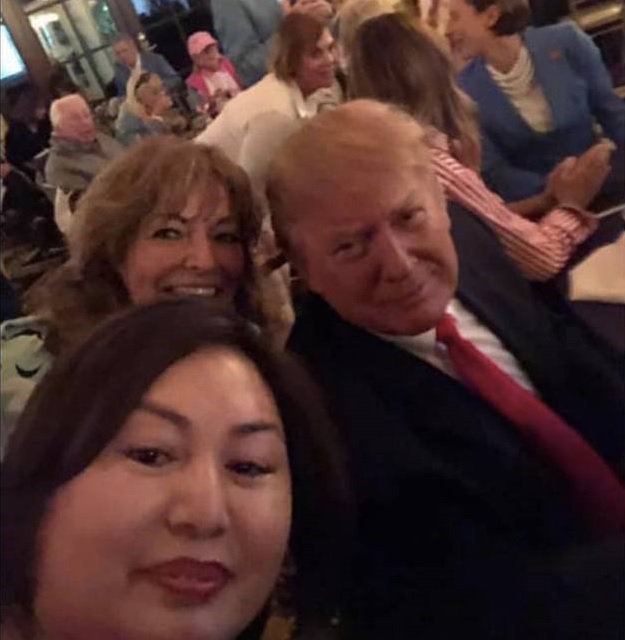
In a photo posted to her Facebook account, Cindy Yang appeared alongside Florida Gov. Ron DeSantis, holding a sequined MAGA clutch and wearing a blue ballgown.
It was just one of numerous photos that the Republican political donor and operator of a string of spas and massage parlors has used to advertise her access to the Trump White House for Chinese business executives willing to pay for her services.
But the Florida-based entrepreneur has also been active in several organizations that are closely linked to the Chinese Communist Party’s global efforts to quietly increase influence within foreign political systems—a decades-long effort spearheaded by a party agency known as the United Front Work Department.
Yang, who first made national news last month when New England Patriots owner Robert Kraft was arrested for soliciting prostitution at a massage parlor she founded, runs a private investment firm that primarily caters to Chinese-speaking executives who desire access to the U.S. political class, according to Mother Jones. 
Yang is a member of Donald Trump’s private Florida club Mar-a-Lago. 
She has appeared in photos with such prominent Republicans as Trump, Donald Trump Jr., Eric Trump, White House advisor Kellyanne Conway, Transportation Secretary Elaine Chao, Florida Sen. Rick Scott, Florida Rep. Matt Gaetz, Texas Rep. Louie Gohmert, Republican National Committee Chair Ronna Romney McDaniel, former Alaska Gov. Sarah Palin, former presidential advisor Sebastian Gorka, and ultraconservative Fox News commentator Jeanine Pirro, as well as at a 2018 meeting tagged as being at the White House, and at the 2016 Republican National Convention.


Jeffrey Guterman
✔@JeffreyGuterman

Li Yang and @realDonaldTrump: https://www.miamiherald.com/news/politics-government/article227186429.html …
This is the first tweet of a thread that documents photos of Li Yang with Trump and his associates. Please let me know which ones I am missing.

But more disturbing to China analysts are her connections to the United Front, a Chinese Communist Party agency in existence for decades but given greater importance under Xi Jinping, that aims to strengthen party influence over society at home and abroad.
In recent years, organizations and individuals tied to the United Front have been connected to numerous political scandals and corruption cases in the United States, Canada, Australia, and elsewhere. 
It has a long history, both in the United States and elsewhere, of working with China’s traditional intelligence apparatus to cultivate relationships with wealthy political elites, recruit assets, and gather intelligence.
Senior White House and intelligence officials are deeply concerned about the extent of covert Chinese political interference in the United States—a worry that long predates the Trump administration and affects both major U.S. political parties. 
In recent months, numerous government bodies, including the FBI (which created a new foreign influence task force), the National Security Council, the White House, and Congress, have committed resources to tackling covert Chinese political interference operations inside the United States and other Western democracies.
But Yang’s is the first major known case of a United Front-affiliated political operative successfully ingratiating herself with the Trump administration.
In 2016, Yang served as a vice president of the newly founded Florida chapter of the China Council for the Promotion of Peaceful National Reunification, a Beijing-based organization under the direct oversight of the United Front Work Department. 
The nominal purpose of the organization is to ensure the so-called reunification of Taiwan and China; in practice, chapters function as a political action group receiving broad direction from the mainland
Branches exist in more than 70 countries around the world and in more than 30 U.S. cities. (When asked, individual chapters typically claim to be independent, despite being listed on the website of the Beijing-based council.) 
Yang has been active in numerous other organizations that the United Front has sought to co-opt, including hometown groups such as the Northeast Florida Hometown Association, of which Yang is a member.
Lists of branch officers often read like a who’s who of prominent local members of the Chinese community. 
That’s not a coincidence. 
The Chinese Communist Party uses peaceful reunification societies as foreign outposts to identify, assess, and reward influential members of the Chinese diaspora who are willing to promote party objectives within their communities.
That grows out of the United Front’s work at home. 
To maintain and solidify its sway over a huge population, the party has become skilled at implementing what is known as “united front” strategy—a classic communist maneuver to amplify friendly voices and marginalize critical ones through a carrot and stick approach. 
While this is a is a partywide strategy, the United Front Work Department promotes and coordinates it, specializing in its implementation across society.
Chinese diaspora, where the United Front focuses on identifying rising community leaders, whether they may be promising young politicians, wealthy campaign donors, or prominent members of the community, and cultivating close relationships with them over many years. 
Many of those involved may not actually agree with the party’s goals, or even be fully aware of the goals of the groups they participate in — but these relationships are still meaningful to Beijing.
Groups and individuals outside of China targeted by united front work find themselves offered numerous benefits, including lucrative business deals tied to mainland China, prestigious positions in government-affiliated organizations, and networking opportunities, in an often-implicit exchange for supporting party objectives when the need arises. 
Those who refuse the proffered perks may find themselves isolated, their business opportunities drying up, and in some cases they may be subject to harassment or even coercion.
These relationships can be quietly drawn upon in times of need to promote Chinese Communist Party objectives—diaspora leaders can mobilize Chinese community members to write letters to their democratic representatives opposing government action that displeases Beijing, and political donors can pressure those who have received their financial support. 
Businesses enjoying Beijing’s largesse can align their business strategy with party objectives, such as not making deals with outspoken proponents of Hong Kong or Taiwanese independence.
There is documented evidence of this kind of political influence—or, as some call it, interference, due to its secretive and sometimes coercive nature—occurring in the United States, Taiwan, Australia, New Zealand, and other countries. 
In the Vancouver area, for instance, a United Front-linked civil society group became ensnared in a vote-buying scandal in local 2018 elections.
Peaceful reunification societies are a main conduit of united front work abroad, not just serving as hubs for visiting Chinese dignitaries and for identifying party-friendly people overseas, but also actively getting involved in local politics and organizing. 
In Australia and New Zealand, local leaders, some connected to the peaceful reunification societies there, have attempted to organize Chinese-Australian communities to bloc-vote for Beijing-friendly politicians. 
In the United States, these societies respond when the local Chinese diplomatic establishment requests that they help mobilize Chinese in America to attend pro-Beijing demonstrations in support of visiting Chinese leaders.
But another, and likely far more effective, task of the United Front Work Department and its proxies is to cultivate high-level, behind-the-scenes political influence.
That’s exactly what Yang’s private investment firm, GY US Investments LLC, prided itself on. 
On its website, the company claimed that it could provide “the opportunity to interact with the president, the [American] Minister of Commerce and other political figures,” according to Mother Jones. 
Connections to high-level political figures are a vital form of protection in China, where photos of businesspeople with leaders are a prized commodity. 
But these kinds of ties have also been sought by the Chinese government itself as a form of influence abroad.
To be sure, there is no evidence that Yang has ties to the Chinese intelligence apparatus, nor that she had any particular political end goal in mind. 
But it’s clear she served as a connector between rich Chinese entrepreneurs and the U.S. political system, and that she was willing to publicly align herself with the Chinese Communist Party and one of its primary political influence mechanisms.
Evidence of similar work goes back decades. 
In the mid-1990s, the former Arkansas restaurateur Charlie Trie was accused by federal prosecutors as serving as a conduit of up to $600,000 in illegal campaign contributions from China to the 1996 Clinton re-election campaign
“The allegation was that the Chinese Communists were using these businessmen to curry favor with the president,” recalled a former U.S. official involved with the investigation. 
“We couldn’t pin it down whether the party was behind it.” 
The value of photos taken with prominent politicians, one investigator commented, was so high in China that it was difficult to distinguish private corruption from government action. 
Trie later pleaded guilty to violating federal campaign finance laws.
According to a 1998 Senate report, one of the main sources of Trie’s laundered donations was the Macau-based billionaire Ng Lap Seng, who was convicted in a U.S. federal court in 2018 in an unrelated case involving the bribery of high-ranking United Nations officials. 
“Ng was seen as a conduit of money—no one knew where it was coming from,” recalled another former official familiar with the investigation. 
Ng’s meteoric rise fits a pattern, known to U.S. intelligence officials, wherein the Chinese government, beginning in the 1980s, strategically seeded an influence network worldwide, said this source. 
Ng has also been a member of an elite United Front body, the Chinese People’s Political Consultative Conference. 
Even back in the 1990s, investigators believed that Ng “was at least co-opted” by the Chinese government, said this former official.
Or take Katrina Leung, a Los Angeles-based socialite and Republican fundraiser.
Leung, a key FBI informant on China for two decades, was indicted in 2003 for mishandling classified information—a central law used in espionage-related cases. 
According to prosecutors, while Leung was providing information to the FBI, she was in reality a Chinese double agent; her access to sensitive materials came from a multi-decade affair she was having with her main FBI handler, J.J. Smith. 
Leung’s compromise was highly damaging, said multiple former intelligence officials, with the damage from her disclosures still being sorted out in the late 2000s.
While Leung was secretly working as a Chinese agent, she sought to cultivate U.S. politicians and bring them closer to Beijing. 
Leung helped organize a trip for Los Angeles Mayor Richard Riordan to visit China in the late 1990s, even helping arrange Riordan to have a meeting with Chinese leader Jiang Zemin, which Leung attended. 
The trip was designed to encourage a Chinese state-owned shipping conglomerate to increase its business with the Port of Los Angeles. (According to the Los Angeles Times, one former mayoral aide recalled Leung telling aides that if they put money in a bank account in Hong Kong, they’d receive the contract; the aide demurred, and Los Angeles was not awarded the contract.)
Yang has already begun to face blowback for the scandals now swirling around her. 
The National Committee of Asian American Republicans has dismissed Yang from her position as the Florida director of community engagement. 
It’s possible the U.S. Department of Justice, tasked with implementing the Foreign Agents Registration Act, may also become involved. 
Since the investigations into Russian meddling in the 2016 U.S. election, the Department of Justice has become more proactive in pushing foreign agents and foreign government-sponsored media outlets to register. 
If Yang’s investment firm is deemed to have engaged in political lobbying or public communications on behalf of a foreign principal, her firm may be required to register with the Department of Justice, which triggers disclosure requirements but does not prohibit such activities.
But the scrutiny Yang is now facing may make such activities moot. 
In the current climate, it seems unlikely that Republican luminaries will continue to grant her the access, and photo opportunities, she previously seemed to relish. 
That may act as a disincentive to others—or it may mean opportunities.

jeudi 5 octobre 2017

For the women who escape to China from North Korea, a terrible fate awaits them

Some women who cross the border are sold to men in rural areas who cannot find wives. Others are abducted and forced into prostitution
By Hyun-Joo Lim
Even those fortunate enough to escape from their dire situations in North Korea and China are left with agonising worry and guilt about their left-behind children.

As North Korea’s nuclear weapons programme and provocative missile tests draw the world’s attention, one crucial reality about the totalitarian regime has been left largely unnoticed: as bleak as life is for most who live in North Korea, it is often far worse for those who flee – most of whom are forced to suffer horrific human rights abuses away from the world’s scrutiny.
Since China shares a border with North Korea, it has become the first destination for desperate North Koreans who risk their lives to escape. 
An unofficial figure estimates that there are between 50,000 and 200,000 North Koreans living in China. 
The Chinese government denies most of them refugee status, instead treating them as economic migrants who have illegally crossed the border to seek work. 
Most have no formal identification or legal status.
In addition, Beijing works together with Pyongyang to capture defectors and send them back, making their lives as escapees completely untenable.
I have interviewed many North Koreans now settled in the UK. 
Many of them told me they had been caught by the Chinese police and repatriated to the north a number of times, but managed to escape again and again. 
The combination of desperation, the denial of legal status and the terror of the Chinese police operation exposes these people to gross exploitation – especially women.
Among those who successfully leave North Korea, women make up the majority
In their search for freedom, many of them paradoxically end up being trafficked, detained and treated inhumanely because of their precarious and insecure positions in China as “illegal migrants”.

Vulnerability exploited

Drawn to what they hope is a guarantee of work, some women who cross the border are instead sold to Chinese or Korean-Chinese men in rural areas who cannot find wives due to poverty, undesirable living conditions, disability and the lopsided gender demographics created by the now-replaced one-child policy
Other women are abducted in public spaces, such as streets and trains, and forced into prostitution. As a survival strategy, a few women or family members volunteer themselves to be sold. 
Some are lucky enough to find decent and kind men, but they are a vanishingly small minority.
Most are locked up so they cannot escape. 
They are denied contact with their family members or friends, and often a whole village effectively becomes a community of guards to watch them so they cannot run. 
Many of the women forced into these relationships endure physical hardships, forced to work in the fields and do endless household chores. 
Some are trafficked to households with several men, where their keepers take turns to violate them on a regular basis.
During their captivity, many of them also become pregnant. 
If they manage to escape to other countries, such as South Korea, they are forced to leave their children behind – and since these children aren’t officially recognised in China, they are denied basic rights and entitlements, foregoing even basic healthcare and education.
And so even those fortunate enough to escape from their dire situations in North Korea and China are left with agonising worry and guilt about their left-behind children. 
Out of shame, many never talk about the intense pain they feel, instead suffering in lonely silence.

What must be done

A 2014 UN Commission of Inquiry report on the human rights situation in North Korea criticised the Chinese government for its violation of the human rights of North Korean refugees on a number of counts, including its repatriation of North Korean refugees, its failure to protect them from trafficking, and its refusal to recognise the children of North Korean women and Chinese men. However, the Chinese government rejected the commission’s report and refused to change its stance.
It is therefore time for the rest of the world to change the way it interacts with China. 
International organisations, governments and the media must apply even greater pressure on Beijing to change its policy towards North Korean refugees and the children they have in China; it must recognise that they’re entitled to refugee status by virtue of the human rights abuses they endure at home.
If governments are to act, their citizens and media must pressurise them to make this issue a higher priority. 
If a global campaign can gather enough momentum and strength, the Chinese government will be forced to listen and reconsider.
It may be a significant obstacle, but it is a challenge we can all play our part in. 
By demanding action, we can all support the fight against the sustained human rights abuse of desperate North Korean defectors and their invisible children. 
We might not be able to see it, but we know it’s happening – and we have a human duty to act.

samedi 13 mai 2017

Billionaire's corruption claims ripple through China's Communist Party

A Chinese billionaire in exile is meddling with the inner workings of China's Communist Party.
DW

China's government censor warned in April there would be "serious consequences" for unauthorized media coverage of Guo Wengui, the billionaire real estate magnate living in the United States. 
His case is "highly politically sensitive," it stated.
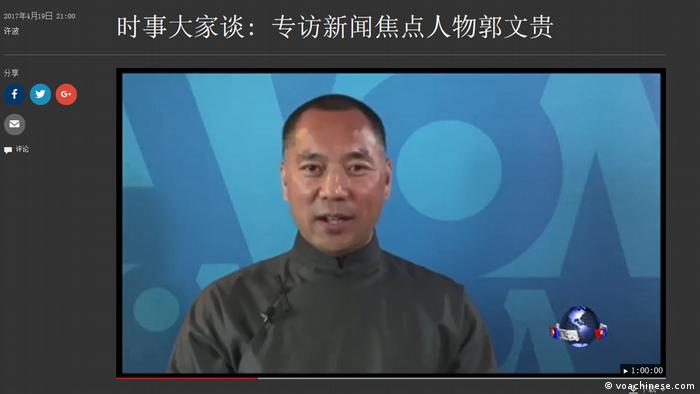
There is a reason China's Communist Party is so concerned: A few days earlier Guo had accused high-ranking party members of corruption in a live interview with the Mandarin-language service of Voice of America (VOA), a US government-funded media outlet. 
The livestream, scheduled for three hours, was halted after 80 minutes. 
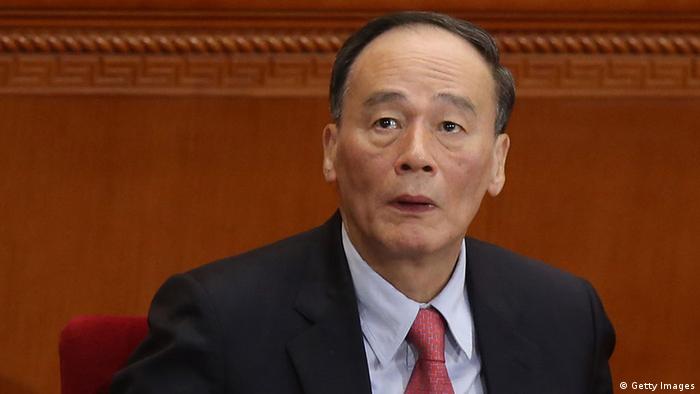
The video stopped just as Guo began discussing Wang Qishan, who heads China's internal corruption watchdog.
Five VOA employees were put on administrative leave thereafter, including Service Chief Sasha Gong. 
The decision to cut short the livestream was made before it began, VOA stated. 
It added there was no pressure to do so from the US government, and while China did pressure the organization, VOA said that did not influence its decision.

Wang Qishan's role as chief corruption watchdog is considered second in power only to President Xi Jinping

Ex-spy chief on video

Bill Ide, a Beijing correspondent for VOA, was informed that the Guo interview was viewed as an interference in internal Chinese affairs and summoned by the Foreign Ministry, two VOA employees told The New York Times. 
The broadcast will reportedly play a role in visa extensions for VOA journalists.
A Chinese media campaign against Guo is underway, including videos with Ma Jian, the former acting director of state security who was detained two years ago in a corruption investigation. 
In the videos, he speaks about a number of unseemly business dealings he helped Guo with.
China's foreign ministry said on April 20 that Interpol had issued a "red notice" for Guo. 
A "red notice" is an international alert for someone wanted for extradition. Guo, a member of Donald Trump's Mar-a-Lago Club in Florida, resides in the US, which does not have an extradition treaty with China.

Abduction in Hong Kong

Despite China's official designation as a socialist country "with a Chinese character," its economic opening starting more than 25 years ago has produced the most billionaires in the world. 
Real estate has been a particularly fruitful way to amass wealth, which is maintained with the help of political connections and protection. 
But it can be risky business: Billionaire Xiao Jianhua was abducted from his hotel in Hong Kong in January and returned to mainland China. 
The Canadian passport holder, who the New York Times reported in 2014 had business ties with relatives of Xi Jinping, has not been heard from since.

Billionaire Xiao Jianhua was abducted from his hotel in Hong Kong and taken to mainland China in January

Dangerous political infighting

Information on powerful families is particularly valuable this year. 
The Communist Party will hold its quinquennial conference in the fall, during which new leadership will be chosen. 
Corruption accusations can serve as a useful tool for eliminating opposition vying for top posts. 
Guo's claims may wreak havoc on internal party politics, and there may be more to come: He has announced a press conference for June in New York. 
He has already compared the relationship between Chinese business people and politicians to prostitution.

samedi 14 janvier 2017

Lotus Plumbs The History Of Chinese "Flower Girls" and Modern-Day Sex Work

By Abbie Winters

I was standing in front of my grandmother’s deathbed when my mother revealed the long kept family secret: Grandma, or Na, as we called her, had been a “flower girl” in her youth.
The revelation came as a shock. 
My beloved Na — the woman who had fed us rice and brought us up — a prostitute? 
That’s when my mother finally told me Na’s story. 
My grandmother had been orphaned at six before being adopted by her aunt. 
When she blossomed into a beautiful young woman at 14, the aunt’s husband sold her to a brothel. 
In the twenty years since I heard this story, I’ve often wondered how Na, a devout Buddhist, endured life inside a brothel called Spring Fragrance Pavilion, its front always lit up by red lanterns.
My grandma’s fate was a common one for orphans at that time when women were treated as a commodity to be bought, sold, and traded. 
As soon as the Chinese Communists took power in 1949, they shut down all the brothels and reformed the prostitutes. 
In the reform era, however, relaxed social control and growing wealth led to a spectacular resurgence in the sex trade, especially along more developed coastal areas. 
Working girls were hired to lubricate the wheels of business negations — or used as bribes in the trade between power and money. 
Since then, the sex industry has become the fastest growing industry in China, staffed by some ten million girls.
Although illegal in China, prostitution is difficult to avoid even now. 
Once, during a reporting trip to Shenzhen, I walked into a salon, hoping for a haircut. 
One of the three giggling girls, her full chest threatening to spill out of her tiny top, told me that they didn’t really know how to cut hair. 
I looked down and spotted no shavings on the floor; it dawned on me what kind of establishment I had actually entered. 
Perhaps I should have known: After all, we were in Shenzhen, referred to by some as China’s Capital of Sins.
I chatted with the salon girls and learned that they were migrants from the impoverished countryside. All three were poorly educated and unskilled: The youngest was in her early teens — the same age as my grandma when she began work at a brothel in 1928. 
How did these women end up here? I wondered. 
And how did they reconcile their trade with their conservative upbringing in the village?
It was at that moment the seed for my novel, Lotus, was planted. 
Through the lives of these women, I could explore China’s growing gap between men and women, urban and rural — as well as the tug of war between modernity and tradition.
Because my last book was a memoir, people often wonder if I’ve penned another autobiography: I am always quick to point out that Lotus is purely a work of fiction, not based on personal experience. Keenly aware that my middle-class urban existence is so removed from that of a migrant-worker, I knew I needed serious research. 
And so I interviewed sex workers in Shenzhen, Dongguang, a neighboring city, Beijing, and other cities. 
I tried to make friends with these sources, but it proved to be a very challenging task: Their lives are so transient, as they change from one massage parlor to another, from one city to another. 
They change their mobile numbers — or they simply vanish.
My breakthrough came after I managed to gain work as a volunteer for a non-governmental organization NGO that is dedicated to helping female sex workers in a northern city in China. 
The main task of these volunteers is to distribute condoms to sex workers operating at massage parlors and hair salons — all fronts for brothels — in an outskirt of Tianjin.
They are mostly low-class establishments, and I usually went out with a staff member from the organization, Little Y — a former sex worker herself, who is very skilled in her NGO role. 
She would sit down and chat over a cup of weak jasmine tea; she would always find something flattering to say.
“Wow, what a pair of heavy melons!” Little Y would say, pointing at one woman’s robust chest. 
“Are they real?” 
She would volunteer that she had had implants herself; on several occasions, she lifted up her top and compared herself to other women who also had breasts enlargement. 
Little Y’s augmentation was done in a back-alley clinic, and resulted in one of her nipples pointing westward.
Her language and approach made the girls feel she was one of them: They would tell her about the problems they had with their boyfriends, or some funny anecdotes about their clients, or just vent about the injustices they suffered at the hands of the police. 
One woman told us how she’d been arrested during a police raid: At a police station, they beat her up. To avoid being sent to a labour camp, she had to pay a bribe of 3000 yuan (almost $500 at the time) to a policeman and provide her services to him for free. 
Upon being released, she returned to her parlor. 
A laid-off worker with two children to support, she needed the money.
Little Y would offer advice how to dodge police in case their parlors were raided. 
When she handed out condoms, she would urge women to use one for each transaction and warn them about the dangers of unprotected sex. 
At night, I stayed at NGO’s office, its walls studded with heart-shaped plastic-encased prophylactics. There, I would furiously write down the details of our conversations and the stories the girls had shared with me.
Quite a few of them had experienced traumas, like losing their jobs or being deserted by their husbands. 
Other made a choice to become sex workers, because their other professional options were extremely limited.
The story of one massage parlor girl, Xiaohua, was typical: Lured by the bright lights of the city, she left her village of Sichuan, in China’s hinterland, and joined a shoe factory in Dongguang. 
One of her friends found a job at a massage parlor in Shenzhen, which would not only earn her more income but also spare her the grueling tasks of production line; she decided to to take the job after her family wrote her a letter, asking for money. 
Xiaohua took the job and sent the requested funds to Sichuan: Almost all girls I know provided financial support to their homes back in their villages.
Of course, it partly justified their profession and made them feel better. 
Still, their sense of filial duty, deeply imbedded in their upbringing, played a large part.
But what impressed me most in those vulnerable girls was their strength: their ability to cope with hardship and setbacks and simply keep going. 
It is the same quality I’ve long appreciated in my grandma, to whom the novel is dedicated.

mercredi 9 novembre 2016

Yan Lianke’s Novel Assesses the Moral Cost of China’s Growth

By JIAYANG FAN

Yan Lianke 

THE EXPLOSION CHRONICLES
By Yan Lianke
Translated by Carlos Rojas
457 pp. Grove Press. $26.


Here are four scenarios to test one’s ability to differentiate between fact and fiction in modern China: (1) Elderly people hastily kill themselves so that they will be buried traditionally, in tombs, before a cremation law takes effect. 
(2) Thousands of dead pigs float down the river of a major metropolis that supplies drinking water to 26 million residents. 
(3) A village of several hundred inhabitants swells into a city of 20 million, its growth fueled by prostitution and corruption. 
(4) All three story lines are used as inspiration by a Communist Party propagandist-turned-novelist who is both celebrated and censored by a country that can’t make up its mind on whether he should be exalted or exiled.
If all four scenarios seem fantastical, Yan Lianke, the propagandist-turned-writer, will have succeeded in realizing a central theme of “The Explosion Chronicles,” a novel premised on No. 3: that what Yan calls the “incomprehensible absurdity” of contemporary China — elderly people in the city of Anxing reportedly did kill themselves to avoid cremation; thousands of dead pigs did float down the Huangpu River — renders the boundary between reality and fantasy virtually indistinguishable. 
Stylistically, this is not new terrain for Yan, whose fiction has lampooned some of the darkest moments in Chinese history, including the Great Leap Forward, the Cultural Revolution and the 1990s AIDS scandal in his home province of Henan. 
In this latest work, however, Yan shifts his irreverent gaze from the past to the present and toward projections of the future, taking stock of China’s vertiginous economic rise and the astonishing dissolution of its collective social conscience.
“The Explosion Chronicles” traces the ascent of a “fallen fruit” village named Explosion to a city on par with Shanghai and Beijing. 
The levers of power rest within the Kong family (incidentally, also the surname of Confucius), which divvies up political, economic and military might among four brothers. 
Prosperity is the official religion, while prostitution and larceny are among the founding industries. Bribery, fraud and vote-rigging are so common and lucrative that their impropriety is efficiently buried under heaps of money; appropriately, Explosion is soon celebrated for holding the first democratic elections since the founding of the People’s Republic.
The Kongs, who treat Explosion like a familial plot of land to be irrigated with Deng-era watchwords — economic “development zone”; “central policy directives”; Reform and Opening Up campaign — do not only want to install a new dynasty. 
By the time Explosion has been promoted from town to county, the rulers view themselves as gods, and in magic-realist fashion, the moral chaos is horrifyingly reflected in the dysfunction of nature. 
A member of the Kong clan can literally make snow fall from the sky with one document and get flowers to bloom from his pen tip. 
The climate acquiesces to the demands of urban expectation, and everything from squirrels to crickets to shrubbery is reduced to a subject of the Kong empire.
As with Yan’s previous novels, the formal inventiveness of “The Explosion Chronicles” is impressive and its fictional universe vividly drawn. 
But one cannot help wishing it were less an operatic allegory of political principles and more a story, animated by fallible protagonists who are not entirely devoid of moral ambivalence. 
In an Op-Ed for The New York Times in 2014, Yan lamented the costs of China’s economic development. 
“No one can tell us what price should be paid for human feelings, human nature and human dignity,” he wrote. 
“What is the price for abandoning the ideals of democracy, freedom, law and morality?” 
These are grim but urgent questions that affect the varied lives of 1.4 billion. 
I can think of few better novelists than Yan, with his superlative gifts for storytelling and penetrating eye for truth, to imagine the answers.