Affichage des articles dont le libellé est Fiery Cross. Afficher tous les articles

lundi 16 septembre 2019

FONOPs

U.S. warship challenges Chinese illegal claims in South China Sea
BY JESSE JOHNSON

The guided-missile destroyer USS Wayne E. Meyer prepares to refuel at sea with the Nimitz-class aircraft carrier USS Carl Vinson in the Pacific Ocean in November 2017

China sent military vessels and aircraft in an attempt to expel a U.S. warship asserting international freedom of navigation rights in the Paracel Islands of the disputed South China Sea on Friday.
The U.S. Navy said in a statement that guided-missile destroyer USS Wayne E. Meyer had conducted a “freedom of navigation operation” (FONOP) without requesting permission from Beijing — or from Hanoi or Taipei, which also claim the archipelago.
The FONOP “challenged the restrictions on innocent passage imposed by China, Taiwan, and Vietnam and also contested China’s claim to straight baselines enclosing the Paracel Islands,” said Cmdr. Reann Mommsen, a spokeswoman for the U.S. Navy’s 7th Fleet.
Under international law, ships of all states — including their warships — enjoy the right of innocent passage through territorial seas.
Mommsen said that the sailing had also “challenged China’s 1996 declaration of straight baselines encompassing the Paracel Islands.”
Beijing has effectively drawn a line around the entire Paracels archipelago in a bid to claim the entire territory, despite rival claims.
Mommsen noted that international law does not permit continental states like China to establish baselines around entire island groups. 
Using these baselines, China, she said, “has attempted to claim more internal waters, territorial sea, exclusive economic zone, and continental shelf than it is entitled under international law.”
The USS Wayne E. Meyer conducted a similar operation last month, sailing within 12 nautical miles (22 km) of the contested Fiery Cross and Mischief Reefs, two Chinese-occupied islands in the South China Sea.
That sailing came just days after the Pentagon issued a strong statement that accused Beijing of employing bullying tactics in the waterway, citing what it said was “coercive interference” in oil and gas activities in waters claimed by Vietnam.
Beijing claims much of the South China Sea, though the Philippines, Vietnam, Malaysia, Taiwan and Brunei have overlapping claims in the waters, where the Chinese, U.S., Japanese and some Southeast Asian navies routinely operate.
Neither Japan nor the U.S. have claims in the waters, but both allies have routinely stated their commitment to a “free and open Indo-Pacific.”
“U.S. forces routinely conduct freedom of navigation assertions throughout the world, including in the South China Sea, as a routine part of daily operations,” Mommsen said.
“The Freedom of Navigation Program’s missions are conducted peacefully and without bias for or against any particular country,” she added.
Washington has lambasted Beijing for its moves in the waterway, including the construction of man-made islands — such as those in the Paracel chain and further south in the Spratlys — some of which are home to military-grade airfields and advanced weaponry.
The U.S. fears the outposts could be used to restrict free movement in the waterway, which includes vital sea lanes through which about $3 trillion in global trade passes each year. 
The U.S. military regularly conducts FONOPs in the area.
Beijing says it has deployed the advanced weaponry to the islets for defensive purposes, but experts say this is part of a concerted bid to cement de facto control of the waters.
In a defense white paper released for the first time in years in July, China highlighted a new emphasis on “combat readiness and military training in real combat conditions” and China’s new war-fighting capabilities in the Western Pacific and South China Sea.
Beijing, the white paper said, “has organized naval parades in the South China Sea” and “conducted a series of live force-on-force exercises” while its air force “has conducted combat patrols in the South China Sea and security patrols in the East China Sea, and operated in the West Pacific.”

jeudi 29 août 2019

Stop the Beijing Bully in the South China Sea

Destroyer USS Wayne E. Meyer Sails Past Fiery Cross, Mischief Reefs in Latest FONOPS
By Megan Eckstein

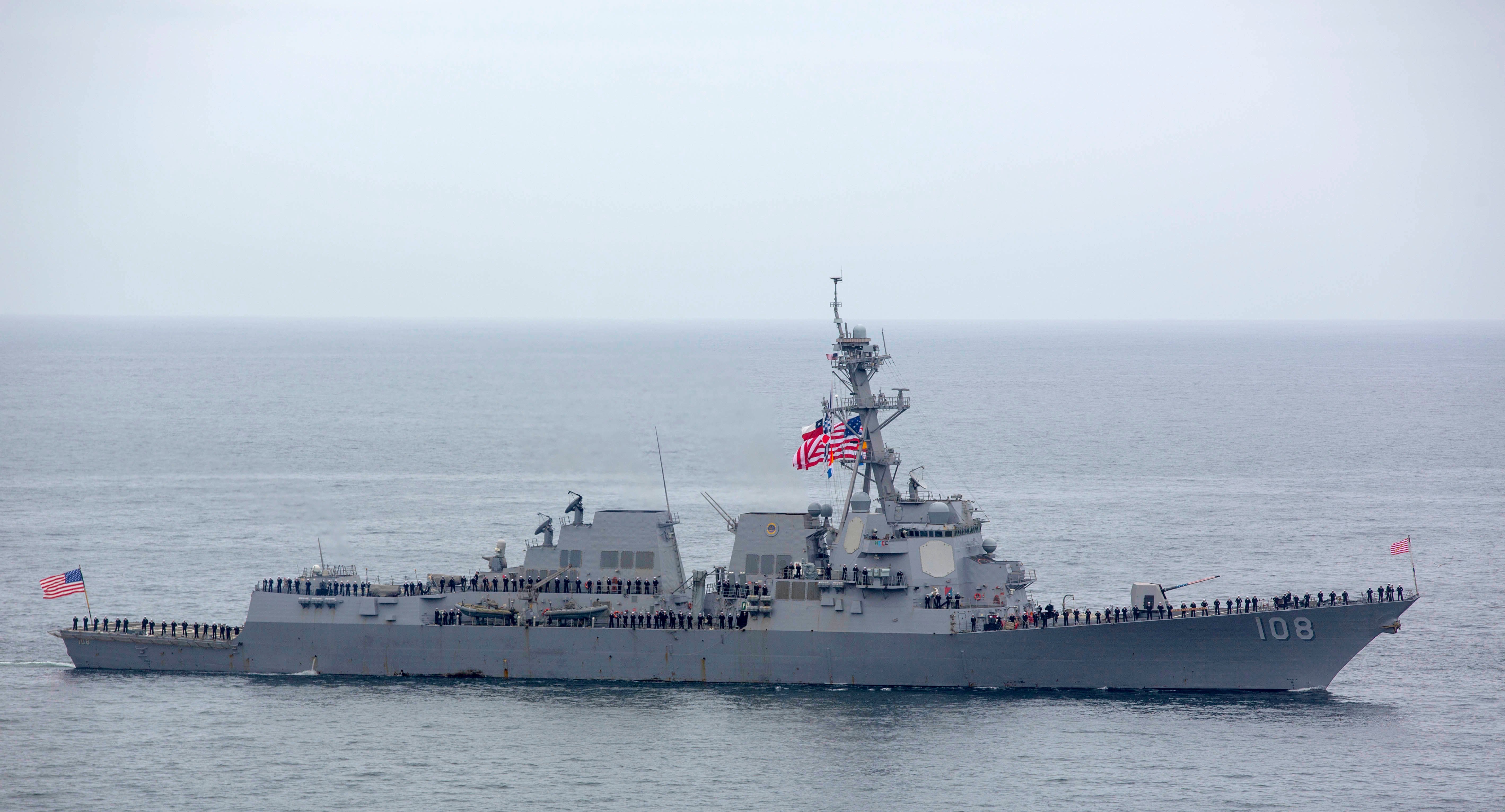
Sailors man the rails aboard the Arleigh Burke-class guided missile destroyer USS Wayne E. Meyer (DDG 108) as the ship transits along the coast of Valparaiso, Chile during a parade of ships on Nov. 19, 2018. 

A U.S. destroyer conducted a freedom of navigation operation in the Spratly Islands today.
Arleigh Burke-class destroyer USS Wayne E. Meyer (DDG-108) sailed within 12 nautical miles of both Fiery Cross Reef and Mischief Reef today to challenge excessive maritime claims in the South China Sea, U.S. 7th Fleet spokeswoman Cmdr. Reann Mommsen told USNI News.
“U.S. Forces operate in the Indo-Pacific region on a daily basis, including in the South China Sea. All operations are designed in accordance with international law and demonstrate that the United States will fly, sail and operate wherever international law allows,” she said.
Ships operating the U.S. Indo-Pacific Command have conducted several FONOPS this year, with officials saying they wanted FONOPS to be viewed as more routine operations. 
In late May, USS Preble (DDG-88) sailed near the Scarborough Shoal, and earlier that month Preble and USS Chung-Hoon (DDG-93) steamed within 12 nautical miles of the Gaven and Johnson Reefs.
In February, Preble and USS Spruance (DDG-111) steamed within 12 nautical miles of Mischief Reef, an artificial island China built up in the Spratly Islands chain. 
In January, USS McCampbell (DDG-85) steamed past the Paracel Islands.

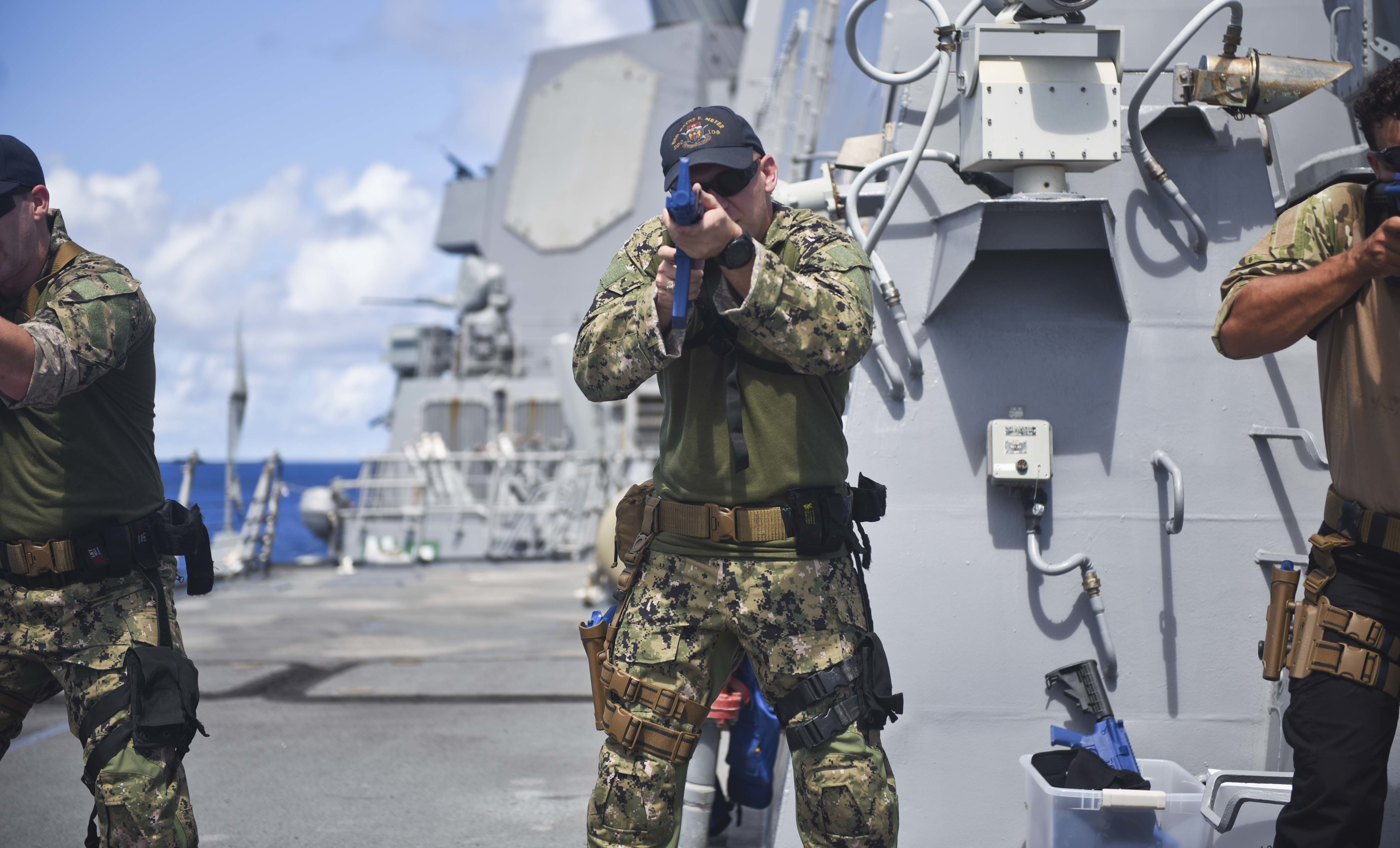
Ens. Christian Meyer practices visit, board, search and seizure (VBSS) techniques aboard the Arleigh Burke-class guided-missile destroyer USS Wayne E. Meyer (DDG 108) on Aug. 22, 2019. Wayne E. Meyer is deployed to the U.S. 7th Fleet area of operations in support of security and stability in the Indo-Pacific region. 

The South China Sea continues to be a key location where U.S. warships promote freedom of navigation and open international waterways, and also where China has taken a stand this summer. 
A group of Chinese warships, including aircraft carrier Liaoning, sailed through the South China Sea earlier this summer, operating in territorial waters of the Philippines and near Japan.
When Wayne E. Meyer conducted its FONOP today, other ships were in the vicinity, but all interactions were considered routine, a source told USNI News.
Today’s operation comes just after China denied a U.S. Navy request to send a warship to the eastern port city of Qingdao, Reuters first reported. 
The U.S. and China are locked in a growing trade war, and while U.S. Navy ships have made port visits in Chinese cities previously, the rejection of the request may reflect those growing tensions between the two economic powers. 
China also denied two warships access to Hong Kong, the semi-autonomous islands where protests against the government in Beijing are ongoing.
The full statement from U.S. 7th Fleet:
“The guided-missile destroyer USS Wayne E. Meyer (DDG 108) conducted a Freedom of Navigation Operation (FONOP) in the South China Sea, Aug. 28 (local time). Wayne E. Meyer sailed within 12 nautical miles of Fiery Cross and Mischief Reefs in order to challenge excessive maritime claims and preserve access to the waterways as governed by international law. U.S. Forces operate in the Indo-Pacific region on a daily basis, including in the South China Sea. All operations are designed in accordance with international law and demonstrate that the United States will fly, sail and operate wherever international law allows. That is true in the South China Sea as in other places around the globe. We conduct routine and regular Freedom of Navigation Operations (FONOPS) as we have done in the past and will continue to in the future. FONOPs are not about any one country, nor are they about making political statements.”

jeudi 16 novembre 2017

Beijing Sails Ahead in South China Sea

China is starting to dictate terms in one of the world’s strategic waterways, and the United States is largely missing in action.
BY DAN DE LUCE

A Chinese navy formation, including the aircraft carrier Liaoning, takes part in military drills in the South China Sea on Jan. 2.

In his 12-day trip to Asia, Donald Trump largely focused on North Korea and trade, all but avoiding the simmering disputes in the South China Sea and steering clear of sharp criticism of Beijing’s increasingly aggressive activities there.
With the Trump administration focused elsewhere for now, China is quietly pressing ahead with its agenda in one of the world’s most strategic waterways, building more military facilities on man-made islands to buttress its expansionist claims and dramatically expanding its presence at sea at the expense of its smaller neighbors.
Beijing’s under-the-radar advances in the South China Sea could be bad news for countries in the region, for U.S. hopes to maintain influence in the Western Pacific, and for the rules-based international order that for decades has promoted peace and prosperity in Asia.
At the Chinese Communist Party congress last month, Xi Jinping cited island building in the South China Sea as one of his top achievements so far, and touted the “successful prosecution of maritime rights.” 
Those rights appear at odds with international law: Xi is now assuring nervous neighbors that China will offer “safe passage” through the seas to other countries in the region.
“The South China Sea has fallen victim to a combination of Trump’s narrow focus on North Korea and the administration’s chaotic and snail-paced policymaking process,” said Ely Ratner of the Council on Foreign Relations, who served as an advisor to former Vice President Joe Biden.
China’s recent advances in the South China Sea aren’t as eye-popping as the overnight creation of artificial atolls in recent years, a massive engineering project dubbed the “great wall of sand” by a top U.S. admiral. 
That’s one reason the disputes got pushed to the back burner on Trump’s big trip.
“Because there’s no sense of immediate or medium-term crisis (in the South China Sea), they didn’t make it a big priority on the trip,” said Evan Medeiros of the Eurasia Group, who oversaw Asia strategy in the Obama White House.
But experts say the quiet moves — including expanding military bases, constructing radar and sensor installations, hardened shelters for missiles, and vast logistical warehouses for fuel, water, and ammunition — are threatening to turn China’s potential stranglehold on the region into reality.
Much of the activity has centered on three reefs converted into artificial islands through large-scale dredging: Fiery Cross, Mischief Reef, and Subi Reef in the Spratly Islands, about 650 miles from Hainan Island in southern China. 
Satellite imagery in June revealed a large dome had been erected on Fiery Cross with another under construction, suggesting a substantial communications or radar system, experts say. 
At Mischief Reef, workers were installing two more domes.
With runways, hangars for fighter jets, and communications hardware in place on the artificial islands, China can deploy military aircraft and missiles whenever it wants, solidifying its grip over the area and flouting international maritime law. 
The three newly built bases in the Spratlys, combined with another on Woody Island, will enable Chinese warplanes to fly over nearly the entire South China Sea.
That could be the precursor to an “air defense identification zone” similar to the one that China slapped onto the East China Sea in 2013.
And the new bases have given China much greater reach at sea. 
Beijing has deployed more naval ships, Coast Guard vessels, and a flotilla of fishing boats that act as a maritime militia virtually around the clock. 
The ships can now dock nearby to refuel and resupply, rather than sail home, extending their time on station and their ability to project Chinese power through the area. 
That is changing the balance of power as fishing ships and coast guard vessels from other claimant countries like Vietnam and the Philippines are elbowed away from disputed features.
This summer, for example, Vietnam hoped to drill for natural gas off its own coast. 
But China reportedly summoned the Vietnamese ambassador and threatened military action if Hanoi went forward with development in its own exclusive economic zone. 
Sensing little backing from Washington, Vietnam quietly backed down and stopped drilling.
“The sheer numbers are starting to push the Filipinos, the Vietnamese, and the Malaysians out,” said Gregory Poling of the Center for Strategic and International Studies.
More than nine months into the Trump administration, contrasts with U.S. policy under Barack Obama toward the South China Sea are apparent — as they are with the initial saber-rattling tone of Trump administration officials. 
The Obama administration put a focus on diplomacy and consistently sought to uphold international law regarding the disputed waterway, though it often shied away from sailing U.S. Navy ships through the waters to send a tough signal to Beijing.
The Trump administration has taken almost the opposite approach: Navy cruises to assert the right of navigation have become commonplace, but there is little sign yet of a concerted U.S. policy to diplomatically push back against Chinese encroachment or offer encouragement to U.S. allies and partners threatened by Beijing’s advances.
“By having no South China Sea policy, Trump ensures that all the initiative lies with Beijing,” said Mira Rapp-Hooper, a senior fellow at Yale’s Paul Tsai China Center.
Former U.S. officials and congressional aides said the Trump administration appears to be pulling its punches on the South China Sea, as well as trade issues, in hopes of securing Beijing’s cooperation to cut off North Korea’s access to fuel and cash to fund its nuclear weapons program. 
So far, China has stopped short of drastic action to squeeze the regime in Pyongyang — and Chinese officials just contradicted Trump’s claims that the two countries have found more common ground.
At the end of his Asia trip, Trump did offer to “mediate” between Vietnam and China, but that spooked officials in Hanoi who fear they could be a pawn in a bigger U.S.-China game centered on North Korea.
The White House did not respond to requests for comment on its approach to the South China Sea.
However, some former Obama officials are cautiously optimistic that the Trump administration, hamstrung so far by short staffing at key positions, especially regarding Asia policy, is starting to craft a more coherent policy toward the region, including a sharper focus on China’s activities in the South China Sea. 
Joint communiques in Japan and Vietnam stressed continued U.S. support for the rule of law and an end to coercion in maritime disputes, for example.
Ratner, the former Biden advisor, said he expects the Trump administration to chart a more proactive course as it settles into office.
“They appear to finally be getting their policy feet under them and I’m expecting more focus on South China Sea in the months ahead,” he said. 
“So it’s premature to declare it’ll remain a low priority going forward.”