Affichage des articles dont le libellé est Melbourne. Afficher tous les articles

mercredi 11 décembre 2019

NOISY INVASION

Hong Kong democracy protester was ambushed by masked Chinese in Australia
By Ben Smee and Ben Doherty

The allegations made by Jack* match a trend of Chinese noisy intimidation and surveillance on Australian soil. 

A “frontline” Hong Kong democracy protester who recently fled the territory in fear of his safety says he was ambushed and chased in an Australian city by a group of masked Chinese men.
“They were nearby my house and waiting for me,” Jack* told Guardian Australia. 
“They knew my address, they knew where I was going to be.
“I think they don’t want to hurt me, they just want to make me scared. It was like intimidation, a message that ‘we know where you are’.”
Guardian Australia has been able to confirm some elements of Jack’s story, including that he arrived in Australia a few months ago and has attended pro-Hong Kong demonstrations since arriving. 
He has since reported the incident to police.
Human rights advocates and China experts say the claims match a trend of intimidation and surveillance on Australian soil. 
Several recent incidents – including a brawl at the University of Queensland where pro-China participants were praised by the consulate – have raised concerns about the extraterritorial activities of China, including the state’s pursuit of critics beyond its borders.
Jack told Guardian Australia he expected to be safe in hiding in Australia and that he had no choice but to leave Hong Kong after being arrested twice earlier this year and seemingly targeted by Hong Kong police since. 
Police also twice searched his parents’ home.
“I love Hong Kong and wish I was in Hong Kong but I felt I had no choice,” Jack said. 
“They came with a warrant to search my house.”
Jack said he was beaten when he was first arrested and then held in a police station in Hong Kong, in a room with no cameras, for 48 hours before being charged with unlawful assembly.
My family and the lawyer went to the police station to look for me but the police said that I wasn’t there,” he said. 
“It was like torture inside. They kept me awake, they kept checking on me every hour. They splashed water on me. So I was soaked in ... cold water. They turned down the aircon to be a lot colder than normal.”
After several months, Jack said he and other protesters became increasingly concerned for their safety. 
They began to carry around “death notes” with messages to family members.
“I was one of the most frontline protesters,” he said. 
“One of the more radical in a way. Most of my group members are willing to sacrifice themselves, willing to be injured or arrested, and so they all kept a death note in their pocket.
“Because I was one of the frontline protesters ... I got more scared of the police and what they might do to me.”
Jack has been supported by a network of Hong Kong expats and supporters since arriving in Australia. 
He said he did not expect to be approached by the masked Chinese men, who followed him home after an Australian rally.
“No, it’s not unsafe in Australia,” he said.
“[The Chinese] just want to make you scared.
“I have never seen them again. Maybe they just want to make you scared, don’t say anything bad about China or anything. If I’m scared, I’m not a protester.”
Elaine Pearson, the Australia director for Human Rights Watch, said allegations of masked assailants assaulting protesters on Australia soil were disturbing.
“This person escaped Hong Kong and yet it seems like the surveillance apparatus of the Chinese state is alive and well right here in Australia,” she said. 
“Up until now, we’ve seen intimidation, harassment and surveillance of students and activists protesting on university campuses but brazen acts of physical violence are a real step up.
“The new foreign interference laws are supposed to protect people from such acts and send a message to foreign governments and their proxies not to interfere. But these allegations call into question whether that message is getting through. Police should thoroughly investigate these allegations and hold the perpetrators to account.”
Drew Pavlou
, a University of Queensland student who is taking legal action against the Chinese consul general in Brisbane, Xu Jie, said that last week he began receiving threats at his home address.


Drew Pavlou@DrewPavlou
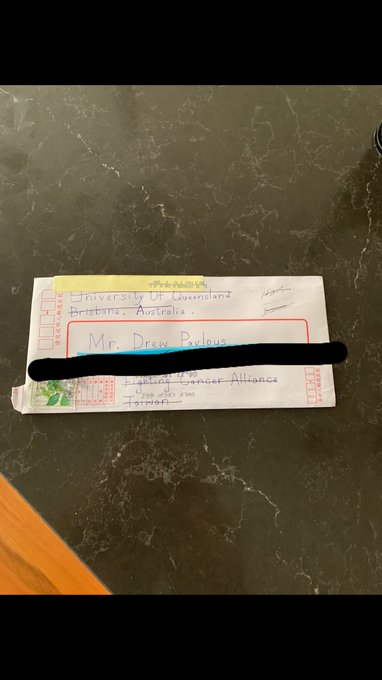
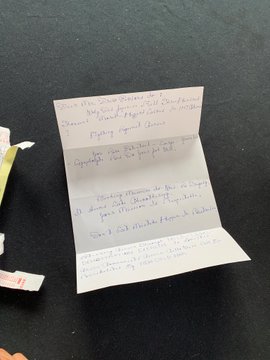
Really terrified -- my family and I have been receiving death threats for months due to my pro Hong Kong activism in Brisbane Australia . But this is a new escalation -- received this threatening letter in mail today, meaning the address of my family home has been compromised.
531
8:10 AM - Nov 21, 2019

“To me, it seems like it must be some sort of coordinated approach,” Pavlou said. 
“I had a letter sent to my house, it was a clear message that they know my address. It’s not just heat of the moment, two opposing sides clashing at a protest, it’s planned.”

Death threats in Melbourne
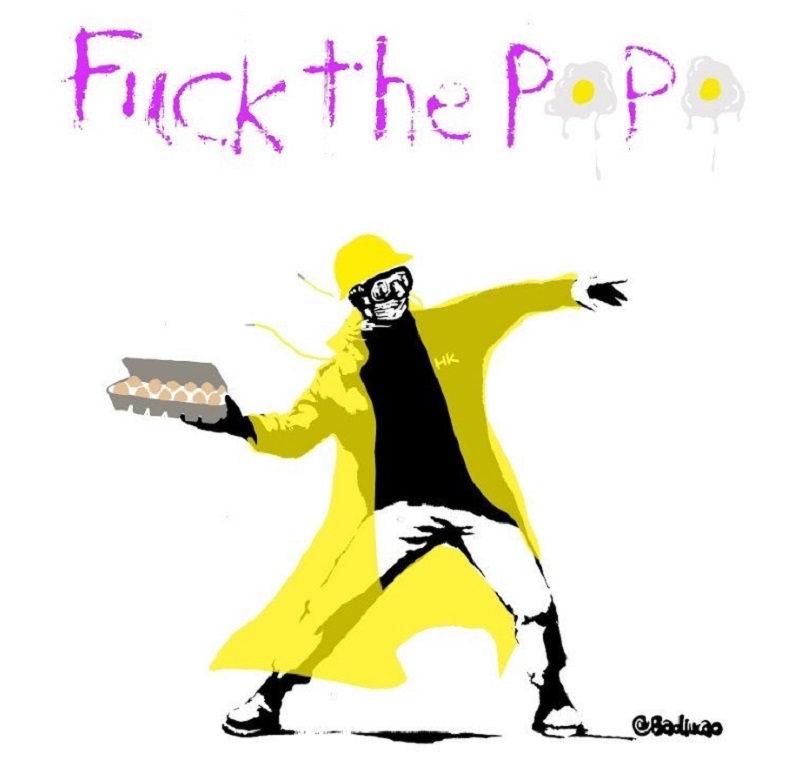
The artist Badiucao, who has been an outspoken critic of Beijing through his artwork and his ABC documentary China’s Artful Dissident, said Beijing’s “sharp power” was manipulating members of the Chinese community in Australia.
“No one who has a different voice against Beijing feels safe in Australia,” he said. 
“Like the Hong Kong [protester], I certainly do not feel safe either. I have experienced being followed by Chinese men several times and a possible home invasion.
“Death threats have been sent to me on a daily basis via social media and the people behind those trolls are not just movement-hired bots but real Chinese students living and studying in Melbourne, the city I see as home now. But I am not scared of those threats, I just feel sorry for those Chinese kids being brainwashed and missing the chance to see the truth of China, Hong Kong and the world.”
*Jack’s name has been changed

mardi 27 août 2019

'This Is a Fight.'

Meet Badiucao, the Dissident Cartoonist Taking on the Chinese Government
BY AMY GUNIA / HONG KONG

Chinese cartoonist Badiucao standing behind his artwork titled 'Light' in his studio in Melbourne on May 28, 2019.

A giant tattoo of tiny man standing in front of an oncoming tank covers the entirety of one of artist Badiucao’s upper arms. 
It’s an inspired choice of ink for the Chinese artist who has earned both the fury of the Chinese Communist Party and excited comparisons to Banksy.
Images of the individual known to history as Tank Man flashed around the world on June 5, 1989, when the anonymous Beijing resident, clutching a shopping bag, faced down a column of advancing tanks. 
The night before, troops had rolled into Tiananmen Square and brutally suppressed a weeks-long, peaceful occupation by students and workers calling for political reform. 
Thousands are thought to have died.
“I wanted [the Tank Man tattoo] on my right arm, the arm that I use to draw,” Badiucao (pronounced ba-doo-chow) tells TIME. 
“It’s a personal reminder to keep having courage with my arm, with my hand, and with my pen.”
Born in China in 1986, Badiucao grew up in a society where all mention of the Tiananmen massacre is fanatically censored
He was in university in 2007, studying law, when he gathered with friends in his dormitory to watch what they thought was a Taiwanese rom com. 
In turned out that their copy had been doctored by activists intent on spreading awareness of the events of 1989—a few minutes into the film, the movie suddenly cut to a documentary about the massacre.
“It shocked me deeply,” he says. 
For Badiucao, it was the moment that started his politicization. 
He tried to find out information about Tiananmen, but was quickly stymied. 
“If I can’t see the truth about the country, how can I have hope for the country?”
Out of frustration, he started using his artistic talents to create satirical doodles. 
He had loved painting, drawing and photography as a child: now he used those skills to comment on the political situation in China, and dropped his plans to become a lawyer.
Badiucao comes from a family of artists — his grandfather and his great uncle were filmmakers in China during the 1930s and 1940s. 
As the political situation deteriorated in China in the 1950s, they both considered moving to Hong Kong or Taiwan, but ultimately decided to stay in their homeland. 
It’s a decision they paid for with their lives; both were persecuted and killed in an anti-intellectual crackdown, leaving Badiucao’s father orphaned as a young child.
“In my family, there’s a very clear message that to be an artist in China is dangerous,” he says.
So, in 2009, Badiucao packed his bags for Australia, where he got a masters degree and later naturalized. 
Today, the artist’s work encompasses all mediums, from fine to installation to performance to street art, but he says that everything he creates has a common theme.
“The message from me is always about promoting freedom of speech, advocating for human rights.”
He is best known for the cartoons he posts online, which often take aim at the Chinese government, like a drawing of Chinese dictator Xi Jinping hunting for Winnie the Pooh (the fictional creature was banned on the Chinese internet after a meme comparing Xi to Pooh went viral).
“Why are they censoring such an adorable animal?” the artist asks.

A cartoon drawn by Chinese dissident artist Badiucao

The artist, who now lives in Melbourne, shares much of his work on Twitter, which he started using after censors shut down his account on the Chinese microblogging site Weibo more than 30 times. Twitter is banned in China, but despite China’s Great Firewall, he’s sure that his artwork still reaches people at home who access the website via virtual private networks (VPNs).
“More and more websites, terms and photos are becoming ‘sensitive’ each year and have been added to censorship lists maintained by social media companies,” Yaqiu Wang, China Researcher at Human Rights Watch, tells TIME. 
But she says that creative work like Badiucao’s might be able to slip by the censorship apparatus.
“Netizens can still post about political sensitive topics through creative means,” Wang explains, “such as altering the images or replacing critical characters with characters that look alike or with characters that have the same pronunciations.”
For years, and even though he was no longer living in China, Badiucao attempted to conceal his identity, appearing at events in a ski mask. 
He had good reason to be fearful; others critical of the regime have faced severe punishments. 
Ai Wei Wei, who Badiucao worked for as an assistant at one point, has been imprisoned and hit with hefty tax evasion fines that were politically motivated. 
The political cartoonist Jiang Yefei was sentenced to six and a half years in prison last year for “subversion of state power.”
Badiucao finally unmasked himself on the 30th anniversary of the Tiananmen Square massacre in June, when a documentary about him called China’s Artful Dissident came out. 
It had become terrifyingly clear to him that Beijing already knew his identity. 
Ahead of a planned exhibition in Hong Kong late last year, he began receiving threats. 
When several of his family members in China were detained by the police, he decided to cancel his trip to Hong Kong and call off his show, which was going to feature artwork like an installation made from neon lights depicting the late Nobel Prize winning Chinese political prisoner Liu Xiaobo.
Despite the danger he faces, Badiucao refuses to stand down, and although he wasn’t able to have his exhibition in Hong Kong, his work is now being featured across the city in another way. 
Since early June — when Hong Kong’s anti-government protests began — the artist has spent much of his time creating artwork to comment on the unrest and the government’s response to it. 
When Hong Kong’s top official, Chief Executive Carrie Lam, wept on television as she spoke about the sacrifices she had made for the city, the artist released a cartoon of the leader with a reptilian arm wiping away what many Hongkongers said were crocodile tears.

A Badicao cartoon depicting Carrie Lam, Hong Kong's Chief Executive
Demonstrations have now become a near daily occurrence in the city, and Badiucao’s art can often be seen at rallies, printed out and turned into posters, or taped onto one of the colorful “Lennon Walls” of protest messages and artwork that have popped up across the city. 
It inspires the protesters to keep fighting.
“Protest art serves the function of not only spreading the necessary political messages but also connecting movement participants’ emotions, which are pivotal in sustaining a movement,” Vivienne Chow, a journalist and cultural critic based in Hong Kong, tells TIME.
Although Badiucao can’t be in Hong Kong alongside the protesters, he is happy that his artwork has finally reached the city, even if it’s via the Internet instead of a gallery. 
As the Hong Kong protests enter their third month, he hopes that his work will continue motivating the protesters to carry on their resistance against what is perceived as Beijing’s tightening grip.
“What’s happening in Hong Kong is not just about Hong Kong, it’s also about every country that values freedom and democracy,” Badiucao says. 
“This is a fight, and it’s a meaningful fight.”

mardi 25 juin 2019

‘We must protect and stand up for our youth’: Thousands in Australia protest against Hong Kong extradition law

Thousands of people across Australia took to the streets last Sunday to protest against Hong Kong’s controversial extradition law.
By Tim Lam

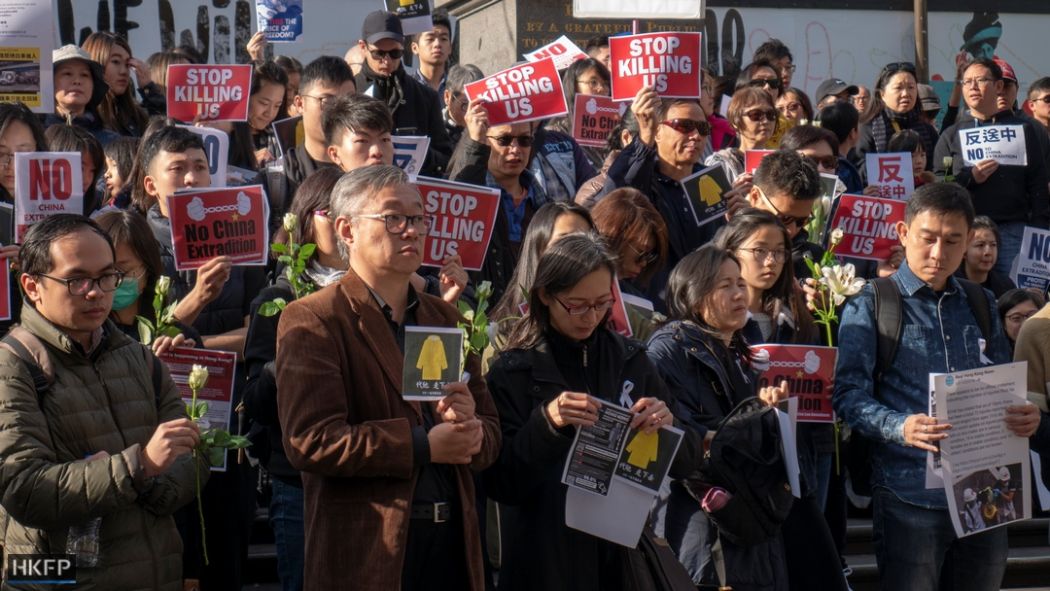
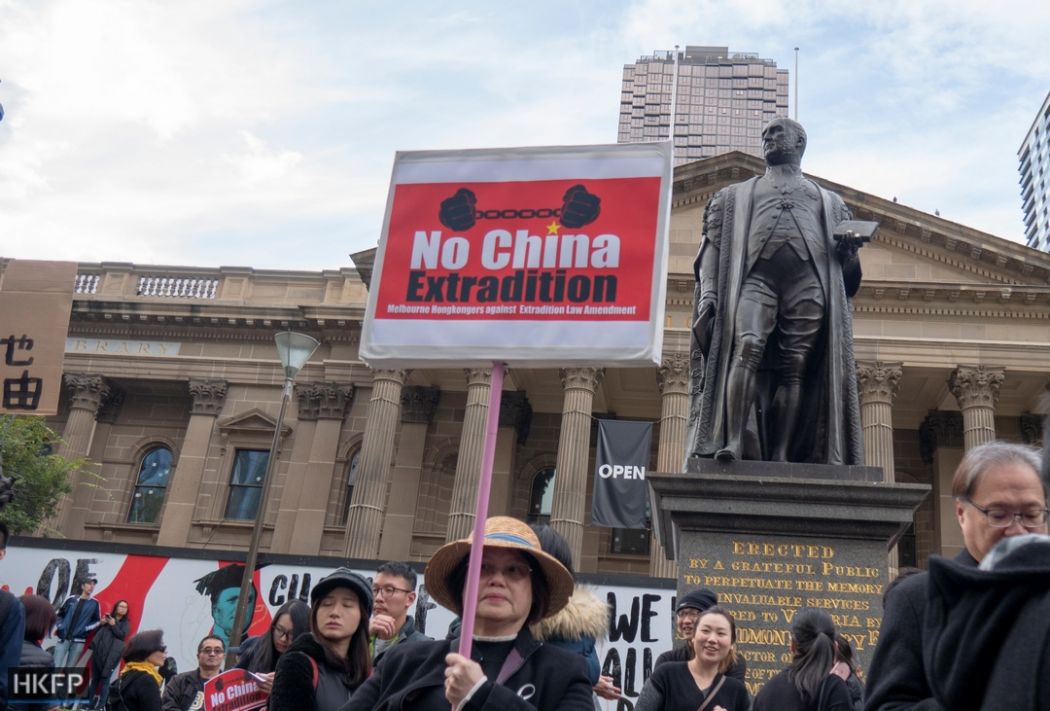
Hundreds gather outside the State Library of Victoria to call for the withdrawal of the Extradition Law. 

Rallies were held in all six Australian states, with protests in Melbourne, Sydney, Brisbane, Hobart, Perth and Adelaide. 
A demonstration was also held at the national capital in Canberra.
In Melbourne, home to one of Australia’s largest Hong Kong communities, hundreds gathered outside the State Library of Victoria to express solidarity with Hong Kong protesters.
The demonstrators included a large contingent of Hong Kong and Taiwanese students, along with members of the Australian Tibetan community and former Umbrella Movement protesters.

Hundreds gather outside the State Library of Victoria to call for the withdrawal of the Extradition Law. 

The rally began with a minute’s silence for an extradition law protester who died on Saturday evening after falling from a mall in Admiralty.
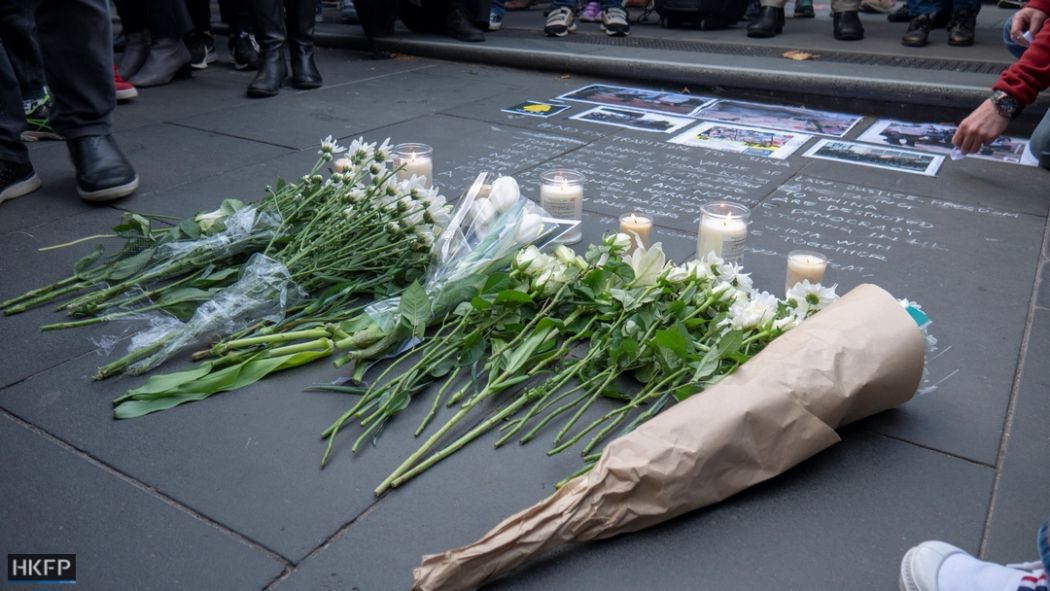
Flowers and candles were also placed at a memorial on the steps of the State Library of Victoria.
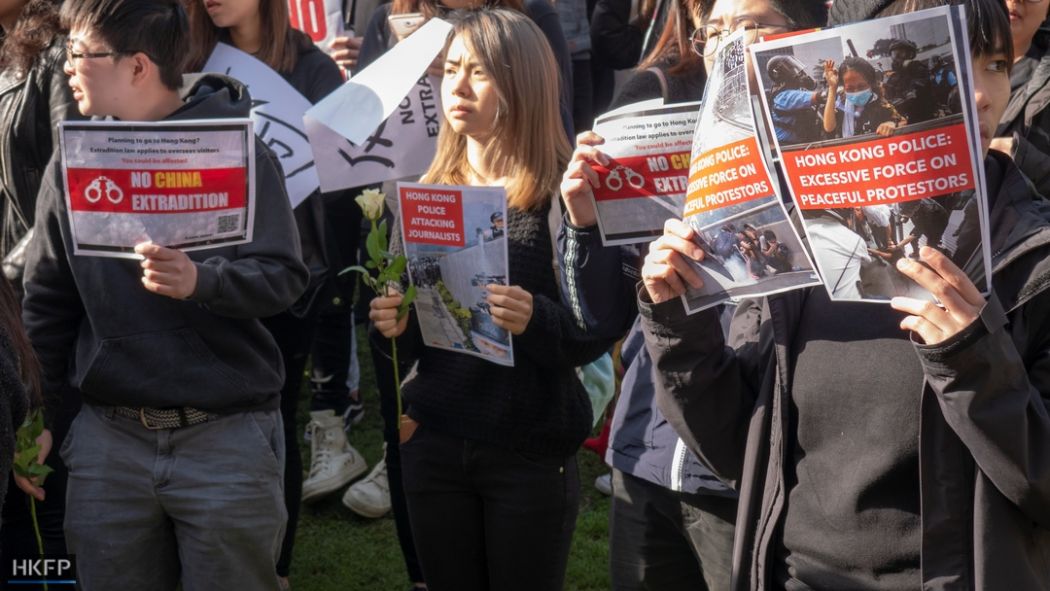
Chanting “Say No to China Extradition”, the protesters called on Hong Kong chief executive Carrie Lam to withdraw the extradition law, condemn and investigate police violence and retract the classification of the June 12 protests as a “riot”.

Hundreds gather outside the State Library of Victoria to call for the withdrawal of the Extradition Law. 

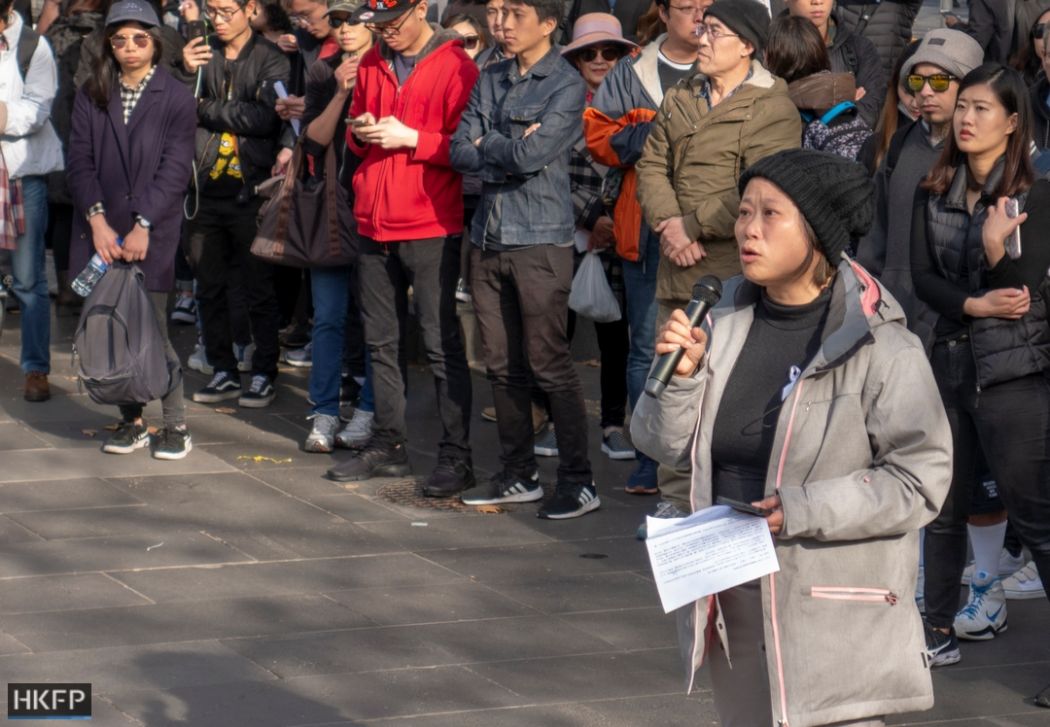
Jane Poon, from Australia-Hong Kong Link, was one of the event organisers who addressed the crowd.
“How can Carrie Lam, as a mother, use tear gas, rubber bullets and bean bag rounds to ‘reprimand’ her children?” Poon said.
“How can Stephen Lo send his police to use their batons to strike our youth?

Jane Poon addresses the crowd outside the State Library of Victoria. 

“We must protect and stand up for our youth. Carrie Lam and Stephen Lo still June 12 a riot – so the young people can still be arrested and jailed.”
Hannah, originally from Hong Kong, asked people who care about human rights to pray for Hong Kong.
“I am a Hong Kong person and I’m also a Christian. Seeing so many Christians peacefully singing Sing Hallelujah to the Lord in front of the police made me very emotional,” she said.
“God is watching what’s happening in Hong Kong right now.”

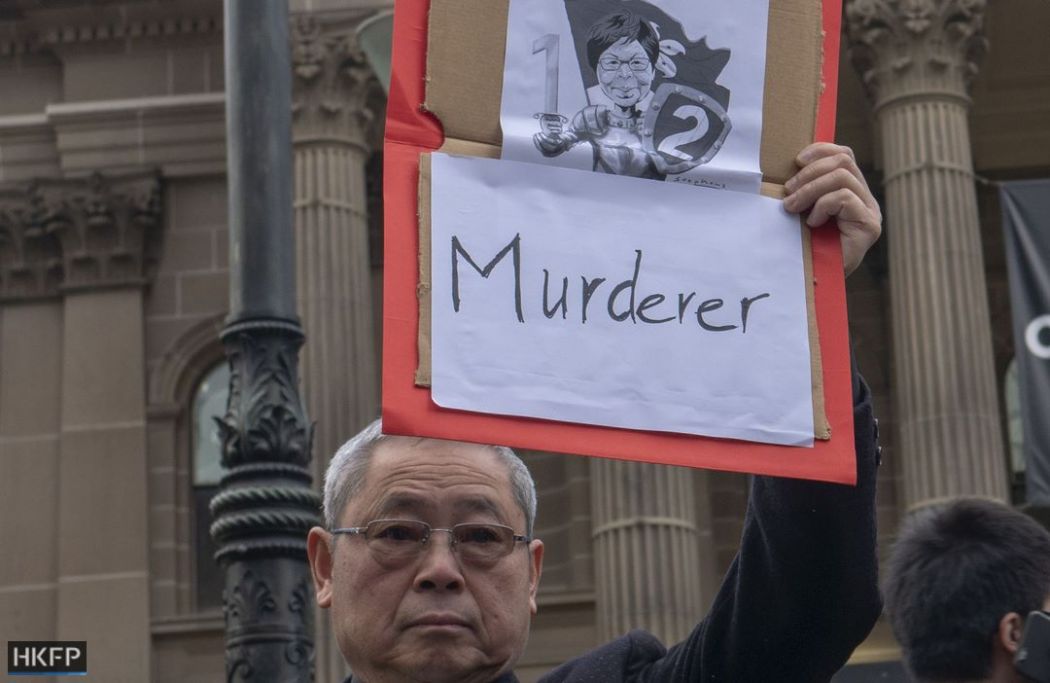
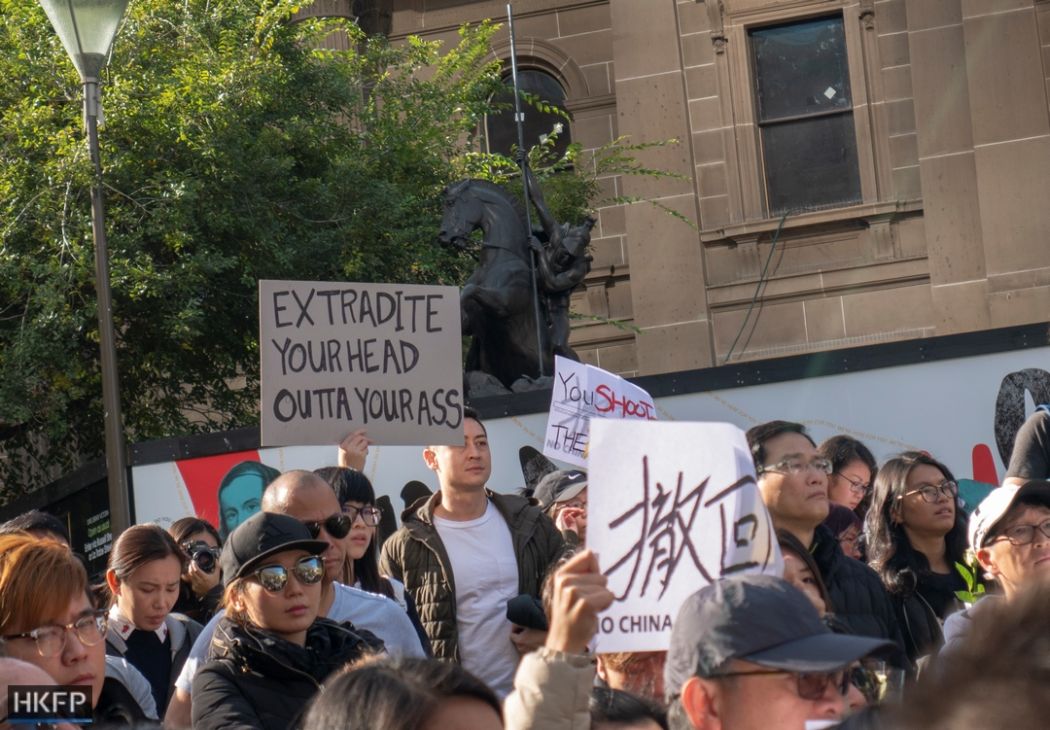
Protesters hold up signs showing their opposition to the Extradition Law.
A number of people from mainland China also attended the Melbourne protest.
A man who identified himself as Ming said he joined the rally to show his support for the Hong Kong protests.
“A lot of people in China don’t know what’s going on as they just follow the mainstream media report from the government’s side,” he said.
“I feel very sad about what’s happening to the Hong Kongers. Their freedom becomes more and more limited.”

Protesters hold up signs showing their opposition to the Extradition Law. 
“But the younger generation of Hong Kongers haven’t been brainwashed. So many people have come out and I think that’s the future of Hong Kong.”
Earlier in the day, Hong Kong international students from Melbourne universities organised a silent protest in the heart of Melbourne’s central business district.
“Many of the young people protesting in Hong Kong right now are our friends,” one of the protesters said.
“We are in the exam period here in Australia, and we feel so powerless.”

Protesters hold up signs showing their opposition to the Extradition Law. 

“But even though we are in Melbourne and not Hong Kong, we can still do something.”
Protesters also expressed disappointment at the response of Hong Kong born-Australian MP (a member of Parliament) Gladys Liu to the extradition law.
Last month, Liu became the first Chinese woman elected to the Australian parliament.
In an interview with Australian news channel SBS, Liu said she “hasn’t really looked into the details of the legislation”.

Candles and flowers are placed on the steps of the State Library of Victoria in memory of an anti-extradition law protester who died last Saturday. 

This was the second time in two weeks that public demonstrations against the extradition law were held in Australia.
Previously, protests in five Australian cities attracted an estimated 5,000 people.

mercredi 19 juillet 2017

Badiucao Launches Global Art for Liu Xiaobo Campaign

China Digital Times

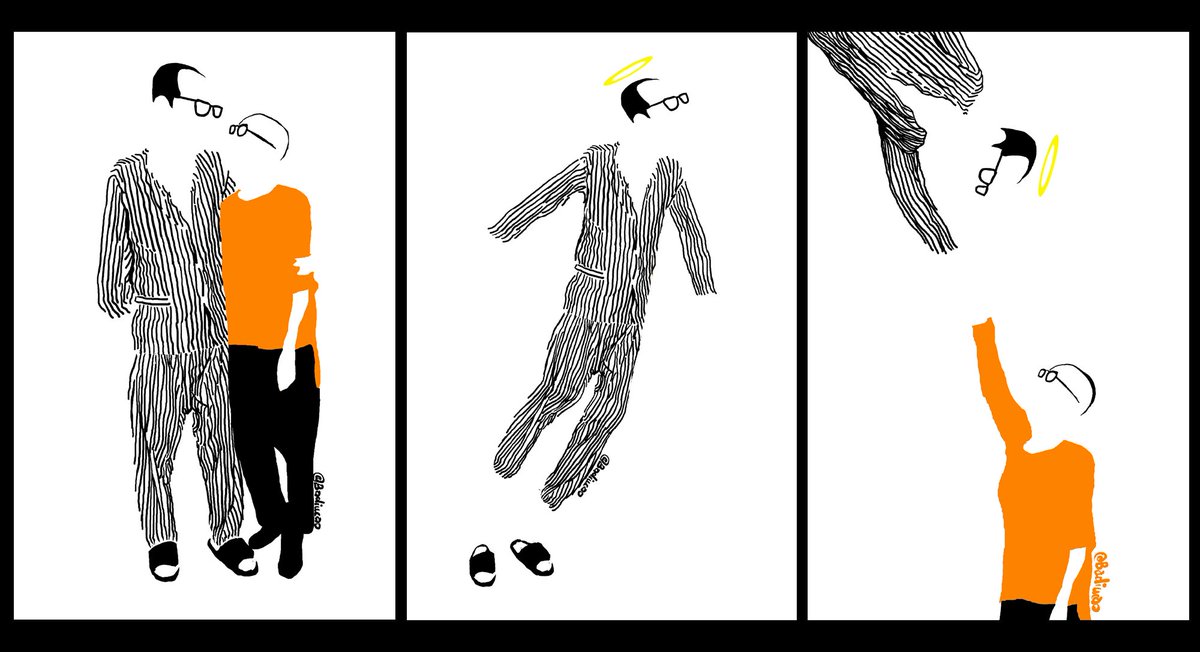
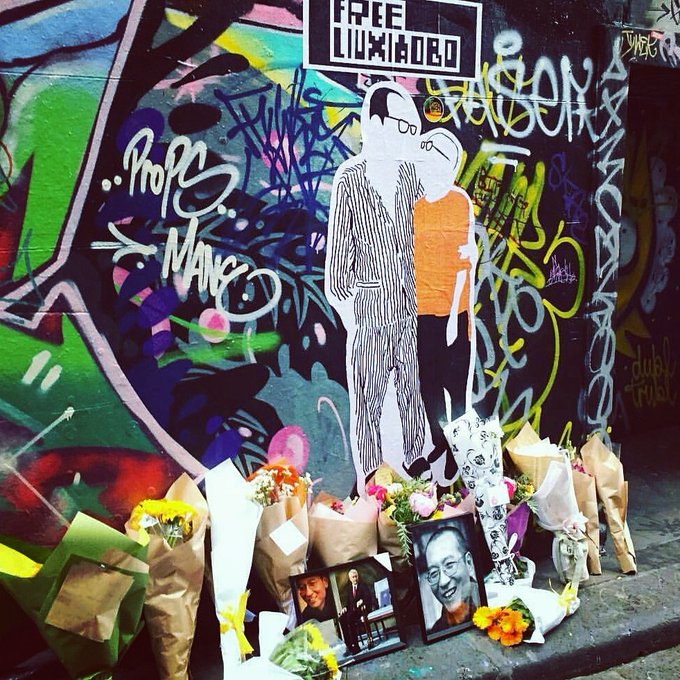
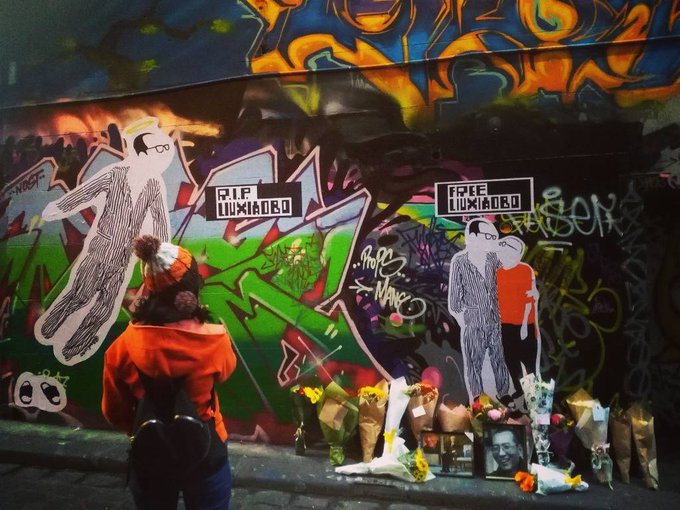
On July 12, as  was in his final hours of life and Chinese authorities had made clear they wouldn’t allow the imprisoned Nobel Peace Prize laureate to go abroad for medical treatment, CDT resident cartoonist Badiucao headed to the public  alley on Hosier Lane in Melbourne, Australia to hang a commemorative poster and “Free Liu Xiaobo” sign. After Liu’s death, the Melbourne-based artist is continuing his “Art for Liu Xiaobo” campaign, calling on his fans and Liu Xiaobo supporters worldwide to take it global. In correspondence with CDT Chinese editors, Badiucao explained the campaign:
7/12, Mr. Liu Xiaobo’s fatal illness has sent me to the Melbourne streets to launch a commemorative poster campaign. After the 13th, the sadness of Xiaobo’s passing and anger with the ruthless treatment from authorities has led me to continue the “posters for Xiaobo” campaign and appeal to society for help. Perhaps art is the best way to pay homage to Liu Xiaobo, a doctor of aesthetics, art can also influence all people around.  
I have created these Liu Xiaobo and  cartoons, which are the main pieces I plan to post on the streets. [Chinese]
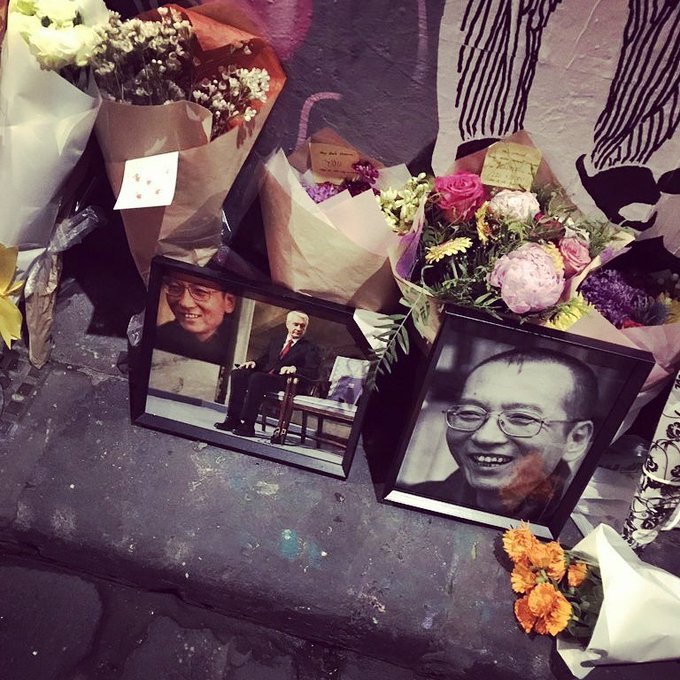
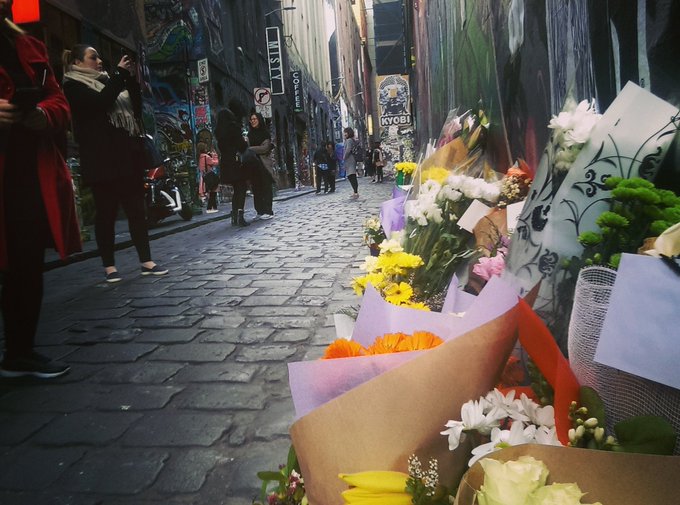
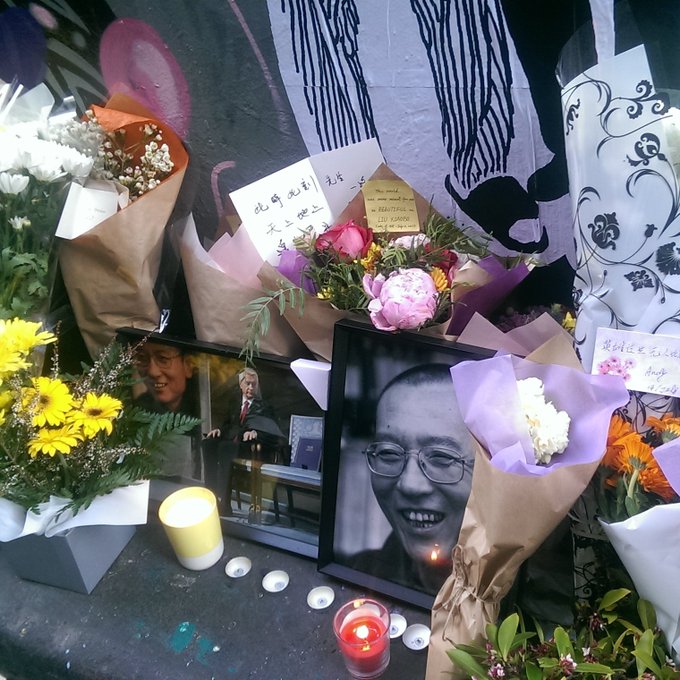
On July 12 in Australia I launched a Support Liu Xiaobo  movement (at that time the state of Xiaobo’s illness was getting extremely severe). The entire process was very simple, seek out a legal and local graffiti site, and put up posters of Mr. Liu Xiaobo. This was just for self-expression, but the next day I discovered Melbourne residents had filled the alley with flowers, in one evening what began as one poster in the city center had turned into a corner for investing support and thoughts. Perhaps Dr. [Liu] is feeling comforted in heaven. [Chinese]
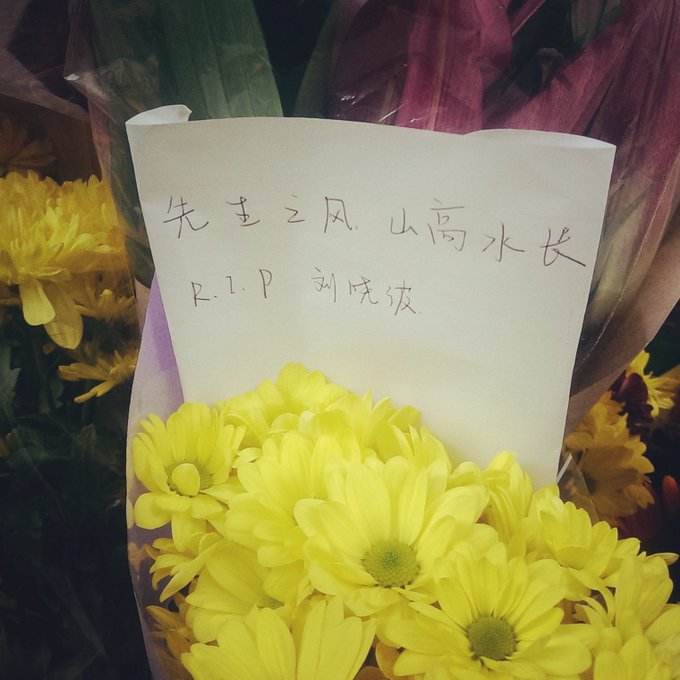
Flowers are already filling the alley at the Hosier Lane #LiuXiaobo commemorative graffiti spot.  Tourists were constantly snapping pictures while coming and going, some of them took the initiative to stop for a moment and read the introduction to Liu Xiaobo, some wrote a brief note, some lit a long-life candle.
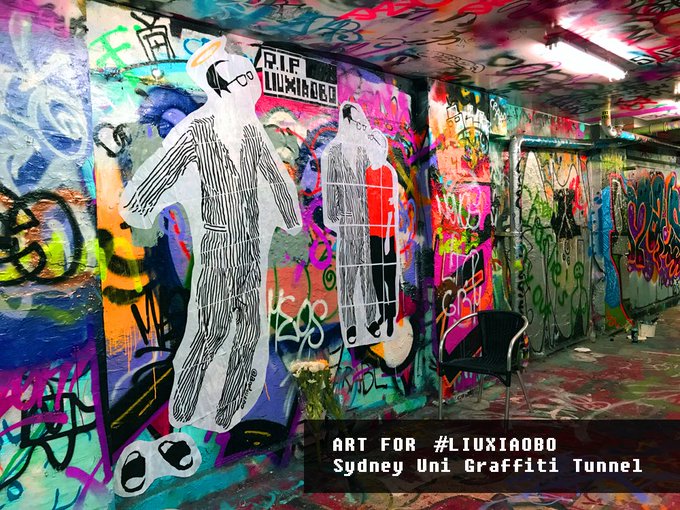
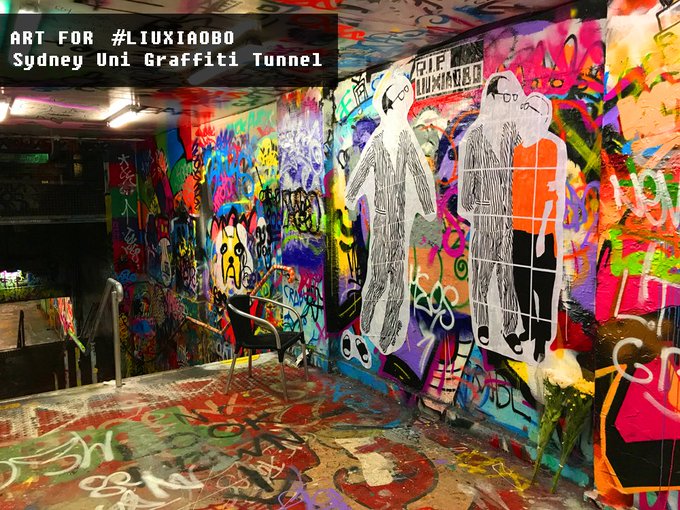
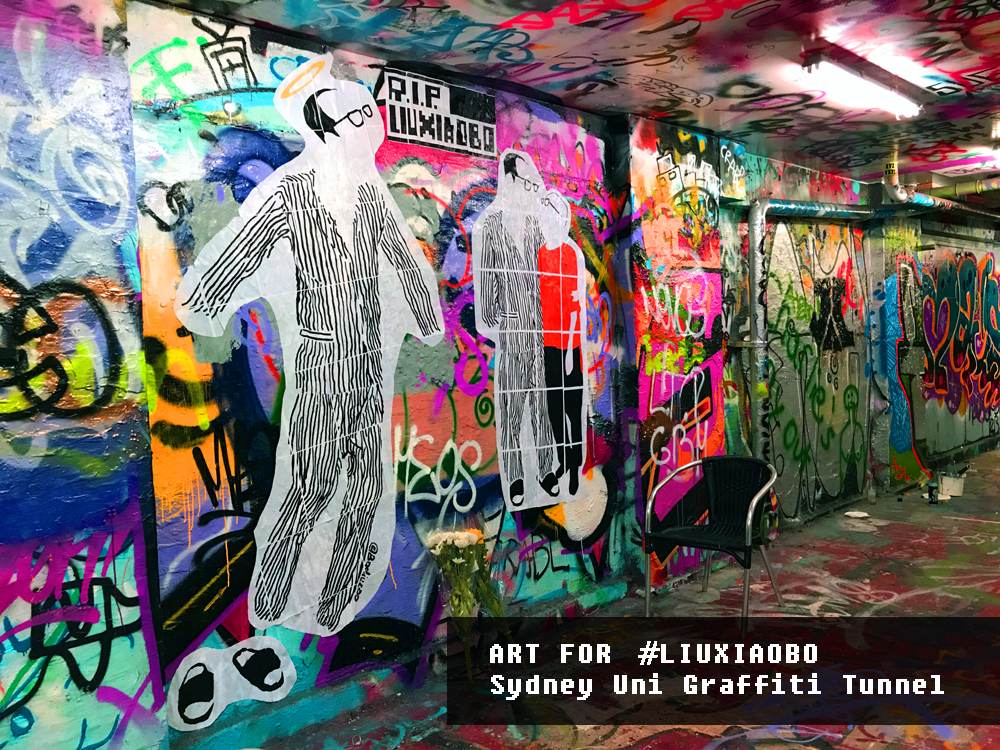
On July 16, Badiucao thanked his Twitter friends for replicating his efforts at the Sydney University Graffiti Tunnel, and promised to make his art available for more commemorative spaces elsewhere:
Thank you Twitter friends for bringing my #LiuXiaobo and #LiuXia pictures to Sydney University! I look forward to everyone seeing the commemoration! In a short while I will provide poster-making and hanging instructions, I want to bring Xiaobo to more of the world’s cities!
True to his promise, Badiucao has uploaded multi-panel versions of his artwork on Google Drive to be printed and posted in cities around the world in commemoration of Liu Xiaobo. Badiucao also invites other artists to supply their designs for the campaign via Twitter.
So far I’ve already constructed and arranged a set of tutorials available to download, print, and use to friends across the world—I even invite those in China to join in. Use these to establish a commemorative space for Liu Xiaobo. Mr. Liu Xiaobo’s remains are already at sea, but his soul will forever be on this earth. [Chinese]
To start a commemorative space in your city, find a legal graffiti wall, visit Badiucao’s collection of printable posters on Google Drive or Dropbox, and follow his print and paste instructions (in Chinese, or follow similar instructions for wheat-pasting in English). Once the art is hung, take a picture and tweet it to @Badiucao.
You can support Badiucao by buying “Watching Big Brother: Political Cartoons by Badiucao,” available in EPUB and PDF formats. The book covers the early years of Xi’s presidency, from December 2013 to January 2016. No contribution is required, but all donations will go to Badiucao to support his artwork. CDT is also selling merchandise featuring Badiucao’s work in our Zazzle store. See also interviews with the artist by CDTPRI’s The World and Australian Broadcasting Corporation’s RN. Many of his earlier  are available via CDT.