Affichage des articles dont le libellé est WHO. Afficher tous les articles

vendredi 14 février 2020

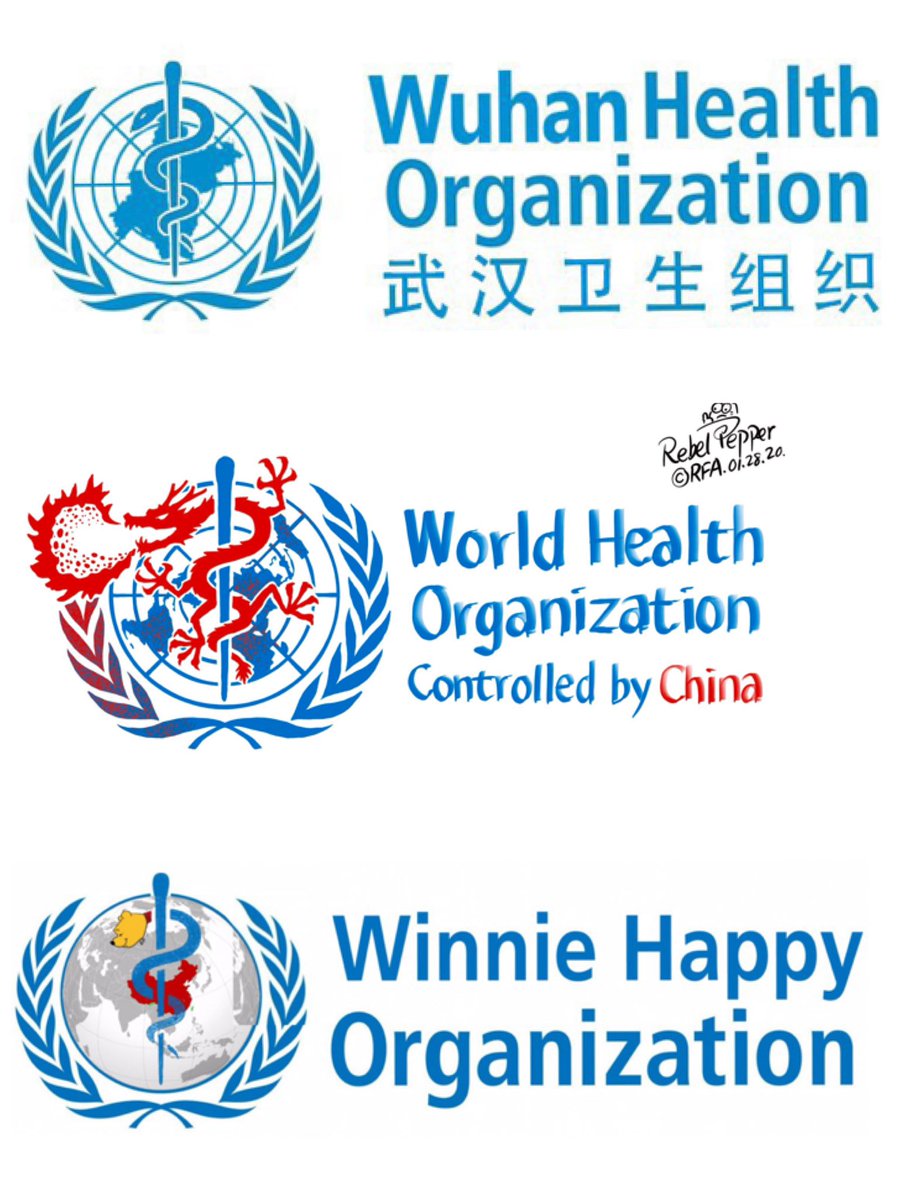
WHO accused of being a Beijing puppet

The Chinese coronavirus outbreak shows WHO kowtowing to China's despots
By FRANK CHEN
Questions have been raised over the World Health Organization’s handling of the Chinese coronavirus in China, with one dissident calling the WHO an ‘affiliated organization’ of the Chinese Communist Party.
The comment came from Yu Jie, a scholar-turned-dissident who lives in exile in the US. 
Yu was a close associate of the late Nobel Peace Prize laureate Liu Xiaobo and compared the WHO to an ‘affiliated organization’ of the Chinese Communist Party.
Yu noted the WHO’s flawed risk assessment of the spread of the Chinese coronavirus as well as its foot-dragging before declaring the public health emergency as an incident posing global risks.
Another critic was famed Chinese artist Ai Weiwei, a thorn in Beijing’s side for his politically iconoclastic artwork. 
He also relayed a petition letter demanding WHO Director-General and famous Beijing puppet Tedros Adhanom’s resignation.
“On January 23rd, 2020, Adhanom declined to declare China virus outbreak as a global health emergency. The number of infected and deaths has risen more than tenfold within only five days since then. Part of it is related to Adhanom’s underestimation of the situation in China.
“We believe the WHO is supposed to be politically neutral … On the other hand, Taiwan should not be excluded from the WHO for any political reasons. Their technologies are far more advanced than some of the countries on the ‘selected WHO list’ and can contribute to the global fight against the virus given its well-rounded medical and public health expertise and geographical proximity to mainland China,” read the petition.

When Chinese dictator Xi Jinping met Adhanom in Beijing at the end of last month, there were three tables separating Xi and Adhanom when the two were seated inside the Great Hall of the People, with no interpreters working behind them.
This unusual arrangement for when Xi receives a foreign dignitary has been interpreted by some observers as Xi’s unease about being infected with the coronavirus.
It was thought Xi wanted to keep a safe distance and take no risks, even though Adhanom was coming from Geneva, which had not been hit by the outbreak that started in Wuhan in the central Chinese province of Hubei.
Chinese dictator Xi Jinping with his puppet Tedros Adhanom in the Great Hall of the People in Beijing.

In a long-winded speech during the sit-down, Xi talked up how he had personally orchestrated the response to the pandemic and overseen the deployment of resources, stressing China’s confidence and capabilities to triumph over the virus under the strong and robust leadership of himself and the mighty Communist Party.
It was surely too much to expect Xi to make a personal appearance in the epidemic epicenter of Wuhan, where the acute respiratory disease has, regardless of the rampant under-reporting, struck down 35,991 people and killed more than 1,000, according to the latest official figure as of Friday afternoon.
The WHO, nonetheless, praised China’s “aggressive response” to the virus by closing transportation, schools and markets.
Adhanom, who hails from Ethiopia, a country that is a recipient of a large amount of Chinese foreign aid for Africa, was addressed by Xi and the Chinese state media as an “old friend” of China.However, he is now accused of fawning to Xi and putting the WHO under Beijing’s spell, especially after his indecision to announce a global health emergency early on, as well as his “gullible” acceptance of China’s tally of those infected, statistics from a country that are usually met with incredulity internationally.
In a remedial move, the WHO also held a press conference to update the public on the ongoing contagion, but the tone was as optimistic as the theme of many press conferences held by the Chinese government and attended by the deferential state media outlets.
The Beijing stooges: World Health Organization (WHO) Health Emergencies Programme head Michael Ryan, left, WHO Director-General Tedros Adhanom Ghebreyesus and WHO Chair of Emergency Committee on Ebola Robert Steffen attend a combined news conference after a two-day international conference on Chinese coronavirus vaccine research. Chinese Premier Li Keqiang flew into Wuhan at the end of last month, but it appears Xi Jinping has no plans to inspect the epicenter of the contagion. 

The WHO cited Chinese health officials as noting that the number of new infections of the Chinese coronavirus appeared to be stabilizing outside Wuhan and the rest of Hubei province this week, despite a change in China’s methodology for determining who had the disease, which led to a spike in confirmed cases in Hubei.
Cadres in the Chinese virus-stricken province said on Thursday that “clinically diagnosed” cases would be counted as “confirmed cases” and that the change was made so a broader set of patients could receive the same treatment as those confirmed with the infection.

Obsequious Acquiescence
Sylvie Briand, WHO’s director of infectious hazards, endorsed the changes to diagnosis and treatment, saying it would be "normal" for a government to alter the case definition during the course of an outbreak as the situation would be constantly evolving.
Masked doctors wave a Communist Party flag at a hospital in Wuhan in a ceremony to muster ranks. 
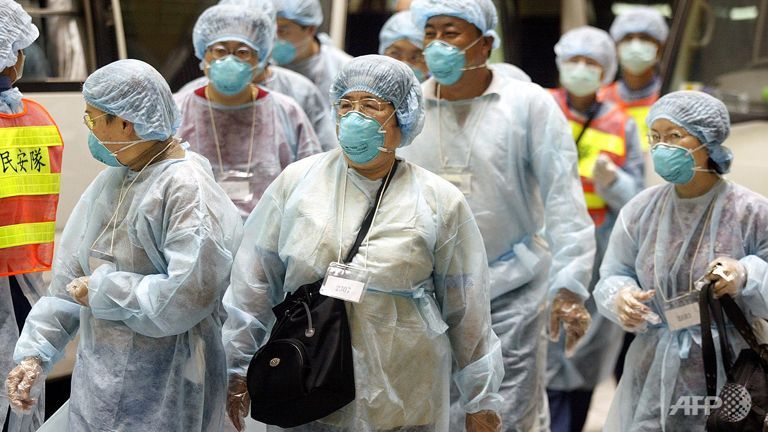
Doctors in protective gear prepare before entering wards for the infected. 

Also, the WHO’s acquiescence when Beijing moved to lock down Wuhan and put its remaining residents – almost 10 million people – into mandatory quarantine regardless of their physical condition contradicts its calls not to curtail the flow of people from China.
It was only after its belated emergency categorization of the disease – seen as being too pliant in the face of Beijing’s concerns over the economy and the country’s image – did the United Nations agency start to mobilize financial and political support to contain the spread.
The WHO has long been seen as under Beijing’s sway.
Adhanom’s predecessor -- also a Beijing puppet -- Margaret Chan, was thrust into her position as the WHO chief with Beijing’s stumping efforts for her during the selection process back in 2007.
Chan, whose catastrophic handling of the SARS crisis once drew hefty flak when she was Hong Kong’s health minister in 2003, in turn did Beijing’s bidding to bar Taiwan’s participation and diverted substantial resources into the WHO’s programs in China, among other things.

jeudi 6 février 2020

Taipei lashes out at vile and evil China for blocking Taiwan’s access to the World Health Organization

  • Taiwan said China was vile and evil for blocking Taipei’s access to the WHO amid the Chinese coronavirus outbreak.
  • As of Tuesday, Taiwan has reported 11 cases of the made in China coronvirus.
By Huileng Tan

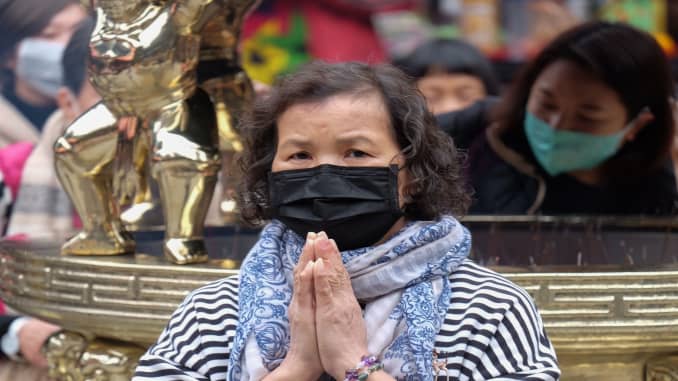
A woman wearing a protective mask prays at the Lungshan temple during the fourth day of the Lunar New year of the Rat in Taipei in January 28, 2020.

Taiwan has become more and more vocal in recent days about its exclusion from World Health Organization meetings.
It comes as the world grapples to contain the growing number of Chinese coronavirus cases that has killed more than 560 people worldwide, most of whom died in China.
Due to Beijing’s objections, Taiwan has been denied membership to most international organizations including the WHO — a United Nations agency. 
Taiwan’s Foreign Ministry spokeswoman, Joanne Ou, on Thursday slammed China and the WHO for providing wrong information about the number of Chinese coronavirus cases in Taiwan. 
The World Health Organization reported Tuesday that the island had 13 cases, when there were only 10 at that time.
Ou blamed Beijing for the error. 
“This was wrong information that was provided by China which created the mistake,” she said.
Taiwan currently has 13 confirmed cases of the Chinese coronavirus outbreak, believed to have originated from China's biowarfare labs of Wuhan in province of Hubei. 
There are more than 28,000 infected people in mainland China alone, and all but two who have died were in China.

Putting political considerations over people’s health and safety; this, basically, is extremely vile.                       --  Joanne Ou, TAIWAN’S FOREIGN MINISTRY SPOKESWOMAN

Earlier this week, Ou criticized Beijing for blocking Ta
ipei’s access to WHO, saying its isolation makes the island vulnerable to the deadly Chinese virus. 
All but two of the deaths occurred outside mainland China.
“Disease knows no national boundaries and there should be no loopholes in global epidemic prevention,” Ou said in Mandarin at the press conference on Tuesday, according to a CNBC translation. 
“Putting political considerations over people’s health and safety; this, basically, is extremely vile.”
Taiwan Affairs Office — an administrative agency under mainland China — warned on Thursday that Taipei should not use the the Chinese epidemic as a pretext to seek independence.
As the Chinese virus continued to spread, Taiwan complained it had not been receiving firsthand information about the virus, vital for the protection and well-being of it people. 
On its part, China reportedly told the WHO in Geneva that it has shared latest information about the coronavirus outbreak with Taiwan on a timely basis.
Ou disputed Beijing’s claims and said Taiwan has had very limited information, and instead relied on friendly countries such as the U.S. and Japan for information.
Taiwan participated in the World Health Assembly, the WHO’s annual policy meeting, from 2009 to 2016.
But relations between Beijing and Taipei have cooled, especially since Taiwan President Tsai Ing-wen of the Democratic Progressive Party took office in 2016. 
Tsai won a second term in office after sweeping to victory in January’s presidential election.
Taiwan’s diplomatic allies have been speaking out for its inclusion into the WHO, but Taipei has been left with a dwindling list of allies as various nations switch allegiances to Beijing, and cut diplomatic ties with the island.

Travel implications for Taiwanese
Taiwan’s foreign minister Joseph Wu on Sunday the World Health Organization’s listing of Taiwan as a province under China has created practical problems.
Countries like Italy and Vietnam suspended flights to and from China, and included Taiwan on the list of destinations where flights were halted. 
Myanmar also directed domestic carriers to suspend charter flights between the city of Mandalay and Taipei alongside flights to some cities in China.
Meanwhile, Taiwanese are facing problems after Bangladesh stopped issuing visa on-arrival to Chinese on Sunday, Taiwan’s Central News Agency reported.
Taipei said its diplomats are working hard on the ground to solve such issues.
“Cases like what’s happening with Italy also show that the interests of the Taiwanese people are negatively affected by the WHO’s decision to list Taiwan as part of China,” said Wu on Sunday. “Hundreds, if not thousands, of passengers who got caught up at the airports will not be able to get compensation from airlines, and certainly not from the WHO.”
On Tuesday, Taiwan evacuated the first batch of Taiwanese stranded in Wuhan, which is under lockdown in efforts to contain the spread of the Chinese coronavirus. 
Taiwan had complained that China was not responding to requests to fly out Taiwanese, even as Beijing approved similar requests by other governments.

mercredi 5 février 2020

US lawmakers push Beijing puppet WHO to recognize Taiwan as independent state as Chinese coronavirus outbreak continues

BY J. EDWARD MORENO

U.S. lawmakers are pushing legislation that would work toward granting Taiwan recognition in the World Health Organization (WHO) in light of the Chinese coronavirus outbreak that has left Taiwan subject to flight bans and limited information.
The WHO — a branch of the United Nations — has relayed communication on the virus to China, which considers Taiwan a Chinese territory with an illegitimate independent government. 
The island’s status as a nation is a matter of international disagreement: the U.S., Japan, Canada and the European Union all recognize Taiwan as a sovereign state, while the UN and Chinese satellites consider Taiwan a province of China. Taiwanese officials have received little information on the virus from WHO while also struggling to communicate with Chinese officials as they attempted to evacuate Taiwanese citizens from Wuhan, where the virus originated. 
Taiwan has 10 confirmed cases of the coronavirus, and on Monday night quarantined 247 people repatriated to the island after being stranded in Wuhan.
According to Taiwan’s Minister of Foreign Affairs Joseph Wu, flights to Taiwan from Vietnam and Italy were canceled last week based on information that grouped Taiwan as part of China. 
Flights from Vietnam were restored, but Taiwan is still “working through all diplomatic channels” to restore flights from Italy.
Wu argues that the WHO's choice to exclude Taiwan from the organization puts the health of Taiwanese citizens at risk. 
“While we are still going through our own channels and through like-minded friends to reason with the WHO to right its wrong, I would like to publicly call upon the WHO to recognize the simple fact that Taiwan is Taiwan and it is not part of the [People's Republic of China]," Wu told press on Sunday
"Taiwan is not under China's jurisdiction; Taiwan's and China's health are administered by separate and independent health authorities, and Taiwan's and China's flight information regions are administered by separate and independent civil aviation administrations."
“This is such a simple reality that the WHO should never have missed it," he continued. 
"Again, I call upon the WHO to correct its gross mistake.”
Taiwan was recognized by the WHO under the name “Chinese Taipei” from 1997 to 2016, when pro-sovereignty Taiwanese President Tsai Ing-wen took power, leading China to pressure the UN to subject Taiwan to the “one China principle.” 
The Chinese coronavirus outbreak comes less than a month after Taiwan reelected Tsai by a large margin, sending a message to mainland China about where the Taiwanese electorate stands on the issue of sovereignty.
Last month Rep. Ted Yoho (R-Fla.) introduced legislation that would direct the State Department to develop a strategy that would give Taiwan recognition in the WHO. 
The bill passed the House unanimously and is currently in the Senate Foreign Relations Committee. 
“Taiwan’s exclusion from the WHO puts the world at risk,” Yoho wrote in an op-ed in the Taipei Times
“That is why I have called for the re-establishment of Taiwan’s observer status on numerous occasions.”
Last week, Sen. Ed Markey (D-Mass.), a member of the Senate Foreign Relations Committee, wrote a letter to the State Department asking it to push for Taiwan’s inclusion in the WHO. 
Days later, seven GOP senators — several of whom are also members of the Foreign Relations Committee — penned a letter to the WHO asking them to recognize Taiwan as an independent state.

Today @SenTomCotton @SenRubioPress @JohnCornyn @JimInhofe @SenatorRomney @SenTedCruz and I are calling on the @WHO to grant Taiwan observer status in light of the coronavirus outbreak to better protect global health and security. pic.twitter.com/dogp9EvOCR
                                — Cory Gardner (@SenCoryGardner) January 31, 2020

The relationship between the United States and Taiwan is a partnership between two vibrant democracies based on shared values and vision,” wrote Sen. Marco Rubio (R-Fla.), in an op-ed in the Washington Examiner in which he argued for U.S. assistance to Taiwan in trade and defense.
The WHO did not immediately respond to a request for comment from The Hill.

The Chinese coronavirus lays bare WHO's abject obedience to China

The global body is  complicit in China’s flawed handling of the Chinese virus's outbreak by failing to act fast to halt pandemic 
By Peter Beaumont

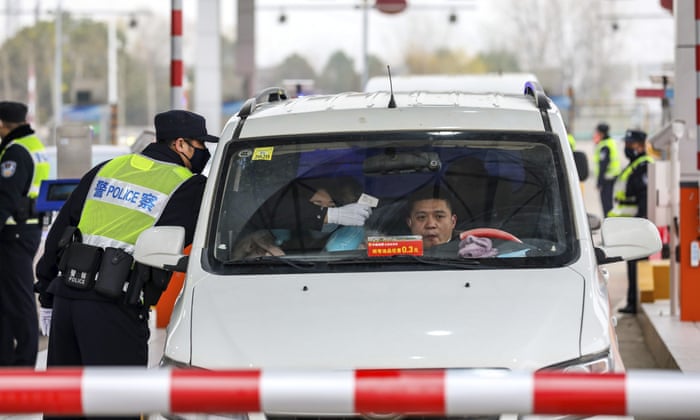
A police officer uses a thermometer to take a driver’s temperature at a checkpoint in Wuhan. 

On social media this week the insults were flying thick and fast, some tinged with racism, but all with a common theme: how the World Health Organization, and its head, the incompetent Tedros Adhanom Ghebreyesus, was effectively doing the bidding of the Chinese government in the midst of the Chinese coronavirus outbreak.
It is a charge that has also been expressed in less offensive terms elsewhere in columns and articles, some of which have focused on whether, in praising China’s response to the deadly Chinese coronavirus outbreak during a visit to Beijing, the Beijing puppet Ethiopian allowed himself to become complicit in China’s flawed handling of the outbreak in its early days?
In some respects, it is a hoary old paradox, familiar to many international bodies and NGOs. 
How – when dealing with a health crisis or a humanitarian disaster – you are limited in the choice and nature of your partners in the place where it is occurring, and the limitations they impose.
But if the politics of such accommodations is always uncomfortable, the Chinese coronavirus outbreak encapsulates in a stark fashion a number of difficult issues.
Above all, it asks how the UN’s international health diplomacy, confronted with a pandemic where a timely and accurate flow of information is crucial, should interact with one of the world’s most criminal states.
Looming above all else is the fact that China is a country whose trajectory under Xi Jinping has been to become more, not less, authoritarian, marked by mass internment camps for Uighurs, a growing internet crackdown and its harsh response to street protests in Hong Kong.
There seems little doubt either that China’s bureaucratic culture of control and secrecy, including the local government’s efforts to clamp down on the information emerging about the disease in the first weeks of the epidemic, contributed to its spread in December and the first weeks of January.


Tâi Siáu-káu (台痟狗) ㄊㄇㄉ Taiwan @TimMaddog
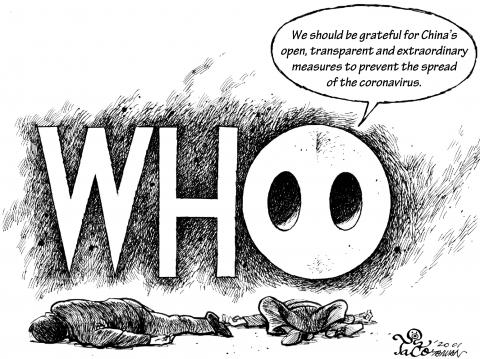
TaCo editorial cartoon: World Health Organization'a (@WHO) words vs. the truth about China (dead people in the streets) .http://www.taipeitimes.com/News/editorials/photo/2020/02/03/2008185035 …#2019nCoV#WuhanCoronavirus#武漢肺炎


4
12:56 PM - Feb 3, 2020
Twitter Ads info and privacy


Interposed into the midst of all this has been the pro-China WHO – and the Tedros – a relationship complicated by the fact that China is a major donor to the world health body. 
The mix of health and international politics has been underlined by the exclusion of Taiwan from discussions even after the coronavirus spread there.
The argument about how the WHO has negotiated the complexities boils down to several key questions.
The first is whether the organisation should have pushed harder for Beijing to be more forthcoming when evidence of a new form of coronavirus first emerged, but before the scale of the outbreak was fully acknowledged. 
And whether the head of the UN body should have been so degraded in praising the response of a country that unsettles so many for its secrecy and rights violations.
In particular, the fraught politics of the WHO declaring the outbreak a public health emergency of international concern (PHEIC) has once again come under the spotlight in the same way it did during the Ebola crisis in the Democratic Republic of the Congo.
Some of those most critical have parsed Xi’s meeting with Tedros – and Xi’s declared hope that the UN body would assess the “epidemic situation in an objective, just, calm and reasonable way” – as pressure from Beijing to ensure WHO would refrain from designating the epidemic a global health emergency to protect China’s economy.
Although that didn’t happen, the WHO’s advice – contrary to that of many governments – is that it still “advises against the application of any restrictions of international traffic based on the information currently available on this event”.
And on this front some are pointing to a startling contradiction: how the discredited UN body has praised the extreme internal travel restrictions in China while criticising other countries for implementing their own travel measures.

mercredi 29 janvier 2020

Containing the Coronavirus: Countries Limit Travel to China

With cases spiking in China and early signs of a spread outside Asia, Hong Kong severely cut back transportation to the mainland.
By Paul Mozur

Medical workers at a checkpoint near the border of Hubei Province on Tuesday.

HONG KONG — Countries, cities and businesses across the globe issued new travel warnings on Tuesday, vastly expanding a cordon intended to control the flow of people to and from China, where the authorities are struggling to contain the outbreak of the new coronavirus.
In the most drastic measure to limit travel, the Hong Kong authorities reduced by half the number of flights and shut down rail service to mainland China, and they also limited visas — moves that could inspire other governments to follow suit.
Measures to contain the outbreak of the virus to its epicenter in Hubei Province appear to have failed to stop the contagion.
On Wednesday morning, Chinese officials said the number of cases had increased by nearly a third overnight. 
Experts warned that the actual number of cases could be significantly higher and growing quickly. The number of deaths attributed to the virus also continued to grow.
The new travel restrictions put a deeper freeze on China’s contact with the world, cutting off business and tourism as China’s economy faces a potential slowdown.
With China’s Lunar New Year holiday nearing its end, companies ordered workers to stay home and avoid travel. 
The economic impact of such measures pointed to a deeper political crisis, with many people accusing the Chinese authorities online of failing to act quickly to contain the virus, even as the government continues to struggle to control its spread.
The travel advisories and bans came as the virus showed early signs of spreading outside China, with cases of transmission to people who had not recently traveled to China reported in Japan, Germany and Vietnam. 
Countries across the world may now be faced with the task of limiting the spread of the disease on their own soil, not simply seeking to identify and quarantine infected people who had been in China.

Disinfecting a Thai Airways airplane near Suvarnabhumi Airport in Thailand.

Officials at the United States Centers for Disease Control and Prevention warned against nonessential travel to China, noting that there is “limited access to adequate medical care in affected areas.” 
The United States is expanding the screening of travelers arriving from Wuhan to 20 airports and other ports of entry, from five, federal officials said on Tuesday.
The World Health Organization revised its global risk assessment for the outbreak from “moderate” to “high,” although it noted this shift in a footnote buried in a report published on Monday. 
The change in the risk assessment, which coincided with a visit to China by the organization’s director general, risked confusing the public about the severity of the outbreak, which has killed more than 130 people in China and been diagnosed in at least 14 countries.

The pro-China World Health Organization was criticized after it refused twice in recent days to declare the outbreak a global emergency, despite its spread.
With other countries scrambling to evacuate their citizens from the locked-down epicenter of the outbreak in central China, the WHO said its director general, Beijing puppet Tedros Adhanom Ghebreyesus, had discussed with Chinese officials “possible alternatives to evacuation of foreigners if there are ways to accommodate them and protect their health.”
Although Chinese medical workers have described a desperate need for more resources to treat thousands of new patients, state-run Chinese media reported that Tedros had spoken highly of the Chinese efforts to contain the virus. 
The Chinese authorities agreed on Tuesday to allow in teams of international experts, coordinated by the World Health Organization, to help with research and containment.

A hospital under construction in Wuhan that will treat people infected with the coronavirus.

Chinese officials said Wednesday that 132 people had died from the virus, up from 106 the day before. 
The total number of confirmed cases rose sharply as well, to 5,974 on Wednesday, according to the National Health Commission.
The youngest confirmed patient is a 9-month-old girl in Beijing. 
While the majority of confirmed cases were in Hubei, where a number of cities have been put under effective lockdown, an additional 1,800 cases have been diagnosed outside the province, the authorities said.
In Wuhan, medical workers have cited a lack of masks and kits to test for the virus. 
China’s medical products administration said on Sunday it had approved new virus detection kits to speed detection, but three Chinese medical companies said they did not have the capacity to produce enough of them, according to local news media reports.
Many in Wuhan with symptoms of the virus have not been tested or have been told the hospitals did not have enough test kits, some local residents said.
During a visit to Wuhan on Monday, Li Keqiang promised to provide more equipment, and the local government has begun building new hospitals that it hopes to open in a matter of weeks. 
But online, many people mocked the government’s efforts.
In indications of the virus’s spread beyond China’s borders, Thailand reported 14 cases of infection, while the United States and Australia have each confirmed five cases. 
Singapore, South Korea and Malaysia each said they had confirmed four cases.

Japan’s Ministry of Health, Labor and Welfare, which has now confirmed six cases, said that the virus had been found in the first Japanese citizen. 
The ministry said he had worked as a bus driver for two different tour groups from Wuhan. 
He had no history of traveling to Wuhan.
The man, who had driven for the tours earlier this month, first reported experiencing chills, a cough and joint pain on Jan. 14. 
He visited a clinic three days later, but was sent home. 
On Jan. 22, his joint pain and cough grew worse, and he returned to a health clinic on Saturday, when a chest X-ray showed abnormalities and he was admitted to a hospital. 
A test confirmed the coronavirus on Tuesday.
German officials said Tuesday that they had identified what they believed was the first instance of the virus spreading within Europe. 
They said a man from Starnberg in Bavaria was infected and was being treated and kept in isolation. The health ministry described him as being in “good condition” medically and said it was also monitoring his family and other people who might have been exposed, including in his children’s day care center.
“It was to be expected that the virus would come to Germany,” Jens Spahn, Germany’s health minister, said in a statement on Tuesday. 
“But the Bavarian case shows us that we are well prepared.” 
He said the risk to Germans remained low.
Japan planned to send a chartered plane to Wuhan on Tuesday night to bring back the first Japanese citizens who wish to be repatriated. 
At least 13 countries have said they would evacuate their citizens from Wuhan, where the virus is believed to have been transmitted from animals to humans.
Businesses that operate in China have issued warnings of their own. 
In a flurry of emails sent in recent days, General Motors, Honeywell, Bloomberg, Facebook and other companies have warned employees not to travel within mainland China.

A shopping area in Beijing, normally busy during the Chinese New Year, was nearly empty on Tuesday.

Honeywell, which has offices and operations across China, said it had restricted travel to some regions, but did not specify which ones. 
A spokesman for General Motors said the company had issued a global travel ban to China, with only “business-critical” travel allowed and only after clearance from a doctor. 
Bloomberg told its employees in Hong Kong and mainland China to work remotely until further notice and it restricted travel to China and Hong Kong over the next 30 days, according to an email seen by The New York Times.
The Chinese government has extended the Lunar New Year holiday until Feb. 3, with some of China’s biggest cities telling businesses not to open until the following week. 
China’s biggest technology companies went further, notifying employees to work from home until Feb. 10. 
NetEase, an internet and entertainment platform, asked employees who were returning from another city to quarantine themselves for 14 days.
Investors in Asia were gripped on Tuesday with fear about the health of the global economy for a second day, with a widespread sell-off continuing in the markets. 
Investors dumped stocks in companies thought to be most vulnerable to the effects of the virus.
“The coronavirus is the No. 1 threat to financial markets currently as global investors are becoming jittery on the uncertainty,” said Nigel Green, founder of an investment company, the deVere Group.
In Hong Kong, medical professionals called for additional border checkpoints.
“The next week or two will be a critical time for the development of the epidemic,” the faculty at the Chinese University of Hong Kong wrote on its Facebook page. 
“We must closely monitor whether there is a community outbreak outside Hubei Province, especially in Hong Kong’s neighboring regions.”

A checkpoint on the outskirts of Beijing.

vendredi 6 septembre 2019

Plagues of China

China has the world's biggest hepatitis C problem, says WHO
By Julie Zaugg and Yong Xiong

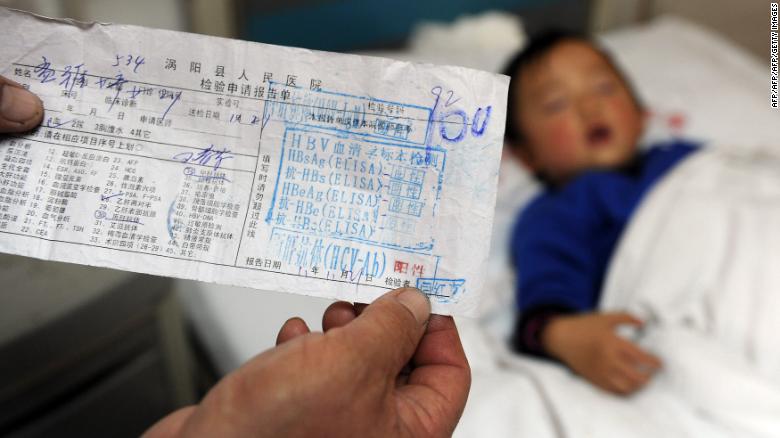
In this picture taken on November 28, 2011, a Chinese parent shows a test result slip confirming his child has hepatitis C, at a hospital in Hefei, east China's Anhui province.

China is facing a hepatitis C epidemic. 
The infectious disease, which can lead to cirrhosis, liver cancer and early death if left untreated, has hit rural areas particularly hard.
In June, China recorded 21,419 new cases of hepatitis C and 14 deaths related to the disease, according to new figures released by China's Center for Disease Control and Prevention. 
For the whole of 2018, the country had 219,375 new cases -- 43% more than in 2010.
China now has the world's largest burden of hepatitis C -- an estimated 8.9 million people, or 0.6% of the overall population -- according to a WHO study released in March. 
Many of them will die from it: China accounts for more then half of the world's annual liver cancer fatalities caused by hepatitis C, according to the study.
The disease is commonly spread by shared needles. 
Consumption of crystal methamphetamine, which has snowballed in recent years in China according to the United Nations Office on Drugs and Crime and can be taken by injection or inhalation, has contributed to the growing number of new infections, according to the WHO.
In Yi Prefecture, a mountainous region in Sichuan province along a major trafficking route with a high proportion of drug users, nearly five times the national average -- 2.8% of the population -- have hepatitis C, according to a study published in 2017 in the British Medical Journal.
Another contributor to China's epidemic is "unsterile medical injections which are often administered for unnecessary reasons," say the WHO report's authors. 
In May this year, 69 dialysis patients were infected in eastern China's Jiangsu province, primarily by unclean equipment and hospital workers' hands, China Central Television reported in May.
To exacerbate the problem, hepatitis C patients in China are not getting the care they need. 
In 2018, just 3.5% of infected people in the country were treated, according to the Polaris Observatory, a non-profit US initiative.
And while the most advanced antiviral treatments for the disease can cure 90% of cases, many patients simply can't afford medication, especially in rural areas. 
Three new hepatitis C drugs were approved by China's Food and Drug Administration in 2017, but they are not covered by China's basic medical insurance, which means patients have to pay for them out of pocket, according the Beijing medicine purchasing database, a government list of medicine purchased by state hospitals.
A 12-week course of Sofosbuvir, one of the treatments not covered by basic insurance, costs 69,600 yuan ($9700 USD).

mardi 28 août 2018

China's Biological Warfare

For Over a Year, China Has Withheld Samples of a Dangerous Chinese Flu Virus
Despite an international agreement, U.S. health authorities still have not received H7N9 avian flu specimens from the Chinese.

By Emily Baumgaertner
Health workers attending to an H7N9 avian flu patient in Wuhan, China, in 2017. 

For over a year, the Chinese government has withheld lab samples of a rapidly evolving influenza virus from the United States — specimens needed to develop vaccines and treatments, according to federal health officials.
Despite persistent requests from government officials and research institutions, China has not provided samples of the dangerous virus, a type of bird flu called H7N9. 
In the past, such exchanges have been mostly routine under rules established by the World Health Organization.
Now, as the United States and China spar over trade, some scientists worry that the vital exchange of medical supplies and information could slow, hampering preparedness for the next biological threat.
The scenario is “unlike shortages in aluminum and soybeans,” said Dr. Michael Callahan, an infectious disease specialist at Harvard Medical School.
“Jeopardizing U.S. access to foreign pathogens and therapies to counter them undermines our nation’s ability to protect against infections which can spread globally within days.”
Experts concur that the world’s next global pandemic will likely come from a repeat offender: the Chinese flu. 
The H7N9 virus is one candidate.
Since taking root in China in 2013, the virus has spread through poultry farms, evolving into a highly pathogenic strain that can infect humans. 
It has killed 40 percent of its victims.
If this strain were to become highly contagious among humans, seasonal flu vaccines would provide little to no protection. 
Americans have virtually no immunity.
“Pandemic influenza spreads faster than anything else,” said Rick A. Bright, the director of Biomedical Advanced Research and Development Authority, an agency within the Department of Health and Human Services that oversees vaccine development. 
“There’s nothing to hold it back or slow it down. Every minute counts.”
Under an agreement established by the World Health Organization, participating countries must transfer influenza samples with pandemic potential to designated research centers “in a timely manner.”
That process — involving paperwork, approval through several agencies and a licensed carrier — normally takes several months, according to Dr. Larry Kerr, the director of pandemics and emerging threats at the Department of Health and Human Services.
But more than one year after a devastating wave of H7N9 infections in Asia — 766 cases were reported, almost all in China — the Centers for Disease Control and Prevention is still waiting for several viral samples, the National Security Council and the W.H.O. confirmed.
Scientists at the Department of Agriculture have had such difficulty obtaining flu samples from China that they have stopped requesting them altogether, according to a government official who spoke anonymously because he was not authorized to discuss the matter.
At least four research institutions have relied upon a small group of H7N9 samples from cases in Taiwan and Hong Kong. (All four asked not to be identified for fear of further straining ties.)
The Chinese embassy in Washington did not respond to multiple requests for comment. 
The Chinese Center For Disease Control and Prevention also did not reply to inquiries regarding the transfer.
When the H7N9 virus first appeared in China, researchers say the Chinese government at first provided timely information. 
But communication has gradually worsened.
Yet a sudden spike in infections during the 2016-2017 outbreak wave demands intense research, said scientists aiming to understand the virus’ evolution.
Health workers culling chickens in Hong Kong in 2014 following an outbreak of avian flu.
Recent trade tensions could worsen the problem.
The Office of the United States Trade Representative in April released a proposed list of products to be targeted for tariffs — including pharmaceutical products such as vaccines, medicines and medical devices.
So far, none of those medical products have landed on the final tariff lists. 
But lower-level trade negotiations with China concluded on Thursday with few signs of progress, increasing the likelihood of additional tariffs.
The United States relies on China not only for H7N9 influenza samples but for medical supplies, such as plastic drip mechanisms for intravenous saline, as well as ingredients for certain oncology and anesthesia drugs. 
Some of these are delivered through a just-in-time production model; there are no stockpiles, which could prove dangerous if the supply was disrupted, health officials said.
Scientists believe top commerce officials in both governments view the viral samples much like any other laboratory product, and may be unfamiliar with their vital role in global security.
“Countries don’t own their viral samples any more than they own the birds in their skies,” said Andrew C. Weber, who oversaw biological defense programs at the Pentagon during the Obama administration.
“Given that this flu virus is a potential threat to humanity, not sharing it immediately with the global network of W.H.O. laboratories like C.D.C. is scandalous. Many could die needlessly if China denies international access to samples.”
For over a decade, epidemiological data and samples have been used as trade war pawns.
China hid the 2002 outbreak of severe acute respiratory syndrome, or SARS, for four months and then kept the findings of its research private. 
Some provinces withheld information about cases even from the central government in Beijing.
In 2005, Chinese authorities insisted an H5N1 influenza outbreak was contained, contradicting University of Hong Kong scientists who offered evidence that it was expanding. 
Those authorities hesitated to share viral samples from infected wild birds with the international community, concealing the scope to avoid a hit to their vast poultry industry.
Indonesia followed suit, refusing in 2007 to share specimens of H5N1 with the United States and United Kingdom, arguing that the countries would use the samples to develop a vaccine that Indonesians could not afford.
Those episodes led to the 2011 development of the W.H.O.’s Pandemic Influenza Preparedness Framework, which aims to promote sample exchanges as well as developing countries’ access to vaccines.
But for countries like China, bearing the burden of a novel virus is paradoxical. 
Outbreaks are expensive — the wave of H7N9 infections in 2013 alone cost China more than $6 billion, according to the United Nations — but they can provide a head-start in developing valuable treatments.
“In a sense, China has made lemonade from lemons — converting the problem of global infectious disease threats into lifesaving and valuable commodities,” Dr. Callahan said.
And now, as the H7N9 virus evolves, United States authorities worry that the Chinese have obfuscated the scale and features of this outbreak.
The Chinese government has refused to share clinical data from infected patients, according to scientists, and claims to have all but eradicated H7N9 through a single poultry vaccination campaign.
“Influenza is going to do what it does best, which is mutate,” Dr. Kerr said.

mardi 30 mai 2017

Taiwan burnishes its freedom credentials even as China closes diplomatic doors

By Kirsty Needham 

Beijing -- For Taiwan, it has been the best of weeks and the worst of weeks.
First it suffered its biggest diplomatic humiliation in a decade, shut out of the world's peak health summit in Geneva, at China's demand.
Yet just two days later, the island was exalted by the international community for breaking new ground in Asia as Taiwan's high court ruled in favour of same-sex marriage.
Both events came as Taiwan's President Tsai Ing-wen marked a year since her inauguration, and a seismic shift in Taiwan's politics.
First year in office: Taiwanese President Tsai Ing-wen. 

For nine years under her predecessor Ma Ying-jeou, the Kuomintang (KMT) had built an economic bridge to China, allowing direct flights, tourism, and trade, but overreached and alienated young voters facing high unemployment.
In her inauguration speech as president, Ms Tsai -- leader of the Democratic Progressive Party (DPP), which has traditionally leaned towards independence -- had refused to acknowledge Beijing's core policy on cross-strait relations, the so-called 1992 Consensus that there is one China.
China froze official communication
The consequences are still flowing. 
Chinese tourist numbers to Taiwan fell 42 per cent in the first three months of 2017.
On Friday a former DPP employee, human rights activist Li Ming-che, became the first Taiwanese to be arrested in China on subversion charges. 
His wife, Li Ching-yu, said on Monday she is yet to be notified by the Chinese government, despite previous agreements between China and Taiwan that notification of a detention occur within 24 hours.
Taiwan's annual sky lantern festival is among its major attractions for tourists.

China has racheted up efforts to isolate Taiwan internationally.
After meeting Xi Jinping at the Belt and Road forum in Beijing on May 18, Fijian Prime Minister Frank Bainimarama shut down his country's representative office in Taipei the next day. 
Only 21 small nations offer diplomatic recognition to Taiwan.
The tourism industry in Taiwan, seen here during a protest in September, is feeling the pinch as relations with mainland China go sour. 

Australia, which abides by the One China policy, was among the four major countries to risk China's ire and speak in Taiwan's support at the opening of the World Health Assembly on May 22.
Australia's Chief Medical Officer, Brendan Murphy, told the meeting it was "Australia's strong view" that the World Health Organisation was unique and needed to be as inclusive as possible.
Same-sex marriage supporters cheer after Taiwan's Constitutional Court ruled in favour of same-sex marriage. 

"The practice over the last eight years of inviting Taiwan as an observer to the WHA was a valuable signal of the WHO's engagement with Taiwan and Australia supports this practice continuing," Mr Murphy said in Australia's opening statement, according to a transcript.
But China's view that Taiwan couldn't attend because Ms Tsai refused to acknowledge the 1992 Consensus prevailed.
December 2016: Tsai Ing-wen (centre) speaks on the phone with US President-elect Donald Trump, prompting an angry backlash from Beijing. 

Sheryn Lee, a Macquarie University associate lecturer in security studies, says China's moves to cut off Taiwan's voice in the international area have "taken a step up" since Ms Tsai's inauguration, and have a long-term objective of reunification.
"Taiwan receives less and less recognition for its de facto sovereignty," she says.
"I think the election of Trump and his phone call [with] Tsai definitely did not help. Taiwan-China relations must also consider the US and its security guarantee for Taiwan. If the US's 'strategic ambiguity' approach becomes dismantled because of Trump's erratic [behaviour], then Taiwan-China relations will worsen."
Ms Lee says Ms Tsai was voted in to address domestic socio-economic problems, so both political parties in Taiwan are invested in maintaining the status quo in cross-strait relations.
But she says clearly acknowledging the 1992 Consensus would be a "political nightmare" for Ms Tsai, as 42 per cent of voters in Taiwan are swing voters.
Jerome Cohen, an NYU law professor and senior fellow at the US Council on Foreign Relations think tank, says the same-sex marriage ruling was "a shot in the arm for Taiwan's standing in the world".
His former students famously include the last president, Mr Ma.
Professor Cohen wrote that Taiwan's constitutional court ruling "reminds people of the immense progress [Taiwan] has made, although a Chinese civilisation, in instituting legal protection for human rights, judicial independence, separation of powers and all the other 'Western values' openly condemned on the [Chinese] mainland at present."
News of Taiwan's same-sex marriage ruling ricocheted through Australian social media, where politicians, same-sex marriage advocates and opponents alike were reminded that Taiwan is different to China.
Professor Cohen points out Taiwan's national security and survival depend on the willingness of the US, Japan and other democratic countries to guarantee its protection against the threat of military action by mainland China.
"That willingness will turn in large part on the extent to which those countries are aware of Taiwan's accomplishments in achieving political freedoms," he wrote.

dimanche 21 mai 2017

Chinese Aggressions

Shut Out of U.N. Forum, Taiwan Slams China's 'Coercion and Threats'
By Tom Miles

Chen Shih-chung Taiwan's Minister of Health and Welfare gestures during an interview with Reuters ahead of the World Health Assembly of the World Health Organization (WHO) in Geneva, Switzerland May 20, 2017. 

GENEVA -- Taiwan hopes its allies will stand up to China's "coercion and threats" that have shut it out of the U.N.'s annual World Health Assembly (WHA), Taiwanese Health Minister Chen Shih-chung told Reuters on Saturday.
Thousands of delegates from the World Health Organization's 194 members will attend the Geneva meeting this week, but Chen's delegation and Taiwanese media are barred from entry.
"I have to call on China to realize the traditional wisdom of Chinese culture, which is that people are won over by goodwill instead of coercion and threats. That is how a big country should present itself to the world," Chen said.
China views democratic Taiwan as a renegade province to be retaken with the use of force if necessary, and says other countries and international organizations should not recognize or treat it as a separate country.
Taiwan is not a member of the United Nations, which recognizes the "one China" policy centered on Beijing, and it never formally takes part in U.N. meetings.
Since 2009 it has been given observer status at the WHA with Beijing's acquiescence. 
But President Tsai Ing-wen has angered Beijing by refusing to recognize the "1992 consensus", as the previous China-friendly Nationalist government did.
The "1992 consensus" acknowledges Taiwan and China are part of a single China but allows both to interpret who is the ruler.
WHO chief Margaret Chan, a Chinese national whose replacement will be elected on Tuesday, has the right to invite Taiwan as an observer.
"I’m not very willing to focus criticism on an individual and I believe she must be under great pressure but I believe that as the most important leader of the WHO she should be able to make judgments and uphold the principle of global health," Chen said.
Chan's successor will be one of three candidates -- from Pakistan, Ethiopia or Britain.
"Our expectations are high and we believe that the next candidate will do better and we will give them our full support," Chen said. 
"You can’t afford to exclude 23 million people from the global health network."
Taiwan wants to be at the WHA to share its experience in national health insurance, disease prevention, and know-how in areas such as hepatitis-C treatment, AIDS, organ transplants, and craniofacial treatment, Chen said.
The WHO is also the global coordinator of responses to disease outbreaks such as Severe Acute Respiratory Syndrome (SARS), which hit Asia in 2002.
"After the SARS pandemic Taiwanese people are highly concerned with the incomplete disease prevention system and the untransparent information channels of mainland China," Chen said.
Taiwan contributes to the system, Chen said, having shared information on a mutating strain of bird flu imported from China earlier this year.
"We don’t know when things will get worse, therefore the first to see this trend has to report in time so that the world will have better and faster action in developing vaccines and medicines."
Exclusion from the WHA follows a similar refusal from the U.N. aviation agency's conference in Canada last September.
"I believe that the continuation of such incidents will only show that some parties of the world care more about politics and their own desires than about basic human rights," Chen said.
He said he would be willing to take any opportunity to meet and make contact with health officials from mainland China.
"It is a must for all countries to cooperate with each other on the health of their citizens. And I also believe it is the responsibility of the world to make sure that Taiwan is not excluded from the global health system."

vendredi 5 mai 2017

China Is Trying to Bar Taiwan From the World's Top Health Summit. The Consequences Could Be Deadly

By Nicola Smith / Taipei

Taipei has threatened to gate-crash the World Health Assembly’s annual meeting in Geneva this month, after a raucous Chinese protest saw the Taiwanese delegation humiliatingly ejected from an international diamond congress in Australia on Monday.
Australia has complained to the Chinese ambassador about an “extraordinary” disruption to the Kimberley Process conference's opening ceremony in Perth, which saw China’s delegates grab a microphone and loudly protest Taiwan’s presence in the room.
The outburst was described as “disgusting” by an Australian official, but Taiwan was still sent home. The incident fits a growing pattern of attempts by Beijing, which views Taiwan as a renegade province, to squeeze Taipei out of the international arena.
Taiwan is now bracing for another blow if it does not receive an official invitation to the World Health Assembly (WHA), the world’s highest health policy setting body, before the close of registration on Monday.
Health minister, Chen Shih-chung, has pledged to send a delegation to the May 22-31 meeting whether invited or not.
Experts warn that Taiwan’s exclusion from the assembly, the decision-making body of the World Health Organisation, creates a “dangerous” public health risk for East Asia and beyond.
“It’s health apartheid,” charges Lo Chih-cheng, a legislator with the ruling Democratic Progressive Party. 
“Disease knows no borders and what happens in other countries clearly impacts on Taiwan and the other way round. It’s a lose-lose situation,” he argues.
“Taiwan is the only country to have been left out from this international health community…the reason for the exclusion is purely a political objection on the part of Beijing,” Lo says.
The WHO has been silent over whether Taiwan will retain the “observer” status to the WHA that it has been granted every year since 2009, allowing it to participate in the global fight against pandemics and disease. 
Inquiries from TIME to the body’s Geneva secretariat have gone unanswered.
Taiwan’s President Tsai has been forced down the unconventional route of using Twitter and YouTube to lobby for her country’s attendance.
“Taiwan should not be excluded from WHA this year for any reason. Health issues don’t stop at border and Taiwan’s role is impt to global health,” she wrote as one of an unusual splurge of eight tweets on this issue this week.
“Taiwan provides medical assistance to millions of patients around the world,” she said on Wednesday, linking to an emotive two minute YouTube video showing images of Taiwanese doctors providing humanitarian medical assistance in Africa, with the sign-off “WHO cares, TAIWAN cares.”
In an interview with Reuters last week Tsai said Taiwan’s ability to attend the WHA would be a key indicator of the development of cross-Taiwan Strait relations, and urged China to avoid counterproductive policies.
China’s efforts to pressure foreign governments to renounce diplomatic recognition of Taiwan have intensified over Tsai’s refusal to publicly endorse Beijing’s view that the self-governed island and the mainland are part of a single Chinese nation.
But for Dr Wang Pi-sheng, secretary general of the Taiwan Medical Association, the country’s participation in the WHA is not a question of politics, but of practical and medical common sense.
Taiwan’s health system is considered to be world-class — even a global leader in some specializations like cardiac arrhythmia and liver transplants.
“We want to share our resources and information,” Dr Wang tells TIME.
But including Taiwan in global health plans is also a question of public safety, he argues.
“It’s about the epidemic protection network. We don’t want any gap from this network because now we have some new viral epidemic diseases,” he says.
“If we are absent you will have a so-called critical gap.”
The regular wearing of face-masks on Taiwanese streets is an outward sign that the public’s memory is still scarred by a 2003 outbreak of Severe Acute Respiratory Syndrome [SARS], which killed 37 in Taiwan, as well as 349 in China and 299 in Hong Kong.
Many Taiwanese felt abandoned by the international community at the time.
“We asked for help from the WHO and they denied us because we were not a member, or even an observer,” claims Wang.
He later added that the WHO sent two officials after four requests from Taipei, claiming it had taken the WHO two months to do so and that the officials refused to meet with Taiwan's health minister. 
The WHO did not respond to the allegation that they had denied assistance.
It’s not the first time that China puts politics ahead of the public good,” says Michael Cole, a Taipei-based political analyst, of the current situation with the WHA.
If you create a blindspot by excluding Taiwan from all of these organizations, it puts lives at risk, not only in Taiwan but in China, regionally and globally because germs and communicable diseases do not care one iota about China’s claims over Taiwan,” he says.
On Thursday, Canada became the latest country to support Taiwan’s bid to attend WHA talks this month, after Senator Peter Harder said that a “Taiwanese absence would be detrimental to global interests.”
James Moriarty, chairman of the American Institute in Taiwan — the de facto U.S. embassy as there are no formal diplomatic ties — also recently backed Taiwanese participation, according to local media reports.
Activists like Michael Tsai, a former defense minister and head of the Taiwan United Nations Alliance lobby group, argue that there should be no preconditions for joining a non-political international body.
“We appeal to international opinion, in good will, to help Taiwan join the WHO,” he says.
“I really hope that many nations help the Taiwanese people to have their voices heard.”