Affichage des articles dont le libellé est Yang Hengjun. Afficher tous les articles

lundi 2 décembre 2019

Chinazism

Yang Hengjun: Australia criticises China for detainment of 'democracy peddler'
BBC News
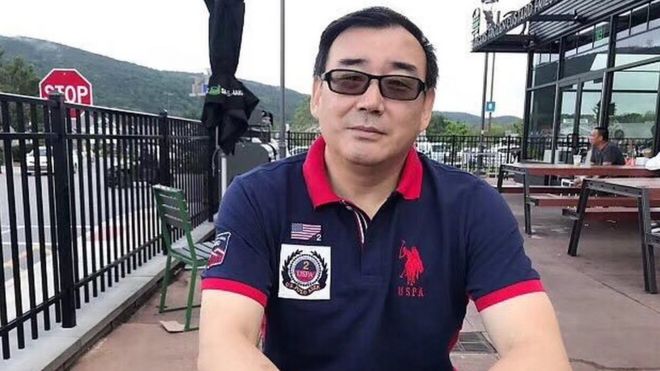
Yang Hengjun, a popular blogger and former Chinese diplomat, was detained in January.

Australia says the treatment endured by one of its citizens in criminal detention in China is "unacceptable".
Chinese-Australian writer Dr Yang Hengjun has been held in Beijing since January.
He has been accused of espionage -- charges denied by him and the Australian government.
He now faces daily interrogations while being shackled, and has been increasingly isolated, Canberra said.
Australia has consistently lobbied Chinese authorities for his release.
But China's foreign ministry has told Australia to not interfere in the case, and to respect the nation's "judicial sovereignty".
On Monday, Foreign Minister Marise Payne said she was "very concerned" about his condition, which was reported in a recent consulate visit.
Mr Yang, a former Chinese diplomat, has been allowed one visit from Australian officials per month.
But he has been barred from contact with his lawyers and his family for close to 11 months and has not been given any of their letters.
His health has deteriorated in recent months. 
China formally charged him in August.
Mr Yang, a scholar and novelist based in New York, was detained when he travelled to China in January with his wife Yuan Ruijuan and her child.
Prior to the arrest he had maintained an active presence on Chinese social media.
Nicknamed "the democracy peddler", he maintained a blog on the country's current affairs and international relations. 
However, he had not been directly critical of Chinese authorities in recent years.
Beijing has held him for alleged "involvement in criminal activities endangering China's national security". 
Australia has called for clarification of the charges.
Australia has also repeatedly requested that he receive "basic standards of justice, procedural fairness and humane treatment" during his detention.
His lawyers say his treatment has got worse as Chinese authorities attempt to extract a confession from him. 
His case must be brought before a court by March.
Canberra's rebuke comes as tensions remain heightened with Beijing.
Australia's political class was rocked last week by allegations of Chinese espionage and interference in domestic issues. 

lundi 20 mai 2019

A Country Under the Influence

Australia’s China Challenge
With Beijing pushing as far as it can wherever it can in the era of Xi Jinping, Australia has become a global case study in Chinese influence.
By Damien Cave

Australia's Chinese fifth column: Beijing Bob and his gang

SYDNEY, Australia — In a gold-curtained meeting room in Sydney, the Chinese consul general appealed to a closed-door gathering of about 100 people, all of them Australian residents and citizens of Chinese ancestry.
He called on the group to help shape public opinion during a coming visit of China’s prime minister, Li Keqiang, in part by reporting critics to the consulate. 
Rallies in support of China should be coordinated, he suggested, and large banners should be unfurled to block images of protests against Beijing.
“We are not troops, but this task is a bit like the nature of troops,” said the diplomat, Gu Xiaojie, according to a recording of the session in the consulate obtained by The New York Times and verified by a person who was in the room. 
“This is a war,” he added, “with lots of battles.”
The previously unreported meeting in March 2017 is an example of how the Chinese government directly — and secretly — engages in political activity in Australia, making the nation a laboratory for testing how far it can go to steer debate and influence policy inside a democratic trade partner.
It is a calculated campaign unlike any other Australia has faced — taking advantage of the nation’s openness, growing ethnic Chinese population and economic ties to China — and it has provoked an uncomfortable debate about how Australia should respond.
Many countries face the same challenge from China, an authoritarian power pushing its agenda inside and beyond its borders.
In Asia, China has been funneling funds to the campaigns of preferred presidential candidates in Malaysia and Sri Lanka. 
In the United States, there is concern about Beijing’s efforts to stifle dissent on college campuses. And in Europe, Chinese companies and organizations tied to the ruling Communist Party have held events for political leaders and donated millions of dollars to universities.
China once sought to spread Marxist revolution around the world, but its goal now is more subtle — winning support for a trade and foreign policy agenda intended to boost its geopolitical standing and maintain its monopoly on power at home.
The contours of its playbook are especially visible in Australia, where trade with China has fueled the world’s longest economic boom. 
Australian intelligence agencies have warned of Beijing’s efforts, and the issue is likely to be contentious for Australia’s conservative prime minister, Scott Morrison, who won a surprise victory in elections Saturday.

Labor Party senator Sam Dastyari did China’s bidding at the behest of Chinese donors.

Chinese representatives routinely lobby Australian politicians behind closed doors without disclosing their activities, often by threatening economic punishment and persuading Australian business and academic leaders to deliver their message.
The Chinese and their supporters have also sought to suppress criticism and elevate its views in the Australian news media, by suing journalists and publishers for defamation, financing research institutes and using advertisers to put pressure on Chinese-language outlets.
Beijing has even promoted political candidates in Australia with these outlets as well as via the United Front Work Department, the party’s arm for dealing with overseas Chinese, and with campaign contributions made by proxies.
Last year, after a scandal involving donors with ties to Beijing forced a senator to resign, Parliament approved an overhaul of espionage laws making it illegal to influence Australian politics for a foreign government.
Australia’s new government — led by Mr. Morrison, who has been vague about his plans for foreign policy — must now decide what to do next at a time when the public is divided: Many Australians fear China but also favor good relations to maintain economic growth and regional stability.
“There is a lot to unravel with the China story here,” said Mark Harrison, a China scholar at the University of Tasmania.
The Communist Party, he said, is essentially trying to enforce the same bargain with Australia that it has with the Chinese people: a promise of prosperity in exchange for obedience and censorship.
The new master: Xi Jinping addressed the Australian Parliament in 2014.

Weaponized Economics
China’s economic bonds with Australia can be traced to the 19th century, when a gold rush drew Chinese immigrants to the continent. 
Now, China is an engine of economic growth for the country and its largest trading partner by far, accounting for 24 percent of Australian imports and exports.
With that reliance comes an implied threat: China can take its money elsewhere.
The problem, current and former Australian officials say, is the Chinese government rarely discloses its lobbying activities. 
Australian businesses linked to China often lean on politicians without public scrutiny, leading security agencies to warn about Beijing manipulating politics.
“In no country is there such a profound rift between business community and security,” said Linda Jakobson, founding director of China Matters, a nonprofit policy group based in Sydney.
China has exploited that rift — and even tried to use its economic leverage to punish Australia for adopting the new law requiring those working on behalf of a “foreign principal” to register their activities.
In June, Australian winemakers said they were facing problems with their exports to China, and a major deal to expand chilled beef exports into China — negotiated during Li’s visit — stalled. 
In January and February, China also delayed coal imports from Australia at some ports.
It hardly the first time Beijing blurred the lines between business and politics.
In 2009, the Australian government rejected a bid by a Chinese state-owned firm to purchase 18 percent of Rio Tinto, the Anglo-Australian mining giant, after officials argued privately that the sale would give China too much power to set prices.
Beijing’s response was an early version of what has since become common in the relationship: a campaign to pressure the Australian government via China’s business partners.
Chinese officials and investors “put the weights on the relevant Australian executives,” Kevin Rudd, the prime minister at the time, recalled in an interview. 
“The whole idea at that stage was to maximize business lobby pressure on the government.”
Chau Chak Wing, a billionaire property developer with Australian citizenship, is one of at least two wealthy political donors who have filed lawsuits against media companies in Australia for reporting on donations and links to the Chinese government.

Silencing Dissent
In May 2018, two children in Rockhampton, a rural capital of beef production, painted tiny Taiwanese flags on a statue of a bull during an event celebrating the town’s diversity. 
There were flags from many countries, but the local government painted over those from Taiwan to avoid offending Beijing, which says the self-governing island is part of China.
“What they want are pre-emptive concessions to Chinese interests,” said Peter Varghese, a former head of Australia’s Department of Foreign Affairs and Trade.
Beijing tries both to suppress speech in Australia that undercuts its priorities — such as the diplomatic isolation of Taiwan — and to promote its own agenda.
One prominent example is the Australia-China Relations Institute, a research organization in Sydney led until recently by Bob Carr, a former foreign minister and outspoken defender of China’s positions. 
The institute was established with a gift from Huang Xiangmo, a Chinese real-estate developer who had donated generously to both of Australia’s main political parties.
Australia recently rejected his citizenship application and revoked his residency.
China has also had success shaping news coverage in Australia, especially in Chinese-language outlets.
Maree Ma, general manager of the company that owns Vision China Times, a newspaper in Sydney and Melbourne, said Chinese officials successfully pressured businesses in 2015 and 2016 to pull their ads because of its critical coverage.
And before Saturday’s election, on WeChat — the Chinese social media platform, which is also popular in Australia — accounts affiliated with the Chinese Communist Party mocked the conservative government, disparaging Australia as “a country whose head has been kicked hard by kangaroos.”
English-language outlets are not immune to the pressure. 
In 2017, Australia’s largest independent publishers delayed publication of a book examining Chinese influence in Australian institutions.
Because Australian law favors plaintiffs in defamation suits, such cases — including a large payout in February to Chau Chak Wing, a Chinese-born property tycoon and political donor — have had a chilling effect on reporting and public protesting that might anger Beijing or its allies.
At the Chinese consulate in 2017, organizers showed photos of pro-China activists in Australia roughing up protesters from the Falun Gong spiritual movement, which is banned in China.
The audience applauded.

Running for Office
China’s playbook prioritizes one particular group: Australia’s growing ethnic Chinese population, a group of more than one million people, about half of whom are immigrants from mainland China.
The Chinese government treats Australian citizens of Chinese ancestry as if they’re still subject to its rule. 
Critics of Beijing are pressured.
In January, Yang Hengjun, an Australian writer and former Chinese official, was arrested on dubious charges of espionage while visiting China.
More often, Beijing tries to woo people like Yongbei Tang.
Tang moved to Australia 23 years ago with her husband, an electrical engineer, settling in Hobart, the capital of Tasmania, where she started editing a newspaper called Chinese News Tasmania. 
Last year, she ran for the City Council.
“All the people in the community know me,” she said, when asked why.
“I’m a media person. Influential.”
Tang had also helped start a local chapter of the Australian Council for the Promotion of Peaceful Reunification of China, which promulgates Beijing’s position that Taiwan is part of China.
The group was established by Huang, the donor whose residency was revoked, and it is an arm of the party’s overseas influence efforts.
That connection and others made Tang, an Australian citizen, a subject of intense debate during the campaign, which she lost.
Several local Chinese leaders published an open letter condemning her “hiding of titles of many organizations including her association with the Chinese Government.”
Cassy O’Connor, the leader of the local Greens Party, accused her of being part of an attempt by Beijing to dominate the Tasmanian tourism and property investment. 
“The Chinese government actually picks off smaller states like Tasmania, with smaller economies,” she said.
What Tang actually reveals is the Chinese party’s ability to recruit sympathizers around the world, many of whom gravitate to Beijing’s orbit less because of ideology than the potential for wealth and influence.
Even after her loss, she received favorable coverage on state television in China.
jeudi 7 février 2019

Australia Cancels Residency for Wealthy Chinese Donor Huang Xiangmo Linked to Communist Party

By Damien Cave

Huang Xiangmo in Sydney, Australia, last year. His donations to Australian politicians were linked to Beijing.

SYDNEY, Australia — Australia has canceled the residency of a wealthy political donor tied to the Chinese government, officials confirmed Wednesday, denying his citizenship application and stranding him overseas in a widening conflict with Beijing over its efforts to influence Australian politics.
The donor, Huang Xiangmo, is a successful developer who has lived in Sydney since 2011 and who has donated millions of dollars across the Australian political spectrum in recent years. 
He has done so while leading organizations tied to the United Front Work Department, an arm of the Chinese Communist Party that promotes Chinese foreign policy abroad and works with various groups inside China.
Huang’s office did not respond to requests for comment, and his whereabouts were unknown.
Experts said that keeping him out of Australia reflected deepening global skepticism about China — and a tougher stance toward its proxies.
“It’s a very punitive measure,” said Euan Graham, executive director of La Trobe Asia, a regional research and engagement arm of La Trobe University in Melbourne. 
“It’s a signal of the pushback against Chinese interference — the government remains committed to that despite whatever softer line there may have been in the official diplomatic relationship.”
Some experts cautioned that it was still not clear exactly why Huang was turned down for citizenship; his permanent residency was canceled for a range of reasons, including character grounds, according to The Sydney Morning Herald, which first reported the citizenship rejection.
What is clear is that Huang, a billionaire property developer who founded Yuhu Group Australia in 2012, has become the most visible target of concern and debate about Chinese influence in Australian politics.
His political gifts totaling at least 2.7 million Australian dollars, or about $1.95 million, have gone to both major parties. 
And while the contributions were perfectly legal (Australia lacks a ban on foreign donations), his efforts have been increasingly viewed with suspicion.
Records shows that between 2014 and 2016, Huang made more than a dozen large donations, including $50,000 to the Liberal Party of Victoria and $55,000 paid to the opposition Labor Party for a seat at a boardroom lunch with the party’s leader, Bill Shorten.

Sam Dastyari, a former senator, resigned in 2017 after remarks defending China’s aggressive military posture in the South China Sea, comments at odds with his party’s position.

He was also at the center of a political scandal involving a young Labor Party senator, Sam Dastyari, an aggressive fund-raiser who resigned in 2017 after he made comments at a news conference defending China’s aggressive military posture in the South China Sea — comments that contradicted his own party’s opposition to China’s actions there.
He was invited to the event by Huang, who stood by him as he spoke.
Huang also financed a "think tank", the Australia-China Relations Institute, that was run by Bob Carr, alias Beijing Bob, a reliably pro-China voice who was Australia’s foreign minister from 2012 to 2013.
And Huang’s ties to organizations affiliated with Beijing are well documented. 
He has led several organizations that work closely with the Chinese Consulate, including the Australian Council for the Promotion of the Peaceful Reunification of China, which experts describe as a United Front group aiming to influence foreign policy abroad and the ethnic Chinese diaspora.
“Australia has woken up to the threat posed by authoritarian states and their attempts to influence and undermine our democratic institutions,” said Andrew Hastie, a Liberal Party lawmaker who is chairman of the Parliamentary Joint Committee on Intelligence and Security. 
“We are pivoting to protect our sovereignty,” he said.
The process, however, is far from over. 
Huang has the right to appeal the decision by Australia’s Home Affairs Department, and there will be challenging questions ahead about whether his family can stay in Australia, and about his assets.
His companies own and manage several properties across Australia worth tens of millions of dollars.
The rejection also comes at an uncertain time in Australian-Chinese relations. 
Last month, the Chinese authorities detained a well-known writer and former Chinese official with Australian citizenship, Yang Hengjun, after he flew to China from New York.
He is still being held on charges of “endangering national security,” making him the third foreigner to have been detained on that ominous charge since December.
In a few weeks, on March 1, Australia’s new espionage and foreign interference laws will also take effect, suggesting to some that this will be the first of several actions to disclose and resist Beijing’s more covert attempts to shape politics.
“There may be a sense of trying to get things in a row,” said Mr. Graham. 
“This is obviously a big signal that underlines the commitment to doing that.”

mardi 29 janvier 2019

ADVERTISING CHINA'S THUGGISH SOCIALISM

Promoting China's communist regime to Australia's 1.2 million ethnic Chinese
By Andrew Bolt

Cinema advertisements espousing Chinese propaganda’ and socialism are airing in movie theatres across Sydney, including before children’s films such as the latest How To Train Your Dragon sequel.
A bizarre advertisement promoting “socialism with Chinese characteristics” and aimed at increasing China’s “soft power’’ over Australia has appeared on the silver screen in a string of theatres.
So who pays for this?
Chinese film distribution company TangRen... is behind the advertisement.
The Daily Telegraph yesterday asked TangRen owner Jiayin Yuan if the company was financially supported by the Chinese government and why it was promoting socialism in Australia.
She directed the questions to company director Li Tongliang who did not respond.
The company’s website states TangRen distributes two thirds of all the Chinese and Korean films shown in Australia and New Zealand.
“TangRen promotes Chinese political philosophy and cultural concepts of socialism with Chinese characteristics,” the advertisement states.
The propaganda is the carrot. 
Then there's the stick: a Chinese Australian critic of the regime gets arrested in China:
Yang Hengjun, the Australian-Chinese writer and democracy activist... was detained in China accused of spying.
He now has a friend release a letter:
In the letter, Mr Yang urges activists to "maintain belief in China's democratic future, and, when it doesn't put yourself or your family at risk, to use all your means to push China's democratic development to happen sooner... If I cannot come out or disappear again, remember my articles and let your children read them."
The 53-year-old had been living in New York as a visiting scholar at Columbia University, before leaving for Guangzhou on January 18.
Yang admits in that letter he was also arrested by China in 2011 and forced to lie about it:
On Monday, Australian professor Feng Chongyi published an apology that Yang wrote to his supporters on US-based ­Chinese alternative news website Boxun, detailing his regret over how he handled his previous detention in China in 2011...
Back then, when Yang was ­released, he denied it occurred and said his phone was turned off and there had been a misunderstanding. 
Chinese dissidents and critics of the Chinese government abroad were suspicious of his ­explanation, and accused him of being a spy for the Communist Party...
In the letter, Yang said he did not reveal that he was detained publicly in order to be able to ­return to China and continue his work writing about Chinese democracy...
“I choose to ‘lie’ and let myself be insulted (in order to continue to be) able to do the things which I think right. Can you forgive me?”...
Dr Feng, a University of Technology Sydney professor who is also a critic of the Chinese government and has been detained in China, said Yang asked him to release the letter if he was ever detained again.
Chinese Australians here get the message. 
Here's Jieh-Yung Lo in the Sydney Morning Herald:
Since the news about Chinese-Australian writer and blogger Yang Hengjun broke, I received a call from my mother urging me to stop writing and commentating on issues relating to China. 
She pointed out it doesn’t matter what I write or how I write it, it will cause “unnecessary complications” and make myself and my immediate family a target.
But it's not just Chinese Australia critics who should worry:
After a quarter-century of researching China, Anne-Marie Brady is a veteran of Chinese government spying and harassment. 
"I was prepared for pressure in China," says the 52-year-old New Zealander, a well-regarded professor of political science at the University of Canterbury in Christchurch. 
"But I always felt safe in New Zealand. So that changed." ...
First came the pressure on her university. 
Chinese officials demanded that her immediate superior stop her research...
Next, her office was broken into in December 2017.... 
If she had any doubt that she'd been targeted, she got a detailed warning letter from a concerned friend in the Chinese community to let her know that an official campaign of intimidation against her – and others – was under way.
Brady's home was next... 
The only things missing were laptops, phones and an encrypted memory stick from her last trip to China... 
Brady went to her office the next morning to discover that it had been broken into. 
Again. 
It was February 15 last year.
Brady was scheduled to give testimony to Australia's Parliament that afternoon... to two committees keen to know about, among other things, her groundbreaking research into the Chinese Communist Party's activities in Antarctica... 
Her work uncovered, for instance, that the Chinese People's Liberation Army had built three military facilities on Australian Antarctic territory...
The harassment in her own country seems to have been in angry response to her 2017 report in New Zealand, titled Magic Weapons: China's Political Influence Activities Under Xi Jinping.
The title is a reference to the fact that Xi named three "magic weapons" of Chinese Communist Party power – the People's Liberation Army, the party's program to strengthen and build itself, and the party's United Front Work Department that covertly spreads party influence through the overseas Chinese diaspora and elements of Chinese culture and business.
Given this growing Chinese authoritarianism, this seems very unwise:
Australia is playing a role in helping China develop its rival global positioning system that will be used for guiding missiles and other military technology, according to a leading expert.
New Zealand academic Anne-Marie Brady — who says she has faced a campaign of harassment and intimidation for her research on the Chinese Communist Party — said the "BeiDou" alternative to the American-controlled GPS carries significant benefits for the Chinese military.

jeudi 24 janvier 2019

Australia Probes China’s Detention of Australian-Chinese Writer

Yang Hengjun is detained in China after Canberra’s decision to ban Huawei from Australia’s 5G network
By Eva Dou in Beijing, Rob Taylor in Canberra and Yifan Wang in Hong Kong

The Australian-Chinese writer Yang Hengjun disappeared ahead of a visit to China by Australia’s defense minister. 

Australia’s government is investigating the detention of an Australian-Chinese political writer and academic in China amid heightened concern over detentions of Western nationals in the country.
Australia’s foreign ministry said it was seeking access to Yang Hengjun, an Australian spy novelist who once worked for China’s Foreign Ministry, and that no reasons had been provided by security or diplomatic authorities in Beijing for his detention.
Mr. Yang’s case threatens to cast a shadow over a visit to China by Australia’s defense minister. 
It follows months of tension between Australia and Beijing over Canberra’s decision to lock Chinese phone giant Huawei Technologies Co. out of future 5G communication networks and to challenge Chinese influence in the South Pacific.
His detention also comes as China enters a year of sensitive political anniversaries, including the 30th anniversary of pro-democracy protests in Tiananmen Square. 
Several labor organizers and student activists in multiple cities either have disappeared or been taken into police custody in recent days, in what some observers described as a sign authorities are on edge.
There were no immediate indications of whether Mr. Yang’s case was linked to those broader issues. Mr. Yang has been detained previously on trips to China, including in 2011, when a friend reported that Chinese authorities told him he could be released only if he agreed to say he had been sick for the preceding few days.
Australia’s defense minister, Christopher Pyne, was due to arrive in China Thursday in an effort to soothe recent tensions evident since Australia’s conservative government targeted foreign influence in domestic politics and society with counterespionage legislation, triggering a chill in trade and diplomatic relations.
Australia’s Department of Foreign Affairs and Trade said in a statement Wednesday that it wanted to know why Mr. Yang had been detained and was seeking “to obtain consular access to him, in accordance with the bilateral consular agreement, as a matter of priority.”
Asked about Mr. Yang’s case at a regular China Foreign Ministry news conference, spokeswoman Hua Chunying said she wasn’t aware of the situation.
Mr. Yang had flown from New York to Guangzhou on Jan. 18, but he didn’t continue onto a second flight to Shanghai, according to the Sydney Morning Herald, citing friends. 
It wasn’t immediately clear what the purpose of his trip was.
There has been concern about the risks for Western nationals in China in recent weeks after China detained Canadian researcher Michael Kovrig and businessman Michael Spavor, in apparent retaliation for Ottawa’s arrest of Huawei’s finance chief at the U.S.’s request. 
Canada issued a travel alert this month, warning of the possibility of “arbitrary enforcement” of local laws in China.
More than 100 scholars and former diplomats from Western countries signed an open letter to Xi Jinping this week calling for the release of Messrs. Kovrig and Spavor, saying it would make China experts think twice about visiting the country. 
While Australia’s government has been cautious with its criticism to protect trade ties, several Australians signed, including Gareth Evans, a former Australian foreign minister and president emeritus of Mr. Kovrig’s employer, the International Crisis Group.
China has accused the two Canadians of activities that endanger national security, without specifying what those activities are. 
They haven’t been formally charged.
On Jan. 16, Mr. Yang posted a comment on his Weibo social-media account criticizing a travel warning China issued for Canada, warning Chinese citizens to be careful of their safety and follow local laws. 
“Canada is pretty much one of the top three countries that treat tourists the best,” he wrote.
Mr. Yang, who was born in China, joined China’s Foreign Ministry in the 1980s, and at one point he posted a photo of himself online in a police uniform. 
He later switched to academic work and moved abroad.
It has been unclear what happened during his previous disappearances in China. 
When he emerged in 2011, he only said he had fallen ill and had communication issues, leading to what he called a misunderstanding.
Feng Chongyi, a friend and a Sydney-based academic who was himself detained in China last year, expressed concern that Mr. Yang had been detained on national-security grounds.
“It is an extension of China’s hostage-diplomacy issue,” Mr. Feng said. 
He said he had tried to warn Mr. Yang against travel to China following the detention of the two Canadians.
In a sign that Chinese residents critical of government policy also face heightened risks, police from the southern city of Shenzhen took six labor activists into custody on Sunday night, according to friends and family members. 
Three of the activists were formally detained on suspicion of “disturbing social order,” while another has since been released, they said.
Separately, five current students and two recent graduates from top universities in Beijing who belong to a group that supported worker-unionizing efforts in southern China last year disappeared on Monday, according to friends. 
The seven were hiding out in an apartment in the coastal city of Tianjin while the group released statements excoriating Beijing police for having shown several of them videotaped confessions by fellow activists detained last year, friends said.
One of the people detained, Peking University student Zhang Ziwei, described others being grabbed by unidentified people in messages he sent to friends by smartphone late Monday night. 
In a video message, viewed by The Wall Street Journal, Mr. Zhang said he could hear the people going to door-to-door.
“The proletariat doesn’t fear death, much less repression!” he said in the video. 
Friends said he later stopped sending messages and they haven’t been able to reach him since.
The Shenzhen Public Security Bureau didn’t respond to a request for comment.

mercredi 23 janvier 2019

Chinese State Terrorism

Chinese-Australian Writer Yang Hengjun Disappears in China
By Damien Cave and Chris Buckley

Yang Hengjun in San Diego in 2012.

SYDNEY, Australia — A well-known writer and former Chinese official with Australian citizenship flew from New York to China on Friday despite warnings from friends who told him it was too dangerous.
Now, he is missing and appears to have been detained by the Chinese authorities.
The writer, Yang Hengjun, did not answer his Chinese cellphone despite repeated attempts to reach him on Tuesday and Wednesday. 
Nor did he answer messages on WeChat, the popular Chinese social media service.
Deng Yuwen, a Chinese journalist and current affairs commentator who knows Mr. Yang, said that the writer appeared to have vanished shortly after landing in the southern Chinese city of Guangzhou.
“We don’t know what Yang Hengjun did that would prompt the Chinese government to detain him,” Mr. Deng said by telephone from New York. 
“In recent years, he’s been very low key and hasn’t published anything that could be construed as antigovernment.”
Australia’s Department of Foreign Affairs and Trade confirmed that the government “is seeking information about an Australian citizen who has been reported missing in China.”
A spokeswoman for China’s foreign ministry said she had no information about the case. 
American officials did not respond to requests for comment.
Mr. Yang was detained in 2011, but his disappearance now carries additional risk.
China’s relationship with the United States and its democratic allies continues to deteriorate. 
A trade war between the two countries is rattling the Chinese economy. 
Xi Jinping has pushed the country toward a more muscular brand of authoritarianism. 
And the December arrest in Canada of a senior executive from Huawei, China’s most important telecommunications company, has led to tit-for-tat retaliation from China.
Last month, the Chinese police detained two Canadians, Michael Kovrig and Michael Spavor, as officials in Beijing pressed Canada to free Meng Wanzhou, the Huawei executive who was held for extradition to the United States on fraud charges.
If Mr. Yang’s detention is prolonged, he could become another strain in Australia’s volatile relations with China. 
Australia’s economy has been buoyed by raw material exports to China, especially iron ore. 
But in recent years relations between the two countries have been troubled by Australian complaints of political interference from Beijing.
In August, Australia rejected potential participation by Huawei in developing the country’s 5G telephone network, a step that angered the Chinese government.
Mr. Yang, 53, a novelist and commentator who worked for the Chinese foreign ministry before moving to Australia and becoming a citizen in 2000, has spent the past two years with his family in New York, where he works as a visiting scholar at Columbia University.
In his writing, he has been critical of the Chinese government. 
But in recent years he has eschewed interviews with the news media and avoided outright opposition to the Communist Party.
In December, he retweeted one of his earlier articles about rule of law in China, which said: “I have faith in the future, but without today’s endeavors and sacrifices, the future will never come. For people like me, the goal, the dream is for the future to arrive earlier.”
Friends of his said they had told him that none of his calibrated caution mattered, and that his Australian citizenship would not act as a deterrent because the Chinese government sees anyone of Chinese descent as under the jurisdiction of the country’s Communist Party.
“The intention of his writing is clear — he wanted to educate people about democracy and universal values, and has influenced many young people,” said Weican Meng, a friend of Mr. Yang’s and the founder of Boxun News, a Chinese-language website in the United States.
“Before he went back to China, we had a meal together and a number of friends told him it’s not a good time to go,” added Mr. Meng, whose pen name is Wei Shi. 
“The situation in China right now is like during the Cultural Revolution: People are being punished for talking about very minor things.”
On Thursday, China’s minister of public security, Zhao Kezhi, told a meeting of police commanders in Beijing to guard against political subversion and attempts to foment “color revolution” against the government.
Mr. Yang’s family and friends believe Mr. Yang is being held in Beijing.
Feng Chongyi, a friend of the writer’s and an associate professor at the University of Technology Sydney who was himself detained by the Chinese authorities in 2017, said he had spoken to Mr. Yang’s relatives. 
They told him that Mr. Yang had landed in Guangzhou early Friday morning, but that he did not make his planned connection to Shanghai, Mr. Feng said.
According to Mr. Feng, Mr. Yang went to China in part because his United States visa was to expire in a few months and he was waiting for a residence visa in Australia for his wife and stepdaughter. They had traveled with him to China on this trip.
According to Mr. Feng’s conversations with the writer’s relatives, Mr. Yang and his wife were interrogated for over 12 hours — probably at the airport in Guangzhou — before Mr. Yang’s wife was then allowed to go to Shanghai to drop off her daughter.
“At home in Shanghai,” Mr. Feng added, “she was in tears and asked relatives to not contact them again, but said she would post their whereabouts.”
The writer’s wife, Yuan Rui Juan, posted a picture on her Weibo page on Saturday from Beijing’s main airport, with the caption “It’s been a long time, my eyes are filled with tears.”
Mr. Feng said that family members were fearful and appeared to have been silenced about Mr. Yang’s status. 
“When asked about Yang’s situation, they say that they’re not in a position to discuss the matter,” he said. 
“And they implored us not to ask.”
Mr. Feng said he had been talking to security sources in China and believes that Mr. Yang could be charged with espionage, a broad charge in China that can include simply discussing matters that the government deems sensitive.
In Mr. Yang’s last blog post on his website, he praised President Trump for trying to close “loopholes” that Mr. Yang said had allowed other governments and migrants to Western countries to take advantage of these societies’ tolerance and hospitality.
Mr. Yang developed a large following as a blogger in China in the previous decade, and then an equally avid audience on WeChat, where he also advertised lectures and classes for which he charged a fee.
One of his last announcements on WeChat invited readers to sign up for his classes on studying and living in the United States, Australia and other Western countries, lessons that would also include his “thoughts on history, economics, culture and politics.”
Since Friday, his account has been silent.

dimanche 26 mars 2017

Rogue Nation

China Bars Professor at Australian University From Leaving
By CHRIS BUCKLEY
Feng Chongyi, associate professor at the University of Technology Sydney

BEIJING — A Chinese-born professor at an Australian university who has often criticized Beijing’s crackdown on political dissent has been barred from leaving China and is being questioned by state security officers as a suspected threat to national security, his lawyer said on Sunday.
The confinement of Feng Chongyi, an associate professor at the University of Technology Sydney, or U.T.S., unfolded over the weekend while Li Keqiang visited Australia to promote deeper trade and diplomatic ties. 
Professor Feng’s case could cloud those ties.
The lawyer, Chen Jinxue, said Professor Feng had not been arrested or formally charged.
The professor has been staying in a hotel in Guangzhou, a city in southern China, and has been repeatedly questioned by national security officers after being stopped by entry-exit checkpoint officials on Friday and Saturday from taking flights back to Australia, Mr. Chen said from Guangzhou, where he was accompanying Professor Feng.
“He’s been told he’s suspected of involvement in a threat to national security,” Mr. Chen said by telephone, adding that Professor Feng declined to comment.
“His movements inside China aren’t officially restricted, but national security authorities have questioned him a number of times about who he’s met and that kind of thing,” the lawyer added. “They’ve told him that he’ll have to stay around for at least a couple more days to answer their questions.”
Professor Feng has been researching Chinese human rights lawyers, who have been subjected to a withering crackdown and detentions since 2015, and that work may have caught the attention of security investigators, Mr. Chen said.
Li Keqiang ended a five-day visit to Australia on Sunday, and it was unclear whether the professor came up during his talks with Australian politicians. 
But that nation’s Department of Foreign Affairs and Trade said it could not demand to see Professor Feng because he is not an Australian citizen.
“The Australian Government is aware that a U.T.S. professor, who is an Australian permanent resident, has been prevented from leaving China,” the department said in an email. 
Under an agreement with China, the department said, “the Australian government is able to provide consular assistance only to Australian citizens who have entered China on their Australian passport.”
Professor Feng, 56, was born in southern China. 
His lawyer confirmed he has permanent residence in Australia and was not a citizen. 
Even so, the case has ignited demands that the Australian government do more to secure his quick release.
“We are urging the Australian government to intervene,” John Hu, a spokesman in Sydney for the Embracing Australian Values Alliance, which has sought to promote free speech and counter the Chinese government’s influence over the ethnic Chinese community in Australia.
“Right now the excuse for their inaction is that Chongyi Feng is only a permanent resident but not a citizen,” said Mr. Hu, who is a friend of Mr. Feng’s. 
“Feng has not breached the Chinese law — his doings were not even in China’s jurisdiction, and the Chinese government has no right to persecute him.”
The university has been in contact with Professor Feng and was helping his family, Greg Walsh, a university spokesman, said by email.
The professor is probably better known in Chinese intellectual circles than in Australia. 
A historian, he has long been involved in debates about China’s future, advocating a path of political liberalization.
He has also criticized the Chinese government’s increasing efforts to exert influence over ethnic Chinese in Australia. 
Last year, he spoke out against plans for concerts honoring Mao Zedong in Sydney Town Hall and Melbourne Town Hall.
“Australia is proud of its commitment to free speech, tolerance and cultural diversity,” he wrote. “However, should intolerance be tolerated? Should lies about Mao and promotion of Maoism, which denies freedom of speech, be allowed as a legitimate part of free speech?”
With its growing ethnic Chinese population and growing economic ties to China, Australia has experienced a succession of cases of residents or citizens being detained in China, creating tensions over their legal rights and access to Australian diplomats. 
In 2011, Yang Hengjun, a writer and former Chinese official who had migrated to Australia, was detained for days in Guangzhou by security officials.
Until the 1960s, Australia excluded Chinese migrants through the “White Australia” policy. 
In recent decades, the number of migrants from China has grown drastically, and by 2015, nearly 500,000 of Australia’s 24 million residents had been born in China.
The disappearance of those seen as acting against China’s interests has stirred concerns in other territories. 
A Taiwanese activist for human rights and democratic rights, Lee Ming-cheh, has been missing since last Sunday morning, when he boarded a flight from Taipei to Macau but never emerged from the arrivals gate. 
His friends and family fear he may have been detained by the Chinese authorities.
As Xi Jinping has clamped down on dissent, Professor Feng and other advocates of political relaxation have no longer been able to write for the domestic Chinese news media. 
But on overseas Chinese websites and in interviews with foreign journalists, he has sharply criticized Beijing’s clampdown.
“Since Xi Jinping came to office, he has not only failed to lead China forward in reform and opening up and constitutional government, he has made an historical U-turn,” he wrote last year.