Affichage des articles dont le libellé est oil. Afficher tous les articles

mercredi 5 juillet 2017

Chinese Aggressions

Vietnam drills for oil in South China Sea
By Bill Hayton
The two countries had a tense stand-off in 2014 when China drilled for oil in disputed waters
Vietnam has begun drilling for oil in an area of the resource-rich South China Sea also claimed by China.
An oil industry consultant told the BBC that a drilling ship on contract to international firm Talisman-Vietnam was working off Vietnam's south-east coast.
This appears to be why a senior Chinese general cut short an official visit to Vietnam last month.
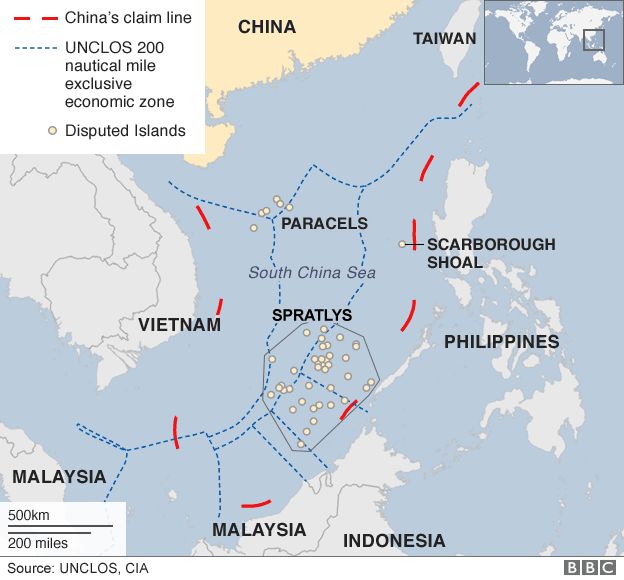
China claims almost all of the South China Sea, including reefs and islands also contested by other nations.
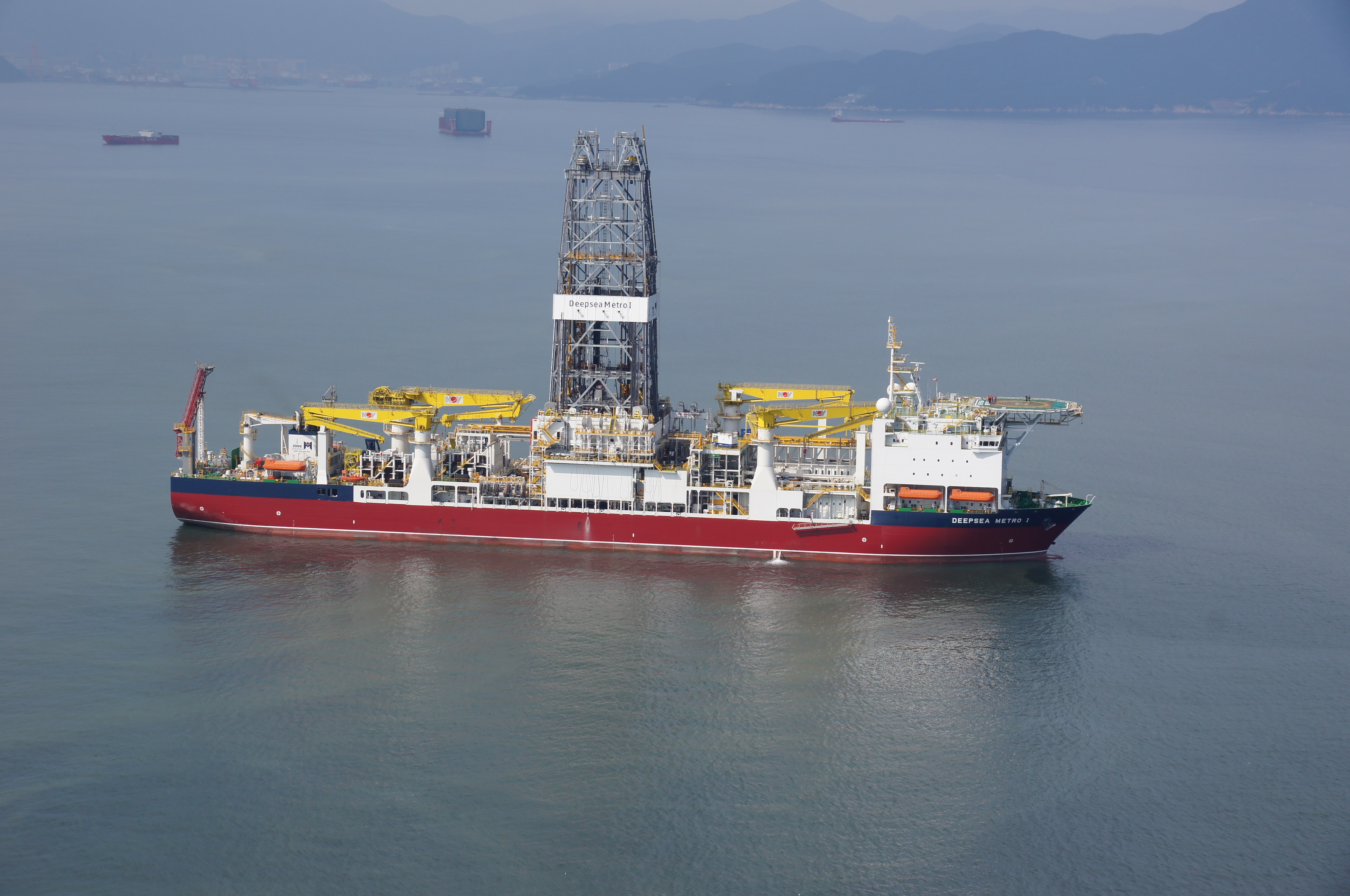
Deepsea Metro I

According to Ian Cross, of Singapore-based Moyes & Co, the drillship Deepsea Metro I, began to drill in an area of sea about 400km (250 miles) off the Vietnamese coast on 21 June.
It is likely that the news was kept secret because of its extreme sensitivity.

Other oil industry sources have told the BBC that Talisman-Vietnam was denied permission to drill over the past three years to avoid upsetting China.
It would appear that by taking such a bold move, the leadership in Hanoi is less concerned about such risks now.
The piece of seabed in question is known as Block 136-03 by Vietnam, but China has leased out the same area to a different company. 
In 2014 the Chinese rights were bought by a Hong Kong-based company called Brightoil.
Two of the directors of Brightoil are senior members of the Chinese Communist Party.

Talisman-Vietnam was formerly owned by the Canadian company Talisman but since 2015 has been part of the Spanish-owned Repsol group.
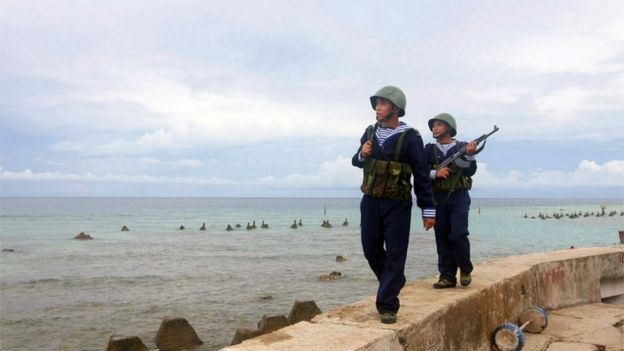
Vietnam and other neighbours contest China's territorial claims in the area
Gen Fan Changlong, who is Vice-Chair of China's Central Military Commission, recently paid a visit to Madrid, where Repsol is based. 
Repsol has not responded to BBC questions about whether the Chinese authorities have made any protest to the company.
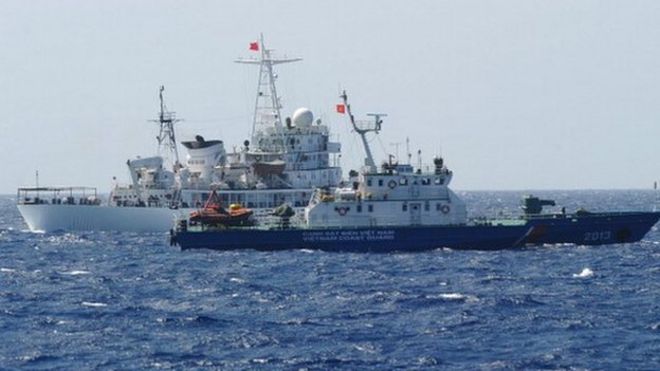
In 2014 coastguard vessels and other ships belonging to China and Vietnam confronted each other in a different area of the South China Sea, further north near the Paracel Islands.
Since then the two countries have tried to avoid confrontation. 
However, Vietnam has clearly decided that the risks of a crisis are relatively low.
So far the only casualty of Vietnam's new oil expedition has been a planned meeting of the annual Vietnam-China border defence friendship exchange.
That high-level meeting between the two countries' militaries was supposed to have taken place on the same day the Deepsea Metro I began drilling.
Instead, Gen Fan -- who was due in Hanoi after his Madrid visit -- flew home, citing problems with the "working arrangements".
Vietnam may have judged that with China currently promoting its "Belt and Road" initiative to the region and encouraging other countries to agree the new Regional Comprehensive Economic Partnership (RCEP), at the same time as it is preparing for its crucial Communist Party congress, it would be unwilling to provoke a regional crisis.
There are no obvious signs of Chinese retaliation so far but we could see a tit-for-tat response with Beijing authorising a drilling operation in an area that Vietnam also claims. 
This, however, would take some time to organise.

lundi 13 mars 2017

Congenital Mythomania

Fake China data: was it just one province? 
Revelations Liaoning fabricated statistics raise questions over rest of rust belt 
By Lucy Hornby and Archie Zhang in Beijing and Jane Pong in Hong Kong

Sceptics about China’s economic statistics have taken a special pleasure in revelations of fake data in the north-eastern province of Liaoning dating at least to 2011.
Along with an officially reported contraction in its economy last year, they have given the impression that Liaoning’s economy is unusually troubled.
That impression may be unfair to Liaoning.
In 2007 when Li Keqiang was party secretary of Liaoning, he made waves when he declared China’s gross domestic product figures “man-made”. 
Last week, even Xi Jinping weighed in on Liaoning’s data-faking, telling the province’s delegation to China’s annual legislative meeting that “the practice must be stopped”.
But is Liaoning the only province to have doctored its statistics?
The map below shows the share of metals and mining (a category that includes crude oil output) in the nominal gross domestic product of Chinese provinces in 2011.
China stopped publishing this data in 2012, the same year the commodity cycle turned sour.
The FT examined four provinces that are more reliant than Liaoning on the coal, steel and oil industries.
Shanxi, Shaanxi and Inner Mongolia comprise China’s coal heartland; Liaoning and Hebei together account for almost one-third of China’s steel output. 
In regions where resources or steel dominate, the commodity cycle is more extreme.
Booms inflate the service sector, consumer spending and property prices; busts have an outsized effect on employment and government finances.
“China has a rust belt just like the US or UK,” says Andy Rothman, investment strategist at Matthews Asia. 
Below are coal, oil and steel prices since 2010.
These benchmarks were multiplied by each province’s reported output of coal, oil and steel, and charted against the reported growth in GDP.
Below is Liaoning.
Strangely, when it admitted to a contraction in 2016, steel, coal and oil were already recovering. 
The other provinces show a similar pattern in the three key industries.
Output values weakened in 2012, briefly recovered in the second half of 2013 and then took a deep dive.
Below is Hebei, home to one-quarter of Chinese steel production:
The worse period was the winter of 2015-2016, followed by a recovery in 2016, as seen below in Shaanxi...
and Inner Mongolia...
This pattern diverges from reported GDP figures, which show growth speeding up from early 2015. Below is Shanxi, the most mining-dependent of all Chinese provinces.
Metals and mining (mostly coal) made up 62 per cent of its industrial output in 2011 and 37 per cent of GDP.
Did Liaoning underperform last year, or were its reported data suddenly brought back in line with reality?
And what does that imply about the other rust-belt provinces?
“Liaoning is the most developed and diversified of the three north-eastern provinces, therefore it should have been performing better, not worse,” says Andrew Batson, economist at research group Gavekal Dragonomics.
In 2013 the Communist party pledged to implement a unified system for compiling provincial GDP. Rather than relying on provincial agencies to produce GDP figures in parallel with the national survey, the pledge called for the National Bureau of Statistics in Beijing to take charge of the process. The goal was to avoid the perennial problem of provincial GDPs summing up to a higher number than the national figure. 
NBS circulated a draft plan for the unified system in late 2014.
Ning Jizhe, director of NBS, told official media on Sunday that phase-in will begin in 2017 and be complete by 2020.
Observers must await the release of four years of corrected data from Liaoning — if indeed the true numbers are ever divulged — if they are to find out what really happened to northern China’s economy when the economic books were being cooked.

mercredi 23 novembre 2016

Oil Becoming Code for Sovereignty in Contested South China Sea

By Ralph Jennings

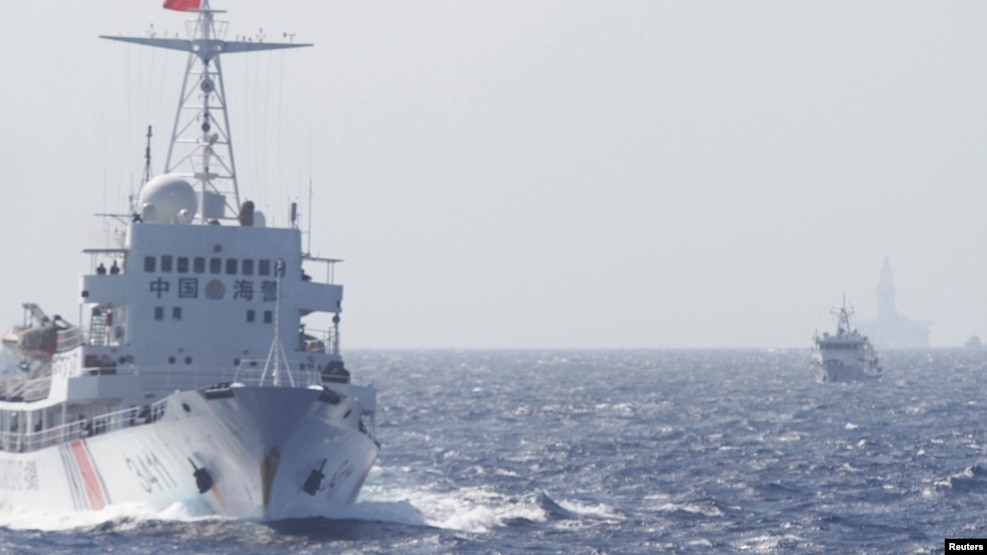
Ships of Chinese Coast Guard are seen near Chinese oil rig Haiyang Shi You 981 in the South China Sea, about 210 km (130 miles) off shore of Vietnam.

TAIPEI — The search for oil and natural gas is seen as a driving factor in rival claims to the South China Sea, with many of the countries in the region currently reliant largely on fuel imports.
Yet no one has struck a head-turning deposit of oil or gas in the 3.5-million-square-km (1.4-square-mile) sea, which stretches from Taiwan to Singapore, despite prospecting since 1970.
Analysts who follow the South China Sea disputes point to national sovereignty as a top reason that countries are exploring for oil and gas. 
Brunei, China, Malaysia and Vietnam do their own prospecting. 
The Philippine government accepted exploration bids in 2014 from private companies.
“The South China Sea is not Saudi Arabia, it’s not Iraq, it’s not the Middle East,” said Fabrizio Bozzato, associate researcher specialized in international affairs at Tamkang University in Taiwan. “The primary purpose of the claimants to be there is not because they want to access the oil and gas resources in the area. Developing hydrocarbon resources in the South China Sea would be way to mark the territory.”
Fossil fuel exploration came up in October when Manila and Beijing began discussing joint oil exploration, according to Philippine media. 
The talks are part of rebuilding relations that were strained since 2012 when vessels from the two sides became locked in a standoff at Scarborough Shoal west of Luzon Island.
In Taiwan, which also claims much of the South China Sea, the former president suggested joint resource exploration with rival claimants.
But the act of exploring for oil or gas sends a signal of control over the tract of sea being drilled, analysts say, pointing to a series of spats.
An aerial view of one of the structures built by China at the Philippine-claimed Mischief Reef, Spratly Islands in South China Sea.
When the Philippines turned up gas off Palawan in 1976, China complained and stalled the project.
The positioning of a Chinese offshore oil driller’s rig in the Gulf of Tonkin in 2014 sparked a boat ramming incident with Vietnam, where deadly anti-China riots also erupted. 
Vietnam formally protested another Chinese rig in April this year.
Joint exploration would imply a concession of sovereignty, Baker said.
“There’s probably very little incentive for countries to actually go and try to do this exploration simply because it’s very difficult to come to an agreement between different countries because it requires some acknowledgement of the right to exploit those resources, which means they have to give up some sense of sovereignty,” said Carl Baker, director of programs at Pacific Forum CSIS in Honolulu.
“And for the Chinese this is very difficult to do, and for the Philippines and Vietnam, they’ve found it creates problems in domestic circles as well,” he said.
The Philippines began more than 40 years ago looking for oil west of Palawan island, at Reed Bank. In 1984, a Philippine company found an oil field in the same region and it supplies 15 percent of the annual oil consumption in the Philippines.
The U.S. Energy Information Agency estimates 11 billion barrels’ worth of oil under the sea and 190 trillion cubic feet of natural gas. 
Much of that lies under the continental shelves of Southeast Asian claimants, which are not disputed. Much of that potential energy has not been tapped yet, Baker said.
Saudi Arabia has an estimated 268 billion barrels of proven oil reserves and Iraq has 144 billion, the U.S. Energy Information Agency says. 
Russia leads the world in natural gas reserves with 5,085 trillion cubic feet.
Falling oil prices and the costs of extracting any fuel from under the seabed limit the value of exports from any undersea discoveries, analysts add.
In Malaysia, the claimant country that has found the most fossil fuel to date, few are pushing for exploration, said Oh Ei Sun, international studies teacher at Singapore Nanyang University. 
Malaysia has about five billion barrels of oil and 80 trillion cubic feet of natural gas.
“Even if you discover new sources of oil and gas, you would still have to spend a lot on equipment and other resources to dig them out, so the urgency, the call for having new sources of oil and gas at the moment I don’t think they are very high,” Oh said.

samedi 22 octobre 2016

US on edge over new powder keg in the South China Sea

By Clay Dillow

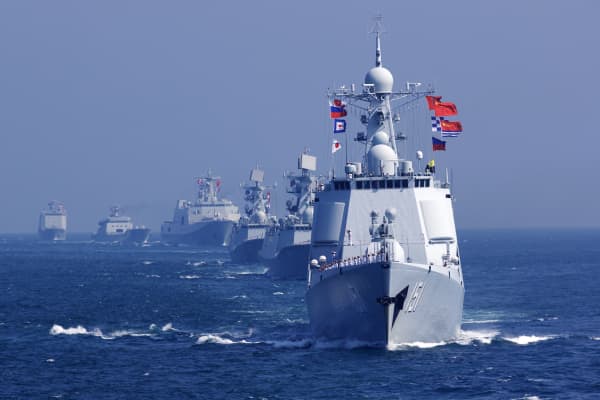
A China-Russia naval joint drill off south China's Guangdong Province
 
China and the Philippines could begin exploiting long-untapped energy reserves in the South China Sea, according to reports coming out of this week's meeting between Rodrigo Duterte and high-ranking Chinese officials — including a Thursday sit-down with Xi Jinping — in Beijing. 
How soon that may happen remains unclear, however, as Duterte cautioned reporters that he has not been empowered by his Congress to finalize any energy exploration deal with his Chinese counterparts.
Earlier reports by Philippine newspaper the "Inquirer" suggested that Beijing and Duterte were set to enter into an agreement to explore for energy sources in a part of the South China Sea close to the Philippine coastline. 
China has long sought to exploit what it believes could be more than 100 billion barrels of oil and hundreds of trillions of cubic feet of natural gas lurking beneath the South China Sea. 
However, a litany of overlapping territorial claims in the region by the more than half-dozen nations rimming the South China Sea has rendered broad energy development there a nonstarter.
The fact that potential joint development of offshore energy deposits in the region is even being discussed underscores the tectonic shift in regional foreign policy undertaken by Duterte since winning the Filipino presidency in May.
The Philippines, long a U.S. ally in the region, has moved away from its bilateral ties and military entanglements with the United States and instead embraced a budding new friendship with China, long a regional rival. 
A joint energy-exploration deal between China and the Philippines could serve as a way to dodge thorny questions of national sovereignty and begin extracting energy wealth from the South China Sea, potentially setting a precedent for future energy development deals.
The U.S. Geological Survey estimates the South China Sea region holds reserves of some 11 billion barrels of oil and 190 trillion cubic feet of natural gas. 
China National Offshore Oil — the state-owned energy company responsible for offshore energy exploitation — provides a much rosier estimate, predicting the region holds some 125 billion barrels of oil and 500 trillion cubic feet of natural gas.
Neither estimate is insignificant for a region woefully dependent on imported oil and natural gas. China is the second-largest consumer of oil after the United States and critically dependent on imports to feed its energy demands. 
Japan and South Korea are likewise dependent on foreign oil to keep their economies humming. Booming growth in Southeast Asia has pushed the region to emerge as a net oil and gas importer as well.
The Philippines, too, faces a looming energy shortage. 
The nation's main island of Luzon depends heavily on the Malampaya gas field, an energy deposit estimated to hold perhaps another decade's worth of energy before running out. 
Given that it can take half a decade or longer to bring a major new energy project online, the clock is ticking for the Philippines, which could experience rolling brownouts on Luzon — home to the capital, Manila — if new energy sources are not tapped.
One potential source is the Reed Bank, an underwater mountain off the Philippine coast believed to hold significant oil and gas deposits. 
The Reed Bank falls exclusively in the Philippines' exclusive economic zone, which according to the UN Convention on the Law of the Seas (UNCLOS), places it firmly in the Philippines' possession. China, however, doesn't see it that way.
Developing the South China Sea's energy reserves has proved problematic for decades, in part due to China's sweeping territorial claims. China's so-called "nine-dash line" encompasses much of the strategic waterway, conflicting with the various territorial claims of other Asian states, including the Philippines, Vietnam, Malaysia and Brunei.
Reed Bank, like many other contested areas, falls within the nine-dash line. 
Under Duterte's predecessor, the Philippines challenged China's claim at the Permanent Court of Arbitration at the Hague, which ruled in July under UNCLOS that China's claims are invalid. 
China has refused to accept the decision.
These types of conflicting claims and the political risk associated with them have made exploration and development of even nearby uncontested areas difficult, as energy companies and foreign investors seek to steer clear of international entanglements. 
"I have not seen anyone go into these developments in any meaningful, substantial way," said Clara Gillispie, senior director of trade, economic, and energy affairs at the National Bureau of Asian Research. 
"There's been a number of starts and stops. But in terms of breakthroughs in collaborative, joint efforts or in terms of pure Chinese development, I think we're still talking about what could happen rather than what is happening."

Territorial disputes

Joint development between the Philippines and China could reverse the trend toward disputes and conflict in at least one corner of the South China Sea, though it will likely take much more than a deal between the two states to open the wider South China Sea for exploitation.
"I think the biggest factor impacting exploration activities, or lack thereof, in the South China Sea are the low oil prices that we've seen for the past two years now — that's been big disincentive to do exploration activity there," said Erica Downs, a senior analyst at the Eurasia Group. 
"Plus, nobody knows exactly how much energy is there."
At press time, the Brent crude-oil price was $51.37 a barrel, way off its historic peak of $139.05 a barrel in June 2008.
To lure foreign energy companies and their deepwater drilling technology into the region, things will have to change economically, said Michal Meidan, a China analyst at the London offices of consultancy Energy Aspects. 
"If you had proven reserves and you knew this was a very attractive resource, the story might be different," she said. 
"But prices would need to go up considerably, which is not likely — we'd need to go back to at least a 100-dollar-a-barrel kind of world." 
Prices currently hover around half that.
Circumstances would have to adjust on the political stage as well. 
China has floated various other attempts at joint development deals previously, "but those kinds of agreements have been very tenuous in the past," Meidan said, adding that the region would require some kind of internationally agreed-upon code of conduct for joint exploration, something that seems unrealistic at the present time.

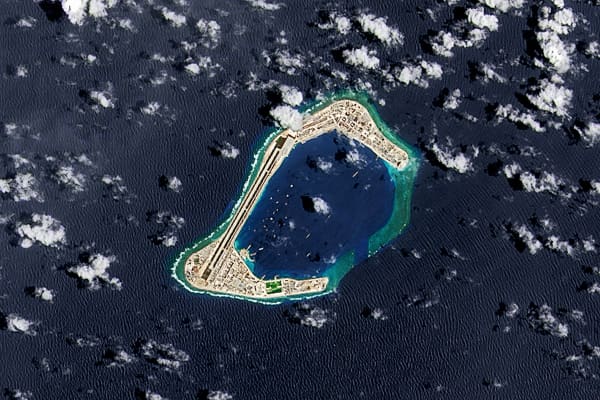
A satellite image of Subi Reef, an artificial island being developed by China in the Spratly Islands in the South China Sea, on September 4, 2016.

Disagreements over who owns what in the South China Sea have long stoked tensions there, exacerbated in recent years by China's building of artificial islands in areas like the contested Spratly Islands, a cluster of 14 islands and more than 100 submerged reefs (and claimed in part by Malaysia, China, the Philippines and Vietnam).
These islands, complete with military installations and runways that can accommodate combat aircraft, lie far from China's continental shores. 
Nonetheless, China has claimed in many cases that these manufactured islands confer rights to 12 nautical miles of territorial waters surrounding each island and in some cases exclusive economic zones extending up to 200 nautical miles away from these disputed island outposts.
If honored, these claims would give China de facto territorial control over much of the South China Sea. 
A warming relationship between China and the Philippines — and particularly a successful joint-development deal allowing both countries to begin extraction of the South China Seas energy wealth — could prove a first step in changing the entrenched political reality in the region. 
It might also help China validate its territorial claims elsewhere in the region.

$5 trillion in global trade

The territorial disputes over the South China Sea are about much more than energy resources buried in the seabed. 
More than $5 trillion in global trade passes through the strategic waterway annually, including the vast majority of the imported oil on which Japan, China and South Korea rely. 
China sees control of the waterway as a key security concern — not just in terms of national defense but also in terms of energy and economic security.
The linking of various nations' energy security with political tensions in the South China Sea has driven an uptick in military activity in the strategic waterway. 
Over the past several weeks, the United States (along with the Philippines), Indonesia and a consortium of nations, including Australia, Malaysia, Singapore, New Zealand and the United Kingdom all conducted separate military exercises in or around the South China Sea. China and Russia also conducted joint naval drills in the region. 
The Indonesian Air Force's two-week exercise was that nation's largest to date in the South China Sea. 
Meanwhile, defense budgets have experienced a pronounced uptick across the region as nations bordering the sea look to bolster and modernize their armed forces with new patrol boats, submarines and aircraft.
The uptick in military spending doesn't necessarily spell looming confrontation or an outright arms race, analysts say. 
But the increased tempo of military activity by a growing number of actors heightens the risk of a mishap or misunderstanding between militaries that could quickly escalate.
"There's still a low likelihood of a conflict because that's bad for everyone," said Meidan, the China analyst. 
"But the chance of an accident are greater than they have been in the past."

mardi 18 octobre 2016

You Can Strike Oil In China: Four Reasons The Satellite Market Is Taking Off

By Michael Kanellos

China has more oil than people thought.
Orbital Insight, a Palo Alto-based startup hoping to capitalize on the growing interest in mining satellite imagery, undertook an interesting assignment: it captured, and then analyzed, satellite images regarding the world’s 20,000+ oil storage depots to try to determine the real-time supply of oil.
How? 
It focused on the shadows being cast on the inside of the world’s 20,000+ oil storage tanks. 
Oil storage tanks have floating ceilings: a short shadow indicated a well-stocked silo while a long one indicated potential shortages. 
And while doing their shadow analysis, Orbital discovered a funny thing. 
China had 2,000 more coastal tanks than people thought, said Orbital’s Shwetank Kumar at the Center for Effective Global Action in Berkeley, California this week.
The hunt may not be over either: South American nations regularly do not report their oil inventories either, he added.
So what do you need to know?

It’s a Huge Opportunity
The global satellite market is growing at 19.54%, according to some estimates. 
Venture capitalists invested $1.8 billion in space startups in 2015.
But more importantly, a growing raft of companies want to couple their data with imagery. 
I attended the conference to speak about the epidemic of water leakage—over 30% of the water in many areas of the world drips away before it gets to your tap. 
Satellite imagery can be matched with pressure data to pinpoint leaks. 
Farming and health care companies are mining data. 
Even stock traders are getting into the act.
The world takes an estimated 1 trillion images a year: it’s only going to expand.
Hello from Beijing: an image from Orbital insight

It’s Multifaceted
Like other digital imaging markets, there are a number of entry points and companies are carving out areas of specialization. 
Orbital’s stock-in-trade, for instance, revolves around blending satellite data with other streams like commodity prices or poverty index. 
The satellite images aren’t the end goal: they become a source of data for macroeconomic analysis.
Planet, meanwhile, is putting up an armada of Dove CubeSats – or very small, but capable —satellites for capturing images of life on earth. (I wrote about CubeSats back in 2005 when it was a research project so it’s gratifying to see it come to fruition.) 
Planet’s goal is to use “space to help life on earth,” said Planet’s Tara O’Shea. 
The satellites capture images at three to five meters of earth space per pixel. 
That’s fine enough to capture the progress of road building in India or the Amazon and far greater than the 30 meters per pixel resolution of Landsat. 
At the same time, it’s not deep enough to pinpoint faces, license plates or personal information. 
In Palawan, an island in the Philippines, the company is helping map the 50% of roads that wouldn’t ordinarily show up on maps.
To avoid the cost creep that can impact companies developing hardware, Planet tries to develop and launch quickly. 
It has developed 13 different versions of its satellite in 3 years and a new vehicle gets launched every three to four months. 
By contrast, it typically takes three years to launch a conventional satellite.
A Dove Cubesat from Planet.com

It has 70 satellites in orbit today and should have 100 by the end of the year. 
That will give the company the capability to take a new, comprehensive image of the earth every day.
By contrast, you have DigitalGlobe, a publicly-held company that recently bought the Radiant Group for $140 million. 
It specializes in super-high resolution photos. 
A traditional Landsat image might take up half a gigabyte, said Shay Har-Noy. 
An image from Planet might come to 16GB. 
One of DigitalGlobe’s images can weigh in at a hefty 941GB: more data, more insight. 
The company takes on projects like mapping Australia to help map out water and agricultural issues.

It’s Not Just About Hardware
Software is where you will see most of the startup activity, says Ruchit G Garg, a Microsoft alum who has founded Harvesting, which uses satellite imagery to optimize harvests. 
The data will help farmers, but mostly it’s for banks and insurance companies. 
Ideally, better data will lower the barriers to credit, he says. (SlantRange is taking a similar tack with drones.).
Likewise, Facebook is using satellite data as part of its plan to bring Internet access to emerging nations and rural communities. 
1.6 billion people worldwide live outside the reach of mobile networks, said Andreas Gros of the Facebook Connectivity Lab. 
99% of the world, however, lives within 80 kilometers of a city with a population of 10,000 or more. 
The idea is to leverage that as much as possible.
Combining imagery with census data is giving the company greater insight into population density and settlement patterns. 
So far, Facebook has scanned 27 million square kilometers and amassed 500TB of data. 
It can analyze some countries for density in population density eight hours.

It’s Not Just About Space

If there’s one meme that kept getting past around at the event, it was “ground truth,” i.e., information from people on the ground that confirms or expands satellite data.
Prabal Dutta at the University of Michigan is overseeing a project to pinpoint grid outages by using cell phones as sensors. 
73.8% of Kenyans, after all, have cell phones.
Traffic? 
70% of the traffic in Kenya comes from Matatus, or drivers for hire, said UC Berkeley’s David Schonholzer. 
Three million people use this precursor of Uber on a daily basis. 
His department is integrating sensors to monitor drivers—how fast they accelerate, whether the go off-road, how many sudden stops or sharp turns they take—to improve road safety. 
If you tried to analyze grid or road traffic with imagery alone, you’d only get a partial answer.