Affichage des articles dont le libellé est unfair trade practices. Afficher tous les articles

mardi 21 mai 2019

A ‘Reagan moment’ for President Trump on China

  • President Trump is creating a new economic world order in his China trade war, says economist Mohamed El-Erian.
  • “We win a relative trade war. In absolute terms we suffer. But we win relative to others,” says El-Erian.
By Matthew J. Belvedere

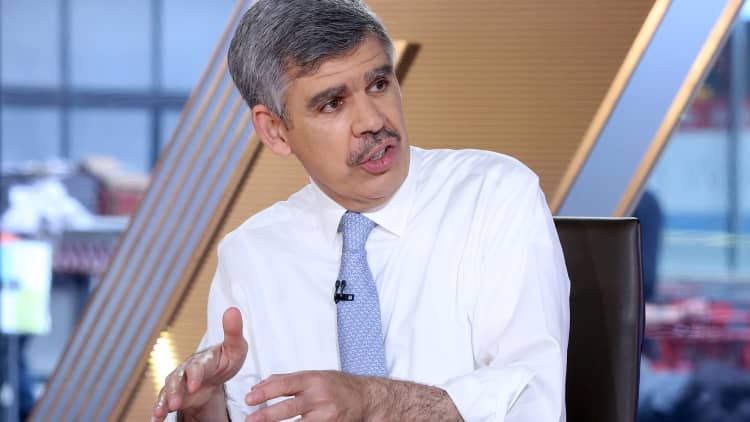
Mohamed El-Erian says US wins the trade war

President Donald Trump stands a chance of creating a new economic world order in his fight with China over unfair trade practices, American intellectual property theft and cyberspying, economist Mohamed El-Erian said on CNBC Monday.
“I think we should not underestimate something ‘Reaganesque,’” said El-Erian, chief economic advisor of Allianz, likening the current situation to how former President Ronald Reagan was able to change the global geopolitical landscape after winning the Cold War against Russia.
As El-Erian spoke in a “Squawk Box” interview, U.S.-China trade talks have stalled, and the two nations have stepped up tariffs on each other’s imports. 
In addition, the U.S. has effectively blacklisted Chinese telecom giant Huawei on national security concerns. (Alphabet’s Google followed the Trump administration’s lead and suspended business with Huawei.)
El-Erian has handicapped three scenarios, listing the chances of a “short-term” trade deal between the U.S. and China at 65%, a “Reagan moment” at 15%, and a full-blown trade war at 20%.
“I think what you’re seeing is the status quo is coming down. And the possibility of the other two are going up,” he said. 
“If the U.S. goes full-blown with this as about national security, it can actually change the economic dynamics on a global scale. It really can.”
No matter the resolution, it won’t come quickly, and Wall Street is going to have to deal with the uncertainty in the meantime, he added.
However, El-Erian said the U.S. stock market is better positioned to weather the trade storm than are Chinese equities.
“We win a relative trade war. In absolute terms we suffer. But we win relative to others, ” he said. 
“I think the markets have understood that the U.S. is in a better place than the rest of the world.”
As of Friday’s close, which marked two straight weekly losses for the S&P 500, the broad-based measure of the U.S. stock market had still surged about 14% this year. 
Despite all the recent trade-induced turmoil, the index was only about 3% off record high close on April 30. 
Chinese stocks in the Shanghai Stock Exchange Composite Index have lost about 10% in 2019.
“The realization in the U.S. is that this is the time. If not now, when?” he said.

jeudi 17 novembre 2016

U.S. Should Get Tougher on China’s Deal Making

By EDWARD WONG

The Yangshan Deep Water Port in Shanghai in September. The panel’s report this year took a critical look at the free-trade relationship between the United States and China — for example, implying that the two countries are not competing on a level playing field. 

Congress should exercise greater scrutiny over trade and investment practices between the United States and China in order to prevent China from taking advantage of the economic relationship, a congressional commission said in a report released on Wednesday.
In its long list of recommendations, the commission advised Congress to authorize a government panel that reviews foreign takeover deals to bar Chinese state-owned companies from acquiring or gaining “effective control” of American companies. 
It also said Congress should ask a government watchdog agency to write a report on whether large-scale outsourcing of manufacturing to China “is leading to the hollowing out of the defense industrial base.”
The commission also suggested ways in which Congress could better bring antidumping cases against China.
Each year, the U.S.-China Economic and Security Review Commission releases a report to Congress with recommendations based on months of research. 
The commission aims to make suggestions after examining trade, investment and national security issues between the two nations. 
Its recommendations are not binding.
The report this year took a critical look at the free-trade relationship between the United States and China — for example, implying that the countries are not competing on a level playing field. 
It follows a populist airing of grievances over the downsides of free trade and a globalized economy in Western nations this year. 
That helped lead to the election last week of Donald J. Trump as the next United States president and to the vote by Britons in June to leave the European Union.
China, in its recent public statements, has emphasized the tight economic ties between the two major trading partners and said the countries would benefit more from working together.
During his campaign, Mr. Trump said he would bring manufacturing jobs back to Middle America and consider imposing a 45 percent tariff on Chinese exports, as well as labeling China a currency manipulator. 
In September, after prodding from some lawmakers, the Government Accountability Office, a watchdog agency, said that it would examine whether reviews of foreign purchases should include more types of foreign investments and be broadened to define more industries as important to the nation’s economy.
The report released on Wednesday said Congress should create an office in the International Trade Administration to identify and bring antidumping and countervailing duty cases. 
Countervailing duties are imposed on goods to offset the fact that the goods may have been made with the help of subsidies.
Besides trade and investment, the report covers topics like security relations, China’s global footprint and the United States’ rebalancing to Asia.
In one section, the authors criticize meager American government efforts to block intelligence collection by China. 
The Obama administration has expressed concern over what it sees as state-sponsored hacking from China in recent years.
“The U.S. government response to the threat from Chinese intelligence collection has suffered from the lack of an integrated, coordinated effort within the U.S. intelligence community,” the report said.
“The U.S. government’s efforts to counter Chinese intelligence collection operations have manifested largely as a series of espionage prosecutions rather than a strategic, whole-of-government response,” it added. 
“The Obama administration has taken steps to improve cybersecurity among U.S. government agencies and defense contractors, but these measures could mitigate, not eliminate, the significant cyber espionage threats to these organizations.”

vendredi 11 novembre 2016

'We can't continue to allow China to rape our country'

In China-U.S. Trade War, President Trump Would Have Weapons
By KEITH BRADSHER


Is Xi Jinping a rapist?

SHANGHAI — As a candidate, Donald J. Trump aimed some of his most blistering words at China, declaring that “we already have a trade war” and suggesting that “we have the power over China, economic power.”
As president of the United States, Mr. Trump can use trade as a weapon, with the potential to drastically reshape the world’s two largest economies, as well as the companies, industries and workers who depend on their hundreds of billions of dollars in closely linked goods. 
The unsettling reality for Beijing is that Mr. Trump has a variety of ways to get back at China for trade practices that are unfair. 
China sells a large array of goods to the United States that he can aim at for higher tariffs.
The opportunities for China to retaliate would be more limited. 
In the most basic terms, China buys less from the United States.
But China could make some strategic strikes at targets like Boeing, American automakers and American farmers. 
Beijing exerts tight control over China’s airlines, for example, and sometimes steers contracts to Airbus, Boeing’s European rival, when officials feel that Washington is uncooperative.
“Boeing complains, ‘We have been pretty good friends with China. Why are we always a target?’” said He Weiwen, a former Chinese commerce ministry official who is now the co-director of the China-U.S.-E.U. Study Center at the influential China Association of International Trade in Beijing.
Or China could wreak havoc on the vast yet delicate supply chain behind a wide range of products like iPhones and auto parts. 
Six years ago, Chinese restrictions on exports of obscure yet vital minerals led to a global outcry by manufacturers.
Early indications are that trade could take a more prominent place on the White House’s China agenda, which under President Obama was dominated by Beijing’s territorial claims in East Asia and its influence over North Korea.

The night shift at a shoe factory that employs about 15,000 workers in Guangdong Province in southern China. Exports to the United States represent about 4 percent of the Chinese economy.

In a strong signal, Mr. Trump has turned to Dan DiMicco, a longtime steel executive and trade critic, to oversee trade issues during his administration’s transition. 
Mr. DiMicco writes a personal blog, liberally sprinkled with exclamation points, that blames America’s industrial decline on cheating by trade partners, particularly China.
“Hillary Clinton has claimed Trump’s trade policies will start a ‘Trade War’ but what she fails to recognize is we are already in one,” he wrote on his blog last summer. 
“Trump clearly sees it and he will work to put an end to China’s ‘Mercantilist Trade War’! A war it has been waging against us for nearly 2 decades!”
China over the last two days has emphasized that a "healthy" relationship would benefit both sides. 
On Thursday, Lu Kang, a spokesman for China’s Foreign Ministry, said, “It is in the common interests of both countries to develop a long-term, stable and prosperous trading relationship, and any American politician would take a policy in the interest of his country and the American people.”
Mr. Trump’s views veer widely from the free-trade positions of the Republican Party in recent years and signal a return to the more patriotic positions of the Reagan administration.
Since President Ronald Reagan, Republican and Democratic administrations have been reluctant to confront countries that were subsidizing or dumping exports, because of a risk of damaging diplomatic relations.
“This is the kind of stuff you learn in law school, and in the early days of your law career,” said Alan H. Price, a longtime lawyer for the American steel and aluminum industries at Wiley Rein.
When used, the measures were sometimes deemed ineffective.
In one rare example, President Obama used his powers to impose tariffs of up to 35 percent on imports of Chinese tires soon after he took office. 
The tariffs prompted China to impose steep tariffs on American chicken meat and automotive products. 
Both countries complained to the World Trade Organization, which mostly sided with the United States.
The case resulted in the United States producing more tires, but imports from other countries rose even faster. 
And the Obama administration later became more cautious about challenging China with trade restrictions.
Any trade actions by Mr. Trump would face limits.
This year, he mentioned imposing a tariff of 45 percent on all imports from China. 
But he later avoided specifics — and he has limited power to do so anyway. 
The law allows him to impose tariffs of no more than 15 percent, and for as long as 150 days, on all imports, unless a national emergency is declared. 
Other laws allow him to impose tariffs on targeted goods.
Should Mr. Trump want to signal an aggressive stance quickly, he could move against imports of steel and aluminum from China. 
The Obama administration has been preparing to file a World Trade Organization case against China over claims that it subsidized aluminum exports. 
And the United States, Japan and the European Union already complain that Chinese government subsidies have produced a bloated domestic steel industry that they say dumps millions of tons of excess goods on world markets each year.

Donald J. Trump: 'We can't continue to allow China to rape our country'

China is more vulnerable given the sheer amount of stuff it sells to America.
For more than a decade, China has consistently exported about $4 worth of goods to the United States for each $1 of goods that it imports.
Exports to the United States represent about 4 percent of the Chinese economy; American exports to China are only about two-thirds of 1 percent of the United States economy.
“We don’t have many things in the toolbox for retaliation, because we export more than we import,” said Mr. He, the former Chinese commerce ministry official.
Still, China could inflict pain on sensitive areas that provide American jobs, like Boeing’s jetliners.
Boeing declined to comment except to say, “We congratulate President-elect Trump and newly elected members of Congress and look forward to working with them to make sure we continue to grow the global economy and protect our people.”
General Motors and Ford Motor consider China a big contributor to sales.
They mostly manufacture in China to supply the domestic market.
But much of the design and engineering work is still done in the United States.
China could hurt the automakers by adopting domestic policies that help their big European rivals, notably Volkswagen and Mercedes-Benz.
Other American companies may be less opposed to trade limits than in the past.
Some American companies have been struggling to sell in China.
Beijing has steered contracts to Chinese telecommunications companies after Edward Snowden’s revelations about American intelligence gathering in China.
And Chinese state-owned enterprises have shifted much of their investment banking business from Wall Street to homegrown rivals.
American farmers have welcomed Chinese purchases, but it is unclear how badly they could be hurt by any trade action.
Chicken meat, soybeans, corn and other foodstuffs are commodities traded in world markets, and farmers are often able to sell elsewhere.
Chinese goods have long helped keep prices down for Americans.
But Chinese exports play a shrinking role in holding down prices as labor costs rise in China and as rivals like Indonesia, Vietnam and India expand manufacturing.
China’s biggest potential weapon is to disrupt the supply chains of multinationals by halting exports of crucial materials or components. 
But that could damage China’s reputation as a reliable supplier.
“I don’t think we will go that far at the moment, because there is a lot of room to negotiate,” Mr. He said.
“If we are forced too much, nothing can be excluded.”