- China has world’s fastest-modernizing military after U.S.
- Officials share insights on China’s ambitions, activities
By Nafeesa Syeed
China’s first overseas military base in the small African country of Djibouti is “probably the first of many” the country intends to build around the world, which could bring its interests into conflict with the U.S., according to American intelligence officials.
“China has the fastest-modernizing military in the world next to the United States,” according to insights provided Thursday by U.S. intelligence officials, who asked not to be identified discussing the information.
China’s first overseas military base in the small African country of Djibouti is “probably the first of many” the country intends to build around the world, which could bring its interests into conflict with the U.S., according to American intelligence officials.
“China has the fastest-modernizing military in the world next to the United States,” according to insights provided Thursday by U.S. intelligence officials, who asked not to be identified discussing the information.
That will create “new areas of intersection -- and potentially conflicting -- security interests between China and the United States and other countries abroad,” according to the officials.
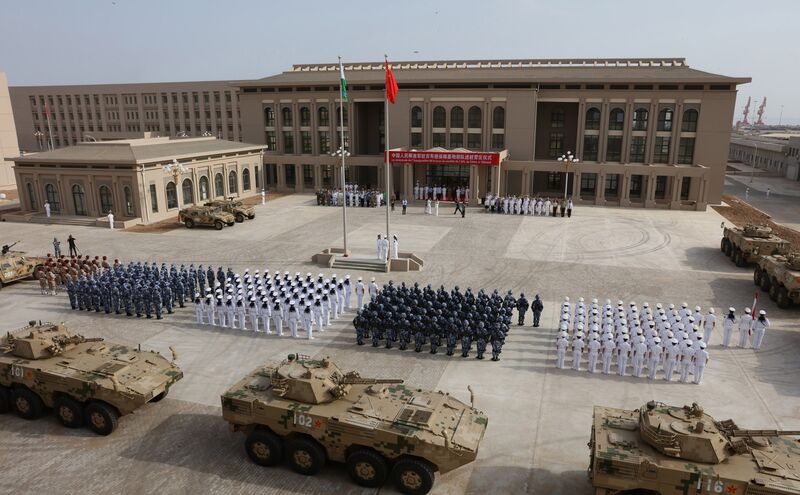
The opening ceremony of China’s new military base in Djibouti on Aug. 1.
The People’s Liberation Army announced the establishment of a logistics support base in Djibouti in July, saying it would back up China’s military’s naval escort, peacekeeping and humanitarian missions in Africa and western Asia as well as military exercises and emergency evacuation.
As part of China’s expanding military and economic clout, the country is taking a stronger stance on territorial claims in the South China Sea, relations with Taiwan and in promoting its “One Belt, One Road” trade initiative.
The opening ceremony of China’s new military base in Djibouti on Aug. 1.
The People’s Liberation Army announced the establishment of a logistics support base in Djibouti in July, saying it would back up China’s military’s naval escort, peacekeeping and humanitarian missions in Africa and western Asia as well as military exercises and emergency evacuation.
As part of China’s expanding military and economic clout, the country is taking a stronger stance on territorial claims in the South China Sea, relations with Taiwan and in promoting its “One Belt, One Road” trade initiative.
Where Chinese interests conflict with the U.S., Beijing is actively seeking to undermine U.S. influence.
The rare comments on how U.S. intelligence agencies view China’s ambitions come as Xi Jinping seeks to consolidate support at this month’s Communist Party Congress, held once every five years. Donald Trump plans to visit China next month and, while the two countries have found areas of cooperation, including over United Nations sanctions against North Korea, they have unresolved disagreements over trade, Beijing’s territorial claims and Syria’s civil war.
The rare comments on how U.S. intelligence agencies view China’s ambitions come as Xi Jinping seeks to consolidate support at this month’s Communist Party Congress, held once every five years. Donald Trump plans to visit China next month and, while the two countries have found areas of cooperation, including over United Nations sanctions against North Korea, they have unresolved disagreements over trade, Beijing’s territorial claims and Syria’s civil war.
Steel Dispute
Commerce Secretary Wilbur Ross, visiting Beijing last month, stressed his intent to cut the U.S. trade deficit with the world’s largest exporter through “increased exports of high-value U.S. goods and services to China and improved market access.”
Ross also announced a probe into China’s stainless steel flanges for unfair subsidies, the latest move after the U.S. trade representative opened an investigation into China’s intellectual property practices.

Wilbur Ross
Wilbur Ross
Chinese leaders see the U.S.-led world order, most notably the U.S. alliance network and promotion of U.S. values worldwide, as constraining China’s rise and are attempting to reshape the world order to better suit Chinese preferences and growing clout.
Ahead of the Communist Party Congress, officials in Beijing have increased control of domestic dissent.
The world’s second-largest economy is on track to reach its 6.5 percent annual growth target, the officials said.
The country is fueling that growth, in part, by seeking deeper technology "collaboration" with U.S. companies.
Bannon’s Warning
Former Trump adviser Stephen Bannon has called the transfer of U.S. technology to China “the single biggest economic and business issue of our time,” adding that “if we don’t get our situation sorted with China, we’ll be destroyed economically.”
The U.S. intelligence officials suggested China’s government is aware of the threat that perception poses to its ambitions.
“Beijing is trying to downplay concerns that this state-led technology acquisition drive creates an unlevel playing field, forces technology transfer to China, limits foreign companies’ access to the Chinese market, and is a threat to U.S. and other countries’ economic strength.”