Affichage des articles dont le libellé est pro-democracy activists. Afficher tous les articles

jeudi 19 septembre 2019

House Speaker Nancy Pelosi welcomes Hong Kong pro-democracy activists to Capitol

By LISA MASCARO

WASHINGTON — House Speaker Nancy Pelosi on Wednesday welcomed Hong Kong pro-democracy activists to the U.S. Capitol, sending a message to Beijing that Congress supports the protesters in their months-long campaign for human rights.House Speaker Nancy Pelosi is given a lapel pin by a Hong Kong activist following a news conference on human rights in Hong Kong on Capitol Hill in Washington, Wednesday, Sept. 18, 2019. Behind Pelosi is Hong Kong activist Joshua Wong. 

Pelosi thanked the activists for "challenging the conscience," not only of the Chinese government, but the worldwide community with their mass protests over the territory's autonomous status. 
She sided with the protesters' demand for universal suffrage and "a political system accountable to the people." 
And Pelosi warned others in the U.S. government not to allow "commercial interests" to drive foreign policy in the region.House Speaker Nancy Pelosi, left, with Hong Kong activist Joshua Wong and other members of Congress during a news conference on human right in Hong Kong on Capitol Hill in Washington, Wednesday, Sept. 18, 2019. 

"If we do not speak up because of commercial interests in support of human rights in China, we lose all moral authority to speak up for them any other place in the world," Pelosi said.
Republicans joined the Democratic leader, alongside several Hong Kong activists who have become prominent figures in the mass protests since June, in a stately room off the House floor beneath a portrait of George Washington.
Republican Rep. Michael McCaul of Texas said Americans see the young people waving American flags on the Hong Kong streets. 
"America stands with you," he said.
Several of the activists appeared before Congress this week, appealing to lawmakers to support the mass protests that began with a now shelved proposal to extradite people arrested in Hong Kong to China.
Against the backdrop of the 30-year anniversary of the Tiananmen Square uprising, with its brutal and bloody crackdown on young democracy protesters a generation ago, the U.S. lawmakers are prominently backing today's young activists. 
Hong Kong activist Joshua Wong called it "a remarkable day" to share the support of the U.S. leaders.
"We will continue our uphill battle until the day we enjoy freedom and democracy," Wong said.
Denise Ho, a singer and pro-democracy activist based in Hong Kong, thanked Pelosi for the "warm welcome" during their visit to the Capitol amid what she called a "very difficult but also very empowering" time in Hong Kong.
"This is a message to the Hong Kong people that we are not isolated in this fight," Ho said. 
"We are in the forefront of this great noble fight for universal values."
During a hearing Tuesday before a U.S. government commission set up by Congress to monitor human rights in China, several activists asked lawmakers to support their efforts by banning the export of American police equipment that is used against demonstrators. 
They also want lawmakers to more closely monitor Chinese efforts to undermine civil liberties in the city.
Republicans and Democrats on the panel, the Congressional-Executive Commission on China, expressed their support. 
Rep. Jim McGovern, D-Mass., said Wednesday the hearing was beamed around the world and "no doubt" watched closely by the Chinese government.
The House is expected to advance legislation that would require the secretary of State to annually review Hong Kong's special economic and trade status, providing a check on the Chinese government's influence and the territory's autonomy.
Pelosi welcomed the Hong Kong government's decision to drop the extradition bill that sparked the protests over summer, but she said Wednesday, "We all know it's not enough. Much more must be done."
The speaker, who has become something of an alternative ambassador on the global stage during her tenure, has a long history of monitoring China from her early years in Congress when she appeared with other lawmakers in Tiananmen Square to pay tribute to the protesters.
Hong Kong, a former British colony, has been allowed certain autonomy and freedoms since it was returned to China in 1997 as a territory, with a "one country, two systems" policy that was supposed to ensure a smooth political transition.
Under U.S. law, the territory of Hong Kong receives special treatment in matters of trade, customs, sanctions enforcement, law enforcement cooperation and more. 
China has benefited from this and used it to evade U.S. export controls and sanctions.
The legislation to be considered by the House from Rep. Christopher Smith, R-N.J., places Beijing on "annual notice" that it will lose Hong Kong's special economic and trade status if its autonomy continues to erode.

mardi 22 août 2017

Britain cannot shirk its duty to defend Hong Kong from China's authoritarianism

Arrests of pro-democracy activists show China is breaching its commitments to the “one country, two systems” agreement.
BY CATHERINE WEST

When Chinese Foreign Ministry spokesman Lu Kang said in June that the Sino-British Joint Declaration no longer has any “practical significance”, shivers were sent down the spines of those who want democracy to flourish in Hong Kong.
“It is not at all binding for the central government's management over Hong Kong. The UK has no sovereignty, no power to rule and no power to supervise Hong Kong after the handover,” he said.
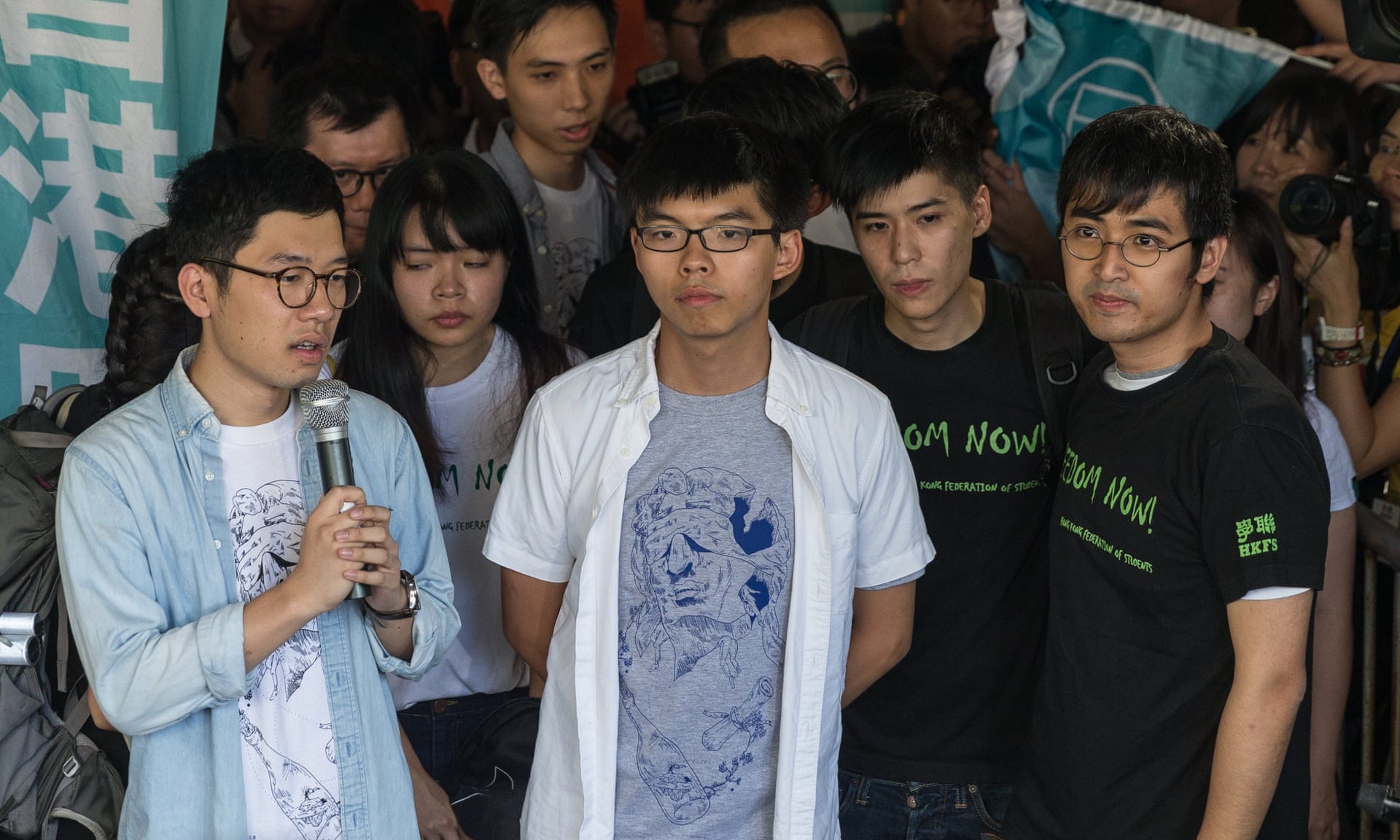
Going by the British government's failure to respond firmly to the jailing of Joshua Wong, Nathan Law and Alex Chow for standing up for democracy, it appears the UK agrees.
The Sino-British Joint Declaration, signed in 1984, was committed to the “one country, two systems” principle, making Hong Kong a Special Administrative Region of China but ensuring a range of freedoms, which future British governments would ensure were upheld.
China’s creeping influence over Hong Kong’s legal affairs and freedom of speech are not new. 
Earlier this year, Amnesty International said the human rights situation in Hong Kong was at its worst since the handover in 1997. 
That assessment followed the disappearance of five Hong Kong booksellers, later found to have been in the custody of the Chinese police, with one describing having been blindfolded and kept in a tiny cell. 
In other instances journalists have been attacked by police.
But in Hong Kong, resistance is on display in familiar scenes on the streets. 
Tens of thousands of people have marched through the financial and legal hub in protest at the jailing of the three pro-democracy activists for their role in the Umbrella Revolution in 2014 – a fundamentally peaceful movement.
It was a moment where people came out to fight for universal suffrage, which I continue to support as key to safeguarding the island’s stability and prosperity (and something Hong Kong’s Basic Law secures by stating that the chief executive should be selected by “by universal suffrage upon nomination by a broadly representative nominating committee in accordance with democratic procedures”).
For showing courage in fighting for universal suffrage, Wong has already served 80 hours of community service and Law 120 hours. 
Chow received a three-week suspended prison sentence a year ago.
Yet now Wong has been jailed for six months, Chow for seven months and Law for eight months.
Wong was even summoned again to court today for an ongoing contempt charge related to the 2014 "Occupy" pro-democracy protests.
Perhaps more importantly, Wong is now not eligible to stand for the legislative council for five years due to his six-month jail sentence, while Law, who was a member of the council, was removed from office.
This all comes after a 2016 order from Beijing for Hong Kong’s government to dismiss officials thought lacking in their allegiance to China, which led to six legislators being banned from holding office.
Many, including Hong Kong’s last Governor, Chris Patten, have suggested Wong, Law and Chow's sentences were a deliberate attempt to prevent them from taking on these legislative positions.
Patten added that he hopes friends of Hong Kong will speak out, having previously written the UK is “selling its honour” to secure trade deals with China, letting down pro-democracy activists who have been trying to fight to maintain freedoms that were guaranteed during the deal that ended over 100 years of British rule.
The prising open of the case by the Hong Kong government to push for tougher punishments reinforces concerns about Beijing’s willingness to interfere in Hong Kong’s democracy. 
As Amnesty International stated, seeking jail terms was a “vindictive attack” on freedom of expression.
China’s enthusiasm for subverting democracy has recently been on show in its attempts to censor Cambridge University Press (CUP), which initially complied with a Chinese request to block access to more than 300 articles from the China Quarterly, a leading China studies journal, including articles on Mao Zedong’s Cultural Revolution and the Tiananmen Square Massacre. 
Following public pressure CUP have now reversed their position.
But while freedoms granted under the Joint Declaration may have contributed to Hong Kong becoming fertile ground for those supportive of democracy and critical of China, it does not free the United Kingdom from its responsibility to uphold the “one country, two systems” principle, which promises extensive autonomy and freedoms to the island, except in the area of foreign relations and military defence.
The Joint Declaration is a legally binding treaty. 
It is registered with the UN and is still in force. 
As the UK is a co-signatory, it should be doing all it can to make sure it is upheld.
Yet, in late June one of Hong Kong’s most respected democracy activists Martin Lee described the British government as "just awful. I’m afraid I cannot find any kind words to say about that.”
It is not for either China or the UK to unilaterally decide the Joint Declaration is null and void. 
The people of Hong Kong understand that and are standing up for democracy in the face of adversity. Our Government has a duty to stand by them.

dimanche 20 août 2017

Rogue Nation

Hong Kong’s rapid descent into repression


Pro-democracy activists Joshua Wong, right, and Nathan Law, left, speak outside the high court in Hong Kong on Thursday. They were sentenced to six to eight months in prison. 

IN 2014, as Hong Kong erupted into protests calling for free elections, Joshua Wong emerged as the face of the city’s pro-democracy Umbrella Movement
Just 17 years old at the time, he led demonstrators as they marched on a fenced government square and organized weeks of sit-ins thereafter. 
In the years since, he has continued to champion democratic reform, establishing a student-led political party that won a seat on the legislative council. 
Apparently, this was more than Beijing and the pro-China local government could bear: On Thursday, Mr. Wong and two other activists, Alex Chow and Nathan Law, were sentenced to six to eight months in prison for their role in the peaceful protests.
Thursday’s ruling overturns lighter penalties handed down last year. 
Mr. Wong and Mr. Law were initially sentenced to community service, and Mr. Chow was given a suspended sentence. 
That the Hong Kong government pressed forward with prosecution was troubling enough, but its decision to appeal the original penalties and push for jail time is particularly vindictive. 
It is also politically self-serving: Hong Kong law prohibits people sentenced to more than three months in prison from running for office for five years
By cracking down on three rising political stars, the pro-Beijing establishment has managed to cripple its opposition and discourage further criticism.
The sentences send a chilling message that speech and assembly are only permitted in the city if they support the status quo. 
This strikes at many Hong Kong residents’ deepest fear: that the local government has become an extension of Beijing. 
When Hong Kong was officially transferred from British to Chinese rule in 1997, it was on the condition that China would allow the city a measure of autonomy and democracy. 
Hong Kong has long prided itself on its independent judiciary and system of self-rule. 
It is becoming increasingly clear, however, that the local leadership is willing to jettison these principles.
Over the past three years, Beijing and its loyalists in Hong Kong have restricted the field of candidates allowed to run for chief executive; reached across borders to detain five Hong Kong booksellers who stocked politically sensitive books; cracked down on street protesters calling for democracy; and stacked the deck to elect a pro-China leader, Carrie Lam, who trailed in public opinion polls
Most recently, Chinese lawmakers reinterpreted Hong Kong’s charter to disqualify four pro-democracy legislators for peacefully protestingduring their swearing-in ceremony. 
Thursday’s decision should not be seen in isolation but as part of Hong Kong’s rapid descent into political repression.
What is especially sad about this crackdown is that it is so self-defeating: Both China and Hong Kong would benefit from a city that upholds the rule of law and promises a stable environment for investment. 
The more Hong Kong embraces authoritarianism, the less vibrant and prosperous it will be.

vendredi 18 août 2017

A letter to China: Hong Kong's democrats should be honoured

An open letter from political figures around the world calls on Beijing to free three jailed pro-democracy activists

Pro-democracy activists Nathan Law (L), Joshua Wong (C) and Alex Chow (R), who were jailed on Friday. 

The decision by the courts in Hong Kong to sentence three courageous, principled young men to jail yesterday is an outrageous miscarriage of justice, a death knell for Hong Kong’s rule of law and basic human rights, and a severe blow to the principles of “one country, two systems” on which Hong Kong was returned to China 20 years ago.
Joshua Wong, Alex Chow and Nathan Law helped lead the umbrella movement in Hong Kong in 2014 – one of the most peaceful and restrained movements of public protest the world has ever seen. Joshua Wong and Nathan Law have already served the penalties imposed by a court a year ago. Joshua Wong served 80 hours of community service and Nathan Law 120 hours. 
Alex Chow received a three-week suspended prison sentence a year ago. Yet the Hong Kong government decided to reopen the case and seek tougher punishments. 
Yesterday the court of appeal jailed Joshua Wong for six months, Alex Chow for seven months and Nathan Law for eight months.
Joshua Wong turns 21 in October, an age where he could be eligible to stand for election to the legislativecouncil. 
However, his eligibility is automatically now removed as a result of a six-month jail sentence. 
Nathan Law, aged 24, was elected as the youngest ever member of the legislative council a year ago, but was removed from his seat earlier this year on the grounds that he failed to take his oath properly. Alex Chow is 27 and has recently completed his studies at the London School of Economics.
Yesterday’s verdict is not only outrageously unjust because these three young men had already served their sentences and because it strikes a severe blow to Hong Kong’s freedoms, but also because it robs three bright, intelligent, principled and courageous young men of more than half a year of their lives and potentially denies them a future in politics or other employment in Hong Kong.
The three student leaders were charged for leading a peaceful sit-in that triggered the 79-day pro-democracy umbrella movement in 2014. 
At that time, the Hong Kong government described the demonstrations as illegal, invoking the public order ordinance, which has been criticised by the United Nations human rights committee for “facilitat[ing] excessive restrictions” to basic rights. 
The law, which requires that processions involving more than 30 people and assemblies with more than 50 must apply for and receive a “letter of no objection” from the government in advance, is incompatible with article 21 of the international covenant on civil and political rights (ICCPR), which applies to Hong Kong. 
Human rights organisations such as Human Rights Watch have long urged Hong Kong authorities to revise the ordinance to comply with the ICCPR. 
According to Human Rights Watch, imposing new punishments on Joshua Wong and Nathan Law, who had already completed their sentences of community service, may violate article 14(7) of the ICCPR, which enunciates the principle of “double jeopardy” that no one shall be “punished again” for the same offence.
In a series of tweets Joshua Wong exhibited his courage even upon learning of his sentence. 
He wrote: “You can lock up our bodies, but not our minds! We want democracy in Hong Kong. And we will not give up. They can silence protests, remove us from the legislature and lock us up. But they will not win the hearts and minds of Hong Kongers. Imprisoning us will not extinguish Hongkongers’ desire for universal suffrage. We are stronger, more determined, and we will win.”
As former heads of government, parliamentarians, lawyers and civil society leaders, we stand in solidarity with these three brave young men, we condemn yesterday’s verdict by the court of appeal, we call for it to be reviewed and for these three political prisoners to be released, and we urge the international community to put pressure on the governments of the People’s Republic of China and the Hong Kong Special Administrative Region to respect the principles of “one country, two systems” and the Basic Law in Hong Kong.
Joshua Wong, Alex Chow and Nathan Law should be honoured, encouraged and supported, not jailed.
Yesterday was a dark day for Hong Kong and it should be met with international condemnation.

The Rt Hon Lord Alton of Liverpool Independent crossbench peer, House of Lords, United Kingdom
The Rt Hon Lord Ashdown of Norton-sub-Hamden Former leader of the Liberal Democrats, former UN high representative in Bosnia, UK
His Eminence Cardinal Charles Maung Bo Archbishop of Yangon, Myanmar
Fiona Bruce MP Chair of the Conservative party human rights commission, UK
Andrew Khoo Co-chairperson, human rights committee, Bar Council Malaysia
The Hon David Kilgour Former Canadian secretary of state for Asia-Pacific, former member of parliament and Nobel peace prize nominee 2010, Canada
Mohamed Nasheed Former president of the Maldives
The Hon Consiglio Di Nino Former senator, Canada
Grover Joseph Rees United States ambassador (retired), US
The Rt Hon Sir Malcolm Rifkind Former foreign secretary, United Kingdom
Charles Santiago Member of parliament, Malaysia
Congressman Christopher Smith Member of the United States Congress and co-chair of the Congressional-Executive Commission on China, US
Charles Tannock MEP Member of the European parliament
Alissa Wahid Daughter of former president Abdurrahman Wahid and founder of the Gusdurian Network, Indonesia
Zarganar Comedian and former political prisoner, Myanmar
John Dayal Writer and activist, India
John McCarthy Former Australian ambassador to the Holy See
Sir Geoffrey Nice QC Former chief prosecutor in the trial of Slobodan Milosevic, UK
Janelle Saffin Former member of parliament, Australia
Jonathan Aitken Former member of parliament, cabinet minister and author, UK
Sonja Biserko Human rights campaigner, Serbia, and former member of the UN Commission of Inquiry on North Korea
David Matas Human rights lawyer, Canada
Catherine West MP Former shadow foreign minister, UK

mardi 15 novembre 2016

The Nazi Interpol

The appointment of Meng Hongwei is alarming given China’s longstanding practice of trying to use Interpol to arrest dissidents and refugees abroad
The New York TimesMeng Hongwei, right, in Beijing in August. 

Interpol, the international law enforcement agency, has had a history of allowing its international database of fugitives to be used by authoritarian governments to persecute dissidents and critics. 
It is therefore deeply troubling that a senior Chinese security official will become the organization’s next president.
Interpol announced last week that Meng Hongwei, China’s vice minister of public security, was elected by members of the agency’s general assembly to serve as president for a four-year term. 
He is the first Chinese official to lead the agency.
Human rights lawyers and activists in China have been persecuted by the authorities for years. 
Some have been detained and harassed; dozens have been held in secret prisons without access to lawyers, according to Human Rights Watch.
“The appointment of Meng Hongwei is alarming given China’s longstanding practice of trying to use Interpol to arrest dissidents and refugees abroad,” Nicholas Bequelin, East Asia director of Amnesty International, said in a statement
“It seems at odds with Interpol’s mandate to work in the spirit of the Universal Declaration of Human Rights.”
Beyond handling routine policing matters, China’s Ministry of Public Security protects the Communist Party and its leaders. 
This raises the possibility that Meng could use his influence at Interpol to target critics of the Chinese government. 
Meng steps into the post as Interpol embarks on an effort to systematically collect and share biometric information of suspected terrorists.
China and Russia are among the countries that have abused Interpol’s “red notice” database of information about fugitives. 
While the system is central to international law enforcement cooperation — preventing suspected terrorists from obtaining visas, for instance — it has been used to punish journalists, pro-democracy activists and human rights defenders. 
There is a mechanism for people to challenge red notice alerts, but it can be time-consuming and costly.
As Interpol’s president, Meng will run its executive committee, which plays a key role in setting the agenda for new initiatives and has oversight over the work of the secretary general, the day-to-day chief. 
His appointment calls into question the firmness of Interpol’s commitment “not only to refrain from any possible infringements of human rights, but also to actively promote the protection of human rights.”
When Interpol’s general assembly meets next year in Beijing, it should, at the very least, take steps to prevent the red notice database from being misused. 
It can also clarify and strengthen its human rights policy so that Interpol is used solely to share intelligence about legitimate threats and criminals.