Affichage des articles dont le libellé est Norsat. Afficher tous les articles

lundi 19 juin 2017

The Manchurian Canadian

Trudeau’s strange China syndrome
By John Roe
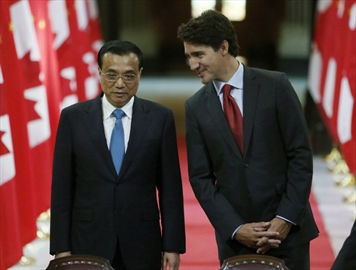
In this photo, Li Keqiang and Justin Trudeau stand in the Hall of Honour as they take part in a signing ceremony on Parliament Hill in Ottawa in 2016. Caution is urged by many as the Canadian government pursues a stronger relationship with China.

The Canadian government's worthy pursuit of a stronger relationship with China should not come at any cost.
Justin Trudeau's Liberals should not make a new friend of the Chinese in a way that recklessly alienates our oldest and strongest friends in the United States and Europe.
Nor should Canada seek short-term economic gains by putting at risk the long-term security of our trusted North Atlantic Treaty Organization allies.
Regrettably, the federal government could be making all of these mistakes by saying yes — too quickly, too carelessly and without a strong enough review — to a Chinese takeover of the Canadian high-tech company, Norsat.
Norsat sells satellite communications systems to the U.S. Department of Defense, the U.S. army, the U.S. Marine Corps, NATO, the Taiwanese army as well as NAV Canada, the agency that oversees civil aviation in Canada.
From a security standpoint and the perspective of those customers, that's highly sensitive technology.
However, Trudeau's government has OKed the takeover of Norsat by Hytera Communications of Shenzhen, China.
This decision came after the federal government conducted only a routine security analysis.
What should worry Canadians — and what is worrying an American congressional committee — is that the Liberals failed to conduct a full, national-security review of the takeover to discover how it might affect the transfer of important technology outside Canada.
Trudeau says there's nothing to worry about.
A host of security and diplomatic experts disagree.
Two former directors of the Canadian Security Intelligence Service — Richard Fadden and Ward Elcock — say they would have recommended that Hytera's proposed takeover of Norsat be vetted by a comprehensive, national-security review.
That process, they say, would determine whether the deal could hurt Canada and its allies.
A former Canadian ambassador to China, David Mulroney, is also puzzled by the government's behaviour and calls the takeover "worrying."
The most pointed American response so far has come from Michael Wessel, head of the U.S.-China Economic and Security Review Commission, an American congressional body.
He says the sale "raises significant national-security concerns for the United States" and wants the Pentagon to review its dealings with Norsat.
These are significant alarms Trudeau is doing his best to ignore. 
He should think again.
Canada has a long, usually positive history of engaging China. 
There are compelling arguments for strengthening our economic and cultural ties even more.
But this should not blind Canada to reality.
China is a communist country ruled by a single party. 
It is a dictatorship with a terrible record of trampling the human rights of its own citizens.
It is challenging the United States' status as the world's pre-eminent superpower, expanding its armed forces and militarizing reefs in the South China Sea to add muscle to its bid. 
And it is a part-owner of Hytera, which wants Norsat.
While an American company is making a counter-offer to Norsat, that offer will likely fail.
If it does, the Liberals should order a proper, in-depth national-security review of the Hytera takeover — for the sake of Canada and its allies.

dimanche 18 juin 2017

Why Ottawa should have red-flagged — not approved — Chinese takeover bid for satcom firm Norsat

By Diane Francis
Ottawa inked the takeover by the People’s Republic of China of a tech company called Norsat International in Vancouver. 
The company sells satellite-communication systems to the U.S. military and agencies and now a Washington D.C. commission has red-flagged this deal as a threat to U.S. national security.
This permission should never have been granted to China-based Hytera Communications Co.
Hytera, which has been competing with U.S.fund manager Privet to buy the company, has raised its offer to US$11.50 per share and amended the break fees, but Norsat says there’s no assurance that the transaction will get all necessary approvals and be completed.
There is a strategic reason why the Chinese would buy this company and Canada must, on behalf of our trading partner, not allow itself to become a backdoor entry into the U.S. Pentagon or other sensitive sectors and entities.
This displays the same naivete as afflicted former Prime Minister Stephen Harper who pursued a “free trade” deal with unfair trader China.
This week, Justin Trudeau answered critics by stating that the deal was run by American authorities. 
But, given China’s avowed goal of snapping up important technology, a full detailed analysis with the Americans of what this company does – and why the Chinese want to buy it – should have been undertaken.
Now there’s a U.S. political backlash.
This is not a matter of sovereignty, but alliance. 
Ottawa cannot ignore or bypass military, and national security concerns, and certainly never to please China.
What would Canada think if the U.S. signed a bilateral with a country whose corporations threatened Canada’s national security?
Besides scrapping this deal, Ottawa must stop pursuing a bilateral “free trade” deal with China, given its past negotiations, behaviour, and continuing damage to the west, through cyberattacks and counterfeiting.
We are the two most symbiotic and synergistic economies in the world, good friends, cultural cousins, and inter-dependent in terms of security and business.
Donald Trump doesn’t make the relationship any easier, but it’s never been totally smooth sailing.
Canada’s best course in trade policy is to double down on its biggest asset which is this economic relationship with the United States. 
A replacement for NAFTA should be a bilateral deal that is more far-reaching and includes free movement of workers across the border.
This makes sense – whoever is President — because the United States is where the capital, expertise, and opportunities are and will be for Canadians, individually and corporately.
Except for this China misstep, the Trudeau government has handled the volatile U.S. situation quite well. 
Ottawa announced more spending on military and defence. 
This has been a request that was not only Trump’s but Obama’s too, who said elegantly that the “world needs more Canada and NATO needs more Canada” in his address to Parliament before leaving office. 
Finally, this month Ottawa announced increases of $70 billion over a decade.
But Ottawa must drop the myth, once and for all, that China is a desirable bilateral trade partner. 
Here’s why:
China’s corporations are state-owned enterprises, or client corporations, and accede to the wishes of the Politburo.
China will never grant reciprocity in terms of market access or the rule of law.
China is a known trade cheat who conducts cyber warfare against governments and corporations, and indulges in large-scale counterfeiting by ignoring copyright and patents.

Deborah Wince-Smith, President of the United States Council on Competitiveness in Washington D.C., said at a tech conference last month in Boston:China is the epicenter of digital theft. If nothing had been stolen by China, the U.S. would have another $1.7 trillion [or 10 per cent more] in GDP.”
China’s track record in Canada is abysmal and includes a request to the Supreme Court of Canada, by a Chinese engineering giant a handful of years ago, to exempt it from our laws after it breached safety violations and ignored our courts following workers’ deaths. 
The Court refused to hear the case. 
Fines were never paid.
China is on a tear to snap up strategic assets –telecom, satellite, defense, aerospace, artificial intelligence – around the world. 
It’s also snapping up farmland, resources and infrastructure deals (through their Silk Road initiative) wherever it can.
Norsat is small potatoes, but obviously of importance or wouldn’t be sought. 
If it’s for sale, an American or European bidder would be acceptable because we have trade deals which grant Canadians market access and legal rights in those jurisdictions.
China wants one-way trade — its way — and nobody will ever be able to buy their technology or resource companies or be granted reciprocal access privileges.
The Canada and the U.S. economic union is the envy of the world and must be safeguarded and enhanced.
The best advice, when navigating among superpowers, is that Canada must remember that the enemy of my friend does not have to be my enemy, but it certainly cannot be my friend.

jeudi 15 juin 2017

The Manchurian Liberals

Australia's not ready to trust China. Why are we?
By Jonathan Manthorpe 
Xi Jinping shakes hands with Justin Trudeau in Beijing, Wedensday, Aug. 31, 2016. 

Australians have been warned by two of their most senior security officials that their country is the target of Chinese espionage and influence-buying “on an unprecedented scale.”
“This has the potential to cause serious harm to the nation’s sovereignty, the integrity of our political system, our national security capabilities and other interests,” Duncan Lewis, the director general of the Australian Security Intelligence Organization (ASIO), said last month.
This view was echoed by the most senior official in the Defence Department — the equivalent of the deputy minister in Canada — Dennis Richardson
He said in a speech in Canberra that the Chinese Communist Party’s campaign of subversion in Australia has gone well beyond stealing classified technology. 
It extends into buying political influence, the control of Chinese language media and the ability to monitor and harass Chinese dissidents in Australia.
All the charges levelled against the Chinese Communist Party (CCP) by the two officials and others in Australia can be made in Canada, too. 
Indeed, Canada has been an active CCP target for espionage and the embedding of agents of influence for considerably longer than Australia. 
Canada was marked out by the CCP even before it came to power in China in 1949, while Australia has only figured as a serious espionage target in the last 30 years.
Even so, Australia’s relationship with China is more fraught than Canada’s. 
China is Australia’s largest trade partner and the main customer for the country’s natural resource exports.
So it’s a measure of how seriously the Canberra government takes the CCP threat to its national sovereignty that it recently appointed David Irvine, the former director of its overseas spy agency — the Australian Secret Intelligence Service — as chairman of its foreign investment advisory committee.
In recent years, Australia has blocked many Chinese investments, mostly from state-controlled or state-linked companies, in sensitive infrastructure projects and technology companies.
It is highly unlikely, for example, that Canberra would have followed the example of the Justin Trudeau government in allowing the takeover of the British Columbia satellite communications company, Norsat, by the Chinese radio-systems manufacturer Hytera. 
The Chinese government is a Hytera shareholder.
Norsat’s customers include NATO, the United States Department of Defense, the U.S. Army and Marine Corps, the Taiwanese Army and the Irish Department of Defence. 
That’s a list of institutions whose communications should not be controlled by a dangerous enemy like the CCP.
The Conservative government of Stephen Harper was more robust in blocking the sale to China of companies owning sensitive technology. 
The Liberals, in contrast, have always had a blithe attitude towards Beijing — because the CCP has put much effort into forging friendships with senior Liberals and associates for well over 50 years.
The warnings of CCP infiltration by the two Australian security officials coincide with a major series of exposes by Australia’s largest news organization, Fairfax Media, which owns such well-known newspapers as the Sydney Morning Herald and The Age in Melbourne, in partnership with the Australian Broadcasting Corporation television program ‘4 Corners’.
The series of stories has set out a welter information about CCP efforts to suborn Australian political parties with large donations, usually made through proxies, and politicians themselves, often through offers of lucrative post-retirement posts in Chinese companies or institutions.
Canada has tighter rules than Australia on foreign donations to political parties, but that is easily circumvented through the use of Canadian listed companies controlled at arms’ length by the CCP.
Following the money, the Australian media series also tracked how the CCP has acquired influence and access to technologies with military applications by arranging large donations to Australian universities and other research institutes.
One of the most compelling segments in the Fairfax-4 Corners series deals with efforts by Beijing’s diplomats and agents of influence to control Chinese immigrants and temporary residents, such as students.
The series charts incidents of Beijing’s diplomats threatening immigrant dissidents in Australia with reprisals against their families in China unless they curb their activism.
The CCP also has paid special attention to Australian universities and colleges as the country has attracted — as Canada has — a large number of Chinese students. 
The CCP, through diplomats in its embassy and consulates, has recruited informants and cadres among Chinese student populations. 
These spies are there to smother any anti-Beijing activities by the Chinese students and to arrange counter-demonstrations against protests by groups like Falun Gong, Hong Kong democracy advocates, Taiwan independentists and the Free Tibet movement.
However, there’s a serious academic consequence from these spies-in-the-classrooms, according to Australian professors and tutors: Chinese students are now unwilling to express themselves or voice ideas that might get them into trouble with the CCP. 
The Fairfax-4 Corners series reports several professors saying Chinese students had come to them asking to be put in groups without any other Chinese students in them, so they could feel free to fully take part in their courses.
Canadian immigrants from China, and Chinese students here, are subject to exactly the same pressures as their Australian counterparts. 
A detailed report on the harassment of Chinese Canadians and members of groups opposed to Beijing by the CCP’s diplomats and other agents was presented recently to the Ottawa government.
It’s no accident that Beijing keeps twice as many “diplomats” in its embassy and four consulates in Canada than does the U.S., our immediate neighbour, closest ally and largest trading partner. 
As a result, the Canadian Security Intelligence Service, according to a former director, James Judd, uses half its time and resources trying to monitor the extracarricular activities of these Chinese “diplomats.”