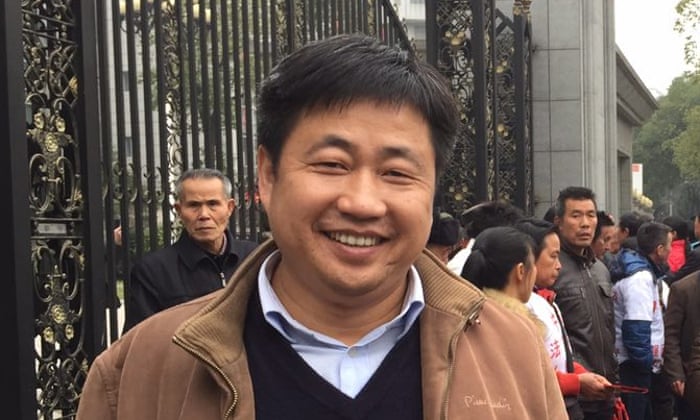
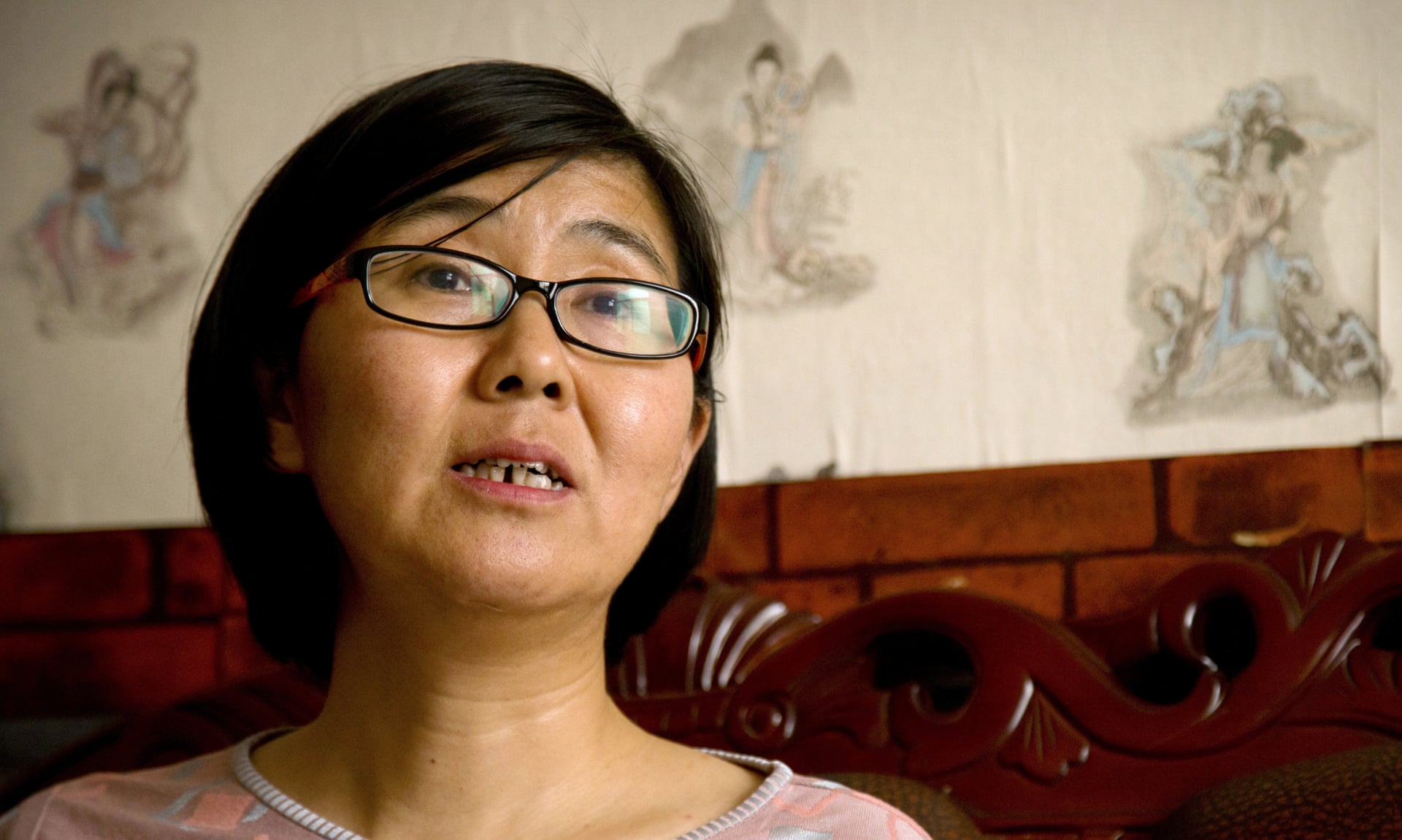
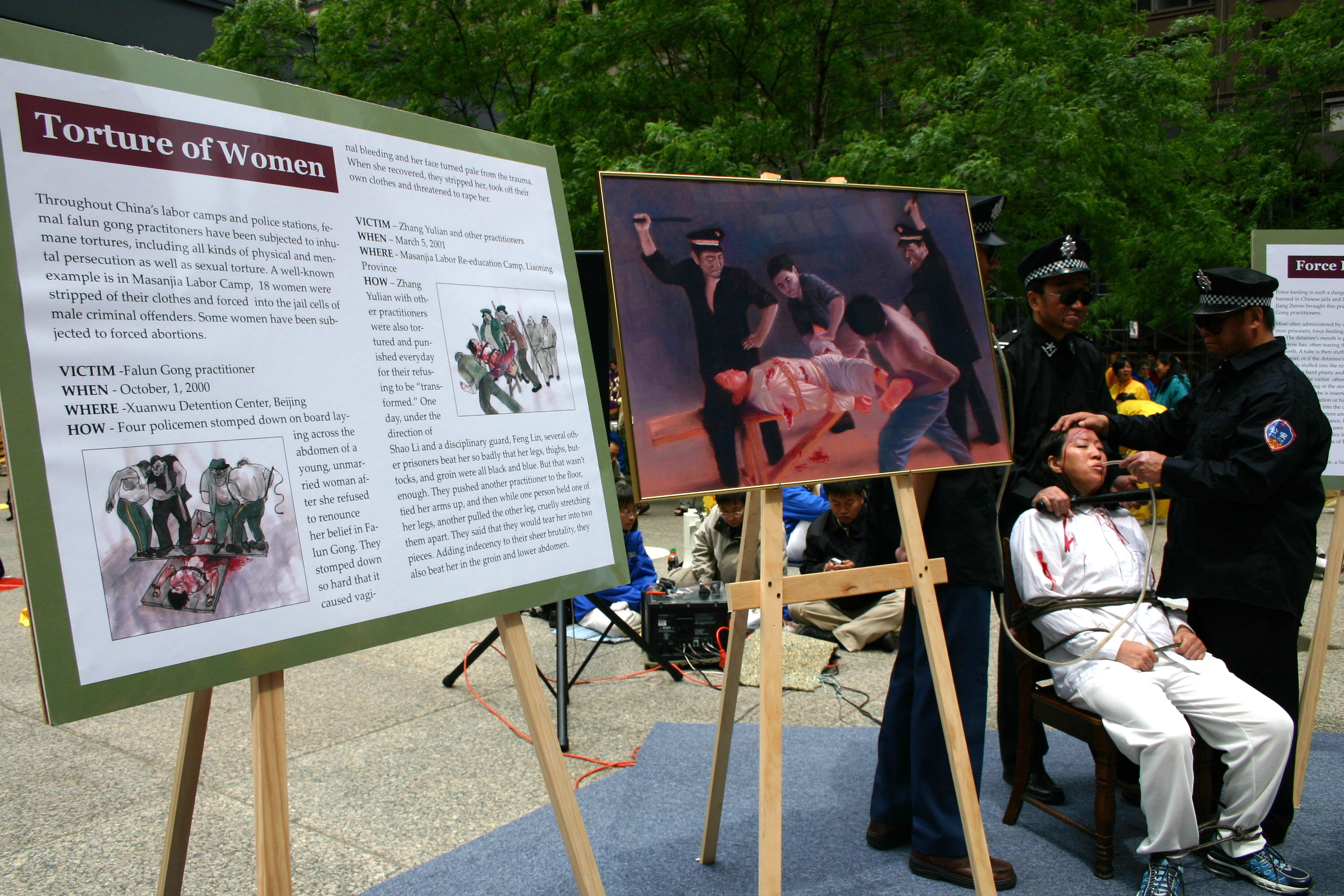
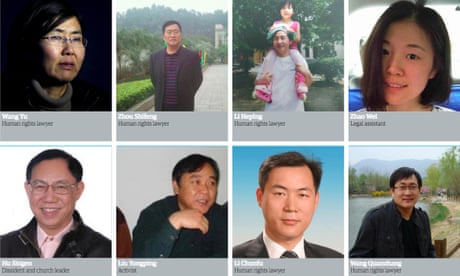
Affichage des articles dont le libellé est Li Heping. Afficher tous les articles

jeudi 5 avril 2018

Rogue Nation

Wife marches for 'vanished' husband
BBC News

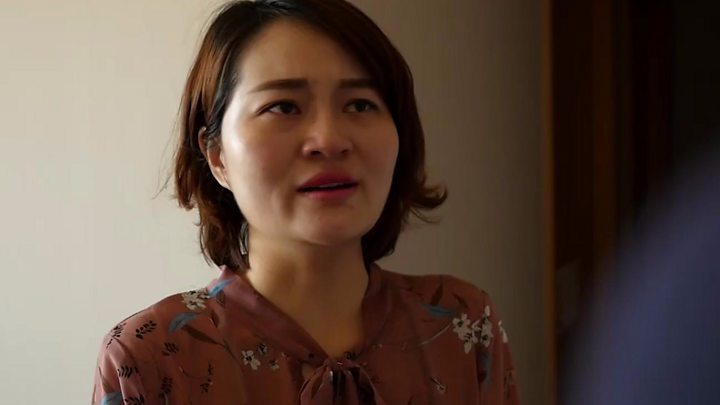
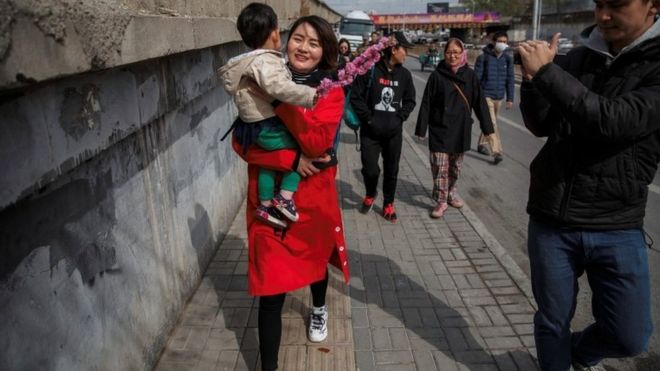
Li Wenzu is walking from Beijing to Tianjin

The wife of a detained Chinese lawyer has begun a march of more than 100km (62 miles) to try to find answers about his fate.
Li Wenzu is walking from Beijing to Tianjin, where she thinks Wang Quanzhang may be being held.
She told the BBC she had heard nothing since his arrest 1,000 days ago and did not even know if he was still alive.
Mr Wang was held in August 2015 during a nationwide crackdown that detained more than 200 rights activists.
Activists say the "709" crackdown as it is now known -- a reference to 9 July, the date it began -- was a sign of the growing intolerance of dissent under Xi Jinping.

Li Wenzu, speaking last year about her husband's disappearance

The state-run People's Daily at the time called some of the leading detainees "a major criminal gang that has seriously damaged social order".
Ms Li is doing the 12-day walk to try to force the authorities to tell her what has happened to her husband. 
All she knows is that he was detained.
She asked whether China was following its policy of "ruling the country according to the law" if her husband's lawyer was not allowed to see him.
She also said she suspected her husband had been tortured.
Ms Li does not even know if her husband is still alive

Ms Li told Reuters: "[They have] abused all of our rights. Arresting an innocent person like this, locking him up for almost 1,000 days, I think this is cruel. It's heartless."
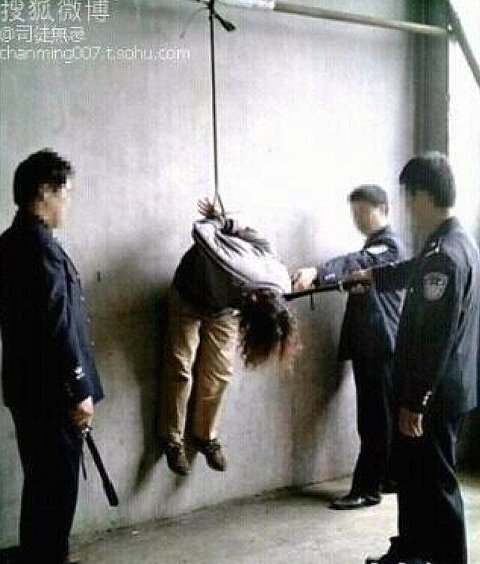
Mr Wang handled cases of complaints of police torture, and defended members of the banned Falun Gong spiritual movement, which China calls an evil cult.
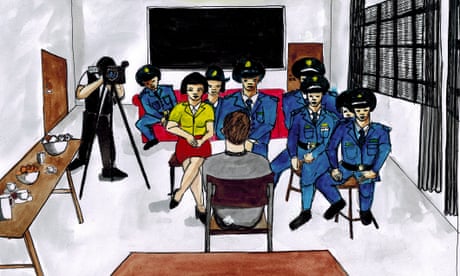
In this interview from 2015, he recounted being beaten in the basement of a court building for challenging the order of a judge.
Ms Li is being accompanied on her walk by Wang Qiaoling, wife of rights lawyer, Li Heping, who was given a suspended sentence for subversion last April.
Many of those held in the "709" crackdown were given jail terms, suspended sentences or house arrest.

vendredi 19 mai 2017

China's war on law: victims' wives tell US Congress of torture and trauma

Women whose husbands were targets of Communist party crackdown on human rights lawyers call for US sanctions
By Tom Phillips in Beijing

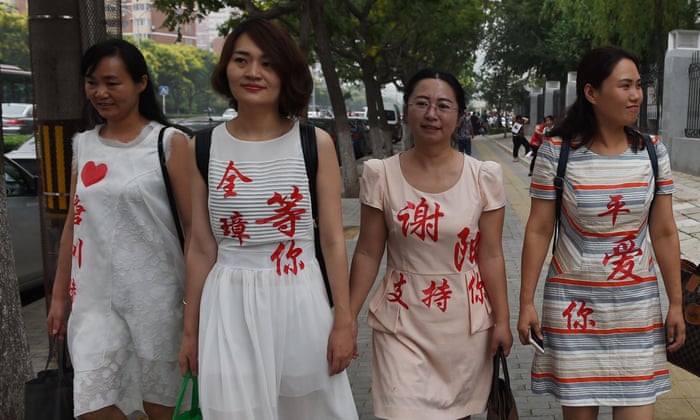
Chen Guiqiu (3rd L), the wife of detained human rights lawyer Xie Yang, with other wives of detained human rights lawyers wearing the names of their husbands on their dresses in 2016. 

The wives of some of the most prominent victims of Xi Jinping’s crackdown on civil society have stepped up their campaign for justice, backing calls for US sanctions against Chinese officials involved in barbaric cases of torture and abuse.
Addressing a congressional hearing in Washington on Thursday, the women, whose husbands were among the key targets of a Communist party offensive against human rights lawyers, detailed the physical and psychological trauma inflicted by China’s war on law.

Chen Guiqiu, who fled to the United States in March, told of how her husband, the attorney Xie Yang, had been imprisoned and brutally tortured because of his work defending victims of land grabs, religious persecution and dissidents.
She described her husband’s ordeal as an example of China’s lawlessness and claimed that at his recent trial Xie had been forced to refute detailed claims that he had been the victim of sustained and brutal campaign of torture.
Wang Yanfeng, the wife of Tang Jingling, a lawyer and democracy activist who was jailed in 2016 in what campaigners described as “a gross injustice”, said her husband had suffered repeated spells of abuse, threats and torture. 
“Today other [lawyers and political prisoners] are still suffering from such torture,” Wang said, calling on Donald Trump to challenge China over such abuses.
In a video message, Li Wenzu, the wife of lawyer Wang Quanzhang, said she had heard nothing from him since he was seized by police at the start of the campaign against lawyers in July 2015. 
“I am deeply concerned about my husband’s safety. I don’t know how his health is. I don’t know whether he has been left disabled by the torture. I don’t even know whether he is alive.”
Wang Qiaoling, whose husband, Li Heping, recently emerged from a 22-month stint in custody, said he returned home looking “20 years older” and had told of being forced to sit for hours in stress positions and being shackled with chains. 
“He suffered from very cruel and sick torture,” Wang added.
Also giving testimony was Lee Chin-yu, whose husband, the Taiwanese human rights activist Lee Ming-che, vanished into Chinese custody in March after travelling to the mainland. 
“I stand alone before you today to plead for your help for my husband,” Lee said, calling on Washington to pressure China to end her husband’s “illegitimate detention”.
Since China’s crackdown on lawyers began almost two years ago, its victims’ wives have emerged as a relentless and forceful voice of opposition, often using humorous online videos and public performances to champion their cause. 
They say they have done so in defiance of a campaign of state-sponsored intimidation that has seen them trailed by undercover agents, struggle to enrol their children into schools or be evicted from their homes.
Terry Halliday, the author of a book about China’s human rights lawyers, said the lawyers’ wives had opened up “a new line of struggle that we have not seen before in China”.
“These women have become a very powerful and visible public presence both of criticism of the government, of appeals for the release of their loved-ones but also impugning China in the eyes of the world. It is remarkable.”
“It’s a whole new front,” Halliday added. 
“It is not so easy for the government to silence wives and daughters.”
Thursday’s hearing was part of a push by human rights groups to convince the Trump administration to use a law called the Magnitsky Act to bring sanctions such as travel bans or property seizures against Chinese officials involved in human rights abuses.
“We should be seeking to hold accountable any Chinese officials complicit in torture, human rights abuses and illegal detentions,” said Chris Smith, the Republican congressman who chaired the session and said he was compiling a list of potential targets.
Smith said he hoped such action could help end the “shocking, offensive, immoral, barbaric and inhumane” treatment of Chinese activists that has accelerated since Xi Jinping took power in 2012.
“While Xi Jinping feels feted at Davos and lauded in national capitals for his public commitments to openness, his government is torturing and abusing those seeking rights guaranteed by China’s own constitution,” Smith said.

jeudi 18 mai 2017

When Chinese Rights Activists Were Jailed, Their Wives Fought Back

By CHRIS BUCKLEY and DIDI KIRSTEN TATLOW
In Beijing last year, the wives of human rights lawyers who were detained in 2015, from left, Wang Yanfang, Li Wenzu, Chen Guiqiu, Fan Lili, Liu Ermin, and Wang Qiaoling. 

BEIJING — Before her husband disappeared into detention, Chen Guiqiu did not ask him much about his risky work as a Chinese human rights lawyer. 
Before word crept out that he had been tortured, Ms. Chen trusted the police. 
Before she was told she could not leave China, she never expected she would make a perilous escape abroad.
Ms. Chen and her two daughters reached the United States in March after an overland journey to Thailand that almost ended in their deportation back to China. 
Her husband, Xie Yang, was tried and convicted this month of subversion and disrupting a court. 
But Ms. Chen said her escape was the culmination of a personal transformation that began after he was detained almost two years ago.
“It was because of all the pressure from all sides — from state security police, my employer — and slowly I lost commitment and hope,” Ms. Chen said in a telephone interview from her temporary home in Texas. 
“I was always being followed. I felt I was living without freedom.”
Ms. Chen’s evolution was part of a startling outcome of China’s crackdown on outspoken rights lawyers and advocates that began in July 2015 — the spouses who resisted. 
She and other wives of rights advocates held in China described their experiences to a congressional subcommittee in Washington on Thursday.
After their loved ones disappeared in the wave of arrests, some family members, especially the wives of the detained lawyers, overcame their fear and fought back, often in a theatrical fashion. 
They used online appeals and visits to jails, prosecutors and courts. 
They gathered in bright red clothes and with red buckets to publicize their demands for information and access to the prisoners.
Their tongue-in-cheek slogan became “Leave the dressing table and take on the thugs,” said Li Wenzu, whose husband, Wang Quanzhang, a human rights lawyer, has remained in secretive custody 21 months after he was detained in August 2015.
“The story of the wives is one of the great stories of the whole crackdown — it is a brilliant adaptation by the activists to repression,” said Terence Halliday, a researcher at the American Bar Foundation in Chicago who has written a book on Chinese criminal defense lawyers. 
“My goodness, the attention they have brought to bear, not just for their husbands, but also the state of the crackdown.”
Chinese state investigators have long applied pressure on detainees’ families to win cooperation and confessions. 
But this time their tactics seemed more systematic, said Wang Qiaoling, the wife of a detained lawyer, Li Heping
Mr. Li was recently released after being tried and receiving a suspended prison sentence.
“They can treat you like hand-pulled noodles, squeeze you into any shape,” Ms. Wang, 45, said in an interview. 
“If you’re isolated and scared, it’s hard to resist.”
Some wives of detainees said they had been forced to move from rented apartments after the police warned landlords. 
Some were prevented from enrolling their children in school. 
And the police recruited relatives to beg them to stay quiet and compliant. 
The families described these tactics as “lianzuo” or “zhulian,” old Chinese terms for the collective punishment of families.
Wang Qiaoling, the wife of the detained lawyer Li Heping, in Beijing last year. Mr. Li was recently released after receiving a suspended prison sentence. 

Some families buckled. 
But others protested and filed petitions about the secretive detentions and trials. 
Ms. Wang encouraged a tight circle of women who rallied the relatives of detainees, arguing that silence would only encourage courts to hand down stiffer sentences.
“If you want to protect your family, you can’t stay silent,” Ms. Wang said. 
“It’s been crucial that we’ve been able to stick together.”
But for Ms. Chen, 42, the journey to defiance was especially wrenching.
While many of the detained lawyers lived in Beijing, she lived in Changsha, the capital of Hunan Province, about 800 miles to the south. 
And she had a secure, state-funded job as a professor of environmental engineering at Hunan University, studying ways to remove heavy metal and organic pollution from water.
While Mr. Xie traveled relentlessly, she cared for their two daughters, now ages 4 and 15. 
And when Mr. Xie was home, they barely discussed his contentious legal cases. 
“It never occurred to me that he could get into serious trouble for being a lawyer,” she said. 
“The children kept us busy enough.”
Initially, when the police took Mr. Xie away, Ms. Chen thought he would be freed quickly once investigators found that he had committed no crime. 
She kept quiet, heeding the advice of the police that silence would buy him lenience.
“Under heavy pressure and ignorant, I chose to accept the police’s illegal orders and went along with them for nearly nine months,” she wrote last year in an essay about her experiences
“I heeded the advice of the state security: no media interviews, no going abroad, no contact with other families involved in the case.”
But like other family members, she ran up against an opaque legal system that held detainees in secrecy for many months with no visits by relatives or access to lawyers.
“Not one office followed the law, not one gave us a legal response,” she said in the interview. 
“That was totally different from what I expected. This was a legal case, and I wanted to defend my husband by using the law, but it was impossible to use the law.”
Her growing frustration led her to speak up and contact other wives of detainees, including Ms. Wang, who offered advice and encouragement.
Ms. Chen was spared some of the intimidation that other families described. 
Her children were not singled out at school, she said. 
But other wives of detainees said their children had been denied access to schools or kindergartens in Beijing after officials warned principals or refused to process paperwork.
But Ms. Chen felt a shock in April last year when she tried to take her daughters on a trip to Hong Kong, a self-governed city that mainland Chinese must get a special pass to enter. 
The police stopped her from taking the train across the border on the grounds that she was a security risk.
Chen Guiqiu, right, with her daughters after arriving at an airport in Texas in March.

“I woke up to the fact that I was being treated as guilty by association,” she said. 
“They told me I was deemed a threat to national security, and if I was already regarded as guilty, then Xie Yang was, too.”
In touch now with a circle of wives of detainees, she occasionally took part in their demands for access and information when she visited Beijing. 
Partly inspired by feminist protests in China in 2015, they took to carrying red buckets and displaying red slogans on their dresses as a display of defiance, especially when visiting Tianjin, the port city near Beijing where many of their husbands were held.
“We developed a headstrong mentality,” Ms. Wang said. 
“The more they wanted to make us feel like heinous criminals, the more we kept up a relaxed, casual attitude.”
But staying upbeat was not easy. 
Ms. Chen began to hear that her husband had been tortured in Hunan, where he was held. 
At first, the accounts came indirectly. 
Then, when Mr. Xie was allowed to see his lawyers in January this year, he spilled out a description of abuses, including beatings and deprivation of sleep
Ms. Chen decided to release the transcripts online, hoping that the publicity would help end the abuses.
Let the world know what forced confession through torture is, what shamelessness without limit is,” Ms. Chen said in a statement at the time.
The government has denied those claims of torture, and at his recent trial, Mr. Xie also retracted them and pleaded guilty, after his own lawyers were replaced by ones chosen by the authorities. 
But many family members of detained lawyers say that the evidence points to widespread abuses, including the forced taking of drugs that made the detainees docile and submissive.
By February, Ms. Chen lived under stifling surveillance, she said. 
Constantly monitored at home and work, and warned by the police, university officials and relatives not to speak out more about her husband, she decided to escape.
She gathered up her daughters, confided her plan to the older one and told the younger one they were going on a trip. 
The security officers who followed her had become used to her driving away to work each day, but Ms. Chen and her daughters quietly walked out, evading the watchers.
Ms. Chen declined to describe the details of how she and her children made the journey to Thailand, fearing that would endanger people who helped her. 
She kept her cellphone turned off, but the Thai police tracked her to a safe house — she believes with help from Chinese security officers alerted to her disappearance.
After a court appearance, Ms. Chen and her children were taken to a detention center and told they would be sent back to China. 
Officials from the United States Embassy in Bangkok stepped in and secured her release after haggling with the Thai authorities, she said. 
On March 17, Ms. Chen and her children arrived in Houston, after a standoff with Chinese and Thai officials at Bangkok International Airport.
Mr. Xie was given a suspended prison sentence, but he remains cut off from normal contact, apparently under police guard outside Changsha, Ms. Chen said.
“I hope that one day Xie Yang can join us here,” she said. 
“But we might have to wait a long time to see him. We’ve already waited a long time.”
samedi 13 mai 2017

Rule by Fear and Torture: China's War on Law

Chinese lawyer wore torture device for a month
By John Sudworth
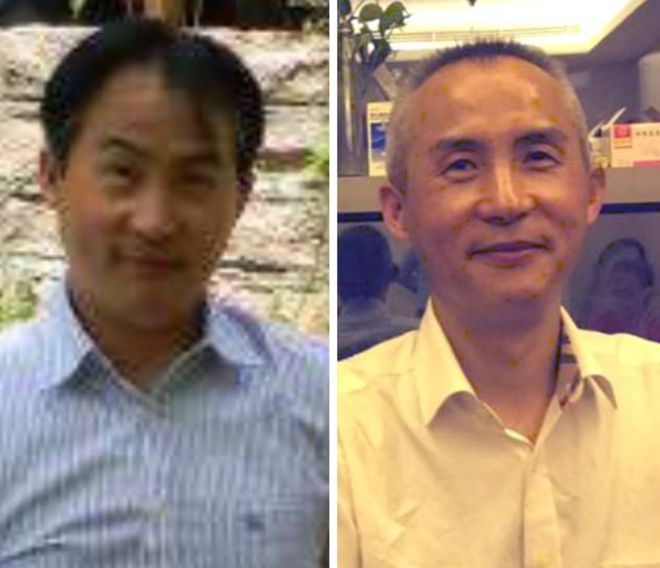
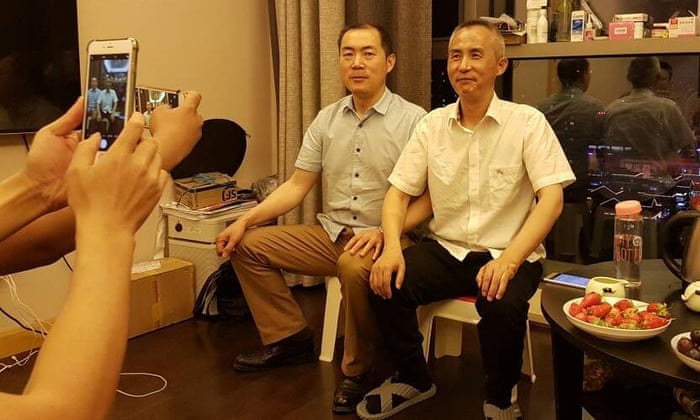
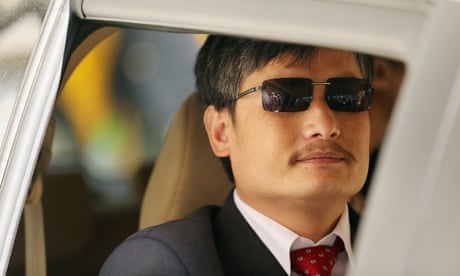
A picture of Mr Li from 2012 and one taken after his release

It's a form of restraint that would be more in keeping with the practices of a medieval dungeon than a modern, civilised state.
But the device -- leg and hand shackles linked by a short chain -- is a well-documented part of the toolkit that the Chinese police use to break the will of their detainees.
And it is one that they forced one of this country's most prominent human rights lawyers to wear, for a full month.
Li Heping was finally released from detention on Tuesday and his wife Wang Qiaoling has now had time to learn about the treatment he endured over his almost two-year-long incarceration.
"In May 2016 in the Tianjin Number One Detention Centre, he was put in handcuffs and shackles with an iron chain linking the two together," she tells me.
"It meant that he could not stand up straight, he could only stoop, even during sleeping. He wore that instrument of torture 24/7 for one month."
She adds: "They wanted him to confess."

China's war on law
In one sense, Mr Li was lucky.
A 2015 investigation by Human Rights Watch into the use of torture by the Chinese police revealed the case of a man who was forced to wear this type of device for eight years.
In 2014 an Amnesty International report documented the supply and manufacture of torture equipment by Chinese companies, including the combined hand and leg cuffs.
Torture devices like the one used on Li Heping are readily available online
"The use of these devices causes unnecessary discomfort and can easily result in injuries," William Nee, China Researcher at Amnesty International, tells me.
"Such devices place unwarranted restrictions on the movement of detainees and serve no legitimate law enforcement purpose that cannot be achieved by the use of handcuffs alone."
Li Heping is one of a group of human rights lawyers who were detained in July 2015, in a crackdown since referred to as China's war on law.
Of course, threats, intimidation and violence have always been part of the risks for any lawyer daring to take on the might of the Communist Party in its own courts.
But Xi Jinping has made it clear that he sees the ideal of constitutional rights, guaranteed by independent courts, as a threat to national security.
So his war on law sends a clear message.
Résultat de recherche d'images pour "badiucao torture"
For those like Mr Li, representing the victims of China's illegal land grabs, religious persecution or political repression, the threat is not just from corrupt local officials or powerful businessmen, but from the state itself.
The before and after photos offer a visual clue to his time in detention.
One taken in 2012 shows an assured, cheery lawyer.
The one taken on his release shows him noticeably thinner and looking older than his years.
Wang Qiaoling tells me she barely recognised him.
And she tells me about the other forms of ill-treatment that her husband has described to her since his release.
"He was forced to take medicine. They stuffed the pills into his mouth as he refused to take them voluntarily," she says.
"The police told him that they were for high blood pressure, but my husband doesn't suffer from that.
"After taking the pills he felt pain in his muscles and his vision was blurred."

Gruelling questioning
"He was beaten. He endured gruelling questioning while being denied sleep for days on end," she goes on.
"And he was forced to stand to attention for 15 hours a day, without moving."
Amnesty International's William Nee tells me that each of these methods of ill-treatment could be considered torture by themselves.
"Cumulatively, they would demonstrate a clear intent by the authorities to inflict physical and mental torture with the goal of getting Li Heping to confess," he says.
"Since China is a party to the Convention against Torture, these serious allegations should prompt the Chinese authorities to immediately launch a prompt, effective and impartial investigation to assess whether this torture took place."
Despite the prolonged and extreme nature of the torture, Ms Wang tells me her husband never did confess.
"He was worried that he might be tortured to death in the detention centre and he wouldn't make it to meet his family again, so he reached an agreement with the authorities that the trial would be held in secret.
"He would be given a suspended sentence but he never admitted guilt or confessed that he had subverted state power."

Barred from the media
At that secret trial, the details of which were released by China's state-controlled media afterwards, the court ruled that Mr Li had "repeatedly used the internet and foreign media interviews to discredit and attack state power and the legal system".
As a result of his conviction, he is now unable to practise law and has also signed an agreement that he will not carry out any further media interviews.
But his wife, despite constant intimidation, refuses to be similarly constrained.

Plain-clothes policemen still surround the family home and she was followed to our agreed interview location.
Wang Qiaoling's account tallies with that of other lawyers caught up in the crackdown, including Xie Yang, whose court case was heard this week.
He had alleged similar abuses during his interrogations -- including shackling, beatings and being made to remain in the same position for hours on end.
We called the Tianjin Number One detention centre to ask about the allegations that Li Heping was tortured there.
"We don't do any interviews," came the reply. 
"If you want to do an interview, please go through the legal and proper channels."

mercredi 10 mai 2017

Rule by Fear and Torture

'Emaciated, unrecognisable': China releases human rights lawyer from custody
Li Heping was held in secret for two years and deprived of all contact with his family
By Tom Phillips in Beijing

Chinese human rights lawyer Li Heping (right) is released from custody after two years in which he was tried in secret.

The last time Terry Halliday saw Li Heping, just a few days before he was snatched by police in the summer of 2015, he remembers sitting down to lunch with a stimulating, thoughtful and physically fit man.
“Slim, yes, but not emaciated. A man clearly in his 40s … A man who was fully present,” the American Bar Foundation scholar recalled.
Just days later Li, a crusading Chinese human rights lawyer, was spirited into secret custody at the start of an unprecedented government crackdown on his trade that has drawn widespread international condemnation.

'I want to rescue my dad': children's heartbreak for the lawyers China has taken away


On Tuesday afternoon, after almost two years languishing behind bars, Li finally emerged, having been secretly tried and handed a suspended sentence for “subversion of state power” at the end of last month.
Photographs and a brief video clip posted online showed the Christian attorney, now 46, being reunited with his wife and daughter, Wang Qiaoling and Li Jiamei, at their family home in Beijing.
“I have to say I didn’t recognise him in the [photo],” said Halliday, the author of a book on China’s human rights lawyers, who like many was disturbed at the toll incarceration appeared to have inflicted on his friend.
“[He looked] very thin. He’s aged about 20 years. His hair has gone grey. He’s gone through a torturous time, I would say,” Halliday added. 
“I would defy anybody ... to imagine that so much transformation could have occurred over two years.”
“The only thing that I recognised was his smile: that wonderful smile of his that has always been a reflection of his warmth and his kindness.”
As news of Li’s release spread on social media, friends and supporters expressed a similar mix of relief and outrage.
“This is Li Heping? Almost unrecognizable!” Liu Xiaoyuan, a prominent rights lawyer who clients have included the dissident artist Ai Weiwei, tweeted alongside an image of the lawyer’s homecoming.
“Hair completely white,” tweeted Zhang Dajun, a Chinese legal scholar.
“Visibly emaciated,” tweeted human rights researcher Ye Shiwei alongside footage of Li’s first hug with his wife and daughter in more than 600 days.

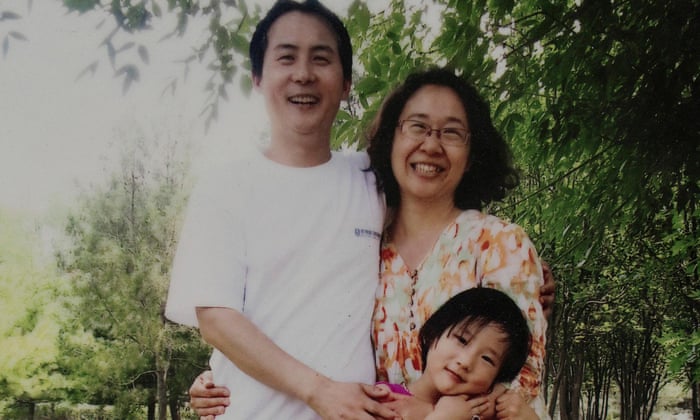
A photo of a printed family photo of Li Jiamei, 6, her father and imprisoned lawyer Li Heping and her mother Wang Qiaoling at home in Beijing, China. 

Zhong Jinhua
, a former judge and government critic, wrote: “Thank God!” Li Heping finally [back] home.”
Halliday said he was delighted, relieved and gratified by Li’s release despite his obvious physical deterioration.
“Friends and supporters and NGOS and governments and churches have been hoping and praying for this since [he was taken on] 10 July 2015,” he said.
“I think this demonstrates how sensitive China’s government is to the unrelenting pressure that has come from all sides,” over its so-called “war on law” crackdown.
However, Halliday cautioned against interpreting Li’s release as a sign that Beijing was showing leniency or mercy to a man who has been held without charge for nearly two years on what supporters and diplomats believe were politically-motivated charges.
“We have got to be very sober that this is no release by the standards of any rule-of-law country. He is going to be ... quarantined with his family. There will be cameras outside his building and outside his apartment. There will be security people on mattresses or chairs sitting outside his front door. They may be under audio or video surveillance inside their apartment. They won’t be able to go anywhere at all without having security people accompany them, whether it is to the grocery store or the park.”
Halliday added: “He’s lost his income and his living. He’ll be kept away from his church. He will be shielded from other lawyers, from his Christian friends. So while I’m very glad that he is no longer in a formal jail, many of us who watch this … believe that China has substituted the formal jail for an invisible prison in the hope that the optics will be better for international audiences.”
Chinese authorities claim that at his secret trial Li pleaded guilty to using social media and interviews with foreign media to attack China’s political and legal systems and having colluded with “individuals engaged in illegal religious activities”.
In the nearly two years since her husband was seized, Li’s wife Wang Qiaoling has emerged as a feisty and sharp-witted campaigner who has refused to be cowed into silence by pressure from China’s security services.
During a meeting with the Guardian last May she burst into laughter when asked what she most missed about her husband. “What do you think I most miss about my husband?” she replied.
On Wednesday morning, Wang again appeared in high spirits although she said she had been shocked when she first set eyes on her husband who she hardly recognised.
“He has changed completely, his appearance, his physical looks... [he is] so different from the husband I remember,” she said by phone.
Wang said her husband seemed “fine mentally” but had “wasted away”. 
She said he had told her of the “sufferings” he had endured while in prison. 
“I am pretty sure he was treated with great cruelty.”
Despite his release, Wang said her husband was “absolutely not free” and could not be interviewed at this stage.
“We are now being followed by six or seven tall, burly men. They simply follow us wherever we go,” she complained.

lundi 20 mars 2017

Rule by Fear and Torture

Canada, 10 other countries call out China for torturing human rights lawyers
By NATHAN VANDERKLIPPE

BEIJING — Eleven countries have jointly called on the Chinese government to investigate reports of torture against human rights lawyers and urged Beijing to abandon a controversial detention system that holds suspects in secret locations for months at a time.
The unusually direct criticism comes in a letter from the Chinese diplomatic missions of the signatory countries, including Canada, that expresses “growing concern over recent claims of torture and other cruel, inhuman or degrading treatment or punishment in cases concerning detained human rights lawyers and other human rights defenders.”
The signatories call for China to end the practice of “residential surveillance at a designated place,” a Chinese form of pretrial custody for sensitive cases that allows suspects to be held for up to six months, often without families or lawyers being told where they are.
Residential surveillance amounts to “incommunicado detention in secret places, putting detainees at a high risk of torture and ill-treatment,” the letter states. 
China should, it says, remove all suspects from residential surveillance and repeal enabling legislation.
Detaining people without any contact with the outside world for long periods of time is contrary to China’s international human rights obligations,” the letter says.
It calls for a prompt and independent investigation into “claims of torture” against lawyers Xie Yang, Li Heping, Wang Quanzhang and Li Chunfu, as well as activist Wu Gan.
Under Xi Jinping, Chinese authorities have waged a war on civil society, detaining and arresting labour activists, women’s rights campaigners and human rights defenders. 
Hundreds of human rights activists and lawyers have been questioned and detained, Amnesty International has said.
Mr. Xie was punched, kicked and kneed by interrogators who threatened: “I’m going to torment you until you go insane.” 
Authorities used electric shocks to torture Li Heping and Mr. Wang.
Family members of Li Chunfu said 500 days of secret detention left him with a mind that was “shattered.” 
Wu Gan was not allowed to sleep for several days and nights.
The Globe and Mail obtained a copy of the Feb. 27 letter, which has not been made public. 
It was addressed to Guo Shengkun, China’s Minister of Public Security. 
It was signed by ambassadors and chargés d’affaires from Australia, Canada, Japan and Switzerland, along with seven European Union member countries: Belgium, the Czech Republic, Estonia, France, Germany, Sweden and the United Kingdom.
Neither China’s public security ministry nor its foreign ministry responded to requests for comment on Monday.
“Canada raises human rights with our Chinese counterparts regularly, using a variety of methods,” an embassy spokesperson said in a statement. 
“Sometimes it is public, but often these issues are best raised privately, where we can have a frank discussion.” 
The Japanese embassy declined comment, since the letter was sent through a diplomatic channel. 
The German embassy said it is “not in a position to comment.”
Joint action is often the most effective way to pressure China, human rights advocates say.
“Beijing always hears a clearer and firmer message when it’s delivered by multiple governments,” said Sophie Richardson, China director for Human Rights Watch. 
The issuance of joint letters is “a strong indication of the widespread concern about human rights erosions in China today.”
Shortly after the letter was sent, Chinese government-controlled media published a week-long series of articles and social media posts lashing out at what People’s Daily called “FAKE NEWS” in Western media reports on the torture of Mr. Xie, the human rights lawyer. 
State-run news agency Xinhua called Mr. Xie’s accusations of mistreatment “nothing but cleverly orchestrated lies” orchestrated by a legal team “aiming to cater to the tastes of Western institutions and media organizations and to use public opinion to pressure police and smear the Chinese government.”
Mr. Xie’s lawyer, Chen Jian'gang, has issued a detailed rebuttal of what he called “groundless lies” in those state media reports.
In an interview Monday, Mr. Chen questioned why the 11-country letter was submitted quietly.
Had it been made public, “the effect would have been much stronger,” he said. 
In a closed and restrictive system like China’s, he said, “secret talk and private questions will have no effect whatsoever.”
Joint diplomatic letters are rare, but becoming more common as countries seek a way to raise issues with China, while avoiding individual retribution from a government that often exacts revenge through economic means.
Last year, the U.S., Canada, Germany and Japan together expressed concern about three new Chinese laws on counterterrorism, cybersecurity and the management of foreign non-governmental organizations. 
Those laws, they wrote, had “the potential to impede commerce, stifle innovation, and infringe on China’s obligation to protect human rights.” 
The European Union submitted a similar letter.
Adding several signatures to one document was a way to raise attention in Beijing, said Guy Saint-Jacques, who was then Canada’s ambassador to China.
“We came to the conclusion that the Chinese were not listening to what we had to say,” he said.
The letter “was badly received by the Chinese government. It accused us of ganging up on them,” he said. 
It produced limited results. 
“There was an offer in one case to have more consultation, and there were some slight changes” to proposed legislation, said Mr. Saint-Jacques, who retired from the foreign service last fall. 
But “they didn’t go as far as we would have liked them to go.”
The new letter on torture, he said, comes at a time when “all observers agree that the human rights situation has deteriorated a lot under Xi Jinping,” even as China has grown more confident in promoting the merits of its autocratic system to other countries.
The letter is notable, however, in part for who did not sign. 
Only seven members of the European Union participated; several diplomatic sources said unanimous support was blocked by Hungary, whose Prime Minister Viktor Orban has praised China’s authoritarian model and sought Chinese investment. (The EU in January publicly called for an investigation into the handling of Chinese human rights lawyers, saying their treatment, if verified “would amount to torture.”)
The United States was also absent from the letter, which human rights workers took as a worrying sign of Washington’s posture under Donald Trump.
“When a country like the U.S. is silent on this, it’s really interpreted by Beijing as a free hand to do what they want. And that costs people their lives,” said Sarah Cook, senior East Asia research analyst at Freedom House, a Washington-based watchdog on political, religious and economic liberties. 
“So it’s unfortunate if the U.S. removes itself from that type of leadership role.”
U.S. Secretary of State Rex Tillerson has pledged to keep pressing China on such issues.
“I made clear that the United States will continue to advocate for universal values such as human rights and religious freedom,” he said in Beijing on Saturday.
The latest U.S. report on Chinese human rights documents former prisoners and detainees who “were beaten, subjected to electric shock, forced to sit on stools for hours on end, hung by the wrists, raped, deprived of sleep, force-fed, and otherwise subjected to physical and psychological abuse.”
The United Nations Committee against Torture, too, has criticized China for allowing torture to become “deeply entrenched” in its criminal justice system. 
In a late 2015 report, it urged Beijing to eliminate residential surveillance and hold criminally responsible any officials responsible for abuse.
Mr. Chen, the lawyer for Xie Yang, called residential surveillance a form of “illegal prison” that allows interrogators power to “do whatever they want.”
But he held out little hope that real change is possible in authoritarian China, even if the residential surveillance is formally abolished. 
He pointed to previous Chinese practices of “re-education through labour” and “custody and repatriation” that were scrapped, only to have other abuse-prone forms of detention emerge.
“As long as there is poison in the system, you can remove one poisonous fruit today — and that looks good,” Mr. Chen said. 
“But these kinds of poisonous fruit will grow out anew every day, without stop.”

dimanche 29 janvier 2017

EU demands China investigate torture of lawyer and release political prisoners

Rare statement cites China’s own laws that prohibit torture in condemnation of mistreatment of detained rights lawyer Xie Yang and others.
By Benjamin Haas in Hong Kong

Lawyer Xie Yang who has been detained by Chinese authorities as part of a crack down on human rights. 

China must investigate a harrowing account of torture by a detained lawyer and release several political prisoners, the European Union has demanded in a rare statement amid a deteriorating human rights situation under Xi Jinping.
Detained rights lawyer Xie Yang detailed his treatment in detention last week, where he was beaten, forced into stress positions, denied medical care and deprived food, drink and sleep by police. 
Interrogators threatened him repeatedly, allegedly saying: “We’ll torture you to death just like an ant”.
Separate reports have said two other civil rights attorneys, Li Heping and Wang Quanzhang, have also been tortured while in custody.
“If verified, this mistreatment would amount to torture,” the European Union’s foreign affairs spokesperson said in a statement
“All necessary measures to ensure the safety and wellbeing of these individuals need to be taken.”
“If the accounts of mistreatment or torture are confirmed, this should result in the punishment of the responsible persons,” the statement added, citing China’s own laws that prohibit torture.
All three were detained in July 2015, part of an unprecedented nation-wide crackdown on human rights lawyers, legal assistants and activists. 
Nearly 250 people were targeted during the campaign, with some still held by police without trial over 18 months later.
“We reiterate our call for the release of the lawyers and human rights defenders who remain in detention, including Jiang Tianyong,” the EU statement said, referring to another lawyer who disappeared into police detention in November.
The EU applauded the release of two other rights defenders, Xie Yanyi and Li Chunfu, but for relatives there is little cause for celebration.
Li, who’s brother is Li Heping, was granted bail earlier this month and returned home. 
But relatives claim nearly 17 months of severe abuse have transformed the 44-year-old lawyer into a shadow of his former self.
“His mind is shattered,” his wife, Bi Liping, was quoted as saying in one online account of the lawyer’s ordeal
A local hospital offered a preliminary diagnosis of schizophrenia.
The EU statement comes just days after a group of leading lawyers and judges writing in The Guardian expressed “grave concern” over the detention of legal professionals.
“In order to vindicate its claim to be a responsible stakeholder in the international community and to be a respected global superpower, it is imperative that China honour its international commitments to international conventions and human rights,” the letter said.

mardi 24 janvier 2017

China must respect lawyers’ human rights

"By detaining and disappearing these lawyers and law firm staff, China is in breach of its international obligations as well as Chinese domestic criminal law and constitutional principles. 
"It is also violating the UN basic principles on the role of lawyers, the UN declaration on human rights defenders and the UN body of principles for the protection of all persons under any form of detention or imprisonment."

Wang Yu, a prominent Chinese human rights lawyer, pictured in April 2015. She and her husband Bao Longjun were arrested on subversion charges. Her son Bao Zhuoxuan has also disappeared. 
On 18 January 2016, senior lawyers, judges and jurists from many countries and international organisations wrote a letter to the Guardian to express our deep concern about the unprecedented crackdown on criminal defence and human rights lawyers that began on the night of 9 July 2015 with the enforced disappearance of lawyers Wang Yu and Bao Longjun, and their 16-year-old son, and has most recently included the emergence of lawyer Li Chunfu from over 500 days of incommunicado detention with signs of serious mental illness, as well as physical suffering.
From 9 July 2015 to the present, hundreds of lawyers, law firm staff, and family members have been subject to intimidation, interrogation, detention as criminal suspects, wrongful criminal convictions and forced disappearance.
We, the undersigned lawyers, judges and jurists, now write again to express our continued grave concern over subsequent developments in China, in particular the treatment of the lawyers and legal assistants named in our 18 January 2016 letter, as well as some of their close colleagues, supporters and family members.
We observe the following developments with concern:
The authorities have continued to deny several of the detainees, who have been held incommunicado and are facing trial, access to their appointed lawyers (in cases including those of, Li Heping, Wang Quanzhang, and until recently Xie Yang and Li Chunfu.
• Detainees are reported to have suffered physical violence at the hands of prison guards: lawyer Xie Yang in January 2017 testified to torture methods including beatings; stress positions; several guards simultaneously blowing cigarette smoke in his face; food, drink and sleep deprivation; denial of medical care; denial of basic personal hygiene; death threats; and excessive questioning at the hands of the authorities. On 23 January 2017, lawyers Li Heping and Wang Quanzhang were reported to have been tortured with electric shocks that made them faint.
• Detainees are feared to have been inappropriately medicated (documented in the case of Li Chunfu, who was given pills for “high blood pressure” even though his blood pressure according to independent diagnosis is normal).
• The authorities have claimed that lawyers chosen by the detainees or their family members have been “dismissed” and replaced by lawyers chosen by the authorities (for example, in the case of Li Heping).
• Some detainees have suffered judicial persecution through implausible criminal charges and convictions including “subversion of state power”, “inciting subversion of state power” and other crimes against national security and public order (for example, in August 2016, Zhou Shifeng was sentenced to seven years in prison).
• Some detainees, including Wang Yu and her husband Bao Longjun and legal assistant Zhao Wei, are claimed to have been “released” from detention centres into private homes, and yet they are closely monitored and wholly isolated from friends and colleagues.
• Written, oral and video statements of self-incrimination and self-renunciation by the detainees, apparently induced by the authorities, have been released through official media channels (for example, lawyer Zhang Kai was induced to make such a statement, which he later retracted).
The authorities have put pressure on detainees’ spouses, siblings, children and parents to persuade the detainees to confess and admit guilt (for example, video-recorded statements by the parents of lawyers Li Chunfu and Li Heping were obtained by means of false representations).
Detainees’ families have suffered further persecution: for example, the wives of Li Heping, Wang Quanzhang, Xie Yang and Xie Yanyi have been subjected to police monitoring and harassment; the children of Li Heping and Wang Quanzhang have been denied enrolment at state schools due to police pressure; and the authorities have put pressure on the landlords of Wang Quanzhang’s and Xie Yanyi’s families to evict them from their homes.
• Detainees have been defamed through media reports, officially released video-clips and similar materials similar materials portraying them as criminals and enemies of their country.
Further, human rights lawyer Jiang Tianyong is being held on charges of inciting subversion of state power, after having been disappeared on 21 November 2016. 
A colleague and friend of several of the original detainees, lawyer Jiang Tianyong has been forcibly disappeared and on at least two occasions tortured in the past; and his health remains frail, partly as a result of previous torture. 
There is grave concern that his rights to personal liberty, the right not to be tortured, and right to a fair trial have been violated yet again.
We continue to be particularly concerned about people who have been detained and/or disappeared and tortured on past occasions of forced disappearance or criminal detention. 
These include Li Heping, his brother Li Chunfu, Wang Quanzhang and Jiang Tianyong, as well as Zhang Kai, who retracted his self-renunciation statement in late August 2016.
Xi Jinping has repeatedly stated that “China is a country ruled by law” and that “every individual [Communist] party organisation and party member must abide by the country’s constitution and laws and must not take the party’s leadership as a privilege to violate them”. 
Yet the events just described appear to move farther and farther away from those commitments.
China has signed and ratified the UN convention against torture and signed the international covenant on civil and political rights. 
By detaining and disappearing these lawyers and law firm staff, China is in breach of its international obligations as well as Chinese domestic criminal law and constitutional principles. 
It is also violating the UN basic principles on the role of lawyers, the UN declaration on human rights defenders and the UN body of principles for the protection of all persons under any form of detention or imprisonment.
In order to vindicate its claim to be a responsible stakeholder in the international community and to be a respected global superpower, it is imperative that China honour its international commitments to international conventions and human rights. 
Therefore, we respectfully urge China to:
• Ensure the release of the detained or arrested lawyers and others held with them without legal basis.
• Ensure access to counsel for all those detained, arrested or otherwise held as a criminal suspect.
• Confirm the whereabouts of those forcibly disappeared.
• Ensure that the rights of those detained, including their right to adequate medical treatment, are safeguarded.
• Ensure that those detained and their colleagues will be protected from any future control measures such as: tracking and following, violent attacks, soft detention, being “travelled”, being asked to have “chats”, criminal, administrative, judicial detention, forced disappearance, torture and psychiatric incarceration.
We will continue to monitor the fate of the lawyers and staff concerned closely.


Dominique Attias
Vice-president of the Paris bar, general secretary of the International Observatory of Lawyers in Danger, France
Robert Badinter Former French minister of justice and former president of the French Constitutional Council, France
Gill H Boehringer Coordinator of the International Association of People’s Lawyers, former dean of the Macquarie University Law School, Australia
Laurence Bory President of the International Association of Lawyers (IAL)
Edgar Boydens Dormer president of the Dutch Brussels Ba, president of Lawyers with Borders (Belgium)
Kirsty Brimelow QC Chair of the Bar Human Rights Committee of England and Wales (BHRC), UK
Jean-Pierre Buyle President of the French and German speaking bar of Belgium
Reed Brody Counsel and spokesperson for Human Rights Watch, United States
David Collins President, American Bar Foundation (2014-2016), United States
Alexandre Couyoumdjian and Virginie Dusen Co-chair, Association of Armenian Lawyers and Jurists, France
Elizabeth Evatt Companion of the Order of Australia; former president, Australian Law Reform Commission, and member of the UN Human Rights Committee; currently, commissioner, International Commission of Jurists, Australia
Pascal Eydoux President of the French National Bar Council; president of the International Observatory for Lawyers in Danger, France
Carlos Fuentenebro President of the Bizkaia Bar Association, Spain
Ruthven Gemmell President of the Council of Bars and Law Societies of Europe
Sonia Gumpert President of the Madrid Bar Association, Spain
Patrick Henry President of the Human Rights Committee of the Council of Bars and Law Societies of Europe (CCBE) and vice-president of Lawyers without Borders, Belgium
Asma Jahangir Jurist, president of the Supreme Court Bar Association of Pakistan, founding member of the Human Rights Commission of Pakistan
Grégoire Mangeat President of the Geneva Bar Association, Switzerland
Michael Mansfield QC Barrister and professor at law, City University, London, UK
Andrea Mascherin President of the Italian National Bar Council, Italy
Juan E Mendez Professor of human rights law, former UN special rapporteur on torture, 2010-2016, Argentina
Marcus Mollnau President of the Berlin bar (Rechtsanwaltskammer Berlin), Germany
Manfred Nowak Professor of international law and human rights at Vienna University, Austria
Victoria Ortega Benito President of the Spanish National Bar Council, Spain
Christophe Pettiti General secretary of the Paris Bar Human Rights Institute, France
Stuart Russell Former administrative judge, Australia
Clive Adrian Stafford Smith Human rights lawyer, UK
David J Scheffer Former US ambassador at large for war crimes issues; Mayer Brown/Robert B Helman professor of law and director, Center for International Human Rights, Northwestern University Pritzker School of Law, USA
Rechtsanwalt und Notar Ulrich Schellenberg President of the German Bar Association (Deutscher Anwaltverein), Germany

Rule of Fear and Torture

China abandoning rule of law: Group of leading lawyers and judges expresses grave concern over the detention of legal professionals
By Benjamin Haas in Hong Kong

Top human rights lawyers say Xi Jinping’s China is moving farther and farther away from the rule of law amid new claims about torture of Chinese attorneys.
Writing in the Guardian on Tuesday, a group of leading lawyers and judges from the US, Europe and Australia expressed “grave concern” over the detention and treatment of legal professionals.
The authors – which include former French justice minister Robert Badinter as well as British human rights lawyers Michael Mansfield QC and Clive Stafford Smith -- called on China to release “the detained or arrested lawyers and others held with them”, describing their detention as “without legal basis”.
The letter – written to coincide with the Day of the Endangered Lawyer – comes after human rights lawyer Xie Yang detailed being tortured while in police custody
He was beaten, forced into stress positions, deprived food, drink and sleep, denied medical care and received death threats, with one inquisitor saying: “We’ll torture you to death just like an ant”.
Xie was one of nearly 250 lawyers, legal assistants and activists that were rounded up in a nationwide crackdown in July 2015. 
While most were released, about ten are still in custody or have been disappeared.
Two other lawyers targeted in that campaign, Li Heping and Wang Quanzhang, were tortured with electroshocks until they fainted, drawing particular concern from the authors of the letter.
The signatories also detailed instances of detainees fed unnecessary medicine, and highlighted one case where the repercussions of torture do not end once released. 
Li Chunfu, a lawyer and brother of Li Heping, was released earlier this month but displayed signs of severe mental illness, with some describing him as a “broken man”.
China has ratified the UN convention against torture, and the authors called on Xi to uphold international law if China truly wanted the responsibility of a global power.
“In order to vindicate its claim to be a responsible stakeholder in the international community and to be a respected global superpower, it is imperative that China honour its international commitments to international conventions and human rights,” the letter said.
Xi Jinping has repeatedly stated that ‘China is a country ruled by law’ and that ‘every individual [Communist] party organisation and party member must abide by the country’s constitution and laws and must not take the party’s leadership as a privilege to violate them’. Yet the events just described appear to move farther and farther away from those commitments.”
A similar group penned a letter a year ago calling for China to end its crackdown on lawyers and activists then in its early days, but there has been no signs of improvement, promoting the lawyers to “write again to express our continued grave concern over subsequent developments in China”.
The signatories also included David Collins, former president of the American Bar Association, Elizabeth Evatt, a leading Australian civil rights lawyer, and Manfred Nowak, the former UN rapporteur on torture.

lundi 23 janvier 2017

“We’ll torture you to death just like an ant”

'Your only right is to obey': human rights attorney Xie Yang  describes torture in China's secret jails
By Tom Phillips in Beijing
Lawyer Xie Yang before his detention by Chinese authorities. 

On day one of his detention Xie Yang was shackled to a metal chair and ordered to explain why he had joined an illegal anti-Communist party network.
On day two he was moved to a secret prison and informed: “Your only right is to obey.”
Finally, on day three, the violence began.
We’ll torture you to death just like an ant,” one inquisitor warned the Chinese human rights lawyer during a punishing marathon of interrogation sessions and beatings designed make him confess to crimes he denies.
“I’m going to torment you until you go insane,” another captor bragged. “Don’t even imagine that you’ll be able to walk out of here and continue being a lawyer. You’re going to be a cripple.”

The disappeared: faces of human rights activists China wants to silence

The claims – which human rights activists say are consistent with previously documented forms of abuse in China – are contained in a transcript of lawyers’ interviews with one victim of the country’s ongoing crackdown on human rights attorneys.
Xie Yang, a 44-year-old lawyer, was detained in the central city of Hongjiang on 11 July 2015, on day three of what campaigners describe as an unprecedented Communist party assault on civil rights attorneys.
More than 18 months after that crackdown began, at least four of its key targets, including Xie, remain behind bars facing trial for crimes including subversion.
Xie’s legal team decided to release the explosive and highly detailed transcript of their conversations with him last week – in defiance of authorities – in protest at the refusal to set their client free.
His statement paints a devastating portrait of the tactics being used to wage China’s so-called “war on law”.
It comes after Peter Dahlin, a Swedish human rights activist who worked with several of the detained lawyers, gave the most detailed account yet of his 23-day imprisonment in an underground jail in Beijing.
Speaking to the Guardian at his new home in northern Thailand, Dahlin claimed that after being detained by state security agents in January 2016 he was deprived of sleep and forced to endure exhausting late-night interrogation sessions; denied the right to exercise, sunlight and access to his embassy; and questioned using lie-detection equipment with the Orwellian name of a “communication enhancement machine”.
“These facilities are built to break you,” Dahlin said of the covert centre where he was held under 24-hour guard in a padded cell.
In a series of interviews with his lawyers at the start of this year, Xie, whose Chinese nationality appears to have exposed him to far more brutal treatment than Dahlin, described a range of physical and mental abuse.
After being picked up by security agents on 11 July, he was taken to a police station, chained up and questioned about his involvement in an “anti-party and anti-socialist” group of lawyers.
The next day he was moved to a secret interrogation facility inside a guesthouse in the state capital, Changsha, where the torture began.
Xie was forced to sit in stress positions on a stack of plastic chairs in which it was impossible for his feet to touch the floor. 
“I had to sit there for more than 20 hours, both legs dangling in such pain until they began numb,” he recounted.
Traditional beatings were also doled out.
“They’d split up the work: one or two would grab my arms while someone used their fists to punch me in the stomach, kneed me in the stomach, or kicked me with their feet,” Xie claimed, according to a translation of his testimony published on China Change, a human rights website.
“This is a case of counterrevolution! Do you think the Communist party will let you go?” he quoted one of his captors as saying. 
“I could torture you to death and no one could help you.”
Xie, who remains in custody, claimed agents also issued thinly veiled threats against his family and friends.
“Your wife and children need to pay attention to traffic safety when they’re out in the car. There are a lot of traffic accidents these days,” one agent told him.

Trump has the power to fight China on human rights. Will he use it?

Chinese authorities have not responded to Xie’s allegations and security officials rarely address such claims.
But in a recent editorial, Xinhua, Beijing’s official news agency, rejected criticism of China’s current human rights situation, which some observers describe as the worst since the days following the 1989 Tiananmen massacre.
“Certain western countries, while turning a blind eye to their own deep-rooted human rights issues, such as rampant gun crime, refugee crises and growing xenophobia, have a double standard on human rights, alongside a sense of superiority,” Xinhua said.
Terry Halliday, an American Bar Foundation scholar who recently published a book about China’s human rights lawyers, said the abuse described by Xie was now “par for the course” for those deemed enemies of the Chinese Communist party.
“It all rings true,” he said. 
“Nothing would surprise me about the degree to which the authorities will go in order to get the kind of response they want.
“It seems to me that part of the evil genius of the Chinese security apparatus has been that they have perfected forms of enormous pressure on individuals that are so powerful that they can compel almost any individual to comply, but yet they are not so manifest with broken bones, or the shedding of blood or external marks that can be used by the media or advocates around the world to criticise the government for inhumane treatment,” Halliday added.
It’s torture behind a veil. We are left in the position of having to believe or not the person describing what happened to them, with very little evidence externally that allows us to validate that.”
Halliday said one case where there did appear to be clear and dramatic proof of abuse was that of Li Chunfu, another attorney who was seized during the crackdown and recently emerged from 500 days of secret detention.
Li, whose brother, Li Heping, was one of the operation’s best-known targets, was taken on 1 August 2015 during the initial wave of arrests of lawyers and activists. 
He returned home on 12 January after being granted bail.
But relatives claim nearly 17 months of severe abuse have transformed the 44-year-old lawyer into a shadow of his former self.
“His mind is shattered,” his wife, Bi Liping, is quoted as saying in one online account of the lawyer’s ordeal
A local hospital offered a preliminary diagnosis of schizophrenia.

Peter Dahlin and his Chinese torturers

Halliday said that in meetings Li Chunfu had always struck him as “a very poised, very articulate, sophisticated person”. 
In photographs taken following his release he was unrecognisable.
“He looked like a different man; someone a generation older. Five hundred days of total isolation. Who can withstand that?”
Xie Yang admitted that he, for one, had not been able to withstand it.
Speaking to his lawyers, he claimed he had suffered a “complete mental breakdown” and, facing a barrage of violence and threats, had caved in.
“I wanted to be done with he interrogations as quickly as possible … so whatever they wanted me to write, I wrote,” he said.
“I told them to type something up and I’d sign it, no matter what it said … I didn’t want to go on living.”

dimanche 22 janvier 2017

Rule by Fear and Torture

A tortured, broken lawyer and a hawkish judge cast deep pall over China’s legal system
By Simon Denyer
Zhou Qiang, chief justice of the country’s Supreme Court, gives a report during the third plenary meeting of the National People's Congress, at the Great Hall of the People, in Beijing, March 13.

BEIJING — For 500 days, Li Chunfu, once a lively and tough human rights lawyer, was kept in secret detention by China’s Communist Party. 
When he was finally released last Thursday, his wife was so shocked she could hardly believe her eyes.
Instead of her 44-year-old husband, stood a thin, pale and sick man who looked as if he was in his 70s, Bi Liping said, a fearful and paranoid person who seemed to have been broken by the system.
A Beijing hospital soon gave him a tentative diagnosis of schizophrenia.
Li was one of 300 lawyers and advocates who were rounded up in a crackdown in July 2015: although most were soon released, two have been sentenced and four remain in detention.
In statements to the China Change website, relatives and fellow lawyers said Li had been severely tortured and drugged during detention.
But his story is not the only one to have cast a dark shadow over the rule of law in China this month.
In a remarkable speech on Saturday, the chief justice of the country’s Supreme Court told provincial judges to resist “erroneous” Western ideals of judicial independence, constitutional democracy and the separation of powers.
“One needs to have a clear-cut stand, and dare to show the sword against them, to struggle against any erroneous words and actions that deny the leadership of the Communist Party, or slander the rule of law and the judicial system of socialism with Chinese characteristics,” Zhou Qiang said.
While the idea that the Communist Party is in firm control of the legal system is hardly new, to see the idea of judicial independence so explicitly condemned by the country’s topmost judge, a man once seen as a reformer keen on limiting officials’ power over local courts, came as a shock to many people.
Two open letters are circulating expressing outrage at Zhou’s remarks, one signed by 23 lawyers, and another signed by 155 leading liberal intellectuals.
“In the past few years, the legal community has been working hard toward establishing an independent judicial system,” said Lin Liguo, a former lawyer based in Shanghai, who wrote the lawyers’ letter and said Zhou’s remarks had burst reformers’ optimism.
“What Zhou said is basically that we don’t need judicial independence at all,” he said. 
“That’s why people are so upset.”
At a key meeting in October 2014, the party’s top leaders promised to give judges more independence from interference by local officials, while Xi Jinping has often pledged to strengthen the rule of law — while at the same time underlining that the Communist Party remains firmly in control and effectively above the law.
Yet such was the controversy stirred by Zhou’s remarks that the Supreme Court issued five separate social media posts on Sunday and Monday, each hundreds of words long, explaining and amplifying his remarks. 
At first, they attracted hundreds of comments from ordinary people, until censors shut down the comment function.
In a blog post, Jerome Cohen, an expert in Chinese law at New York University School of Law, called it “the most enormous ideological setback for decades of halting, uneven progress towards the creation of a professional, impartial judiciary.”
He said there was “enormous dissatisfaction among many judges at the restrictive, anti-Western legal values being imposed by Xi Jinping, with many younger officials leaving the courts and procuracy for work in law firms, business and teaching.”
Eva Pils, an expert in transnational law at King’s College, London said Zhou’s speech had come as a “real shock” to people in the legal system who had been educated to believe that China was striving for better rule of law, and who found it unacceptable that their country was “departing so completely and so rapidly from the reform path.”
It is, in other words, one more nail in the coffin of the idea that China’s legal and political system would ultimately move in a more liberal direction, experts said.
“I think that lots of people are still in denial about this departure from the reform path, and the turn to rule by fear, and that they are unwilling to consider the full implications of the new rhetoric,” Pils said.
Experts said Zhou may have come under pressure to publicly declare his loyalty to the party, especially as a team from the Communist Party’s anti-corruption arm had been reportedly carrying out an inspection of the Supreme Court since mid-November — or to have his appointment renewed at a major party congress in October.
But Zhou’s words still came across as particularly strident, as he insisted on the importance of “ideological work,” and recommended judges “severely strike” at people who use the Internet to endanger national security — code for undermining the Communist Party.
He also recommended judges protect the images of leaders, heroes and historical figures, “to resolutely safeguard the glorious history of the Party and the People’s Army.”
Zhou’s warning chimes with Xi’s campaign against “historical nihilism — questioning the Communist Party’s heroic account of its own history. 
In the past few weeks alone, a Chinese professor and a government official were both sacked, and a television producer was suspended, for criticizing Mao Zedong, who is officially revered as the founder of modern China even though he presided over the deaths of tens of millions of people in a famine during the Great Leap Forward and unimaginable cruelty during the Cultural Revolution.
The case of lawyer Li has underlined what happens to people who dare to challenge the party.
Li grew up poor in China’s central Henan province, dropping out of school at 14 to work in factories but then spending six grueling years studying in his spare time to follow in his brother’s footsteps to become a lawyer.
Maya Wang at Human Rights Watch said it was unclear what he was supposed to have done wrong — perhaps demonstrating outside a police bureau in Heilongjiang in 2014 to demand access to his client, perhaps being the brother of Li Heping, a well-known civil rights lawyer who was also detained in July 2015, or perhaps simply being tarred as an agent of a hostile foreign government.
But what broke him is no mystery, she said in a statement, citing how suspects are frequently beaten, hung by their wrists and deprived of sleep, as well as subject to indefinite isolation and threats to their families.
Lawyer Chen Jiangang said Li had lost around 30 lbs. in detention. 
He described his close friend’s mental health as worrying.
“He is constantly in doubt and fear after his release,” Chen said. 
“He is always fearful of police showing up to take him away. He is always fearful of leaving the house. Even when he is surrounded by family and friends, he still keeps asking ‘are they coming to get me?’”
Human Rights Watch’s Wang said China will have “zero credibility on rule of law” so long as individuals are tortured with impunity. 
“Li will likely never be the same after this horrific experience — and neither should Beijing,” she said.

samedi 10 décembre 2016

Human Rights Day: US and EU call on China to release political prisoners

‘I remain extremely concerned about the ongoing detention of Chinese lawyers,’ the US ambassador to China says
By Benjamin Haas in Hong Kong

More than half a dozen political prisoners in China should freed, the United States and European Union have said, citing a deteriorating human rights situation that has seen hundreds lawyers and activists detained in the past year.
Since coming to power in 2012, Xi Jinping has presided over a wide-ranging crackdown on freedom of expression, rights lawyers, feminists, activists and religion. 
About 250 lawyers and activists were detained by police starting in July last year in what some have called a war on law.
“I remain extremely concerned about the ongoing detention of Chinese lawyers,” Max Baucus, the US ambassador to China, said in a statement
“China’s treatment of these lawyers and advocates calls into question its commitment to the rule of law.”
Crusading attorneys Li Heping, Wang Quanzhang, Xie Yang and Xie Yanyi all remain remain behind bars, and Baucus singled out their cases and called for their release. 
The EU echoed many of the same sentiments and highlighted the same jailed lawyers.
“We urge China to immediately release any individual who has been detained … for seeking to exercise, protect or promote their own rights or the rights of others,” the EU statement said.
The US and EU made the calls to mark Human Rights Day, a United Nations holiday commemorating the adoption of the Universal Declaration of Human Rights, which China signed.
“During the past year, we have been extremely troubled about the deterioration of the situation with respect to freedom of expression and association,” the EU statement said.
“We are equally concerned about all human rights defenders and their family members who have been harassed and punished because of their work in promoting rights which are protected in China’s Constitution and international law.”
Both the US and EU called for Nobel Peace prize laureate and democracy activist Liu Xiaobo, who has been in prison since 2008, to be freed.
Tashi Wangchuk, a jailed Tibetan language advocate, was also mentioned by both governments. 
His case is emblematic of the hardline stance China has taken towards ethnic minorities who do not toe the Communist party line. 
Another victim of those policies is Ilham Tohti, a Muslim Uighur academic sentenced to life in prison, who the EU said should be released.
“I can tell you that China’s approach to human rights directly impacts our overall bilateral relationship,” Baucus said. 
“While other countries celebrate when their citizens win the Nobel Peace prize, Chinese Peace prize winner Liu Xiaobo remains jailed.”
The strongly-worded statement on human rights from the US may be its last for a while, Chinese activists worry
They fear president-elect Donald Trump will pull back from defending right around the world.
Curiously absent from the EU statement was Gui Minhai, a Swedish national and publisher of books critical of China’s leaders, who was abducted from Thailand a year ago
He later appeared in China, giving a televised “confession”.
More than 120 authors also took the opportunity of Human Rights Day to call on Xi to his end his government’s fierce crackdown on writers and dissidents, with the authors saying they “cannot stand by as more and more of our friends and colleagues are silenced”.