Affichage des articles dont le libellé est concentration camps. Afficher tous les articles

mardi 18 février 2020

China's state terrorism uproots Uighur families, leaked data shows

Newly revealed database exposes methods the Chinese government employed to crack down on Muslim minorities in East Turkestan.
Al Jazeera
For decades, a Uighur imam was a bedrock of his farming community in China's far west.
On Fridays, he preached Islam as a religion of peace. 
On Sundays, he treated the sick with free herbal medicine. 
In the winter, he bought coal for the poor.
But as a Chinese government mass detention campaign engulfed Memtimin Emer's native East Turkestan colony three years ago, the elderly imam was swept up and locked away, along with all three of his sons living in China.
Now, a newly revealed database exposes in extraordinary detail the main reasons for the detentions of Emer, his three sons, and hundreds of others in Karakax County: their religion and their family ties.
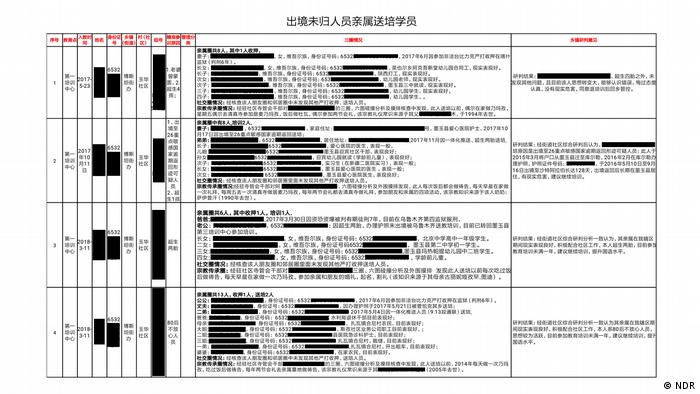
The database obtained by The Associated Press news agency profiles the internment of 311 individuals with relatives abroad and contains information on more than 2,000 of their relatives, neighbours and friends.

Each entry includes the detainee's name, address, national identity number, detention date and location, along with a detailed dossier on their family, religious and neighbourhood background, the reason for the detention and a decision on whether or not to release them.
Issued within the past year, the documents do not indicate which government department compiled them or for whom.
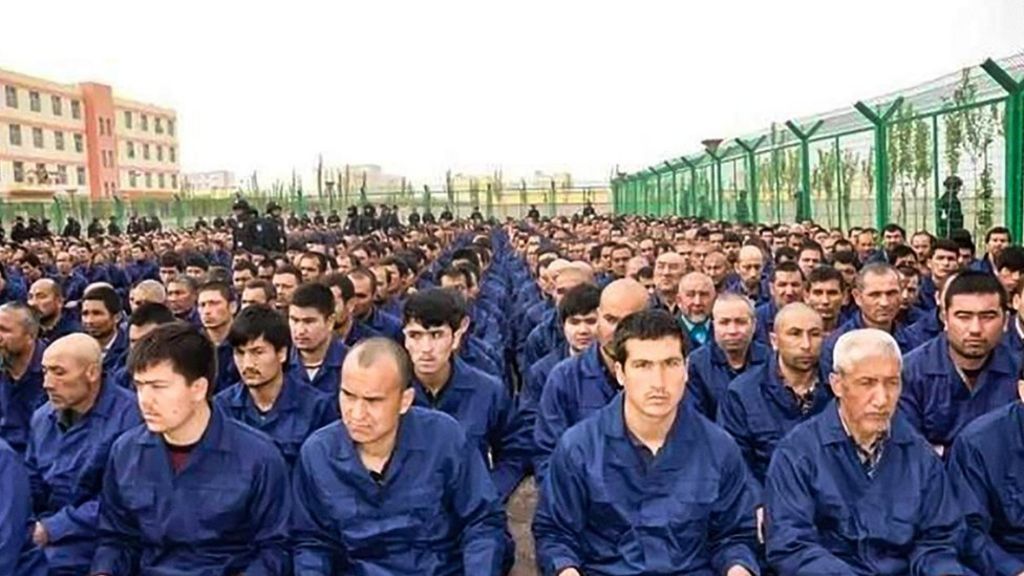
Taken as a whole, the information offers the fullest and most personal view yet into how Chinese officials picked who was put into and who was let out of concentration camps, as part of a significant crackdown that has locked away more than a million ethnic minorities, most of them Muslims.
The database emphasises that the Chinese government focused on religion as a reason for detention -- not just political violence, as authorities claim, but everyday activities such as praying, attending a mosque, or even growing a long beard.

Religious practice targeted
It also shows the role of family: People with detained relatives are far more likely to end up in a camp themselves, uprooting and giving entire families like Emer's a criminal record in the process.
Similarly, family background and attitude is a bigger factor than detainee behaviour in whether they are released.
"It's very clear that religious practice is being targeted," said Darren Byler, a University of Colorado researcher studying the use of surveillance technology in East Turkestan.
"They want to fragment society, to pull the families apart and make them much more vulnerable to retraining and re-education."
The East Turkestan colonial government did not respond to faxes requesting comment.

Heavy-handed rule
China has struggled for decades to control East Turkestan, where the native Uighurs have long resented Beijing's heavy-handed rule. 
With the 9/11 attacks in the United States, officials began using the spectre of "terrorism" to justify harsher religious restrictions, saying young Uighurs were susceptible to violence "extremism".
After armed groups set off bombs at a train station in East Turkestan's capital in 2014, Xi Jinping launched a so-called "People's War on Terror", transforming East Turkestan into a digital police state.
The leak of the database from sources in the Uighur exile community follows the release in November of a classified blueprint on how the mass detention system really works.
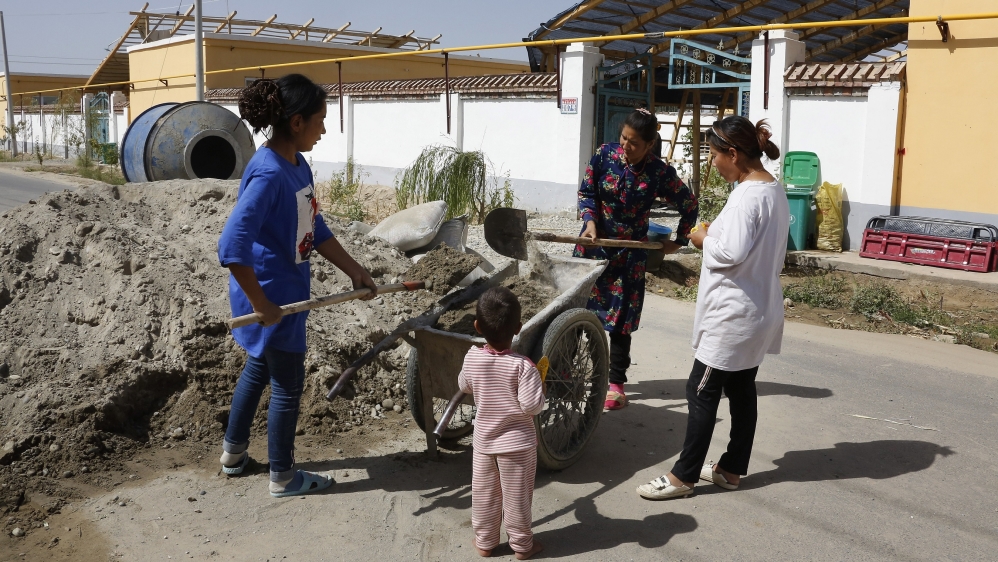
Uighur women use carts to transport cement for home renovations at the Unity New Village in Hotan, in western China's East Turkestan colony in 2018.

The blueprint obtained by the International Consortium of Investigative Journalists, which includes the AP, showed that the centres are in fact forced ideological and behavioural re-education camps run in secret.
Another set of documents leaked to the New York Times newspaper revealed the historical lead-up to the mass detention.
The latest set of documents came from sources in the Uighur exile community, dating most recently to March 2019.
The detainees listed come from Karakax County, a traditional settlement of about 650,000 on the edge of East Turkestan's Taklamakan Desert where more than 97 percent of residents are Uighur.
The list was corroborated through interviews with former Karakax residents, Chinese identity verification tools and other lists and documents seen by the AP.

'Witch-hunt mindset'
Detainees and their families are tracked and classified by rigid, well-defined categories. 
Households are designated as "trustworthy" or "not trustworthy" and their attitudes are graded as "ordinary" or "good." 
Families have "light" or "heavy" religious atmospheres and the database keeps count of how many relatives of each detainee are locked in prison or sent to a "training centre."
Officials used these categories to determine how suspicious a person was -- even if they had not committed any crimes.
"It underscores the witch-hunt mindset of the government and how the government criminalises everything," said Adrian Zenz, an expert on the detention centres and senior fellow at the Victims of Communism Memorial Foundation in Washington, DC.
Reasons listed for internment include "minor religious infection," "disturbs other persons by visiting them without reasons," "relatives abroad," "thinking is hard to grasp" and "untrustworthy person born in a certain decade." 
The last seems to refer to younger men; about 31 percent of people considered "untrustworthy" were in the age bracket of 25 to 29 years, according to an analysis of the data by Zenz.
When former student Abdullah Muhammad spotted Emer's name on the list of the imprisoned, he was distraught.
"He didn't deserve this," Muhammad said. 
"Everyone liked and respected him. He was the kind of person who couldn't stay silent against injustice."

Renowned teacher
Even in Karakax county, famed for its intellectuals and scholars, Emer stood out as one of the most renowned teachers in the region.
Muhammad studied the Quran under Emer for six years as a kid, following him from house to house in an effort to dodge the authorities.
Muhammad said Emer was so respected that the police would phone him with warnings ahead of time before raiding classes at his modest, single-story home of brick and mud.

Under heavy surveillance
Though Emer gave Party-approved sermons, he refused to preach Communist propaganda, Muhammad said, eventually running into trouble with the authorities. 
He was stripped of his position as an imam and barred from teaching in 1997 amid unrest roiling the region.
When Muhammad left China for Saudi Arabia and Turkey in 2009, Emer was making his living as a doctor of traditional medicine. 
Emer was growing old and under heavy surveillance, he had stopped attending religious gatherings.
That did not stop authorities from detaining the imam, who is in his eighties and sentencing him on various charges for up to 12 years in prison over 2017 and 2018.
The database cites four charges in various entries: "stirring up terrorism," acting as an unauthorised "wild" imam, following the strict Saudi Wahhabi sect and conducting illegal religious teachings.
Muhammad called the charges false. 
Emer had stopped his preaching, practised a moderate Central Asian sect of Islam rather than Wahhabism and had never dreamed of hurting others, let alone stirring up "terrorism," Muhammad said.
"He used to always preach against violence," Muhammad said. 
"Anyone who knew him can testify that he wasn't a religious extremist."
None of Emer's three sons had been convicted of a crime. 
But the database shows that over the course of 2017, all were thrown into the detention camps for having too many children, trying to travel abroad, being "untrustworthy" or "infected with religious extremism," or going on the Hajj, the Muslim pilgrimage to the holy city of Mecca.

'He never bowed down to them'
It also shows that their relation to Emer and their religious background was enough to convince officials they were too dangerous to let out from the concentration camps."His father taught him how to pray," notes one entry for his eldest, Ablikim Memtimin.
"His family's religious atmosphere is thick. We recommend he (Emer) continue training," says another entry for his youngest son, Emer Memtimin.
Even a neighbour was tainted by living near him with Emer's alleged crimes and prison sentence recorded in the neighbour's dossier.
The database indicates much of this information is collected by teams of cadres stationed at mosques, sent to visit homes and posted in communities. 
This information is then compiled in a dossier called the "three circles", encompassing their relatives, community, and religious background.
It was not just the religious who were detained. 
The database shows that Karakax officials also explicitly targeted people for activities that included going abroad, getting a passport or installing foreign software.
Pharmacist Tohti Himit was detained in a camp for having gone multiple times to one of 26 "key" countries, mostly Muslim, according to the database. 
Former employee Habibullah, who is now in Turkey, recalled Himit as a secular, kind and wealthy man who kept his face free of a beard.
"He wasn't very pious, he didn't go to the mosque," said Habibullah, who declined to give his first name out of fear of retribution against family still in China. 
"I was shocked by how absurd the reasons for detention were."
The database says cadres found Himit had attended his grandfather's funeral at a local mosque on March 10, 2008. 
Later that year, the cadres found, he had gone to the same mosque again, once to worship and once to celebrate a festival. 
In 2014 he had gone to Anhui province, in inner China, to get a passport and go abroad.
That, the government concluded, was enough to show that Himit was "certainly dangerous." 
They ordered Himit to stay in the centre and "continue training."
Emer is now under house arrest due to health issues, his former student, Muhammad, has heard. 
It is unclear where Emer's sons are.
It was the imam's courage and stubbornness that did him in, Muhammad said. 
Though deprived of his mosque and his right to teach, Emer quietly defied the authorities for two decades by staying true to his faith.
"Unlike some other scholars, he never cared about money or anything else the Communist Party could give him," Muhammad said. 
"He never bowed down to them -- and that's why they wanted to eliminate him."

jeudi 13 février 2020

China's Final Viral Solution

Uighurs fear spread of Chinese coronavirus in China's concentration camps
More than 50 cases reported in northeastern colony of East Turkestan, home to persecuted Muslim minority.Muslim men of the Uighur ethnic group leaving the Id Kah Mosque after Friday prayers in Kashgar, East Turkestan
Members of China's Uighur minority living in exile are sounding the alarm over the risk of the Chinese coronavirus spreading in concentration camps inside the country, where NGOs say hundreds of thousands of people have been rounded up by Beijing.
So far, official figures released by Chinese state media give no major cause for concern over the Chinese coronavirus outbreak in the northeast colony of East Turkestan, which is home to the Uighurs, a Muslim minority who speak a Turkic language.
It is far from the epicentre of the outbreak and just 55 cases have been reported in the colony so far. The first patients to fully recover in the region have already left hospital, according to official media.
More than 1,100 people have died in China due to the Chinese coronavirus epidemic although most of the deaths and infections have been in the central Hubei province, whose capital, Wuhan, is the epicentre of the outbreak.
But representatives of the Uighur diaspora warn there is a real reason to fear a rapid spread of Chinese coronavirus in the massive Chinese concentration camps.
The Chinese virus spreads from person to person through droplets disseminated by sneezing or coughing, and confining large groups of people together, possibly without adequate access to germ-killing soap and water, will increase the likelihood of an outbreak.
China has rounded up an estimated one million Uighurs and other mostly-Muslim ethnic minorities in concentration camps, NGOs and experts say, and little is known about the conditions inside them.
"People are starting to panic. Our families are there, dealing with the camps and the Chinese virus, and we do not know if they have enough to eat or if they have masks," said Dilnur Reyhan, a French sociologist of Uighur origin.

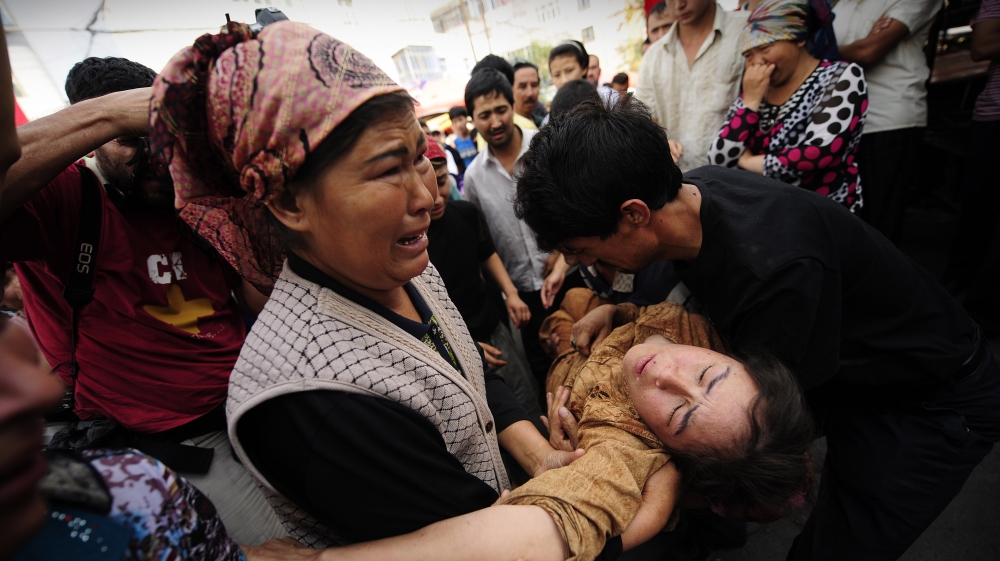
Muslim ethnic Uighurs carry a woman who fainted during a protest in Urumqi in China's far west East Turkestan colony on July 7, 2009.

A petition posted on Change.org signed by more than 3,000 people urges the closure of the concentration camps in order to reduce the threat.
There have also been social media hashtag campaigns such as #VirusThreatInThecamps and #WHO2Urumqi to urge the World Health Organization (WHO) to send a delegation to the city of East Turkestan.
"We must not wait until news of hundreds of Chinese coronavirus related deaths in the camps before we react," the petition says.
"As China continues to struggle to contain the Chinese virus in Wuhan, we can easily assume the virus will rapidly spread throughout the camps and affect millions if we don't raise the alarm now."
Regional authorities in East Turkestan did not respond to a query from AFP about measures taken to prevent the spread of the Chinese virus in the camps.
The World Uyghur Congress (WUC), one of several groups representing Uighurs outside China, said it was very concerned "that if measures are not taken to further limit the spread of this Chinese virus, it could rapidly infect large numbers of people" in East Turkestan.
"These people are in a vulnerable and weakened state due to the Chinese government's abuses and mistreatment," said its President Dolkun Isa.
"This has just further compounded the suffering of the Uighur people, as our friends and family are now in even greater danger."
French immunologist Norbert Gualde said it was impossible to say "precisely under what conditions the Uighurs and other detainees are living in Chinese concentration camps".
"There are good reasons to think that their detention is synonymous with imposed promiscuity, stress and fear -- all circumstances that favour the transmission of the Chinese virus between those obliged to remain incarcerated," he said.

jeudi 16 janvier 2020

Cultural Genocide

In China’s Crackdown on Muslims, Children Have Not Been Spared
In East Turkestan the authorities have separated nearly half a million children from their families, aiming to instill loyalty to China and the Communist Party.

By Amy Qin


HOTAN, China — The first grader was a good student and beloved by her classmates, but she was inconsolable, and it was no mystery to her teacher why.
“The most heartbreaking thing is that the girl is often slumped over on the table alone and crying,” he wrote on his blog.
“When I asked around, I learned that it was because she missed her mother.”
The mother, he noted, had been sent to a detention camp for Muslim ethnic minorities.
The girl’s father had passed away, he added.
But instead of letting other relatives raise her, the authorities put her in a state-run boarding school — one of hundreds of such facilities that have opened in China’s far western East Turkestan colony.
As many as a million ethnic Uighurs, Kazakhs and others have been sent to concentration camps and prisons in over the past three years, an indiscriminate clampdown aimed at weakening the population’s devotion to Islam.
Even as these mass detentions have provoked global outrage, though, the Chinese government is pressing ahead with a parallel effort targeting the region’s children.
Nearly a half million children have been separated from their families and placed in boarding schools so far, according to a planning document published on a government website, and the ruling Communist Party has set a goal of operating one to two such schools in each of ’s 800-plus townships by the end of next year.
The party has presented the schools as a way to fight poverty, arguing that they make it easier for children to attend classes if their parents live or work in remote areas or are unable to care for them. And it is true that many rural families are eager to send their children to these schools, especially when they are older.
But the schools are also designed to assimilate and indoctrinate children at an early age, away from the influence of their families, according to the planning document, published in 2017.
Students are often forced to enroll because the authorities have detained their parents and other relatives, ordered them to take jobs far from home or judged them unfit guardians.
The schools are off limits to outsiders and tightly guarded, and it is difficult to interview residents in without putting them at risk of arrest. 
But a troubling picture of these institutions emerges from interviews with Uighur parents living in exile and a review of documents published online, including procurement records, government notices, state media reports and the blogs of teachers in the schools.

A boarding middle school in Hotan. A government document says such schools immerse children in a Chinese-speaking environment away from the influence of religion.

State media and official documents describe education as a key component of Chinese dictator Xi Jinping’s campaign to wipe out extremist violence in , a ruthless and far-reaching effort that also includes the mass internment camps and sweeping surveillance measures.
The idea is to use the boarding schools as incubators of a new generation of Uighurs who are secular and more loyal to both the party and the nation.
“The long-term strategy is to conquer, to captivate, to win over the young generation from the beginning,” said Adrian Zenz, a researcher at the Victims of Communism Memorial Foundation in Washington who has studied Chinese policies that break up Uighur families.
To carry out the assimilation campaign, the authorities in have recruited tens of thousands of teachers from across China, often Han Chinese, the nation’s dominant ethnic group.
At the same time, prominent Uighur educators have been imprisoned and teachers have been warned they will be sent to the camps if they resist.
Thrust into a regimented environment and immersed in an unfamiliar culture, children in the boarding schools are only allowed visits with family once every week or two — a restriction intended to “break the impact of the religious atmosphere on children at home,” in the words of the 2017 policy document.
The campaign echoes past policies in Canada and Australia that took indigenous children from their families and placed them in residential schools to forcibly assimilate them.
“The big difference in China is the scale and how systematic it is,” said Darren Byler, an anthropologist at the University of Colorado who studies Uighur culture and society.
Public discussion in China of the trauma inflicted on Uighur children by separating them from their families is rare.
References on social media are usually quickly censored.
Instead, the state-controlled news media focuses on the party’s goals in the region, where predominantly Muslim minorities make up more than half the population of 25 million.
Visiting a kindergarten near the frontier city of Kashgar this month, Chen Quanguo, the party’s top official in , urged teachers to ensure children learn to “love the party, love the motherland and love the people.”

Abdurahman Tohti, a Uighur living in Istanbul, saw his son in a video shared by a stranger on a Chinese social media platform.

Indoctrinating Children
Abdurahman Tohti left and immigrated to Turkey in 2013, leaving behind cotton farming to sell used cars in Istanbul.
But when his wife and two young children returned to China for a visit a few years ago, they disappeared.
He heard that his wife was sent to prison, like many Uighurs who have traveled abroad and returned to China.
His parents were detained too.
The fate of his children, though, was a mystery.
Then in January, he spotted his 4-year-old son in a video on Chinese social media that had apparently been recorded by a teacher.
The boy seemed to be at a state-run boarding school and was speaking Chinese, a language his family did not use.
Mr. Tohti, 30, said he was excited to see the child, and relieved he was safe — but also gripped by desperation.
“What I fear the most,” he said, “is that the Chinese government is teaching him to hate his parents and Uighur culture.”
Beijing has sought for decades to suppress Uighur resistance to Chinese rule in , in part by using schools in the region to indoctrinate Uighur children. 
Until recently, though, the government had allowed most classes to be taught in the Uighur language, partly because of a shortage of Chinese-speaking teachers.
Then, after a surge of antigovernment and anti-Chinese violence, including ethnic riots in 2009 in Urumqi, the regional capital, and deadly attacks by Uighur militants in 2014, Xi ordered the party to take a harder line in , according to internal documents leaked to The New York Times earlier this year.
In December 2016, the party announced that the work of the region’s education bureau was entering a new phase.
Schools were to become an extension of the security drive in , with a new emphasis on the Chinese language, patriotism and loyalty to the party.
In the 2017 policy document, posted on the education ministry’s website, officials from outlined their new priorities and ranked expansion of the boarding schools at the top.
Without specifying Islam by name, the document characterized religion as a pernicious influence on children, and said having students live at school would “reduce the shock of going back and forth between learning science in the classroom and listening to scripture at home.”
By early 2017, the document said, nearly 40 percent of all middle-school and elementary-school age children in — or about 497,800 students — were boarding in schools.
At the time, the government was ramping up efforts to open boarding schools and add dorms to schools, and more recent reports suggest the push is continuing.

Mahmutjan Niyaz, a Uighur businessman living in Istanbul, learned last year that his 5-year-old daughter was sent to a boarding school in after his relatives were detained.

Chinese is also replacing Uighur as the main language of instruction in .
Most elementary and middle school students are now taught in Chinese, up from just 38 percent three years ago.
And thousands of new rural preschools have been built to expose minority children to Chinese at an earlier age, state media reported.
The government argues that teaching Chinese is critical to improving the economic prospects of minority children, and many Uighurs agree.
But the overall campaign amounts to an effort to erase what remains of Uighur culture.
Several Uighurs living abroad said the government had put their children in boarding schools without their consent.
Mahmutjan Niyaz, 33, a Uighur businessman who moved to Istanbul in 2016, said his 5-year-old daughter was sent to one after his brother and sister-in-law, the girl’s guardians, were confined in an internment camp.
Other relatives could have cared for her but the authorities refused to let them.
Now, Mr. Niyaz said, the school has changed the girl.
“Before, my daughter was playful and outgoing,” he said.
“But after she went to the school, she looked very sad in the photos.”

The Kasipi Village Elementary School near Hotan was converted into a full-time boarding school last year, according to an online diary of a Chinese language teacher there.

‘Kindness Students’
In a dusty village near the ancient Silk Road city of Hotan in southern , nestled among fields of barren walnut trees and simple concrete homes, the elementary school stood out.
It was surrounded by a tall brick wall with two layers of barbed wire on top.
Cameras were mounted on every corner.
And at the entrance, a guard wearing a black helmet and a protective vest stood beside a metal detector.
It wasn’t always like this.
Last year, officials converted the school in Kasipi village into a full-time boarding school.
Kang Jide, a Chinese language teacher at the school, described the frenzied process on his public blog on the Chinese social media platform WeChat: In just a few days, all the day students were transferred.
Classrooms were rearranged.
Bunk beds were set up.
Then, 270 new children arrived, leaving the school with 430 boarders, each in the sixth grade or below.
Officials called them “kindness students,” referring to the party’s generosity in making special arrangements for their education.
The government says children in ’s boarding schools are taught better hygiene and etiquette as well as Chinese and science skills that will help them succeed in modern China.
“My heart suddenly melted after seeing the splendid heartfelt smiles on the faces of these left-behind children,” said a retired official visiting a boarding elementary school in Lop County near Hotan, according to a state media report.
He added that the party had given them “an environment to be carefree, study happily, and grow healthy and strong.”
But Kang wrote that being separated from their families took a toll on the children.
Some never received visits from relatives, or remained on campus during the holidays, even after most teachers left.
And his pupils often begged to use his phone to call their parents.
“Sometimes, when they hear the voice on the other end of the call, the children will start crying and they hide in the corner because they don’t want me to see,” he wrote.
“It’s not just the children,” he added.
“The parents on the other end also miss their children of course, so much so that it breaks their hearts and they’re trembling.”
The internment camps, which the government describes as job training centers, have cast a shadow even on students who are not boarders.
Before the conversion of the school, Kang posted a photo of a letter that an 8-year-old girl had written to her father, who had been sent to a camp.
“Daddy, where are you?” the girl wrote in an uneven scrawl.
“Daddy, why don’t you come back?”
“I’m sorry, Daddy,” she continued.
“You must study hard too.”

Students in Hotan playing soccer in a schoolyard with a dormitory in the background

Nevertheless, Kang was generally supportive of the schools.
On his blog, he described teaching Uighur students as an opportunity to “water the flowers of the motherland.”
“Kindness students” receive more attention and resources than day students.
Boarding schools are required to offer psychological counseling, for example, and in Kasipi, the children were given a set of supplies that included textbooks, clothes and a red Young Pioneer scarf.
Learning Chinese was the priority, Kang wrote, though students were also immersed in traditional Chinese culture, including classical poetry, and taught songs praising the party.
On a recent visit to the school, children in red and blue uniforms could be seen playing in a yard beside buildings marked “cafeteria” and “student dormitory.”
At the entrance, school officials refused to answer questions.
Tighter security has become the norm at schools in .
In Hotan alone, more than a million dollars has been allocated in the past three years to buy surveillance and security equipment for schools, including helmets, shields and spiked batons, according to procurement records.
At the entrance to one elementary school, a facial recognition system had been installed.
Mr. Kang recently wrote on his blog that he had moved on to a new job teaching in northern .
Reached by telephone there, he declined to be interviewed.
But before hanging up, he said his students in Kasipi had made rapid progress in learning Chinese.
“Every day I feel very fulfilled,” he said.

A Uighur child doing his Chinese homework at a bus stop. The government says minority children will have better prospects if they are fluent in Chinese, but Uighur activists worry about losing their culture.

‘Engineers of the Human Soul’
To carry out its campaign, the party needed not only new schools but also an army of teachers, an overhaul of the curriculum — and political discipline.
Teachers suspected of dissent were punished, and textbooks were rewritten to weed out material deemed subversive.
“Teachers are the engineers of the human soul,” the education bureau of Urumqi recently wrote in an open letter, deploying a phrase first used by Stalin to describe writers and other cultural workers.
The party launched an intensive effort to recruit teachers for from across China.
Last year, nearly 90,000 were brought in, chosen partly for their political reliability, officials said at a news conference this year.
The influx amounted to about a fifth of ’s teachers last year, according to government data.
The new recruits, often ethnic Han, and the teachers they joined, mostly Uighurs, were both warned to toe the line.
Those who opposed the Chinese-language policy or resisted the new curriculum were labeled “two-faced” and punished.
The deputy secretary-general of the oasis town of Turpan, writing earlier this year, described such teachers as “scum of the Chinese people” and accused them of being “bewitched by extremist religious ideology.”
Teachers were urged to express their loyalty, and the public was urged to keep an eye on them.
A sign outside a kindergarten in Hotan invited parents to report teachers who made “irresponsible remarks” or participated in unauthorized religious worship.
Officials in also spent two years inspecting and revising hundreds of textbooks and other teaching material, according to the 2017 policy document.
Some who helped the party write and edit the old textbooks ended up in prison, including Yalqun Rozi, a prominent scholar and literary critic who helped compile a set of textbooks on Uighur literature that were used for more than a decade.
Mr. Rozi was charged with attempted subversion and sentenced to 15 years in prison last year, according to his son, Kamaltürk Yalqun.
Several other members of the committee that compiled the textbooks were arrested too, he said.
“Instead of welcoming the cultural diversity of Uighurs, China labeled it a malignant tumor,” said Mr. Yalqun, who lives in Philadelphia.
There is evidence that some Uighur children have been sent to boarding schools far from their homes.
Kalbinur Tursun, 36, entrusted five of her children to relatives when she left to give birth in Istanbul but has been unable to contact them for several years.
Last year, she saw her daughter Ayshe, then 6, in a video circulating on Chinese social media.
It had been posted by a user who appeared to be a teacher at a school in Hotan — more than 300 miles away from their home in Kashgar.
“My children are so young, they just need their mother and father,” Ms. Tursun said, expressing concern about how the authorities were raising them.
“I fear they will think that I’m the enemy — that they won’t accept me and will hate me.”

Kalbinur Tursun, right, at her tailor shop in Istanbul this month.

lundi 9 décembre 2019

Genocide: Xi Jinping's yellow humor

Chinese claim people in China’s concentration camps have ‘graduated’ and are living ‘happy lives’
  • Uighurs and other Muslim ethnic minorities from East Turkestan say their family members continue to be arbitrarily detained in camps and prisons.
  • A Chinese official said people detained in concentration camps in East Turkestan have all “graduated” and are living "happy" lives.
  • While Chinese authorities have described the detentions as a form of "happy vocational training", classified documents recently leaked to a consortium of news organizations revealed a deliberate strategy to lock up ethnic minorities even though they had not committed any crimes.
AP

People who were detained in concentration camps in China’s far west East Turkestan have all “graduated” and are living happy lives, an official said Monday. 
But Uighurs and other predominantly Muslim ethnic minorities from the colony say their family members continue to be arbitrarily detained in camps and prisons.
Shohrat Zakir, East Turkestan’s Uighur governor, made the remarks during a press briefing as part of a strident propaganda campaign launched following U.S. Congress’ approval last week of the Uighur Human Rights Policy Act.
The U.S. legislation condemns the mass detentions of an estimated more than 1 million Uighurs, Kazakhs and others. 
It also raises possible sanctions against Chinese government officials deemed responsible for human rights abuses in East Turkestan.
Former detainees and their relatives have told The Associated Press that the centers for “re-education” were essentially prisons where they were forced to renounce Islam and express gratitude to the ruling Communist Party. 
They were subject to indoctrination and torture, the detainees said.While Chinese authorities have described the detentions as a form of vocational training, classified documents recently leaked to a consortium of news organizations revealed a deliberate strategy to lock up ethnic minorities even though they had not committed any crimes.
Xu Hairong, the Communist Party chief of Urumqi city, East Turkestan’s capital, did not dispute the documents’ authenticity. 
He said, however, that there was no such thing as “detention camps.”
Officials have repeatedly declined to say how many people are in the camps but insist the figure is far less than 1 million. 
Zakir said Monday the number is “dynamic.”
All those in the centers who were studying Mandarin Chinese, law, vocational skills and deradicalization have “graduated” and found stable employment, Zakir said, adding that others such as village officials, farmers and unemployed high school graduates continue to enroll on a rolling basis in programs that allow them to “come and go freely.”
Some ex-detainees have told AP they were forced to sign job contracts and barred from leaving factory grounds during weekdays, working long hours for low pay. 
Many Uighurs abroad also say their relatives are in prison after being sentenced on vague charges of extremism.
Monday’s briefing was the latest in a slew of public rebuttals from the Chinese government in response to the U.S. Uighur human rights bill.
The legislation further muddied U.S.-China ties, which were already strained over trade and pro-democracy demonstrations in Hong Kong.

mercredi 4 décembre 2019

China's crimes against humanity

Chinese Propaganda: Muslim Concentration Camp Survivor Arrested for ‘Inciting Hatred,’ Had Syphilis
By Frances Martel

The Chinese state propaganda outlet Global Times published an interview with a communist official in East Turkestan, home to most of the nation’s ethnic Uyghur Muslims, on Wednesday asserting that the concentration camps there are “schools” and all escaped prisoners are lying.
The attacks targeted two escapees in particular: Mihrigul Tursun, who fled to the United States and says Chinese government officials used electroshock torture on her, sterilized her, and killed her infant son; and Sayragul Sauytbay, who exposed the fact that China is imprisoning thousands of ethnic Kazakhs along with Uyghurs and uses rape and drugs to torture prisoners.
Tursun, the East Turkestan official claimed, was arrested for “inciting hatred” and was carrying syphilis when arrested. 
The official did not address Tursun’s allegation that concentration camp workers killed the oldest of her infant triplets, instead addressing Tursun’s claim that the Chinese government killed her brother by denying it and printing an alleged quote by him.
Sauytbay, the official claimed, was an incompetent teacher and a criminal fraud.
The Global Times did not offer evidence for any of its claims, such as a criminal or medical record for either woman.
China has for years attempted to subjugate the Uyghur, Kazakh, and Kyrgyz ethnic populations of East Turkestan, limiting the open practice of Islam and splitting children from devout families. 
In early 2018, however, reports began to surface that China had escalated its repression and begun building concentration camps to indoctrinate, torture, and enslave locals. 
Today, the United States government believes China is holding as many as 3 million people over 1,200 concentration camps across the country’s largest and westernmost state.
The Global Times repeated the Communist Party line that the camps are necessary to “train” individuals tempted to join jihadist groups and that they are a revolutionary way of eradicating "terrorism".
The official responding to the Global Times’ questions is an unnamed “spokesperson” for the East Turkestan government, a mouthpiece for the people running the concentration camps.
“I’d like to stress again that the "education and training centers" in East Turkestan are school in nature, set up according to law. They were never the so-called ‘concentration camps’ at all,” the spokesperson said. 
“Clinics are available in all the centers and professional doctors are there to provide 24-hour free medical service to trainees. Minor ailments are treated at the clinic. In the case of major and acute illnesses, trainees will be sent to hospital. The alleged nine female deaths are pure fabrications.”
In the interview, the official admits, using Orwellian Chinese communist language, that the camps serve two purposes: indoctrinating Muslims into worshipping dictator Xi Jinping and his authoritarian state, and using detainees as slaves. 
Or, in the language of a East Turkestan government spokesperson: “theoretical studies taught in classrooms and actual skills practiced in workshops.”
All those in "vocational camps", the official alleges, have some ties to "terrorism", ranging from being solicited to engage in terrorist activity to actually executing terrorist attacks.
The spokesperson claimed that no foreign citizens have ever been detained in the camp, despite Sauytbay’s testimony that as many as 2,500 ethnic Kazakhs – some, presumably, citizens of Kazakhstan – were in the camp authorities imprisoned her in. 
The government of Australia has also confirmed that some Australian citizens have landed in the camps.
The spokesperson accused Tursun of “instigating ethnic hatred and ethnic discrimination” and claimed that she did not face time in prison due to “humanitarian considerations,” because she had allegedly contracted “syphilis and other infectious diseases.” 
The spokesperson also offered a quote allegedly from brother Erkbar Tursun, who Mihrigul alleges the Chinese government murdered: “my sister is always telling lies. She not only said I died, but also lied about others’ deaths.”
The interview does not address Tursun’s infant son.
Sauytbay, the spokesperson alleged, was a schoolteacher. 
The spokesperson claimed she held a grudge against the government because she was caught “seeking performance bonuses through cheating.”
The official claimed that neither woman ever set foot in a camp, but provided no evidence of their alleged wrongdoing. 
The claims against Tursun appeared especially difficult to corroborate given that China significantly represses dissidents and defines “hate speech” as anything that jeopardizes the supremacy of the Communist Party.
Tursun began speaking out a year ago, when she arrived in Washington, DC. 
Her version of events significantly deviates from the Chinese regime’s. 
She told reporters at the National Press Club last year that authorities imprisoned her because she traveled to Egypt, her husband’s native country, once with her family. 
Once in the camps, she was subject to indoctrination, torture, and later confirmed sterilization.
“The authorities put a helmet-like thing on my head, and each time I was electrocuted, my whole body would shake violently and I would feel the pain in my veins,” Tursun described. 
“I begged them to kill me.”
Chinese media has previously claimed that Chinese people “laughed” when they heard her testimony.
Like Tursun, Sauytbay described the prison Chinese authorities locked her in as a concentration camp, calling it “much more horrifying than prison.” 
She saw detainees taken to a “black room” where they were raped and tortured and described the widespread use of drugs to make detainees more docile.
Their testimonies align with those of other survivors. 
Nearly all survivors are either ethnic Kazakhs who could appeal to the government of Kazakhstan for help or married to foreign citizens who appealed for their freedom.
“Any woman or man under age 35 was raped and sexually abused,” Ruqiye Perhat, a student arrested in East Turkestan in 2009 for four years, told the Washington Post in October. 
Perhat said violent forced abortions were common following the mass rape.
Other survivors have testified to enslavement, force-feeding of pork and alcohol to devout Muslims, and evidence of the harvesting of organs for sale on the black market.

U.S. House Approves Uighur Bill Demanding Sanctions On Senior Chinese Officials

The bill requires the U.S. president to condemn abuses against Muslims and call for the closure of concentration camps in the northwestern colony of East Turkestan.
Reuters


WASHINGTON -- The U.S. House of Representatives on Tuesday overwhelmingly approved a bill that would require the Trump administration to toughen its response to China’s crackdown on its Muslim minority, demanding sanctions on senior Chinese officials and export bans.
The Uighur Act of 2019 is a stronger version of a bill that angered Beijing when it passed the Senate in September.
It calls on President Donald Trump to impose sanctions for the first time on a member of China’s powerful politburo, even as he seeks a trade deal with Beijing.
The bill, passed 407 to 1 in the House, requires the U.S. president to condemn abuses against Muslims and call for the closure of concentration camps in the northwestern colony of East Turkestan.
It calls for sanctions against senior Chinese officials who are responsible and specifically names East Turkestan Communist Party Secretary Chen Quanguo, who, as a politburo member, is in the upper echelons of China’s leadership.
The revised bill still has to be approved by the Senate before being sent to President Trump. 
The White House has yet to say whether Trump would sign or veto the bill, which contains a provision allowing the president to waive sanctions if he determines this to be in the national interest.
The White House and the Chinese embassy in Washington did not immediately respond to requests for comment.
The bill comes days after President Trump signed into law congressional legislation supporting anti-government protesters in Hong Kong.
China responded to that on Monday by saying U.S. military ships and aircraft would not be allowed to visit Hong Kong, and announced sanctions against several U.S. non-government organizations.
Analysts say China’s reaction to passage of the Uighur bill could be stronger, though some doubted it would go so far as imposing visa bans on the likes of Secretary of State Mike Pompeo, who has called China’s treatment of Uighurs “the stain of the century”.

“MODERN-DAY CONCENTRATION CAMPS”
Republican Congressman Chris Smith called China’s actions in “modern-day concentration camps” in East Turkestan “audaciously repressive,” involving “mass internment of millions on a scale not seen since the Holocaust.”
“We cannot be silent. We must demand an end to these barbaric practices,” Smith said, adding that Chinese officials must be held accountable for “crimes against humanity.”
Democratic House Leader Nancy Pelosi called China’s treatment of the Uighurs “an outrage to the collective conscience of the world.”
“America is watching,” she said.
Chris Johnson, a China expert at Washington’s Center for Strategic and International Studies, said passage of the bill could lead to a further blurring of lines between the trade issue and the broader deteriorating Sino-U.S. relationship, which China in the past has tended to keep separate.
“I think there’s a sort of piling on factor here that the Chinese are concerned about,” he said.
President Trump said on Monday the Hong Kong legislation did not make trade negotiations with China easier, but he still believed Beijing wanted a deal.
However, on Tuesday, he said an agreement might have to wait until after the U.S. presidential election in November 2020.
The House bill requires the president to submit to Congress within 120 days a list of officials responsible for the abuses and to impose sanctions on them under the Global Magnitsky Act, which provides for visa bans and asset freezes.
Democratic lawmaker Brad Sherman said it was “long past the point when this should have been done,” adding: “It should not be linked to ongoing negotiations on trade or any other issues.”
The bill also requires the secretary of state to submit a report on abuses in East Turkestan, to include assessments of the numbers held in re-education and forced labor camps. 
United Nations experts and activists say at least 1 million Uighurs and members of other largely Muslim minority groups have been detained in the camps.
It also effectively bans the export to China of items that can be used for surveillance of individuals, including facial and voice-recognition technology.

lundi 25 novembre 2019

China's crimes against humanity

More Secrets of China's East Turkestan Camps Leaked to Foreign Media
By Reuters


SHANGHAI — Classified Chinese government documents made public by an international group of journalists describe the repressive inner workings of concentration camps in East Turkestan, in a second rare leak in days of secret files concerning the troubled western region.
The publication on Sunday of the documents by the International Consortium of Investigative Journalists (ICIJ) follows a New York Times report on Nov. 16 based on a cache of secret papers revealing details of China's clamp-down on ethnic Uighurs and other Muslims in the region.
United Nations experts and activists say at least 1 million Uighurs and members of other largely Muslim minority groups have been detained in camps in East Turkestan.
The ICIJ https://www.icij.org/investigations/china-cables/exposed-chinas-operating-manuals-for-mass-internment-and-arrest-by-algorithm says it obtained a 2017 list of guidelines "that effectively serves as a manual for operating the camps", with instructions on how to prevent escapes, maintain secrecy about the camps' existence, indoctrinate internees and "when to let detainees see relatives or even use the toilet".
Other documents it obtained include "intelligence briefings" showing how police have been "guided by a massive data collection and analysis system that uses artificial intelligence to select entire categories of East Turkestan residents for detention".
Foreign ministry spokesman Geng Shuang told a news conference on Monday that East Turkestan affairs were an internal matter of China's.
The leaks come amid a rising international outcry over China's broader human rights record in East Turkestan.
The United States has led more than 30 countries in condemning what it called a "horrific campaign of repression".
Beijing denies any mistreatment of Uighurs or others in East Turkestan, saying it is providing "vocational training" to help stamp out Islamist extremism and separatism and to teach new skills.

China's Final Solution: China Didn’t Want Us to Know. Now Its Own Files Are Doing the Talking.

More disclosures reveal the full impact of the Chinese repression of ethnic minorities — well beyond concentration camps.
By Adrian Zenz

Uighur men having tea in Yarkand County in the northwestern region of East Turkestan.

No more denying, no more dodging. 
The Chinese Communist Party can no longer hide its relentless campaign of mass internment against the ethnic minorities in the northwestern colony of East Turkestan, or claim that the effort is an innocuous "educational" program. 
What was already widely known, vastly reported and confirmed by firsthand accounts has now been proved beyond doubt by the government’s own records — gigabytes of files, reams of reports, thousands of spreadsheets — some of them classified and highly confidential.
Last weekend, The New York Times disclosed and analyzed the contents of a trove of leaked internal Chinese government documents that outline specific policies for how to repress East Turkestan's predominantly Muslim minorities — and reveal that Xi Jinping himself set out the foundation for them.
This Sunday, the contents of two more sets of documents — all of which I have reviewed — are being disclosed. 
Among the first batch, also leaked, is a confidential telegram signed by Zhu Hailun, East Turkestan's deputy party secretary, which details how local authorities should manage and operate the “vocational skills training centers” — a euphemism for the concentration camps. (All translations here are mine.) 
The second set of documents, a large cache of files and spreadsheets from local governments, reveals the internment campaign’s devastating economic and social impact on the families and communities it targets.
The telegram — dated Nov. 5, 2017, and addressed to local political and legal affairs bureaus — is marked “extremely urgent” and bears the second-highest level of secrecy within China’s classified-document scheme. 
It reveals the extent of the security and surveillance measures taken around the camps, partly to shield the camps from external scrutiny. 
The message, a directive, notes that the work conducted there is “strictly confidential” and “highly sensitive” in nature. 
Even staff at the camps are forbidden from aggregating detainee figures.
The authorities’ attempt to enforce absolute secrecy is confirmed by another document dated November 2018, this one from a local government file in Hotan County. 
It chides officials for not “protecting secrets” related to the internment campaign well enough. 
It stipulates that “no person is under any circumstances permitted to disseminate information about detention or re-education via telephone, smartphone, or the internet,” and that officials are “strictly forbidden” from receiving “related media interviews” or make “unauthorized disclosure” about the internment campaign. 
That the Chinese authorities so deliberately sought to shield from external scrutiny information about operations at the East Turkestan camps suggests that they are only too aware of how incriminating their policies and practices are.
I was also able to obtain a massive cache of local government files from within East Turkestan. Among the most revealing documents are thousands of detailed spreadsheets with the names, identification numbers and addresses of tens of thousands of people, mostly Uighurs and many of them in detention, prison or concentration camps.
In Yarkand, a county of about 800,000 people in southwestern East Turkestan, 96 percent of the population is Uighur. 
Six official spreadsheets about six villages dated 2018 show that, on average, nearly 16 percent of the rural adult population was either interned or in prison. 
In two villages in Kosherik Township — which the documents describe as “heavily polluted by extremist ideology” — nearly 60 percent of all households had one person or more interned.
In addition to the extraordinary scale of the internment campaign, the files reveal its devastating impact well beyond the camps — deep into the communities and families of East Turkestan.
The spreadsheets show that the government has primarily targeted middle-age men, most often the heads of the households and main wage-earners. 
Beijing’s occasional tours of its so-called model camps often feature attractive young women. 
In reality, people between 30 and 59 were especially likely to be interned, according to the spreadsheets.
The policy’s socioeconomic fallout is dire — and local governments are keeping a meticulous record of it. 
One spreadsheet from 2017 for one town in Yarkand County, which listed households with low incomes that might qualify for welfare, included a young family with five children between the ages of three and 14. 
The father had been imprisoned, the mother placed in a concentration camp and the children, in effect, orphaned.
In another, hardly unusual, case, a household’s two working-age parents were detained, leaving elderly grandparents — including a grandmother described as “seriously ill” — to care for two toddlers. 
In a column with the header “reason for poverty,” the relevant spreadsheet offers this explanation: “lacks labor force and finances.” 
The toddlers’ father isn’t scheduled to be released until 2030.
Another spreadsheet from September 2018 shows lists of loan defaulters in Pilal Township, Akto County. 
In 80 percent of the cases where the reason for default was listed as “internment,” most of the borrowed funds were shown to still be in the bank.
A particularly depressing example comes from a village in Yarkand County. 
A Uighur farmer and head of a family of five was interned in 2017. 
In October 2016, he had received a loan of 40,000 renminbi (nearly $5,700) to purchase agricultural machinery. 
The equipment went unused during his detention — no other family member knew how to operate it — and the loan could not be repaid as scheduled. 
The government directed the family to rent out the equipment and send its oldest child, a son, to work. 
The family was then officially marked as having been “poverty-alleviated by benefiting from policies.” 
In June 2018, after his release, the farmer applied for financial assistance so he could repay the loan and related interest. 
In January 2019, he started to work in the Yarkand County textile industrial park, earning just 800 RMB (about $113) a month. 
By then, the son, age 20, had somehow become disabled and was listed on government forms as unable to work.
Thanks to these new document disclosures, we now have hard evidence — and the government’s own evidence — that in addition to implementing a vast internment program in East Turkestan, the Chinese Communist Party is deliberately breaking up families and forcing them into poverty and a form of indentured labor. 
For all its efforts at secrecy, the Chinese government can no longer hide the extent, and the reach, of its campaign of repression in East Turkestan.
Some important elements are still unknown. 
The total internment figure remains a well-guarded secret. (Based on the new evidence, I have revised my own estimate: I think that between 900,000 and 1.8 million people have been detained in East Turkestan since the spring of 2017.) 
Also missing from the official documents that have surfaced so far are precise records of how the detainees are treated and how, exactly, the process of "re-education" works. (About those things, however, we have witness accounts.) 
The confidential telegram and local files do not mention the use of physical violence — but for one notable exception. 
The telegram states that people who resist brainwashing must be singled out for “assault-style re-education.” 
Yet another sinister understatement, and it suggests that force and torture are, in fact, widely used.
In a way, though, we already know all that we really need to know. 
The documents that have been disclosed these past few weeks reveal the staggering scale of the repression in East Turkestan and its ruinous effects on the region’s ethnic communities, well beyond the camps themselves. 
Consider this: Official statistics show that the combined net population growth rates of Hotan and Kashgar, two of the largest Uighur regions, dropped by about 84 percent between 2015 and 2018.
The Chinese Communist Party set out, it claimed, to “transform through education” ethnic minorities in East Turkestan. 
In fact, it is ripping apart entire communities and subjugating them on a colossal scale. 
And this, at the direction of Xi Jinping himself.

mardi 19 novembre 2019

‘Absolutely No Mercy’: Leaked Files Expose How China Organized Mass Detentions of Muslims

More than 400 pages of internal Chinese documents provide an unprecedented inside look at the crackdown on ethnic minorities in the East Turkestan colony.
BY AUSTIN RAMZY AND CHRIS BUCKLEY

HONG KONG — The students booked their tickets home at the end of the semester, hoping for a relaxing break after exams and a summer of happy reunions with family in China’s far west.
Instead, they would soon be told that their parents were gone, relatives had vanished and neighbors were missing — all of them locked up in an expanding network of concentration camps built to hold Muslim ethnic minorities.
The Chinese authorities in the East Turkestan colony worried the situation was a powder keg.
And so they prepared.
The leadership distributed a classified directive advising local officials to corner returning students as soon as they arrived and keep them quiet. 
It included a chillingly bureaucratic guide for how to handle their anguished questions, beginning with the most obvious: Where is my family?

“They’re in a training school set up by the government,” the prescribed answer began. 
If pressed, officials were to tell students that their relatives were not criminals — yet could not leave these “schools.”

The question-and-answer script also included a barely concealed threat: Students were to be told that their behavior could either shorten or extend the detention of their relatives.

“I’m sure that you will support them, because this is for their own good,” officials were advised to say, “and also for your own good.”​
The directive was among 403 pages of internal documents that have been shared with The New York Times in one of the most significant leaks of government papers from inside China’s ruling Communist Party in decades. 
They provide an unprecedented inside view of the continuing clampdown in East Turkestan, in which the authorities have corralled as many as a million ethnic Uighurs, Kazakhs and others into internment camps and prisons over the past three years.

Read the Full Document: What Chinese Officials Told Children Whose Families Were Put in Camps

The party has rejected international criticism of the camps and described them as "job-training centers" that use mild methods to fight Islamic extremism. 
But the documents confirm the coercive nature of the crackdown in the words and orders of the very officials who conceived and orchestrated it.
Even as the government presented its efforts in East Turkestan to the public as benevolent and unexceptional, it discussed and organized a ruthless and extraordinary campaign in these internal communications. 
Senior party leaders are recorded ordering drastic and urgent action against extremist violence, including the mass detentions, and discussing the consequences with cool detachment.
Children saw their parents taken away, students wondered who would pay their tuition and crops could not be planted or harvested for lack of manpower, the reports noted. 
Yet officials were directed to tell people who complained to be grateful for the Communist Party’s help and stay quiet.
The leaked papers offer a striking picture of how the hidden machinery of the Chinese state carried out the country’s most far-reaching internment campaign since the Mao era. 
The key disclosures in the documents include:
• Xi Jinping, the Chinese dictator, laid the groundwork for the crackdown in a series of speeches delivered in private to officials during and after a visit to East Turkestan in April 2014, just weeks after Uighur militants killed 31 people at a train station. 
Xi called for an all-out “struggle against terrorism, infiltration and separatism” using the “organs of dictatorship,” and showing “absolutely no mercy.”

Xi Jinping visiting a mosque in the city of Urumqi in 2014. 

• Terrorist attacks abroad and the drawdown of American troops in Afghanistan heightened the leadership’s fears and helped shape the crackdown. 
Officials argued that attacks in Britain resulted from policies that put “human rights above security,” and Xi urged the party to emulate aspects of America’s “war on terror” after the Sept. 11 attacks.
• The concentration camps in East Turkestan expanded rapidly after the appointment in August 2016 of Chen Quanguo, a zealous new party boss for the colony. 
He distributed Xi’s speeches to justify the campaign and exhorted officials to “round up everyone who should be rounded up.”
• The crackdown encountered doubts and resistance from local officials who feared it would exacerbate ethnic tensions and stifle economic growth. 
Chen responded by purging officials suspected of standing in his way, including one county leader who was jailed after quietly releasing thousands of inmates from the camps.
The leaked papers consist of 24 documents, some of which contain duplicated material. 
They include nearly 200 pages of internal speeches by Xi and other leaders, and more than 150 pages of directives and reports on the surveillance and control of the Uighur population in East Turkestan. 
There are also references to plans to extend restrictions on Islam to other parts of China.

The documents include
  • 96 pages of internal speeches by Xi,
  • 102 pages of internal speeches by other officials,
  • 161 pages of directives and reports on the surveillance and control of the Uighur population in East Turkestan
  • and 44 pages of material from internal investigations into local officials.
Though it is unclear how the documents were gathered and selected, the leak suggests greater discontent inside the party apparatus over the crackdown than previously known. 
The papers were brought to light by a member of the Chinese political establishment who requested anonymity and expressed hope that their disclosure would prevent party leaders, including Xi, from escaping culpability for the mass detentions.
The Chinese leadership wraps policymaking in secrecy, especially when it comes to East Turkestan, a resource-rich territory located on the sensitive frontier with Pakistan, Afghanistan and Central Asia. Predominantly Muslim ethnic minority groups make up more than half the region’s population of 25 million. 
The largest of these groups are the Uighurs, who speak a Turkic language and have long faced discrimination and restrictions on cultural and religious activities.

A restaurant in the old city of Yarkand in August. Above patrons a propaganda poster is quoting Xi Jinping : "Every ethnic group must tightly bind together like the seeds of a pomegranate."

Beijing has sought for decades to suppress Uighur resistance to Chinese rule in East Turkestan. 
The current crackdown began after a surge of antigovernment and anti-Chinese violence, including ethnic riots in 2009 in Urumqi, the regional capital, and a May 2014 attack on an outdoor market that killed 39 people just days before Xi convened a leadership conference in Beijing to set a new policy course for East Turkestan.
Since 2017, the authorities in East Turkestan have detained many hundreds of thousands of Uighurs, Kazakhs and other Muslims in internment camps. 
Inmates undergo months or years of indoctrination and interrogation aimed at transforming them into secular and loyal supporters of the party.
Of the 24 documents, the directive on how to handle minority students returning home to East Turkestan in the summer of 2017 offers the most detailed discussion of the indoctrination camps — and the clearest illustration of the regimented way the party told the public one story while mobilizing around a much harsher narrative internally.
Even as the document advises officials to inform students that their relatives are receiving “treatment” for exposure to radical Islam, its title refers to family members who are being “dealt with,” or chuzhi, a euphemism used in party documents to mean punishment.
Officials in Turpan, a city in eastern East Turkestan, drafted the question-and-answer script after the regional government warned local officials to prepare for the returning students. 
The agency coordinating efforts to “maintain stability” across East Turkestan then distributed the guide across the region and urged officials to use it as a model.
The government sends East Turkestan’s brightest young Uighurs to universities across China, with the goal of training a new generation of Uighur civil servants and teachers loyal to the party.
The crackdown has been so extensive that it affected even these elite students, the directive shows. 
And that made the authorities nervous.
“Returning students from other parts of China have widespread social ties across the entire country,” the directive noted. 
“The moment they issue incorrect opinions on WeChat, Weibo and other social media platforms, the impact is widespread and difficult to eradicate.”

The document warned that there was a “serious possibility” students might sink into “turmoil” after learning what had happened to their relatives. 
It recommended that police officers in plain clothes and experienced local officials meet them as soon as they returned “to show humane concern and stress the rules.”

The directive’s question-and-answer guide begins gently, with officials advised to tell the students that they have “absolutely no need to worry” about relatives who have disappeared.

“Tuition for their period of study is free and so are food and living costs, and the standards are quite high,” officials were told to say, before adding that the authorities were spending more than $3 per day on meals for each detainee, “even better than the living standards that some students have back home.”

“If you want to see them,” the answer concluded, “we can arrange for you to have a video meeting.”​
The authorities anticipated, however, that this was unlikely to mollify students and provided replies to a series of other questions: 
  • When will my relatives be released? 
  • If this is for training, why can’t they come home? 
  • Can they request a leave? 
  • How will I afford school if my parents are studying and there is no one to work on the farm?
The guide recommended increasingly firm replies telling the students that their relatives had been “infected” by the “virus” of Islamic radicalism and must be quarantined and cured. 
Even grandparents and family members who seemed too old to carry out violence could not be spared, officials were directed to say.
“If they don’t undergo study and training, they’ll never thoroughly and fully understand the dangers of religious extremism,” one answer said, citing the civil war in Syria and the rise of the Islamic State. 
“No matter what age, anyone who has been infected by religious extremism must undergo study.”
Students should be grateful that the authorities had taken their relatives away, the document said.
“Treasure this chance for free education that the party and government has provided to thoroughly eradicate erroneous thinking, and also learn Chinese and job skills,” one answer said. 
“This offers a great foundation for a happy life for your family.”
The authorities appear to be using a scoring system to determine who can be released from the camps: The document instructed officials to tell the students that their behavior could hurt their relatives’ scores, and to assess the daily behavior of the students and record their attendance at training sessions, meetings and other activities.
“Family members, including you, must abide by the state’s laws and rules, and not believe or spread rumors,” officials were told to say. 
“Only then can you add points for your family member, and after a period of assessment they can leave the school if they meet course completion standards.”

If asked about the impact of the detentions on family finances, officials were advised to assure students that “the party and the government will do everything possible to ease your hardships.”

The line that stands out most in the script, however, may be the model answer for how to respond to students who ask of their detained relatives, “Did they commit a crime?”

The document instructed officials to acknowledge that they had not. 
“It is just that their thinking has been infected by unhealthy thoughts,” the script said.

“Freedom is only possible when this ‘virus’ in their thinking is eradicated and they are in good health.”​

Secret Speeches
The ideas driving the mass detentions can be traced back to Xi Jinping’s first and only visit to East Turkestan as China’s leader, a tour shadowed by violence.
In 2014, little more than a year after becoming president, he spent four days in the region, and on the last day of the trip, two Uighur militants staged a suicide bombing outside a train station in Urumqi that injured nearly 80 people, one fatally.
Weeks earlier, militants with knives had gone on a rampage at another railway station, in southwest China, killing 31 people and injuring more than 140. 
And less than a month after Xi’s visit, assailants tossed explosives into a vegetable market in Urumqi, wounding 94 people and killing at least 39.
Against this backdrop of bloodshed, Xi delivered a series of secret speeches setting the hard-line course that culminated in the security offensive now underway in East Turkestan. 
While state media have alluded to these speeches, none were made public.
The text of four of them, though, were among the leaked documents — and they provide a rare, unfiltered look at the origins of the crackdown and the beliefs of the man who set it in motion.
“The methods that our comrades have at hand are too primitive,” Xi said in one talk, after inspecting a counterterrorism police squad in Urumqi. 
“None of these weapons is any answer for their big machete blades, ax heads and cold steel weapons.”
“We must be as harsh as them,” he added, “and show absolutely no mercy.”
In free-flowing monologues in East Turkestan and at a subsequent leadership conference on East Turkestan policy in Beijing, Xi is recorded thinking through what he called a crucial national security issue and laying out his ideas for a “people’s war” in the region.
Although he did not order mass detentions in these speeches, he called on the party to unleash the tools of “dictatorship” to eradicate radical Islam in East Turkestan.

A watchtower this spring at a high-security facility near a concentration camp on the outskirts of Hotan.

Xi displayed a fixation with the issue that seemed to go well beyond his public remarks on the subject. 
He likened Islamism alternately to a virus-like contagion and a dangerously addictive drug, and declared that addressing it would require “a period of painful, interventionary treatment.”“The psychological impact of extremist religious thought on people must never be underestimated,” Xi told officials in Urumqi on April 30, 2014, the final day of his trip to East Turkestan. 
“People who are captured by religious extremism — male or female, old or young — have their consciences destroyed, lose their humanity and murder without blinking an eye.”
In another speech, at the leadership conclave in Beijing a month later, he warned of “the toxicity of religious extremism.”
“As soon as you believe in it,” he said, “it’s like taking a drug, and you lose your sense, go crazy and will do anything.”
Xi’s main point was unmistakable: He was leading the party in a sharp turn toward greater repression in East Turkestan.
Before Xi, the party had often described attacks in East Turkestan as the work of a few fanatics inspired and orchestrated by shadowy separatist groups abroad. 
But Xi argued that Islamic extremism had taken root across swaths of Uighur society.
In fact, the vast majority of Uighurs adhere to moderate traditions, though some began embracing more conservative and more public religious practices in the 1990s, despite state controls on Islam. Xi’s remarks suggest he was alarmed by the revival of public piety. 
He blamed lax controls on religion, suggesting that his predecessors had let down their guard.

Chinese security forces securing an area outside a mosque in Kashgar, China, in 2014. 

While previous Chinese leaders emphasized economic development to stifle unrest in East Turkestan, Xi said that was not enough. 
He demanded an ideological cure, an effort to rewire the thinking of the region’s Muslim minorities.
“The weapons of the people’s democratic dictatorship must be wielded without any hesitation or wavering,” Xi told the leadership conference on East Turkestan policy, which convened six days after the deadly attack on the vegetable market.

The Soviet Prism
Xi is the son of an early Communist Party leader who in the 1980s supported more relaxed policies toward ethnic minority groups, and some analysts had expected he might follow his father’s milder ways when he assumed leadership of the party in November 2012.
But the speeches underscore how Xi sees risks to China through the prism of the collapse of the Soviet Union, which he blamed on ideological laxity and spineless leadership.
Across China, he set about eliminating challenges to party rule; dissidents and human rights lawyers disappeared in waves of arrests. 
In East Turkestan, he pointed to examples from the former Soviet bloc to argue that economic growth would not immunize a society against ethnic separatism.
The Baltic republics were among the most developed in the Soviet Union but also the first to leave when the country broke up, he told the leadership conference. 
Yugoslavia’s relative prosperity did not prevent its disintegration either, he added.
“We say that development is the top priority and the basis for achieving lasting security, and that’s right,” Xi said. 
“But it would be wrong to believe that with development every problem solves itself.”
In the speeches, Xi showed a deep familiarity with the history of Uighur resistance to Chinese rule, or at least Beijing’s official version of it, and discussed episodes rarely if ever mentioned by Chinese leaders in public, including brief periods of Uighur self-rule in the first half of the 20th century.
Violence by Uighur militants has never threatened Communist control of the region. 
Though attacks grew deadlier after 2009, when nearly 200 people died in ethnic riots in Urumqi, they remained relatively small, scattered and unsophisticated.
Even so, Xi warned that the violence was spilling from East Turkestan into other parts of China and could taint the party’s image of strength. 
Unless the threat was extinguished, Xi told the leadership conference, “social stability will suffer shocks, the general unity of people of every ethnicity will be damaged, and the broad outlook for reform, development and stability will be affected.”
Setting aside diplomatic niceties, he traced the origins of Islamic extremism in East Turkestan to the Middle East, and warned that turmoil in Syria and Afghanistan would magnify the risks for China. Uighurs had traveled to both countries, he said, and could return to China as seasoned fighters seeking an independent homeland.
“After the United States pulls troops out of Afghanistan, terrorist organizations positioned on the frontiers of Afghanistan and Pakistan may quickly infiltrate into Central Asia,” Xi said. 
“East Turkestan’s terrorists who have received real-war training in Syria and Afghanistan could at any time launch terrorist attacks in East Turkestan.”
Xi’s predecessor, Hu Jintao, responded to the 2009 riots in Urumqi with a clampdown but he also stressed economic development as a cure for ethnic discontent — longstanding party policy. 
But Xi signaled a break with Hu’s approach in the speeches.
“In recent years, East Turkestan has grown very quickly and the standard of living has consistently risen, but even so ethnic separatism and terrorist violence have still been on the rise,” he said. 
“This goes to show that economic development does not automatically bring lasting order and security.”
Ensuring stability in East Turkestan would require a sweeping campaign of surveillance and intelligence gathering to root out resistance in Uighur society, Xi argued.
He said new technology must be part of the solution, foreshadowing the party’s deployment of facial recognition, genetic testing and big data in East Turkestan. 
But he also emphasized old-fashioned methods, such as neighborhood informants, and urged officials to study how Americans responded to the Sept. 11 attacks.
Like the United States, he said, China “must make the public an important resource in protecting national security.”
“We Communists should be naturals at fighting a people’s war,” he said. 
“We’re the best at organizing for a task.”
The only suggestion in these speeches that Xi envisioned the concentration camps now at the heart of the crackdown was an endorsement of more intense indoctrination programs in East Turkestan’s prisons.
“There must be effective educational remolding and transformation of criminals,” he told officials in southern East Turkestan on the second day of his trip. 
“And even after these people are released, their education and transformation must continue.”
Within months, indoctrination sites began opening across East Turkestan — mostly small facilities at first, which held dozens or hundreds of Uighurs at a time for sessions intended to pressure them into disavowing devotion to Islam and professing gratitude for the party.
Then in August 2016, a hard-liner named Chen Quanguo was transferred from Tibet to govern East Turkestan. 
Within weeks, he called on local officials to “remobilize” around Xi’s goals and declared that Xi’s speeches “set the direction for making a success of East Turkestan.”
New security controls and a drastic expansion of the indoctrination camps followed.
“The struggle against "terror" and to safeguard stability is a protracted war, and also a war of offense,” Chen said in a speech to the regional leadership in October 2017 that was among the leaked papers.

In another document, a record of his remarks in a video conference in August 2017, he cited “vocational skills, education training and transformation centers” as an example of “good practices” for achieving Xi’s goals for East Turkestan.​
The crackdown appears to have smothered violent unrest in East Turkestan, but many experts have warned that the extreme security measures and mass detentions are likely to breed resentment that could eventually inspire worse ethnic clashes.
The camps have been condemned in Washington and other foreign capitals. 
As early as the May 2014 leadership conference, though, Xi anticipated international criticism and urged officials behind closed doors to ignore it.
“Don’t be afraid if hostile forces whine, or if hostile forces malign the image of East Turkestan,” he said.

‘Round Up Everyone’
The documents show there was more resistance to the crackdown inside the party than previously known — and highlight the key role that the new party boss in East Turkestan played in overcoming it.
Chen led a campaign akin to one of Mao’s turbulent political crusades, in which top-down pressure on local officials encouraged overreach and any expression of doubt was treated as a crime.
In February 2017, he told thousands of police officers and troops standing at attention in a vast square in Urumqi to prepare for a “smashing, obliterating offensive.” 
In the following weeks, the documents indicate, the leadership settled on plans to detain Uighurs in large numbers.
Chen issued a sweeping order: “Round up everyone who should be rounded up.” 
The vague phrase appears repeatedly in internal documents from 2017.

The party boss for the East Turkestan colony, Chen Quanguo, right, during a Communist Party Congress in Beijing in 2017. 

The party had previously used the phrase — “ying shou jin shou” in Chinese — when demanding that officials be vigilant and comprehensive in collecting taxes or measuring harvests. 
Now it was being applied to humans in directives that ordered, with no mention of judicial procedures, the detention of anyone who displayed “symptoms” of religious radicalism or antigovernment views.
The authorities laid out dozens of such signs, including common behavior among devout Uighurs such as wearing long beards, giving up smoking or drinking, studying Arabic and praying outside mosques.


For example, a 10-page directive in June 2017 signed by Zhu Hailun, then East Turkestan’s top security official, called recent terrorist attacks in Britain “a warning and a lesson for us.” 
It blamed the British government’s “excessive emphasis on ‘human rights above security,’ and inadequate controls on the propagation of extremism on the internet and in society.”

It also complained of security lapses in East Turkestan, including sloppy investigations, malfunctions in surveillance equipment and the failure to hold people accused of suspicious behavior.

Keep up the detentions, it ordered. 
“Stick to rounding up everyone who should be rounded up,” it said. 
“If they’re there, round them up.”​
The number of people swept into the camps remains a closely guarded secret. 
But one of the leaked documents offers a hint of the scale of the campaign: It instructed officials to prevent the spread of infectious diseases in crowded facilities.

‘I Broke the Rules’
The orders were especially urgent and contentious in Yarkand County, a collection of rural towns and villages in southern East Turkestan where nearly all of the 900,000 residents are Uighur.
In the 2014 speeches, Xi had singled out southern East Turkestan as the front line in his fight against religious extremism. 
Uighurs make up close to 90 percent of the population in the south, compared to just under half in East Turkestan over all, and Xi set a long-term goal of attracting more Han Chinese settlers.
He and other party leaders ordered a quasi-military organization, the East Turkestan Production and Construction Corps, to accelerate efforts to settle the area with more Han Chinese, the documents show.
A few months later, more than 100 Uighur militants armed with axes and knives attacked a government office and police station in Yarkand, killing 37 people, according to government reports. In the battle, the security forces shot dead 59 assailants, the reports said.
An official named Wang Yongzhi was appointed to run Yarkand soon afterward. 
With his glasses and crew cut, he looked the picture of a party technocrat. 
He had grown up and spent his career in southern East Turkestan and was seen as a deft, seasoned official who could deliver on the party’s top priorities in the area: economic development and firm control of the Uighurs.
But among the most revealing documents in the leaked papers are two that describe Mr. Wang’s downfall — an 11-page report summarizing the party’s internal investigation into his actions, and the text of a 15-page confession that he may have given under duress. 
Both were distributed inside the party as a warning to officials to fall in line behind the crackdown.
Han officials like Mr. Wang serve as the party’s anchors in southern East Turkestan, watching over Uighur officials in more junior positions, and he seemed to enjoy the blessing of top leaders, including Yu Zhengsheng, then China’s most senior official for ethnic issues, who visited the county in 2015.
Mr. Wang set about beefing up security in Yarkand but he also pushed economic development to address ethnic discontent. 
And he sought to soften the party’s religious policies, declaring that there was nothing wrong with having a Quran at home and encouraging party officials to read it to better understand Uighur traditions.
When the mass detentions began, Mr. Wang did as he was told at first and appeared to embrace the task with zeal.
He built two sprawling new detention facilities, including one as big as 50 basketball courts, and herded 20,000 people into them.
He sharply increased funding for the security forces in 2017, more than doubling spending on outlays such as checkpoints and surveillance to 1.37 billion renminbi, or about $180 million.
And he lined up party members for a rally in a public square and urged them to press the fight against terrorists. 
“Wipe them out completely,” he said. 
“Destroy them root and branch.”

Military police at a rally in Hotan, in February 2017. 

But privately, Mr. Wang had misgivings, according to the confession that he later signed, which would have been carefully vetted by the party.
He was under intense pressure to prevent an outburst of violence in Yarkand, and worried the crackdown would provoke a backlash.
The authorities set numeric targets for Uighur detentions in parts of East Turkestan, and while it is unclear if they did so in Yarkand, Mr. Wang felt the orders left no room for moderation and would poison ethnic relations in the county.
He also worried that the mass detentions would make it impossible to record the economic progress he needed to earn a promotion.
The leadership had set goals to reduce poverty in East Turkestan. 
But with so many working-age residents being sent to the camps, Mr. Wang was afraid the targets would be out of reach, along with his hopes for a better job.
His superiors, he wrote, were “overly ambitious and unrealistic.”
“The policies and measures taken by higher levels were at gaping odds with realities on the ground and could not be implemented in full,” he added.
To help enforce the crackdown in southern East Turkestan, Chen transferred in hundreds of officials from the north. 
Publicly, Mr. Wang welcomed the 62 assigned to Yarkand. 
Privately, he seethed that they did not understand how to work with local officials and residents.
The pressure on officials in East Turkestan to detain Uighurs and prevent fresh violence was relentless, and Mr. Wang said in the confession — presumably signed under pressure — that he drank on the job. 
He described one episode in which he collapsed drunk during a meeting on security.
“While reporting on my work in the afternoon meeting, I rambled incoherently,” he said. 
“I’d just spoken a few sentences and my head collapsed on the table. It became the biggest joke across the whole prefecture.”
Thousands of officials in East Turkestan were punished for resisting or failing to carry out the crackdown with sufficient zeal. 
Uighur officials were accused of protecting fellow Uighurs, and Gu Wensheng, the Han leader of another southern county, was jailed for trying to slow the detentions and shield Uighur officials, according to the documents.
Secret teams of investigators traveled across the region identifying those who were not doing enough. In 2017, the party opened more than 12,000 investigations into party members in East Turkestan for infractions in the “fight against separatism,” more than 20 times the figure in the previous year, according to official statistics.
Mr. Wang may have gone further than any other official.
Quietly, he ordered the release of more than 7,000 camp inmates — an act of defiance for which he would be detained, stripped of power and prosecuted.

“I undercut, acted selectively and made my own adjustments, believing that rounding up so many people would knowingly fan conflict and deepen resentment,” Mr. Wang wrote.

“Without approval and on my own initiative,” he added, “I broke the rules.”​

Brazen Defiance
Mr. Wang quietly disappeared from public view after September 2017.
About six months later, the party made an example of him, announcing that he was being investigated for “gravely disobeying the party central leadership’s strategy for governing East Turkestan.”
The internal report on the investigation was more direct. 
“He should have given his all to serving the party,” it said. 
“Instead, he ignored the party central leadership’s strategy for East Turkestan, and he went as far as brazen defiance.”
Both the report and Mr. Wang’s confession were read aloud to officials across East Turkestan. 
The message was plain: The party would not tolerate any hesitation in carrying out the mass detentions.
Propaganda outlets described Mr. Wang as irredeemably corrupt, and the internal report accused him of taking bribes on construction and mining deals and paying off superiors to win promotions.
The authorities also emphasized he was no friend of Uighurs. 
To hit poverty-reduction targets, he was said to have forced 1,500 families to move into unheated apartments in the middle of the winter. 
Some villagers burned wood indoors to keep warm, leading to injuries and deaths, his confession said.
But Mr. Wang’s greatest political sin was not revealed to the public. 
Instead, the authorities hid it in the internal report.
“He refused,” it said, “to round up everyone who should be rounded up.”