Affichage des articles dont le libellé est UNCLOS. Afficher tous les articles

mardi 7 janvier 2020

Chinese Aggressions

Indonesia Will Not Negotiate Its Sovereignty in South China Sea
  • Indonesia will never recognize China’s fallacious claims
  • Indonesia has plans to develop fishing grounds near Natuna
By Arys Aditya and Philip Heijmans
Natuna Islands

Indonesia will not compromise on its sovereignty in the South China Sea amid the recent sighting of Chinese fishing vessels near the Natuna Islands, which lie between Malaysia and Borneo, President Joko Widodo said.
Speaking at a plenary cabinet session in Jakarta Monday, Jokowi, as Widodo is known, said the increased presence of Chinese ships in the disputed waters since December was a violation of international law. 
He said in a statement posted on the cabinet secretariat website there would be “no negotiation when it comes to our sovereignty.”
Jokowi is scheduled to visit Natuna on Wednesday, according to Defrizal, head of communications at the Natuna regency who goes by one name, while the Indonesian Air Force had deployed four F-16 fighter jets to the islands, Detik news site reported on Tuesday.
Indonesia has also stepped up patrols in the gas-rich area, deploying five ships and two aircraft last week. 
On Monday, the navy dispatched additional warships to the area, Channel News Asia reported citing Commander Fajar Tri Rohadi, a public affairs officer with the First Fleet Command of the Indonesia Navy.
“This is our sovereign right,” Indonesian Foreign Minister Retno Marsudi said after the cabinet meeting, urging China to comply with the United Nations Convention on the Law of the Sea.
 “Indonesia will never recognize nine dash lines or unilateral claims made by China that do not have legal reasons recognized by international law.”
The latest conflict follows accusations by the U.S. and other coastal states in Southeast Asia that China was taking a more aggressive stance on its claims to more than 80% of the lucrative waters in the South China Sea.
China has said it’s operating legally, and has called on the U.S. to stop interfering in the region.
There were several reported incidents involving Chinese coast guard vessels entering waters controlled by other claimants last year, including one that resulted in a nearly four-month-long standoff with Vietnam.
Malaysia also drew an objection from Beijing on Dec. 12 when it issued a submission to the UN defining its continental shelf.
 
Sovereignty Battle
The incident began more than two weeks ago when Chinese coast guard vessels escorting dozens of fishing vessels were spotted in Indonesia’s exclusive economic zone, the Jakarta Post reported, triggering the foreign ministry to send a diplomatic protest to Beijing on Dec 30.
Last year, the Indonesian government announced plans to develop the lucrative fishing grounds near Natuna in part to assert its sovereign authority there.
It also pledged to build new cold-storage facilities to turn the area into a functional fishing hub by the year’s end.
In addition to the navy, Mahfud MD, coordinating Minister for Political, Legal, and Security Affairs, said on Monday 120 fishing vessels had been called in to further reinforce patrols.
“Aside from using your rights as a citizen, you are also obligated to help defend the country, showing that this is ours,” Mahfud said in a statement on the coordinating ministry website.
This is not the first time the two sides have faced conflict near Natuna.
Indonesia has for years fended off Chinese fisherman caught poaching in its waters -- confiscating and destroying hundreds of boats.
While Indonesia has sought to remain neutral in the wider dispute, Jokowi also offered a similar statement on Indonesia’s sovereignty in May 2016 following several incursions by Chinese fishing boats and its coast guard.
“This is how it has responded since the 2016 incursions. So if there was posturing, it was back then,” said Aaron Connelly, a research fellow at the International Institute for Strategic Studies’ Southeast Asian Political Change and Foreign Policy program.
“Indonesian policy has been remarkably consistent on this issue.”— With

vendredi 3 janvier 2020

Malaysia FM: China's 'nine-dash line' claim 'ridiculous'

Foreign Minister Saifuddin says Malaysia's decision to take South China Sea claim to UN is its 'sovereign right'. 
by Ted Regencia
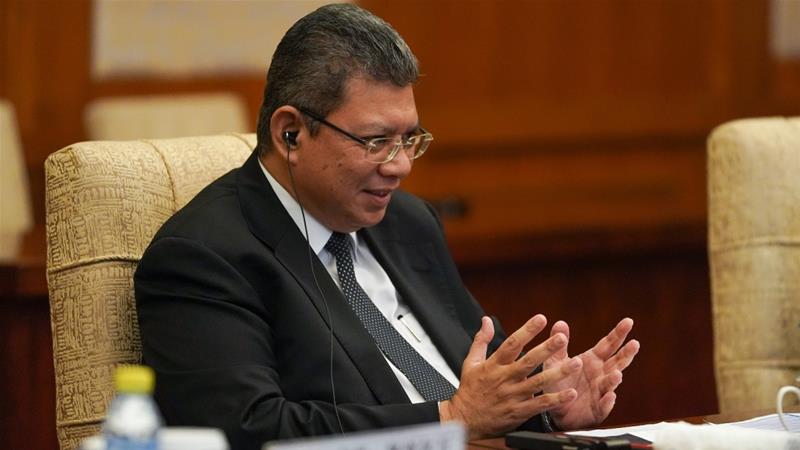
Malaysian Foreign Minister Saifuddin Abdullah said he expects ASEAN to further debate in the coming months the need for a 'Code of Conduct' with China over the South China Sea issue

Kuala Lumpur, Malaysia - Malaysia has hardened its diplomatic position on the disputed South China Sea, questioning China's "nine-dash line" claim over the entire sea lane that has already been previously declared with "no legal basis" by an arbitration tribunal in The Hague.
Malaysian Minister of Foreign Affairs Saifuddin Abdullah said late on Friday that Kuala Lumpur has the "sovereign right to claim whatever that is there that is within our waters".
"For China to claim that the whole of South China Sea belongs to China, I think that is ridiculous," Saifuddin said in response to an Al Jazeera question about Malaysia's decision last week to take its case to the United Nations.
"It is a claim that we have made, and we will defend our claim. But of course, having said that, anyone can challenge and dispute, which is not something unusual."
On December 12, Malaysia formally filed a submission seeking clarity on the limits of its continental shelf beyond the 322 kilometre (200 nautical miles) exclusive economic zone (EEZ) in the disputed body of water claimed by several countries in the Southeast Asian region.
The move has angered China, which claims "historic rights" over all of South China Sea.
It has also blamed the United States for raising tensions in the area.
In response, the US Navy's Pacific Fleet commander, Admiral John Aquilino accused China of "bullying" its Southeast Asian neighbours.
Malaysia and China are both signatories to the UN Convention for the Law of the Sea (UNCLOS), which codifies the rights and responsibilities of independent states' use of the oceans.
Under UNCLOS, coastal states like Malaysia are entitled to an EEZ.
Beyond that waters are considered the high seas, common to all nations.
UNCLOS also defines rules in the case of overlapping EEZs.
It was on this basis that the Permanent Court of Arbitration in The Hague rejected in 2016 China's claims to almost the entire sea, through which an estimated $3 trillion of trade pass each year.
China, however, rejects the ruling in The Hague, and since then has expanded its presence in the region, building artificial islands with runways and installing an advanced missile system.

ASEAN Code of Conduct
Beijing has insisted on the application of its "nine-dash line" demarcation, which claims that the littoral countries are only entitled to the seas and other resources nine miles from their shore.
Aside from the Philippines and Malaysia, China's claim is also being questioned by Vietnam.
Brunei and Taiwan also claim parts of the South China Sea.
Asked whether Malaysia's latest diplomatic move would strengthen the Association of Southeast Asian Nations' (ASEAN) push for a unified "Code of Conduct" in the South China Sea, Foreign Minister Saifuddin replied, "It would be debated for sure."
It was unclear what prompted Malaysia to file a formal submission this month.
In August, Saifuddin had said that he was "very hopeful" that ASEAN and China can reach an agreement within the three-year deadline or earlier, to help ease the tensions, Bloomberg News reported him as saying.
In September, Saifuddin also met his Chinese counterpart Wang Yi to set up a "bilateral consultation mechanism for maritime issues".
The agreement was dubbed "a new platform for dialogue and cooperation".
China has tried to keep discussions over the sea on a bilateral basis rather than negotiating with ASEAN as a group.
In October, Saifuddin told members of Parliament that Malaysia should be "upgraded" in order to "better manage our waters should there be a conflict between major powers in the South China Sea."
For the last 10 years, China has been Malaysia's largest trading partner.
In 2018, its trade was estimated to be at about $76.6bn, representing 16.7 percent of Malaysia's total trade, according to Malaysia's trade ministry.

Chinese Paranoia

Indonesia rejects China's claims over South China Sea
Reuters

Indonesia's Deputy Minister for Maritime Affairs Arif Havas Oegroseno points at the location of North Natuna Sea on a new map of Indonesia during talks with reporters in Jakarta, Indonesia, July 14, 2017. 

JAKARTA -- Indonesia said on Wednesday it rejected China’s claims over a disputed part of the South China Sea as “having no legal basis”, after two days earlier protesting to Beijing over the presence of a Chinese coastguard vessel in its territorial waters.
The boat trespassed into Indonesia’s exclusive economic zone off the coast of the northern islands of Natuna, leading Indonesians officials to issue a strong protest and summon the Chinese ambassador in Jakarta.
Speaking in Beijing on Tuesday, Chinese Foreign Ministry spokesman Geng Shuang had said China had sovereignty over the Spratly Islands and their waters and that both China and Indonesia have “normal” fishing activities there.
In a sharp rebuke, Indonesia’s foreign ministry called in a statement on Wednesday for China to explain the “legal basis and clear borders” regarding its claims on the exclusive economic zone, as based on the 1982 United Nations Convention on the Law of the Sea (UNCLOS).
“China’s claims to the exclusive economic zone on the grounds that its fishermen have long been active there... have no legal basis and have never been recognized by the UNCLOS 1982,” the foreign ministry said.
Jakarta also noted that the argument had been refuted during China’s legal defeat against the Philippines in 2016 over disputed South China claims at Permanent Court of Arbitration in The Hague.
Indonesia has no claims over the Spratly Islands, which lie to the northeast of the Natuna Islands.
The foreign ministry reiterated its stance that the country is a non-claimant state in the South China Sea and that it has no overlapping jurisdiction with China.
However, Jakarta has repeatedly clashed with China over fishing rights around the Natuna Islands, detaining Chinese fishermen and expanding its military presence in the area.
China claims most of the South China Sea, an important trade route which is believed to contain large quantities of oil and natural gas.
Several Southeast Asian states dispute China’s territorial claims and are competing with China to exploit the South China Sea’s abundant hydrocarbon and fishing resources.
Beijing has raised the ante by deploying military assets on artificial islands constructed on shoals and reefs in disputed parts of the sea.
China’s embassy in Indonesia was not immediately reachable for comment.

lundi 16 septembre 2019

FONOPs

U.S. warship challenges Chinese illegal claims in South China Sea
BY JESSE JOHNSON

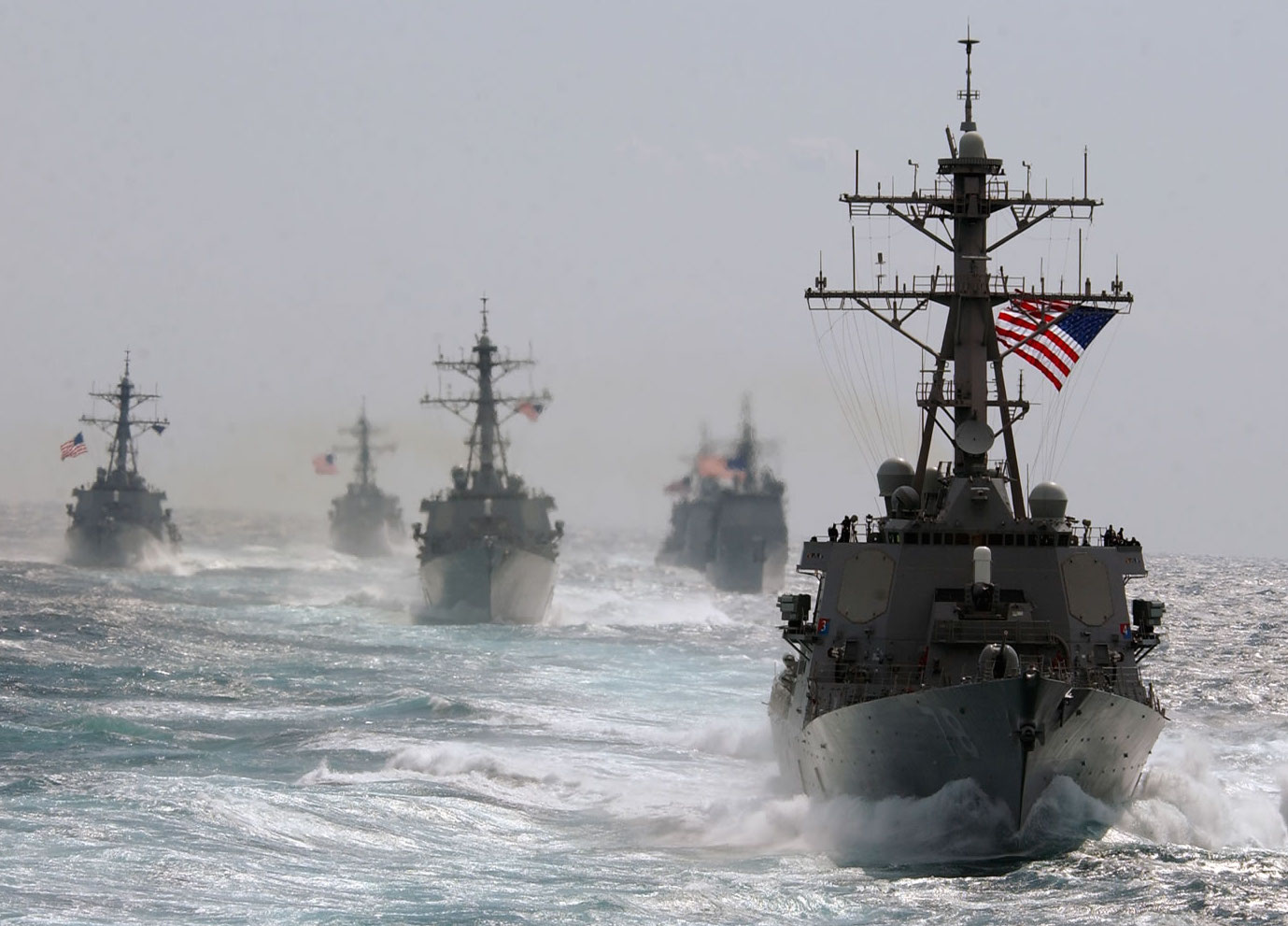
The guided-missile destroyer USS Wayne E. Meyer prepares to refuel at sea with the Nimitz-class aircraft carrier USS Carl Vinson in the Pacific Ocean in November 2017

China sent military vessels and aircraft in an attempt to expel a U.S. warship asserting international freedom of navigation rights in the Paracel Islands of the disputed South China Sea on Friday.
The U.S. Navy said in a statement that guided-missile destroyer USS Wayne E. Meyer had conducted a “freedom of navigation operation” (FONOP) without requesting permission from Beijing — or from Hanoi or Taipei, which also claim the archipelago.
The FONOP “challenged the restrictions on innocent passage imposed by China, Taiwan, and Vietnam and also contested China’s claim to straight baselines enclosing the Paracel Islands,” said Cmdr. Reann Mommsen, a spokeswoman for the U.S. Navy’s 7th Fleet.
Under international law, ships of all states — including their warships — enjoy the right of innocent passage through territorial seas.
Mommsen said that the sailing had also “challenged China’s 1996 declaration of straight baselines encompassing the Paracel Islands.”
Beijing has effectively drawn a line around the entire Paracels archipelago in a bid to claim the entire territory, despite rival claims.
Mommsen noted that international law does not permit continental states like China to establish baselines around entire island groups. 
Using these baselines, China, she said, “has attempted to claim more internal waters, territorial sea, exclusive economic zone, and continental shelf than it is entitled under international law.”
The USS Wayne E. Meyer conducted a similar operation last month, sailing within 12 nautical miles (22 km) of the contested Fiery Cross and Mischief Reefs, two Chinese-occupied islands in the South China Sea.
That sailing came just days after the Pentagon issued a strong statement that accused Beijing of employing bullying tactics in the waterway, citing what it said was “coercive interference” in oil and gas activities in waters claimed by Vietnam.
Beijing claims much of the South China Sea, though the Philippines, Vietnam, Malaysia, Taiwan and Brunei have overlapping claims in the waters, where the Chinese, U.S., Japanese and some Southeast Asian navies routinely operate.
Neither Japan nor the U.S. have claims in the waters, but both allies have routinely stated their commitment to a “free and open Indo-Pacific.”
“U.S. forces routinely conduct freedom of navigation assertions throughout the world, including in the South China Sea, as a routine part of daily operations,” Mommsen said.
“The Freedom of Navigation Program’s missions are conducted peacefully and without bias for or against any particular country,” she added.
Washington has lambasted Beijing for its moves in the waterway, including the construction of man-made islands — such as those in the Paracel chain and further south in the Spratlys — some of which are home to military-grade airfields and advanced weaponry.
The U.S. fears the outposts could be used to restrict free movement in the waterway, which includes vital sea lanes through which about $3 trillion in global trade passes each year. 
The U.S. military regularly conducts FONOPs in the area.
Beijing says it has deployed the advanced weaponry to the islets for defensive purposes, but experts say this is part of a concerted bid to cement de facto control of the waters.
In a defense white paper released for the first time in years in July, China highlighted a new emphasis on “combat readiness and military training in real combat conditions” and China’s new war-fighting capabilities in the Western Pacific and South China Sea.
Beijing, the white paper said, “has organized naval parades in the South China Sea” and “conducted a series of live force-on-force exercises” while its air force “has conducted combat patrols in the South China Sea and security patrols in the East China Sea, and operated in the West Pacific.”

vendredi 23 août 2019

The Necessary War

SAYING CHINA IS BLOCKING TRILLIONS IN OIL AND GAS, U.S. WILL SEND NAVY FOR ASIA DRILLS
BY TOM O'CONNOR 

The United States has accused China of preventing Southeast Asian countries from accessing trillions of dollars worth of untapped oil and gas reserves in the South China Sea as the Pentagon planned to hold its first exercise with regional powers near the strategic region.
In a press statement, State Department spokesperson Morgan Ortagus said Thursday that the "United States is deeply concerned that China is continuing its interference with Vietnam's longstanding oil and gas activities in Vietnam's Exclusive Economic Zone (EEZ) claim" following recent incursions there by Chinese survey ship Haiyang Dizhi 8 and an armed escort. 
Beijing has laid vast claims to the South China Sea and does not recognize boundaries established there by a number of Southeast Asian nations who are supported by the U.S. 
The most recent incident occurred last week near Vanguard Bank, a Vietnam-administered outpost in the Spratly Islands, and Ortagus attributed the move to China "pressuring Vietnam over its work with a Russian energy firm and other international partners."
"China's actions undermine regional peace and security, impose economic costs on Southeast Asian states by blocking their access to an estimated $2.5 trillion in unexploited hydrocarbon resources, and demonstrate China's disregard for the rights of countries to undertake economic activities in their EEZs, under the 1982 Law of the Sea Convention, which China ratified in 1996," Ortagus said.
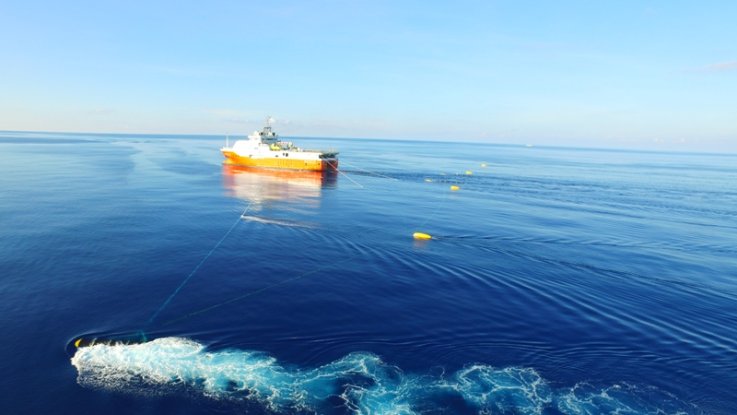
Chinese survey vessel Haiyang Dizhi 8 conducts research on behalf of the Guangzhou Marine Geological Survey in this photo shared July 25, 2018. The ship once again entered what Vietnam's exclusive economic zone near Vanguard Bank of South China Sea's Spratly Islands on August 13 of this year.
Washington has signed, but not ratified the 1982 Law of the Sea Convention, though it justified sending warships through Beijing-claimed waters in the South China Sea by citing "freedom of navigation" operations outlined in the deal. 
China has responded by scrambling military ships and aircraft to intercept the U.S. vessels in the resource-rich region.
While China may have backed Vietnam's communist revolutionaries in their victory over U.S. and allied local forces decades ago, Beijing and Hanoi quickly became rivals and engaged in deadly border clashes, including near the Spratly Island, lasting up until the 1990s. 
In 1995, Vietnam and the U.S. normalized their relations, putting pressure on China as the region's geopolitical dynamics shifted.
As the U.S. began to increasingly assert its own presence in the South China Sea, it has sought to push back on China there, exploiting territorial tensions between Beijing and the Association of Southeast Asian Nations (ASEAN), a 10-nation grouping of which Vietnam was a part. 
Washington sided with Hanoi in 2014 when China moved its Hai Yang Shi You 981 oil rig near the disputed Paracel Islands and sank a Vietnamese fishing vessel amid a standoff there.
Last year, the U.S. sent a historic message to China by sending Nimitz-class supercarrier USS Carl Vinson to dock in Vietnam in March. 
In May, the U.S. disinvited China from the Rim of the Pacific (RIMPAC) exercise involving Vietnam and several other ASEAN states over Beijing's increased militarization of the Spratly Islands.
The U.S. also began planning joint drills with ASEAN, but it was China that secured an exercise alongside the regional collective months later in October. 
That same month, then-Defense Secretary James Mattis confirmed that a U.S.-ASEAN exercise was still in the works and on both The Bangkok Post and Nikkei Asian Review reported Thursday that the maneuvers were set to begin early next month in Thailand.
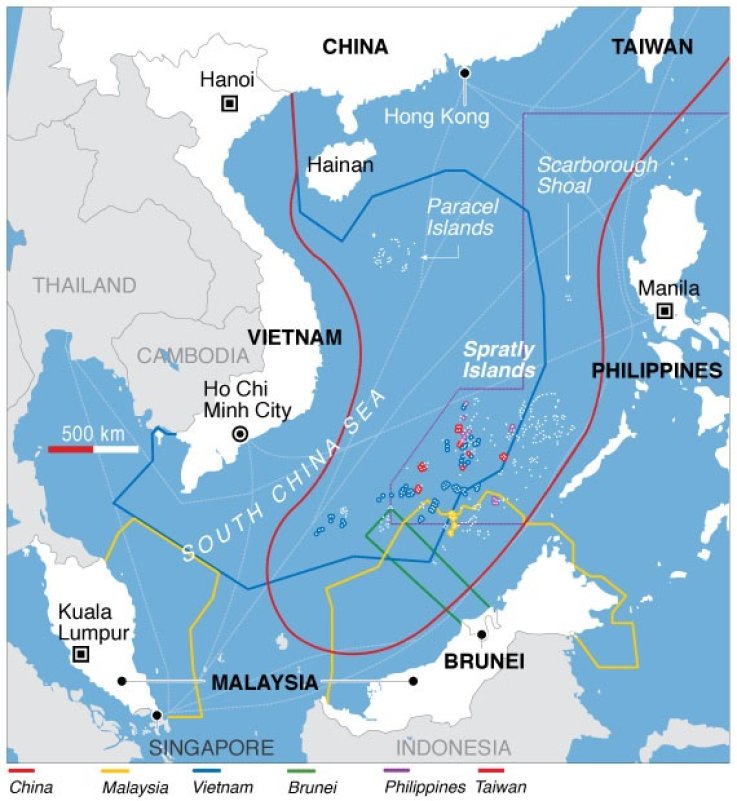
A map created July 30, 2012 details the multinational, overlapping territorial disputes involving Brunei, China, Malaysia, the Philippines, Taiwan and Vietnam in the South China Sea. Many of these countries, especially China, have expanded their presence on contested land masses known as the Spratly Islands and an incident on August 13 of this year took place on the westernmost stretch of reefs.

Tensions in the South China Sea add to an array of issues already putting a major strain on ties between the world's top two economies. 
President Donald Trump and Chinese Xi Jinping are embroiled in a multibillion-dollar trade war of tit-for-tat tariffs with Vietnam finding itself right in the middle of the feuding powerhouses.
Beijing has also repeatedly accused Washington of interfering in its internal affairs, both in the ongoing protests that U.S. officials and politicians have expressed support for in the semi-autonomous city of Hong Kong and in a recent $8 billion arms sale involving F-16V fighters jets to Taiwan, an independent island nation also claimed by Beijing.

lundi 4 juin 2018

Britain Is Right to Stand Up to China Over Freedom of Navigation

By sailing through the Spratly Islands, the UK is pushing back against China’s attempts to close off these waters – and standing up for freedom of navigation around the whole world.
By Bill Hayton

HMS Sutherland visits Japan in April.

This weekend the British defence secretary, Gavin Williamson, is likely to reveal that two British naval ships have taken part in ‘freedom of navigation’ operations in the South China Sea during the past month. 
This will highlight a significant revival of British interest in Asian security after four years in which no Royal Navy ship visited the Asia-Pacific.
Williamson is expected to tell the international security conference in Singapore known as the ‘Shangri La Dialogue’ that HMS Albion and HMS Sutherland sailed through parts of the South China Sea to which China is attempting to restrict access. 
HMS Albion navigated through the Spratly Islands in early May en route from Brunei to Japan. 
It is not yet clear where HMS Sutherland sailed but it has recently transited from Japan to Singapore through the same region.
Why is the UK taking an interest in the right of ships to sail through distant waters? 
The simple answer is that China is attempting to reverse hundreds of years of international consensus and close off access to the sea for military vessels. 
If this goes unchallenged, the world will be reverting to an era in which navies had to fight their way through blockades and when seaborne trade, the lifeblood of the global economy, was subject to the whims of coastal states. 
By sailing through the Spratly Islands, the UK is pushing back against China’s attempts to close off these waters – and standing up for freedom of navigation around the whole world.
What are the international rules about military ships sailing across seas? 
Put simply: they can sail almost anywhere they like. 
Both the UK and China have signed and ratified the United Nations Convention on the Law of the Sea (UNCLOS) and the document is clear. 
It was entirely legal for naval ships from any country to sail through even the most hotly disputed regions of the South China Sea.
Countries only ‘own’ the sea up to 12 nautical miles from their coast. 
That is one of the rules laid down by UNCLOS. 
But military vessels can still sail through this ‘territorial sea’ – right up to the coast if they choose – provided they do nothing to threaten ‘peace, good order or security’ or jeopardize anyone’s safety. 
Article 24 of UNCLOS clearly states: ‘The coastal State shall not hamper the innocent passage of foreign ships through the territorial sea.’ 
This right applies everywhere, including around rocks and reefs subject to sovereignty disputes.
These rights – and many others – were agreed by almost every country in the world in 1982, after nine years of negotiations. 
The concern of the British government – and others – is that China is trying to undermine an international agreement by unilaterally acting against its provisions. 
Ten years after it agreed to UNCLOS, China approved its 1992 ‘Law on the Territorial Sea’, which directly contradicts it.
The law states that ‘foreign ships for military purposes shall be subject to approval by the Government of the People’s Republic of China for entering the territorial sea of the People's Republic of China’. 
Then, when China ratified UNCLOS four years later, it asserted an opt-out from the ‘innocent passage’ provisions, requiring that a foreign state ‘obtain advance approval from or give prior notification … for the passage of its warships through the territorial sea’.
China’s position here is hypocritical.
It is making demands on other countries that it does not itself respect in other parts of the globe.
In July 2017, three Chinese naval vessels, including a Type-052D guided missile destroyer, sailed through the English Channel. 
The Dover Strait is 18 nautical miles wide at its narrowest point, meaning the flotilla had to sail through the territorial waters of either Britain or France. 
The Chinese navy made use of the right of ‘innocent passage’ to make the transit to the Baltic Sea in order to take part in war-fighting exercises with the Russian Navy. 
They sailed right past the UK’s naval bases in Plymouth and Portsmouth and nobody objected. This is what freedom of navigation is all about.
If the UK and France took the same position on the territorial sea that China takes, it could have blocked Chinese navy ships from passing through the English Channel. 
In Asia, Indonesia, Malaysia and Singapore could use the same argument to block the Strait of Malacca to Chinese vessels. 
Is this the world that China wants to create – where states can unilaterally block waterways? 
The consequences for international peace will be dire.
This is particularly important because some Chinese officials have argued for even more restrictions on where ships can sail. 
For example, the sirector of China’s National Institute for South China Sea Studies, a body jointly run by the Chinese Foreign Ministry and the province of Hainan, has argued in a recent book that China has the ‘historic right’ to control navigation across almost the entirety of the South China Sea. 
This would completely undermine the ‘freedom of the seas’ currently enjoyed by every country.
Some of the media reaction to the news of the Royal Navy’s voyages contained an element of this Chinese attitude – as if the UK was somehow impinging on China’s rights simply by sailing through the South China Sea. 
The South China Sea does not belong to China any more than the English Channel belongs to England. 
Outside the territorial sea it belongs to no one at all.
This is a critical test for what has become known as the rules-based international order. 
Governments are supposed to stick to international agreements, not undermine them. 
By sailing through the South China Sea, wherever international law allows, HMS Albion and HMS Sutherland are showing that the British government supports the rules that have prevented superpower conflict for over 70 years. 
China should come forward and make it clear that it respects them as well.

mercredi 31 janvier 2018

Wanted: A Strategy to Limit China's Grand Plans for the South China Sea

The United States needs to play an active role in helping broker resistance to the Chinese political push.
By Dean Cheng

The United States has significantly accelerated the pace of it freedom of navigation operations (FONOPs) in the South China Sea. 
Last year it conducted four such operations in the span of five months. 
This contrasts with the four FONOPs conducted during Barack Obama’s entire second term.
On January 17, the USS Hopper, a U.S. Arleigh Burke-class destroyer, conducted the first FONOPs of 2018. 
This one occurred near Scarborough Shoal, much farther north than the previous operations. 
Like those earlier FONOPs, it rapidly drew a rebuke from the People’s Republic of China.
China’s Defense Ministry spokesman declared that the repeated “illegal” entry (feifa jinru 非法进入) of American warships to Chinese island groupings and maritime regions in the South China Sea endangered both sides. 
He condemned the operations as a threat to Chinese sovereignty and security and said they disrupted regional security and stability.
Scarborough Shoal has been a source of ongoing friction. 
Claimed by both China and the Philippines, it was the scene of a confrontation between Manila and Beijing in 2012. 
The United States brokered what was supposed to be a mutual withdrawal, but which saw the Chinese remain establishing effective control over the area. 
Thus far, however, Beijing has refrained from engaging in the kind of island reclamation or building at Scarborough that it has conducted in the Spratly Islands and the Paracel Islands.
But that restraint may be coming to a close. 
China’s state-run news agencies now openly acknowledge that the nation has, indeed, engaged in significant land reclamation and artificial island building in the South China Sea region. 
Chinese media have also unveiled a number of new dredges. 
This includes the Tian Kun Ho, one of the most powerful excavation vessels in Asia. 
The 140-meter-long vessel can reportedly dredge six thousand cubic meters per hour, and reach thirty-five meters below the ocean surface. 
Beijing appears to be warning that it can engage in rapid island development at any time—and Scarborough Shoal is potentially one of those sites.
The People’s Republic of China has long promulgated a map of the South China Sea that includes a “nine dash line” encompassing most of the region. 
Based upon a map initially published by the Republic of China, Beijing has been ambiguous over what exactly the nine-dash line represents. 
Is it a claim over the land features within it, including the Paracel Islands, Spratly Islands and Scarborough Shoal? 
Or is it an assertion that the entire region, including the waters, belongs to Beijing, essentially making the South China Sea its territorial waters? 
Its behavior, including repeatedly interfering with American warships and military aircraft transiting the region, would seem to suggest the latter. 
Beijing, however, has protested this view, arguing that it has never interfered with civilian ships on the sea lanes that traverse the area.
In 2016, the Permanent Court of Arbitration (PCA) ruled on a complaint against China filed by the Philippines, as part of the binding arbitration applicable to signatories of the UN Convention on the Law of the Sea (UNCLOS), to which both the Philippines and China are parties. 
The PCA ruled on a number of elements, in almost all cases finding in favor of Manila. 
This included a ruling that China’s claims to "historic" rights, or other sovereign rights or jurisdiction, within the area encompassed by the nine-dash line was contrary to the UN Convention on the Law of the Sea (UNCLOS), and without lawful effect.
But Beijing bluntly rejected the findings, often in very intemperate terms. 
Chinese Foreign Ministry spokesman Lu Kang described the PCA as a “law-abusing tribunal” engaging in a “farce.” 
China’s ambassador to the United States, Cui Tiankai, accused the tribunal of “professional incompetence” and “questionable integrity.” 
Indeed, since the ruling, Beijing has expanded its military presence, despite promises to Obama not to “militarize” the South China Sea.
Meanwhile, Chinese actions have also increasingly worried Indonesia. 
Indonesian territory extends to Natuna Island and an associated array of natural gas fields in the southwestern portion of the South China Sea. 
Chinese fishing boats have steadily encroached on its waters—much like they had on Scarborough Shoal. 
More alarming, one Chinese fishing boat detained by Indonesian authorities for illegal fishing has been seized back by the China Coast Guard. 
China’s growing naval capabilities have therefore also raised concerns. 
Most worrisome, Indonesian requests to clarify whether Natuna Island (and the surrounding waters) are encompassed within the nine-dash line have not received official clarification from Beijing. Instead, the PRC has said that, while it recognizes Indonesian sovereignty over Natuna island, it still retains “overlapping claims to maritime rights and interests.”
These issues led Indonesia to expand military facilities near Natuna in 2016. 
This has included expanding the island’s runway and increasing the number of troops deployed there. In 2017, Djakarta announced that it would rename the area near Natuna, within its own Exclusive Economic Zone, the North Natuna Sea. 
The Chinese promptly rejected this move, warning that it would not be “conducive” to good relations.
The name change has been endorsed by the United States, however. 
Secretary of Defense James Mattis used the term while visiting Indonesia, saying, “We can help maintain maritime domain awareness in the South China Sea, the North Natuna Sea. . . . This is something that we look forward to doing.”

An Integrated Course of Action for the Future

There is no reason to think the Chinese will back away from their increasingly assertive stance toward the South China Sea. 
Far from opening to compromise, Beijing has steadily tightened its grip over the area, while its actions toward Indonesia suggest that its ambitions may extend even further. 
Beijing is clearly engaged in a long-term effort. 
It is essential, then, for the United States to have short-, medium-, and long-term responses.

Short-Term: Slowing Down Chinese Actions

One of the great challenges has been China’s island construction. 
Literally moving earth and sea, Beijing has built entirely new islands, complete with airfields and military installations, and thereby changing the facts on the ground. 
The growing strength of all parts of the People’s Liberation Army (PLA)—including the PLA Navy, PLA Air Force, and the PLA Rocket Forces—makes challenging China an ever more dangerous proposition.
But China’s ability to build these islands rests upon certain companies, such as the state-owned China Communications Construction Company, and their attendant ability to build and maintain dredging capabilities. 
Insofar as their dredging equipment relies on imported parts, restricting the sale and supply of those parts can affect the pace of operations. 
The Tian Kun Hao’s predecessor, the Tianjing, clearly relies on imported equipment.
It is also possible to restrict the operations of companies engaged in Beijing’s dredging operations. 
Not all are state-owned enterprises. 
Some are commercial entities, based in China and Hong Kong. 
Denying them the ability to bid on commercial contracts in the United States (and, ideally, Japan, Australia and Europe), would compel them to assess whether South China Sea operations are worth the price. 
State-owned enterprises, too, can be vulnerable to sanctions. 
Even though they are less vulnerable to sanctions, China would nonetheless like to expand their global footprint. 
By publicizing their role in South China Sea activities, and imposing sanctions on their operations, it may be possible to limit their international presence, or at least affect perceptions of them.
Medium-Term: Improving Local Coordination and Capacity

Perhaps the greatest political challenge to limiting Chinese action is the lack of coordinated responses among the other claimants. 
In the Spratly Islands, it is not a matter of ASEAN states versus China, but rather an array of mutually challenging claims. 
Malaysia, Vietnam, Brunei and the Philippines all claim at least parts of the Spratly Islands. 
For there to be any hope for balancing the Chinese political push, the local states must first reach a common negotiating stance among themselves. 
The United States needs to play an active role in helping broker such a stance among Kuala Lumpur, Manila and Hanoi.
Similarly, any kind of common Southeast Asian response to China must eventually include Indonesia, the most populous of the ASEAN members. 
ASEAN is unlikely to assume a direct military-security role, but enhancing the members’ mutual information-sharing, maritime domain awareness, and general situational awareness would facilitate intra-ASEAN confidence. 
The inability to determine the fate of Malaysian Airlines MH17 underscores the general utility such improved information sharing could have, regardless of Chinese claims in the region.
Improving local coordination will also require rehabilitating relations with Thailand. 
Within ASEAN, Thailand is the fourth most populous nation, boasting the second largest GDP (in nominal terms) and one of the largest militaries. 
It is also a U.S. ally and has been a key partner in many U.S. military interventions in the post–Cold War era. 
It is also centrally located as part of the “Indo-Pacific” region.
But Thailand’s 2014 coup and the regime’s subsequent suppression of public dissent are inconsistent with American sensibilities, severely complicating Washington’s relations with Bangkok. 
The United States should certainly not approve of such moves, and should strive to shift Thailand back on a path to civilian rule and orderly civil-military relations. 
But just as the United States nonetheless maintained coordination and interaction with the Egyptian military in the wake of its toppling of Mohammed Morsi, strategic calculations should be integrated into our handling of Thailand.

Long-Term: Building New Approaches

At the end of the day, these moves underscore that the United States cannot, by itself, manage, much less resolve, the South China Sea issue. 
But as President Trump indicated at the recent World Economic Forum, “America first” is not the same as America alone. 
Similarly, while there are many things that America can do to help balance China, more can be achieved in conjunction with other states.
The nascent “quad” of the United States, Japan, Australia and India offers a potential new path for addressing some of the South China Sea issues. 
When officials from the four states met during President Trump’s November circuit of Asia, it gave new life to the concept, which has hibernated for nearly a decade.
The “quad” is not—and should not be—an effort at creating a regional-alliance structure. 
The four states have very divergent views on security, as well as national constraints on their ability to interoperate. 
But facilitating political and diplomatic coordination among these states, and perhaps advancing certain economic and political policies jointly, can provide a significant underpinning for individual- and bilateral-security moves.
For example, making clear that all four states believe in freedom of the seas and reject the idiosyncratic Chinese interpretation is a political, not a military, move, which could then be buttressed by individual national naval activities. 
Simply having all four nations maintain a steadfast position on the importance of keeping the region’s sea lanes open is likely to have salutary effects.
At the same time, should China choose to adjust its approach and refrain from further destabilizing the region with its artificial island construction efforts, an informal “quad” is far better placed to respond positively than a formal alliance which presupposes incipient hostilities.

Prospects: Still a Question Mark

The Trump administration continues to be a work-in-progress. 
For that matter, so is Xi Jinping’s administration.  
We have yet to fully understand the impact of the personnel changes announced in the 19th Party Congress, including the elevation of Yang Jiechi to the Chinese Communist Party Politburo and Wang Huning to the Politburo Standing Committee. 
The next several years may see a mutual focus on domestic economic development, and, if so, then there will be a significant likelihood of cooperation.
But the past decade suggests that there is growing friction in the South China Sea, and recent events give us little reason to believe that trend is changing. 
What will follow in the wake of the USS Hopper FONOPs remains to be seen, but it might be best to batten the hatches.
lundi 2 octobre 2017

Paper Tiger

How America Is Losing the Battle for the South China Sea
Washington should step up its efforts to make Beijing pay a more serious price for such a flagrant disrespect for international law.

By Bill Bray

What a difference a year makes. 
In late summer 2016, there was some hope the July 2016 Permanent Court of Arbitration’s ruling in favor of the Philippine interpretation of the UN Convention on the Law of the Sea regarding the Spratly Islands and Scarborough Shoal would curtail Beijing’s subsequent activity in the South China Sea (despite China’s refusal to even participate in the arbitration case or recognize the court’s jurisdiction, let alone accept the ruling). 
In fact, some optimists, like Lynn Kuok from the National University of Singapore, have pointed to small developments—such as China this year permitting Filipino and Vietnamese fishing around Scarborough Shoal for the first time since 2012—as encouraging signs that the Hague’s ruling is having a positive effect. 
But most observers see it much differently, and developments this past summer seem to support a much more pessimistic forecast.
With the U.S. government and the world understandably focused on North Korea and escalating tensions in northeast Asia, China this summer has made substantial progress in further establishing de facto control over most of the South China Sea. 
Indeed, aside from Secretary Defense Mattis’ strongly-worded speech in June at the annual Shangri-La dialogue in Singapore, and an uptick in U.S. Navy freedom-of-navigation operations in the South China Sea, the administration seems uninterested in reinforcing—let alone more forcefully emphasizing—international law and the longstanding U.S. position that all claimants must take concrete steps in accordance with said law to resolve the disputes peacefully. 
As Bonnie Glaser from the Center for Strategic and International Studies noted this past July at CSIS’s seventh annual South China Sea conference, the United States seemed surprised and ill-prepared for the Permanent Court of Arbitration’s 2016 ruling, and has yet to devise a comprehensive South China Sea policy or strategy. 
Freedom-of-navigation operations is simply a policy tool, not a policy in itself.
This isn’t lost on Beijing or the ten Association for Southeast Asian Nation (ASEAN) states. 
As the diplomatic winds blow harder in China’s favor, Beijing’s next move could very well be a security power play, like declaring maritime base points and strait baselines from the islands and shoals it has occupied and militarized. 
Or perhaps it could establish an air defense identification zone (ADIZ) over the same area. Furthermore, U.S.-China relations are worsening over North Korea and trade, and, following the Nineteenth Party Congress in late October, Xi Jinping may see, from a position of greater domestic strength, both an opportunity and a need to make that very type of play.

What China Got During Its Summer Vacation

China scored two important victories this summer in the South China Sea confrontation, and this barely got any notice in mainstream Western media. 
First, after a hotly divided politburo debate in Hanoi in July, Vietnam yielded to a Chinese threat of force and suspended drilling in block 136/3, which is licensed to Vietnam’s state oil company, the Spanish firm Repsol S.A., and the Mubadala Development Company in the United Arab Emirates. China had first tried to pressure the Spanish government, as Repsol S.A. provided the drilling vessel and started the onsite project in June. 
When that didn’t work, Chinese Gen. Fan Changlong, deputy chair of China’s Central Military Commission, explicitly threatened force if Vietnam did not cease the project (block 136/3 is inside China’s South China Sea maritime rights claim, or the Nine-Dash Line) while on an annual border-exchange visit to Vietnam. 
Let’s be clear on just what exactly happened: Vietnam began a legal resource extraction operation inside its exclusive economic zone, and China, opposing it on dubious historical and legal grounds (grounds that the Hague’s PCA firmly rejected), threatened war if they didn’t cease the project. Beijing didn’t threaten to take Vietnam to court in the Hague, or raise the matter before the United Nations in another forum, or try to apply greater diplomatic and economic pressure. 
The Chinese government instead threatened military action. 
And Vietnam took the threat seriously and complied. 
And the United States and the rest of the world essentially registered no serious rebuke.
Second, China hit the trifecta at the ASEAN foreign ministerial in Manila on August 8. 
As expected, all ten ASEAN nations and China signed a framework for an eventual South China Sea code of conduct. 
For those not paying attention at home, this might sound like meaningful diplomatic progress. 
It was not. 
Instead, it was a completely vacuous exercise because it no more than restated principles all had agreed to fifteen years earlier, and China still refuses to enter into a binding code of conduct. 
Just to get to a framework for a nonbinding code took well over a year, so long one has to wonder whether the whole effort amounted to little more than a charade.
Vietnam at least lobbied hard for more forceful language in the post-ministerial joint statement, and after much wrangling it was agreed that language expressing concern about “reclamation” and “militarization” in the South China Sea be added. 
Then, in a breathtaking breach of protocol, the Philippines’ foreign secretary, Alan Peter Cayetano, told the press he agreed with China’s criticism of the joint statement, which included a bold-faced canard that China hasn’t engaged in reclamation since 2015. 
Cayetano trashed the ASEAN joint statement as if ASEAN were some nascent assembly of nations unnecessarily picking a fight with China, and not the fifty-year-old prestigious, diplomatic and economic grouping currently chaired by the Philippines. 
As one of China’s long-standing strategic goals is to divide ASEAN and deal with each SCS claimant bilaterally, this certainly saw champagne corks popping in the Chinese Foreign Ministry. 
Not quite the coup de grace, perhaps, but a powerful blow to ASEAN unity.
Finally, during and after the ASEAN ministerial in Manila, U.S. Secretary of State Rex Tillerson seemed to be focused on everything but the South China Sea, in marked contrast to not only Mattis’ June speech but also to Tillerson’s own statement on the South China Sea at the ASEAN summit in May. 
Tillerson instead praised China’s foreign minister after China joined in a unanimous UN Security Council vote to enact more sanctions on North Korea following that regime’s late July ballistic-missile test. 
This is understandable, of course, but even implicitly signaling to Beijing that the U.S. position on the South China Sea, Taiwan or any other issue is a potential bargaining chip for China’s cooperation on North Korea is a major win for China. 
China likely believes denuclearizing North Korea through economic and diplomatic pressure without causing state collapse is all but impossible, but if it can advance its interests elsewhere by giving the United States the impression that it is ready to finally take North Korea to task, all the better. 
The United States would be wise to steer clear of this quid pro quo trap. 
Instead, it should insist China meet unconditionally its international security responsibilities as a permanent member of the UN Security Council.

China’s Next South China Sea Act

Following China’s recent South China Sea victories, the table is now set for an even bolder move to further cement Beijing’s de facto control of its expansive Nine-Dash Line claim. 
This could come in many forms, such as declaring an ADIZ or maritime base points from various occupied islands and shoals, as mentioned above, or by simply beginning routine military operations from its occupied reefs. 
The U.S. Navy has increased its South China Sea patrols (on pace for nine hundred days in 2017, up from seven hundred in 2016), and its freedom-of-navigation operations near Chinese-claimed and occupied territory. 
And, Vietnam sent its defense minister to Washington in August and subsequently agreed to host a U.S. aircraft carrier on a port visit. 
But neither will deter China from pressing forward more aggressively in the South China Sea this winter and into 2018.
China is getting much more comfortable challenging the U.S. Navy. 
Each year the Chinese Navy grows in size, capability, and proficiency. U.S. freedom-of-navigation operations are simply going to become a lot more risky in the future, to the point where the potential cost to continue them may outweigh the benefit. 
As for Vietnam, China knows Hanoi remains ambivalent about getting too close to the United States and will prefer to hedge its relationship, considering its proximity to China and its close defense relationship with Russia. 
Unlike with the Philippines, the United States has no formal security relationship with Vietnam. Pulling the Philippines even partly out of the U.S. orbit is far more valuable to China than a few more U.S. Navy port visits is to Vietnam.
Threatening war with China over the South China Sea is not credible. 
But that does not mean the United States should not step up its efforts to make China pay a more serious price for such a flagrant disrespect for international law. 
As Ely Ratner so thoughtfully pointed out recently in Foreign Affairs, the United States has yet to employ many tools in this regard, and its lack of a comprehensive policy underscores how confused and inconsistent its approach has been over the past decade or so. 
In many ways, the South China Sea is no less a supreme test of U.S. leadership than the Korea crisis. Trade disputes come and go, given the ephemeral and complex nature of global economics. 
Giving up on the South China Sea will cast a much longer shadow on the viability and credibility of international law.

dimanche 24 septembre 2017

Beijing Adopts New Tactic for South China Sea Claims

Paranoia: 'Four Sha' island groups replace illegal 9-Dash Line
By  Bill Gertz

The Chinese government recently unveiled a new legal tactic to promote Beijing's aggressive claim to own most of the strategic South China Sea.
The new narrative that critics are calling "lawfare," or legal warfare, involves a shift from China's so-called "9-Dash Line" ownership covering most of the sea.
The new lawfare narrative is called the "Four Sha"—Chinese for sand—and was revealed by Ma Xinmin, deputy director general in the Foreign Ministry's department of treaty and law, during a closed-door meeting with State Department officials last month.
China has claimed three of the island chains in the past and recently added a fourth zone in the northern part of the sea called the Pratas Islands near Hong Kong.
The other locations are the disputed Paracels in the northwestern part and the Spratlys in the southern sea. 
The fourth island group is located in the central zone and includes Macclesfield Bank, a series of underwater reefs and shoals.
China calls the island groups Dongsha, Xisha, Nansha, and Zhongsha, respectively.

Ma, the Foreign Ministry official, announced during the meetings in Boston on Aug. 28 and 29 that China is asserting sovereignty over the Four Sha through several legal claims. 
He stated the area is China's "historical" territorial waters and also part of China's 200-mile Exclusive Economic Zone that defines adjacent zones as sovereign territory. 
Beijing also claims ownership by asserting the Four Sha are part of China's extended continental shelf.
U.S. officials attending the session expressed surprise at the new Chinese ploy to seek control over the sea as something not discussed before.
State Department spokesman Justin Higgins said the department does not comment on diplomatic discussions.
The United States, he said, has a longstanding global policy of not adopting positions on competing sovereignty claims over land features in the South China Sea.
"The United States does take principled positions, and has been clear and consistent, that maritime claims by all countries in the South China Sea and around the world must be made and pursued in accordance with the international law of the sea as reflected in the 1982 Law of the Sea Convention," Higgins said.
All the islands are claimed by other states in the region, including Vietnam and the Philippines, as well as by China.
The United States does not recognize China's control over the island groups and insists the sea, which sees an annual transit of an estimated $3.37 trillion in trade, is international.
The Pentagon and State Department have said the South China Sea is international waters and that American vessels and aircraft will transit the area unimpeded by Chinese claims of control.
The State Department in December formally protested China's unlawful maritime claims in a diplomatic note.
The Trump administration's recent focus on pressuring North Korea to denuclearize has given China a green light to step up its South China Sea control efforts.
Chinese coast guard and navy vessels successfully blocked the Philippines from repairing a runway on one of the Spratly islands, and in July China pressured Vietnam into halting natural gas drilling in the Paracels.
The Chinese Four Sha legal maneuver follows the Permanent Court of Arbitration ruling in July 2016 that legally nullified China's claim to historically own all waters and territory within the Nine-Dash Line.
The international tribunal ruled in favor of the Philippines government, which disputed the Chinese claim to the Spratlys.
The tribunal noted "there was no evidence that China had historically exercised exclusive control over the waters or their resources," according to a statement by the court last year.
China has rejected the international ruling, which has the force of international law.

Michael Pillsbury, senior fellow at the Hudson Institute and director of the Center for Chinese Strategy, said the latest maritime maneuver by the Chinese is lawfare—one of China's three information warfare tools. 
The two others are media warfare and psychological warfare.
Pillsbury noted that the U.S. government lacks both legal warfare and counter legal warfare capabilities.
"The Chinese government seems to be better organized to design and implement clever legal tactics to defy international norms with impunity," Pillsbury said.
"It may ultimately require congressional legislation to mandate our executive branch to build a better capacity to counter the Chinese use of lawfare," he added. 
"If we had such a unit, it would be easy to counter China, especially when we have the United Nations on our side."
Retired Navy Capt. Jim Fanell, a former Pacific Fleet intelligence chief, said if confirmed the Four Sha program appears to be "Beijing's next logical step in their ‘salami slicing,' asserting the PRC's claims to the South China Sea."
"Given that an announcement of claims to the entirety of the Nine-Dash Line raised alarms throughout the region, it makes sense for the PRC Foreign Ministry to float this notion of an incremental step forward with the concept of the Four Sha approach to the eventual restoration of the entirety of the South China Sea."
Fanell said the Trump administration should first remind Beijing and the rest of the world about the 2016 Permanent Court of Arbitration ruling that found China's sovereignty claims to the sea both illegal and illegitimate.
"Second, the U.S. would do well to permanently deploy a carrier or expeditionary strike group to the South China Sea in order to make sure Beijing knows that our words are backed up by more than mere words," he said.
The United States has been pushing back against China's maritime claims in the sea by conducting Navy warship freedom of navigation operations around the disputed islands.
The naval operations were stalled during the Obama administration in a bid to avoid upsetting China. Under President Trump and Defense Secretary Jim Mattis, warship freedom of navigation operations have resumed with regularity but without formal public acknowledgement of the operations.
In August, the destroyer USS John S. McCain sailed with 12 miles of Mischief Reef in the Spratlys, drawing criticism from China.
China denounced the warship passage as a provocation and violation of Chinese sovereignty.
China over the past several years has reclaimed some 3,200 acres of islands in the sea and in recent months began militarizing the islands with missile emplacements and other military facilities.
China also created a new governing unit over the sea called the Sansha administration in 2012. Sansha, or Three Sha, includes the Paracels, Macclesfield Bank, and the Spratlys and covered a total of 20 square kilometers of land, more than 2 million square kilometers of water, and a population of around 2,500 people.
A State Department notice at the end of what was billed as an annual U.S.-China Dialogue on the Law of the Sea and Polar Issues made no mention of the new Chinese lawfare tactic.
The statement said only that officials from foreign affairs and maritime agencies "exchanged views on a wide range of issues related to oceans, the law of the sea, and the polar regions."
The U.S. delegation was led by Evan Bloom, State Department director for ocean and polar affairs in the Bureau of Oceans and International Environmental and Scientific Affairs.
Bloom declined to comment on the talks.

jeudi 14 septembre 2017

China Threat

Indonesia & China: The Sea Between
By Philip Bowring
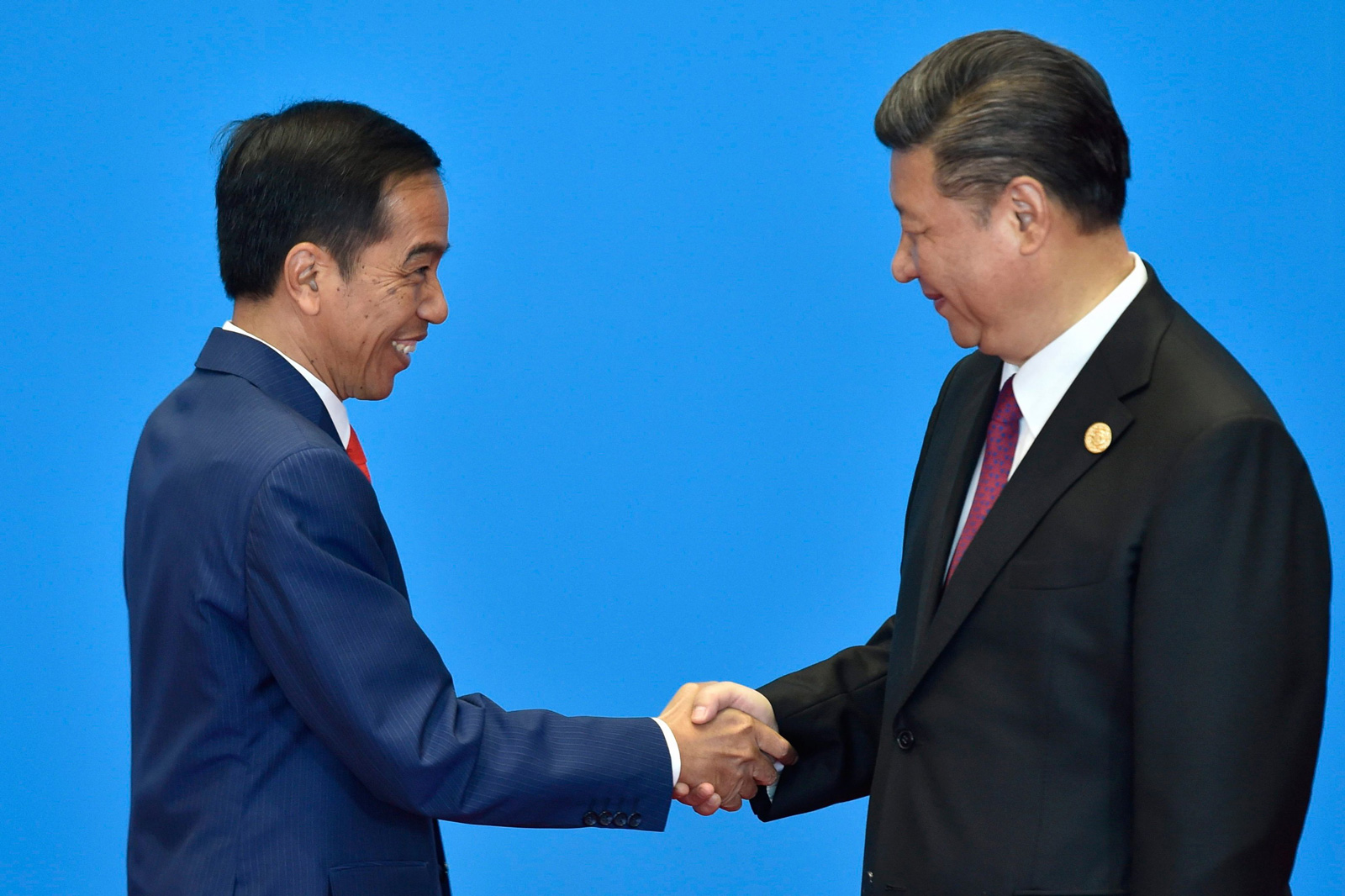
Indonesian President Joko Widodo and Xi Jinping, Yanqi Lake, China, May 15, 2017.

Indonesia has long been cautious in confronting China’s claims in the South China Sea, so its announcement on July 14 that it was renaming a part of the area the “North Natuna Sea” may have come to many as surprise. 
The new name encompasses a region north of the Natuna islands that partly falls within the infamous “nine dash line,” by which China claims the sea stretching fifteen hundred miles from its mainland coast almost to the shores of Malaysia, the Philippines, Brunei, Vietnam, and Indonesia.
China immediately demanded a retraction—which it will not get.
The naming was a reminder of how seriously Indonesia treats its position as the seat of ancient trading empires and location of some of the world’s strategically most important straits—Melaka, Sunda, Lombok, and Makassar. 
Since he was elected in 2014, President Joko Widodo has made maritime issues central to Indonesia’s foreign policy, building up its navy, arresting dozens of foreign ships caught fishing illegally, and taking a quiet but firm stand on sea rights. 
Although not a populist vote-winner, the policy is generally approved, particularly by the military, which since the war of independence against the Dutch has seen itself as the guardian of the integrity of the nation and its internationally recognized status.
The naming also came shortly before the sixtieth anniversary of a pronouncement that has had a profound impact on the whole world. 
On December 13, 1957, the Indonesian government unilaterally declared that it was an “archipelagic state,” claiming sovereignty over all the waters within straight baselines between its thousands of far-flung islands. 
Though the young republic was in no position to enforce it, this was a revolutionary move: at the time, Western powers asserted that territorial seas were limited to three miles, and that otherwise foreign ships, military included, had complete freedom of movement.
Twenty-five years of international negotiation followed, culminating in the 1982 United Nations Convention on Law of the Sea, defining rights and obligations relating to sea boundaries and resources, and rights of “innocent passage”—not endangering the security of the coastal state—through straits and internal and territorial seas. 
It accepted the archipelagic state principle, and made twelve-mile territorial seas and two-hundred-mile “exclusive economic zones,” or EEZs—which give exclusive rights for fishing and exploitation of seabed resources—the global norm. (The United States in practice accepts the Convention, as clarified by a subsequent 1994 agreement, but has never ratified it.)
Although Indonesia has no island disputes with China, its stance on the Natuna waters allies it with the other littoral nations in facing up to China (though the Philippines under Duterte currently appears to prefer Chinese money to sovereignty over its seas). 
Last year, the Permanent Court of Arbitration in The Hague applied the Convention to rule decisively for the Philippines in its claim against Chinese actions within its EEZ, including driving out Philippine fishing boats, and building structures on rocks and shoals that did not have the status of islands. 
In doing so, the court rejected China’s claims to the whole sea and by implication the waters of North Natuna.

Do not imagine that the term “South China Sea” ever implied Chinese ownership. 
It is a Western construction that dates to about 1900. 
Previously, European maps referred to it as the China Sea, and before that as part of the Indian Sea. When the Portuguese arrived there in the early sixteenth century they called it the Cham Sea, after the maritime kingdom of coastal Vietnam. 
Other names at various times include Luzon Sea and (by early Arab traders) the Clove Sea. 
To China it has long been the South Sea and to Vietnamese the East Sea. 
The Philippines now refers to it as the West Philippine Sea.
“Malay seas” is another term that has been applied to it and its immediate neighbors, the Java, Sulu, and Banda seas. 
The South China Sea itself is predominantly a Malay sea, as defined by the culture and language group of the majority of people living along its shores. 
Until European imperialism from the sixteenth century onward gradually snuffed out these trade-based kingdoms and sultanates, they were the region’s principal traders.
Earlier, the Sumatra-based Srivijaya kingdom held similar sway through its control of the Melaka straits and hence all seaborne trade between China and the Spice Islands with India, Arabia, and beyond. 
It was during this era that ships from the archipelago brought the first colonists to Madagascar, leaving a language and genetic imprint that remains to this day. 
They also traded across the Indian ocean to Africa and Yemen.
The first Romans known to have visited China did so by sea via India and the Malay peninsula. 
Trade spread Buddhism to Sumatra and Java, where by the fifth century it was flourishing to such an extent that Srivijaya attracted Chinese monks, who then traveled on to Sri Lanka and India. 
Chinese traders occasionally visited countries to the south, but did so on “barbarian” ships based out of Champa, Funan (in the Mekong delta), Java, Borneo, or Sumatra. 
Some of these ships were fifty meters long and capable of carrying five hundred people, according to contemporary Chinese sources.
Trade with China boomed during the seventh through tenth-century Tang dynasty, an era of peace and progress. 
As Chinese were barred from going overseas, trade brought large numbers of Indian, Malay, Persian, and Arab merchants to settle in the southern Chinese ports Guangzhou and Quanzhou, and prosperity to the ports of Sumatra, Java, and the Malay peninsula.
It was not until the Southern Song era, when northern China was under Central Asian rule, that Chinese began to participate directly in the trade, and even then it was often not in their own ships. The Yuan dynasty that followed further relaxed restrictions on Chinese participation in trade, but also invaded Java when the King of Singasari in east Java refused to pay tribute to the emperor Kublai Khan. 
The invasion was a disaster. 
What Kublai wanted was political submission that went beyond the so-called “tribute” missions sent by trading states to the imperial court. 
Contrary to what is often assumed, these missions mostly had no political implications. 
They were most frequent at a time when port rivalries were most intense. 
Tribute was a payment to receive preference for trading in China, and it also applied in reverse: Chinese traders visiting the Philippines had to bring gifts for local chiefs in order to be allowed to trade.
Kublai’s imperial ambitions were partly taken up by the Ming dynasty with the despatch between 1405 and 1433 of seven huge fleets under Muslim eunuch Zheng He to demonstrate Chinese power throughout the southern and western seas, demanding local rulers acknowledge the supremacy of the emperor. 
But the voyages had scant strategic value and were too costly to be sustained. 
Nor did they contribute much to the development of China’s trade. 
By then, small settlements of Chinese traders could be found in Java and Sumatra ports, some as a result of purges of Muslims in Quanzhou, but they were still only minor players when, a mere eighty years after the last Zheng He voyage, the Portuguese arrived to conquer Melaka, the Malay Muslim city which was the leading entrepôt of the region.
This was to be the start of more than four centuries of European influence, with Spain, the Netherlands, Britain, and the US following the Portuguese and in time converting commercial presence in the region into economic dominance and political control. 
The Dutch in Batavia (Jakarta) took trade way from Java’s other ports. 
Makassar, a beacon of free trade and religious tolerance, was also subdued by the Dutch. 
After the British took control of Singapore in 1824 and opened it to all comers, the ports of Sumatra and the peninsula—Aceh, Palembang, etc.—slowly faded until almost obliterated.
The role of overseas Chinese in regional trade grew steadily as colonial cities such as Batavia, Manila, and then Singapore offered opportunities for engagement in the local economy as well as regional trade. 
Then the mining and plantation booms of the nineteenth and early twentieth centuries attracted hundreds of thousands of Chinese migrants, who formed their own trading networks around the region. 
Meanwhile, the biggest businesses of all were Western-owned. 
Thus by the time of independence after 1945, the once trade-based states of the region saw their commerce in alien hands.
None of this was the doing of China itself. 
It was the work of enterprising Chinese leaving an overcrowded country. 
At no point since Zheng He had a Chinese government been actively involved in the seas that it now claims on the basis of history. 
Any actions it takes now to press those claims against its neighbors have the potential to arouse communal feeling, never far below the surface, against commercially dominant ethnic Chinese communities in those countries. 
The naming of North Natuna is a sign that the world’s largest archipelagic state will stand firm, encouraging the Philippines and Malaysia to do likewise, until China’s bout of arrogance abates and it can treat its 400 million maritime neighbors as equals, acknowledging their seafaring and trading history.

mardi 29 août 2017

Sina Delenda Est

How China Plans to Win a War in the South China Sea
By James Holmes

Last year China’s defense minister, General Chang Wanquan, implored the nation to ready itself for a “people’s war at sea.” 
The purpose of such a campaign? 
To “safeguard sovereignty” after an adverse ruling from the International Tribunal for the Law of the Sea. 
The tribunal upheld the plain meaning of the UN Convention on the Law of the Sea (UNCLOS), ruling that Beijing’s claims to “indisputable sovereignty” spanning some 80-90 percent of the South China Sea are bunk.
A strong coastal state, in other words, cannot simply wrest away the high seas or waters allocated to weaker neighbors and make them its own.
Or, at any rate, it can’t do so lawfully. 
It could conceivably do so through conquest, enforced afterward by a constant military presence. Defenders of freedom of the sea, consequently, must heed General Chang’s entreaty. 
Southeast Asians and their external allies must take such statements seriously—devoting ample forethought to the prospect of marine combat in the South China Sea.
That’s the first point about a people’s war at sea. 
A clash of arms is possible. 
Statesmen and commanders in places like Manila, Hanoi, and Washington must not discount Chang’s words as mere bluster.
Indeed, it’s doubtful China could comply with the UNCLOS tribunal’s ruling at this stage, even if the Chinese Communist Party leadership wished to. 
Think about the image compliance would project at home. 
For two decades now, Beijing has invested lavishly in a great navy, and backed that navy up with shore-based firepower in the form of combat aircraft, anti-ship missile batteries, and short-range warships such as fast patrol craft and diesel submarines.
Party leaders have regaled the populace with how they will use seagoing forces to right "historical wrongs" and win the nation nautical renown. 
They must now follow through.
It was foolish to tie China’s national dignity and sovereignty to patently absurd claims to islands and seas. But party leaders did so. 
And they did so repeatedly, publicly, and in the most unyielding terms imaginable. 
By their words they stoked nationalist sentiment while making themselves accountable to it. 
They set in motion a toxic cycle of rising popular expectations.
Breaking that cycle could verge on impossible. 
If Beijing relented from its maritime claims now, ordinary Chinese would—rightly—judge the leadership by the standard it set. 
Party leaders would stand condemned as weaklings who surrendered sacred territory, failed to avenge China’s century of humiliation despite China’s rise to great power, and let jurists and lesser neighbors backed by a certain superpower flout big, bad China’s will.
No leader relishes being seen as a weakling. 
It’s positively dangerous in China. 
As the greats of diplomacy teach, it’s tough for negotiators or political leaders to climb down from public commitments. 
Make a promise and you bind yourself to keep it. Fail to keep it and you discredit yourself—and court disaster in the bargain.
Like any sane leadership, Beijing prefers to get its way without fighting. 
Fighting, though, could be the least bad of the options party leaders have left themselves. 
Quite the predicament they’ve made for themselves.
Which leads to the second point. 
Judging from Chang’s words, small-stick diplomacy has run its course. 
Small-stick diplomacy was about deploying the China Coast Guard and fellow nonmilitary sea services to police waters Beijing claimed. 
It depicted China’s sovereignty in the South China Sea as a fact, and dared woefully outmatched rivals to reverse that fact.
Left unopposed, de facto Chinese sovereignty—a near-monopoly on the use of force within borders sketched on the map—would have become entrenched over time. 
Once it became the new normal, it might even have taken on an aura of legitimacy among seafaring states.
The UNCLOS tribunal struck China’s approach a grievous blow, collapsing the quasi-legal arguments underlying small-stick diplomacy. 
The tribunal’s decision makes it clear that Chinese maritime forces operating in, say, the Philippines’ exclusive economic zone are invaders or occupiers—not constables.
If Beijing can’t get its way through white-hulled coast-guard vessels, that leaves military force. Sovereign states deploy law-enforcement assets to police what is rightfully theirs. 
They deploy military forces to fight for things that are in dispute. 
Chang’s warlike talk implies that Beijing has abandoned the softly, softly approach and has tacitly admitted Southeast Asia constitutes a contested zone.
And the lingo he employs matters. 
People’s war is a Maoist phrase used to convey certain martial ideas. 
Mao Zedong’s Red Army waged people’s war to seize contested ground from Japanese invaders and Chinese Nationalists. 
It appears China now sees the South China Sea in similar terms—as an offshore battleground where rivals must be overcome by force.
But not by military force alone. 
Beijing won’t withdraw the coast guard, maritime enforcement services, or the fishing fleet—an unofficial militia—from embattled waters. 
They will stay on as part of a composite whole-of-government armada. 
But the People’s Liberation Army (PLA) Navy and Air Force will figure more prominently in the force mix.
In the days of small-stick diplomacy, the naval big stick posed an implicit threat from over the horizon. 
Philippine or Vietnamese mariners knew the China Coast Guard had backup if they defied it. 
In all likelihood Chinese commanders will flourish the big stick more promiscuously in the future—rendering the threat overt and visible rather than latent and unobtrusive.
Here’s the third point. 
A people’s-war-at-sea strategy will confront a motley coalition in which outsiders—America, maybe joined by Japan or Australia—supply the bulk of the heavy-hitting combat power. 
The Philippines is lopsidedly outgunned. 
Vietnam has pluck and a formidable military, but it can hardly stand up to the northern colossus without help.
The coalition’s curious makeup would furnish Beijing opportunities for coalition-breaking. 
China might reckon that any conflict in the South China Sea would be a “war by contingent” for the United States, a war in which Washington fixes the size of a force dispatched to support regional allies and instructs the commanders of that force to do the best they can with the resources they have.
Such strategies are excellent for troublemaking but seldom decisive in themselves. 
Lord Wellington, for instance, led a contingent ashore in Iberia in 1807. 
The expedition gave Napoleon a “Spanish ulcer,” a nagging commitment on a new front. 
Yet Wellington never kidded himself that he would win a continent-spanning war with a modest expeditionary force augmented by partisans and the Royal Navy.
Such an approach, in other words, would betray half heartedness on Washington’s part. 
After all, America would have embarked on an open-ended enterprise in a distant theater off the opponent’s shores without any real thought of victory. 
Half Heartedness kills in such ventures.
People’s war is about outlasting stronger foes under circumstances like these. 
If the weaker contender is a China endowed with sizable reserves of hard power to tap, then that contender needs time. 
Its armed forces protract the campaign, both to gain time to muster more strength and to wear away at enemy combat strength.
In short, China could win even if it remains weaker than America in the aggregate. 
The PLA could narrow or reverse the balance of forces in the theater—overpowering the U.S. contingent at the place and time that truly matter. 
It could dishearten Washington. 
U.S. leaders might despair of sustaining the undertaking indefinitely. 
Or, China could outlast America—inflicting numerous tactical losses over a long time, and thus driving the price tag of preserving freedom of the seas higher than U.S. leaders are willing to pay. 
If America goes home, the venture collapses.
How, in operational and tactical terms, can PLA commanders bring this about? 
By hewing to their own warmaking traditions. 
China is politically and strategically predictable in the South China Sea yet operationally and tactically unpredictable. 
Politically and strategically predictable because party leaders painted themselves into a corner with domestic constituencies. 
Tactically unpredictable because that’s how Chinese forces have fought since the age of Mao.
Indeed, “active defense,” the concept whereby Mao codified his ideas about people’s war, remains the heart of Chinese military strategy. 
To oversimplify, the conceit behind active defense is that a weaker China can lure a stronger pugilist into overextending and tiring himself before delivering a punishing counterpunch. 
Conjure up the great Muhammad Ali’s Rumble in the Jungle in your mind and you get the idea.
If the rope-a-dope approach works on a grand scale, Chinese forces can inflict tactical defeats that enfeeble the foe over time. 
Active defense, then, is all about harnessing tactical offense for strategically defensive campaigns.
To prosecute it, Chinese commanders seek out isolated enemy detachments they can assault on “exterior lines,” encircling and crushing them. 
The cumulative effect of repeated tactical setbacks wears down the strong—and could prompt their leadership to question whether the endeavor is still worth its hardships, perils, and costs. 
If not, cost/benefit logic will prod U.S. leaders toward the exit—and China will prevail even without an outright victory over allied forces.
U.S. and allied mariners and airmen, accordingly, must study China’s martial traditions, gleaning insight into how offshore active defense might unfold in the South China Sea. 
If you’re Beijing and have built up a seagoing militia, an impressive coast guard, Asia’s biggest indigenous navy, and a sizable arsenal of land-based weaponry to influence events at sea, how do you alloy those components into a sharp combat implement—and consolidate control over a semi-enclosed sea?
Essaying some foresight into these matters now could pay off handsomely if China tries to put General Chang’s—and Mao’s—strategic concept into practice.
Speaking of whom, a final bit of advice from Mao Zedong. 
Chang deployed China’s traditional lexicon, centered on people’s war, to describe how Beijing may transact business in Southeast Asia. 
But bear in mind that a strategy of the weak was expedient for Mao, not his strategic preference. 
He was writing for a China that was flat on its back, wracked by civil war and foreign invasion.
It could do little else. 
But the goal of active defense—of people’s war—was to make the Red Army the stronger antagonist. Once Maoist forces reversed the force imbalance, they meant to unleash a counteroffensive and win on the conventional battleground.
This is not Mao’s China. 
It’s already a brawny economic and military power, and would be fighting on its own ground. 
Today’s PLA enjoys far more offensive options than did Mao’s Red Army. 
Rather than revert to pure people’s war on the Maoist pattern, PLA commanders could pursue a mix of small- and big-unit engagements against the U.S.-led coalition.
People’s war, then, could start to look awfully like conventional marine combat if Beijing believes the military balance and the trendlines favor China.
By all means, let’s review China’s way of war, discerning what we can about Chinese warmaking habits and reflexes. 
But these are not automatons replaying the Maoist script from the 1930s and 1940s. 
How they might transpose Maoist doctrine to the offshore arena—and how an unruly coalition can surmount such a challenge—is the question before friends of maritime freedom.

samedi 26 août 2017

Chinese Aggressions

China’s latest moves in the South China Sea have sparked fears of a new land grab
By Steve Mollman

Filipino patriotism on Thitu Island.
In 2012, China wrested control of Scarborough Shoal in the South China Sea from the Philippines. With the shoal—reefs, rocks, and a vast lagoon—located just 220 km (137 miles) from the Philippines’ main island Luzon, the incident heightened tensions and embarrassed Manila, which the following year opened a case in an international tribunal challenging Beijing’s territorial moves in the sea.
 
The Spratly archipelago. 

So alarm bells went off earlier this month when Chinese ships gathered at Sandy Cay, a set of sandbars close to Philippines-occupied Thitu Island in the sea’s Spratly archipelago. 
The island has a small civilian population and a decrepit runway the Philippines has been meaning to repair.
The flotilla was seen as intimidating at the very least. 
“China’s ongoing maritime activity around Thitu is worrisome… if the objective of the operation is to occupy Sandy Cay, that would mean a significant escalation in tension in the South China Sea. Asia has acquired yet another flashpoint it could well do without,” wrote Euan Graham, a security analyst with the Lowy Institute for International Policy in Sydney.
A number of nations have claims to various features in the Spratlys. 
China, for its part, claims nearly the entire sea for itself, based on its infamous nine-dash line. 
The tribunal invalidated that sweeping claimin a nearly 500-page ruling issued in July 2016, but Beijing dismissed the legal proceedings entirely.
Satellite images shared by the Center for Strategic and International Studies’ Asia Maritime Transparency Initiative, based in Washington, DC, confirmed the presence of the flotilla, which included fishing, coastguard, and navy ships. 
The Philippines military confirmed it as well. 
It’s unclear at the time of this writing whether the vessels are still present.

Filipinos living on Thitu Island.

The governments of both countries have remained tight-lipped about the murky incident. 
Chinese foreign ministry spokesperson Hua Chunying said that people with ulterior motives were trying to “stir up conflicts between China and the Philippines.” 
Philippines foreign minister Alan Peter Cayetano said the mere presence of the Chinese ships was no cause for alarm “despite the lack of details that we give you,” saying the matter would be resolved through diplomatic channels. 
That followed similar reassurances a day earlier from Rodrigo Duterte.
But not everyone in the Philippines is so sure. 
The Chinese ships were reportedly blocking access to Sandy Cay, about 5 km (3.1 miles) from Thitu Island. 
They also blocked a vessel from the Philippine Bureau of Fisheries and Aquatic Resources, according to lawmaker Gary Alejano, who last week shared photos of the Chinese ships. 
For many Filipinos the thought of a Chinese blockade dredges up bad memories. 
When China took over Scarborough Shoal, it blocked Philippine ships from accessing it.
A contested sea.

Something for Subi

If China did occupy Sandy Cay (not to be confused with the nearby Sand Cay) and claim territorial waters around it, that could bolster the legal status of another nearby feature: Subi Reef, where China has built a militarized artificial island.
A sandbar seen from Thitu Island.

When the tribunal made its ruling, it went by the rules of the UN Convention on the Law of the Sea (Unclos), which is at the core of modern maritime law. 
The tribunal designated Subi Reef a “low-tide elevation.” 
Such legal designations matter a great deal, as they determine what kind of rights a nation gets in the surrounding waters.
Under Unclos, a “low-tide elevation”—above water at low tide but submerged at high tide—generates no territorial sea. 
A territorial sea extends out 12 nautical miles (22 km or 13.9 miles) from shore, and within it a nation can better enforce its rules.
A “rock,” by contrast, does generate a territorial sea. 
An “island” generates an exclusive economic zone, which grants a nation sole rights to natural resources in an area extending 200 nautical miles from the shore.
In its ruling, the tribunal didn’t determine Sandy Cay’s legal designation. 
But Antonio Carpio, a Supreme Court senior associate justice in the Philippines, said on Aug. 19:
“Sandy Cay is a Philippine land territory that is being seized (to put it mildly), or being invaded (to put it frankly), by China. If China acquires sovereignty over Sandy Cay, it can now claim Subi Reef as part of the territorial sea of Sandy Cay, legitimizing China’s claim over Subi Reef.”
Carpio said Duterte should send navy vessels to defend Sandy Cay. 
Were China to start a skirmish with them, he noted, the government could then invoke the mutual defense treaty with the US. 
Duterte, however, said he would not invoke the treaty in such a case: “I will not call on America. I have lost trust in the Americans.”
In a situation where Sandy Cay was designated a “rock” and China established sovereignty over it, its territorial sea would be extended by Subi Reef, noted Conor Cronin, a research associate with the Asia Maritime Transparency Initiative. 
In other words, Subi Reef would then generate territorial waters.
That’s something Subi Reef doesn’t have now, and didn’t have when the US conducted a nearby “freedom of navigation” operation challenging China’s claims in 2015.
The USS Lassen’s 2015 freedom of navigation operation near Subi Reef.

Testing the waters
For China, occupying the sandbar would probably not matter much right now. 
But one day, it might.
“I suppose that in a future world where China and the Philippines agree to divide up sovereignty over the islands and rocks, China is better off with Sandy Cay if it ever had to give up its claim to Thitu Island,” said Julian Ku, a professor at the law school of Hofstra University in New York.
Thitu Island seen from the sky.

It’s possible that China, by occupying Sandy Cay—or simply putting a flotilla near it—could be testing the waters in terms of reactions in the Philippines.
“I think the occupation of Sandy Cay would be a useful way for China to test the Philippines (and to a lesser extent the US),” Ku added. 
“As a legal matter, the Philippines also claims Sandy Cay, and if they allow China to occupy it… it would be a signal the Philippines will not resist Chinese changes to the status quo.”
Another theory is that China is trying to intimidate the Philippines against building at Sandy Cay itself, or against bolstering its presence on Thitu Island.
Either way, the flotilla has given Asia one more flashpoint to worry about.