Affichage des articles dont le libellé est Scarborough Shoal. Afficher tous les articles

lundi 20 mai 2019

FONOPs

U.S. warship sails near the Scarborough Shoal
By Idrees Ali

The Arleigh Burke-class guided-missile destroyer USS Preble (DDG 88) transits in the the Indian Ocean, March 29, 2018.

WASHINGTON -- The U.S. military said one of its warships sailed near the disputed Scarborough Shoal claimed by China in the South China Sea on Sunday.
The busy waterway is one of a growing number of flashpoints in the U.S.-China relationship, which include a trade war, U.S. sanctions and Taiwan.
China struck a more aggressive tone in its trade war with the United States on Friday.
The tough talk capped a week that saw China unveil new retaliatory tariffs in response to a U.S. decision to raise its levies on $200 billion of Chinese imports to 25% from 10%.
The U.S. destroyer Preble carried out the operation, a U.S. military spokesman told Reuters.
Preble sailed within 12 nautical miles of Scarborough Reef in order to challenge excessive maritime claims and preserve access to the waterways as governed by international law,” said Commander Clay Doss, a spokesman for the Seventh Fleet.
It was the second such U.S. military operation in the South China Sea in the last month.
On Wednesday, the chief of the U.S. Navy said its freedom of navigation movements in the disputed South China Sea drew more attention than they deserved.
The U.S. military has a long-standing position that its operations are carried out throughout the world, including areas claimed by allies, and they are separate from political considerations.
The operation was the latest attempt to counter what Washington sees as Beijing’s efforts to limit freedom of navigation in the strategic waters, where Chinese, Japanese and some Southeast Asian navies operate.
China claims almost all of the strategic South China Sea and frequently lambastes the United States and its allies over naval operations near Chinese-occupied islands.
Brunei, Indonesia, Malaysia, the Philippines, Taiwan and Vietnam have competing claims in the region.
China and the United States have repeatedly traded barbs in the past over what Washington says is Beijing’s militarization of the South China Sea by building military installations on artificial islands and reefs.

lundi 13 mai 2019

Beijing's South China Sea Bet On Duterte's 'Friendship' Is Souring

By Panos Mourdoukoutas

China’s bet on Philippines President Rodrigo Duterte’s ‘friendship” to advance its South China Sea agenda is beginning to sour.
Last Monday, the Philippines high court instructed key government agencies, like the Philippine Navy, police and the Coast Guard, to do what Rodrigo Duterte should have done three years ago: protect reefs and marine life in Scarborough Shoal, Second Thomas Shoal and Mischief Reef.
That’s according to Radio Free Asia report (RFA), which quoted presidential spokesman Salvador Panelo saying that the government was “duty bound” to enforce the court order.
Apparently, the Philippines’ high court ruling puts an end to Duterte’s flip-flops on the South China Sea disputes, which begun in 2016.
Back then, China lost an international arbitration ruling to the Philippines and its close ally the US regarding its claim that it has historic title over the waters of the South China Sea.
In theory, that is. 
In practice, the ruling didn’t mean much. 
While China lost the ruling, it won a new “friend,” Rodrigo Duterte. 
Rather than teaming up with the US to enforce the ruling, he walked the other way.
He sided with Beijing on the dispute, and pursued a “divorce” from the U.S. 
On April 2018, for instance, Duterte backed off his earlier decision to raise the Philippine flag in disputed islands, following Beijing’s “friendly” advice.
Apparently, Duterte was concerned about the prospect of an outright war with Beijing should he had tried to enforce the international arbitration ruling, reasoning that America wouldn’t rush to the Philippines side in that case.
But there was something else in the works, it seems. 
Beijing had offered Manila a couple of promises, as was discussed in previous pieces here. 
Like the promise to finance Duterte’s “Build, Build, Build” initiative, and the promise of peace and a partnership for prosperity.
Meanwhile, there are a couple of things Beijing and Duterte miscalculated. 
The first is that America has assured the Philippines that it would come to that nation’s defense if it comes under attack in the South China Sea.
That’s according to reports in early March, when Washington reaffirmed a defense code that Manila has sought to revise.
Secondarily, this has removed a major snag in relations between Washington and Manila; and seems to have appeased two former Filipino officials who filed a complaint with the International Criminal Court (ICC) over China’s aggression in the disputed South China Sea.
But not Rodrigo Duterte. 
He didn’t seem to be ready for another foreign policy flip-flop – nor does he seem ready to get the country’s South China Sea Policy right: i.e. stick with the international law.
Until this week, that is, when the Philippines high court ruling forced him to do so, ruining China’s bet on his “friendship.”

mercredi 10 avril 2019

U.S. Sends Warship Carrying Fighter Jets to Disputed Sea in Signal to China

  • USS Wasp spotted near China-occupied feature
  • Warship joins Philippine drills in American show of support
By Ditas B Lopez
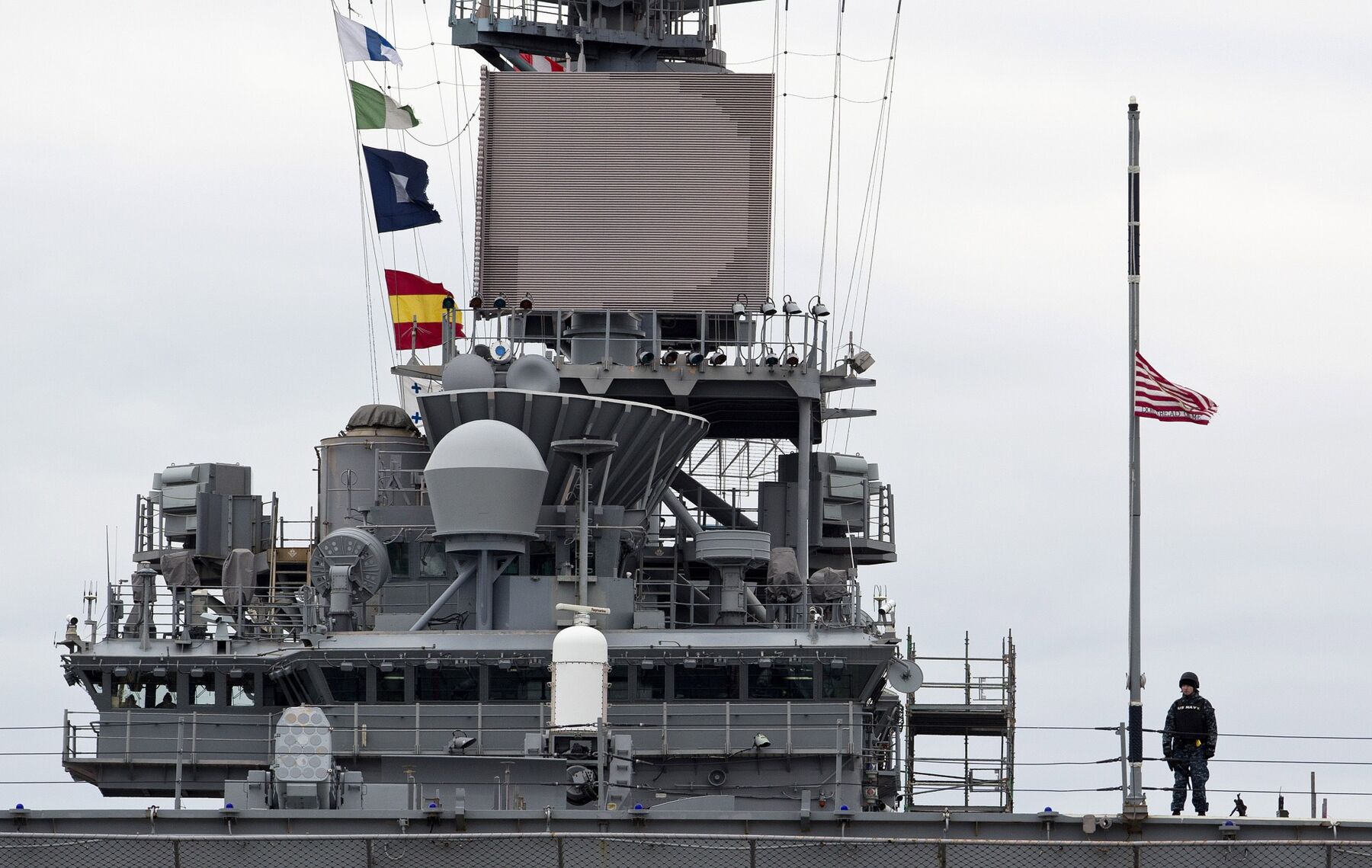
The USS Wasp Navy ship. 

The U.S. sent a fighter-jet-carrying warship to join drills near Scarborough Shoal for the first time, sending a pointed message to China as tensions simmer over territorial claims in the region.
The USS Wasp -- an amphibious assault ship outfitted last year with F-35B jets -- joined the annual Exercise Balikatan with the Philippines this month. 
A ship matching the USS Wasp’s description was spotted in waters “near the Scarborough Shoal,” a feature occupied by China since a tense standoff in seven years ago, the Philippines’ ABS-CBN News reported Tuesday.
The USS Wasp didn’t pass within 25 nautical miles of the shoal, according to a U.S. defense official who spoke on the condition of anonymity. 
The figure suggests that the ship wasn’t conducting a so-called freedom of navigation operation, a practice criticized by China that the U.S. uses to assert international sailing rights within 12 nautical miles of disputed features.

‘Free and Open’
The moves come as officials in Manila escalate protests over the presence of more than 200 Chinese ships near the Philippine-occupied South China Sea feature of Thitu
Philippine President Rodrigo Duterte has urged China to “lay off” the feature, saying he would order a military action.
The U.S. has been seeking to firm up its treaty alliance with the strategically located Southeast Asian nation ever since Duterte was elected in 2016 and announced his “separation” from Washington in favor of Beijing. 
In March, U.S. Secretary of State Michael Pompeo assured local officials during a visit to Manila that their treaty would apply to Philippine vessels or planes attacked in disputed waters.
Philippine Foreign Affairs Secretary Teodoro Locsin said earlier this week that the U.S. would remain the country’s only military ally.
More than 7,000 soldiers from the Philippines and the U.S. are participating in Exercise Balikatan, according to General Benjamin Madrigal Jr., the Philippine military chief.
The combined information bureau for the joint military drills said Tuesday that the USS Wasp “has been training with Philippine Navy ships in Subic Bay and international waters of the South China Sea as part of the Exercise Balikatan for several days.”
The training is focused on “maritime security and amphibious capabilities, as well as multinational interoperability through military exchanges,” the bureau said. 
This year’s joint exercise was the first to incorporate the USS Wasp with the U.S. Marines Corps’ F-35B Lighting II aircraft.
“Together they represent an increase in military capability committed to a free and open Indo-Pacific,” the bureau said. 
“Participating in Balikatan demonstrates their ability to forward deploy in support of an ally should a crisis or natural disaster occur.”

lundi 24 septembre 2018

Chinese Peril

China’s Sea Control Is a Done Deal, ‘Short of War With the U.S.’
By Hannah Beech

An American crew monitored China’s buildup in the South China Sea this month from a Navy P-8A Poseidon reconnaissance plane.

NEAR MISCHIEF REEF, South China Sea — As the United States Navy reconnaissance plane banked low near Mischief Reef in the South China Sea early this month, a Chinese warning crackled on the radio.
“U.S. military aircraft,” came the challenge, delivered in English in a harsh staccato.
“You have violated our China sovereignty and infringed on our security and our rights. You need to leave immediately and keep far out.”
Aboard the P-8A Poseidon maritime patrol aircraft, flying in what is widely considered to be international airspace, Lt. Dyanna Coughlin scanned a live camera feed showing the dramatic evolution of Mischief Reef.
Five years ago, this was mostly an arc of underwater atoll populated by tropical fish and turtles.
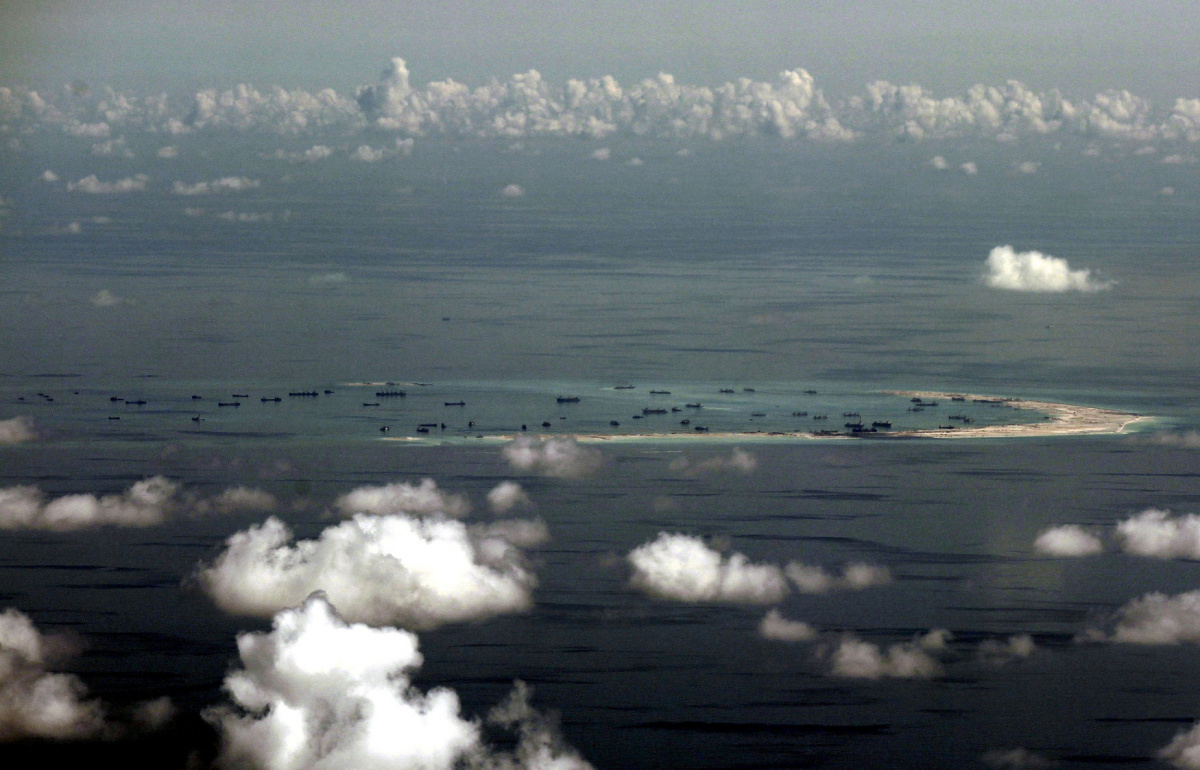
Now Mischief Reef, which is off the Philippine coast but controlled by China, has been filled out and turned into a Chinese military base, complete with radar domes, shelters for surface-to-air missiles and a runway long enough for fighter jets.
Six other nearby shoals have been similarly transformed by Chinese dredging.
“I mean, this is insane,” Lieutenant Coughlin said.
“Look at all that crazy construction.”
A rare visit on board a United States Navy surveillance flight over the South China Sea pointed out how profoundly China has reshaped the security landscape across the region.
The country’s aggressive territorial claims and island militarization have put neighboring countries and the United States on the defensive, even as President Trump’s administration is stepping up efforts to highlight China’s controversial island-building campaign.
In congressional testimony before assuming his new post as head of the United States Indo-Pacific Command in May, Adm. Philip S. Davidson sounded a stark warning about Beijing’s power play in a sea through which roughly one-third of global maritime trade flows.
“In short, China is now capable of controlling the South China Sea in all scenarios short of war with the United States,” Admiral Davidson said, an assessment that caused some consternation in the Pentagon.

A view of Subi Reef and the array of vessels there.

How Beijing relates to its neighbors in the South China Sea could be a harbinger of its interactions elsewhere in the world.
Xi Jinping has held up the island-building effort as a prime example of “China moving closer to center stage” and standing “tall and firm in the East.”
In a June meeting with Defense Secretary Jim Mattis, Xi vowed that China “cannot lose even one inch of the territory” in the South China Sea, even though an international tribunal has dismissed Beijing’s expansive claims to the waterway.
The reality is that governments with overlapping territorial claims — representing Vietnam, the Philippines, Malaysia and Brunei — lack the firepower to challenge China.
The United States has long fashioned itself as a keeper of peace in the Western Pacific.
But it’s a risky proposition to provoke conflict over a scattering of rocks in the South China Sea, analysts say.
“As China’s military power grows relative to the United States, and it will, questions will also grow regarding America’s ability to deter Beijing’s use of force in settling its unresolved territorial issues,” said Rear Adm. Michael McDevitt, who is now a senior fellow in strategic studies at the Center for Naval Analyses.
An unexpected encounter in the South China Sea could also set off an international incident.
A 1.4-million-square-mile sea presents a kaleidoscope of shifting variables: hundreds of disputed shoals, thousands of fishing boats, coast guard vessels and warships and, increasingly, a collection of Chinese fortresses.
In late August, one of the Philippines’ largest warships, a cast-off cutter from the United States Coast Guard, ran aground on Half Moon Shoal, an unoccupied maritime feature not far from Mischief Reef.
The Chinese, who also claim the shoal, sent vessels from nearby artificial islands, but the Philippines refused any help.
After all, in 2012, the Chinese Coast Guard had muscled the Philippines off of Scarborough Shoal, a reef just 120 nautical miles from the main Philippine island of Luzon.
Another incident in 1995 brought a Chinese flag to Mischief Reef, also well within what international maritime law considers a zone where the Philippines has sovereign rights.
Could somewhere like Half Moon Shoal be the next flash point in the South China Sea?
“A crisis at Half Moon was averted, but it has always been the risk with the South China Sea that a small incident in remote waters escalates into a much larger crisis through miscommunication or mishandling,” said Ian Storey, a senior fellow at the ISEAS-Yusof Ishak Institute in Singapore. “That’s why this is all so dangerous. It’s not just a pile of rocks that can be ignored.”
Monitoring feeds from a camera controlled by an observer, front left, on the naval reconnaissance mission early this month.

‘Leave immediately!’
On the scratchy radio channel, the Chinese challenges kept on coming.
Eight separate times during the mission this month, Chinese dispatchers queried the P-8A Poseidon. Twice, the Chinese accused the American military aircraft not just of veering close to what Beijing considered its airspace but also of violating its sovereignty.
“Leave immediately!” the Chinese warned over and over.
Cmdr. Chris Purcell, the American squadron commander, said such challenges have been routine during the four months he has flown missions over the South China Sea.
“What they want is for us to leave, and then they can say that we left because this is their sovereign territory,” he said.
“It’s kind of their way to try to legitimize their claims, but we are clear that we are operating in international airspace and are not doing anything different from what we’ve done for decades.”
In 2015, Xi Jinping stood in the Rose Garden at the White House and promised that “there is no intention to militarize” a collection of disputed reefs in the South China Sea known as the Spratlys.
But since then, Chinese dredgers have poured mountains of sand onto Mischief Reef and six other Chinese-controlled features in the Spratlys.
China has added at least 3,200 acres of new land in the area, according to the Asia Maritime Transparency Initiative run by the Center for Strategic and International Studies.
Descending as low as 5,000 feet, the surveillance flight this month gave a bird’s-eye view of the Chinese construction.
On Subi Reef, a construction crane swung into action next to a shelter designed for surface-to-air missiles.
There were barracks, bunkers and open hangars.
At least 70 vessels, some warships, surrounded the island.
On Fiery Cross Reef, a complex of buildings with Chinese eaves was arrayed at the center of the reclaimed island, including an exhibition-style hall with an undulating roof.
It looked like a typical newly built town in interior China — except for the radar domes that protruded like giant golf balls across the reef.
A military-grade runway ran the length of the island, and army vehicles trundled across the tarmac. Antenna farms bristled.
“It’s impressive to see the Chinese building, given that this is the middle of the South China Sea and far away from anywhere, but the idea that this isn’t militarized, that’s clearly not the case,” Commander Purcell said.
“It’s not hidden or anything. The intention, it’s there plain to see.”
In other spots, reclamation could also be seen on Vietnamese-controlled features, such as West London Reef, where workers dragged equipment past piles of sand.
But dredging by Southeast Asian nations is scant compared with the Chinese effort.
In April, China for the first time deployed antiship and antiaircraft missiles on Mischief, Subi and Fiery Cross, American military officials said.
The following month, a long-range bomber landed on Woody Island, another contested South China Sea islet.
A Pentagon report released in August said that with forward operating bases on artificial islands in the South China Sea, the People’s Liberation Army was honing its “capability to strike U.S. and allied forces and military bases in the western Pacific Ocean, including Guam.”
In response to the intensifying militarization of the South China Sea, the United States in May disinvited China from joining the biannual Rim of the Pacific naval exercise, the world’s largest maritime warfare training, involving more than 20 navies.
“We are prepared to support China’s choices, if they promote long-term peace and prosperity,” Mr. Mattis said, explaining the snub.
“Yet China’s policy in the South China Sea stands in stark contrast to the openness of our strategy.”

Radar towers, hangars and five-story buildings seen on Fiery Cross Reef.

Projecting Power
For its part, Beijing claims the United States is the one militarizing the South China Sea.
In addition to the routine surveillance flyovers, President Trump has sent American warships more frequently to waters near China’s man-made islands.
These freedom of navigation patrols, which occur worldwide, are meant to show the United States’ commitment to maritime free passage, Pentagon officials say.
The last such operation by the United States was in May, when two American warships sailed near the Paracels, another contested South China Sea archipelago.
Beijing was irate.
The United States says that it does not take any side in territorial disputes in the South China Sea.
On its maps, China uses a so-called nine-dash line to scoop out most of the waterway’s turf as its own.
But international legal precedent is not on China’s side when it comes to the dashed demarcation, a version of which was first used in the 1940s.
In 2016, an international tribunal dismissed Beijing’s nine-dash claim, judging that China has no historical rights to the South China Sea. 
The case was brought by the Philippines after Scarborough Shoal was commandeered by China in 2012, following a tense blockade.
The landmark ruling, however, has had no practical effect.
That’s in large part because Rodrigo Duterte, who became president of the Philippines less than a month before the tribunal reached its decision, chose not to press the matter with Beijing.
He declared China his new best friend and dismissed the United States as a has-been power.
But last month, Mr. Duterte took Beijing to task when a recording aired on the BBC from another P-8A Poseidon mission over the South China Sea demonstrated that Chinese dispatchers were taking a far more aggressive tone with Philippine aircraft than with American ones.
“I hope China would temper its behavior,” Mr. Duterte said.
“You cannot create an island and say the air above it is yours.”

The crew disembarking on Okinawa, Japan, after their mission over the South China Sea.

Missed Opportunities
Perceptions of power — and Chinese reactions to these projections — have led analysts to criticize Barack Obama as having been too timid in countering China over what Adm. Harry B. Harris Jr., the former head of the United States Pacific Command, memorably called a “great wall of sand” in the South China Sea.
Critics, for instance, have faulted the previous administration for not conducting more frequent freedom of navigation patrols.
“China’s militarization of the South China Sea has been a gradual process, with several phases where alternative actions by the U.S., as well as other countries, could have changed the course of history,” said Alexander Vuving, a professor at the Daniel K. Inouye Asia-Pacific Center for Security Studies in Honolulu.
Chief among these moments, Mr. Vuving said, was China’s takeover of Scarborough Shoal.
The United States declined to back up the Philippines, a defense treaty ally, by sending Coast Guard vessels or warships to an area that international law has designated as within the Philippines’ exclusive economic zone.
“Seeing U.S. commitment to its ally, Beijing might not have been as confident as it was with its island-building program,” Mr. Vuving said.
“The U.S. failure to support its ally in the Scarborough standoff also demonstrated to people like Duterte that he had no other option than to kowtow to China.”
With most of the Spratly military bases nearing completion by the end of the year, according to Pentagon assessments, the next question is whether — or more likely when — China will begin building on Scarborough.
A Chinese base there would put the People’s Liberation Army in easy striking distance of the Philippine capital, Manila.
From the American reconnaissance plane, Scarborough looked like a perfect diving retreat, a lazy triangle of reef sheltering turquoise waters.
But Chinese Coast Guard vessels could be seen circling the shoal, and Philippine fishermen have complained about being prevented from accessing their traditional waters.
“Do you see any construction vessels around there?” Lieutenant Coughlin asked.
“Negative, ma’am,” replied Lt. Joshua Grant, as he used a control stick to position the plane’s camera over Scarborough Shoal.
“We’ll see if it changes next time.”

jeudi 25 janvier 2018

American Paper Tiger

China Wants Confrontation in the South China Sea
By Gordon G. Chang

Last Wednesday, the USS Hopper, an Arleigh Burke–class missile destroyer, sailed within twelve nautical miles of Scarborough Shoal, a few rocks in the northern portion of the South China Sea.
We would not have known about the sail-by if we were relying on the Pentagon.
Beijing announced the event and then made threats.
The Chinese, we have to conclude, are itching for a confrontation.
Therefore, strategic Scarborough Shoal, a mere 124 nautical miles from the main Philippine island of Luzon and guarding Manila and Subic bays, could be the hinge on which America’s relations with China swings.
Think of Scarborough as perhaps this century’s Sudetenland. 
In the spring of 2012, Chinese and Philippine vessels sailed in close proximity of contested Scarborough. 
Washington brokered an agreement between Beijing and Manila for both sides to withdraw their craft. 
Only the Philippines did so, leaving China in control of the feature, which had long been thought to be part of the Philippines even though it was inside Beijing’s infamous “nine-dash line.”
Washington, unfortunately, did not enforce the agreement it had arranged, undoubtedly under the belief it could thereby avoid confrontation with China. 
The White House’s inaction just made the problem bigger, however. 
By doing nothing, the Obama administration empowered the most belligerent elements in the Chinese capital by showing everyone else there that duplicity—and aggression—worked.
An emboldened Beijing then ramped up pressure on Second Thomas Shoal, where China employed Scarborough-like tactics by swarming the area with vessels, and the Senkakus, eight specks under Japanese administration in the East China Sea.
In short, Washington, through timidity, ensured the Chinese took ever more provocative actions.
And ensured American allies questioned Washington’s leadership. 
Today, American policymakers complain that the current Philippine president, Rodrigo Duterte, has been cozying up to Beijing. 
Although thoroughly anti-American all his adult life, the Philippine leader has a point when he said his country, despite the mutual defense treaty with America, could not rely on Washington to defend his islands. 
The result of irresolute American policy is that China, which is dismembering the Philippines, is now more influential in Manila than the United States, the only nation pledged to defend the archipelago’s security.
In view of China’s growing confidence and assertion, it is no surprise that its reaction to the Hopper’s passage has been intense. 
State and party media, while replaying old themes of protecting “indisputable” sovereignty, went into overdrive with their most provocative language, that of inflicting indignity on the United States. 
“The reckless provocation ended in disgrace for the U.S. Navy,” wrote Curtis Stone of the Communist Party’s People’s Daily, China’s most authoritative publication.
The Global Times, the tabloid controlled by People’s Daily, predicted that if Washington did not change course, it would become “a lonely pirate” and “suffer complete humiliation.”
Washington’s reaction was, in keeping with its traditional posture, low-key. 
“All operations are conducted in accordance with international law and demonstrate that the United States will fly, sail, and operate wherever international law allows,” said Pentagon spokesman Lt. Col. Christopher Logan, without specifically mentioning Hopper’s patrol.
And when Washington policymakers did talk about the Hopper, they did so anonymously and in tones meant to avoid offense. 
A “U.S. official” said the transit was an “innocent passage” and not a freedom of navigation operation.
That stance allowed the Philippine defense secretary, Delfin Lorenzana, on Sunday to defend the U.S. Navy’s sail-by, because it did not impinge on his nation’s sovereignty.
Yet Hopper would have never made the transit if Manila were in sole control of the shoal. 
The motivating factor, of course, was China. 
“China’s goal in the South China Sea appears to be a gradual extension of its sovereignty to a maritime space the size of India,” Anders Corr, editor of the just-released Great Powers, Grand Strategies: The New Game in the South China Sea, told the National Interest.
In view of this expansive vision, an “innocent passage” is a counterproductive response.
“In our department in Newport, we’re always taking leaders to task for ‘self-defeating behavior,’” James Holmes of the Naval War College e-mailed me on Monday, commenting for himself and not on behalf of the U.S. government. 
“The anonymous official quoted in press accounts as saying the Hopper passage was an ‘innocent passage’ is guilty of that behavior.”
“Innocent passage is something ships do when passing within 12 nautical miles of sovereign territory,” Holmes, co-author of Red Star Over the Pacific: China’s Rise and the Challenge to U.S. Maritime Strategy, points out. 
“So if we’re depicting the Hopper passage by Scarborough Shoal as an innocent passage, we are conceding precisely what a freedom-of-navigation operation is supposed to dispute: that China is the lawful sovereign over Scarborough and that it’s entitled to a 12-mile territorial sea around the shoal.”
Scarborough is well within the exclusive economic zone of the Philippines, and China is essentially asserting squatter’s rights. 
Moreover, Philippines vs. China, the July 2016 Hague decision applying the UN Convention on the Law of the Sea, holds that the shoal does not confer a twelve-nautical-mile band of territorial water. “Our passes by Scarborough must show that they are not innocent in legal terms,” Holmes notes. 
“We must get our language straight, stay on message, and remind everyone regularly that the Hague tribunal smacked down China’s unlawful claims with extreme prejudice back in 2016. That’s how we avoid defeating ourselves.”
American officials, for years, have been characterizing freedom of navigation exercises around Chinese-held features as “innocent passages,” hoping not to rile Beijing. 
That strategy, unfortunately, has produced the opposite result.
The Trump administration, however, is changing four decades of America’s soft approach to China. That “pivot” is evident in the National Security Strategy, unveiled in December, and the National Defense Strategy, a summary of which was released Friday.
China in these landmark policy statements is essentially characterized as an adversary.
Yet historic changes in policy take years to implement.
“My belief is that we still have a long way to go to undo the pernicious impact of the policy of appeasement,” James Fanell, a former U.S. Navy intelligence officer with the Pacific Fleet, told the National Interest in strong, but nonetheless accurate, terms.
“We have several generations of government workers who have been trained to be more attuned to ‘not provoking’ or ‘not offending’ the Chinese than in openly challenging their expansionist activities. This is despite two new policy documents, the NSS and NDS, that clearly intend to challenge Beijing’s outrageous expansionism.”
American policymakers are struggling to come to terms with Beijing’s open hostility to the United States.
Obviously, Chinese officials could have ignored the Hopper’s passage, but their choosing to make an issue of it suggests they are determined to pick a fight.

mardi 23 janvier 2018

Chinese Aggressions


As U.S. goes quiet on close naval patrols, China speaks out
By Greg Torode, Philip Wen

HONG KONG/BEIJING -- While the Pentagon plays down patrols close to Chinese-controlled reefs and islands in the South China Sea, Beijing is sounding the alarm about them, seeking to justify what experts say will be an even greater presence in the disputed region.

An aerial photo taken though a glass window of a Philippine military plane shows the alleged on-going land reclamation by China on Mischief Reef in the Spratly Islands in the South China Sea, west of Palawan, Philippines, May 11, 2015. 

Chinese officials publicized the latest U.S. “freedom of navigation patrol”, protesting the deployment last week of the destroyer USS Hopper to within 12 nautical miles of Scarborough Shoal, an atoll west of the Philippines which Beijing disputes with Manila.
It was the second time in recent months that confirmation of a patrol came from Beijing, not Washington, which had previously announced or leaked details.
Bonnie Glaser, a security expert at Washington’s Center for Strategic and International Studies, said while the administration of U.S. President Donald Trump had a policy of keeping the patrols regular but low key, China was willing to publicly exploit them to further their military ends.
“It is difficult to conclude otherwise,” she said. 
“Even as it pushes ahead with these (patrols), I don’t think the Trump administration has really come to terms with what it will tolerate from China in the South China Sea, and what it simply won’t accept, and Beijing seems to grasp this.”
In official statements, Chinese foreign ministry official Lu Kang said China would take “necessary measures to firmly safeguard its sovereignty” in the resource-rich sea.
Some regional diplomats and security analysts believe that will involve increased Chinese deployments and the quicker militarization of China’s expanded facilities across the Spratlys archipelago.
While U.S. officials did not target China in their comments, couching freedom-of-navigation patrols as a “routine” assertions of international law, Beijing was quick to cast Washington as the provocateur.
The Communist Party’s official People’s Daily newspaper on Monday accused the U.S. of upsetting recent peace and co-operation and “wantonly provoking trouble”, saying China had must now strengthen its presence in the strategic waterway.

CONSTRUCTION AND MILITARIZATION

In recent years, China has built up several reefs and islets into large-scale airstrips and bases as it seeks to assert and enforce its claims to much of the sea, through which some $3 trillion in trade passes annually. 
The Philippines, Vietnam, Malaysia and Brunei hold rival claims.
Chinese coastguard and People’s Liberation Army navy ships patrol vast swathes of the South China Sea, routinely shadowing U.S. and other international naval deployments, regional naval officers say.
Zhang Baohui, a mainland security analyst at Hong Kong’s Lingnan University, told Reuters he believed Beijing was rattled by Trump’s sharpening Asia strategy and they might be tempted to react in the South China Sea, even after months of relative calm.
“We can expect the Chinese to push ahead with militarization as retaliation,” he said.
A new U.S. national defense strategy unveiled last week stressed the need to counter the rising authoritarian powers of China and Russia, outlining a need to better support allies and newer partners against coercion.
While most analysts and regional envoys believe China remains keen to avoid an actual conflict with the significantly more powerful U.S. navy in the South China Sea, it is working to close the gap.
China has added bunkers, hangars and advanced radars on its new runways in the Spratlys, although it has not fully equipped them with the advanced surface-to-air and anti-ship missiles they use to protect the Paracels grouping further north.
Similarly, Beijing has yet to land jet fighters in the Spratlys -- test flights some experts are expecting this year.

POTENTIAL FLASHPOINT

The latest patrol was at least the fifth such patrol under the Trump administration and the first to Scarborough -- one of the more contentious features in the region.
Scarborough, once a U.S. bombing range, was blockaded by the Chinese in 2012, prompting the Philippines to launch its successful legal case in the Hague against China’s excessive territorial claims.
China allowed Filipino fishermen back to Scarborough’s rich waters last year, but it remains a potential flashpoint as both sides claim sovereignty and China maintains a steady presence of ships nearby.
While experts and regional envoys expect China to ramp up operations from the Spratlys, none expect it to build on Scarborough -- something widely believed to be a red line that would provoke the United States, given its long-standing security treaty with the Philippines.
Shi Yinhong, who heads the Center for American Studies at Beijing’s Renmin University, said China had “lived with” U.S. patrols for several years but the key facts on the ground remained in China’s favor and broader tensions had “improved remarkably”.
“These islands, especially those with reclaimed land and military capability already deployed, they’re still in Chinese hands,” Shi, who has advised the Chinese government on diplomacy, told Reuters.
“I don’t think Trump has the stomach and the guts to change this fundamental status quo.”

vendredi 1 septembre 2017

The United States Has Not Yet Lost the South China Sea

Despite many setbacks, the United States has not totally lost influence in the vital waterway.
By Tuan N. Pham

The last two months saw an uptick in tensions in the South China Sea (SCS) following a period of relative calm since the arbitral tribunal at the Hague handed down its historic and sweeping award on maritime entitlements in the SCS, overwhelmingly favoring Manila over Beijing. 
After a year of successfully diminishing the legal and diplomatic impact of the unfavorable ruling, China has resumed a pattern of brazen intimidation against its fellow SCS claimants.
In July, Beijing bullied Hanoi into suspending oil drilling in a disputed oil block 250 nautical miles off the southeast coast of Vietnam. 
China threatened that it would attack Vietnamese bases in the Spratly Islands if the oil drilling did not cease immediately. 
A month later, Beijing sent a flotilla of Chinese fishing boats, escorted by People’s Liberation Army-Navy (PLAN) ships and Chinese Coast Guard (CCG) vessels to Thitu Island, the largest land feature claimed and occupied by the Philippines in the Spratly Islands.
The purpose of the deployment remains unclear, but some have speculated that it may have been a coercive demonstration to dissuade Manila from carrying out announced infrastructure repairs and upgrades on Thitu; or a more provocative move of posturing (or threatening) to blockade or even land on one or more of the adjoining unoccupied sand bars. 
If the latter, however unlikely, it would suggest a similar modus operandi to the illegal seizure of Scarborough Shoal in 2012 and a destabilizing escalation with strategic ramifications if one of those sand bars includes Sand Cay – an unoccupied high-water feature that could affect the sovereignty and maritime jurisdiction of nearby Chinese-claimed Subi Reef (one of China’s seven artificial islands in the SCS). 
As per United Nations Convention on the Law of the Sea (UNCLOS), Subi Reef cannot generate its own territorial sea, but it has the potential to supersede a territorial sea claim from Sandy Cay because the distance between them (unlike Thitu) is less than 12nm.
Also of consequence was the disappointing outcome of the 24th Meeting of the Association of Southeast Asian Nations (ASEAN) Regional Forum (ARF) in Manila 2-8 August. 
The joint communique of the ASEAN Foreign Ministers Meeting mostly favored China’s positions over those of the United States, Australia, and Japan
Beijing wanted no discussion or reference to its claims or activities in the SCS, last year’s arbitration ruling, and need for an ASEAN Code of Conduct (COC). 
Washington, meanwhile, advocated for the implementation of the 2016 arbitration decision and a substantive and legally binding COC. 
In the end, Chinese positions largely won out. 
The communique wording was far less forceful and China-specific than Vietnam and the United States and its allies preferred. 
Indeed, it was sufficiently ambiguous that Beijing and its supporters within ASEAN could tolerate and accept – another successful diplomatic obstruction on China’s part.
So, what does all of this means for the region and the United States? 
Part one of this two-part series provides perspectives and context to the strategic question. 
Part two examines ways and means the United States could turn the tide and regain the strategic initiative, recover the high ground of regional influence, and stave off losing the SCS.

Prevailing Perspectives

Pundits within U.S. and foreign think tanks were quick to analyze the recent developments and assess the strategic implications thereof. 
The assessments vary from diminished U.S. regional influence to loss of the SCS by the United States. 
The following are two exemplars of such judgments:
A scholar with the National Institute for South China Sea Studies, a Chinese think tank, wrote in the International Public Policy Review and later republished by The Diplomat that the recent ASEAN meetings capped an trend of eroding U.S. regional influence (soft diplomatic power) and that this decrease is both absolute and relative to that of China. 
The United States, the piece argued, is realizing that “its soft power relationships in Southeast Asia are shallower and more ephemeral than it thought.” 
Washington, therefore, needs to enhance its soft power commitments in the region if it hopes to keep pace with Beijing, or stem China’s growing influence.
A former journalist and noted author, now an associate fellow with the Chatham House, wrote in Foreign Policy that Vietnam’s capitulation shows China’s neighbors fear that the United States no longer has their backs. 
If Hanoi thought Washington had its back, Beijing could have been deterred and the credibility of the United States in the region strengthened. 
Instead, Washington has left the region drifting in the direction of Beijing.

One More Perspective

Although one can quibble on the scope, nature, and extent, America has indeed lost some influence over the years – especially with some allies, partners, and organizations in the region. 
The whys and wherefores vary, but largely revolve around the geostrategic contest between the United States and China for regional dominance with the SCS as a prominent manifestation of that strategic rivalry.
Washington has generally responded to Chinese assertiveness in the SCS with an ambiguous restraint policy, concurrently accommodating and balancing Beijing. 
The former reassures China and encourages a cooperative relationship to maintain the regional status quo and acceptance of the greater international system from which Beijing itself has greatly benefited. 
The latter seeks to dissuade China to not alter the regional order through an amalgamation of soft and hard deterrent powers.
In the beginning, the policy favored accommodation (cooperative), but has since migrated to a more balancing (competitive) posture because of Beijing’s increasingly strident behavior despite repeated U.S. overtures and deference to Chinese national interests. 
Moreover, the U.S. response to China’s call for a “new type of great-power relationship” has been mostly disjointed, uneven, and at times, confusing. 
There is still a distinct disconnect in how Beijing and Washington perceive and understand the model. What the United States views as a way to manage competition (weaken instability) and promote cooperation (strengthen stability), China sees it as a framework to acknowledge its new global status and respect its core strategic interests – one of which is territorial integrity and, by extension, maritime sovereignty claims in the SCS.
Most Southeast Asian countries (Vietnam, Malaysia, Brunei, Indonesia, Thailand, and Singapore) have responded to China’s aggression by pursuing a security strategy that seeks to hedge against the prevailing uncertainty, insecurity, and instability from the Sino-American strategic rivalry. 
They address their security concerns and supplement their security shortfalls by pursuing stronger relations with the United States; maintaining good ties with China; building up their own military capabilities and capacities; forging security partnerships among themselves; and looking to regional institutions (ASEAN) and international law (UNCLOS) to manage disputes and temper U.S.-Chinese competition. 
Much is driven by the uncertainty of U.S. commitment and policy constancy; geographic reality of China (proximity); and the economic benefits derived from good ties with both Beijing and Washington. 
All told, this creates a geo-political situation in which many regional countries are unwilling to choose between the United States and China, and resist any initiatives that may be perceived as a counterbalancing coalition against Beijing. 
That may change though, if China overreaches and pushes them too far.
The loss of regional influence did not happen overnight, but was the result of a cumulative aggregation of events through the years. 
Hindsight suggests China’s seizure of Scarborough Shoal in 2012 was the beginning of the steady slide in regional trust and confidence in America’s traditional role as the guarantor of the global economy and provider of regional security, stability, and leadership. 
Beijing interpreted the weak international and U.S. responses to its bold provocation as an opportunity to press ahead with its strategic agenda in the SCS.
For the next three years, China built land out of extant geographic features for permanent presence and occupation; militarized the new land outcrops for maritime security and power projection; and employed an aggressive legal and diplomatic crusade to characterize the developed geographic features as islands deserving of maritime zones. 
In 2014, Beijing unilaterally placed an oil-drilling rig in waters 120nm from Vietnam’s coast – near islands claimed by both countries and well within Hanoi’s 200nm exclusive economic zone (EEZ) set by international law – and surrounded it with a protective cordon of Chinese fishing boats, PLAN ships, and CCG vessels. 
In 2015, Beijing tried to intimidate Manila to not submit its arbitration case to the PCA and spent the following year undermining the authority and legitimacy of the court and diminishing the legal and diplomatic impact of the unfavorable ruling.
Hence, the recent events are just the latest in a series of Chinese bullying acts against its regional neighbors and incremental erosion of U.S. standing as the preeminent naval power that ensures the seas are free and open to commerce for all nations. 
In sum, Southeast Asian leaders took notice of perceived American passivity and acquiescence through the years, and adjusted their foreign policies accordingly and will continue to do so as Washington and Beijing posture (compete) for relative regional dominance.
All things considered, America has had several setbacks, but has not lost the SCS yet. 
The SCS is a fluid environment that makes any recalibrations transitory. 
The strategic shift in China’s favor – change in Philippine foreign policy, Manila and Washington’s failure to capitalize on the arbitral tribunal ruling, ASEAN under Manila’s chairmanship, warming relations between Beijing and Bangkok, closer Chinese ties with Laos and Cambodia, Trans-Pacific Partnership withdrawal, inclusion of the RMB in the International Monetary Fund’s Special Drawing Rights basket, and rise of the Chinese economy to second largest in the world – is not permanent.
Regional sentiments constantly change with the geopolitical and economic tides as evidenced by the tenuous ties between Manila and Beijing; rising friction between Hanoi and Beijing; Hanoi joining the U.S.-led coalitionat the last ARF; Hanoi agreeing to host a U.S. aircraft carrier port visit next year; Jakarta renaming the resource-rich northern portion around its Natuna Islands, which lie in the southern end of the SCS (and part of Beijing’s disputed nine-dash line claim), as the North Natuna Sea; developing United States-Japan-Australia trilateral alliance; Tokyo’s continuing outreach to SEA capitals; New Delhi’s making greater inroads into SEA (Act East policy); and slowing Chinese economic growth and persistent worries over rising debt, credit, banking, and social demographic challenges. 
Opportunities exist for America to regain the strategic initiative in the vital waterway and recover the high ground in diminished regional influence.
This concludes a short discourse on the recent developments in the SCS and the strategic implications thereof; and sets the conditions for further discussion in part two on the ways and means the United States could turn the tide and regain the strategic initiative, recover the high ground of regional influence, and stave off losing the SCS.

samedi 26 août 2017

Chinese Aggressions

China’s latest moves in the South China Sea have sparked fears of a new land grab
By Steve Mollman

Filipino patriotism on Thitu Island.
In 2012, China wrested control of Scarborough Shoal in the South China Sea from the Philippines. With the shoal—reefs, rocks, and a vast lagoon—located just 220 km (137 miles) from the Philippines’ main island Luzon, the incident heightened tensions and embarrassed Manila, which the following year opened a case in an international tribunal challenging Beijing’s territorial moves in the sea.
 
The Spratly archipelago. 

So alarm bells went off earlier this month when Chinese ships gathered at Sandy Cay, a set of sandbars close to Philippines-occupied Thitu Island in the sea’s Spratly archipelago. 
The island has a small civilian population and a decrepit runway the Philippines has been meaning to repair.
The flotilla was seen as intimidating at the very least. 
“China’s ongoing maritime activity around Thitu is worrisome… if the objective of the operation is to occupy Sandy Cay, that would mean a significant escalation in tension in the South China Sea. Asia has acquired yet another flashpoint it could well do without,” wrote Euan Graham, a security analyst with the Lowy Institute for International Policy in Sydney.
A number of nations have claims to various features in the Spratlys. 
China, for its part, claims nearly the entire sea for itself, based on its infamous nine-dash line
The tribunal invalidated that sweeping claimin a nearly 500-page ruling issued in July 2016, but Beijing dismissed the legal proceedings entirely.
Satellite images shared by the Center for Strategic and International Studies’ Asia Maritime Transparency Initiative, based in Washington, DC, confirmed the presence of the flotilla, which included fishing, coastguard, and navy ships. 
The Philippines military confirmed it as well
It’s unclear at the time of this writing whether the vessels are still present.

Filipinos living on Thitu Island.

The governments of both countries have remained tight-lipped about the murky incident. 
Chinese foreign ministry spokesperson Hua Chunying said that people with ulterior motives were trying to “stir up conflicts between China and the Philippines.” 
Philippines foreign minister Alan Peter Cayetano said the mere presence of the Chinese ships was no cause for alarm “despite the lack of details that we give you,” saying the matter would be resolved through diplomatic channels. 
That followed similar reassurances a day earlier from Rodrigo Duterte.
But not everyone in the Philippines is so sure. 
The Chinese ships were reportedly blocking access to Sandy Cay, about 5 km (3.1 miles) from Thitu Island. 
They also blocked a vessel from the Philippine Bureau of Fisheries and Aquatic Resources, according to lawmaker Gary Alejano, who last week shared photos of the Chinese ships. 
For many Filipinos the thought of a Chinese blockade dredges up bad memories. 
When China took over Scarborough Shoal, it blocked Philippine ships from accessing it.
A contested sea.

Something for Subi

If China did occupy Sandy Cay (not to be confused with the nearby Sand Cay) and claim territorial waters around it, that could bolster the legal status of another nearby feature: Subi Reef, where China has built a militarized artificial island.
A sandbar seen from Thitu Island.

When the tribunal made its ruling, it went by the rules of the UN Convention on the Law of the Sea (Unclos), which is at the core of modern maritime law. 
The tribunal designated Subi Reef a “low-tide elevation.” 
Such legal designations matter a great deal, as they determine what kind of rights a nation gets in the surrounding waters.
Under Unclos, a “low-tide elevation”—above water at low tide but submerged at high tide—generates no territorial sea. 
A territorial sea extends out 12 nautical miles (22 km or 13.9 miles) from shore, and within it a nation can better enforce its rules.
A “rock,” by contrast, does generate a territorial sea. 
An “island” generates an exclusive economic zone, which grants a nation sole rights to natural resources in an area extending 200 nautical miles from the shore.
In its ruling, the tribunal didn’t determine Sandy Cay’s legal designation. 
But Antonio Carpio, a Supreme Court senior associate justice in the Philippines, said on Aug. 19:
“Sandy Cay is a Philippine land territory that is being seized (to put it mildly), or being invaded (to put it frankly), by China. If China acquires sovereignty over Sandy Cay, it can now claim Subi Reef as part of the territorial sea of Sandy Cay, legitimizing China’s claim over Subi Reef.”
Carpio said Duterte should send navy vessels to defend Sandy Cay. 
Were China to start a skirmish with them, he noted, the government could then invoke the mutual defense treaty with the US. 
Duterte, however, said he would not invoke the treaty in such a case: “I will not call on America. I have lost trust in the Americans.”
In a situation where Sandy Cay was designated a “rock” and China established sovereignty over it, its territorial sea would be extended by Subi Reef, noted Conor Cronin, a research associate with the Asia Maritime Transparency Initiative. 
In other words, Subi Reef would then generate territorial waters.
That’s something Subi Reef doesn’t have now, and didn’t have when the US conducted a nearby “freedom of navigation” operation challenging China’s claims in 2015.
The USS Lassen’s 2015 freedom of navigation operation near Subi Reef.

Testing the waters
For China, occupying the sandbar would probably not matter much right now. 
But one day, it might.
“I suppose that in a future world where China and the Philippines agree to divide up sovereignty over the islands and rocks, China is better off with Sandy Cay if it ever had to give up its claim to Thitu Island,” said Julian Ku, a professor at the law school of Hofstra University in New York.
Thitu Island seen from the sky.

It’s possible that China, by occupying Sandy Cay—or simply putting a flotilla near it—could be testing the waters in terms of reactions in the Philippines.
“I think the occupation of Sandy Cay would be a useful way for China to test the Philippines (and to a lesser extent the US),” Ku added. 
“As a legal matter, the Philippines also claims Sandy Cay, and if they allow China to occupy it… it would be a signal the Philippines will not resist Chinese changes to the status quo.”
Another theory is that China is trying to intimidate the Philippines against building at Sandy Cay itself, or against bolstering its presence on Thitu Island.
Either way, the flotilla has given Asia one more flashpoint to worry about.

dimanche 21 mai 2017

Chinese aggressions

China's Threat Of War Against Philippines Is Baseless Scare Tactic
By Anders Corr

On Friday, Philippine President Rodrigo Duterte said Xi Jinping threatened war if Duterte started developing Philippine oil and gas resources in the South China Sea. 
The Philippines has every right to do so, per the award of an international arbitral tribunal in the Hague last year. 
After describing Xi’s threat, Duterte told his Philippine military audience, “What more could I say?” 
I sympathize. 
The Philippines is a much smaller country militarily, economically, and in diplomatic power, than is China. 
As Duterte points out, war with China would be a “massacre and it will destroy everything,” starting in Palawan, a long Philippine island bordering the South China Sea.

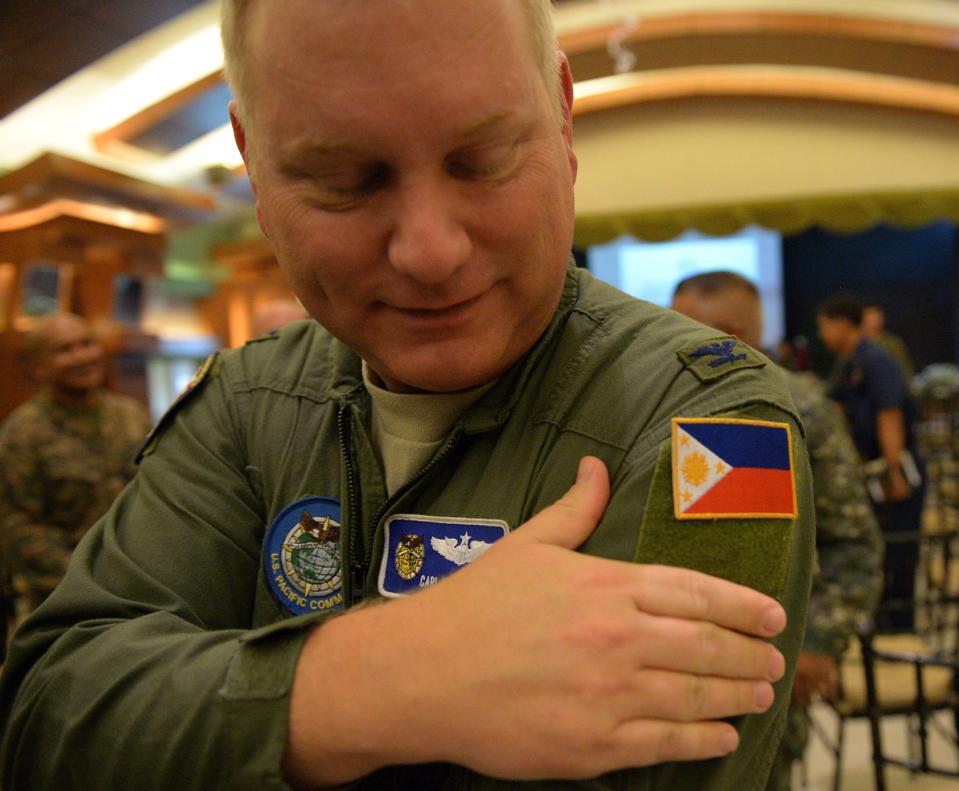
A US air force personnel looks at a Philippine flag patch he exchanged with his Philippine counterpart after the closing ceremony of the annual joint US-Philippines military exercise in Manila on May 19, 2017. The Philippines and the United States launched annual military exercises on May 8 but the longtime allies scaled them down which focuses only on counter-terrorism and disaster relief in line with President Rodrigo Duterte's pivot to China and Russia. 

But let’s consider a few options that show this threat of war for what it is: a baseless scare tactic. First, Duterte could hang tough and seek a stronger stance on the issue by the U.S., which is a Philippine ally per the Mutual Defense Treaty of 1951
In his defense, Duterte and his predecessor Benigno Aquino may already have sought such help from the U.S. and gotten turned down or dissuaded. 
That would be a stain on U.S. honor. 
But redoubling his efforts, for example reaching out to Trump and bringing the threat before the United Nations General Assembly, is constitutionally required according to Philippine Senior Associate Justice Antonio Carpio.
The U.S.-Philippine alliance failed to defend the Philippine EEZ when China occupied Mischief Reef in 1995, and Scarborough Shoal in 2012. 
That is a fact. 
Every day that China continues its occupation, the alliance fails anew.
The U.S. and Philippines together, could easily have defended these locations. 
The Philippines tried briefly at the Scarborough standoff of 2012, but U.S. ships did not join, and then the U.S. and China brokered a deal in which the Philippines backed off, and China stayed. 
Why didn’t the U.S. and Philippines return in force when they realized they had been tricked? 
It was a startling admission, one gotten when I surprised them with the question. 
But I bet it is true, even today. 
That would be militarily and economically damaging, if not catastrophic, to both countries. 
Therefore a Chinese war against the Philippines is unlikely to happen as long as the alliance with the U.S. is healthy. 
President Duterte could make this clear to the public in both nations by visiting the White House, and inviting Trump to Malacañang Palace, rather than amplify China’s scare tactics.


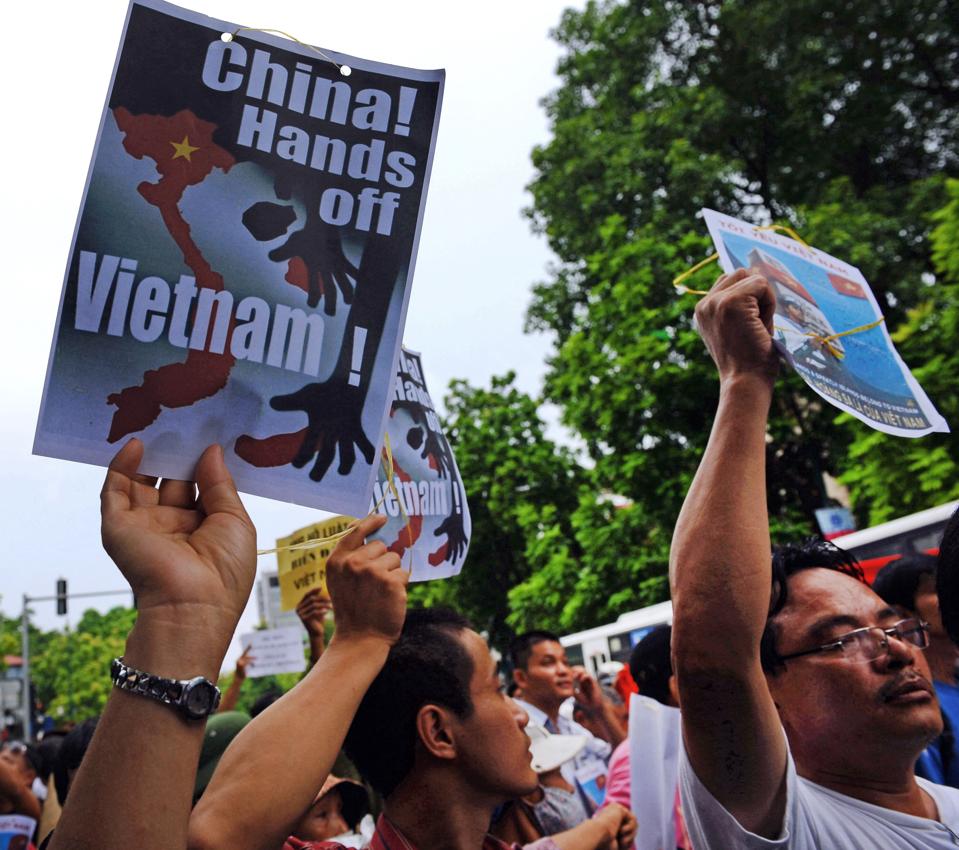
Vietnamese protesters hold up posters while shouting anti-China slogans in front of the Chinese embassy in Hanoi on July 8, 2012. Hundreds of people staged the anti-China protest, the second one in a week, after the China National Offshore Oil Corporation announced last month that nine offshore blocks were available for exploration, and said it was seeking bids from foreign companies. Vietnam contends that the blocks 'lie entirely within Vietnam's 200-mile exclusive economic zone.' 

More likely than war would be Chinese attempts to interdict Philippine commercial vessels trying to drill for oil, and offering to sell Philippine oil rights. 
China did this to Vietnam in 2012
When Vietnam tried to tow sonar in its EEZ, looking for oil and gas, a Chinese boat ran over the cables and cut them. 
Also in 2012, China National Offshore Oil Corporation (CNOOC) tried to auction blocks for oil exploration that were within Vietnam's EEZ. 
The Philippines could protect its oil exploration and drilling with its own Coast Guard, perhaps accompanied by U.S., European and Japanese Coast Guard.

mercredi 10 mai 2017

Chinese Aggressions

No freedom of navigation operations yet: Trump administration wrestles with posturing in the South China Sea
By Christopher Diamond
Since Donald Trump took over as commander in chief, the U.S. Navy has not sailed within 12 miles of China’s man-made islands in the disputed South China Sea. 
But a top U.S. Navy commander in the Pacific says that doesn’t mean Navy ships are reluctant to confront China and exercise the right to sail in international waters, reports Bloomberg.
“We just went through a change in administration,” Pacific Fleet Commander Adm.​ Scott Swift said at a Monday briefing in Singapore. 
“I am not surprised that process has continued in a dialogue as the new administration gets its feet on the ground and determines where would be appropriate to take advantage of these opportunities and where we may want to wait.”
Freedom of navigation operations have not been conducted in the South China Sea since ​Trump took office. 
FONOPS — routine under President Barack Obama — were intended to assert that waters remain open despite a growing Chinese military presence on the disputed islands. 
As the U.S. has put its presence in the disputed territory on hold, China continues to build airstrips on the islands, even launching its first domestically built aircraft carrier last month.
For months, the Navy's leadership has wanted to take a more aggressive stance and test China’s claims in the region. 
The carrier Carl Vinson and its strike group were originally being considered by the Navy for operations in the South China Sea before making news as part of the U.S. response to further nuclear weapon and long-range missile tests by North Korea.
In March, U.S. Pacific Command requested permission for a Navy warship to sail within 12 nautical miles of Scarborough Shoal, a disputed reef in the South China Sea that has been claimed by both China and the Philippines. 
But the March request, as well as two similar requests made in February, were turned down by Pentagon officials without ever making it to the White House, according to The New York Times.
“We just present the opportunities when we have a ship in the area and there is an area of interest,” said Adm.​ Swift, adding that there has been “no change in policy” regarding the territorial disputes.
The lack of action in the region has caught many off guard as it seemed clear that the Trump administration wanted a tough stance toward Beijing.
Then-candidate ​Trump criticized President Obama on the campaign trail for being weak on China in the South China Sea.
During Secretary of State Rex Tillerson’s Senate confirmation hearings, he stressed that China needs to be denied access to the islands. 
But China’s actions remain unchallenged as the White House has turned to Beijing for assistance amid growing tensions with North Korea.
An unnamed official from the U.S. Defense Department told The New York Times that they believed a request for ​naval operations within 12 nautical miles of the artificial islands was exactly the kind of thing Trump would be looking for. 
The same official went on to say Defense Secretary​ James Mattis is putting the FONOPS on hold as part of a broader review of “the American security posture around the world.”
The Spratly and Paracel island chains in the South China Sea have been at the center of territorial disputes from 1947. 
In recent years, China, Vietnam and the Philippines have claimed territory in the region, while the United States has allocated significant military resources towards upholding free navigation of the waters.
While it seems clear that the White House is looking to work with Xi Jinping on a range of geopolitical issues, it remains unclear whether the administration will respond to the ongoing territorial disputes.

mercredi 3 mai 2017

The Manchurian President

Trump’s Turn Toward China Curtails Navy Patrols in Disputed Zones
By HELENE COOPER

The Chancellorsville, a United States guided missile cruiser, in the Luzon Strait after a patrol of the South China Sea last year. 

WASHINGTON — Six weeks ago, the United States Pacific Command requested permission from senior American officials for a United States warship to sail within 12 nautical miles of Scarborough Shoal, a disputed reef in the South China Sea that is claimed by the Philippines and China.
The Navy had good reason to think the request would be granted. 
During last year’s campaign, Donald J. Trump labeled President Barack Obama as weak in defending international waters in the South China Sea, where Beijing has started a sharp military buildup to reclaim land, install runways and haul equipment onto reefs and shoals it claims as its own. 
Secretary of State Rex W. Tillerson, during his confirmation hearing in January, called for China to be denied access to the artificial islands. 
And foreign policy experts and Asia watchers braced for a return to routine Navy patrols within China’s self-proclaimed territorial waters, something Mr. Obama allowed sparingly.
But instead, the Pacific Command request — and two others by the Navy in February — was turned down by top Pentagon officials before it even made it to Trump’s desk. 
More than 100 days into the Trump presidency, no American Navy ship has gone within 12 miles of any of the disputed islands in the South China Sea, Defense Department officials said.
The decision not to challenge China’s territorial claims represents a remarkable deference toward Beijing from an administration that is increasingly turning toward Xi Jinping for help amid the crisis in the Korean Peninsula. 
It remained unclear on Tuesday whether it was Defense Secretary Jim Mattis; Gen. Joseph F. Dunford Jr., the chairman of the Joint Chiefs of Staff; or one of their deputies who turned down the three requests. 
Defense officials said the White House was not involved.
Robert Daly, the director of the Kissinger Institute on China and the United States at the Wilson Center, said of the Navy excursions, officially known as freedom of navigation operations, or Fonops: “All of the language, combined with the fact that the Republican foreign policy establishment had been critical of Obama for not carrying out enough Fonops, means there was a wide expectation that Trump would put down a marker early. And that hasn’t happened.”
The simmering crisis in North Korea seems to have changed the Trump administration’s earlier assumptions on how to handle China. 
Trump campaigned on being tough on Beijing, promising that he would label China a currency manipulator and would go after Beijing on trade.
But with North Korea escalating its provocative behavior the past three months, attempting nine missile launches on six occasions since Trump came to power, his administration has adopted a conciliatory air with Beijing as Trump seeks help to rein in Pyongyang.
With each missile launch, Trump’s newfound affection for the Chinese leader, Mr. Xi, has increased. Last week, after the most recent launch, Trump wrote on Twitter: “North Korea disrespected the wishes of China and its highly respected president when it launched, though unsuccessfully, a missile today. Bad!”
Decisions to deny the Navy’s requests to sail within 12 nautical miles of disputed islands in the South China Sea were fairly routine during the Obama administration. 
In fact, Mr. Obama came under sharp criticism from Republicans for suspending such excursions for more than two years, out of concern that they would further raise tensions with Beijing.
In October 2015, the Obama administration sent a guided missile destroyer, the Lassen, within territorial waters near Subi Reef, one of several artificial islands that China has built in the disputed Spratly Islands chain. 
At the time, Mr. Obama’s White House played down the episode and directed Defense Department officials not to talk about it publicly, wanting to avoid escalating a conflict.
Such hesitancy prompted harsh words from Trump during the presidential campaign. 
In an interview with The New York Times in March 2016, Trump said that Beijing had built in the South China Sea “a military fortress, the likes of which perhaps the world has not seen.”
“Amazing, actually,” he said. 
“They do that at will because they have no respect for our president and they have no respect for our country.”
Tillerson came to office saying that China’s island-building campaign was “akin to Russia’s taking of Crimea.” 
He said that the Trump administration was “going to have to send China a clear signal that, first, the island-building stops” and, “second, your access to those islands also is not going to be allowed.”
That denial of access is now on the back burner. 
In fact, said Mr. Daly, of the Wilson Center, China has continued to militarize the islands and has bomb-proofed airplane hangars that were built on the reclaimed islands, as well as brought in additional equipment.
Chinese officials have maintained that such action does not constitute militarizing the islands. 
They say the islands are Chinese territory and Beijing therefore cannot militarize land it already owns. 
The United States and other countries disagree.
The Chinese have not yet begun construction on Scarborough Shoal. 
American officials have long viewed doing so as something of a red line, and have cautioned Chinese counterparts that any building on the shoal would be viewed as provocative.
Mr. Obama warned Mr. Xi at a March 2016 meeting in Washington not to start building an island at Scarborough Shoal. 
Late last year, an unusually large number of Chinese vessels were positioned close to the disputed reef, renewing American concerns.
A Defense Department official described the Pacific Command request last month to conduct a naval excursion within 12 nautical miles of Scarborough Shoal as a signal to the Chinese that building on the atoll remained a red line for the United States. 
The official, who spoke on condition of anonymity to discuss sensitive operations more frankly, added that Navy officials believed the request to be in line with what the Trump administration wanted.
But Defense Department officials also said that Mattis and the Pentagon leadership wanted to look carefully at the strategic implications of such excursions on overall national security policy. 
While Mattis is far from opposed to the freedom of navigation trips, he is reviewing the American security posture around the world, Defense Department officials said.
Additionally, Washington’s hope that China will rein in North Korea has called into question the timing of the next freedom of navigation sail.

samedi 15 avril 2017

South China Sea Disputes: Duterte Has Good Advisors, In Beijing

By Panos Mourdoukoutas 

Philippines President Rodrigo Duterte continued his flip-flops in recent weeks, easing geopolitical risks in the region, and helping Philippines’ equities rebound sharply from last year’s losses.
This time around, Duterte reversed his early decision to raise the Philippine’s flag in disputed islands, following Beijing’s “friendly” advice.
“Because of our friendship with China and because we value your friendship I will not go there to raise the Philippine flag,” Duterte said in a speech before the Filipino community in Riyadh late Wednesday.
The trouble is that diplomacy isn't based on friendships, but on interests, Philippines' interests in this case.
But wait, there's more "friendly" advice from Beijing that led President Duterte to "correct" himself. “They said, do not go there in the meantime, just do not go there please. I will correct myself because we value our friendship with China,” he said, adding that he might just send his son to the island.
So far, Duterte’s flip-flops have saved peace in South China Sea by changing the rules of the game for China and the US.
Last July Philippines and its close ally, the U.S., won an international arbitration ruling that China has no historic title over the waters of the South China Sea. 
Yet Rodrigo Duterte surprised the global community and financial markets by siding with China on the dispute, and seeking a “divorce” from the U.S.
Duterte’s flip-flop left the US without a key ally to pursue its cause in South China Sea, and therefore, no choice but to soften its stance.
Meanwhile China continued its activities around the Scarborough Shoal
"So what do you want me to do? Declare war against China?" Duterte was quoted in Chinatopix as having asked reporters. 
"I can but we'll lose all our military and policemen tomorrow, and we are a destroyed nation. And we cannot assert even a single sentence of any provision that we signed."
While Duterte’s flip-flops have saved peace for now, it’s hard to see how they will save peace in the future, as his policies help make China more aggressive in the region.
That’s why investors should always keep a wary eye on the geopolitical risks in the South China Sea region markets.

vendredi 14 avril 2017

Sina Delenda Est

Take Defense Treaty Action For Philippine Sovereignty In South China Sea
By Anders Corr

On Monday, Reuters reported China Coast Guard and industrial fishing ship operations at Scarborough Shoal, the Philippines, which are arguably a violation of Philippine territorial sovereignty. 
The report said China is now allowing Philippine fishermen at the shoal, but restricting full access to the lagoon. 
The ratio of Chinese to Philippine fishing boats on Monday was about 10:1. 
China Coast Guard are typically armed, and have been shown to be armed at the shoal. 
Chinese ships at the shoal on Monday included at least two approximately 75-meter industrial fishing trawlers. 
In addition, according to Reuters, the Chinese Foreign Ministry confirmed that the China Coast Guard was at the shoal to “administer fishing and preserve the peace.” 
This is arguably a direct violation of Philippine sovereignty at what the Hague’s Permanent Court of Arbitration (PCA) found to be an “island” last year. 
The U.S.-Philippine Mutual Defense Treaty of 1951 applies to “islands”, so should be triggered by China’s continued armed occupation of Scarborough.
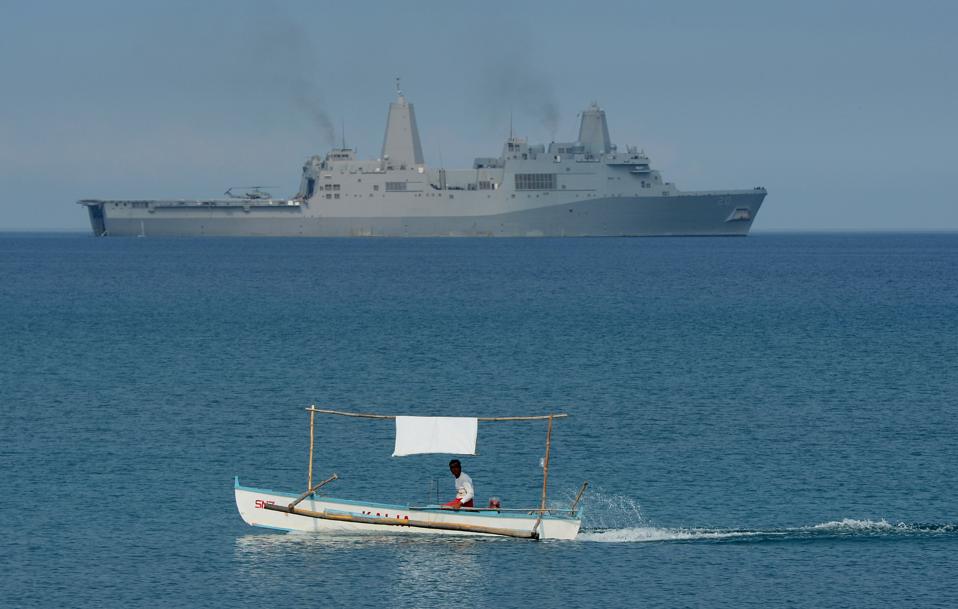
A Filipino fisherman is seen past the US Navy amphibious transport dock ship USS Green Bay.

China’s occupation is an affront to the Philippines’ sovereignty, territorial integrity , and the Constitution of 1987, according to which “The State shall pursue an independent foreign policy. In its relations with other states the paramount consideration shall be national sovereignty, territorial integrity, national interest, and the right to self-determination,” and that “The State shall protect the nation’s marine wealth in its archipelagic waters, territorial sea, and exclusive economic zone , and reserve its use and enjoyment exclusively to Filipino citizens.”
If allowed to continue, Chinese occupation of the shoal degrades the Philippine environment, sovereignty, and the likelihood that it will eventually regain control of the shoal. 
The longer China has control of the shoal, the more likely it is to build planned military facilities there, and the less likely it will return the shoal to the Philippines. 
It is critical for the natural habitat at Scarborough, and for the Philippines’ sovereignty and territorial integrity, that the Philippines, U.S., and allies immediately increase pressure on China, through economic sanctions and activation of the defense treaty if necessary, to vacate the shoal and return it to Philippine administration.
China is in the process of large scale environmental destruction at Scarborough Shoal and other parts of the South China Sea (SCS), including through widespread destruction of endangered coral and harvesting of endangered species such as giant clams and sea turtles. 
China has been turning barely-submerged shoals in the South China Sea into militarized artificial islands, replete with military runways and docks large enough for aircraft carriers and nuclear missile submarines. 
Analysts think China may eventually create underwater submarine bastions or harbors in the South China Sea, including at Mischief Reef and Scarborough. 
A Chinese military source and maritime experts said last year that China plans to turn Scarborough into a military base.
This picture taken on April 23, 2016 shows a member of the Indonesian navy standing before the Chinese trawler ‘Hua Li-8′.

I visited Scarborough Shoal in June 2016, Philippines Independence Day, on a “Freedom Voyage” organized by the Kalayaan Atin Ito activist group. 
Two 2,580-ton China Coast Guard cutters with light cannon, and another medium-sized China Coast Guard boat, made numerous dangerous passes, charges, chases, and blocking maneuvers of our 30-meter wooden fishing boat. 
In one case, the medium-sized China Coast Guard boat charged us to about 4 meters, then began rocking in a way that made our boat pitch violently up and down. 
Once we made it past the larger Coast Guard boats to the shoal, Filipino activist swimmers carrying Philippine and U.N. flags swam towards the shoal, and could have been killed on multiple occasions as two China Coast Guard speed boats circled them aggressively and backed their spraying propellers towards the swimmers within about 3 feet of slicing into their flesh.
Over the course of about an hour, five very brave swimmers were undeterred, and as swimmer and leader of the expedition Joy Ban-eg diverted two China Coast Guard speed boats, from which she was forced to push off on multiple occasions, swimmer Mariel Ipan made it past the Chinese to raise a small Philippine flag on the shoal that day. 
I was there and I saw it happen. 
The next day, Ms. Ipan wrote on Facebook, “My near death experience at Scarborough Shoal; Could’ve been the Sweetest Death.”
Kalayaan Atin Ito’s 2016 protest of China’s occupation of Scarborough was not official, but it had a maximum of heart and patriotism. 
It was one way in which the Philippine people continued to demonstrate non-acquiescence to China’s claim and aggressions, and to show the Philippine government that they demand continued assertive measures to maintain Philippine sovereignty, an independent foreign policy, and the territorial integrity of the Philippines. 
Official non-acquiescence is critical to the maintenance of the Philippines’ claims to sovereignty over Scarborough, and the rest of the Philippines’ territory and exclusive economic zone (EEZ) within China’s nine-dash line.
A Chinese protester throws eggs at photos of US President Barack Obama and torn copies of the ruling by the Permanent Court of Arbitration in The Hague against Beijing’s extensive claims in the South China Sea, outside Hong Kong’s United States Consulate on July 14, 2016. About 50 pro-China activists marched to Hong Kong’s United States Consulate holding placards that read ‘Ruling is a piece of paper’, ‘US sowing discord and stirring up trouble’, as they shouted slogans such as ‘No Compromise on South China Sea’ and ‘Shameless US’. The protesters also threw eggs on pieces of paper placed on the ground — featuring the picture of US President Barack Obama — outside the consulate. 

According to the Permanent Court of Arbitration (PCA) Award in the Philippines v. China case, “In practice, to establish the exclusive historic right to living and non-living resources within the ‘nine-dash line’, which China now appears to claim, it would be necessary to show that China had historically sought to prohibit or restrict the exploitation of such resources by the nationals of other States and that those States had acquiesced in such restrictions.” 
International lawyers will argue that China’s actions over the last 20 years, now that the dispute has started, will not adversely affect the Philippine sovereignty claim. 
But China is progressively destroying the shoal, and to be on the safe side of the sovereignty issue, and increase political as well as legal pressure, I think it critical to physically demonstrate regular official as well as popular non-acquiescence to China’s claim. 
It is a political as well as legal issue, so the duty to defend the sovereign territorial rights of the Philippine nation requires frequent public demonstration. 
The shoal is a high-tide feature according to the PCA’s 2016 interpretation of the United Nations Convention on the Law of the Sea (UNCLOS). 
Scarborough is therefore vulnerable to being claimed as territory by China, along with a 12 nautical mile (nm) territorial sea and rights to build or fish there as China would were it sovereign territory. 
“Whichever state has title to Scarborough shoal is entitled to a 12 nm territorial sea,” according to James Kraska, Professor of Law at the Stockton Center for the Study of International Law at the U.S. Naval War College.
For hundreds of years, Philippine sovereignty and traditional fishing methods at Scarborough Shoal protected it from overfishing. 
The first historical depiction of Scarborough Shoal was on a 1734 map of the Philippines drawn in Manila during the Spanish colonial era. 
In 1953, the Philippines Bureau of Fisheries published a book that discussed Scarborough Shoal as historically one of the “principal fishing areas” of Filipino fishermen. 
In 1965, the Philippine Navy erected an iron tower on the site. 
The Philippines presented affidavits of fishermen to the PCA that showed indirect evidence of Philippine fishing at Scarborough as early as 1972, and direct evidence of fishing since 1982.
Filipino fishermen on a small fishing boat on July 10, 2016 in Mariveles, Bataan, Philippines. Filipino fishermen regularly set sail into the South China Sea while claiming rights to the disputed waters between China and the Philippines. Tony Fernandez, a fisherman who has frequented the South China Sea for nearly 30 years says, ‘we’ve been fishing in these waters within our territories for decades, we know what is ours and not.’

China’s claims to Scarborough are much later, and do not include detailed evidence of fishing. 
They stem from an official 1948 map titled “Map Showing the Location of the Various Islands in the South Sea” of an 11-dash line that surrounds the entire South China Sea, including a depiction of Scarborough. 
In 1997, China erected a flag on the shoal, which was taken down by Filipino fishermen who erected their own flag. 
In 1998 and 1999, the Philippines arrested dozens of Chinese fishermen on multiple occasions after gathering endangered corals and sea turtles. 
They were in possession of blast fishing equipment, like dynamite and detonation cords. 
Between 2000 and 2001, the Philippine Navy attempted to scare off Chinese fishermen from Scarborough, including with live fire, but did not arrest them. 
After the Declaration on the Conduct of Parties in the South China Sea (DOC) was signed in 2002, disputes at Scarborough decreased.
Since 2009, China turbo-charged its sovereignty claims to the entire South China Sea, including Scarborough Shoal, by sending a map of a new 9-dash line (minus two dashes in the Gulf of Tonkin removed in 1953) in an official communication to the United Nations and more aggressively “policing” the area with its coast guard and armed fishing boats called a “maritime militia”.
In 2012, the Philippines Coast Guard once again responded to reports of Chinese destructive fishing methods at Scarborough, including fishing of endangered coral, sea turtles, and live sharks. 
But this time something changed. 
China placed two maritime surveillance ships between the Philippine Coast Guard and Chinese fishermen, then strung 28 utility boats together to block Philippine fishermen and Coast Guard from entering the shoal.
Chinese fishermen unload the last of their catch for the season as fishing boats arrive back in Qionghai, south China’s Hainan province on May 16, 2012.

U.S. Assistant Secretary of State Kurt Campbell brokered a deal whereby the Philippine Coast Guard and fishermen left the shoal to end the standoff. 
China said they would leave but reneged. 
China stayed in the vicinity of the shoal, and continued blocking Filipinos from fishing there, including with water cannon
The Philippine Navy and Coast Guard did not return. 
This affirmed a Chinese strategy of incrementalist salami-slicing tactics by which China could gain territory without ever fighting. 
Chinese analysts called it the “Scarborough Model.”
Due to a Chinese promise of $24 billion in funding and investment commitments to the Philippines, and President Rodrigo Duterte’s thawing of relations, China allowed some Filipino fishermen to return this year. 
But according to this week’s Reuters reports, very small numbers of Philippine fishermen have been allowed to return, and they can only take small boats into the interior lagoon of the shoal. 
The Chinese Foreign Ministry confirmed Tuesday that China Coast Guard at Scarborough Shoal are there administering fishing activities of Filipino fishermen.
China’s administration of Scarborough Shoal is in direct violation of Philippine sovereignty of the feature. 
“The Philippines has sovereignty over Scarborough Shoal,” said Kraska in an email. 
“Territorial title to the feature inured to the Philippines through extensive Spanish possession. Philippine title to Scarborough Shoal was recognized by the United States, which used the feature as a bombing range for US forces based in the Philippines.” 
Environmental destruction by Chinese industrial fishing at Scarborough Shoal is the product of a lack of enforced Philippine sovereignty. 
“This is a common problem in the law of the sea and international law more generally – it is a collective action problem in that all states would benefit from a solution that restrains China, but no state wants to bear the cost of trying to achieve that goal,” said Kraska.
Philippine protesters wearing cut-out turtle shells hold placards during an anti-China protest in front of the Chinese consulate in the financial district of Manila on May 16, 2014. Several hundred Filipino and Vietnamese protesters united in a march in the Philippine capital, demanding that China stop oil drilling in disputed South China Sea waters. 

Lack of enforcement of Philippine sovereignty at Scarborough is now a tragedy for an astonishing range of issues. 
In addition to obvious negative effects on the environment, Philippine fishing families, and the sovereign territorial integrity of the Philippines and its EEZ, it is a tragedy for three policy areas that make this personal.
First, lack of stronger U.S. action at Scarborough has weakened the U.S.-Philippine alliance by making the U.S. commitment to the Philippines appear less credible. 
Second, the ability of China to increasingly occupy the South China Sea without being held accountable, including at Scarborough Shoal since 2012, has strengthened and emboldened it generally. 
Given that China is the world’s most powerful authoritarian regime, its increasing lack of international legal accountability is a threat to democracy in not only Asia, but beyond. 
If China continues to increase its authoritarian reach, that could eventually affect not only the Philippines, but the children and grandchildren of Americans. 
Some would say it already has. 
Third, the fact that the Philippines has no independent legal recourse to address the sovereignty issues of China’s occupation of Scarborough Shoal demonstrates the general weakness of international law, and its lack of enforcement. 
A stronger international legal regime would allow the Philippines to take China to the International Court of Justice (ICJ) on a sovereignty dispute, even without China’s consent. 
That is not currently possible, which is a weakness of international law on sovereignty issues that nation states should rectify. 
That weakness means that sovereignty issues, if one party is not amenable to peaceful arbitration, must be resolved through force or the threat of force, such as economic sanctions or naval blockades. That increases international instability, and is an increasingly dangerous anarchic international situation as military technologies, including nuclear weapons, proliferate and become more powerful.
Scarborough Shoal is therefore much more important internationally than its strict legal designation of a “rock” would imply. 
What happens, or is prevented from happening, at Scarborough will augur more of the same. 
The critical issue at Scarborough is disputed sovereignty, which the PCA Award last year did not and could not address. 
According to the Award, “The [UNCLOS] Convention [] does not address the sovereignty of States over land territory. Accordingly, this Tribunal has not been asked to, and does not purport to, make any ruling as to which State enjoys sovereignty over any land territory in the South China Sea, in particular with respect to the disputes concerning sovereignty over the Spratly Islands or Scarborough Shoal. None of the Tribunal’s decisions in this Award are dependent on a finding of sovereignty, nor should anything in this Award be understood to imply a view with respect to questions of land sovereignty.”
The International Court of Justice.

Conversely, the ICJ is capable of arbitrating sovereignty disputes, and so could resolve the sovereignty issue at Scarborough Shoal. 
“I firmly believe that in this day and age responsible states should take their sovereignty disputes to the International Court of Justice,” said Peter Dutton, Professor of Strategic Studies and Director of the China Maritime Studies Institute at the U.S. Naval War College.
But the ICJ can only arbitrate sovereignty disputes where both parties agree to submit the case. 
“All options (like the ICJ) would require Chinese agreement,” said Greg Poling of the Center for Strategic and International and Studies. 
“There is no such thing as compulsory dispute resolution for a sovereignty dispute.”
Because China is using its increasing military and economic advantages to gain territory in the South China Sea, East China Sea, and Himalayas, it is unlikely to set a precedent against itself by voluntarily agreeing to cede territory or go to the ICJ where those military and economic advantages have little to no effect. 
“I don’t see much chance of anything bringing China around to ceding sovereignty or going to arbitration (which on Scarborough it would likely lose), at least not in any reasonable time frame,” said Poling in an email.
Some analysts, perhaps representing the mainstream of opinion in the U.S. given its inaction on Philippine sovereignty within its EEZ, think the U.S. should not take sides in sovereignty disputes between China and the Philippines. 
“If either China or [t]he Philippines refuses to do so [arbitrate the Scarborough sovereignty disputes at the ICJ], the role of the international community is to support stability until such time as the parties can agree on how to resolve their dispute,” Dutton said by email. 
“In my view it is not the role of the United States to champion the Philippine claim. Our role is to help maintain overall regional stability, not to provoke conflict by choosing a side.” 
But there is no “stability” at Scarborough Shoal, and the theory of balancing in international relations tells us that not taking the side of the weaker party invites conflict. 
Over 20 years, China has gradually removed most Filipino fishermen, destroyed the environmental habitat, and a Chinese military source and military experts have talked of plans to start building a military facility.
Based on U.S. national interests alone, the U.S. and other allies should jointly pressure China into returning Scarborough to the status quo as it was in the mid-1990s. 
Where some dispute exists on the nature of that status quo, we should use all means at our disposal, including economic sanctions and a robust naval presence at Scarborough, to pressure China into accepting arbitration by the ICJ. 
Not doing so increases uncertainty about U.S. intentions in Asia, and thereby increases instability and the likelihood of war. 
By not taking a stronger stand on Scarborough, Second Thomas Shoal, and Mischief Reef, for example, the U.S. actually fails to stop instability by allowing China to think that it can get away with occupying the entire South China Sea as its sovereign territory.
China’s continued incremental acquisitions of the South China Sea, to the extent allowed at places like Scarborough Shoal, will harm the national security of the U.S. by making China stronger and bolder. 
Scarborough Shoal is just 250 km from Subic Bay, one of the most important naval bases in Asia, and one the U.S. historically utilized. 
We could utilize it to a greater extent if we improved relations with the Philippines. 
China’s building of a military base at Scarborough Shoal would make the value of Subic Bay as a naval base much less defensible. 
This decreases the opportunities and relative power of the U.S., and increases those of China.
The U.S. has already taken sides. 
In 1951 we signed the Mutual Defense Treaty, which requires the U.S. to defend the Philippines. According to Article IV of the treaty, “Each Party recognizes that an armed attack in the Pacific Area on either of the Parties would be dangerous to its own peace and safety and declares that it would act to meet the common dangers in accordance with its constitutional processes.”
China Coast Guard is armed at Scarborough Shoal. 
According to the affidavit of Jowe Legaspi, who fished at Scarborough since 1994, “In May or June 2014, they [the Chinese] harassed Filipino fishermen through water cannon, sound blare, and there were times that they have a gun when they came near us.” 
I personally saw light cannon mounted on the two China Coast Guard cutters that harassed the Kalayaan Atin Ito activists at Scarborough last June.
This picture taken on May 13, 2014 from a Vietnamese coast guard ship shows two Chinese coast guard vessels sailling near the area of China’s oil drilling rig in disputed waters in the South China Sea. Vietnam experienced its worst anti-China unrest in decades following Beijing’s deployment of an oil rig to disputed waters, with at least one Chinese worker killed and more than 100 injured. 

These armed Chinese acts, combined with Chinese occupation of the sovereign territory of the Philippines, arguably combine to constitute an “armed attack”. 
The treaty further says, “For the purpose of Article IV, an armed attack on either of the Parties is deemed to include an armed attack on the metropolitan territory of either of the Parties, or on the island territories under its jurisdiction in the Pacific or on its armed forces, public vessels or aircraft in the Pacific.” 
Last year, the PCA found Scarborough Shoal to be a “rock”, which is a legal subcategory of an “island” according to UNCLOS. 
So the 1951 Mutual Defense Treaty appears to apply to Scarborough.
Any attempt to further split legal hairs on the wording of the treaty and its relevance to Scarborough would not reflect well on American defense commitments. 
The appearance of avoiding or reneging on a U.S. treaty commitment to protect Philippine territory in the South China Sea, including Scarborough Shoal, could make the U.S. look weak as an ally, not only to Filipinos, but to the world. 
Ukraine already blames the U.S., rightly or wrongly, for not sufficiently fulfilling security guarantees in the Budapest Agreement of 1994, when Russia invaded Crimea. 
Adding a failure to protect the Philippines from China could further tarnish our reputation. 
The longer that China is allowed to administer Scarborough Shoal with the China Coast Guard, the more China, and international lawyers, will start to see it as China’s de facto sovereign territory. 
And, possession is 9/10 of the law.
Some international lawyers already think China has the right to act as a sovereign at Scarborough. 
“I think China is acting as sovereign — as it has a right to do — when it fishes in and around Scarborough Shoal,” said Dutton. 
“I agree it is not engaging in artisanal fishing when it uses industrial sized vessels. But a sovereign has an unfettered right to choose how to fish in its own territorial sea and internal waters. The [PCA] arbitral opinion merely acknowledged that China and the Philippines (and others) have artisanal fishing rights at Scarborough without limiting other rights that might pertain to the sovereign. So I do not conclude China is acting unlawfully.” 
Dutton’s assumption that China has a right to act as a sovereign at Scarborough Shoal is a stretch, and likely rejected by other international law scholars. 
The Philippines has also alleged that China’s destruction of coral at Scarborough Shoal violates several international conventions to which China is a signatory, including the RAMSAR Convention (1971), the Convention on International Trade in Endangered Species of Wild Fauna and Flora (1975), and the Convention on Biological Diversity (1993).
While some lawyers may be able to justify China’s industrial fishing at Scarborough based on a hypothetical sovereignty, combined with one interpretation of international law, China’s destruction of the environment in what most people think is the EEZ of another country is a dangerous precedent, and flies in the face of common sense values.
Those common sense values that indicate the Philippines should have sovereignty over Scarborough Shoal start with Scarborough being much closer to the Philippines than to China. 
Just look at a map. 
Any reasonable person would say that China should not be “administering” Filipino fishermen at their own shoal. 
Second, Scarborough is within the Philippine EEZ. 
Scarborough at high tide is a small collection of rocks, the largest of which is not much bigger than a car. 
This should not give China the right to claim it as territory, along with a 12 nm radius of territorial sea. 
Third, when the Philippines administered Scarborough up to 2012, the shoal was for the most part sustainably fished by Filipino fishermen. 
Now it is being destroyed by China, which has acted aggressively against Filipino fishermen. 
China is likely seeking to build a military base at the shoal that will increase regional instability. 
Fourth, the Philippine maps of Scarborough predate by centuries the Chinese maps that purportedly claim the shoal, and Philippine fishing at Scarborough predates China’s territorial claim. 
Fifth, China likely refuses to arbitrate the sovereignty dispute at the ICJ, which would place China and its actions squarely outside the international rule of law.
Activists dressed as clowns and holding water pistols spray a map illustrating China’s claim to the South China Sea during a protest in front of the Chinese consular office in the financial district of Manila on March 3, 2014. Activists protested against Chinese ships firing a water cannon at Philippine fishermen. 

Scarborough Shoal is 864 km from the Chinese coast, and only 223 km from the Philippines. 
It is within the Philippines’ EEZ, which according to the basic UNCLOS rule, extends 200 nm (370km) from its coastline. 
The Philippines has for a long time used the shoal as a primary location for fishing. 
Only in very recent history has China increased its claims and activities at the shoal. 
China refused to participate in the PCA arbitration, but in its absence the arbitral panel made an effort to collect evidence that supported China’s case. 
In the award, the PCA referenced China’s embassy in Manila, which chose June 12, 2012, Philippine Independence Day, to publish historical evidence for its claim to Scarborough.
“Scarborough Shoal and its surrounding waters have been China’s traditional fishing grounds since ancient times. Chinese fishermen have engaged in fishery activities for generations. In addition, they have used Scarborough Shoal as a safe have[n] in their voyage in the South China Sea. Genglubu, an ancient Chinese navigation log recording trips in the South China Sea, and other ancient documents and literature contain complete records of Chinese fishermen’s activities around Scarborough Shoal. Since the Yuan Dynasty, the Chinese people have never stopped developing and exploiting Scarborough Shoal and its surrounding waters and the Chinese government has exercised effective management and jurisdiction over their activities all these years. These historical facts are supported by official documents, local chronicles and official maps in the past centuries.”
These Chinese claims of evidence have no specific references or quotes, which puts into question the extent to which they actually show Chinese fishermen’s utilization of Scarborough Shoal. 
In contrast, the Philippines presented a detailed case of its traditional fishing at Scarborough Shoal, which I presented above.
The family-owned Philippine fishing boats that have historically plied the waters of Scarborough Shoal are typically much smaller, for example about 30 meters, when compared to the 75-meter Chinese industrial fishing trawlers documented by Reuters at Scarborough on Monday. 
Some of the Philippine boats at Scarborough are “barely more than rafts,” according to the article. These artisanal fishermen come from family fishing communities in nearby Philippine towns such as Masinloc, Palauig, and Iba. 
Their artisanal spear, line and small-net fishing will not be protected if China is allowed to administer the shoal, and facilitate industrial fishing that progressively denudes the shoal’s fish, coral, giant clams, and sea turtles, many of which are endangered.
The ecosystem at Scarborough is already critically damaged, but continued Chinese industrial fishing at the location will sever a critical link in migratory fish movements around the South China Sea. “Chinese overfishing and, even more damaging, it’s previous reef destruction to poach giant clams, has done horrendous damage to the marine ecosystem at Scarborough,” said Poling. 
“Filipino fishermen report significantly reduced catches, and there’s no telling how bad things will get. It’s entirely possible that so much damage has been done to reef ecosystems in Scarborough and the Spratlys that we’ll soon see a collapse of migratory fish stocks throughout the South China Sea.”
Giant clams flourish on the sea bed off Bolinao in Lingayen Gulf, northwest of Manila on October 18, 2008. Highly prized for its meat and decorative shell the giant clam, scientific name: Tridacna gigas had virtually disappeared from the Philippines fished out by local and foreign fishermen. Marine biologists from the Marine Science Institute of the University of the Philippines launch in 1985 an ambitious programme to breed and restock the waters in this south east Asian archipelago of 7,000 islands. Giant clams form an integral part of a coral reef’s ecosystem. A large clam can weigh up to 230 kilos.

Based on the common sense values above, the Philippines and its allies are arguably not only justified, but legally obligated, to actively defend Philippine sovereignty, territory and the environment at Scarborough. 
To do so, the Philippines should continuously object to China’s occupation. 
“The best Manila can do is continuously object and refuse to recognize Chinese sovereignty, in order to maintain a clear legal record of its objections,” said Poling. 
“The Philippines has effectively used law to chasten China, and should continue to do so,” said Kraska. 
“It might, for example, encourage Vietnam to file a similar suit. Also, the Philippines should try to obtain multilateral lateral agreement on the SCS with the other claimants to further isolate China and attract greater international support.”
These are important legal measures to take. 
But China has shown its disregard for international law by refusing to participate in, or accept the findings of, the Philippines v. China case at the PCA. 
Therefore stronger measures are required. 
Economic sanctions against China and joint U.S.-Philippine Coast Guard and Navy patrols at Scarborough should be utilized to enforce China’s agreement to arbitrate the sovereignty issue at the ICJ, and in the interim block Chinese activities at the shoal, including industrial fishing, pretensions of providing governance through coast guard operations, and military base construction. 
The same tactics should be employed to protect the sovereignty and territorial integrity of the Philippines in the rest of its EEZ, for example at Mischief Reef and Second Thomas Shoal. 
To decrease the likelihood of joint U.S.-Philippine enforcement erupting into conflict with China, take a leaf from the Chinese strategy book: implement enforcement gradually.
If the Philippine and U.S. governments do not take more assertive measures to oppose China’s occupation of Scarborough Shoal, and reaffirm and enforce Philippine sovereignty, they are not sufficiently doing their jobs and are possibly breaking the law. 
In this case the Philippine and American people, and their respective congressional representatives, would be well-advised to encourage stronger executive action through legal activism and new legislation that mandates the enforcement of Philippine sovereignty over its territory.
A protester holds a sign saying ‘Benham Rise is Philippine territory!’ in front of the Chinese Consulate to protest Duterte’s perceived closeness to China and China’s continuing ‘militarization’ of the disputed islands in the South China Sea, on March 24, 2017 in the financial district of Makati, Philippines. The protesters accused President Rodrigo Duterte of siding with China instead of the Filipino people and are protesting against alleged plans to build military structures on Scarborough Shoal as well as months of alleged incursions of Chinese research vessels in the Benham Rise, east of the country.