By RICHARD BERNSTEIN
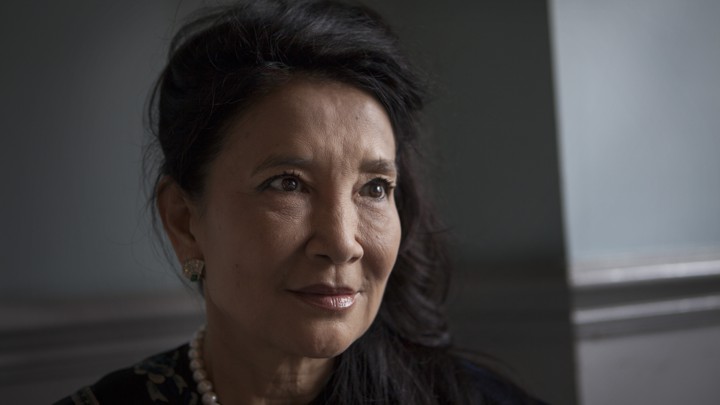 Jung Chang at the Times Cheltenham literary festival.
If you grew up in China in the 1950s and ’60s, as Jung Chang did, the last thing you aspired to be was a writer.
“Writing was the most dangerous profession,” she told me recently.
In fact, writing was taken so seriously that most of the violent purges engineered by the Chinese Communist Party’s demigod leader, Mao Zedong—including the Cultural Revolution—began with an attack on some article or play or piece of literary criticism on the grounds of its alleged bourgeois or anti-Mao characteristics.
In fact, writing was taken so seriously that most of the violent purges engineered by the Chinese Communist Party’s demigod leader, Mao Zedong—including the Cultural Revolution—began with an attack on some article or play or piece of literary criticism on the grounds of its alleged bourgeois or anti-Mao characteristics.
There would be an opening salvo written by a Maoist acolyte, after which everybody who was anybody in China would line up in an Orwellian exercise of ritual denunciation of the isolated and defenseless writer.
From there, the campaign would expand to claim hundreds of thousands of victims.
“No parents would tell their child, ‘Become a writer,’” Chang said.
Of course, Chang did become a writer, leaving China to study in Britain in 1978, and over time a celebrated chronicler of the modern Chinese experience in the English language, one of the first from China itself to overturn some of the romantic-revolutionary conceptions of Mao and his era that had a remarkably long life in the West.
Of course, Chang did become a writer, leaving China to study in Britain in 1978, and over time a celebrated chronicler of the modern Chinese experience in the English language, one of the first from China itself to overturn some of the romantic-revolutionary conceptions of Mao and his era that had a remarkably long life in the West.
Her first book, Wild Swans: Three Daughters of China—a memoir of her grandmother, her mother, and herself living through China’s tragically turbulent 20th century—sold 10 million copies and was probably the most widely read personal account ever to come directly out of the belly of the Chinese beast.
She followed that up 12 years later with a contentious, blistering, 800-page treatment of Mao himself, co-written with her husband, the historian Jon Halliday; then came an eye-opening revisionist biography of the Empress Dowager Cixi, a sinister villain in the eyes of most previous historians, a progressive feminist hero to Chang.
Her role as a writer who explained China to the West has dissipated somewhat—as China has grown in importance and as news coverage of the country and its impact on the world has increased.
Her role as a writer who explained China to the West has dissipated somewhat—as China has grown in importance and as news coverage of the country and its impact on the world has increased.
There are also now an array of writers from China, many of them living in the West, who have created a specifically Chinese voice that is accessible to foreigners in English (as well as a litany of other languages), with much of their best work, be it novels, memoirs, or journalism, banned in their motherland.
In a way, these writers have picked up where Wild Swans left off, providing an ongoing dissenting portrait of China in the years since the events that Chang wrote about.
In addition, a younger cadre of Western historians who study China deeply has emerged, demolishing whatever remains of Maoist apologetics.
Yet one thing is unchanged from Chang’s younger years: Writing about China remains a dangerous occupation—dangerous of course to China’s citizens, but now even to foreigners who challenge the official doctrine.
Yet one thing is unchanged from Chang’s younger years: Writing about China remains a dangerous occupation—dangerous of course to China’s citizens, but now even to foreigners who challenge the official doctrine.
Witness the storm of protest from China, the threats and the economic penalties imposed on the National Basketball Association over a single tweet by Daryl Morey, the general manager of the Houston Rockets, who briefly wrote of (and hastily deleted) his support for pro-democracy demonstrations in Hong Kong.
China’s ruling authority has a very thin skin.
Inside the country, the danger of writing leads to pervasive self-censorship, and more and more that appears to apply to those outside the country, too.
Of course, even at the time when Wild Swans appeared, Chang was not alone in opening Western eyes to the full horror of the Maoist era.
Of course, even at the time when Wild Swans appeared, Chang was not alone in opening Western eyes to the full horror of the Maoist era.
When we spoke, she was quick to give credit to Nien Cheng’s Life and Death in Shanghai, an unforgettable account of survival in the Cultural Revolution, as an earlier example of such works. Subsequently there have been other books—Wu Ningkun’s A Single Tear and the physicist Fang Lizhi’s The Most Wanted Man in China among the most affecting of them.
But while she hasn’t had the field to herself for a long time, Chang occupies a special position, not only because Wild Swans, with its historical, multigenerational sweep and its sheer narrative power, is a true masterpiece, but also because she has moved on from memoirist to what might be called a polemical historian.
Chang could have followed what some might have expected to be her natural trajectory—becoming a kind of Chinese Aleksandr Solzhenitsyn, a public critic of China’s cruelly authoritarian, one-party system.
Chang could have followed what some might have expected to be her natural trajectory—becoming a kind of Chinese Aleksandr Solzhenitsyn, a public critic of China’s cruelly authoritarian, one-party system.
Her more recent works, including Big Sister, Little Sister, Red Sister, out October 29, instead take a different approach.
“I like the distance that only history provides,” she said.
“I like the distance that only history provides,” she said.
“History is no less devastating.”
She meant devastating in the effect that an honest attempt at recounting the past can have on the sanctioned Chinese version of the past.
In China, that is the heroic chronicle according to which the Communist Party rescued the country from the scourges of imperialism, poverty, and oppression.
A few years ago, in a proclamation known as “Document Number Nine,” the party’s central committee warned against what it said were wrong ideological tendencies, among them “historical nihilism,” meaning history that undermines the official account of the past.
“History is one of the biggest taboos in China today,” Chang told me.
“It’s not some harmless, apolitical thing.”
In this sense, Chang is one of the world’s leading historical nihilists.
Big Sister, Little Sister, Red Sister is a collective biography of three women of China’s 20th century, the Soong sisters—famous for marrying powerful men, notorious for their extravagance and corruptibility, and for the ways they used their proximity to power.
Big Sister, Little Sister, Red Sister is a collective biography of three women of China’s 20th century, the Soong sisters—famous for marrying powerful men, notorious for their extravagance and corruptibility, and for the ways they used their proximity to power.
Soong Qingling (Red Sister) married Sun Yat-sen, the leader of the 1911 revolution that overthrew China’s last dynasty; Soong Meiling (Little Sister) was the wife of the Nationalist head Chiang Kai-shek, who led China for 20 years until he was overthrown by the Communists; and Soong Ailing (Big Sister) was married to H. H. Kung, Chiang’s corrupt minister of finance.
Chang makes the case that the trio, in their different, conflicting ways, were both close observers of and participants in the deadly, knife-in-the-back struggle for power between Chiang’s Nationalists and the Communists that in one guise or another dominated China for a quarter century.
Like Wild Swans, the book intertwines the intimate with the big historical picture, tying their personal stories to the deep and irreconcilable political divisions among them.
Like Wild Swans, the book intertwines the intimate with the big historical picture, tying their personal stories to the deep and irreconcilable political divisions among them.
Meiling, for example, had an early, visceral dislike of the Communists, while Qingling loathed Chiang, her brother-in-law, which was one of the things that made her a faithful servant of Mao and the Communists most of her life.
At the end of 1947, not long before the Nationalists would have to flee to what is now Taiwan, it had become clear to both Chiang and Meiling that the Communists were winning the Chinese civil war. Meiling, on a mission from her husband, invited Qingling on an outing to ask her what the Communists’ conditions were for ending the conflict.
Qingling replied with “the same old make-believe,” Chang writes, “that she had nothing to do with the Communists” and didn’t know their conditions.
Then Qingling “left her sister and boarded the next train to Shanghai, where she immediately informed the CCP of the conversation between her and Little Sister,” not wanting the party to suspect her of double-dealing.
The new book fits into the period between Cixi and Mao, and seeks to understand how China went from the promising days after the fall of the last dynasty to the Maoist wreckage.
The new book fits into the period between Cixi and Mao, and seeks to understand how China went from the promising days after the fall of the last dynasty to the Maoist wreckage.
And while it is probably Chang’s least edgy, least contentious work, it is still stamped by her revisionist impulse.
Cixi was the most powerful person in China for most of the second half of the 19th century and has been regarded by most historians as a usurping, reactionary tyrant, but Chang portrayed her as a pioneering reformer, “the modernizer who brought China out of the medieval world,” as she put it to me.
Cixi was the most powerful person in China for most of the second half of the 19th century and has been regarded by most historians as a usurping, reactionary tyrant, but Chang portrayed her as a pioneering reformer, “the modernizer who brought China out of the medieval world,” as she put it to me.
Contrary to the conventional wisdom, Chang argued that it was Cixi who had fostered the freedom that China experienced in the couple of decades after the overthrow of the Manchu dynasty.
“She was the first to ban foot binding, which had tormented my grandmother and Chinese women for a thousand years,” Chang said.
“In school in China we learned that it was the Communist Party that did that.”
Her and Halliday’s biography of Mao was criticized by some historians for always putting forth the worst possible interpretation of things.
Still, informed by some 200 interviews with people who knew Mao, the book made a powerful case for the authors’ withering judgment of a man still admired in parts of the world as a revolutionary genius.
In Chang and Halliday’s view, Mao belonged with Hitler and Stalin as one of the most destructive and hateful figures of 20th-century history.
Big Sister, Little Sister, Red Sister keeps in that revisionist tradition.
Big Sister, Little Sister, Red Sister keeps in that revisionist tradition.
Chang debunks Sun’s reputation as one of China’s great founding figures, for example, finding him to be not just mediocre and self-serving but at least partially responsible for bringing an end to the democratic experiment that marked the first couple of decades following the overthrow of the Manchus.
She also blames him for inviting to China the Soviet advisers who brought Leninism to the country.
In a significant recasting of conventional views on this topic, she also argues that it was Sun’s, and subsequently Chiang’s, war against the republican government in Beijing—presented by most historians as a liberation of the country from warlord control—that doomed the chance of a Chinese liberal democracy.
Chang is translating the book into Chinese for publication in Hong Kong and Taiwan, but almost surely not mainland China.
Chang is translating the book into Chinese for publication in Hong Kong and Taiwan, but almost surely not mainland China.
It contains too much truth about Mao and the Communists to get past the censors.
And here we see again the threat, in Beijing’s view, of writing: Not only are Chang’s and others’ published work not available to Chinese readers, but that work has led many of them to be exiled from the country.
After her biography of Mao came out, Chang was banned from China.
Only through the intervention of the British government did Chinese authorities relent slightly, allowing her to visit the country to see her 88-year-old mother, but just for two weeks at a time and under strict conditions.
“When I’m there, I’m in a cocoon,” she told me of her trips to China.
“When I’m there, I’m in a cocoon,” she told me of her trips to China.
“I can have no contact beyond my immediate family.”
She spoke of her dread that even this “privilege” will one day be revoked, of the anxiety she experienced living apart from her mother, of the sadness she felt for being treated as what she called a “nonperson” in her home country.
“But,” she said, “I realize this is the price I pay for writing honestly.”

 The Hall of Dispelling Clouds at Empress Cixi’s Summer Palace in Beijing. It was renovated in 1895 for her 60th birthday extravaganza.
 Empress Cixi, center, at the Wenchang Gallery of the Summer Palace. She was the last adult ruler of China’s imperial dynasty.
 Chinese children have been taught that Empress Cixi stole money from the imperial navy to renovate the “marble boat” just two years before a war with the Japanese, which China lost.
 Inside the Hall of Dispelling Clouds, where Empress Cixi celebrated her birthdays.