Affichage des articles dont le libellé est Vatican's crypto-communists. Afficher tous les articles

mardi 13 février 2018

Xi Jinping's Pope

Francis’s Capitulation To Communist China Betrays His People And Faith
Far from making life easier for Chinese Catholics, accepting Communist control of their bishops disheartens and oppresses them further.

By Maureen Mullarkey


Is Francis a naive crypto-communist?

Nothing better reveals the moral compass of the current pontificate than its mania for smiling relations with a Leninist dictatorship. 
Francis is not the first modern pope to wish for better relations with the People’s Republic of China. But he is the first to acquiesce in the regime’s goal of absolute dominion over religions, particularly the Catholic Church. 
His predecessors were more lucid. 
And more principled
The Vatican is poised to surrender control of the long-suffering Roman Catholic Church in mainland China to the Central Committee of the Communist Party (CPC). 
Short of full diplomatic recognition, the deal abandons Chinese faithful to their persecutors.
Validly ordained bishops are being asked to step down to make way for government-approved ones, including several who have been excommunicated. (Excommunication is the penalty for accepting ordination without papal approval.) 
Faithful priests already selected as valid successors to retiring bishops have been ordered to forego ordination to avoid offending the Chinese regime.
Far from making life easier for Chinese Catholics, this disheartens and oppresses them further. 
The reward for their heroic decades-long endurance is a garland of tears over betrayal by the papacy they honored at cost to themselves. 
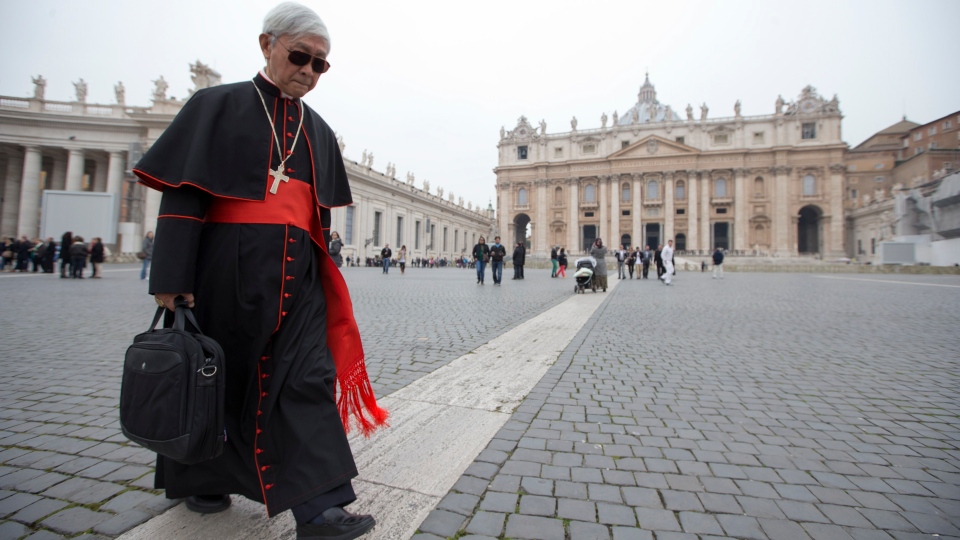
No wonder Cardinal Joseph Zen, the Shanghai-born bishop emeritus of Hong Kong, calls it “a bad deal.” 
A lion of a man, and a persistent advocate for human rights and democratic liberties, Zen has been an obstacle to Vatican appeasement of Beijing.

What China’s Rulers Want, and Are Getting

On January 18, the cardinal posted an open letter on his blog—reposted by AsiaNews—warning against the consequence of accommodation: “The Communist government is making new, harsher regulations limiting religious freedom. They are now strictly enforcing regulations which, up to now, were practically only on paper. From the 1st of February, 2018, attendance to Mass in the underground will no longer be tolerated.”
Mass in the underground will no longer be tolerated. 
In other words, the emboldened regime need no longer keep up appearances for public relations. 
With the Vatican’s blessing, it can openly enforce prohibition of the valid Mass for which close to three generations of Chinese faithful have suffered.
Going forward, all bishops will be “democratically” selected by the government-led Council of Bishops, to which the Vatican has already ceded authority. 
Names will be sent to Rome for rubber stamping, a sellout that appears to have been in the works for some time.
In a significant but overlooked 2015 article in AsiaNews, editor Bernardo Cervellera explained Beijing’s bedrock position in “negotiations” with Vatican sympathizers. 
Then as now, any mention of imprisoned bishops was off the table. 
Then as now, Beijing’s proposal consisted exclusively on complete recognition by the Holy See for all Communist Party-approved bishops. 
Moreover: “The Holy See must approve the Council’s appointment and has a weak veto only in ‘severe’ cases, which must be justified if used. If the Holy See’s justifications are considered ‘insufficient,’ the Council of Bishops may decide to proceed anyway.”
Cervella continued: “The increased controls have only one purpose: to preserve the monopoly of power of the Communist Party of China (CPC) and remove or crush any person who might challenge it or its very existence.”
The Vatican has already quietly accepted certain Communist-appointed bishops. 
But even circumspection no longer applies. 
On January 29, AsiaNews quoted Zen again: “ Do I think that the Vatican is selling out the Catholic Church in China? Yes, definitely, if they go in the direction which is obvious from all what they are doing in recent years and months.”

‘Manipulate Catholics to Submit to the Communist Party’
Francis’ bow to Beijing is not an internal matter for Catholics only. 
The concession is a rag bag of geopolitical ramifications, an ominous move in a larger global power struggle in which the Chinese Catholics are so much collateral damage. 
The omelet matters more than broken eggs.
Judged solely by low Machiavellian standards of statesmanship, the capitulation is a political coup. But for whom? 
For China, thawed relations with the Vatican enhance its global image and deflect attention from its militarism, duplicity, and depravity regarding human rights. 
Plus, the regime earns a diplomatic victory over Taiwan. 
The Vatican can tout the close of a seven-decade breach between the underground “Church of the Catacombs,” loyal to the Holy See, and the Chinese Catholic Patriotic Association, a creature of Beijing.
The Patriotic Association, founded in 1957 as the CPC’s counter-church, is a nationalist stand-in for the ancient repository of thought and worship in communion with Rome. 
Twenty years ago, Matthias Lu, a noted translator of the church fathers, Aristotle, and Thomas Aquinas into Chinese, summarized its aims. 
They have not changed: “Its [the Association’s] commitment is to manipulate the mass of the Catholic population in order to integrate them into the Socialist revolutionary movement by submitting them to the leadership of the Communist Party in all things.”
Vatican press trumpets this pact with the devil as an historic halt to impending schism. 
The spin is worthy of the CPC’s Central Publicity Department. 
Francis has merely flattered the regime by normalizing an existing schism dating from the 1950s when the Catholic Church was outlawed, its properties confiscated (later transferred to the Patriotic Association), and Catholics arrested en masse. 
The winning side in this new order belongs to Xi Jinping.

Communism Is Not Reconcilable with Christianity

In May, 2015, Xi Jinping spoke with the United Front, led by the Central Committee. 
He repeated what Communist Party leasers have affirmed since Mao denounced the Vatican as “the stray dog of capitalism.” 
In sum, he insisted on “Sinicization of religion,” including independence from “foreign influences,” as the only way the Catholic Church will be permitted to survive in China.
Xi’s Sinification is not the dialogue with Chinese culture (inculturation) that has characterized the church in China since the sixteenth century. 
Instead, it is a political power grab that reduces Christianity to an offshoot of socialist doctrine. Churches can continue to function as charitable organizations or non-governmental organizations, but the hierarchy become bureaucrats in the party apparatus.
Autonomy from Rome teems with implication for the Catholic Church’s social doctrines. 
The bureaucrats of collectivism have their own dogmas, infallibilities, and absolutes. 
These are in radical contradiction to traditional Christian reflection on morality, especially those relating to life issues.
Implicit in Francis’ conciliation is permission to ignore a range of moral matters that define a Christian conscience. 
The Catholic Church’s philosophical arguments defending the inviolable dignity of human life and the primacy of the individual cannot be asserted in pulpits. 
Silence is assured on labor camps, on the execution of prisoners to feed the lucrative organ trade, and on “family planning” policies. 
A comfortably Sinicized church can keep a good conscience while disregarding forced abortions, forced sterilizations, or forced migration (e.g., the massive Three Gorges Dam project unhoused 1.4 million peasants and submerged some 900 towns and villages).
In all, the Bergolian pontificate is set to achieve what the Communists have not: strangulating the Catholic Church as a living witness to the gospels and their demands.

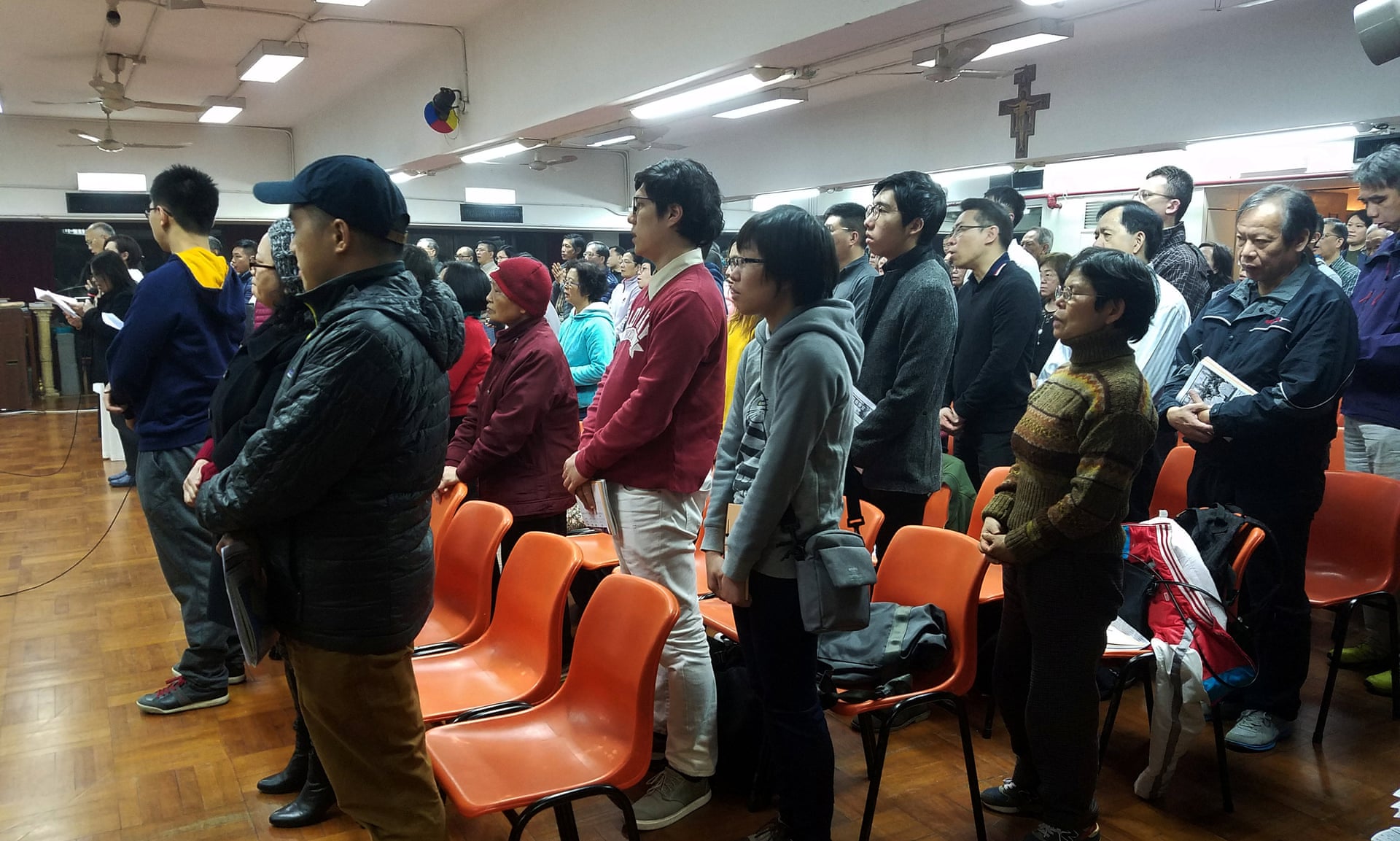
Vatican agreement with China could deal blow to Catholic church

Open letter opposes recognition of Chinese government-appointed bishops by the Vatican
By Harriet Sherwood 

The Catholic church risks damaging its moral authority and plunging its followers into confusion if the Vatican presses ahead with an imminent deal with the Chinese government, a group of influential Catholics has warned.
Fifteen lawyers, academics and human rights activists, most based in Hong Kong, have signed an open letter to bishops across the world expressing dismay at an agreement which would involve the Vatican recognising seven bishops appointed by China’s Communist party.
The deal is aimed at restoring relations between China and the Vatican, which were cut almost 70 years ago. 
But the group of leading Catholics say it could create a schism in the church in China.
“We are worried that the agreement would not only fail to guarantee the limited freedom desired by the church, but also … deal a blow to the church’s moral power,” the letter says. 
“Please rethink the current agreement, and stop making an irreversible and regrettable mistake.”
The letter comes less than two weeks after a senior Catholic leader in Asia accused the Vatican of selling out the church in its efforts to make a deal with the Chinese government.
Cardinal Joseph Zen, the former bishop of Hong Kong, wrote in a blog post: “Do I think the Vatican is selling out the Catholic church in China? Yes, definitely, if they go in the direction which is obvious from all what they are doing in recent years and months.”
Last month, the Vatican asked two “underground” bishops – who operate without Chinese government approval – to relinquish their positions in favour of government-appointed counterparts, one of whom was excommunicated by Rome in 2011.
One of them, Guo Xijin, said at the weekend he would “obey Rome’s decision” and respect any deal struck between the Beijing and Vatican authorities. 
Guo and the second bishop, Zhuang Jianjian, are under police surveillance and Guo has been repeatedly detained, including for 20 days last year.
The issue of bishop appointments is at the centre of efforts to restore Vatican-Chinese relations, which were officially severed after the foundation of the Communist state in 1949.
There are an estimated 10 to 12 million Catholics in China, with about half worshipping in underground churches, and half in government-managed churches.
The Chinese government has appointed seven bishops, who are not recognised by Rome. 
Up to 40 Rome-backed underground bishops operate without Chinese government approval.
Negotiations to restore ties between the two powers opened more than 18 months ago, but the issue of bishops has been a major stumbling block.
Last year Xi Jinping told the Communist party congress that religions in China “must be Chinese in orientation”, and the government must “provide active guidance to religions so that they can adapt themselves to socialist society”.
New regulations came into force on 1 February specifying the types of religious organisations that can exist, where they can exist and the activities they can organise.
There has been a crackdown on burgeoning evangelical Protestant churches, with many being forced to remove crosses and ordered to disband.
According to the Catholic leaders’ open letter, “the Communist party in China, under the leadership of Xi Jinping, has repeatedly destroyed crosses and churches, and the [state-controlled China Catholic Patriotic Association] maintains its heavy-handed control over the church.
“Religious persecution has never stopped. Xi has also made it clear that the party will strengthen its control over religions.”
It goes on: “We cannot see any possibility that the coming agreement can result in the Chinese government stopping its persecution of the church and ceasing its violations of religious freedom.”

lundi 12 février 2018

In praise of China’s outspoken cardinal

Cardinal Zen has history on his side, and he knows China better than any in the Vatican diplomatic corps
By Fr Raymond de Souza

Joseph Cardinal Zen, the emeritus bishop of Hong Kong, will not go away quietly. 
Which makes it difficult for the Vatican diplomats to go quietly and cut a deal with Chinese regime. What is playing out now, as the Holy See reportedly nears a deal with China on normalising relations, revisits a centuries-long debate about how the Church should deal with hostile, persecuting powers.
More specifically, the very public denunciation of Vatican diplomacy by Cardinal Zen revisits the Ostpolitik practised by the Holy See during the 1960s and 70s. 
The “eastern politics” of Vatican diplomacy sought to achieve breathing room for the Church under communism by ratcheting down the anti-communist rhetoric and reining in the underground Churches faithful to Rome. 
The Ostpolitik was the attempt by Paul VI to try a different path than that of Pius XII, who shut down all official contacts with the Soviet empire and its satellites.
In practice, Ostpolitik was bitterly opposed by the much of Catholic leadership who had suffered persecution behind the Iron Curtain. 
To do a deal with the Devil was to betray the witness of the martyrs. 
Or, as Cardinal Zen puts it with characteristic frankness, it is like St Joseph negotiating with King Herod after the massacre of the innocents.
Paul VI’s Ostpolitik was a cause of suffering for him; while he believed it was right, he took no pleasure in either dealing with the Devil or opposing the heroic pastors who daily bore the brunt of the battle. 
It was not, he conceded, a “policy of glory”. 
It was employed on the grounds that it was, according to the Vatican’s diplomatic corps, the best way to salvare il salvabile – to save what could be saved.
The policy did not save much. 
It did not strengthen the Church behind the Iron Curtain, though it did secure the release from prison – at the cost of permanent exile – of several bishops. 
The one local Church that remained steadfast and strong under communism was in Poland, and there the primate, Cardinal Stefan Wyszyński, insisted that he, and he alone, would deal with the Polish communists. 
Such was his towering stature that he kept Vatican diplomats at bay for some 30 years, blocking the ne plus ultra of Vatican diplomacy, a full-status nunciature and exchange of ambassadors. 
He judged the price of that to be too high.
Cardinal Zen has rather the same view. 
The difference today is that we are able to hear the disagreements openly.
“In the Church there is a full right to disagree and to tell one’s own criticisms, and that the Holy See has a moral duty to listen to them and to evaluate them carefully,” Cardinal Pietro Parolin, the Vatican secretary of state, said in defending his China policy. 
“It is legitimate to have different views over the most appropriate responses to the problems of the past and present. That is entirely reasonable.”
Cardinal Parolin may well think that a “far eastern politics” will succeed where Ostpolitik failed. 
But he acknowledges that his view is not the only one, and that those who have suffered most are in disagreement with him. 
Whereas under the original Ostpolitik the Vatican’s diplomats could do their work in secret, and the underground Church had little recourse, today Cardinal Zen ensures that the betrayal of the Church in China – as he sees it – will have to be accomplished in the open.
After Cardinal Parolin’s defence of the Holy See’s China policy, a senior official – perhaps the cardinal himself, but certainly someone authorised by him – gave a lengthy interview to America magazine in which he laid out the path ahead with the Chinese regime.
“It is a suffered accord; it is not a good one, it is not the one we would like, but it is the best that we can get at this moment,” anonymous source said. 
The best that we can get. 
Salvare il salvabile.
Cardinal Zen argues that no accord is better than a bad accord. 
Don’t save what the communists will let you save, he argues. That is an illusion offered by fraudsters. 
The better way is to save your integrity and the fidelity of Catholic witness.
I am inclined to side with Cardinal Zen. 
He has history on his side, and he knows China better than any in the Vatican diplomatic corps. 
But I also am inclined take his side because he is man who speaks clearly and has evident courage.
In 2013 I hosted Cardinal Zen in Kingston for our annual dinner in support of our mission on campus, the St John Fisher Dinner. 
I invited him – without having any relationship with him – because I admired him greatly. 
Yet I was shocked when he accepted. 
For a retired octogenarian, the trip from Hong Kong was long and tiring. 
Why did he accept?
He explained at the dinner that it was foolish for him to travel so far at his age; and, after all, he had to re-arrange the classes he was now teaching to seminarians. 
But he “had to come” when he saw the invitation. 
Anything to honour St John Fisher, he said, meant that he had to accept. 
Cardinal Zen came to Kingston in 2013 because the Church needs more men like St John Fisher in the face of persecuting regimes. 
And that’s why he went to Rome last month to press his case again.

vendredi 9 février 2018

Xi Jinping's Pope

Vatican-China deal would put Catholics in communist cage
By Venus Wu

HONG KONG -- A senior Catholic cardinal accused the Vatican on Friday of acting “unfaithfully” in its rapprochement with China, saying it would put the country’s some 12 million faithful in a bird cage controlled by the Communist Party.

Cardinal Joseph Zen

Addressing a news conference, Hong Kong’s outspoken Cardinal Joseph Zen also said he was highly skeptical of a deal that reportedly would give Francis the final say in the appointment of bishops, the key part of the agreement.
Nearly 70 years after China and the Vatican severed diplomatic relations, the two sides recently reached a framework accord on the thorny issue of who gets to appoint new Chinese bishops and a historic deal could be signed in a few months.
The 86-year-old former bishop of Hong Kong, recently rebuked by the Vatican after he said it had “sold out” China’s faithful, said sources told him that under the framework agreement the pope would have the final veto power over bishops who are effectively chosen by the Chinese government.
“They (The Chinese government) say the last word belongs to the Holy Father. Sounds wonderful? But it’s fake,” Zen said.
”They are not going to make good choices for the Church ... surely they choose the one they prefer, which means the one who always obeys the government. So how (could) the Holy Father approve such a choice?”
“Okay, he can veto. How many times? It takes courage to veto the second time, the third time, five times,” Zen said.
Catholics in China are split between the state-controlled Catholic Patriotic Association, where bishops are appointed by the government, and the “underground” Church that remains loyal to the pope while being systematically persecuted by Chinese authorities for years.
Zen, who has fiercely criticized the Vatican for attempting to force two “underground” bishops to give way to government-backed “illegitimate” bishops in order to foster the deal, was rebuked by the Vatican last Wednesday for “fostering confusion and controversy”.
Zen said that under the status quo, which he described as “the lesser evil,” the Vatican secretly approves candidates who are acceptable to both sides before the state-controlled Church makes them bishop.
But under the new agreement, where candidates would be selected via a “so-called democratic election” inside the Chinese Catholic community and endorsed by a state-controlled bishops’ conference before being submitted to the pope, the choice lies entirely in the hands of the government, Zen said.
“A church enslaved by the government is no real Catholic Church,” he said.
Zen said he was not criticizing the pope, whom he believed might not be briefed on “reality” because bureaucrats in the Holy See are eager to strike a deal.
“What they (Vatican negotiators) are doing is unfaithful,” Zen said. 
“I am not judging their conscience but ... it’s a surrender and they have no right to surrender.”

jeudi 8 février 2018

Xi Jinping's Pope

Francis Made a Deal with the Communist Front Group Oppressing the Real Catholic Church in China
By Robert Kraychik

Is he a naive crypto-communist?

“Those who best realize the social doctrine of the church at this time are the Chinese,” Archbishop Marcelo Sanchez Sorondo told the Italian newspaper La Stampa last Friday. 
“They seek the common good, subordinating all things to the general good.”
John Zmirak, senior editor of The Stream, joined Tuesday’s edition of SiriusXM’s Breitbart News Tonight to discuss Sorondo’s praise of China. 
Sorondo heads the Vatican’s academies of science and social science.
“One of the pope’s right-hand men, Archbishop Sorondo from South America, he is the head of the Vatican’s office on science and social sciences. He actually said a couple of days ago that China does a better job living out Catholic social teachings than the United States,” said Zmirak.
Sorondo pushed left-wing narratives of “climate change” and “capitalism” in his praise of the Chinese state’s policies.
“[Sorondo] is saying that they’re defending the climate; they’re avoiding reckless capitalism,” said Zmirak. 
“It’s staggering. This is a country that still forces women to get abortions after their second child. This is the head of the Vatican’s congregation for science and social sciences. He is saying that because the Chinese government is more responsible, supposedly, on climate change and because it doesn’t allow capitalism, it’s better than the United States.”
Francis abandoned the underground Catholic church in China in favor of legitimizing an ostensibly Catholic church alternative controlled by China’s communist government, said Zmirak.
“The Vatican just cut a deal with the collaborationist Chinese communist party-controlled Catholic church,” said Zmirak. 
“There’s a real church, which has been underground and illegal since Mao Zedong, and then there’s been kind of like a Vichy French collaborationist wing, where they work for the government. The government appoints the bishops. The government controls everything. The Catholic church always condemned that as a communist front group. The Vatican just made a deal with the communist front group that they are going to be regarded as the real church, and the underground church has to resign and just go join the communist church.”
Mansour described Francis’s “about-face” towards communism as a 180-degree reversal of Pope John Paul II’s approach.
“Right now, the Chinese communist government is blowing up the churches of evangelical Protestants, and now, what are we doing?” asked Zmirak. 
“We’re siding with the government that’s blowing up these people’s churches and putting them in prison. I guarantee you, if this continues, in thirty or forty years, when Christianity is continuing to spread through China, Francis is guaranteeing that it will be Protestant rather than Catholic. So, my Protestant friends, you should thank Francis for guaranteeing that, eventually, China will be largest Protestant country on earth, not Catholic.”
A former cardinal from China, Joseph Zen, has criticized the Vatican for “selling out” Catholicism via its overtures to Beijing.
“There’s a cardinal, Cardinal Zen, I believe, who spent a lot of time in a communist prison, and he feels completely betrayed by the fact that they’re making a deal with his persecutors,” said Zmirak. “Vatican officials are saying, ‘Oh, [Joseph Zen is] out of touch. He doesn’t know what he’s talking about.’ They’re dismissing the guy who lives in the country and has been in its prisons while they sit in their little Italian hideaways eating gnocchi, drinking wine, and imagining that they’re great realpolitik practitioners.”
Shantytown-caliber poverty is non-existent in China, said Sorondo, following a state-supervised visit to the authoritarian country.
“I found an extraordinary China,” said Sorondo. 
“You do not have shantytowns. You do not have drugs. Young people do not have drugs. There is a positive national consciousness. They want to show that they have changed. They already accept private property.”

The Vatican's crypto-communist

Why the Pope Is Genuflecting to China
By Yi-Zheng Lian 

Catholics praying in Beijing on Jan. 30, two days before new repressive regulations of religion went into force in China. 

On Feb. 1, the same day that new repressive regulations of religion went into force in China, the Vatican took a deep bow before Beijing. 
After long resisting, it finally agreed to recognize several hack bishops designated by the Chinese Communist Party (C.C.P.), even sidelining two of its own long-serving appointees for the occasion.
Cardinal Joseph Zen Ze-kiun, the outspoken, blogging, 86-year-old retired archbishop of Hong Kong, had recently flown to Vatican City to personally plead the case of the two bishops to the pope himself. 
How nettlesome. 
He was shoved off, and has since been called an “obstacle” to a deal between the Vatican and Beijing.
The reasons the Holy See is caving to the atheist Communist government are not entirely transparent, but it appears to be hoping for a historic thaw. 
Diplomatic ties were severed in 1951, not long after the Communists came to power in China, and relations have since been testy at best.
Catholics in China are thought to number between 9 million and 12 million today, with about half of them adhering to underground congregations loyal to the pope in Rome and refusing to recognize a state-sanctioned version of the Church called the Chinese Catholic Patriotic Association or, more informally, the “patriotic church.”
One major conflict between the two governments has been the method for appointing bishops: Traditionally a prerogative of the papacy, Beijing has steadily tried to usurp it in China. 
The deal that the Vatican currently seems to be seeking would likely formalize some joint vetting procedure.
The Vatican justifies its conciliatory stance toward Beijing as an attempt to overcome the schism that has divided the Catholic community in China for nearly seven decades — as “a balm of mercy,” it has said, for the pain caused by the barriers that have prevented Chinese Catholics “from living in communion with each other and with the Pope.”
Rapprochement could also give the pope, nominally at least, ultimate authority over all the Catholics in China — a standing, however symbolic, that may well matter to a Vatican that is losing ground to other Christian denominations among Chinese converts.
The total population of Christians in China has grown considerably, from about 4 million in 1949 to perhaps as many as 100 million today. 
In relative terms, however, Catholics are falling behind. 
By some estimates, whereas Catholics in China outnumbered Protestants by 3 to 1 in 1949, today Protestants outnumber Catholics by 5 to 1.
A major explanation for the increasing differential is that the Roman Catholic Church wields not only religious and moral authority, but also political and diplomatic power.
The Catholic Church has a relatively unified command structure, a well-defined ideology and a disciplined organizational backbone. 
It has global reach and mass appeal, commands great loyalty and has long demonstrated the ability to survive and expand, all on the merits of peaceful soft power. 
In each of these ways, it rivals, perhaps even bests, the C.C.P.
And so, naturally, the C.C.P. sees Chinese Catholics’ allegiance to the pope as a direct challenge to their allegiance to the party. 
Vatican City is also, still, among the 20 states, all small, that recognize Taiwan diplomatically.
Many Protestant churches, although deemed suspect as well, are on better terms with the C.C.P. 
After a visit to Beijing in 1983, the archbishop of Canterbury gushed about liberalization in China and reportedly praised the emergence of “a church with Chinese characteristics.”
Like his predecessor, the current Anglican archbishop overseeing Hong Kong and Macau is a member of the Chinese People’s Political Consultative Conference, a body including luminaries that supposedly advises the C.C.P. but often promotes the party’s interests informally or clandestinely. Both men have tended to support Beijing’s restrictive reading of democratic freedoms in Hong Kong and opposed the pro-democracy Umbrella Movement of 2014.
Representatives of other faiths have gone further. 
A vice president of the Buddhist Association of China called Xi Jinping’s speech to the Chinese Communist Party’s 19th Congress last fall, “the Buddhist sutra of the current age.” 
Buddhists in China — who are variously said to number between more than 100 million to more than 240 million — have been treated with a relatively light hand by the party, at least if they are not of the Tibetan kind.
Yet even if brown-nosing seems to pay off, the Vatican’s appeasement of the Chinese government would have great downsides, for itself and for the rest of the world.
By recognizing China’s so-called "patriotic" church, the Vatican could harm the wholesomeness of Catholic teachings in the country. 
Sermons given in government-sanctioned churches have been known to exclude passages of the Bible deemed politically subversive (like the story of Daniel) or to include Communist Party propaganda.
Millions of faithful Catholics in China might also soon feel abandoned, perhaps even betrayed, after having suffered decades of oppression. 
Worse, the government, emboldened by the deal, could well come down even harder on them. 
In fact, the religious regulations that recently came into effect include much stiffer fines on underground churches and penalties for public-school teachers who give Sunday-school lessons on their own time.
And then, rapprochement might augur the Vatican’s readiness to eventually stop recognizing Taipei and instead recognize Beijing as truly representing China. 
Such a shift would alter the delicate balance of power across the Taiwan Strait, as well as harm Taiwan’s vibrant democracy. 
It would also confer legitimacy — and with the pope’s imprimatur! — on authoritarian regimes throughout the world that crack down on churches and sects.
The Catholic Church already has a checkered record dealing with fascist or totalitarian states. 
Pope Pius XII was criticized for betraying the Jews of Europe during World War II: Hewing to what he described as a position of neutrality between the Nazis and the Allies, he never denounced Hitler’s Final Solution. 
After Soviet forces violently repressed the Hungarian uprising in 1956, the Vatican sidelined the outspoken anticommunist Archbishop József Mindszenty in favor of a deal with the new puppet regime.
The Vatican’s eagerness to play catch-up in China today may do it no favors either.
Beijing doesn’t have much of a reputation for honoring commitments. 
Just look at its application of the “one country, two systems” arrangement it promised Hong Kong, which was supposed to guarantee the city a large degree of autonomy until 2047.
Even under the deal the Vatican seems to want, the Chinese government could eventually come to control the Catholic Church in China — by, say, simply delaying nominating anyone for bishop or repeatedly rejecting candidates presented by the Vatican until all the bishops previously ordained by the pope have retired or died out. 
Bishops ordain priests and so without bishops, in time there could be no priests, or very few, and Catholicism in China would have died a silent death.
Four decades ago, when a destitute China was emerging from deep Maoism, Western companies got tipsy at the mere notion of selling deodorant to two billion Chinese armpits. 
Now that average Chinese have much more disposable income, major international corporations are willing to hand over proprietary technology, stoically endure violent xenophobic outbursts and take on members of the Chinese Communist Party as senior managers rather than risk losing out on the business prospects.
No one, it seems, can resist the lure of the great market of China, for deodorants, cars — or congregants. 
Not even the Vatican.

mercredi 7 février 2018

Vatican's crypto-communism

China expert: Vatican official naive for saying China “best implementer” of Church’s social doctrine
By Charles Collins

Vatican's crypto-communists: In this file photo, Francis is flanked by Bishop Marcelo Sanchez Sorondo, chancellor of the Pontifical Academies of Sciences and Social Sciences.

A leading commentator on the Church in China said a Vatican official’s proclamation that the Communist state “is the best implementer of the Church’s social doctrine” is making “a laughing stock of the Church.”
Argentine Bishop Marcelo Sánchez Sorondo, chancellor of the Pontifical Academies of Sciences and Social Sciences, said in an interview with the Spanish-language edition of Vatican Insider that Beijing “is defending the dignity of the person,” and “that China is evolving very well,” even calling the country “extraordinary.”
“When my friends tell me they are going to China, I always advise them not to stop at the shopping centers, the ultra-luxury hotels and the skyscrapers, but also to go out to the peripheries to get a better picture of real China,” said Father Bernardo Cervellera, editor of AsiaNews, which closely covers the Catholic Church in China.
“Presenting China as the ‘Land of Wonders’ is a bit too far. In his interview following his recent trip to Beijing, Bishop Sanchez Sorondo describes a China that does not exist or that vigilant Chinese escorts did not show him,” Cervellera said in a Feb. 7 editorial published in AsiaNews.
Sánchez Sorondo attended a conference on organ donation last year in Beijing, where he said “China could be a model we need today to respond to globalization, a model for the dignity and freedom of human beings, a model for the eradication of the new kind of slavery-organ trafficking.”
In 2015, the communist country announced it was stopping the practice of using organs from executed prisoners, and the next year announced all donors were volunteers. 
Despite the assurances of the government, human rights activists are skeptical that the use of prisoners for organs has actually ended.
In his interview with Vatican Insider, the bishop said the Chinese government holds “the common good above all else, everything else comes second to the common good.”
“I met an extraordinary China: what people don’t realize is that the central value in China is work, work, work. There’s no other way, fundamentally it is like St Paul said: he who doesn’t work, doesn’t eat.”
Sánchez Sorondo also claimed there were not shantytowns in China, nor any drug use by young people.    
However, China National Narcotics Control Commission has recently stated the drug problem in the country is “spreading at a fast pace.” 
Meanwhile, Human Rights Watch has condemned China’s “cruel, inhuman and degrading treatment” of addicts.
Drug dealers often face capital punishment in a country that leads the world, by far, in executions.
The bishop also made no mention of the stark poverty and lack of basic rights experienced by rural migrants to China’s growing cities, who do not have the basic paperwork required to receive social services outside their home villages.
“Did our bishop try to go to the south of the capital, where for months the city government has been destroying buildings and houses and driving away tens of thousands of migrant workers? Not to mention the suburbs of Shanghai or other Chinese megalopolis, where a “cleansing” is underway and a ban on the “low-end” and defenseless population?” Cervellera asked.
Sánchez Sorondo also used the opportunity of his interview to positively compare the communist regime to the United States under Donald Trump.
“The economy does not dominate politics, as happens in the United States, as the Americans themselves say. How is it possible for oil multinationals to influence Trump? Knowing that all this hurts the earth, as the encyclical [Francis’s Laudato Si’] and scientists say. Liberal thought has dismissed the concept of the common good, it does not even want to take it into account, it states that it is an empty idea, without any benefits. On the contrary, the Chinese, no, they propose work and the common good,” he said.
Cervellera called Sánchez Sorondo “naïve” and said China has the “most destroyed and poisonous environment in the world.”
“What we need to mention, instead, is that in China the economy and politics are the same thing; that the billionaires sit in the Chinese parliament and determine politics according to their interests, which are not those of the rest of the population,” the priest said.
The interview with Sánchez Sorondo comes during a flurry of diplomatic activity between the Vatican and China. 
Numerous reports are claiming an agreement will soon be made on the appointment of bishops in the country, with the government playing a prominent role in the selection of Church leaders.
The government-controlled Chinese Patriotic Catholic Association supervises an “open” Catholic Church -- which does not recognize the authority of the pope. 
A parallel “underground” Church exists which recognizes papal authority and faces harassment from government officials.
Cervellera said the pursuit for an agreement with the Chinese government may have influenced the effusive praise heaped on the Communist regime by Sánchez Sorondo.
“We can understand that in the enthusiasm of wanting an agreement between China and the Vatican, Chinese culture, Chinese people and Chinese mentality are exaggerated and exalted,” the priest said.
“But the idolization of China is an ideological affirmation that makes a laughing stock of the Church and harms the world,” he concluded.
Since the election of Francis, Sánchez Sorondo has not been afraid to court controversy, or even appear partisan, in his role at the pontifical academies.
In 2016, he drew criticism for inviting U.S. Senator Bernie Sanders to the Vatican in April 2016, during his campaign against Hillary Clinton for the Democratic presidential nomination.
Last year, the bishop said Trump’s decision to withdraw from the agreement was a “slap in the face” to the Vatican.
In November, he invited several U.S. politicians -- all Democrats -- to a conference on climate change taking place in the Vatican.