Affichage des articles dont le libellé est Brussels. Afficher tous les articles

vendredi 17 janvier 2020

Germany Investigates 3 Suspected of Spying for China

Raids were carried out on the homes and offices of the three people
By Melissa Eddy

The Chinese Embassy in Berlin. A spokesman for Germany’s federal prosecutor said the Chinese intelligence service was involved in the inquiry.

BERLIN — German authorities raided the homes and offices of three people suspected of spying for the Chinese government, officials said on Thursday, giving no details about their identities or the nature of the alleged espionage.
“This is a preliminary investigation against three known persons,” said Markus Schmitt, a spokesman for the German federal prosecutor, Peter Frank. 
None of the three have been arrested, he said.
The raid comes amid an intensifying debate in Berlin over the country’s relationship with Huawei, the Chinese technology giant used for espionage by Beijing.
On Thursday, Angela Merkel met with senior lawmakers in her party as part of continuing efforts to resolve a dispute over whether to allow Huawei to help build the country’s 5G next-generation mobile network.
Germany has been concerned about the threat posed by Chinese hackers seeking to steal information from the country’s companies, research facilities and ministries. 
But if sufficient evidence is found in the current case, it would be one of the first in years involving old-fashioned human espionage.
German officials were sifting through evidence gathered in the raids, which were carried out early Wednesday on nine homes and offices in Brussels and Berlin, as well as in the German states of Baden-Württemberg and Bavaria, Mr. Schmitt said.
The Chinese intelligence service is also involved in the inquiry, Mr. Schmitt said.
The German newsmagazine Der Spiegel, which first reported the raids, said that the three people targeted were suspected of passing private and social information to China’s ministry of state security.
Der Spiegel said that one of the three was a German national who had worked as a diplomat for the European Union until 2017, when he switched to a well-known consulting company. 
The other two work for a different consulting company, the report said.
Although some of the searched properties are in Brussels, a spokeswoman for the Brussels-based European Commission said on Thursday that none of its premises had been searched. 
She also said it had not received any requests to work with the German authorities or to hand over any evidence.
“No searches were conducted in the premises of our buildings, we haven’t been contacted by the German authorities,” said the spokeswoman, Virginie Battu-Henriksson.
European Union diplomats are normally senior envoys from their own member states who join the bloc’s diplomatic ranks. 
Many go on to join lobby firms or think tanks after retirement. 
If proven that the suspect was indeed spying for China, it would be a first for the bloc’s foreign policy branch.
China is one of Germany’s most important trading partners, and the two countries collaborate on international issues like climate change and hold regular government-level discussions.
But the relationship has come under scrutiny since the Chinese acquired several German technology companies in 2016. 
The next year, Germany’s domestic intelligence agency accused China of using LinkedIn and other social media sites to infiltrate the government in Berlin.
A year ago, Poland arrested two people, including a Chinese employee of Huawei, and charged them with spying for Beijing.

lundi 16 décembre 2019

Belgium — Den of Chinese spies and gateway for China

The host to EU institutions and NATO headquarters, the European nation is an alluring draw card for China: 250 Chinese spies were working in Brussels — more than from Russia.
By Alan Crawford and Peter Martin 

When a suspected Chinese spy was extradited to the US last year, the US Department of Justice praised the “significant assistance” given by authorities in Belgium.
Xu Yanjun was arrested in Belgium after going there to meet a contact “for the purpose of discussing and receiving the sensitive information he had requested,” the US indictment said.
Xu was charged with attempting to commit economic espionage, with GE Aviation the main target. The case is pending.
Belgium might seem an unlikely destination for a Chinese agent, but it is a den of spies, the Belgian State Security Service (VSSE) says.
It says the number of operatives is at least as high as during the Cold War and Brussels is their “chessboard.”
Host to the EU’s institutions and NATO headquarters, Belgium is an alluring draw card for aspiring espionage-makers. 
Diplomats, lawmakers and military officials mingle, sharing gossip and ideas, while Belgium’s strategic location makes it important to China in its own right as a place to exert its influence in Europe.
“The mere fact that we hold international institutions such as NATO and the EU makes Belgium a natural focus for China,” Brussels-based Egmont Royal Institute for International Relations research fellow Bruno Hellendorff said. 
“It’s common knowledge that there are many spies in Brussels, and these days espionage from China is a major and growing concern.”
German newspaper Die Welt in February cited an unpublished assessment by the EU’s European External Action Service that about 250 Chinese spies were working in Brussels — more than from Russia.
Famous Chinese spy Song Xinning

Song Xinning, a Chinese director of the Confucius Institute at VUB Brussels University, was in October barred from entering the EU Schengen area for eight years after being accused of espionage.
An insight into the methods employed by China are outlined in the Xu indictment.
His duties included obtaining trade secrets from aviation and aerospace companies in the US, “and throughout Europe.”He used aliases and invited experts on paid trips to China to deliver presentations at Nanjing University of Aeronautics and Astronautics, operated by the Chinese Ministry of Industry and Information Technology. 
He ensured targets carried a work computer whose data could be captured.
The US remains at the core of Beijing’s espionage activities — the head of the FBI in July said that China was trying to “steal their way up the economic ladder at our expense.”
Yet Europe appears increasingly in focus, with cases of interference by China identified in Poland, France, Germany and the UK.
“The Chinese are becoming far more active than they were 10 or 20 years ago,” said former British diplomat Charles Parton, who has more than two decades of experience of China.
Espionage is “the far end of the spectrum” of interference that ranges from academia to “technological spillover” — collecting data to send back to China for mining, London-based Royal United Services Institute senior associate fellow Parton said.
Belgium’s elite generally has a relaxed attitude toward China that can open it to charges of complacency. 
A fractured political system makes it harder to craft a unified strategy — there is still no government six months after elections.A delegation to China this month included four ministers responsible for trade relations — a federal minister plus one each for Dutch-speaking Flanders, Francophone Wallonia and Brussels.
Even as the EU adopts a more skeptical stance toward China — losing its naivety, as one senior European official put it — Belgium is opening the gates to Chinese investments in strategic areas from energy to shipping and technology.
Belgium is responding to China’s rise “in a pragmatic way,” stressing its advantages in areas such as logistics, while ensuring “attention to the sustainability of the projects and respect for international standards,” the Belgian Ministry of Foreign Affairs said.
“They [Belgium] have very advanced technologies that China needs,” said Renmin University Institute of International Affairs director Wang Yiwei 王義桅, a former Chinese diplomat based in Brussels. 
“Through Brussels you can access Europe and even the United States.”
He said that Chinese innovation is fast catching up with the US.
All nations make efforts to win over hearts and minds, and much influence-building is legitimate diplomatic activity, but there is also a gray zone and it can be “difficult to tell the hand of the Chinese state from a much more diffuse web of influence-peddling,” the European Council on Foreign Relations said in a 2017 report.

Flemish Quislings
Brecht Vermeulen, chairman of the Belgian parliament’s home affairs committee until losing his seat this year, joined parliament’s China friendship group soon after his election in 2014 as a lawmaker for the Flemish nationalist N-VA party, the largest group in the then-ruling coalition.
Over the course of his five-year term, Vermeulen made several trips to China, where officials briefed him on technological advances in artificial intelligence, facial recognition and cybersecurity.
During that time, N-VA policy evolved from sympathizing with efforts by some in Taiwan and Hong Kong to keep a distance from China, toward what Vermeulen called “Realpolitik.”
“I think we must open more doors to the Chinese and see how they react,” Vermeulen said in an interview in Ghent. 
“If they open their doors, too, then it’s good on both sides. Of course, we are a small country and China is enormous, but if we act in one way and there’s a reaction in the same way, then OK, we can proceed, step by step.”
Still, there are signs that the Belgian authorities are attuned to potential threats.
State Grid Corp of China, which has more employees than Brussels has inhabitants, in 2016 bid for a stake in energy company Eandis. 
A last-minute leak of a VSSE dossier urged “extreme caution,” citing the risk that Belgian technology could be used by the Chinese military, and a planned vote on the bid never took place.
Engaging with China’s influence apparatus is not without risks.
Filip Dewinter, a regional lawmaker with the far-right Vlaams Belang party, was investigated over his ties to an organization suspected of spying for China. 
The probe was dropped after it was found Dewinter had committed no crime.
“Maybe I had too much faith in these people,” De Morgen cited Dewinter as saying in February, adding that he was now “more informed” about Chinese espionage and the need “to be careful.”
However, while there is now “some strategic thinking” on China in Belgium, the institutional setup means it is not across the board, Hellendorff said.
He sees “little to no dialogue between regions on the implications of growing Chinese investment in the country, not only in economic terms, but also in terms of its impact on values and influence.”That lack of coordination between regions and layers of government allows Antwerp Mayor Bart de Wever to play an outsize role in ties with Beijing. 
Antwerp is home to Europe’s second-largest port and has a direct rail link to China.
Wang thinks bilateral relations are developing well.
“In Europe there’s a saying that small is beautiful,” Wang said. 
“Belgium is beautiful in the Chinese understanding.”

lundi 11 février 2019

Born to Spy

Hundreds Of Chinese Agents Operating In Brussels
By RFE/RL
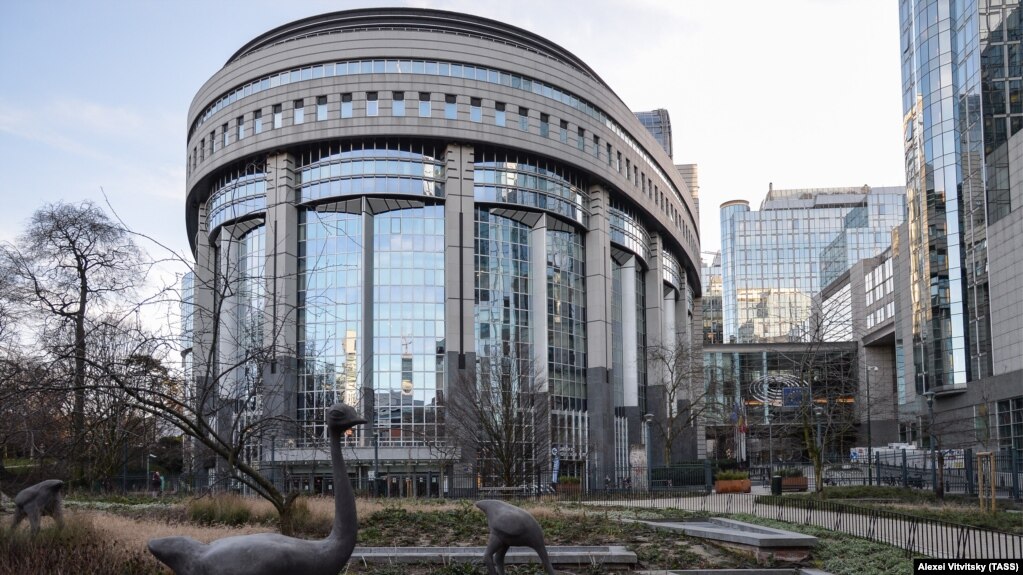
The European Parliament office in Brussels
Hundreds of Russian and Chinese intelligence agents are operating in Brussels, the EU’s foreign service has warned.
The European External Action Service (EEAS) estimates there are “about 250 Chinese and 200 Russian spies in the European capital,” Germany’s Welt am Sonntag newspaper reported, citing EU diplomats.
According to the report, EU diplomats have been advised to stay away from certain parts of Brussels’ European quarter, including a popular steakhouse and a cafe near the European Commission’s main building.
The Russian and Chinese intelligence agents chiefly work at the embassies or trade missions of their home countries, according to the report.