Affichage des articles dont le libellé est elections. Afficher tous les articles

lundi 30 décembre 2019

Taiwan's citizens battle pro-China fake news campaigns as election nears

Contest is in effect a referendum on the future of the nation’s relationship with China
By Lily Kuo and Lillian Yang
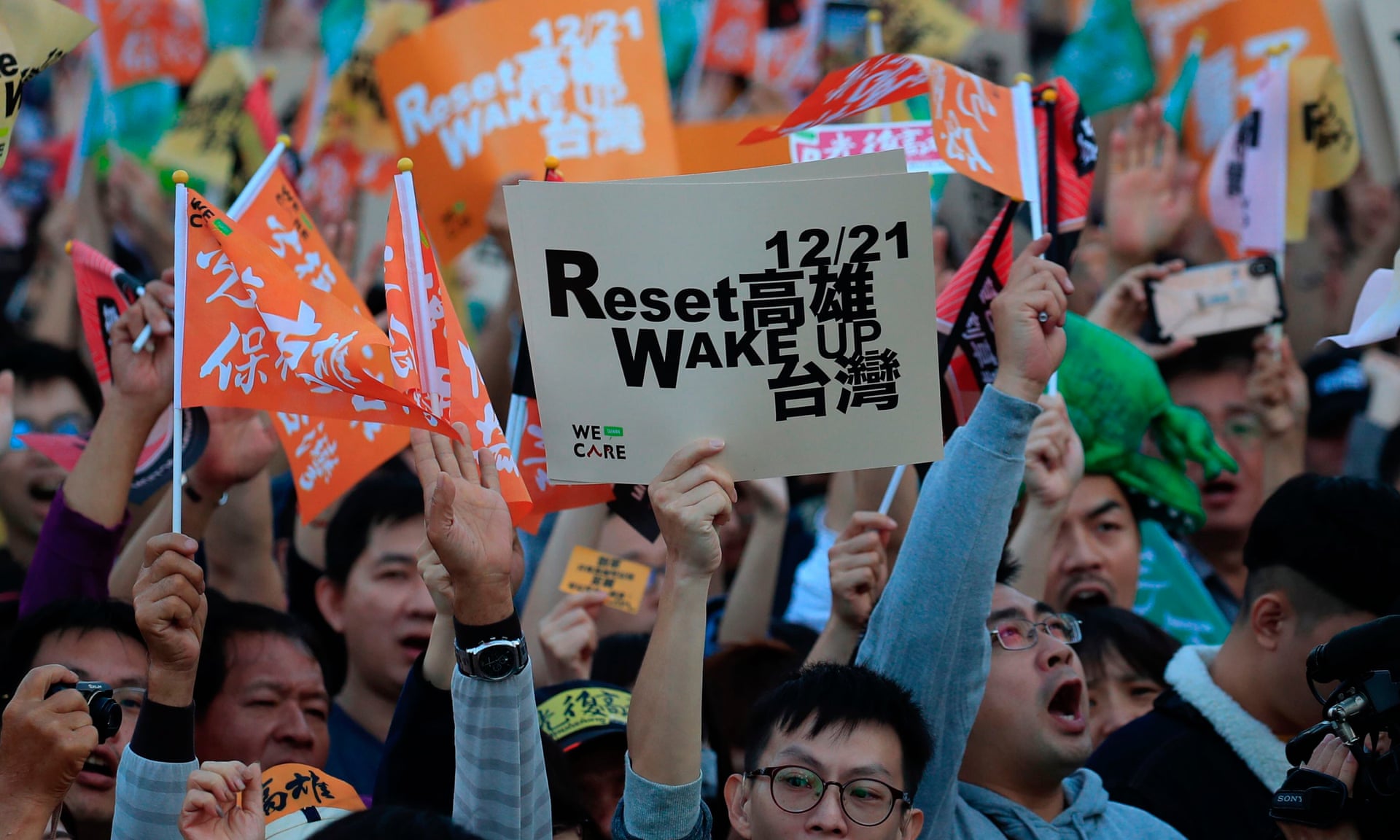
Protesters against Taiwan’s pro-China KMT presidential candidate Han Kuo-yu during a protest in Kaohsiung.
Citizen groups in Taiwan are fighting a Russian-style influence and misinformation campaign that originated across the strait in mainland China with just weeks to go before it votes for its next president,
Taiwan goes to the polls on 11 January to decide between two main candidates, incumbent president Tsai Ing-Wen of the Democratic Progressive party (DPP) under whom ties with Beijing have become fraught, and Han Kuo-Yu of the Kuomintang party (KMT), which advocates closer engagement with China.
The contest is in large part a referendum on the future of Taiwan’s relationship with Beijing, which sees the independent nation as a renegade "province" that one day must return to the fold.
Han is Beijing’s favoured candidate while Tsai’s party has been campaigning on the slogan: “Resist China, Defend Taiwan”.
In a televised debate with her rivals for the job on Sunday, Tsai said China’s “expanding ambitions” were the biggest threat to its democracy. 

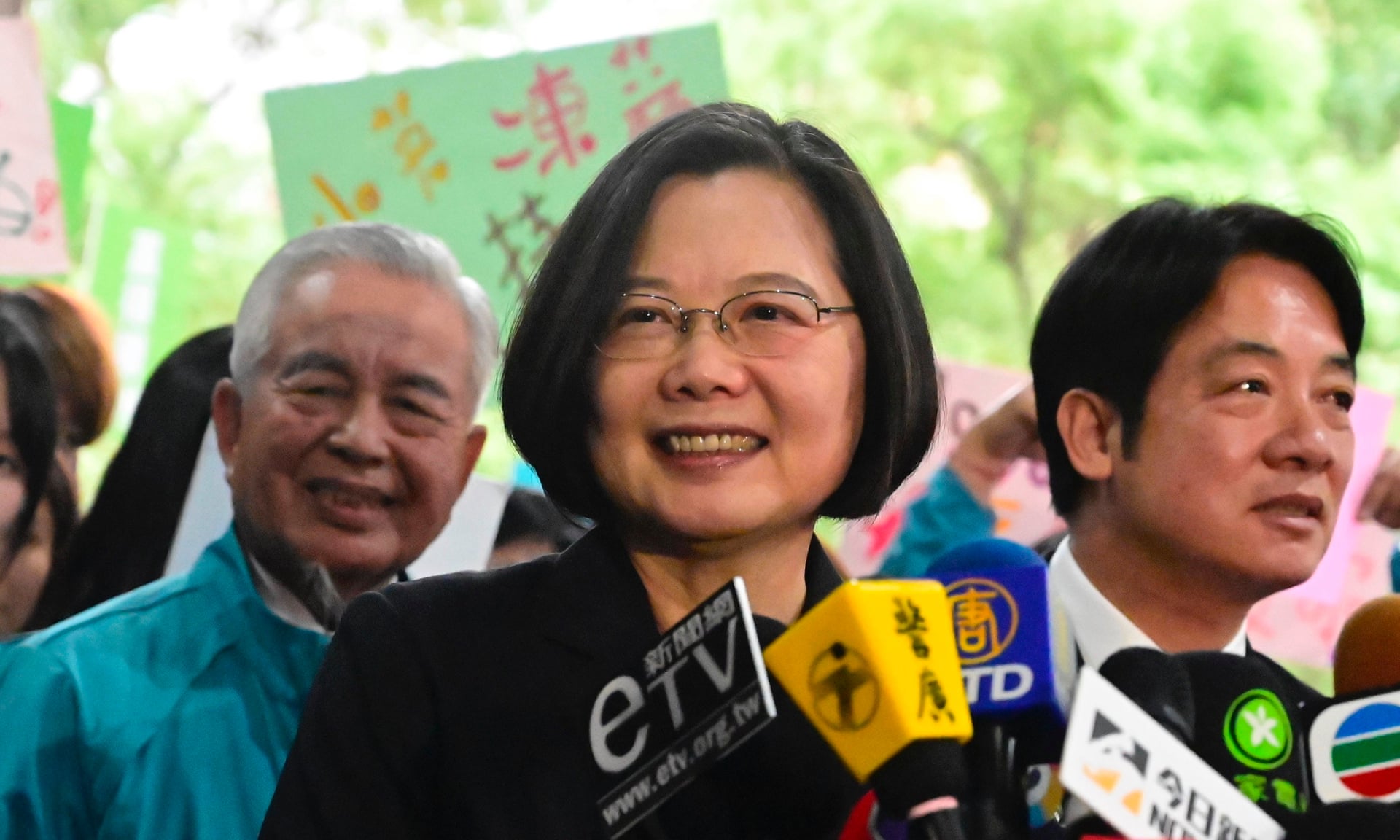
Taiwan’s President Tsai Ing-wen.

Citizen groups in Taiwan say the openness of one of the freest societies in Asia is being used against it by groups in China to wage an online disinformation campaign, made more potent by their shared language, Mandarin.
A recent study by the V-Dem Institute at the University of Gothenburg in Sweden found that Taiwan was the most exposed to foreign dissemination of false information.
False reports include claims Tsai’s doctorate degree was fake or that Hong Kong democracy activist Joshua Wong kicked an elderly man when he visited Taiwan in October and met members of the DPP.
“China has multiple ways of pushing misinformation. We’ve found that content mills are no longer simply producing fake information. More and more, they are manipulating opinions,” said Jarvis Chiu, senior manager for the Institute for Information Industry, which has been assisting government efforts to prevent disinformation.
According to Chiu, an army of trolls will leave thousands of comments under a candidate’s post or a news article, shifting the focus of the debate.
Fake social media accounts also share pro-Beijing content or inflate the number of likes such content gets.
“Subliminal attacks” include repeatedly searching for one candidate’s name to influence search algorithm results.
“China won’t give up this practice. It will only increase and because it is non-military, it won’t get much global attention,” Chiu said.
The uncertain status of Taiwan, functionally independent but not internationally recognised, has been an issue in every campaign since direct elections were introduced in the 1990s following decades of martial law under the KMT.
This year, the question of how Taiwan should deal with Beijing looms even larger after years of increasingly strident rhetoric from China.
On Thursday, China sailed its new aircraft carrier, Shandong, through the Taiwan Strait in a move critics described an effort to intimidate voters.
Months of witnessing Beijing’s inflexible response to protesters in Hong Kong have cast even more doubt on the city’s “one country, two systems” framework, once touted as a possible model for Taiwan.
“There’s a sword hanging over everyone all the time,” said Shelley Rigger, a professor of east Asian politics with a focus on Taiwan at Davidson College.
“It’s exhausting to know that you’re being threatened and that the entity that is threatening you is getting more and more powerful all the time.”
In an attempt to push back against the campaign, citizen watchdog groups are manning social media, debunking rumours and trying to trace questionable content back to its source.
Prosecutors have been charging those who spread disinformation.
The party in office is trying to pass a law that would prohibit support from foreign “infiltration sources” to a political party.
“Taiwanese people have only just started understanding what is happening. It’s still the very beginning,” said Summer Chen, of Taiwan FactCheck Center which works on debunking disinformation on Facebook.
“It is a crisis and all of Taiwan needs to be researching this.”
A series of snappy Youtube tutorials educate viewers on the nature and methods of disinformation warfare.
“Taiwan has become the main laboratory for information warfare from China. If China wants to practice its methods, Taiwan is the starting point,” Puma Shen, who runs DoubleThink Labs, which monitors how false information, explains in one of the videos.
Those working on the issue say it is difficult to definitely say these attacks originated in China or link them to Chinese state actors, which makes the work of raising awareness harder.
“I believe that there is cooperation with China, but how much China knows, how much of this is from the Chinese government or people in Taiwan who are pro-China, we don’t know,” said Vivian Chen, a recent graduate studying medicine from Taipei.
China’s efforts to influence events in Taiwan stretch a long way back and go beyond online information warfare, to include traditional media, incentives for citizens or businesses who cooperate with China, group trips and donations to temples and other grassroots organisations.
Last month when Chinese defector Wang Liqiang detailed ways he had been instructed to interfere in Taiwan’s midterm elections in 2018 as well as the upcoming race, few in Taiwan were surprised.
“The story was not as shocking in Taiwan as it was in other parts of the world,” said Lev Nachman, a PhD candidate at the University of California, Irvine, studying social movements and focusing on Taiwan.
“It is not news to Taiwanese people that China has been co-opting local organisations for political influence.”
Observers say it is unlikely efforts to influence voters will affect the outcome of the race, where voters will also choose representatives for the legislature.
According to polls, Tsai is ahead of her rival, helped by months of protests in Hong Kong and concerns about Beijing, and an improved economy.

vendredi 6 décembre 2019

Taiwan Gets Tough On Chinese Disinformation Ahead Of Elections

By EMILY FENG

Demonstrators protest against what they called "red media" influence in Taiwan during a rally against pro-China media in front of the president's office building in Taipei on June 23. With a presidential election in January, Taiwan is bracing for a new deluge of disinformation, much of it aimed at boosting Beijing's preferred politicians.

Eye Central Television is a popular satirical TV news show in Taiwan, with an active social media presence. 
One day in April, it received a Facebook message from someone using the name Tina Hsu, but this was no ordinary fan.
Hsu's Facebook profile was blank; it had just been created that morning.
And Hsu made a surprising proposition: to buy EyeCTV's Facebook admin rights, taking control of the content shared with its more than 420,000 followers.
At first, the political satire program, reminiscent of The Daily Show, played along. 
"We jokingly asked for 1.4 billion Taiwan dollars [$46 million]," says show writer Sandra Ho — requesting a number that matches the population of China, she notes.
EyeCTV didn't sell out in the end. 
Many in the Taiwanese media suspect the proposition and others like it are part of a Chinese state-backed influence campaign. 
Dozens of Facebook pages in Taiwan have become content mills for Chinese Communist Party propaganda. 
Taiwan is now the liberal democracy that receives the most disinformation spread by a foreign government, according to a May report from the University of Gothenburg in Sweden.
The stakes for curbing the propaganda are especially high right now in Taiwan, a self-governing island that Beijing says belongs to the People's Republic of China. 
In January, Taiwan will vote for its president and legislators. 
Its current leaders are determined to avoid a repeat of the 2018 local elections, which were marred by Chinese interference.
But to filter false content, Taiwan faces free speech concerns that other countries, such as the United States, also have encountered.

Fact-checking Facebook
One of the latest efforts against disinformation is a unique collaboration between Facebook and the Taiwan FactCheck Center. 
The nonprofit center uses a back-end tool provided by Facebook to track viral, misleading posts and works to fact-check them. 
Once it does, Facebook alerts anyone who shared the post that it was wrong and includes a link to the fact-check article below the false post.
"Journalists focus on the truth, on describing something that happened. But for us, we want to prove that something has not happened. 
That's much harder to do," says Summer Chen, the editor-in-chief of the Taiwan FactCheck Center.
The initiative comes as the government is getting tough on disinformation, including steep fines for those caught spreading it.

Taiwan's Foreign Minister Joseph Wu speaks during a news conference in Taipei on Nov. 22.

"It's not only a domestic effort or a [Taiwanese] government interagency effort. There's also an international effort" to ward off Beijing's influence campaigns, Joseph Wu, Taiwan's foreign minister, tells NPR. 
"Because of the experiences we have, we have also built up some of the most formidable defense capabilities in the world."
In April, Taiwan's broadcast regulator fined a TV station over $32,000 for not verifying an inaccurate news item before airing it. 
Dozens of individuals have also been fined for sharing harmful, false items on social media.
The crackdown comes amid rising suspicion of mainland Chinese influence in Taiwan's news media.
In June, thousands marched against what protest organizers called the "threats of infiltration" by Chinese Communist "red media" in Taiwan's democracy. 
Later that month, Taiwan refused entry of a TV journalist from the mainland who broadcast misleading reports. 
Regulators are currently discussing blocking video-streaming sites run by Chinese companies Baidu and Tencent from broadcasting in Taiwan.

No name, no location
There's a central challenge for regulators: Most disinformation coming into Taiwan is through anonymous, hard to detect social media accounts.
Last year, when Taiwanese officials were falsely accused of abandoning Taiwanese tourists stranded by Typhoon Jebi in Osaka, Japan, the story was first spread by an anonymous user on PTT, a messaging forum popular in Taiwan. 
Within a day, several Taiwanese evening talk shows had picked up the item. 
Furious residents heaped criticism on the Taiwanese government's representative in Osaka, Su Chii-cheng.
He killed himself soon after, reportedly leaving a note that said he had been troubled by the news.
Researchers say some of the misleading material, including a doctored image, shows signs of being created in mainland China.
Tracing influence campaigns back to Beijing is difficult though, says Audrey Tang, Taiwan's digital minister. 
Social media users and hackers can use software to conceal their location.
One giveaway on Twitter, Tang says, is when users in mainland China are able to access the site, normally blocked by China's Internet firewall, without help from such software.

Using Taiwanese slang
Puma Shen runs DoubleThink Labs, a research outfit monitoring how false information travels from content farms funded by Chinese state or party-run entities to Facebook fan pages to news shows in Taiwan, and broadcast to an unsuspecting public.
Shen says one tactic he sees is an online "subliminal attack" to sway voters. 
Hundreds of hackers search one candidate's name over and over again to slant search engine algorithms toward displaying their results more prominently than other candidates'.
One day, Shen predicts China will surpass Russia in global disinformation operations.
"It's not really hard to do that," Shen says, pointing to Chinese-run apps like short video platform TikTok, now under U.S. investigation for collecting American user data, and messaging app WeChat. 
"[China] has all these marketing groups' online shopping apps which can easily collect private information on citizens in other countries."
China's influence efforts have advanced rapidly since the last Taiwanese municipal elections in 2018. Some messages stood out because they used mainland Chinese text, written in a simplified alphabet, in contrast with the traditional characters used in Taiwan, researchers say. 
Now, disinformation posts written in fluent Taiwanese slang are shared through private social media channels rather than publicly.

Rights concerns
Cédric Alviani, the head of Reporters Without Borders' East Asia bureau in Taipei, warns that coercive measures against media, including fining news outlets, are counterproductive: "By doing this kind of thing, the Taiwanese authorities are actually doing the exact same thing as they criticize," he says. 
He's referring to how Taiwan is using top-down methods to control undesirable speech comparable to what China's Communist Party does.
Alviani advocates for allowing people and outlets to dispute their fines or revoked credentials.
He also says Taiwanese media need more funds to pay for good journalism, rather than rely on social media for news.
"People don't trust so much their media because the line between the media and entertainment is very blurred in Taiwan," Alviani contends. 
"[Outlets] have an undue pressure to generate audience to their articles."
Government officials say they are aware of concerns that the disinformation crackdown could hinder freedom of the press and expression.
"I think when people still remember the martial law like I do, we just don't want to go back there," says Tang, the digital minister.
The former authoritarian government enforced martial law for almost 40 years until 1987. 
Tang says her parents were journalists and had to work under censorship during that period.
As the government passes tougher legislation to protect Taiwan, it risks affecting the civil liberties Taiwanese have enjoyed for three decades.
"Maybe it's impossible to legislate social media," concedes Ketty Chen, vice president of the government think tank Taiwan Foundation for Democracy. 
"As democracies, a challenge we often face is how you can legislate an individual's right to expression and the freedom of media [and] freedom of journalists to report, to investigate."

mercredi 21 novembre 2018

China’s ‘sharp power’ play in Taiwan

Beijing is seeking to win influence by meddling in the island’s elections 
By Kathrin Hille in Tainan

Officially, Lu Aihua retired from politics eight years ago.
But as the campaign for Taiwan’s local elections on Saturday reached fever pitch last week, Lu received a visit from government investigators who are probing whether he is helping China interfere in the upcoming polls.
 “The investigators are asking if the money the Chinese Communists are paying me comes with instructions to back a particular candidate or a particular party in the election,” says Lu, an influential former lawmaker in the southern city of Tainan.
 China claims Taiwan as part of its territory and threatens to invade if the island insists on keeping its independence indefinitely.
Since the pro-independence Democratic Progressive party (DPP) won the presidency and a parliamentary majority in 2016, Beijing has ramped up pressure against Taipei on all fronts: military posturing, poaching its diplomatic allies, pushing airlines and hotels to refer to Taiwan as part of China, drastically cutting tour groups to the island and reducing agricultural imports from DPP strongholds.
Now, Beijing is trying to meddle from within as the island’s voters prepare to pick mayors, regional and local lawmakers, as well as borough wardens and village heads.
China is seeking to corrode Taiwan’s body politic through infiltration and disinformation — an action that echoes the growing debate in a number of western countries over attempts by China to weaken democratic governments.
Lu Aihua, a former lawmaker who is a power broker in Tainan, shows a photograph of himself with the Chinese foreign minister Wang Yi, from 2012 when Wang was head of China's Taiwan affairs office.

“You have started noticing such tactics in the west since Donald Trump was elected [US president] and since Russia meddled in the US election — you even have a new term for it: ‘sharp power’,” says Chiu Chui-cheng, deputy minister of the Mainland Affairs Council, Taiwan’s cabinet level agency for relations with China.
“Nobody knows better about sharp power than we do — we are at the front lines!”
 Although Saturday’s election will focus on local issues, politicians and experts say it is likely to predetermine the future of cross-Strait relations because a DPP defeat could block the road to re-election in 2020 for President Tsai Ing-wen, the prime target of Beijing’s wrath.
 Foreign diplomats in Taipei say any indications of Beijing meddling in this week’s polls are noteworthy for western democracies grappling with the question of how to deal with a China that is openly challenging the norms and values established by the democratic west. 
 Washington this year for the first time accused China of meddling in US elections.
In Australia, debate is growing over Chinese interference in academic teaching and research.
New Zealand has had scandals over MPs’ links with Chinese Communist party organisations.
Against this backdrop, researchers from the National Endowment for Democracy coined the term sharp power, which Taiwan is identifying as an exact description of its problem.
In a paper published in 2017, they argued that influence wielded by Beijing and Moscow through the media, culture, think-tanks and academia should not be confused with soft power.
 The influence of China and Russia can “pierce, penetrate or perforate the political and information environments in the targeted countries,” they wrote.
“Sharp power enables the authoritarians to cut into the fabric of a society, stoking and amplifying existing divisions. Russia has been especially adept at exploiting rifts within democracies.”
 China has made no secret of its intention to do just that to Taiwan.
In an editorial in December 2016, months after the DPP’s victory, the Global Times, a nationalist tabloid owned by the Communist party’s mouthpiece People’s Daily, wrote in an editorial: “We will Lebanonise Taiwan if necessary,” suggesting that China could turn opposing ethnic, political and social groups inside Taiwan against each other as has happened in the Middle Eastern country.
 “Many people have been focusing on China boasting that their fighter jets are circling our airspace and that their aircraft carrier is sailing through the Taiwan Strait. But that is not what worries me most,” says a senior Taiwanese national security official.
“What worries me most is infiltration and manipulation. You may call it sharp power, or you could just call it political warfare, or United Front work.”

Taiwan has been the target of United Front tactics — the art of influencing and manipulating adversaries going back decades — from Beijing ever since the Kuomintang (KMT) fled to Taiwan in 1949 after losing the Chinese civil war, dragging the island, which had until only four years earlier been a Japanese colony, into conflict with the Chinese Communist party.
 But Beijing’s tactics are changing.
Xi Jinping’s predecessor, Hu Jintao tried to build relations with the KMT, wooing Taiwanese investors in China, and seeking to lure the island’s population of 23m with closer economic ties.
But the radical rejection of closer relations with China by Taiwan’s young generation in the 2014 Sunflower protests and the DPP’s subsequent landslide election victory two years later marked a failure of Hu’s policy.
 China has since tweaked its approach, replacing macro policies with measures to target narrow groups or even individuals.
A former senior official with oversight of the Investigation Bureau, Taiwan’s FBI equivalent, says the bureau is observing a shift in Chinese infiltration.
 “They are no longer betting on Taiwanese businessmen in the mainland, and they are no longer relying on the KMT. They are actively working on cultivating their own people here,” he says.
“They are reaching deep down to the grassroots of our society, and into the power base of the DPP.”


President Tsai Ing-wen at a ceremony to commission two new frigates into the Taiwan navy earlier this month.

That is where Lu comes in.
A tanned, wiry man with a 40-year career in the KMT under his belt, Lu is a “pillar”, or zhuangjiao in Mandarin — a grassroots power broker.
 For local employers, temple community leaders, farmers’ and fishermen’s associations’ executives or even organised crime figures who help parties or individual politicians win elections, the zhuangjiao are a remnant of the KMT’s more than 40 years of authoritarian rule, which later became a tool for politicians across the spectrum when Taiwan democratised in the early 1990s.
 With tactics ranging from friendly neighbourhood chats, to backroom deals, to mobilisation and outright vote buying, they are part of the soft underbelly of Taiwan’s raucous politics.
 DPP officials say these traditional political structures were an easy target for exploitation by China.
“I have run election campaigns and I know how it works. Money changes hands but people tell you ‘I don’t want a receipt’”, says the former senior official with oversight of the Investigation Bureau.
“Our campaign finance accounting system is hollow, it doesn’t catch this kind of thing going on at the grassroots level.”


Taipei city mayoral candidate Yao Wen-chih of the DPP speaks to supporters at a campaign rally.

According to political analysts, Taiwan’s zhuangjiao are less powerful than they were 20 years ago. But they still voice concern that they offer an opening for Chinese sharp power.
 “The population is urbanising, and it’s getting ever more difficult to mobilise and buy votes through traditional patron-client systems, and this trend continued all the way through 2016, with the KMT and the old forces being squeezed out,” says Lin Thung-hong, a researcher who looks at the Chinese impact on Taiwanese society at Academia Sinica, the country’s top academic research institution. “During this election, it’s crucial for us to find out whether this patron-client system has been brought under the control of a new patron, if it has been inherited by the Chinese Communist party.”
 Lu dismisses the idea that he could possibly buy votes or finance a campaign on behalf of a Chinese master, but he does openly push Beijing’s case.
Over the past seven years, he has sold agricultural products from Tainan — a DPP stronghold — to the government of Zhuhai, a city in the Pearl River Delta.
 He admits that Chinese officials have asked him to inform them when he expected the price of certain Taiwanese agricultural produce to drop, so they could step in and buy it.
While the government in Taipei says Beijing cut agricultural imports from southern Taiwan to punish the DPP’s voters after the 2016 result, Lu claims the opposite.
“China is very willing to help us, this little brother of theirs, but it is Taiwan itself that is rejecting them for political reasons,” he says.
 Both farmers and fishermen in rural southern Tainan complain about a contracting market for their produce.
“Things are terrible,” says Tao Langyi, who farms milkfish near Tainan.
“The Chinese bought our fish on contract for three years in a row, but that stopped in 2016. It’s very hard for us now.”
 Government officials accuse Beijing of exploiting real economic problems and creating fake ones with disinformation campaigns via Line, the messaging app popular in Taiwan.
“What they are doing is very similar to what the Russians did in America,” says the senior national security official.
“In the US, the deprived white population of the rust belt were easy prey. Here, it’s our Tainan farmers and fishermen.”
Polls suggest that sentiment is turning more broadly against the DPP with disappointment spreading among Taiwan’s notoriously fickle voters over the government’s record on issues from air pollution to gay marriage.
The Taiwanese Public Opinion Foundation, an independent research organisation, last week reported that only 23.5 per cent of voters identified themselves as DPP supporters while 35.4 per cent said they identified with the KMT and 36 per cent described themselves as independent — a radical shift from the DPP’s all-out victory two years ago.
 Analysts caution, however, against interpreting this swing as a sign that the Taiwanese are moving to embrace China.
According to Academia Sinica, attitudes towards Beijing have barely shifted, with those identifying as Taiwanese or both Taiwanese and Chinese still far outnumbering those identifying as Chinese.

 Local warden for the DPP Li Fu-hsiang waves to residents of his borough in Tainan

While government investigators are asking questions about Lu’s pineapple and fish diplomacy, their probe was actually triggered by another incident: In January, he convinced Li Fu-hsiang, a borough warden for the DPP in Yongkang, to bring two dozen borough wardens to Zhuhai hosted by officials from the Taiwan Affairs Office and the United Front Work department, the Communist party section in charge of foreign influencing operations.
 The trip led to an outcry in the DPP.
“From this you can see how deep China’s hands are reaching into our elections,” says Lin Yi-chin, a DPP city councillor in Tainan who is campaigning for re-election.
“But it is so hard to do something about it. People love money — that Li Fu-hsiang supports me in the election doesn’t mean that he can’t be cheap and greedy.”
Such internal conflict in the DPP is part of Beijing’s calculus.
“In a solidly green [DPP] constituency like Tainan, they can’t hope to turn people to the KMT, but they can aim at sowing discord within the DPP,” says Academia Sinica’s Mr Lin.
 Both Lu and Li dismiss the idea of improper conduct.
Lu justified the trip saying that it had helped Tainan local officials engage with Chinese counterparts and convinced them that China could be the solution to local economic problems caused, he says, by the DPP’s aversion to Beijing.
Li denies there were any serious discussions in Zhuhai, and says: “It was just a fun trip, just tourism.”

 ‘No hope’ candidate stirs mayoral contest 
When Han Kuo-yu announced seven months ago that he was running for mayor in Kaohsiung, Taiwan’s second-largest municipality, few took notice. 
His political career had been going nowhere since he lost his legislator’s seat in 2001. 
His own party, the opposition KMT, agreed to his candidacy only because it considered challenging the Democratic Progressive party, which has governed in the port city for 20 years, a lost cause. 
 But with three days to go until the election, several Taiwanese media polls have Han leading the DPP incumbent. 
 The 61-year-old is offering a cocktail of populist and sometimes outlandish policies: he promises to transform Kaohsiung’s ageing industrial economy into an innovative powerhouse; help everyone “make a fortune”; more than double its population to 5m; and proposes to drill for oil on Taiping, an island in the South China Sea claimed by several countries but controlled by Taiwan. 
While Han, was treated like a clown when peddling such ideas earlier in the campaign, he has rocketed to stardom over the past three months. 
His campaign rallies have become carnival-like events. 
His main event on Saturday attracted 80,000 people according to the police, rivalling that of the DPP mayor on the same day. 
 DPP campaign strategists and some independent observers see the astonishing turnround as a product of Chinese manipulation. 
In a highly unusual pattern, the candidate’s name has been ranking much higher in internet searches in some Chinese provinces — where ordinary people rarely know individual Taiwanese politicians — than in Taiwan in recent weeks. 
Moreover, Taiwanese TV channels, backed by pro-China businessmen, have been broadcasting features and talk shows with breathless primetime coverage of Han. 
 The candidate’s victory is far from certain — Taiwanese election polls are notoriously unreliable. 
But Han has already shaken up the country’s politics.