By Julian Borger in Washington
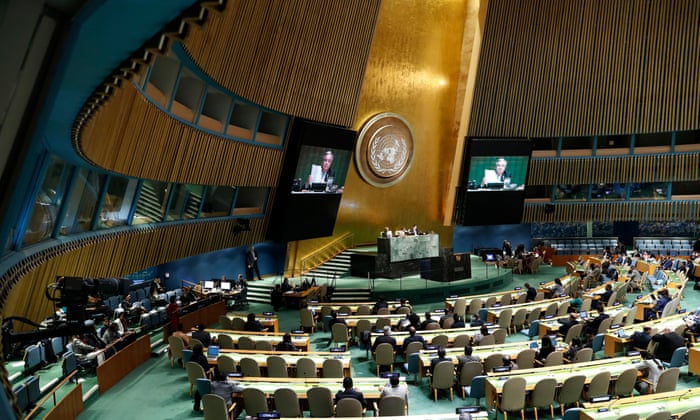
The UN Human Rights Up Front initiative was established in 2014, after a series of UN failures in preventing or sounding the alarm over atrocities.
China and Russia are leading a stealthy and increasingly successful effort at the United Nations to weaken UN efforts to protect human rights around the world, according to diplomats and activists.
The two countries have used the UN budget panel, known as the fifth committee, to cut funding for human rights monitors and for a senior post in the secretary general’s office which is supposed to ensure that human rights – one of three pillars of the UN’s function – are not forgotten in its day-to-day work.
The UN Human Rights Up Front initiative was established in 2014, after a series of UN failures in preventing or sounding the alarm over atrocities, culminating in mass killings in Sri Lanka in 2009.
A senior official in the secretary general’s office was appointed to ensure that progress was made on the issue throughout the organisation, but funding for that post has been cut this year by the fifth committee, as a result of lobbying by China and Russia.
China and Russia are leading a stealthy and increasingly successful effort at the United Nations to weaken UN efforts to protect human rights around the world, according to diplomats and activists.
The two countries have used the UN budget panel, known as the fifth committee, to cut funding for human rights monitors and for a senior post in the secretary general’s office which is supposed to ensure that human rights – one of three pillars of the UN’s function – are not forgotten in its day-to-day work.
The UN Human Rights Up Front initiative was established in 2014, after a series of UN failures in preventing or sounding the alarm over atrocities, culminating in mass killings in Sri Lanka in 2009.
A senior official in the secretary general’s office was appointed to ensure that progress was made on the issue throughout the organisation, but funding for that post has been cut this year by the fifth committee, as a result of lobbying by China and Russia.
The cut, first reported in Foreign Policy, means that the human rights work that was the responsibility of that official will be spread around other posts with other priorities.
The funding of the office of the high commissioner for human rights in Geneva has also been cut.
The funding of the office of the high commissioner for human rights in Geneva has also been cut.
The current high commissioner, Zeid Ra’ad Hussein, has announced that he will be stepping down this year and not seeking another term in the post, explaining to his staff that the lack of global support for protecting human rights made his job untenable.
Last week, Zeid was due to address the UN security council on plight of civilians in Syria but before he began, Russia called a procedural vote to stop him speaking on the grounds that the council was not the proper forum for discussing human rights.
“The fifth committee has become a battleground for human rights,” Louis Charbonneau, the UN director for Human Rights Watch, said.
Last week, Zeid was due to address the UN security council on plight of civilians in Syria but before he began, Russia called a procedural vote to stop him speaking on the grounds that the council was not the proper forum for discussing human rights.
“The fifth committee has become a battleground for human rights,” Louis Charbonneau, the UN director for Human Rights Watch, said.
“Russia and China and others have launched a war on things that have human rights in their name.”
“You can get a mandate for human rights work in the security council, but then Russia and China go behind the scenes to defund it,” Charbonneau said.
“You can get a mandate for human rights work in the security council, but then Russia and China go behind the scenes to defund it,” Charbonneau said.
“And the countries that pay lip service to human rights are not pushing back. But the question is are we going to let them win?”
“China has real political momentum at the UN now,” Richard Gowan, a UN expert at the European Council for Foreign Relations, said.
“China has real political momentum at the UN now,” Richard Gowan, a UN expert at the European Council for Foreign Relations, said.
“It is now the second biggest contributor the UN budget after the US, and is increasingly confident in its efforts to roll back UN human rights activities. It is also pushing its own agenda – with an emphasis on ‘harmony’ rather than individual rights in UN forums. And a lot of countries like what they hear.”
A western diplomat at the UN conceded that human rights were losing ground at the UN, because China had become a more assertive voice, prepared to lead lobbying campaigns, and because Beijing is increasingly leveraging its vast and growing investments in the developing world to win votes for its agenda at the UN.
“The fifth committee is a very important battleground,” the diplomat said.
A western diplomat at the UN conceded that human rights were losing ground at the UN, because China had become a more assertive voice, prepared to lead lobbying campaigns, and because Beijing is increasingly leveraging its vast and growing investments in the developing world to win votes for its agenda at the UN.
“The fifth committee is a very important battleground,” the diplomat said.
“Our team is fighting in the trenches very hard on this. We want to get the best value for the taxpayer, but also to make sure that something as important and central as human rights in the work of the UN is not defunded.”
