Affichage des articles dont le libellé est Marshall Sahlins. Afficher tous les articles

jeudi 21 mars 2019

American Colleges Hosted an Important Part of China’s Propaganda Set-Up. Now They’re Bailing Out.

Congress has demanded more scrutiny of Confucius Institutes.
By DAN SPINELLI

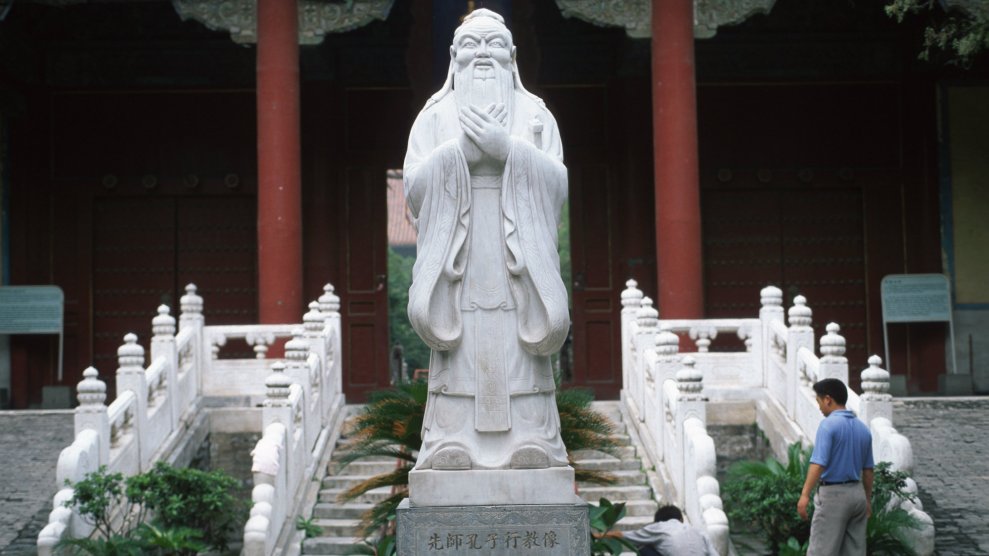
The patron saint of China's propaganda machine

When the University of Minnesota established a Confucius Institute, or center for Chinese language learning, in September 2008, it quickly turned into one of China’s overseas success stories. 
With its efforts to promote the study of Chinese among students “from preschool to 12th grade,” the Minnesota center won plaudits from Hanban, a Chinese government organization that oversees the institutes and China’s other international language partnerships. 
Three years after its opening, the Minnesota outpost was named a Confucius Institute of the Year and between 2014 and 2018, China contributed more than $1.2 million toward the Minnesota center’s operation, according to a report in the Minnesota Daily student newspaper.
In June, the university will cut ties with Hanban, and Minnesota’s Confucius Institute will close. University officials cited a desire to refocus “our China-related activities through a strengthened and enhanced China Center,” spokesperson Katrinna Dodge said in an email to Mother Jones. 
In doing this, Minnesota joins the ranks of roughly a dozen other American colleges that have abandoned their partnerships with Hanban amid increasing criticism of Beijing’s growing authoritarianism and hostility to free speech. 
“Most agreements establishing Confucius Institutes feature nondisclosure clauses and unacceptable concessions to the political aims and practices of the government of China,” the American Association of University Professors concluded in a 2014 report, which said the centers “function as an arm of the Chinese state and are allowed to ignore academic freedom.”
Beijing first imported Confucius Institutes to American universities in 2004, offering generous subsidies and even staff, but the centers have attracted controversy from the start. 
As retired Communist Party bigwig Li Changchun once said, these institutes are “an important part of China’s overseas propaganda set-up.” 
Marshall Sahlins, a University of Chicago anthropologist, called them “academic malware” with propaganda objectives “as old as the imperial era.” 
Many scholars and lawmakers wanted nothing to do with the institutes, which use an authoritarian government’s money to bankroll hundreds of classes and programs at colleges, high schools, and elementary schools. 
Now, as tensions between the US and China have increased, the White House, lawmakers from both parties, and the intelligence community have singled out Confucius Institutes as a nefarious symbol of China’s creeping influence.
In a January Senate hearing, FBI Director Christopher Wray said China posed a threat “more deep, more diverse, more vexing, more challenging, more comprehensive, and more concerning than any counterintelligence threat I can think of.” 
He acknowledged last year that federal agents had targeted some Confucius Institutes with “appropriate investigative steps” over concerns of improper Chinese influence. 
Sen. Marco Rubio (R-Fla.) introduced a bill last month that would require Confucius Institutes to register with the Justice Department as foreign agents, which quickly gained bipartisan support, and the most recent defense appropriations bill restricts schools with Confucius Institutes from receiving Pentagon language grants. “
“Foreign governments should not be funding student organizations on the campuses of democratic societies,” says Larry Diamond, a senior fellow at Stanford University’s Hoover Institution, who examined Chinese influence in American higher education for a November report. 
“And certainly not the foreign government of authoritarian countries.”
In addition to citing concerns about transparency and censorship, lawmakers have also identified a glaring discrepancy between the freedoms afforded to Confucius Institutes in the United States and China’s crackdown on a similar slate of American-run centers abroad. 
In February, a bipartisan report from the Senate Homeland Security subcommittee on investigations identified “over 80 instances in the past four years” in which China interfered with State Department efforts to set up and access “American Cultural Centers” at Chinese universities. 
The US chose to stop funding the program last year amid continuing obstacles put in place by China. 
The report also noted that “nearly 70 percent” of US schools neglected to report Hanban contributions to the Department of Education, despite a requirement that postsecondary institutions report foreign gifts above a certain threshold.
Sen. Tom Carper (D-Del.), the subcommittee’s top Democrat, released a statement with the report that compared China’s influence activities with Russia’s efforts to intervene in the 2016 presidential election. 
“Given what our country experienced during the 2016 election and what we’re preparing to grapple with in 2020,” he said, “it is critical that we be vigilant in combatting foreign efforts to influence American public opinion.”
Diamond does not consider Confucius Institutes a security issue on par with China’s increasing surveillance of its own citizens or its widespread theft of intellectual property, but he argues that unless contracts with Hanban are made public, and assurances put in place to ensure American law governs the centers, the agreements “should be terminated.” 
Gao Qing, a Chinese agent who directed George Mason University’s Confucius Institute and now runs a nonprofit in Washington, DC, that advocates for these centers nationwide, wrote in an email to Mother Jones that Confucius Institutes are meant to offer “apolitical educational programs” and not “engage with any political activity and do not teach politics and policies.”
Confucius, the ancient philosopher whose teachings fell out of favor after the Communist Revolution, became the perfect symbol for China’s renaissance when fifteen years ago, government officials formed a Chinese language-learning center in Seoul. 
More than a century after China ceded control of the Korean peninsula to Japan—and with it, wider influence over the Asia-Pacific region—Beijing was mounting a comeback in its own backyard. 
Who better to adorn the name of its signature foreign influence project than Confucius, a philosopher with a name much easier to market overseas than Marx or Mao.
In the United States, interest in learning Chinese had been rising, but a shortage of qualified instructors left school administrators searching for help. 
By 2008, only 3 percent of elementary schools with language programs taught Chinese. 
After planting roots in South Korea, in 2004, Chinese officials unveiled their first US outpost at the University of Maryland. 
Between 1991 and 1994, Annapolis had slashed funding for state universities by nearly 20 percent, resulting in dramatic cuts at College Park, the University of Maryland’s flagship site. 
Administrators eliminated eight departments and 23 degree programs, according to the Hechinger Report, a nonprofit education news site, so an infusion of Chinese funding looked even more appealing. 
But some faculty members became uncomfortable with the arrangement. 
David Prager Branner, then an associate professor of Chinese, told Mother Jones the agreement to accept funding from the Chinese government constituted a “betrayal of the University’s primary obligation: cultivating young minds and teaching them to cultivate themselves.”
“I imagine the prestige of having the first such Institute in the United States, plus generous (as we were told) funding, more than made up in their minds for the failure to apply normal academic standards,” he wrote in an email. 
He noted that the influx of new instructors with their Hanban-approved textbook “were not even vetted by the University’s own Chinese language faculty.” 
In an email to Mother Jones, a Maryland spokeswoman sent a statement from Donna Wiseman, the university’s Confucius Institute director: “As part of our partnership with Hanban, we are responsible for making decisions about the programs we offer to the community and the extracurricular activities we coordinate on campus.”“
The partnership is a tricky one, as administrators at the College of William and Mary discovered when the Dalai Lama received an invitation to speak on campus seven years ago. 
As the spiritual leader of Tibetan Buddhists, whose land has been under China’s control for centuries, the Dalai Lama is considered a “wolf in monk’s robes” by the Chinese government. 
His appearance at any American university would upset Chinese officials, but especially so at William and Mary, which months earlier had established its own Confucius Institute. 
Ahead of the visit, a university administrator flew to Beijing and briefed Hanban leaders as part of what two knowledgeable sources described as a tense, difficult conversation that included pushback from Chinese officials. 
Nonetheless, the visit went on as planned and the university’s Confucius Institute remains in operation with continuing support from Hanban.
The dust-up was awkward, but ultimately inconsequential for the university. 
Occasional controversies over transparency and improper influence, experts say, largely depend on administrators’ care in reviewing contracts and removing any questionable language from their agreements. 
Qing says Confucius Institutes “affirm the primacy of US law,” but Hanban’s website includes a set of bylaws that several administrators around the country found concerning. 
One line implies that Chinese law, with its noticeably weaker free speech protections, would ultimately govern Confucius Institutes on US soil. 
A current Confucius Institute director at an American college, who requested anonymity to speak frankly about the partnership, said this part of the agreement had “to be watered down” for his school to participate. 
The Chinese officials did not object, he said, and seemed almost to expect the pushback. 
“Some of these nuances take time to learn,” he told Mother Jones. 
“Somebody may, without realizing it, sign the template thinking that’s the way to go forward.”
When George Washington University was first considering whether to form a Confucius Institute, faculty members were put off by a provision in Hanban’s generic agreement that its partners respect the “One China” principle which maintains that Taiwan is part of the People’s Republic of China. 
The US formally adopted this policy in 1979, but the provision still concerned administrators who interpreted it as a backdoor way to stifle academic discourse about Taiwan. 
The university ultimately agreed to a contract, years later, when the provision was no longer required.
A common criticism lodged against Hanban is the secrecy of its contracts. 
“At most Institutes, the terms of agreement are hidden,” a report from the conservative National Association of Scholars found in 2017. 
The key to keeping institutes free of undue influence, several administrators and experts reiterated, involves vetting the contracts more rigorously. 
No matter how innocuous a single institute may be, now that President Trump’s foreign policy has appeared to settle on an adversarial approach to Beijing, it is likely that they will become increasingly isolated. 
Sen. Marco Rubio, one of the most persistent critics of China in Congress, expressed a growing Washington consensus when he asked during a Senate hearing this year whether China had become “the most significant counterintelligence threat this nation has faced, perhaps in its history but certainly in the last quarter century.”

mercredi 17 janvier 2018

Crimes In The Name Of Confucius

How China Infiltrated U.S. Classrooms
Chinese subversion machine has continued its forward march on college campuses across the United States
By ETHAN EPSTEIN


Last year, the University of North Carolina at Charlotte made an announcement to great fanfare: The university would soon open a branch of the Confucius Institute, the Chinese government-funded educational institutions that teach Chinese language, culture and history. 
The Confucius Institute would “help students be better equipped to succeed in an increasingly globalized world,” says Nancy Gutierrez, UNC Charlotte’s dean of the College of Liberal Arts and Sciences, and “broaden the University’s outreach and support for language instruction and cultural opportunities in the Charlotte community,” according to a press release.
But the Confucius Institutes’ goals are a little less wholesome and edifying than they sound—and this is by the Chinese government’s own account. 
A 2011 speech by a standing member of the Politburo in Beijing laid out the case: “The Confucius Institute is an appealing brand for expanding our culture abroad,” Li Changchun said. 
“It has made an important contribution toward improving our soft power. The ‘Confucius’ brand has a natural attractiveness. Using the excuse of teaching Chinese language, everything looks reasonable and logical.”
Li, it now seems, was right to exult. 
More than a decade after they were created, Confucius Institutes have sprouted up at more than 500 college campuses worldwide, with more than 100 of them in the United States—including at The George Washington University, the University of Michigan and the University of Iowa. 
Overseen by a branch of the Chinese Ministry of Education known colloquially as Hanban, the institutes are part of a broader propaganda initiative that the Chinese government is pumping an estimated $10 billion into annually, and they have only been bolstered by growing interest in China among American college students.
Yet along with their growth have come consistent questions about whether the institutes belong on campuses that profess to promote free inquiry. 
Confucius Institutes teach a very particular, Beijing-approved version of Chinese culture and history: one that ignores concerns over human rights, and teaches that Taiwan and Tibet indisputably belong to Mainland China. 
Take it from the aforementioned Li, who also said in 2009 that Confucius Institutes are an “important part of China’s overseas propaganda set-up.” 
The centers have led to a climate of self-censorship on campuses that play host to them.
Despite years of these critiques—including a recent outcry at the University of Massachusetts at Boston and the shuttering of Confucius Institutes at two of the nation’s top research universities—they’re still growing in number in the United States, albeit at a slower clip than a few years ago. Several opened on American campuses last year. 
And vanishingly few schools have rethought the institutes and closed them, suggesting that once they’re implanted, they’re entrenched. 
At several campuses, they’re actually expanding their footprints with bigger facilities and new courses. 
I contacted more than a half-dozen Confucius Institutes, and several officials said in interviews that they’re not looking back. (Others declined to comment or simply ignored me, further suggesting a commitment to keeping the Institutes going. The Chinese Embassy in Washington also did not respond to a request to comment by publication time.)
That so many universities have welcomed the Confucius Institute with open arms points to another disturbing trend in American higher education: an alarming willingness to accept money at the expense of principles that universities are ostensibly devoted to upholding. 
At a time when universities are as willing as ever to shield their charges from controversial viewpoints, some nonetheless welcome foreign, communist propaganda—if the price is right.
***
“Coordinate the efforts of overseas and domestic propaganda, [and] further create a favorable international environment for us,” Chinese minister of propaganda Liu Yunshan exhorted his compatriots in a 2010 People’s Daily article. 
“With regard to key issues that influence our sovereignty and safety, we should actively carry out international propaganda battles against issuers such as Tibet, Xinjiang, Taiwan, human rights and Falun Gong... We should do well in establishing and operating overseas cultural centers and Confucius Institutes.”
Liu’s orders have been heeded. 
The first Confucius Institute opened in South Korea in 2004. 
They quickly spread to Japan, Australia, Canada and Europe. 
The United States, China’s biggest geopolitical rival, has been a particular focus: Fully 40 percent of Confucius Institutes are stateside. 
In addition to the Institutes at universities, Hanban also operates hundreds of so-called Confucius Classrooms in primary and secondary schools. 
The public school system of Chicago, for example, has outsourced its Chinese program to Confucius Classrooms.
Beijing treats this project seriously, as evidenced by who runs the show. 
Hanban (shorthand for the ruling body of the Office of Chinese Language Council International, a branch of the Ministry of Education) is classified technically as a nonprofit agency, but it is dominated by Communist Chinese officialdom. 
Representatives from 12 top state agencies—including the Ministry of Foreign Affairs and the State Press and Publishing Administration, a propaganda bureau—sit on its executive council. 
Hanban’s director general is on the Chinese state council, the 35-member board that basically runs the country.
Hanban has been shrewd in compelling universities to host Confucius Institutes. 
Marshall Sahlins, a retired University of Chicago anthropologist and author of the 2014 pamphlet Confucius Institutes: Academic Malware, reports that each Confucius Institute comes with “$100,000 in start up costs provided by Hanban, with annual payments of the like over a five-year period, and instruction subsidized as well, including the air fares and salaries of the teachers provided from China... Hanban also agrees to send textbooks, videos, and other classroom materials for these courses—materials that are often welcome in institutions without an important China studies program of their own.” 
And each Confucius Institute typically partners with a Chinese university.
They’re kind of like restaurant franchises: Open the kit, and you’re in business. 
American universities can continue to collect full tuition from their students while essentially outsourcing instruction in Chinese. 
In other words, it’s free money for the schools. 
At many (though not all) Confucius-hosting campuses, students can receive course credit for classes completed at the institute.
But the institutes go to some length to obscure their political purpose. 
There’s the name, for example: Most Americans associate Confucius with wisdom, or cutesy aphorisms. 
It’s likely the centers would be less successful were they called Mao Institutes. 
The Institutes also offer a plethora of “fun” classes—not for academic credit, and often open to members of the general public—in subjects like dumpling making and tai chi.
The Chinese teachers are thoroughly vetted by Hanban.
They “must have a strong sense of mission, glory, and responsibility and be conscientious and meticulous in [their] work,” Hanban says. 
They’re also explicitly instructed to toe Beijing’s line on controversial political questions. 
There can be no discussion whatsoever of human rights in China, or the Tiananmen Square massacre. 
Should a student raise an uncomfortable question about, say, the political status of Tibet, Hanban’s instructors are ordered to refocus the discussion on, say, Tibet’s natural beauty or indigenous cultural practices (which, ironically, Beijing has spent decades stamping out).
Matteo Mecacci of the advocacy group International Campaign for Tibet requested a sampling of the Institute’s course materials from a D.C. area university several years ago. 
“Instead of scholarly materials published by credible American authors, not to speak of Tibetan writers, what we received were books and DVDs giving the Chinese narrative on Tibet published by China Intercontinental Press,” he wrote in Foreign Policy,“which is described by a Chinese government-run website as operating ‘under the authority of the State Council Information Office … whose main function is to produce propaganda products.’”
One student I spoke to—a junior at the University of Kentucky, which is home to a Confucius Institute—recalls attending a Confucius event at which another student, who was considering studying abroad in China, asked about the air pollution there. 
The response from the Confucius faculty was that the reports of pollution were “misinformation promoted in the U.S. media.” 
The student says Confucius faculty also “glorified and glossed over” negative aspects of Chinese culture and politics. 
Another student, a Kentucky senior who has taken classes at the same Confucius Institute, agrees that the institute “promotes an overly rosy picture of Chinese culture,” though, the student adds, “I don’t think it’s a problem for students to take advantage of [Confucius Institute] resources as long as they view the institute with a critical eye and round out their perspective on China with other experiences and points of view.”
Meanwhile, if Hanban’s instructors are not adequately vetted back home, there can be trouble. Consider the case of Sonia Zhao. 
Zhao, a Chinese national, was dispatched by Hanban to McMaster University in Hamilton, Ontario, in 2011 to teach Chinese language. 
She’s also a practitioner of Falun Gong, the Buddhist-tinged spiritual movement that Beijing despises as a threat to its authority. 
Zhao quit a year into her tenure, arguing that McMaster University was “giving legitimization to discrimination.” 
That’s because, in order to secure her employment with Hanban, Zhao said she was forced to disguise her fealty to Falun Gong. 
Her employment contract with Hanban explicitly stated that she was “not allowed to join illegal organizations such as Falun Gong,” she said. 
This kind of open religious discrimination is illegal in Canada, as it would be in the United States. 
McMaster University, in light of this disclosure, subsequently shuttered its Confucius Institute in 2013, citing the institute’s “hiring practices.”
Self-censorship has become an issue as well. 
In 2008, a court in Israel found that Tel Aviv University, home to a Confucius Institute, had illegitimately closed an art exhibition on Falun Gong because of Chinese government pressure. 
A year later, North Carolina State University, host to a Confucius Institute, scuttled a planned appearance by the Dalai Lama for fear of Chinese backlash: The director of the Institute warned NC State officials that such a visit could hurt “strong relationships we were developing with China.” A few years later, similar events transpired at the University of Sydney in Australia, which drew heat from members of the Parliament of Australia.
***
In recent weeks, I contracted administrators at several universities with Confucius Institutes, primarily ones that had opened recently, and none expressed regret or indeed much concern. 
The George Washington University, the private university nestled in the heart of the nation’s capital, has hosted a Confucius Institute for several years. 
The institute’s founding director, Peg Barratt, says her university’s “eyes were open” when GW opened its center in in 2013. 
“We were aware there was some controversy” surrounding Confucius Institutes when other universities opened theirs, she told me. 
“Some [other universities] had internal censorship,” she readily acknowledges. 
Nonetheless, she says the Institutes are innocuous, modeled, she argues, on European cultural institutes like the British Council, Goethe Institute and Alliance Française. 
Of course, not only are Great Britain, Germany and France not communist regimes, but those institutes are standalone enterprises, not on college campuses.
Western Kentucky University, where the Confucius Institute is expanding—it just moved into a new building—also defends its partnership. 
Terrill Martin, director of the Institute, told me, “I don’t believe the Confucius Institute program is controversial at all. I just believe that people don’t understand, don’t ask the right questions and make a lot of unfounded assumptions about the program, based on the failures of a few.”
Nancy Gutierrez, at the University of North Carolina at Charlotte, says the institute there will fill an unmet need. 
“We made the decision to host a [Confucius Institute] because we believe that this partnership will allow us to expand understanding of Chinese culture very broadly—for community members and for our students,” she says. 
In other words, Hanban can provide resources that UNC presently can’t. 
Gutierrez also says, “A faculty advisory committee will provide the intellectual guidance … ensuring that we are guided by principles of academic freedom.” 
And she notes that Confucius Institute courses will not offer academic credit at UNC Charlotte—at least not yet. 
The same is true at Western Kentucky University.
Eric Einspruch, who chairs Portland State University’s Confucius Institute, also defends it: The Confucius Institute simply offers “noncredit Chinese courses, cultural programs of interest to the community, and faculty-initiated scholarly activity,” he says. 
But even the Institute’s innocuous-seeming language courses have come in for criticism. 
They only teach simplified characters, which are used on Mainland China but not in Taiwan, Hong Kong or Singapore, estranging language learners from Chinese texts produced anywhere but the Mainland.
One institution that bucked the trend was the University of Chicago. 
The school opened a Confucius Institute in 2010, which quickly proved controversial. 
To Bruce Lincoln, a now-retired religion professor at Chicago who then served on the faculty senate, the Confucius Institute represented the “subcontracting [of the] educational mission” in the United States—a “hostile takeover of U.S. higher education by a foreign power,” as he told me. (Prior to his battle against the Confucius Institute, Lincoln was involved in another fight at the University of Chicago, against the establishment of a Milton Friedman Institute, which would have been largely funded by conservative donors. That too represented a subcontracting of the education mission, he believes—in this case, the “corporatization of universities.”)
When Hanban’s contract came up for renewal in 2014, Lincoln, along with Marshall Sahlins, led a petition drive, which garnered the support of more than 100 other faculty members, demanding that the contract be canceled. (There was very little student involvement, Lincoln says.) 
That year, the University of Chicago booted the Institute because of academic freedom concerns. Chicago’s move won praise from outlets as ideologically diverse as Forbes and the New York Review of Books. 
Shockingly few universities have followed Chicago’s lead, though, Penn State being one notable exception; it also closed its institute in 2014, as well.
Many of those universities who maintain Confucius Institutes appear to go to great lengths to shield them from criticism. 
Last year, Rachelle Peterson, a scholar at the Heartland Institute, a conservative think tank, released a thorough report about Confucius Institutes for the National Association of Scholars, a right-leaning academic organization. 
At the heart of Peterson’s report were 12 case studies of Confucius Institutes at New York and New Jersey universities. 
Over the course of her reporting, Peterson says, “There were a lot of unanswered emails, a lot of unanswered phone calls” (an experience shared by this journalist). 
When she did manage to set up interviews with Confucius Institute staff, they were often canceled at the last minute, like those at the University of Albany and the University of Binghamton. 
Another time, when she managed to secure an interview with a Confucius Institute staff member, he insisted that the meeting “happen in a basement … not in his office.” 
He seemed afraid of being caught, she says.
The most disturbing event transpired at Alfred University in upstate New York. 
There, Peterson, says, she had “called the Confucius Institute, spoken to a teacher … and received permission to sit in on [a class].” 
As she observed the Chinese-language class, she recalls, the provost of the university charged into the classroom, interrupting the lesson. 
He ordered her removal from the classroom and told her she had to leave the campus immediately. Two security guards swiftly escorted her off campus. (Alfred University did not respond to a request for comment asking to confirm or deny Peterson’s account.)
Today, there are signs of a nascent, if isolated, backlash. 
Just last month, a group of students and alumni from UMass Boston, home of the Bay State’s only Confucius Institute, wrote a letter to the school’s chancellor expressing deep concern that the university is “unwittingly assisting the Chinese government to promote censorship abroad, while undermining human rights and academic freedom.” 
The UMass group requested a meeting with the chancellor to discuss their concerns, but according to Lhadon Tethong, a pro-Tibet activist who helped spearhead the letter, that request has yet to be answered. (A spokesperson for the university told the Boston Globe that the institute has succeeded in promoting “the mutual understanding of language and culture.”)
The National Association of Scholars suggests universities shutter their Confucius Institutes. 
But such counsel is hardly limited the ideological right. 
The American Association of University Professors, America’s leading professorial guild, also recommended in 2014 that “that universities cease their involvement in Confucius Institutes unless the agreement between the university and Hanban is renegotiated,” so that the universities have unilateral control over the curriculum and faculty, Confucius faculty have the same rights of free inquiry as their fellow teachers, and contracts between Hanban and the partner universities are made public.
Nonetheless, none of the schools I contacted said that they had any plans to shutter or reform their institutes.
***
Instead, Confucius Institutes continue their forward march.
In 2015, they opened at Tufts University, New Jersey City University, Southern Utah University and Northern State University in South Dakota.
In 2016, Savannah State University added one.
And last year, in addition to UNC-Charlotte, Transylvania University in Kentucky is launching a new branch.
Gutierrez of UNC concedes that, when her school announced it would open one earlier last year, many faculty members were concerned and “raised serious questions.”
But the structure the school developed—so as not allowing courses to be taken for credit—allayed such fears, she says.
Confucius Classrooms, for younger students, are also ascendant these days: In October, local media reported that three new ones would be planted in Texas public schools, and UMass Boston is helping develop them at schools in Massachusetts, including the prestigious Cambridge Rindge and Latin School, where a Confucius Classroom just launched.
At scores of universities, meanwhile, the institutes are expanding both physically and programmatically.
New courses and scholarships at existing ones are announced all the time.
And they’re growing rapidly overseas, particularly these days in Africa, where China has been aggressively expanding its footprint in recent years.
Lincoln, of the University of Chicago, says the institutes have proved successful, in a sense, because Hanban offers a “cheap way to teach classes that [otherwise] wouldn’t have been taught.”
Public universities have suffered punishing funding cuts over the past decade: “A decade since the Great Recession hit, state spending on public colleges and universities remains well below historic levels, despite recent increases,” reads a recent report from the left-leaning Center on Budget and Policy Priorities.
According to the Center, adjusting for inflation, public spending on community colleges and universities was about $9 billion below 2008 levels in 2017.
It’s unsurprising, then, that many institutes have sprung up at public universities, or that a huge amount of growth occurred from 2010 to 2012, when budgets were particularly hard hit.
But those conditions could return: President Donald Trump’s proposed 2018 budget would also severely slash funding for universities, likely pushing more schools to outsource programs.
The Economist, meanwhile, estimates that China is spending $10 billion a year to promote its image abroad through efforts like cultural festivals, foreign media (think of those China Daily inserts that are slipped into the Washington Post) and educational exchanges.
Confucius Institutes are a vital part of this mission.
It’s not hard to envision how they might work, for example, by one day weakening Americans’ loyalty to Taiwan.
It seems that Beijing probed, and found a weakness: money. 
It may be intellectually indefensible for universities to host Confucius Institutes, but at a time of reduced funding, it makes eminent sense.
How ironic that the ostensibly communist Chinese seem to understand financial imperatives better than we Yankees do.