Affichage des articles dont le libellé est FARA. Afficher tous les articles

lundi 6 janvier 2020

U.S.'s 3.17 million Chinese Spies

A Chinese “tourist” accused of espionage is the latest example of a growing threat to US security
By Justin Rohrlich
Chinese tourist-spies

On June 28, 2019, Qingshan Li landed in Southern California on a flight from China.
Li, a Chinese national visiting the US on a tourist visa, was scheduled to return home 10 days later.
The day after he arrived, Li drove his rental car to a storage facility in the San Diego area.
There, he met up with an unidentified person named in court filings only as “AB,” from whom Li had arranged to purchase several pieces of sensitive military gear.
Li’s case, which has not been previously reported and is described in a federal charging document obtained by Quartz, is among the most recent incidents of Chinese civilians accused of spying on behalf of Beijing.
While Li was apprehended by authorities, he represents the immediate—and increasing—threat China poses to US national security, say experts.
One of the items Li was allegedly after, a Harris Falcon III AN/PRC 152A radio, is designated as a defense article on the United States Munitions List, and subject to international arms trafficking regulations.
This means the Falcon III, which provides US troops in the field with National Security Agency-certified encrypted communications, cannot leave the country without a special license issued by the State Department.
Li had agreed to pay AB a total of 50,000 renminbi, or roughly $7,200, for the radio.
He knew AB was already under investigation for export-related crimes and believed AB “was attempting to get rid of the radio in light of AB’s entanglement with law enforcement,” according to court filings.
Li told AB he planned to drive with the Falcon III to Tijuana, Mexico—about 30 minutes by car from San Diego—and ship it to China from there.
This, Li reportedly thought, would help him skirt American trafficking laws.
He gave AB a $600 down payment for the radio, and left the storage facility carrying it in a shoulder bag.
It is unclear from the court record whether AB was cooperating with authorities, or if they had become aware of Li’s activities during their ongoing monitoring of AB’s conversations, but the FBI was waiting for Li outside the building.
Agents intercepted him immediately after the transaction with AB was completed.
Li, they soon discovered, had a second Harris Falcon III in his possession, several antennas, a digital memory card, and a map of the North Island Naval Air Station, a nearby military base home to two US aircraft carriers.


According to an FBI affidavit filed in the case, Li came clean during questioning, confessing he had been tasked with obtaining the Falcon III radio by a contact Li claimed was an officer in the Chinese People’s Liberation Army (PLA).
He told the agents the PLA officer had given him a list of US military items to procure on his trip to the US, including the Falcon III.
Li was indicted by a federal grand jury less than two weeks after his arrest, and in September pleaded guilty to attempting to export defense articles without a license.
The charge carries a possible $1 million fine and 20 years in prison.
Last month, the Naval Criminal Investigative Service seized everything Li had on him at the time he was caught, including an iPhone 10 XS Max, which Li said he used to set up the radio purchase, as well as $2,844 Li said was intended for further illegal buys.
He remains in custody, pending a pre-sentencing hearing set for Feb. 7.
Jonathan Rapel, Li’s attorney, and assistant US attorney Alexandra Foster, the lead federal prosecutor on the case, both declined to comment on Li’s case.

Not the first attempt
Almost exactly a year ago, America’s top counterintelligence official sounded the alarm about Chinese espionage.
China’s spy services are more persistent than even Russia’s or Iran’s, with broader reach and a wider variety of operational techniques than any other US adversary, warned William Evanina, who has led the National Counterintelligence and Security Center, a government agency under the aegis of the Office of the Director of National Intelligence, since 2014.
“China is number one,” Evanina said in a 2018 podcast interview with former deputy CIA director Michael Morell. 
“Existentially, long term, they’re the largest threat to our national security, bar none—it’s not even close.”
There has been a marked increase in non-traditional intelligence collection efforts, Evanina said. “Those out-of-embassy jobs where they send over engineers, businessmen, students to do the same type of collection, recruitment, co-opting of information… at mass scale,” he said.
The Chinese intelligence services possess practically unlimited financial resources, and use this wealth freely, said Janosh Neumann, a former counterintelligence officer with Russia’s Federal Security Service (FSB), which replaced the KGB at the end of the Cold War.
The US, as the undisputed leader in innovation and advanced technology, is the world’s top target for scientific and technical espionage of Chinese intelligence services.
Neumann, who defected to the US in 2008, describes the Li case as a “classic example” of the way China operates, using voluminous numbers of agreeable civilians as freelance agents, as well as private companies, to further its geopolitical aims. (In the espionage world, “officer” denotes a professional intelligence operative, while “agents” are roughly akin to confidential informants.)
“The standard scheme is when special services use agents—sources—for smuggling technical devices or technologies prohibited from export from the United States,” Neumann told Quartz.
“Most likely, Li was one of several agents whom the Chinese side sent with a similar task. To perform such operations, several agents are used simultaneously, thereby increasing the chances of success.”
Documents filed in the Li case do not provide any details about his background.
However, the circumstances do suggest he was a citizen agent.
The intelligence arm of the PLA, for whom Li said he was working, is tasked with obtaining military secrets and related foreign technology, mostly the illegal export of restricted military and dual-use technology, according to Nicholas Eftimiades, who spent 34 years as a senior official with, variously, the CIA, the Defense Intelligence Agency, and the State Department’s Bureau of Diplomatic Security.
Eftimiades, who is considered one of the country’s foremost experts on Chinese espionage, told Quartz that Li’s tasking from the PLA was a “very focused collection operation,” and said the objective for someone like Li is to get in and get out before US authorities can figure out what’s happening.
In this instance, however, Li’s contact, AB, was already in the FBI’s sights.
When Li suddenly appeared on their radar, Eftimiades said, he “walked right into a trap.”
The Li case does not mark the first time China has tried stealing the Harris Falcon III radio, Eftimiades said, pointing to a trio of Chinese agents prosecuted in 2009 for selling an earlier model of the Falcon III.
There is a civilian version of the Falcon III, Eftimiades noted, but that has already been knocked off by the Chinese and is not of particular interest to its spy services.

A threat to US troops
Although China is known for knocking off pilfered technology through reverse engineering, that may not have been the primary goal here.
If China were to successfully acquire a military-grade Falcon III, it could directly endanger US troops on the battlefield.
“What you’d want to do is take it apart and understand the guts of it,” Eftimiades said.
“It also has uploadable software. Were I a bad guy, I would want to know exactly how and where the software is uploaded, because it’s probably done from some central point. If I can get into that supply chain, I could theoretically upload software that may allow me access to [encrypted top secret] communications.”
Dan Grazier, a former US Marine tank commander, relied on the Falcon III regularly during tours of duty in Iraq and Afghanistan.
“This is the handheld unit used by our forward air controllers on the ground,” Grazier told Quartz.
“I would have a forward air controller with my tank company, and he would use this kind of radio to talk to aircraft, to guide close air support missions. So, this is an important system. It’s certainly something that we would not want to fall in the hands of a potential adversary.”
Now a fellow at the nonprofit Project on Government Oversight, Grazier said he assumes the Falcon III Li attempted to buy from AB was smuggled off of a US base, where it was almost certainly kept under lock and key within a secure area.
“The military works hard to control these sensitive items,” Grazier continued.
“When I was the officer of the day for the tank battalion, I had to check to make sure that the vaults were locked, I had to sign the sheet to show that I checked it. If it gets out and if it gets off base, then it becomes really difficult to keep track of these things.”
Li’s sloppy spycraft is another indication he was an asset recruited from outside of the official intelligence community.
If Li were a full-time spy, speculated Eftimiades, everyone involved would have first, at minimum, been vetted thoroughly by the PLA, including his source for the illicit military equipment, and would have established a secure means of communication before anyone was dispatched abroad.
The Li operation was “state-sponsored, clearly,” Eftimiades said, pointing out that Li told the FBI he was taking orders from the PLA, but fits into what Eftimiades described as China’s “whole-of-society approach” towards conducting espionage.

The “million grains of sand” method
In a 2018 op-ed for The New York Times, Paul Moore, a former China analyst for the FBI, explained the technique, which is also known as a “mosaic” or “million grains of sand” method:
“If a beach were a target, the Russians would send in a sub, frogmen would steal ashore in the dark of night and collect several buckets of sand and take them back to Moscow,” Moore wrote.
“The US would send over satellites and produce reams of data. The Chinese would send in a million tourists, each assigned to collect a single grain of sand. When they returned, they would be asked to shake out their towels. And they would end up knowing more about the sand than anyone else.”
Chinese citizens benefit in two ways from this arrangement.
Beijing’s spymasters pay well for valuable information, and a large number of individuals and companies are willing to work with the government. 
This has to do not only with any immediate financial rewards, but also the promise of increased future earnings in one’s regular life, as well.
“If you’re an individual or a company, you stand in very good stead with the Chinese government for doing these sorts of things, which of course raises your own guanxi, your own reputation, inside those circles, and your ability to do more business,” said Eftimiades.
Knowing your adversary is a concept “as old as time,” said Grazier.
By the same token, it’s also incumbent upon US counterintelligence to protect the nation’s sensitive information and materiel as much as possible.
“We don’t want to make it easy for them, that’s the big thing,” Grazier said.
“We know that they’re doing this, but the counterintelligence aspect of the military is to thwart their efforts as much as we possibly can, and not do their jobs for them.”
To that end, the American counterintelligence apparatus is overdue for an update, Eftimiades said. For starters, he believes the federal government must start partnering with industry much more closely than it does now.
The FBI, as well as the Department of Homeland Security and the Department of Commerce are making attempts to strengthen ties with the commercial sector, but this sort of outreach is expensive and time-consuming, said Eftimiades.
Agents get taken off the street to conduct industry briefings, which Eftimiades says doesn’t typically impart much usable information, anyway.
Equally important, Eftimiades said, the US needs to strengthen laws on intellectual property and the Foreign Agents Registration Act (FARA), which requires anyone acting on behalf of a foreign government to register with the Department of Justice and disclose their affiliation.
FARA became law in 1938 to counter Nazi propaganda, and experts say it hasn’t evolved with the times—the 82-year-old regulations obviously don’t cover things like social media, and didn’t anticipate how blurred the lines between private industry and government would eventually become in countries like China and Russia.
“I testified before Congress a couple of times in the 90s, and I told them, ‘Do something about this problem now, because if not, in 20 years, you’re going to be calling me back crying: How did it get this bad?’” Eftimiades said. “And you know what happened? They didn’t do anything about it.”

mardi 20 août 2019

American Tech Quisling

DOJ should take action against China's Twitter propaganda
BY AUSTIN LOWE


Over the last few years, Chinese state media organs have accelerated a campaign to leverage U.S. social media platforms – namely, Twitter – to promote the Chinese Communist Party’s (CCP) narrative on several issues. 
All of China’s major state media outlets have Twitter accounts, through which they regularly disseminate a variety of material.
Hu Xijin, who heads the state-run Global Times, has become the government’s de facto English-language commentator on trade tensions with the United States.
Beyond this, Chinese Ambassador to the United States Cui Tiankai launched an account to share the party line on the recent Hong Kong protests and the Taiwan independence movement. 
Chinese state media outlets have even targeted a U.S. diplomat for meeting with Hong Kong activist Joshua Wong, exposing her personal information and drawing a stern rebuke from the U.S. State Department.
The irony of this trend is not lost on anyone with some familiarity of China’s censorship regime. 
That China’s state-sponsored propaganda can freely subsist in the virtual echo chambers of Twitter while the platform is blocked entirely on the Chinese mainland is certainly a less than reciprocal arrangement. 
But beyond this, the circulation of propaganda by certain Chinese state media outlets throughout the United States via Twitter in its current form is in violation of U.S. law.
Last fall, under the tenure of Attorney General Jeff Sessions, the Department of Justice (DOJ) directed Xinhua News Agency and CGTN to register as foreign agents per the provisions of the Foreign Agents Registration Act, or FARA. 
Xinhua is China’s major state-run media outlet, while CGTN is China Central Television’s overseas operation (the English-language China Daily has also been registered since 1983). 
This was indeed a major step toward ensuring that these entities meet the comprehensive disclosure requirements for foreign lobbyists seeking to influence U.S. politics. 
A critical aspect of their activity that has gone unpunished, however, is their unbridled sharing of CCP narratives on Twitter.
Per the DOJ, Section 4 of FARA “outlines the responsibilities of a registrant who disseminates informational materials on behalf of a foreign principal.” 
Section 4(b) of the law effectively requires that such entities provide a disclaimer on any informational materials disseminated that includes “a conspicuous statement that the materials are distributed by the agent on behalf of the foreign principal, and that additional information is on file with the Department of Justice.”
While it is unclear whether CGTN and China Daily (Xinhua has yet to register) have been regularly providing the DOJ with copies of each of their tweets (let’s just say it’s unlikely), their tweets currently do not include any obvious indication that they are being transmitted on behalf of the foreign principal, the Chinese government. 
More broadly, as a matter of policy, Twitter does not even distinguish between such foreign agents, their employees, and the rest of the Twitter user base. 
To date, the only means of distinguishing one’s account is the coveted “verified” status, which, according to Twitter, is granted to accounts “of public interest.”
Twitter providing foreign agents like CGTN and China Daily with the legitimacy that comes with the verified status without making clear that they are registered foreign agents is negligent, if not irresponsible, and warrants a review of this policy. 
But regardless, the frequent activity of these accounts on the platform – which most certainly falls under the umbrella of “informational materials for or in the interests of such foreign principal” – deserves the attention of the DOJ.
There is undoubtedly a lack of enforcement in this area, and the specifics of how the provision should be applied can be debated by the relevant authorities and Twitter personnel. 
Indeed, the attorney general has the statutory authority to “define what constitutes a conspicuous statement,” or disclaimer label. 
But the need for action is obvious. 
If our government considers Russian bot posts a threat to election security, and Twitter regularly takes action to combat such disinformation, then why are similar campaigns by Chinese state actors any less concerning?
Say what you will about China’s censorship regime and its ability to control narratives within its own borders. 
But Twitter is a U.S. company with more than 300 million active monthly users and, for better or worse, serves as the primary mouthpiece of the sitting U.S. president.
As a platform, it carries significant weight in U.S. politics. 
It thus bears significant responsibility, not only to help foster a secure election environment but also to prevent state-sponsored disinformation campaigns from gaining traction in U.S. political discourse through unfettered, noncompliant distribution of propaganda.
Given that the expressed purpose of FARA itself is to “protect the national defense, internal security, and foreign relations of the United States,” a first step toward this aim would be for the DOJ to require CGTN and China Daily, and eventually Xinhua (and by extension, other foreign agents like Sputnik and RT), to provide the required disclaimers on all media shared via Twitter and work with the company to hammer out the specifics of how this would be implemented.
We do not censor in the United States, and state-sponsored propaganda outlets should still be free to partake in the marketplace of ideas and enjoy the first amendment rights that often do not exist in their home country. 
But first and foremost, they must comply with existing U.S. law.

mercredi 7 août 2019

Chinese Fifth Column

FARA should apply to Confucius Institutes
BY ANDY KEISER

Under Xi Jinping's consolidated power, China is working diligently to supplant the United States as the world's top economic and military power. 
That includes a comprehensive effort to influence American K-12 and higher educational students with a favorable view of the Communist Chinese government to shape U.S. policy over the long-term.
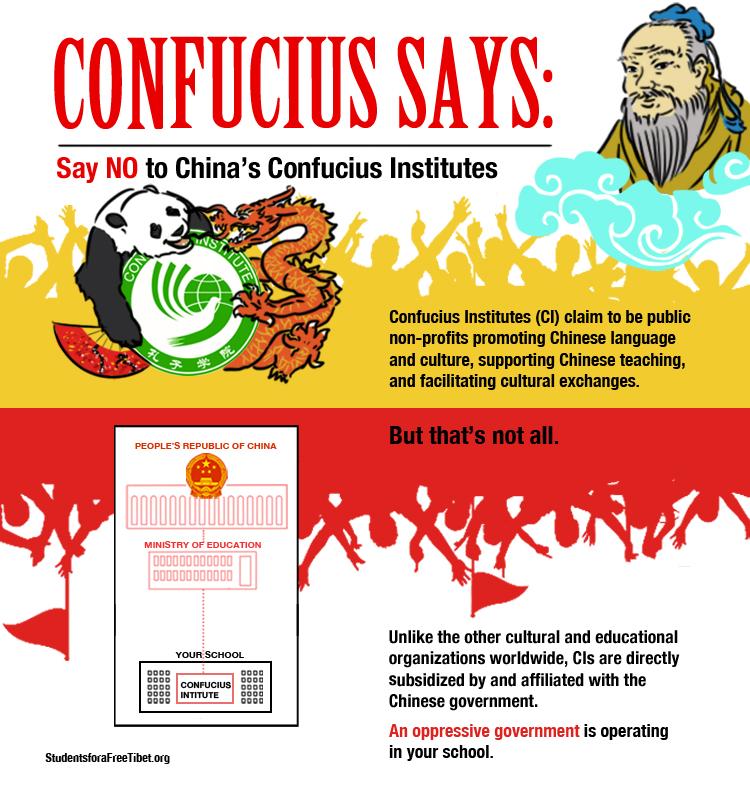
This influence operation by a hostile foreign power, led by China's state-controlled Confucius Institutes, should trigger the Justice Department to require a Foreign Agents Registration Act (FARA) filing by the institutes and its employees.
FARA requires anyone working at the behest of a foreign government to register with the Department of Justice. 
Originally written to combat propaganda, FARA also covers lobbying and public relations. 
FARA is a content-neutral disclosure statute that is designed to expose foreign associations to help ensure transparency and accountability in public policy.
Confucius Institutes are extensions of the Chinese government, plain and simple. 
They are owned and controlled by the government in Beijing and are overseen by the Office of Chinese Language International, commonly known as Hanban, a division of the Chinese Ministry of Education.
The Chinese government spends billions of dollars annually on propaganda activities promoted through Confucius Institutes.
 
Primarily targeted to the U.S., there are more than 100 Confucius Institutes in the American universities and colleges that have opted into the programing. 
Confucius Institutes have expanded their reach to include K-12 education through an effort called "Confucius Classrooms."
The underhanded genius behind Confucius Institutes is that they operate under the benign guise of teaching Chinese language, culture and history while simultaneously ensuring that they can restrict speech, control curriculum and force educational institutions to choose Confucius Institute faculty from a pre-approved list of teachers provided by the Hanban.
According to a letter Senator Chuck Grassley (R-Iowa) sent last year to then-Attorney General Jeff Sessions, Confucius Institutes "require the teaching to ignore human rights abuses, and stress that Taiwan and Tibet are part of China, among other restrictions."
Institute presence, particularly on U.S. college campuses, can also be a threat to economic and national security. 
The Chinese government can hand-pick employees at Confucius Institutes and use them as its eyes and ears or task them to steal sensitive, valuable university research. 
The transparency of a FARA filing would at least give more insight to U.S. counterintelligence professionals and to the public about the scope and scale of Confucius Institute activities.
According to Grassley's letter, a Chinese government official stated that the "Confucius Institute is an appealing brand for expanding our culture abroad. It has made an important contribution toward improving our soft power... using the excuse of teaching Chinese language, everything looks reasonable and logical."
Others have taken note. 
The Permanent Subcommittee on Investigations, led by Senators Rob Portman (R-Ohio) and Tom Carper (D-Del.), released a bipartisan report in 2015 that detailed the activities of Confucius Institutes. 
Among several alarming findings, it details that since 2006 the Chinese government has given more than $158 million to fund Confucius Institutes in the U.S. 
It has veto authority over events and speakers at the institutes, and controls every aspect of their operations in the United States, including staff members pledging to protect Chinese national interests.
Grassley recently introduced the Foreign Agents Disclosure and Registration Enhancement Act of 2019 to beef up FARA enforcement and held a hearing on foreign threats to taxpayer funded research, which focused extensively on China's activities on university campuses. 
Sen. Ted Cruz (R-Texas) has led a series of efforts against Chinese influence and espionage operations targeting American higher education, having secured a provision in the National Defense Authorization Act for Fiscal Year 2019 prohibiting the Department of Defense from funding Confucius Institutes.
Sen. Cruz has also introduced legislation called the Stop Higher Education Espionage and Theft Act to further crack down on Confucius Institutes, which he called "the velvet glove around the iron fist of their campaigns on our campuses."
The Chinese government's desire to influence our public policy through propaganda, conduct aggressive espionage on our soil and steal our intellectual property is real and hard to overestimate. The activities occurring at Confucius Institutes to achieve China's goals undoubtedly trigger the requirements of FARA. 
The Department of Justice should take immediate action to provide the type of transparency needed to help protect our nation.

vendredi 17 novembre 2017

Chinese Spies

U.S. Congress urged to require Chinese journalists to register as agents
By David Brunnstrom

China's mole in New Zealnd: Yang Jian
Spying HQ: Xinhua serves the functions of an intelligence agency by gathering information and producing classified reports for the Chinese leadership. It had important offices at the United Nations in New York, Washington, Chicago, Los Angeles, Houston and San Francisco.

WASHINGTON -- A report to the U.S. Congress released on Wednesday accused Chinese state media entities of involvement in spying and propaganda and said their staff in the United States should be required to register as foreign agents.
The annual report of the U.S. China Economic and Security Review Commission said that while China had tightened restrictions on domestic and foreign media, Chinese state media had rapidly expanded overseas.
The commission, created by Congress in 2000 to monitor national security implications of U.S.-China trade relations, said China’s state media expansion was part of a broader effort to exert greater control over how China is depicted globally, as well as to gather information.
The report highlighted the rapid growth of the Xinhua news agency and noted that it had offices at the United Nations in New York, Washington, Chicago, Los Angeles, Houston and San Francisco.
“Xinhua serves the functions of an intelligence agency by gathering information and producing classified reports for the Chinese leadership on both domestic and international events,” the report said.
It quoted testimony to the commission by the U.S. Government-funded rights organization, Freedom House, as saying it was a “loophole” that individuals working for Xinhua and China’s People’s Daily newspaper were not covered by the Foreign Agents Registration Act.
FARA, first passed in 1938 in the lead up to World War Two to combat German propaganda efforts, requires foreign governments, political parties and lobbyists they hire in the United States to register with the Department of Justice.
The China Daily, an English-language newspaper owned by China’s government and ruling Communist Party, is already registered under FARA but only its top executives are required to individually disclose working for the publication.
A bipartisan group of U.S. lawmakers is working to overhaul FARA after Paul Manafort, former campaign manager for President Donald Trump, and a business associate were indicted for failing to register under the law.
The reform, backed by powerful Senate Judiciary Committee chairman Chuck Grassley, could provide an opportunity for Congress to act on the commission recommendations.
On Monday, the Kremlin-backed television station RT America registered under FARA after U.S. intelligence agencies in a report in January called it a “state-run propaganda machine” that contributed to the Kremlin’s campaign to interfere with last year’s U.S. presidential election.
Under the act, RT will be required to disclose financial information. 
Moscow has said it views the action against RT as an unfriendly act.