Affichage des articles dont le libellé est Xi Jinping's Pope. Afficher tous les articles

lundi 24 septembre 2018

An Incredible Betrayal

Opposition grows to shameful deal between Beijing and the Vatican
By Ben Westcott

Not only pedophilic

A long-expected, controversial deal between the Chinese government and Catholic leaders in the Vatican has sparked opposition, including inside the Church itself.
The provisional agreement, which will see the Vatican recognize the legitimacy of bishops appointed by the Chinese government, comes at a time when the ruling Communist Party is cracking down on "illegal" Christian groups in the country.
Officially, there are about 6 million Catholics in China, although the real number could be more than twice that when counting followers in so-called underground, or unlicensed churches, according to a researcher with the Holy Spirit Study Center in Hong Kong.
The deal, which is part of Francis's vision to expand the Catholic Church's following across the world, would help the Vatican gain access to potentially millions of converts across China, the world's most populous nation.
But critics have questioned why the church, historically a defender of human rights and Christian values, would willingly join forces the increasingly authoritarian Chinese government, which is officially atheist.
Speaking to Reuters, Catholic Cardinal Joseph Zen of Hong Kong said the Church's deal was an "incredible betrayal" and accused the Vatican of "giving the flock into the mouths of the wolves."
Previously Chinese Catholic bishops in the state-sanctioned church were not appointed by the Pope, which had been a key sticking point between Beijing and the Vatican since relations broke down in 1951.
Amnesty International China Researcher Patrick Poon told CNN the agreement created serious concerns for freedom of religion in China in the future.
"Such an agreement will effectively set a very bad precedent for other religions (in China) ... It will put Catholics under a lot of pressure," he said.
While the details around the agreement remain vague, including who would have the final say on appointments, Chinese state media was effusive in its support for the proposal.
The Chinese Catholic Patriotic Association and Bishops' Conference of the Catholic Church in China said in a statement in state media they "wholeheartedly supported" the deal.

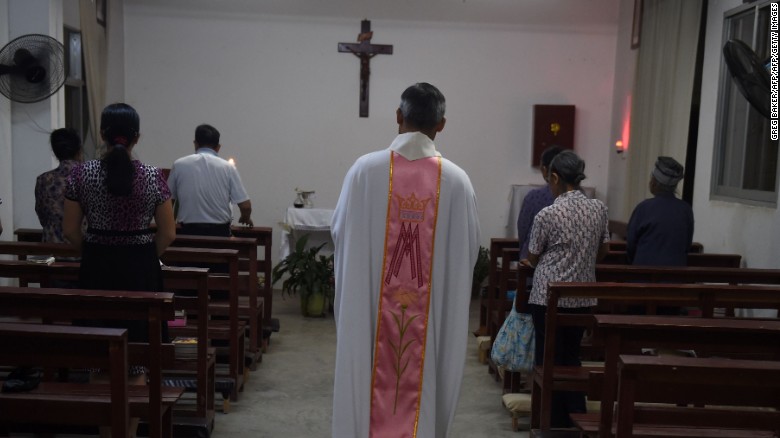
Christian devotees attend a mass at the South Cathedral in Beijing on September 22.

Crackdown in China
The Catholic Church has a long and fractious history with the Chinese government, even before the founding of the People's Republic of China in 1949.
Following's Mao's victory in the civil war, the Communist Party portrayed the Catholic Church as among the hostile forces responsible for the country's decades of suffering and humiliation.
There were even rumors, often discredited, of an assassination plot against Communist leaders involving a Catholic priest.
Even as relations have warmed over the past year, Chinese authorities have been cracking down on "illegal" religion across China, including multiple churches which have been torn down or vandalized.
"Activities in the illegally-built parishes will be prohibited," an Ethnic and Religion Bureau official told the state media tabloid Global Times in April. 
"Other legal Christian activities will remain open."
In April the Bible was pulled from sale in online marketplaces across China, including prominent shoping sites like JD.com and Amazon.cn.
Reports of crackdowns on underground Christian parishes in China continued into September, ahead of the announcement of the deal between Beijing and the Vatican.
In the United States, Republican Senator and frequent China critic Marco Rubio, himself Catholic, asked how the Vatican could justify the deal it had struck with the Communist Party.
"They are giving a government (an atheist one) influence in choosing bishops which (the Church says) are regarded as transmitters of the apostolic line. How does secular (and atheist) interference in that decision not break that line?" Rubio said on his official Twitter.

Concerns in Taiwan
The deal between the Vatican and Beijing is only provisional which means both sides still retain the ability to back out at any time.
The tentative approach isn't surprising. 
Amid reports of resistance among factions on both sides, the deal appears to have been postponed or fallen through multiple times in the past year.
But it is the government in Taiwan who will have looked upon the newly-announced agreement with a particular degree of foreboding.
While Taiwan has been self-governed for almost 70 years following the end of the Chinese civil war, Beijing considers the island to be part of its territory, a breakaway province.
The Vatican is one of Taiwan's last diplomatic allies and its most symbolically important one. 
In recent years, the Chinese Communist Party has been working fiercely to turn as many of the island's former friends as possible, leaving them with only 17.
El Salvador was the latest to recognize Beijing and cut ties with Taiwan in August.
While experts have suggested formal diplomatic recognition of Beijing could still be a while away, the tentative deal will certainly provoke concern in Taipei.
"The Vatican has no scruples about abandoning Taiwan," said Cardinal Zen, former Bishop of Hong Kong and a vocal critic of the Beijing government, told CNN in March.

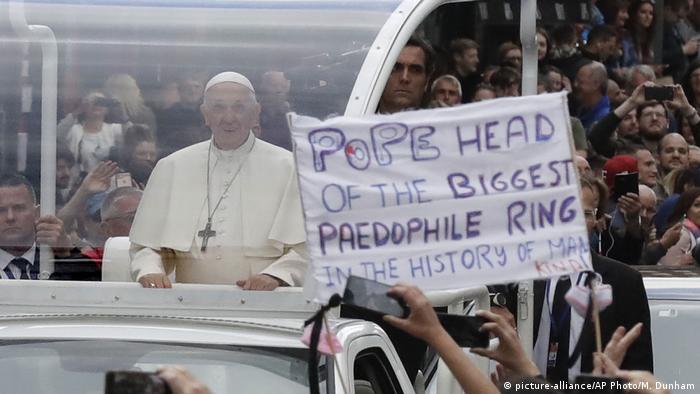
Xi Jinping's Pope

Another Vatican Diplomatic Blunder on the 85th Anniversary of the Reichskonkordat
By GEORGE WEIGEL


The malfeasant Francis

Eighty-five years ago, on July 20, 1933, a concordat defining the legal position of the Catholic Church in the Third Reich was signed by Vatican secretary of state Cardinal Eugenio Pacelli (later Pope Pius XII) and German vice chancellor Franz von Papen.
The Reischskonkordat was then ratified by the Nazi-dominated German parliament some six weeks later, on September 10. 
Pope Pius XI, under whose authority Cardinal Pacelli had negotiated this treaty, was under no illusions about German National Socialism.
And unlike some Vatican diplomats who seem to have imagined that the Third Reich would be a short-run thing, the pope likely thought that Hitler and his gangsters would be in power for some time. 
So he wanted to negotiate legal protections for the Church so that it could operate pastorally under a totalitarian regime that, with the passage of the notorious “Enabling Act” of March 23, had assumed virtually dictatorial powers. 
That one condition for the Reichskonkordat was the de facto destruction of the Catholic-based Center Party was evidently a price Pius XI thought worth paying if the result were the protection of Catholic institutions and pastoral life.
This legal-diplomatic strategy — which seems to have been based on the belief that even a totalitarian regime would honor a treaty commitment — didn’t work. 
The Third Reich began violating the Reichskonkordat shortly after the ink dried on the treaty. 
Then after some two dozen stiff diplomatic notes to Berlin (drafted by Pacelli) had not produced results, an irate Pius XI issued the encyclical Mit brennender Sorge [With Burning Concern] in 1937, had it clandestinely printed in Germany, and ordered that it be read from all German pulpits. 
In the encyclical, Pius denounced an “idolatrous cult” that replaced belief in God with a “national religion” and a “myth of race and blood,” and his stress on the perennial value of the Old Testament made it quite clear what he thought of the Nazi swastika and what it represented.
It is beyond ironic, and it borders on the scandalous, that the lesson of this debacle — paper promises mean nothing to totalitarians — has not been learned in the Vatican, which now appears to be on the verge of repeating its mistake by completing a deal with the government of the People’s Republic of China, on the 85th anniversary of the Reichskonkordat.
Vatican sources are calling the deal “a historic breakthrough,” but the only thing “historic” about it is the inability of Vatican diplomacy to learn from history. 
To make matters worse, others in the Vatican are conceding that the deal is “not a good agreement” but then go on to suggest that it might pave the way for something better in the future. 
Really? 
Haven’t we been down that road before? 
Isn’t the failed Reichskonkordat a cautionary tale? 
Is history taught at the Pontifical Ecclesiastical Academy, the Church’s graduate school for papal diplomats?
According to the deal as described in various media sources, candidates for bishop in China will be chosen by the priests and laity of a diocese, from a list of potential bishops presented by Chinese authorities. 
The result of these “elections” will be sent to Beijing, which will then submit a candidate to the Vatican. 
Rome will then have time to check out the nominee, which it can accept or decline. 
If it’s the latter, a “dialogue” will ensue, presumably to get Beijing to submit another name. 
But that other name will have been produced by the same rigged system, for it is impossible to imagine that any candidate proposed by the Chinese authorities at the local level will not have been thoroughly vetted for reliability as a Communist puppet.
As described in press reports, this deal is a clear violation of current Church law. 
Canon 377.5 in the Code of Canon Law states flatly that “no rights or privileges of election, appointment, presentation, or designation of bishops are conceded to civil authorities” — an unambiguous stipulation that gives legal form to the teaching of the Second Vatican Council in its Decree on the Pastoral Office of Bishops in the Church. 
Even worse, responsibility for Church affairs in the PRC has now been taken from the Chinese state and given to a bureau of the Chinese Communist Party — which means that the Vatican is proposing to give a right of “presentation of bishops” to Communist bureaucrats, whose interests, it may be safely assumed, are not those of the Church and its mission of evangelization.
Worse still, in terms of the eroding moral authority of a Vatican fumbling its response to clerical sexual abuse and malfeasant bishops, this deal comes at a time when the Chinese government is ramping up the persecution of religious groups throughout China, demolishing Catholic churches, stripping others of religious statues, consigning leaders of Protestant house churches to slave-labor camps, and conducting a campaign of genocide against the Uighur Muslims. 
China intensifies religious persecution and the Vatican signs an agreement with the PRC?
Please.

As for the notion that this deal will help bridge the gap between a largely underground Catholic Church loyal to the bishop of Rome and the regime-sponsored Patriotic Catholic Association (PCA), there is no known voice from the persecuted Church in China that supports the proposed agreement. Why? 
Because the persecuted Church knows that the PCA is, functionally, a regime tool, even if some of its clergy are, in their hearts, loyal to Rome. 
It doesn’t take rocket science to figure out that a deal whereby Communist-party authorities “nominate” bishops through faux elections conducted by PCA-approved bodies from candidate lists prepared by other Communist authorities is a deal that further empowers the PCA while disempowering the persecuted Church.
So why is this happening? 
Two explanations occur.
The first is that this misbegotten deal represents the continuing influence in Vatican diplomacy of the Casaroli Gang — the disciples of the late Cardinal Agostini Casaroli, architect of the 1970s Vatican Ostpolitik, which was supposed to make life better for persecuted Catholics behind the Iron Curtain through deal-making with Warsaw Pact regimes. 
The Ostpolitik did nothing of the sort. 
It turned the Hungarian Church into a wholly owned subsidiary of the Hungarian Communist party; it did serious damage to the Church in what was then Czechoslovakia; and it facilitated the deep penetration of the Vatican itself by East Bloc intelligence agencies. 
This massive policy failure has been quite well documented with materials from former Warsaw Pact secret-police archives. 
I have written about it extensively, in books readily available in Italian. 
Yet not a murmur of dissent from the legend of Casaroli the Great is permitted in important Roman circles. 
And it is second- and third-generation Casaroli acolytes who are the drivers of the reported China deal. 
They are, it seems, uneducable. .
Then there is Francis
John Paul II gave the Catholic Church real moral leverage in world politics. 
Benedict XVI offered the post–Cold War incisive commentaries on the political challenges of the 21st century. 
That legacy has been squandered through one ill-advised move after another over the five and a half years of this pontificate: 
  • a Syrian initiative that gave Obama an excuse not to enforce his putative “red line” and thus strengthened the murderous Assad regime; 
  • disastrous and counterproductive kowtowing to the Maduro regime in Venezuela and the Communist dictatorship in Cuba that has demoralized the opposition in both countries; 
  • a refusal to use the words “invasion” in reference to Crimea and “war” in reference to what Russia is doing in eastern Ukraine; 
  • an approach to Russian Orthodoxy that refuses to concede that the Church’s principal interlocutors in that “dialogue” are agents of Russian state power first, and churchmen somewhere down the line; 
  • an absolutist approach to the migrant crisis in Europe that has shrunk the space in which a reasonable political compromise could take shape; 
  • a lot of papal moral capital expended on ephemera like the threat posed by plastic bottles and straws in the oceans. 
Mistake after mistake, now seemingly on the verge of being compounded by the betrayal of persecuted Catholics in China through a deal that empowers the Chinese Communist party in its efforts to make the Church an instrument of the state.
The pope could still call a halt to this, and he should. 
A bad deal in these circumstances is far worse than no deal, for a bad deal further compromises the moral authority of the Church, which is then further weakened in its evangelical mission. 
That is the lesson that should have been learned from the Reichskonkordat of 1933. 
Eighty-five years later, it is long past time for Vatican diplomacy to get on a learning curve.

samedi 31 mars 2018

Xi Jinping's Pope

The case of a bishop detained by the Chinese government—and what it says about a looming deal between Beijing and the Vatican
By BETHANY ALLEN-EBRAHIMIAN 
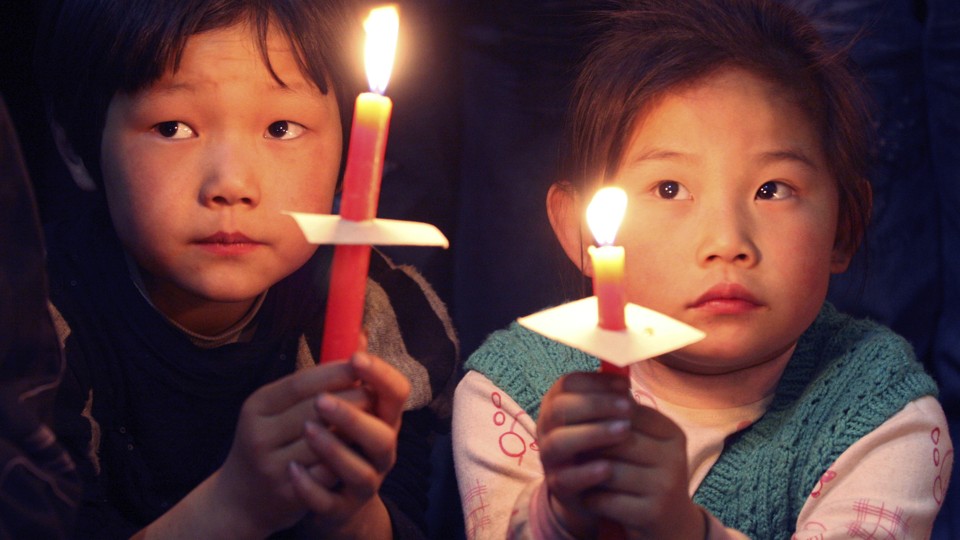
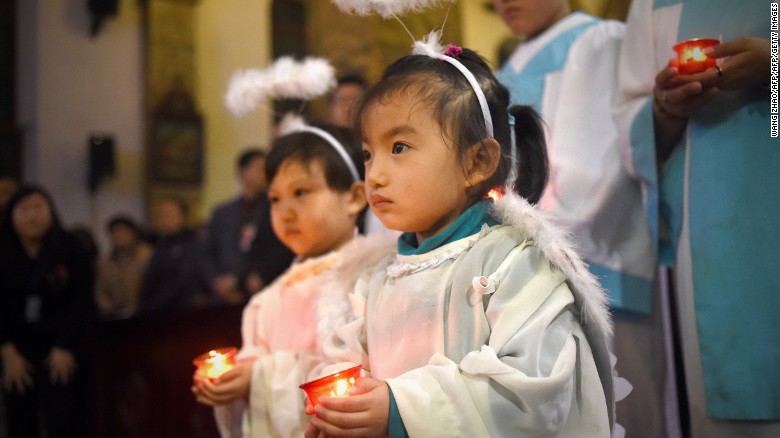
Children hold candles during the Easter mass at a church in Xiaohan village of Tianjin municipality in 2009.

The Chinese government detained a beloved Catholic bishop earlier this week in an apparent attempt to keep him out of sight around the Easter holidays, just as an end to a decades-long split between Beijing and the Vatican may be in sight.
The bishop, Guo Xijin, is recognized by the Vatican but not by the official Catholic Church in China, which is under government control. 
Such underground bishops are at the heart of the split. 
Since the 1950s, the Chinese government has insisted it must approve the selection of bishops, but the Vatican has continued to ordain clergy in secret, leading to overlapping sets of official and underground bishops in some Chinese parishes.
Guo was detained in the days leading up to the Easter holidays after refusing to hold services alongside a government-approved bishop. 
The Vatican had asked the 59-year-old bishop to step down as a concession to Beijing. 
Negotiations between Beijing and the Holy See to end the dueling bishoprics and unify the Church are now underway, and a deal is expected as early as Easter weekend. 
But Guo’s detention is indicative of exactly what kind of solution the Chinese Communist Party has in mind. 
Most likely, it will not be a gentle rapprochement with the Vatican so much as a heavy-handed crackdown on the underground church, with the government attempting to neutralize it once and for all.
For decades, the Communist party-state has tolerated the existence of a parallel system of official churches organized under government auspices, and unofficial, or “underground,” churches that operate without government oversight. 
(This is true of both Protestant and Catholic Churches in China. While the Vatican deal will only affect underground Catholic bishops, legal and bureaucratic changes are likely to pressure both Protestant and Catholic underground churches.) 
A series of recent moves indicates that the party is now rejecting the status quo, and is seeking to extend its control over these formerly independent congregations.
New legislation took effect on February 1, tightening government regulation of religion and placing more explicit restrictions on unofficial religious activity. 
A leaked directive dated March 16 ordered local government agencies to begin investigating all underground Christian activity in Beijing, which suggests a coming crackdown on that activity, as other sectors of Chinese society have experienced in recent years.
Most telling, however, is the government reorganization announced last week that delegated religious affairs, previously under the auspices of the religious affairs bureau, a government office, to the United Front Work Department, a Communist Party organ under the direct control of the party’s Central Committee.
“The party is in some ways distrustful of the religious affairs bureau for fear that some people in that agency may have the kind of training that makes them more open to or sympathetic with different religious groups,” said Xi Lian, a professor of world religion at Duke Divinity School. 
“But now the United Front is going to take over and impose the iron will of the party.”
China is governed by a dual, parallel structure of party and government bodies at every level, from the highest echelons of power down to the village committees. 
Government bodies have tended to have relatively more transparency than party organs; the party is an information black hole. 
And the United Front Work Department in particular is the primary means by which the party has extended and solidified its influence over every level of Chinese society.
There is little room for speculation about the implications of this move for the Catholic Church in China. 
It almost certainly means more direct party control and marginalization for anyone who doesn’t toe the party line.
“The point of having administrative control over religious groups in China is to ‘deconflict’ an organization from competing with the party,” said Peter Wood, an analyst at the datamining firm TextOre who researches the United Front. 
“The point isn’t to provide services—it is control, redirection, and deconfliction.”
None of this bodes well for Chinese Christians, said Lian.
“It’s making a lot of Christians in China very nervous,” said Chloe Starr, a professor of Asian Christianity and theology at Yale Divinity School. 
“A lot of rights lawyers had wanted a greater transfer to the judiciary, rather than state oversight, but we’ve moved in the opposite direction. This is taking it further away from judicial process and more directly under the party influence, which is worrying a lot of Christians.”
A move to co-opt or even disband the underground church would be well in line with Xi Jinping’s sweeping campaigns in the past few years to strangle dissent and consolidate party control over every aspect of Chinese society. 
Xi has eliminated many of the gray areas that in the past allowed for a limited degree of expression. During his tenure, the party has created a comprehensive internet censorship regime, cracked down on human rights lawyers, implemented ideological controls in universities and private businesses, and constructed a high-tech surveillance state in the far-west region of East Turkestan.
The looming Vatican deal, then, comes at a time when Beijing is moving to exercise more control over religious affairs than it has in decades. 
One possible arrangement for such a deal, reportedly being discussed, would allow the party to select bishops but give the Vatican veto power over the final selection. 
But such an admission of foreign control over domestic affairs—and particularly over religion, which the party has always viewed with special suspicion—would likely be anathema to the party given its current direction.
“Not only is the deal a terrible one, the Vatican has chosen the worst time to do it—at a time when Xi Jinping is becoming the new emperor, when the party is cracking down so harshly,” said Lian. 
“I really have a hard time understanding why the Vatican still clings to this completely unrealistic hope of striking a deal that will the benefit the Church, and striking a deal that the Communist Party will honor.”
Lian raised the example of Hong Kong. 
The agreement signed between Britain and China when the city was handed back to the mainland after 150 years of British colonial rule specified that Beijing must allow universal suffrage in Hong Kong by the year 2017. 
But China has come to refer to that agreement as a historical document rather than a binding agreement, and it has refused to allow elections in Hong Kong without first vetting the candidates. 
Similarly, it’s highly unlikely that the Communist Party will now give true veto power to the Vatican. 
More likely, even if some kind of ceremonial veto power is given, all the candidates will be completely pre-vetted by Beijing. 
There is little reason to think that the party would honor any concessions to the Vatican, said Lian.
The case of Guo Xijin is likely a taste of what any supposed deal will look like on the ground—arrests, detentions, and forced adherence to Beijing’s line. 
Going forward, Chinese Catholics can expect more of this, not less.

mercredi 14 mars 2018

On the Vatican’s Capitulation to Beijing

Negotiating with the Devil has never been the long suit of Vatican diplomacy.
By GEORGE WEIGEL
Christmas Eve mass at a Catholic church in Shanghai, China, December 24, 2017. 

The “examination of conscience” is an important part of Catholic spirituality, which always precedes confession but is ideally practiced at the end of each day: a review of what one got wrong, and what right, as preparation for an act of contrition and a prayer of thanksgiving for graces received. 
And while there are obvious and important differences between individual Catholics examining their conscience and Vatican diplomats reviewing the Church’s successes and failures in the thorny, dense thickets of world politics, one might have thought that this spiritual discipline would have some bearing on the diplomacy of the Holy See, if only as a reality check.
But if you thought that, you’d be hard pressed to find evidence for it in the history of Vatican diplomacy’s dealing with totalitarian regimes.
As an integral part of the 1929 Lateran Accords (which also created an independent Vatican City State while recognizing the Holy See as a sovereign actor in world politics), Pope Pius XI made a concordat with Mussolini’s Italy — a treaty that was thought to guarantee the Catholic Church’s freedom of action in the fascist state. 
Two years later, with blackshirt thugs beating up Catholic youth groups and the state media conducting a viciously anticlerical propaganda campaign, Pius XI denounced Mussolini’s policies with the blistering 1931 encyclical Non abbiamo bisogno, in which he condemned fascism’s “pagan worship of the State.”
In 1933, as Hitler was consolidating Nazi power, Vatican diplomacy negotiated the Reich Concordat in another attempt to protect the Catholic Church from the totalitarian state through a web of legal guarantees. 
The strategy worked as poorly in Germany as it had in Italy, and in 1937, after many attacks on churchmen and Catholic organizations, Pius XI condemned Hitler’s race-ideology in another thunderbolt encyclical, Mit brennender Sorge, which had to be smuggled into Germany to be read from Catholic pulpits.
Then came the Ostpolitik of the late 1960s and 1970s. 
Faced with what he once described as the “frozen swamp” of Communist repression behind the iron curtain, Pope Paul VI’s chief diplomatic agent, Archbishop Agostino Casaroli, began to negotiate a series of agreements with Communist governments. 
Those agreements were intended to provide for the sacramental life of the Church by facilitating the appointment of bishops, who could ordain priests, who could celebrate Mass and hear confessions, thereby preserving some minimal form of Catholic survival until Communism “changed.” 
And another disaster ensued.
The Catholic hierarchy in Hungary became a wholly owned subsidiary of the Hungarian Communist Party. 
In what was then Czechoslovakia, regime-friendly Catholics became prominent in the Church while the underground Czechoslovak Church of faithful Catholics struggled to survive under conditions exacerbated by what its leaders regarded as misguided Roman appeasement of a bloody-minded regime. 
In Poland, Holy See envoys tried to work around, rather than through, the heroic Cardinal Stefan Wyszyński, in a vain attempt to regularize diplomatic relations with the Polish People’s Republic. And while all that was going on, the Vatican itself was being deeply penetrated by the KGB, the Polish SB, the East German Stasi, and other East Bloc intelligence services, as I documented from first-hand Communist secret-police sources in the second volume of my John Paul II biography, The End and the Beginning.
In light of this dismal track record, prudence and caution would seem to be the order of the day in Vatican negotiations with the totalitarians in charge in Beijing, at whose most recent party congress religion was once again declared an enemy of Communism. 
But there has been no discernible examination of conscience at the higher altitudes of Vatican diplomacy. 
And now it seems likely that an agreement between Rome and Beijing will be announced, in which the Chinese Communist government will be conceded a role in the nomination of bishops — another step toward what various older but still-key figures in the Vatican diplomatic service have long sought, namely, full diplomatic exchange between the Holy See and the PRC at the ambassadorial level.
One such figure, speaking off the record, tried to justify the impending deal by saying that it was best to get at least some agreement now, because no one knows what the situation would be in ten or 20 years. 
This is obtuse in the extreme.
If the situation gets worse — if, through increasing repression, Xi Jinping manages to hold together a Maoist political system despite a rising middle class — then what reason is there to have any confidence that the Chinese Communist regime would not tighten the screws on Catholics who challenged the state on human-rights grounds? 
What reason is there to believe that the Chinese Communists would break the pattern set by Italian fascists, German Nazis, and Eastern and Central European Communists by honoring treaty obligations? 
Has nothing been learned from the past about the rather elastic view of legality taken by all totalitarian regimes of whatever ideological stripe?
In light of this dismal track record, prudence and caution would seem to be the order of the day in Vatican negotiations with the totalitarians in charge in Beijing.
If, on the other hand, things get better in a liberalizing China, with more and more social space being created for civil-society associations and organizations, why should those Chinese interested in exploring the possibility of religious faith be interested in a Catholicism that had kowtowed to the Communist regime? 
Why wouldn’t Evangelical Protestants who had defied the regime in the heroic house-church movement be the more attractive option?
Vatican diplomacy prides itself on its realism. 
But on any realistic assessment of China’s future — the bad news or the good news — the Catholic Church comes out the loser if it caves to Communist demands that the regime have a significant role in the appointment of Catholic bishops now.
As described in press reports, the new deal between the Holy See and China also violates the teaching of the Second Vatican Council and the embodiment of that teaching in the Church’s own canon law.
For well over a century, Vatican diplomacy worked hard, and in this case effectively, to disentangle the Church from state interference in the appointment of Catholic bishops. 
That achievement was recognized by Vatican II in its decree Christus Dominus, “On the Pastoral Office of Bishops in the Church.” 
There, the Council fathers said this about the imperative that the Church be free to choose its own ordained leaders: “In order to safeguard the liberty of the Church and more effectively to promote the good of the faithful, it is the desire of the sacred Council that for the future no rights or privileges be conceded to the civil authorities in regard to the election, nomination, or presentation to bishoprics.” 
That conciliar desire was then given legislative effect in the 1983 Code of Canon Law, where canon 377.5 flatly states that “for the future, no rights or privileges of election, appointment, presentation, or designation of Bishops are conceded to civil authorities.”
In theory, of course, Francis, as the Church’s supreme legislator, could suspend or even abrogate canon 377.5 in the case of the People’s Republic of China. 
But to do so would not only make something of a mockery of Church law (a temptation too often indulged by some in recent years, in a campaign against “legalism”). 
It would also be to deny the truth that Vatican II taught: The libertas ecclesiae, the freedom of the Church to conduct its evangelical and charitable mission by its own criteria and thereby remain true to its Lord, is not easily squared with state involvement in episcopal appointments.
Vatican diplomats, primarily Italians, have been obsessed with achieving full diplomatic exchange with the PRC for decades. 
It is argued, by these men and their defenders in the media, that China is the rising world power and that for the Holy See to be a player on the world stage requires that it be in formal diplomatic contact with Beijing. 
But this is a fantasy indulged by Italian papal diplomats for whom “the Vatican” is still the Papal States, a third-tier European power that craves recognition of its status by superior powers. 
That world ended, however, at the Congress of Vienna.
The truth of the matter is that, today, the only power the Holy See wields is moral power, the slow accretion of moral authority that has come to Catholicism, as embodied by the pope, through the Church’s sometimes sacrificial defense of the human rights of all. 
How playing Let’s Make a Deal with totalitarians in Beijing who at this very moment are imprisoning and torturing Christians adds to the sum total of Catholicism’s moral authority, or the papacy’s, is, to put it gently, unclear. 
The same might be said for the de facto betrayal of Rome-loyal bishops in China who are now being asked to step aside so that they can be replaced by bishops essentially chosen by the Chinese Communist Party apparatus. 
This is far less realism than a species of cynicism that ill befits a diplomacy presumably based on the premise that “the truth will make you free” (John 8:32).
According to a (sometimes dubious) source, Pope Pius XI once said that he would deal with the Devil himself if doing so would accomplish something good and help the Church in its mission. 
I imagine that if he did say that, it was during one of that crusty pontiff’s crustier moments, and an expression of his own willingness to face down the powers of Hell if necessary. 
But as strategy in the gray twilight zone of world politics, dealing with the Devil — at least as Vatican diplomacy has done in dealing with totalitarianisms — has never worked out. 
Consorting with the Devil’s agents is a ticklish business; assuming their willingness to abide by agreements (much less their goodwill) is folly; and carrying the sulfurous odor of too much contact with the Devil’s legions does absolutely nothing to advance the evangelical mission of the Church.
In fact, it does just the opposite.

mercredi 21 février 2018

Xi Jinping's Pope

Online petition opposing China-Vatican deal was hit by cyber-attack
Christian Today 


The Catholic Church now has a Manchurian Pope

An online petition opposing an agreement between the Chinese government and the Vatican was subject to a cyber attack on February 14, it has emerged.
According to a statement from the group Free Catholics in China, a denial-of-service (DDOS) attack on its website meant that it did not resume normal service until the following day, the Catholic Herald reported.
'We will not be cowed into silence by such attack, and we will never stop voicing out for the Church,' the group said.
The controversial Vatican-China deal is reportedly set to be reached by next month. 
Chinese Catholics are divided between those in the 'underground' Church who are loyal to the pope and the government-backed Catholic Patriotic Association, which appoints bishops without Rome's approval.
The open letter published on the website is signed by named Catholics mainly in Hong Kong and also in the US and the UK. 
It says: 'We are deeply worried that the (proposed) deal would create damages that cannot be remedied.'
The 15 lawyers, academics and human rights activists who have signed the open letter express dismay at an agreement which would involve the Vatican recognising seven bishops appointed by China's Communist party.
The letter censures the appointment of seven bishops by the Chinese state, not the pope, adding that the bishops' 'moral integrity is questionable'.
The letter, published on the influential site Asia News and elsewhere, says: 'We are worried that the agreement would not only fail to guarantee the limited freedom desired by the Church, but also ... deal a blow to the Church's moral power. Please rethink the current agreement, and stop making an irreversible and regrettable mistake.'
The letter to bishops around the world came less than two weeks after Cardinal Joseph Zen, the former bishop of Hong Kong, accused the Vatican of 'selling out', writing in a blog post: 'Do I think the Vatican is selling out the Catholic Church in China? Yes, definitely, if they go in the direction which is obvious from all what they are doing in recent years and months.'
Last month, the Vatican asked two underground bishops to give up their positions in favour of government-appointed counterparts, one of whom was excommunicated by Rome in 2011.
A petition attached to the letter had been signed by 1,600 people as of last week.
The cyber-attack happened within hours of widespread international publicity about the open letter.

mardi 13 février 2018

Xi Jinping's Pope

Francis’s Capitulation To Communist China Betrays His People And Faith
Far from making life easier for Chinese Catholics, accepting Communist control of their bishops disheartens and oppresses them further.

By Maureen Mullarkey


Is Francis a naive crypto-communist?

Nothing better reveals the moral compass of the current pontificate than its mania for smiling relations with a Leninist dictatorship. 
Francis is not the first modern pope to wish for better relations with the People’s Republic of China. But he is the first to acquiesce in the regime’s goal of absolute dominion over religions, particularly the Catholic Church. 
His predecessors were more lucid. 
And more principled
The Vatican is poised to surrender control of the long-suffering Roman Catholic Church in mainland China to the Central Committee of the Communist Party (CPC). 
Short of full diplomatic recognition, the deal abandons Chinese faithful to their persecutors.
Validly ordained bishops are being asked to step down to make way for government-approved ones, including several who have been excommunicated. (Excommunication is the penalty for accepting ordination without papal approval.) 
Faithful priests already selected as valid successors to retiring bishops have been ordered to forego ordination to avoid offending the Chinese regime.
Far from making life easier for Chinese Catholics, this disheartens and oppresses them further. 
The reward for their heroic decades-long endurance is a garland of tears over betrayal by the papacy they honored at cost to themselves. 
No wonder Cardinal Joseph Zen, the Shanghai-born bishop emeritus of Hong Kong, calls it “a bad deal.” 
A lion of a man, and a persistent advocate for human rights and democratic liberties, Zen has been an obstacle to Vatican appeasement of Beijing.

What China’s Rulers Want, and Are Getting

On January 18, the cardinal posted an open letter on his blog—reposted by AsiaNews—warning against the consequence of accommodation: “The Communist government is making new, harsher regulations limiting religious freedom. They are now strictly enforcing regulations which, up to now, were practically only on paper. From the 1st of February, 2018, attendance to Mass in the underground will no longer be tolerated.”
Mass in the underground will no longer be tolerated. 
In other words, the emboldened regime need no longer keep up appearances for public relations. 
With the Vatican’s blessing, it can openly enforce prohibition of the valid Mass for which close to three generations of Chinese faithful have suffered.
Going forward, all bishops will be “democratically” selected by the government-led Council of Bishops, to which the Vatican has already ceded authority. 
Names will be sent to Rome for rubber stamping, a sellout that appears to have been in the works for some time.
In a significant but overlooked 2015 article in AsiaNews, editor Bernardo Cervellera explained Beijing’s bedrock position in “negotiations” with Vatican sympathizers. 
Then as now, any mention of imprisoned bishops was off the table. 
Then as now, Beijing’s proposal consisted exclusively on complete recognition by the Holy See for all Communist Party-approved bishops. 
Moreover: “The Holy See must approve the Council’s appointment and has a weak veto only in ‘severe’ cases, which must be justified if used. If the Holy See’s justifications are considered ‘insufficient,’ the Council of Bishops may decide to proceed anyway.”
Cervella continued: “The increased controls have only one purpose: to preserve the monopoly of power of the Communist Party of China (CPC) and remove or crush any person who might challenge it or its very existence.”
The Vatican has already quietly accepted certain Communist-appointed bishops. 
But even circumspection no longer applies. 
On January 29, AsiaNews quoted Zen again: “ Do I think that the Vatican is selling out the Catholic Church in China? Yes, definitely, if they go in the direction which is obvious from all what they are doing in recent years and months.”

‘Manipulate Catholics to Submit to the Communist Party’
Francis’ bow to Beijing is not an internal matter for Catholics only. 
The concession is a rag bag of geopolitical ramifications, an ominous move in a larger global power struggle in which the Chinese Catholics are so much collateral damage. 
The omelet matters more than broken eggs.
Judged solely by low Machiavellian standards of statesmanship, the capitulation is a political coup. But for whom? 
For China, thawed relations with the Vatican enhance its global image and deflect attention from its militarism, duplicity, and depravity regarding human rights. 
Plus, the regime earns a diplomatic victory over Taiwan. 
The Vatican can tout the close of a seven-decade breach between the underground “Church of the Catacombs,” loyal to the Holy See, and the Chinese Catholic Patriotic Association, a creature of Beijing.
The Patriotic Association, founded in 1957 as the CPC’s counter-church, is a nationalist stand-in for the ancient repository of thought and worship in communion with Rome. 
Twenty years ago, Matthias Lu, a noted translator of the church fathers, Aristotle, and Thomas Aquinas into Chinese, summarized its aims
They have not changed: “Its [the Association’s] commitment is to manipulate the mass of the Catholic population in order to integrate them into the Socialist revolutionary movement by submitting them to the leadership of the Communist Party in all things.”
Vatican press trumpets this pact with the devil as an historic halt to impending schism. 
The spin is worthy of the CPC’s Central Publicity Department. 
Francis has merely flattered the regime by normalizing an existing schism dating from the 1950s when the Catholic Church was outlawed, its properties confiscated (later transferred to the Patriotic Association), and Catholics arrested en masse. 
The winning side in this new order belongs to Xi Jinping.

Communism Is Not Reconcilable with Christianity

In May, 2015, Xi Jinping spoke with the United Front, led by the Central Committee. 
He repeated what Communist Party leasers have affirmed since Mao denounced the Vatican as “the stray dog of capitalism.” 
In sum, he insisted on “Sinicization of religion,” including independence from “foreign influences,” as the only way the Catholic Church will be permitted to survive in China.
Xi’s Sinification is not the dialogue with Chinese culture (inculturation) that has characterized the church in China since the sixteenth century. 
Instead, it is a political power grab that reduces Christianity to an offshoot of socialist doctrine. Churches can continue to function as charitable organizations or non-governmental organizations, but the hierarchy become bureaucrats in the party apparatus.
Autonomy from Rome teems with implication for the Catholic Church’s social doctrines. 
The bureaucrats of collectivism have their own dogmas, infallibilities, and absolutes. 
These are in radical contradiction to traditional Christian reflection on morality, especially those relating to life issues.
Implicit in Francis’ conciliation is permission to ignore a range of moral matters that define a Christian conscience. 
The Catholic Church’s philosophical arguments defending the inviolable dignity of human life and the primacy of the individual cannot be asserted in pulpits. 
Silence is assured on labor camps, on the execution of prisoners to feed the lucrative organ trade, and on “family planning” policies. 
A comfortably Sinicized church can keep a good conscience while disregarding forced abortions, forced sterilizations, or forced migration (e.g., the massive Three Gorges Dam project unhoused 1.4 million peasants and submerged some 900 towns and villages).
In all, the Bergolian pontificate is set to achieve what the Communists have not: strangulating the Catholic Church as a living witness to the gospels and their demands.

vendredi 9 février 2018

Xi Jinping's Pope

Vatican-China deal would put Catholics in communist cage
By Venus Wu

HONG KONG -- A senior Catholic cardinal accused the Vatican on Friday of acting “unfaithfully” in its rapprochement with China, saying it would put the country’s some 12 million faithful in a bird cage controlled by the Communist Party.

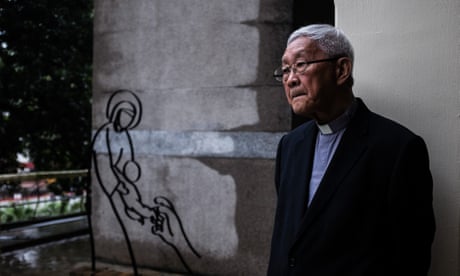
Cardinal Joseph Zen

Addressing a news conference, Hong Kong’s outspoken Cardinal Joseph Zen also said he was highly skeptical of a deal that reportedly would give Francis the final say in the appointment of bishops, the key part of the agreement.
Nearly 70 years after China and the Vatican severed diplomatic relations, the two sides recently reached a framework accord on the thorny issue of who gets to appoint new Chinese bishops and a historic deal could be signed in a few months.
The 86-year-old former bishop of Hong Kong, recently rebuked by the Vatican after he said it had “sold out” China’s faithful, said sources told him that under the framework agreement the pope would have the final veto power over bishops who are effectively chosen by the Chinese government.
They (The Chinese government) say the last word belongs to the Holy Father. Sounds wonderful? But it’s fake,” Zen said.
”They are not going to make good choices for the Church ... surely they choose the one they prefer, which means the one who always obeys the government. So how (could) the Holy Father approve such a choice?”
“Okay, he can veto. How many times? It takes courage to veto the second time, the third time, five times,” Zen said.
Catholics in China are split between the state-controlled Catholic Patriotic Association, where bishops are appointed by the government, and the “underground” Church that remains loyal to the pope while being systematically persecuted by Chinese authorities for years.
Zen, who has fiercely criticized the Vatican for attempting to force two “underground” bishops to give way to government-backed “illegitimate” bishops in order to foster the deal, was rebuked by the Vatican last Wednesday for “fostering confusion and controversy”.
Zen said that under the status quo, which he described as “the lesser evil,” the Vatican secretly approves candidates who are acceptable to both sides before the state-controlled Church makes them bishop.
But under the new agreement, where candidates would be selected via a “so-called democratic election” inside the Chinese Catholic community and endorsed by a state-controlled bishops’ conference before being submitted to the pope, the choice lies entirely in the hands of the government, Zen said.
“A church enslaved by the government is no real Catholic Church,” he said.
Zen said he was not criticizing the pope, whom he believed might not be briefed on “reality” because bureaucrats in the Holy See are eager to strike a deal.
“What they (Vatican negotiators) are doing is unfaithful,” Zen said. 
“I am not judging their conscience but ... it’s a surrender and they have no right to surrender.”

jeudi 8 février 2018

Xi Jinping's Pope

Francis Made a Deal with the Communist Front Group Oppressing the Real Catholic Church in China
By Robert Kraychik

Is he a naive crypto-communist?

“Those who best realize the social doctrine of the church at this time are the Chinese,” Archbishop Marcelo Sanchez Sorondo told the Italian newspaper La Stampa last Friday. 
“They seek the common good, subordinating all things to the general good.”
John Zmirak, senior editor of The Stream, joined Tuesday’s edition of SiriusXM’s Breitbart News Tonight to discuss Sorondo’s praise of China. 
Sorondo heads the Vatican’s academies of science and social science.
“One of the pope’s right-hand men, Archbishop Sorondo from South America, he is the head of the Vatican’s office on science and social sciences. He actually said a couple of days ago that China does a better job living out Catholic social teachings than the United States,” said Zmirak.
Sorondo pushed left-wing narratives of “climate change” and “capitalism” in his praise of the Chinese state’s policies.
“[Sorondo] is saying that they’re defending the climate; they’re avoiding reckless capitalism,” said Zmirak. 
“It’s staggering. This is a country that still forces women to get abortions after their second child. This is the head of the Vatican’s congregation for science and social sciences. He is saying that because the Chinese government is more responsible, supposedly, on climate change and because it doesn’t allow capitalism, it’s better than the United States.”
Francis abandoned the underground Catholic church in China in favor of legitimizing an ostensibly Catholic church alternative controlled by China’s communist government, said Zmirak.
“The Vatican just cut a deal with the collaborationist Chinese communist party-controlled Catholic church,” said Zmirak. 
“There’s a real church, which has been underground and illegal since Mao Zedong, and then there’s been kind of like a Vichy French collaborationist wing, where they work for the government. The government appoints the bishops. The government controls everything. The Catholic church always condemned that as a communist front group. The Vatican just made a deal with the communist front group that they are going to be regarded as the real church, and the underground church has to resign and just go join the communist church.
Mansour described Francis’s “about-face” towards communism as a 180-degree reversal of Pope John Paul II’s approach.
“Right now, the Chinese communist government is blowing up the churches of evangelical Protestants, and now, what are we doing?” asked Zmirak. 
“We’re siding with the government that’s blowing up these people’s churches and putting them in prison. I guarantee you, if this continues, in thirty or forty years, when Christianity is continuing to spread through China, Francis is guaranteeing that it will be Protestant rather than Catholic. So, my Protestant friends, you should thank Francis for guaranteeing that, eventually, China will be largest Protestant country on earth, not Catholic.”
A former cardinal from China, Joseph Zen, has criticized the Vatican for “selling out” Catholicism via its overtures to Beijing.
“There’s a cardinal, Cardinal Zen, I believe, who spent a lot of time in a communist prison, and he feels completely betrayed by the fact that they’re making a deal with his persecutors,” said Zmirak. “Vatican officials are saying, ‘Oh, [Joseph Zen is] out of touch. He doesn’t know what he’s talking about.’ They’re dismissing the guy who lives in the country and has been in its prisons while they sit in their little Italian hideaways eating gnocchi, drinking wine, and imagining that they’re great realpolitik practitioners.”
Shantytown-caliber poverty is non-existent in China, said Sorondo, following a state-supervised visit to the authoritarian country.
“I found an extraordinary China,” said Sorondo. 
“You do not have shantytowns. You do not have drugs. Young people do not have drugs. There is a positive national consciousness. They want to show that they have changed. They already accept private property.”

mercredi 7 février 2018

Xi Jinping's Pope

Cardinal Joseph Zen hits back at Vatican over deal with China
By Gerry Shih 

In this Dec. 24, 2015 file photo, an overflow crowd prays outside of the Southern Cathedral, an officially-sanctioned Catholic church in Beijing, during a Christmas Eve mass. The retired archbishop of Hong Kong has slammed the Holy See’s negotiations with the Chinese government as a “catastrophe” that would bring suffering to millions of worshippers, as he escalates an extraordinary war of words against his church. 

BEIJING — The retired archbishop of Hong Kong has slammed the Holy See’s negotiations with Beijing as a “catastrophe” that would bring suffering to millions of worshippers, as a bitter dispute inside the Roman Catholic Church over its future in China escalates in a dramatic fashion.
Cardinal Joseph Zen warned in a blog post this week that Chinese Catholics who follow so-called underground churches are at risk of arrest even while the Catholic Church pushes for a historic breakthrough in relations with China’s ruling Communist Party.
Zen, a leading critic of the Vatican’s outreach to China, revealed in a statement last month that the Vatican had asked a legitimate “underground” bishop to stand down in favor of an excommunicated one favored by Beijing — a reshuffle that he suggested was orchestrated by church officials without the pope’s full knowledge.
Zen, 86, doubled down on Monday and denounced church officials for betraying Chinese worshippers in what amounted to a highly unusual attack from a clergyman against the Holy See.
“Mainland brothers and sisters fear not losing all they have, the prison cell or shedding their blood,” Zen wrote. 
“Their greatest suffering is being sold out by their ‘loved ones.’”
In an extraordinary escalation, Zen also criticized Secretary of State Pietro Parolin, the official charged with negotiations with Beijing, as a “man of little faith” who did not understand the “true suffering” of persecuted Chinese Catholics.
The proposed changing of the bishops was the clearest evidence yet of the Vatican’s effort to reach a deal with China, a country with an estimated 12 million Catholics. 
Of those, about half worship in “underground” churches that recognize only Rome as their highest authority while the rest belong to state-authorized churches with clergy named by Beijing.
The Vatican, particularly under Francis, has been keen to reach a deal with the Chinese government.
A sticking point in secret negotiations over at least the past year has concerned whether Rome or Beijing has final say over bishop appointments. 
China’s Foreign Ministry has said the government supports dialogue and advancing ties with the Vatican on the basis of “relevant principles” — a reference to Beijing holding final say over appointments.
Zen said the Vatican had “given in” to the Communist Party by seeking to replace Shantou Bishop Peter Zhuang Jianjian with Bishop Joseph Huang Bingzhang, who is backed by the state. 
Last month, he disclosed the behind-the-scenes discussions to replace bishops and said he had been so upset that he traveled to Rome to raise objections with Francis.
Priests and congregants will have many long nights of suffering over the prospect of obeying and respecting those priests who were illegitimate today but will be legitimized by the Holy See tomorrow, having been approved by the government,” Zen wrote.
A pro-democracy advocate and longtime critic of the Chinese government, Zen appeared to suggest that China would crack down more on unauthorized congregations after reaching agreements with the Vatican over authorized congregations. 
He wrote that the government will “strictly enforce regulations on religion” beginning this month and that priests in Shanghai have warned their congregations “not to attend Mass on pain of arrest.”
An official from the Chinese Patriotic Catholic Association, a government body supervising state-authorized Catholic congregations, said he could not respond to Zen’s claim that Shanghai priests have warned their followers against attending Mass.
The Vatican had no immediate comment on Zen’s latest blog post. 
But it said last week it was “surprising and regrettable” that some members of the church were fostering “confusion and controversy.”
In an editorial Tuesday, China’s state-run Global Times newspaper said Beijing and the Vatican would establish diplomatic relations “sooner or later” and that a deal would be “tremendously beneficial to Catholics.” 
Without directly naming Zen, the paper also rebuked “a few radical religious groups who have no right to intervene in bishop appointments.”
“Francis has a positive image with the Chinese public,” the editorial concluded. 
“It is expected he will push China-Vatican ties forward and solve related problems with his wisdom.”

vendredi 2 février 2018

Xi Jinping's Pope

Shady deal between Vatican and China alarms Catholics
By Simon Denyer

Newly baptized Chinese Catholics pray during a special ceremony at a mass last Easter. They were at a government-sanctioned church in Beijing, part of a network of churches not under Vatican control. 

BEIJING — Reports that the Vatican and China have reached an agreement on appointing bishops have been greeted with consternation by many Catholics in China and Taiwan, concerned that the pope is appeasing a government that routinely persecutes people for their faith.
On Thursday, a senior Vatican source told the Reuters news agency that the agreement could be signed in a few months, potentially opening the way for a resumption of diplomatic relations nearly 70 years after they were severed following the communist takeover of China.
But Francesco Sisci, a senior researcher at the Center of European Studies at the Renmin University of China, who has been tracking Vatican-China relations for two decades, said there was still some “fine-tuning” to done before a deal could be signed.
“There is steady progress, but it won’t happen overnight,” he said, in a telephone interview from Rome. 
“People at the Holy See are positive, the Chinese are also positive, but it is not like they are ready to sign an agreement.”
Nevertheless, lay Catholics in Hong Kong reacted with concern.
“A lot of people like myself look to the Holy See as one of the strongest defenders of religious freedom and the Catholic faith,” said Kenneth Chan Ka-lok, an associate professor at Hong Kong Baptist University and pro-democracy activist. 
“To me, this is disturbing, I don’t think it sends the right message.”
Two parallel Catholic churches now exist in China, the Chinese Catholic Patriotic Association (CCPA) run by state-appointed bishops and closely supervised by the Communist Party, and an underground church with many bishops appointed by the Vatican.
This month, it emerged that the Vatican had asked two of its bishops in China to stand aside or step down in favor of bishops appointed by the Chinese government. 
Reuters reported that agreement had been reached for the Vatican to recognize five out of seven “illegitimate” bishops who had been appointed by China.
Under the deal, a senior Vatican source told Reuters, the Vatican would have a say in negotiations for the appointment of future bishops, describing the situation as still “like a bird in a cage, but the cage will be bigger.”
The prospect of a deal sparked an emotional appeal by retired Hong Kong Cardinal Joseph Zen, who travelled to Rome earlier this month to meet the Pope and went public with his concerns on Monday — that the Vatican was “selling out” the Catholic Church in China
He was subsequently rebuked by the Vatican for implying the Pope was not fully supportive of the negotiations.
Chan said he supported Zen’s remarks, arguing that a deal would be a betrayal of the sacrifices made by the Catholic faithful in China, and comparing it to concessions made by the Vatican during communist rule in Hungary and Czechoslovakia that left Catholics there feeling demoralized.
“The Church needs to demonstrate what is right and what is wrong, what is good and what is evil,” he added. 
“It’s quite naive to assume that joining hands with the communist regime, literally leading to the abolition of underground churches, would help to improve religious freedom in China.”
A report on China’s religious revival by Freedom House in London judged that Catholics in China face “moderate” levels of persecution, while Tibetan Buddhists, Uighur Muslims and practioners of the Falun Gong spiritual movement faced “very high” levels of persecution.
In recent weeks, several Protestant and Catholic churches have reportedly been closed down or demolished in China, while new rules have been introduced this week that tighten the authorities’ grip on religious practice, and encourage officials to ramp up the persecution of anyone practicing their religion outside state-sanctioned groups.
While many of the country’s estimated 12 million Catholics can attend Mass relatively freely, seminary students have to attend classes in Marxist theory, while Communist Party cadres exercise close control and surveillance over the Patriotic Church.
Chit Wai John Mok, a writer on Vatican affairs and PhD student in sociology at University of California, Irvine, called the forcing out of two Vatican-appointed bishops “outrageous” and said Catholics in Hong Kong were “mostly shocked and disappointed” by the news.
It was heartrending he said to see Cardinal Zen, who had devoted his life to defending religious freedom in China, publicly rebuked by the Vatican for criticizing the prospect of a deal.
“The Secretariat of State of the Holy See may think the deal would be a step towards conciliation, yet it would more likely to create new cleavages, opening up new wounds and leading to further schism,” he said, arguing that it was naive to think Catholics in China would accept state-appointed bishops who they see as collaborators with the Communist Party.
Xi Jinping, he said, “has repeatedly made it very clear that the party would not loosen any control over religions, so there is no way a deal on paper can improve religious freedom for the Church.”
If the Vatican does establish full diplomatic relations with the Chinese government, Beijing would demand it sever those ties with Taiwan. 
The Vatican is currently one of only 20 states that recognize the government in Taipei.
Five Taiwanese politicians announced plans this week to travel to Europe and seek an audience with the pope to express their concerns, Taiwanese media reported. 
Anna Kao, head of the Department of European Affairs at Taiwan’s Ministry of Foreign Affairs, said that her government was aware of the dialogue, but also pointed out that even if there was a deal over the appointment of bishops, there remain huge differences between the Vatican and Beijing over religious freedom, according to local media.

The Manchurian Pope


Communist China is manipulating Francis as it bulldozes churches
By Robert Royal

In several decades of living in Washington, D.C., I’ve met my share of scamps and scalawags, fabulists and outright liars. 
It would take a modern Dante to determine which circle of Inferno each type of misbehavior merited. But of one thing, I am certain: at least in my own experience, I’ve never encountered more brazen and manipulative liars than Communist Chinese officials responsible for relations with religious believers.
Which is what makes it so disturbing that last week reports surfaced that the Vatican asked two underground Chinese bishops, loyal to Rome, to step aside in order to allow two bishops of the Patriotic Church, submissive to the Communist regime, to take their places. 
That news drove the heroic 86-year-old former Cardinal of Hong Kong Joseph Zen to go to Rome without an appointment, stand outside the Casa Santa Marta, and ask to be allowed to present a letter from the underground believers – who are willing to resist despite personal costs – to Francis. Reliable sources say the pope received the letter and promised to read it. 
(Cardinal Zen has published an account of these events this morning that confirms the basic story and adds that he is pessimistic about the line the Vatican is pursuing. In addition, he says that the government is cracking down on religious institutions, and starting February 1, “attendance to Mass in the underground will no longer be tolerated.”)
Cardinal Zen has been energetic in warning about the unreliability of agreements with the Communists. 
(Rumors of an imminent agreement between China and the Vatican have been floating around for a couple of years now, without anything definite being revealed.) 
Asia News, a publication of the Vatican, itself reacted to last week’s news with a warning about substituting “illegitimate” bishops for “legitimate” ones
The ChiComs (as we used to call them during the Cold War) are smart and shrewd. 
They know how to manipulate Western values, in this case, “unifying” the churches, i.e., the religious inclination to think we can fix all problems with dialogue, building bridges, diplomatic arrangements.
Meanwhile, China continues to cut crosses off church buildings, close some, dynamite still others. The New York Times reported just two weeks ago that China had destroyed the Golden Lampstand church – with 60,000 worshippers the largest evangelical community in the country. 
The reason: the large, conspicuous edifice had been “secretly” constructed, had failed to get official building permits, etc. 
These are the usual fig leaves of tyrannical regimes all over the world when they attack religion. 
I’ve heard top Chinese leaders blame local authorities for “excesses and errors,” but these seem to recur with a suspect regularity that no one seems to take steps to stop.
The Chinese Communists studied the fall of the Soviet Union in 1989 and the liberation of the nations behind the Iron Curtain thanks to John Paul II, Ronald Reagan, Margaret Thatcher, and many others in the West who kept the pressure on Moscow. 
They appreciate the power of religion and clearly believe they can prevent Christianity from doing in China what it did in Poland and elsewhere. 
The tools are familiar: co-opt when you can, persecute and destroy when you can as well, and control information to make it appear you are simply asking for reasonable law and order within your borders.
From the regime’s point of view, there’s great need for all that. 
Most Chinese have a vague attachment to old folk religions. 
Maybe 15 percent are Buddhist and generally quiet – except in Tibet where resistance to Beijing remains alive. 
And then there are Christians, lots of them, if not a large percentage – yet. 
Reliable figures are hard to get, but 60 million (at a minimum) is a reasonable estimate. 
It’s safe to say that more Christians are in church on a Sunday morning in China than in all of Europe. And that despite potentially serious consequences for worshipping in “unapproved” congregations.
Protestants probably make up around two-thirds of that number, but the Catholic Church, of course, has a stronger institutional structure. 
The Chinese are used to playing a long game. 
Given that Christianity is growing rapidly there, the regime will have a hard time if there are tens of millions more Christians who believe every human being is made in the image and likeness of God, meaning they possess human dignity and freedom.
One of the common foreign-policy questions about China is precisely how Communist it is – and therefore whether it has in its very DNA the old Marxist drive to stamp out the “opium of the people,” i.e., religion. 
The economy is managed, but not wrecked along ideologically Marxist lines, as in the former Soviet Union and Eastern Europe. 
It’s not exactly capitalist, of course, but there’s some very serious innovation and entrepreneurship all the same. 
The heavy hand of the state is nonetheless quite evident, not least in the population control measures that even the Chinese now know will bring decades – at least – of trouble as their population ages. But is it a hard atheist system?
I wrote about the history of Chinese persecution of religious believers in my book The Catholic Martyrs of the Twentieth Century
At the time, the Falun Gong, about 10 million people, were being ruthlessly persecuted by the Chinese because that basically traditional spiritual movement was “a threat to social stability.” 
And yet it was said then and now that there were numbers of Christians in the Chinese Communist Party as well.
Whatever China’s ideological composition, the independence of the Church is something that many Christians fought and died for over centuries in the Christian countries of Europe. 
Independence from political regimes is crucial so that the Church can be free to carry out its spiritual mission, not only evangelizing people but working and speaking out, whatever regime it lives under, about justice and right order in society.
The Vatican seems to be stumbling in its relations with a regime that we can be sure will not respect the freedom of the Church since it doesn’t respect the freedom and dignity of its own people. 
Vatican negotiators would do well to remember the lessons of the Communist Era in Europe, particularly Solzhenitsyn’s warning that we must fully understand the nature of Communist regimes and not give in to the illusion that the split between us and them “may be abolished through successful diplomatic negotiations.” 
Because the split is spiritual, deeply so, not political.

mardi 30 janvier 2018

Xi Jinping's Pope: The Secret History of Francis


Francis courts China with plan to install communist bishops
Associated Press

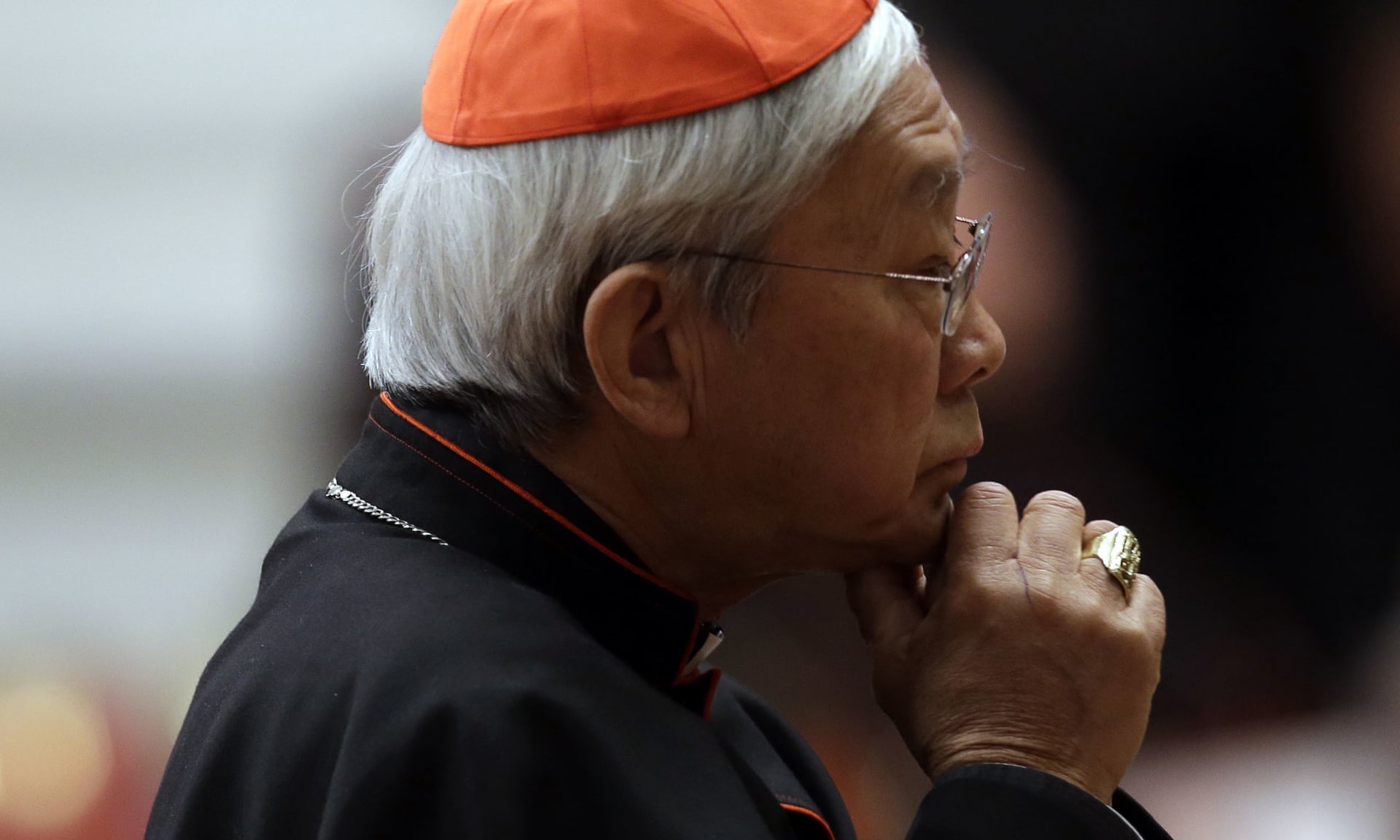
Cardinal Joseph Zen, pictured here in 2013, said he was revealing confidential information because Chinese Christians should know the truth. 

The retired cardinal of Hong Kong has revealed the Vatican’s efforts to improve relations with China included a request for a bishop to retire in favour of an excommunicated one recognised by Beijing.
Cardinal Joseph Zen, the most vocal opponent of Pope Francis’s overtures to China, bitterly criticised the proposed change in Shantou diocese, Guangdong, and revealed in a Facebook post Monday that he had travelled to the Vatican this month to personally raise it with the pope.
Zen confirmed reports by the AsiaNews missionary news agency that the Vatican had asked Shantou bishop Peter Zhuang Jianjian, 88, to step aside for Bishop Joseph Huang Bingzhang
Huang was excommunicated by the Vatican in 2011 after he was consecrated without papal approval.

Pope's deal with China would betray Christ, says Hong Kong cardinal.

Zen said he was exposing the “confidential” information – including the contents of his audience with Pope Francis on 14 January – so China’s Christians “may know the truth to which they are entitled”.
“My conscience tells me that in this case, the right to truth should override any such duty of confidentiality,” he wrote.
The issue of bishop nominations is the key stumbling block in Vatican-Chinese relations, which were officially severed when Beijing ordered Chinese Catholics to cut ties with the Holy See soon after the foundation of the Communist state in 1949.
The Vatican insists only the pope can nominate successors to Christ’s apostles. 
China views the Vatican’s insistence as interference in its sovereignty.
Popes from John Paul II onward have expressed hope for restoring diplomatic ties, with Pope Benedict XVI taking the boldest step in 2007 by urging the millions of Chinese Catholics worshipping in both the state-controlled churches above ground and the oft-persecuted clandestine underground churches to unite under his jurisdiction.
Francis is taking that overture further to try to reach a deal with the state-backed Chinese Patriotic Catholic Association.
“Do I think that the Vatican is selling out the Catholic Church in China?” Zen asked in his post. 
Yes, definitely, if they go in the direction which is obvious from all what they are doing in recent years and months.”
Vatican spokesman Greg Burke declined to comment, or to confirm or deny the AsiaNews report.
The news agency, which follows the Catholic Church closely in China, reported this month that a Vatican delegation was in Beijing in December to negotiate Zhuang’s retirement and Huang’s nomination in Shantou.
The Vatican asked the legitimate bishop of Mindong, Monsignor Joseph Guo Xijin, to accept a demotion to become an auxiliary bishop to Bishop Vincent Zhan Silu, who isn’t recognised by the Vatican, the agency reported.
But Zen wrote that when he raised the cases with Francis during a private audience, the pope said he had told his aides “not to create another Mindszenty case”.
The reference was to the Hungarian cardinal Jósef Mindszenty, who was imprisoned by Hungary’s Communist rulers and, during a brief spell of freedom during the revolution of 1956, took refuge in the US embassy in Budapest. 
Pope Paul VI eventually stripped him of his titles under pressure from the Hungarian government.
Zen said he felt encouraged by the pope’s refusal to allow a similar fate to befall China’s underground churchmen. 
“His words should be rightly understood as of consolation and encouragement more for them than for me,” he said.
Calls to the ethnic and religious authorities in the two dioceses went unanswered. 
There was also no answer at the China Patriotic Catholic Association.

mardi 28 février 2017

Xi Jinping's Pope: As Francis warms to atheist China, religious persecution intensifies

"Jesus said one person cannot serve two gods, now the Vatican is willing to serve God and the Communist Party." --  Paul Dong
By James Griffiths and Matt Rivers
Résultat de recherche d'images pour "xi jinping's pope"
Francis as Pius XII bis

From an altar in a dingy backyard four hours from Beijing, Paul Dong is conducting mass.
He's also breaking the law. 
Dong and his parishioners are among millions of illegal Christians worshiping in officially atheist China.

According to a new report from US-based NGO Freedom House, persecution of Chinese Christians and other faith groups has intensified in recent years.
"Combining both violent and nonviolent methods, the (Communist) Party's policies are designed to curb the rapid growth of religious communities and eliminate beliefs and practices," the report said.
Its release comes amid hot speculation over whether the Vatican and Beijing will strike a potentially historic deal on the ordination of Chinese bishops, ending decades of frosty ties.
Such a deal would not be welcomed by Dong and many of his fellow illegal worshipers.
"Jesus said one person cannot serve two gods, now the Vatican is willing to serve God and the Communist Party," he said.

Persecution

Since Xi Jinping came to power in late 2012, Freedom House said, the scale of religious oppression has increased at all levels of society, despite widespread resistance from believers of all stripes.
"The scale and severity of controls over religion, and the trajectory of both growing persecution and pushback, are affecting Chinese society and politics far beyond the realm of religious policy alone," researcher Sarah Cook said in a statement.
Religious practice in China is tightly controlled by the government, with the five recognized faiths -- Chinese Buddhism, Islam, Catholicism, Protestantism and Taoism -- supervised by official organizations such as the Protestant Three-Self Patriotic Movement or the Buddhist Association of China.
"Places of worship are registered, religious leaders are monitored, theological content is managed, and annual festivals or pilgrimages like the Muslim Hajj are organized under official auspices," Freedom House said.

Chinese Muslims have faced restrictions on traditional practices in recent years.

The report documented particularly onerous restrictions on Muslims -- who have been prevented or discouraged from fasting for Ramadan or wearing veils -- and Tibetan Buddhists. 
The Dalai Lama is regarded as a separatist by Beijing, and sharing his teachings has landed Buddhists in jail, according to Tibetan human rights groups.
Falun Gong -- a banned spiritual movement Beijing regards as a "cult" -- has been subject to an intense crackdown for decades. 

Freedom House said the number of prisoners of conscience in China is in the tens of thousands, with the majority of those being Falun Gong practitioners.
"Many spiritual activities practiced freely around the world -- from fasting during Ramadan to praying with one's children or performing Falun Gong meditation exercises -- are restricted and can be harshly punished in China," Cook said.

Christian crackdown

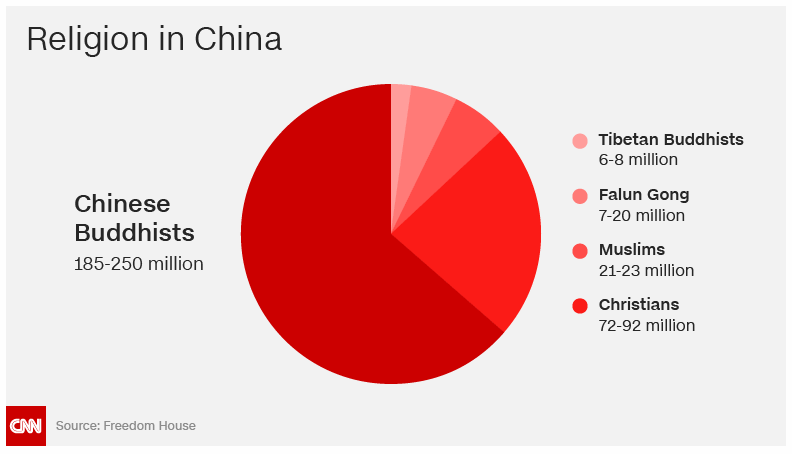
There are an estimated 72 to 92 million Christians in China, the second largest faith group behind Chinese Buddhists.
The majority of those are unaffiliated with the officially-sanctioned churches. 
More than half of Protestants are unregistered, according to Freedom House.
According to US-based Christian NGO ChinaAid, this leaves them vulnerable to oppression and abuse. 
In Zhejiang province alone, the group has documented the forced demolition of more than 20 Protestant and Catholic churches, and the removal of more than 1,000 crosses in recent years.
Hundreds of Christians have also been detained or arrested attempting to resist those demolitions.
As the larger of the Christian denominations in China, Freedom House said Protestants had been "particularly affected by cross-removal and church-demolition campaigns, punishment of state-sanctioned leaders, and the arrest of human rights lawyers who take up Christians' cases."

There are millions of Catholics in China, but around half practice their religion outside the government-run church.

Warming ties

As the situation has worsened for Protestants, relations between the Vatican and Beijing are at their strongest level in years.
Francis has expressed his desire to visit China, and reports last year suggested the two sides were moving closer to a deal on the ordination of bishops, long a sticking point.
Beijing does not recognize the authority of the Pope, and requires bishops to be appointed by local Chinese Catholic bodies. 
The Vatican refuses to permit bishops ordained without papal approval to take part in liturgical acts and has excommunicated Chinese bishops who do so.
Asked about the potential for a deal, the Vatican would not comment, with a spokesman saying it was a "work in progress."

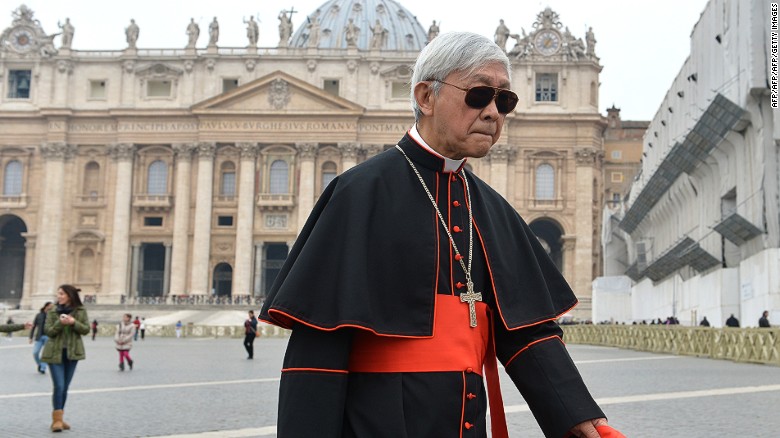
Cardinal Joseph Zen, former Bishop of Hong Kong, has criticized a potential deal between the Vatican and Beijing.

But leading Catholics in the region have been less supportive. 
Retired Cardinal Joseph Zen, former Bishop of Hong Kong, told CNN such a deal risked "selling out" underground Catholics and undermining the authority of the Pope.
Zen said that the situation for Catholics in China has worsened in recent years as the Vatican has sought compromise with Beijing.
"We are afraid it's going to be a bad deal," he said. 
"There's no reason to hope the Communists will change. They already have very tight control of the above ground church, their hope is to have the underground church under their control as well."
Any deal by which the Beijing-dominated Chinese bishops conference nominated candidates for the Pope to appoint would be unacceptable, Zen said: "How can an atheist government choose bishops for us?"
But he suggested that the reverse method, in which bishops put forward by the Pope could be vetoed by Beijing, offers a potential way forward.
"If they veto (the candidate) it is still up to the Pope to suggest another name," he said. 
"The initiative always comes from the Pope."

Christians, and other believers, have long faced oppression within China.
Flawed policy
While the Freedom House report documents widespread abuse of religious practitioners, Cook said Beijing's continued difficulty in controlling the spread of religion shows the "remarkable failure" of its policy.
"It would appear that in the longterm battle for China's spirit, an unreformed Communist Party will ultimately lose," she said.
US Senator Marco Rubio, chair of the Congressional-Executive Commission on China, told CNN that "despite Beijing's recent crackdown on human rights lawyers and civil society, and the deteriorating situation for religious freedom, faith communities continue to grow in China."
Millions of Chinese -- particularly Christians -- practice their religion outside the control of the Party, worshiping in private or at so-called "house churches" like Paul Dong's.
Dong ministers to hundreds of underground Catholics, some of whom were dismissive of the officially sanctioned body.
"I would never join the 'patriotic' church," one elderly parishioner told CNN. 
"They aren't real churches."