Affichage des articles dont le libellé est Tim Cook. Afficher tous les articles

mercredi 16 octobre 2019

American Quisling: Apple's Moral Bankruptcy

Apple supports China’s authoritarian ambitions
The Washington Post


APPLE CHIEF EXECUTIVE Tim Cook has said that “companies should have values, just like people do.” 
He’s right. 
But it is difficult to champion democratic values while doing business in a country that runs on speech-stifling authoritarianism.
China is Apple’s third-largest market, and it brings the company $44 billion per year in sales, plus countless ethical headaches. 
Last week brought several, all surrounding the ongoing anti-government protests in Hong Kong. Apple hid the Taiwanese flag emoji from its keyboard for those tapping away on the island. 
It booted the news outlet Quartz from the Chinese version of its app store after its aggressive coverage of the unrest. 
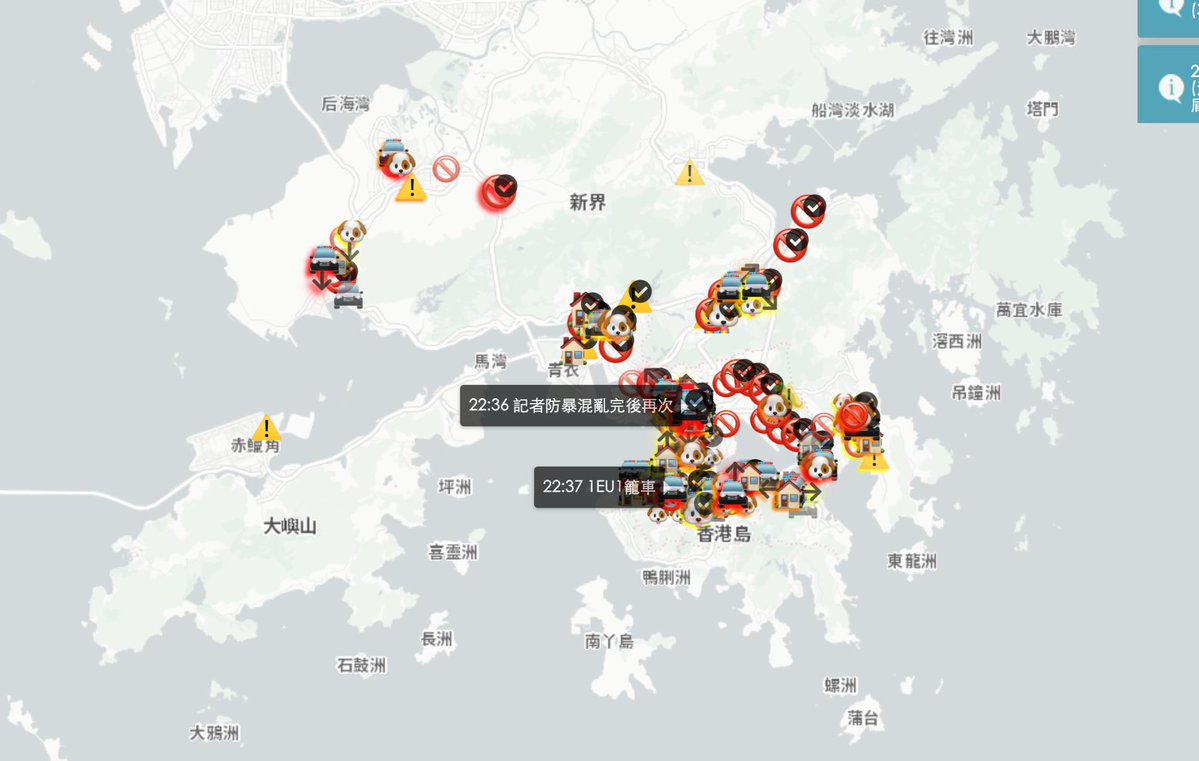
And then there was HKmap.live, an app designed for Hong Kongers to avoid law enforcement amid violent crackdowns. 
Apple, at first, rejected the app. 
Then it approved it. 
Then, finally, it removed it.
Apple says its decision to yank HKmap.live wasn’t a matter of capitulation to the Chinese regime, but rather of internal enforcement. 
The tool’s tracking function was abused to attack police, as well as to commit crimes in unpatrolled areas, and that ran counter to Apple’s guidelines. 
But the company’s reversal came after the ruling party’s official newspaper, the People’s Daily, declared that Apple’s support for “toxic apps” made the company “an accomplice to the rioters.”
Quartz was another story. 
Apple complies with local laws wherever it operates, and Xi Jinping’s laws don’t respect press freedom. 
Apple removed the app because China said to do so, just as it removed the New York Times’s almost three years ago.
Apple justifies acceding to despotic demands by arguing that it is the cost of operating in China, and that the Chinese people are better off with a big U.S. firm around than without. 
Apple and its peers can facilitate a freer flow of information — not to mention better privacy protections, on many of which the company says it will not compromise — than homegrown firms. The question, of course, is how free. 
Sometimes, corporations might go to the mat for what’s right, and sometimes they might win. 
But, other times, they will lose, and then they are left with a choice to leave China altogether or help warp the world its residents are allowed to see.
When the United States and its allies made the decision to engage with China, they imagined that economic growth and trade would promote political liberalization and a convergence of values. 
That hasn’t happened. 
Instead, there is competition between vastly different sets of values, and China doesn’t hesitate to use the lure of its market to demand fealty to its propaganda line. 
Apple, the National Basketball Association and other businesses should resist — but they need help. The United States should negotiate not only over soybean purchases and steel quotas but also to protect free speech and other liberties that China would erode.
vendredi 11 octobre 2019

Money Cult: The Long List of Beijing's Ass Kissers

Here's a list of companies kowtowing to China’s despots
It's not just Blizzard... there is a massive list of companies bowing to Chinese money
By Anthony Garreffa

I'm sure by now you've heard about the massive issues going on in China, which have been going on for a very, very long time now - but we're at a point where it's hard to ignore, even for gamers.
Activision Blizzard is in the crosshairs of Chinese censorship, with the Overwatch, Diablo, and World of Warcraft creator bowing to Chinese pressure. Activision Blizzard recently suspended one of its pro Hearthstone players after the player support pro-democracy protests in Hong Kong.
But the list is growing, wtih Apple taking a knee to Chinese censorship and even the likes of American Airlines, Gap, Mercedes-Benz, Ray-Ban, Nike, TikTok, and many others pressured by the country and its strict stance on criticism. Mashable has compiled a big list of these companies that include (so far, as I'm sure there are more):
  1. Activision Blizzard 
  2. American Airlines 
  3. Apple 
  4. Audi 
  5. Cathay Pacific 
  6. Coach 
  7. Disney/ESPN 
  8. Delta Airlines 
  9. Gap 
  10. Marriott International 
  11. Medtronic 
  12. Mercedes-Benz 
  13. Muji 
  14. NBA 
  15. Nike 
  16. Ray-Ban 
  17. Swarovski 
  18. Tiffany & Co 
  19. Vans 
  20. Versace 
  21. Viacom/Paramount Pictures 
  22. Zara
    Boycott them all, if youcan.

jeudi 3 octobre 2019

Closeted communist: Beijing represses Hong Kong with active Tim Cook's help

Apple bans an app because Hong Kong protesters use it to avoid the murderous, out of control police
https://boingboing.net

Hkmap Live is a crowdsourced app that uses reports from a Telegram group to track the locations of protesters, police, and traffic, as well as the use of antipersonnel weapons like tear gas, mass arrests of people wearing t-shirts associated with the protest movement, and mass transit closures in proximity to demonstrations (it's a bit like Sukey, the British anti-kettling app).
The escalation of indiscriminate violence by Hong Kong's police has driven mainstream opposition to the Chinese state and the Hong Kong authorities. 
The protests continue to grow, the police continue to attack families, elderly people, bystanders, and the main body of protesters, with no mercy or quarter -- including the on-camera, point-blank shooting of an unarmed, nonviolent protester. 
In this context, Hkmap isn't just a way for protesters to evade police, it's a survival lifeline for innocent people facing an occupying army of sadistic armed thugs.
But Iphone owners in Hong Kong can't access the Hkmap Live app anymore. 
Apple has removed it from the App Store, telling the app's creators that "Your app contains content - or facilitates, enables, and encourages an activity - that is not legal ... Specifically, the app allowed users to evade law enforcement."
This isn't the first time that Apple has used its monopoly over which apps can be used on Ios devices to help the Chinese state abuse human rights: in May 2018, the company removed all working VPNs from the App Store, leaving only compromised ones that the Chinese state could surveil.
Apple is America's largest tech company, and its corporate communications have presented the company as an ethical alternative to "surveillance" companies like Google, but while Apple doesn't spy on you to advertise to you, it certainly is willing to facilitate state spying on its customers for the purpose of abetting their arbitrary arrest, torture, and executions.
Moreover, Apple often describes its locked-down App Store model -- which uses technical countermeasures and legal threats to prevent its customers from installing apps that it hasn't approved -- as a way of defending its users' security from unethical apps (this was a claim that was repeatedly raised last year when Apple led an industry coalition that defeated 20 state-level Right to Repair bills).
But Apple's absolute control over the App Store means that when a state suborns the company to serve as part of its anti-democratic enforcement system, users are corralled in its walled garden where they are easy pickings for murderous authoritarians and their hired killers.
Moreover, this outcome is entirely predictable: when you design your device so that users can't override your decisions, you practically beg authoritarian governments to order you to make decisions that help them control their citizens.

HKmap.live 全港抗爭即時地圖@hkmaplive
"Your app contains content - or facilitates, enables, and encourages an activity - that is not legal ... Specifically, the app allowed users to evade law enforcement."@Apple assume our user are lawbreakers and therefore evading law enforcement, which is clearly not the case.
164
8:58 PM - Oct 1, 2019


Pinboard@Pinboard
It appears that Apple has rejected an app that warns Hong Kongers about police activity. The Hong Kong police force shot a high schooler in the chest yesterday and put seventy people, from 11 to 75, in the hospital. That app saves lives in Hong Kong. Let me tweet about it a bit https://twitter.com/hkmaplive/status/1179108329240424448 …
HKmap.live 全港抗爭即時地圖@hkmaplive
"Your app contains content - or facilitates, enables, and encourages an activity - that is not legal ... Specifically, the app allowed users to evade law enforcement."@Apple assume our user are lawbreakers and therefore evading law enforcement, which is clearly not the case.

751

5:14 AM - Oct 2, 2019

mercredi 10 avril 2019

LGBT

China has access to Grindr activity. We should all be worried.
By Isaac Stone Fish

This picture taken on March 27, 2019 shows the Grindr app on a phone in Los Angeles. A Chinese firm has been ordered by American national security officials to sell popular gay dating app Grindr, The Wall Street Journal reported on March 27. 

Recently, the news broke that U.S. national security officials ordered a Chinese company to sell the gay dating and hookup app Grindr. 
Thank goodness.
Around when the Chinese technology company Beijing Kunlun completed its $245 million acquisition of Grindr in January 2018, the Los Angeles-based app wrote that “the Chinese government will not have access to your account. Beijing Kunlun is not owned by the Chinese government.” 
Indeed, Kunlun is a private company. 
Its founder, Zhou Yahui, is known mostly in China for amassing enough wealth to have spent $1.1 billion on a divorce. 
He’s not seen as especially beholden to the ruling Chinese Communist Party.
But Grindr was lying. 
Because a Chinese company now oversees Grindr’s data, photographs and messages, that means the Party can, if it chooses to do so, access all of that information, regardless of where it’s stored. 
And that data includes compromising photos and messages from America’s most powerful men — some openly gay, and some closeted.
Couple this with China’s progress in developing big data and facial recognition software, industries more advanced there than in the United States, and there are some concerning national security implications of a Chinese-owned Grindr. 
In other words, Beijing could now exploit compromising photos of millions of Americans. 
Think what a creative team of Chinese security forces could do with its access to Grindr’s data. 
It could leak compromising photos of gay American generals. 
It could send male honeypots to targets in the American national security apparatus. 
Whether Apple’s openly gay chief executive Tim Cook uses Grindr should be no one’s business but his own — but if he does, that could give Beijing ammunition to pressure or blackmail the head of one of the world’s most important companies. 
Not by threatening to out him, but by threatening to leak salacious photos or details — like Amazon founder (and Post owner) Jeff Bezos’s recent adventure in the tabloids.
In 2015, a Grindr user outed Randy Boehning, a Republican member of the North Dakota House of Representatives, after he voted against a gay rights bill. 
In 2011, then-New York congressman Anthony Weiner tweeted a lewd photograph, setting off a chain of events which led to his 2017 arrest and, in a small way, contributed to the defeat of Hillary Clinton in 2016. 
In 2019, Beijing could extort a closeted congressman who does not want to be Weiner 2.0.
And while Beijing, unlike Moscow, isn’t known for blackmailing its dissidents with sexual kompromat, it’s not hard to imagine the human rights implications for gay activists in China, or for Chinese government officials looking to express themselves outside of the Party’s staid political culture. 
There are no known openly gay mainland Chinese politicians — though in one of history’s greatest owns, the Chinese LGBT community co-opted the word “comrade,” which state media still occasionally uses to refer to top leaders, to mean “gay” — and closeted Chinese gay politicians with accounts on Grindr or its Chinese competitor Blued could find themselves blackmailed by their political rivals.
Since Trump took office in January 2017, the U.S. government — especially the interagency Committee on Foreign Investment in the U.S., or CFIUS, which is led by the Treasury Department — has been subjecting Chinese investment in the United States to greater scrutiny. 
Grindr, which CFIUS has reportedly targeted, shares worrying similarities with Huawei, the telecommunications giant banned by the U.S. government. 
Huawei and Grindr are both private Chinese companies overseen by people who don’t have clear ties to the Party — and officially they’re supposed to be independent.
There is no evidence that Huawei has spied for China in the United States, or that Grindr has given Beijing access to Americans’ private information. 
But Huawei and Grindr’s denials are not believable: They contravene how China actually works. 
The financial fortunes of Huawei founder Ren Zhengfei, Zhou and their colleagues — and their ability to stay out of jail — links directly to how the Party views them. 
The risk that Beijing is exploiting or will exploit Huawei and Grindr remains intolerably high.
How should the United States government balance productivity, free trade and national security? Three months after the 9/11 attacks, Richard Reid attempted to detonate explosives hidden in his shoes. 
Since then, the Transportation Security Administration required most passengers at American airports to remove their shoes for screening — a horrifically inefficient process where the lost productivity fair outweighs the minuscule reduction in risk. 
Similarly, restricting Chinese-made subway cars cuts off an important lifeline to America’s creaking transportation infrastructure — without a meaningful decrease in risk.
In 2014, Chinese hackers breached the Office of Personnel Management, stealing records from more than 21 million current and former federal government employees and contractors. 
Imagine combining the OPM data set with Grindr, to create a database of the Social Security numbers, fingerprints and compromising photographs of thousands of gay U.S. government employees.
In the world of 2019, Grindr is a potent weapon. 
It shouldn’t stay in the wrong hands.

jeudi 7 décembre 2017

Rogue Nation

Inside China’s Big Tech Conference, New Ways to Track Citizens
By PAUL MOZUR

Xi Jinping shown on a screen during the fourth World Internet Conference in Wuzhen.

WUZHEN, China — An artificial intelligence company touted a robot that could help doctors with diagnoses.
A start-up displayed a drone designed to carry a single passenger 60 miles per hour.
And in a demonstration worthy of both wonder and worry, a Chinese facial recognition company showed how its technology could quickly identify and describe people.
If there were any doubts about China’s technological prowess, the presentations made this week at the country’s largest tech conference should put them to rest.
The event, once a setting for local tech executives and leaders of impoverished states, this year attracted top American executives like Tim Cook of Apple and Sundar Pichai of Google, as well as executives of Chinese giants like Jack Ma of Alibaba and Pony Ma of Tencent.
Yet all the advancements exhibited at the event, the World Internet Conference, in the picturesque eastern Chinese city of Wuzhen, also offered reason for caution.
The technology enabling a full techno-police state was on hand, giving a glimpse into how new advances in things like artificial intelligence and facial recognition can be used to track citizens — and how they have become widely accepted here.

U.S. tech Quisling Tim Cook at the World Internet Conference on Sunday.

The tracking was apparent both in the design of the event, which ended on Tuesday, and in the technology on display.
Tight security checkpoints made use of facial recognition.
Chinese armed police patrolled.
And in the dark corners of the whitewashed walls of the convention hall, the red lights of closed-circuit cameras glowed.
A fast-growing facial recognition company, Face++, turned its technology on conferencegoers.
On a large screen in its booth, the software identified their gender, described their hair length and color and characterized the clothes they wore.
Other Chinese companies showed what could be done with such data.
A state-run telecom company, China Unicom, featured a display with graphics breaking down the huge amounts of data the company has on its subscribers.
One map broke down the population of Beijing based on the changing layout of the city’s population as people commuted to and from work.
Another showed where foreign visitors roamed on its network.

Xiao Qiao robots at the conference.

The people overseeing China Unicom’s booth openly discussed the data, a sign of how widely accepted such surveillance and data collection have become in China.
At Unicom’s two other state-run rivals, a similar penchant for measurements and surveillance was also on display.
China Mobile floated a camera on the prow of one of the many boats that drift through Wuzhen’s canals, sending the images over its latest and faster cellular technology.
China Telecom showed off its ability to measure the amount of trash in several garbage cans and detect malfunctioning fire hydrants.
Investors and analysts say China’s unabashed fervor for collecting such data, combined with its huge population, could eventually give its artificial intelligence companies an edge over American ones.
If Silicon Valley is marked by a libertarian streak, China’s vision offers something of an antithesis, one where tech is meant to reinforce and be guided by the steady hand of the state.
Such developments underscore a nascent back-and-forth between China and the United States that will determine much about technology’s future development and application.

The Ehang 184, an oversized flying drone meant to ferry a single passenger at 60 miles per hour, on display at the conference. 

Speaking at a panel on terrorism, Mei Jianming, described as a chief expert on antiterrorism for the Shanghai Cooperation Organization, an intergovernmental group that includes China and Russia among other countries, labeled groups that speak out for the human rights of China’s Islamic minority Uighurs as terrorists.
He then said Beijing should do more to use its influence to push Twitter to change its terms of service and push back against such groups.
“We should strengthen the capability of our propaganda,” he said.
“On the Chinese official side, our China Daily and Xinhua News have their own Twitter presence, but the effectiveness of their propaganda is not enough. It’s clearly not enough.”
The contradictions of using sites like Twitter to change opinions abroad, while blocking them domestically, were often evident but almost as often unremarked upon.
During the opening speech made by Wang Huning, a member of China’s leading seven-man Politburo Standing Committee, there were more overtures to openness and cooperation than to the security and censorship that have marked China’s approach to the internet.
One of the most clear discussions of censorship came not from a speaker at the conference, but from an official watching the conference’s entry gate on the first day.
A representative of the Wenzhou city government, he queried journalists about how they got around China’s internet filters.
It was not clear whether he was genuinely curious, or wanted to find out which tools were most effective so they could be later targeted.

mercredi 6 décembre 2017

America's Tech Quisling

Apple has a moral obligation to push back in China, says senator who probed the company's ties
  • "Tech companies must continue to push back on Chinese suppression of free expression." -- Vermont Sen. Patrick Leahy.
  • Leahy, a Democrat, along with Texas Republican Sen. Ted Cruz, probed Apple for details on Chinese ties
By Anita Balakrishnan

America's tech Quisling

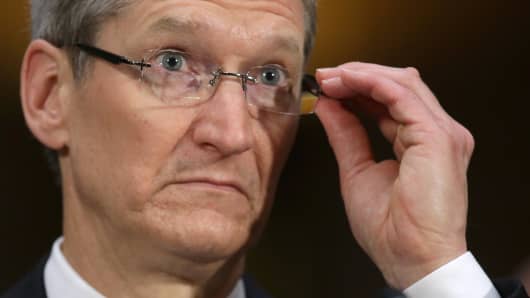
Apple CEO Tim Cook's recent remarks at a conference in China are drawing criticism from U.S. senators, including one who worries that the tech giant is not fulfilling its "obligation to promote free expression and other basic human rights."
The comments have fanned the flames of a relationship that's already facing scrutiny in Congress.
Vermont Sen. Patrick Leahy, a Democrat, along with Texas Republican Sen. Ted Cruz, previously criticized Apple in October after reports that that the company removed VPN apps from the China App Store to comply with Chinese regulators.
When asked to provide a statement condemning the Chinese government's censorship, Apple told the senators that "actions are our most powerful statement."
Then, Cook made a surprisingly high-profile appearance over the weekend at the World Internet Conference in China, where he reportedly said that Apple and China "share" a vision for a "digital economy for openness" and "a common future in cyberspace."
After Cook's remarks at the trade show, Leahy said in a statement to CNBC: "American tech companies have become leading champions of free expression. But that commitment should not end at our borders. ... Global leaders in innovation, like Apple, have both an opportunity and a moral obligation to promote free expression and other basic human rights in countries that routinely deny these rights."
Leahy maintained his call for Apple to challenge Chinese "suppression."
"Apple is clearly a force for good in China, but I also believe it and other tech companies must continue to push back on Chinese suppression of free expression," Leahy said.
Apple is one of the most influential American technology companies in China — Google and Facebook, for example, have limited services there, and Apple is one of the few consumer electronics brands that sells a lot of products during Chinese shopping holidays like Singles Day.
Apple was not available to comment on Leahy's response to the letter.

lundi 4 décembre 2017

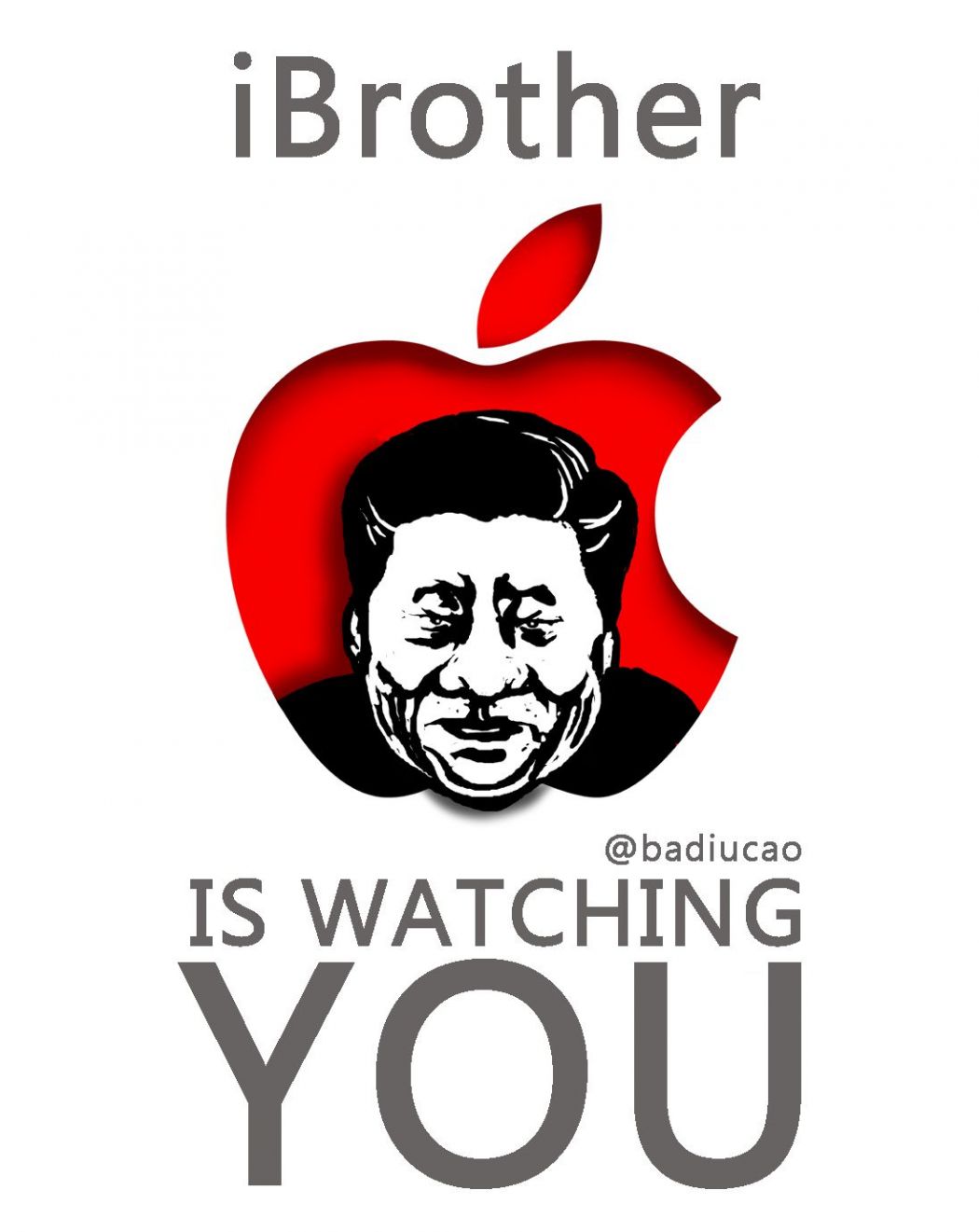
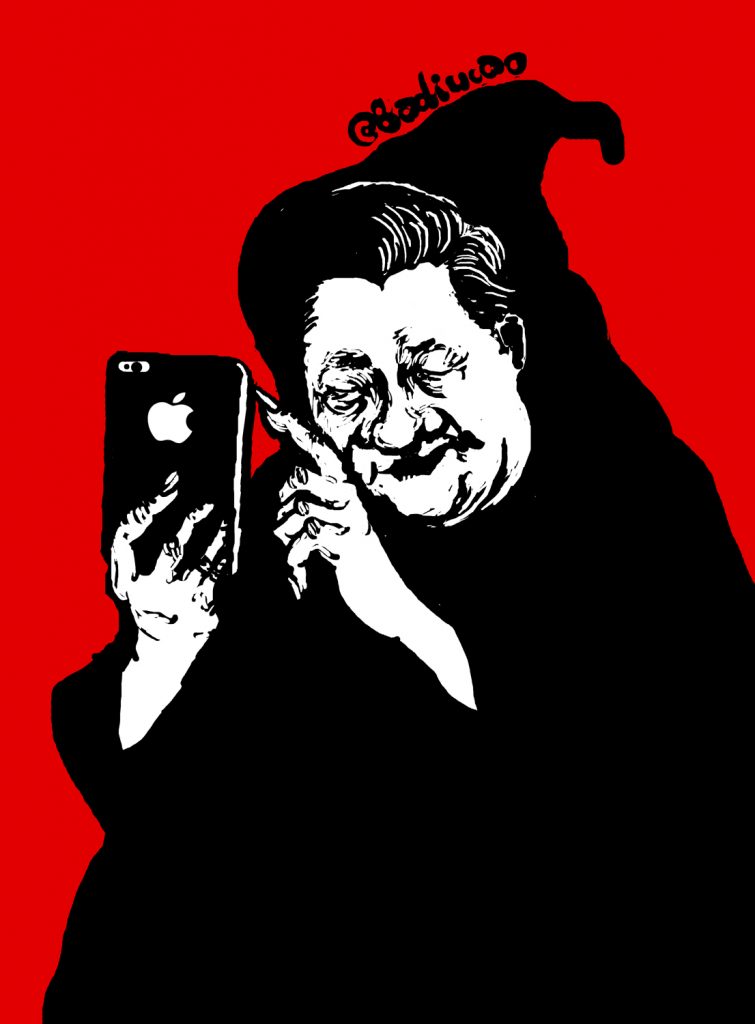
Wicked Xi and the Traitorous Apple

Apple backs China’s vision of an Orwellian Internet as censorship reaches new heights
By Simon Denyer

BEIJING — Reading headlines from the World Internet Conference in China, the casual reader might have come away a little confused. 
China was opening its doors to the global Internet, some media outlets optimistically declared, while others said Beijing was defending its system of censorship and state control.
And perhaps most confusing of all, Apple’s CEO Tim Cook stood up and celebrated China’s vision of an "open" Internet.
Say what?
China has more than 730 million Internet users, boast the largest e-commerce market in the world, and consumers who enthusiastically embrace mobile digital technology. 
But it censors foreign news websites and keeps Western social media companies out.
The World Internet Conference held in the eastern Chinese city of Wuzhen is meant to promote China’s vision of “cyber-sovereignty’ — the idea that governments all over the world should have the right to control what appears on the Internet in their countries.
In practice, in China, that amounts to the largest system of censorship and digital surveillance in the world, where criticism of the Communist Party is forbidden and lands you in jail.
But that wasn’t mentioned when Cook delivered a keynote speech on the opening day of the gathering Sunday.
“The theme of this conference — developing a digital economy for openness and shared benefits — is a vision we at Apple share,” Cook said, in widely reported remarks.
“We are proud to have worked alongside many of our partners in China to help build a community that will join a common future in cyberspace.”
Chinese media welcomed Cook’s endorsement, with the nationalist Global Times declaring in a headline that “Consensus grows at Internet conference.”
Alongside Cook in endorsing China’s digital vision were officials from countries such as Saudi Arabia and Serbia, it noted.

Free speech and human rights advocates were less impressed.
“Cook’s appearance lends credibility to a state that aggressively censors the internet, throws people in jail for being critical about social ills, and is building artificial intelligence systems that monitors everyone and targets dissent,” Maya Wang at Human Rights Watch in Hong Kong wrote in an email.
“The version of cyberspace the Chinese government is building is a decidedly dystopian one, and I don’t think anyone would want to share in this ‘common future.’ Apple should have spoken out against it, not endorsed it.”
And it wasn’t just Cook who some critics accused of indulging in a double-speak.
Xi Jinping opened the conference written remarks that led to a flurry of arguably misleading headlines.
“The development of China’s cyberspace is entering a fast lane,” he said, in remarks read out by an official. 
“China's doors will only become more and more open.”
Yet the audience was soon reminded that nothing that could possibly threaten the Communist Party would be allowed through those supposedly open doors.
China has tightened censorship and controls of cyberspace under Xi, with a new cybersecurity law requiring foreign firms to store data locally and submit to domestic surveillance.
Wang Huning, who serves as a member of the Communist Party’s elite standing committee and is Xi’s top ideologue, defended China’s system and even suggested that more controls could be in the offing.
“China stands ready to develop new rules and systems of internet governance to serve all parties and counteract current imbalances,” he said to the conference, according to Reuters.
But it was Cook’s words that prompted the strongest reaction, coming after Apple has also come under fire for its actions in China.
In a written response to questions from Senators Patrick Leahy (D-Vermont) and Ted Cruz of (R-Texas) last month, Apple said that it had removed 674 VPN apps from its app store in China this year — tools that allow users to circumvent censorship by routing traffic abroad — to comply with local laws. 
Skype was also removed from Apple’s China store, the New York Times reported.
In August, Cook said Apple hadn’t wanted to remove the apps, but had to follow local laws wherever it does business.
But Greatfire.org, a group that combats Chinese censorship, argued Apple’s decision to agree to censorship put pressure on other companies to follow suit, and could even mean that Chinese citizens could ultimately be subjected to Chinese censorship when they travel abroad.
“It is undeniable that Tim Cook and Xi Jinping have a shared vision of the internet. Xi wants to be able to control all information and silence those who may threaten his leadership. Cook helps him with vast, unaccountable, implementation of censorship across Apple products,” it wrote to The Washington Post.
Critics saw simple business calculations in Cook’s appearance in Wuzhen.
“Cook Kisses the Ring,’ Bloomberg columnist Tim Culpan wrote, arguing that Cook was “desperate to hold onto any remaining scraps of the China market” in the face of stiff competition from local rivals.
The head honchos of China’s main digital and Internet companies, Huawei, Baidu and Tencent, “ought to have been grinning like Cheshire cats,” Culpan added, since censorship has kept foreign companies like Facebook, Google and Twitter out of China and served as a “handy little tool of trade protectionism.”
Nor did it matter if Cook’s tongue was in his cheek, for his presence at the conference, along with Google’s Sundar Pichai and CISCO Systems’ Chuck Robbins, not only gave legitimacy to the authorities but also sent a signal to domestic Chinese rivals that their turf is safe, Culpan wrote.
Rights group Freedom House last month branded China the worst abuser of Internet freedom among 65 countries surveyed, followed by Syria and Ethiopia.
But in Wuzhen, that report was not about to be discussed.

Tech Quisling

Cook Kisses the Ring
By Tim Culpan

Tim Cook is desperate to hold onto any remaining scraps of the China market. 
That's a boon for the country's model for the internet, and the local players who dominate.
The Apple Inc. CEO, who last year stood up to the U.S. Federal Bureau of Investigation, took to the stage at China's annual internet conference this past weekend to kiss the ring and give his seal of approval for the way the government there tightly controls the flow of information.
“The theme of this conference -- developing a digital economy for openness and shared benefits -- is a vision we at Apple share,” Cook said. 
“We are proud to have worked alongside many of our partners in China to help build a community that will join a common future in cyberspace."
Ren Zhengfei, Robin Li and Pony Ma ought to have been grinning like Cheshire cats. 
The chiefs of Huawei Technologies Co.1 , Baidu Inc. and Tencent Holdings Ltd. have been great beneficiaries of Chinese censorship. 
Restricting the flow of information, you see, has worked out to be a handy little tool of trade protectionism.


The three Chinese companies have not only embraced domestic rules but actively assisted in enforcing them. 
Google Inc., on the other hand, famously withdrew from China after it decided not to comply with censorship rules, Facebook Inc. has been restricted from the start, while Apple has faced formidable headwinds from government and semi-government agencies.
Openness, shared benefits, common future? Huh?
I wasn't at the speech, but footage does not show Cook's tongue in his cheek. 
It's irrelevant whether he believes the words that he spoke. 
What matters is that landing major overseas CEOs -- including Google's Sundar Pichai and Cisco Systems Inc.'s Chuck Robbins -- not only gave legitimacy to authorities, but sent a signal to domestic rivals that their turf is safe. 
There's no sign that Facebook founder Mark Zuckerberg attended the conference, but his embrace of The Chinese Way is well documented.

Take Baidu. 
Revenue and profit have rebounded this year despite its search business model facing existential threats ranging from regulation to changing user behavior. 
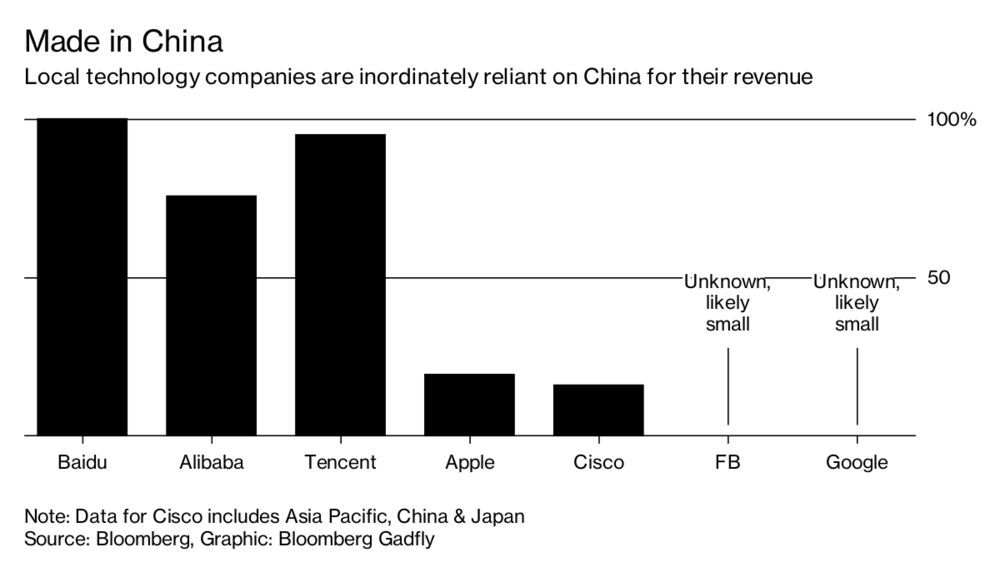
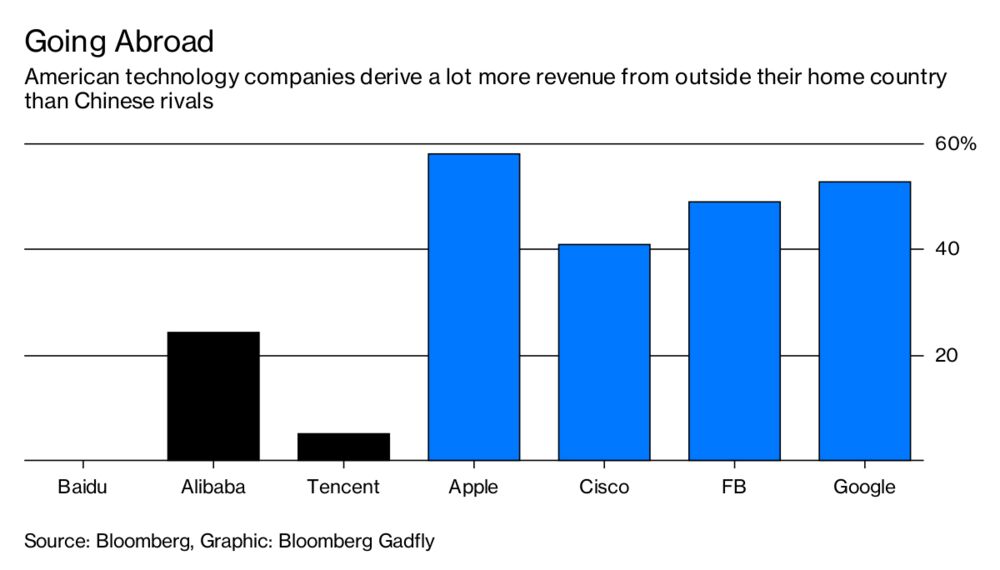
That's because Baidu faces no credible competition in China, and derives negligible revenue from overseas.
Huawei, whose Western competitors ought to include Apple and Cisco, not only has home ground advantage in China but gets favorable treatment from government-backed telcos for its equipment and handsets, and is probably a recipient of Chinese foreign aid that's channeled back into network infrastructure built by the company.
The greatest winner of all is Tencent. 
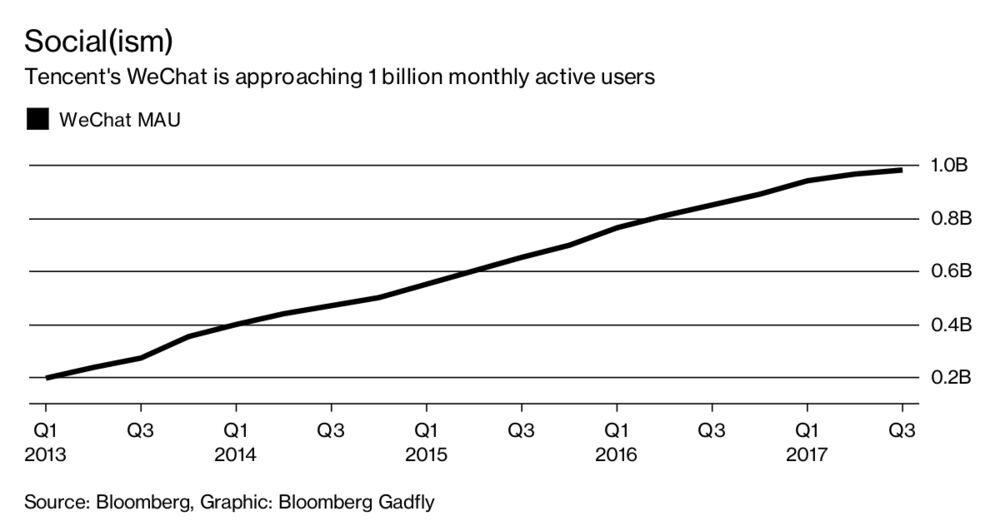
The social media giant has its tentacles throughout all aspects of Chinese culture, yet barely exists outside of the Great Firewall. 
And why should it? 
Although China may soon reach peak WeChat, the company is leveraging its user base by adding more services such as payments and ads -- safe in the knowledge that neither Facebook nor Google are coming anytime soon.

Google, Facebook and even Cisco could thrive even if they didn't bother too much with the world's second-largest economy. 
But Cook's Apple is a little different. 
Huawei is coming for it, and so too is ZTE Corp., not just in the U.S. but globally. 
Apple derives almost 60 percent of its revenue from outside its home country, including close to 20 percent from China.
That's why it's so notable that the chief of a U.S. devices maker agreed to deliver a keynote speech at a Chinese internet conference: Information may be restricted, but hardware still roams free. 
For now.

Note
1. While Ren's current title is deputy chairman of Huawei, he is the founder and probably still calls the shots.