Affichage des articles dont le libellé est THAAD. Afficher tous les articles

lundi 3 février 2020

U.S.'s 5,025,817 Chinese Spies

Sino-American engineer arrested for taking US missile defense secrets to China
By Justin Rohrlich & Tim Fernholz

When Wei Sun, a 48-year-old engineer at Raytheon Missile Systems, left for an overseas trip last year, he told the company he planned to bring his company-issued HP EliteBook 840 laptop along.
Sun, a Chinese-born American citizen, had been working at Raytheon, the fourth-largest US defense contractor, for a decade. 
He held a secret-level security clearance and worked on highly sensitive missile programs used by the US military.Since Sun’s computer contained large amounts of restricted data, Raytheon officials told him that taking it abroad would not only be a violation of company policy, but a serious violation of federal law, as well.

Sun had access to sensitive missile defense technology.
Sun didn’t listen, according to US prosecutors. 
While he was out of the country, Sun connected to Raytheon’s internal network on the laptop. 
He sent an email suddenly announcing he was quitting his job after 10 years in order to study and work overseas.
When Sun returned to the United States a week later, he told Raytheon security officials that he had only visited Singapore and the Philippines during his travels. 
But inconsistent stories about his itinerary led Sun to confess that he traveled to China with the laptop.
A Raytheon lawyer examined the machine, and confirmed it contained technical specifications prohibited from export by the International Traffic in Arms Regulations (ITAR), in addition to security software that is itself export-controlled and requires a special license to take outside the United States.
Sun was arrested by FBI agents the next day. 
His attorney, Cameron Morgan, did not respond to a request for comment. 
Raytheon said only that the company “cooperated with this investigation,” declining to elaborate further.
Court documents refer to Sun possessing classified files related to several different air defense systems designed by Raytheon for the US military and sold to American allies and proxies around the world.
The case, which has not been reported until now, is yet another example of China’s increasing efforts to acquire American military technology. 
The country’s security services have already compromised dozens of crucial US weapons systems, such as the Army’s Terminal High Altitude Area Defense (THAAD) ballistic missile defense system, and the Aegis ballistic missile defense system used by the Navy. 
In 2018, Chinese hackers stole top-secret plans for a supersonic anti-ship missile being developed by the Navy known as Sea Dragon. 
The Chinese managed to get massive amounts of sensitive signals and sensor data, in addition to the Navy’s entire electronic warfare library.
The weapons with which Sun worked are “pretty much top-of-the-line American systems,” according to Dean Cheng, a fellow at the Heritage Foundation who studies China’s military capabilities.
The AMRAAM, or Advanced Medium Range Air to Air Missile, is used on US fighter jets like the F-16 and F-22 to destroy other aircraft before they can be seen by anything but radar. 
It has also been converted into a ground-based air defense system, which is Sun’s focus, since prosecutors describe his work as centered on ballistic missile defense.
The documents also say Raytheon employees will provide testimony about the Stinger missile, a “man-portable” air-defense missile that can be fired by troops on the ground, made most famous when the US supplied it to Afghan warlords fighting against occupying Soviet troops.
Perhaps most significant is Sun’s involvement with the Redesigned Kill Vehicle (RKV) program, an effort to replace the interceptor used by US air defense systems to shoot down incoming ballistic missiles.

The Pentagon cancelled the program last year because of technical problems, but information about the project would still be useful to China to understand what the US might do to defend from conventional or nuclear missiles. 
Missile technology has become central to Beijing’s strategy to deter US power in the Pacific, making up for deficiencies and a lack of experience with weapons systems like jet fighters.
China would be eager to learn how to defeat the missiles by understanding the technical details of how they find their targets with radar and other sensors, and how they respond to attempts to jam or distract them, Cheng told Quartz.
China already has its own equivalents of these weapons, so it’s not necessarily seeking to copy US technology. 
However, as one example, China’s advanced air-to-air missile has never been used in combat, while the AMRAAM has, so its design may offer lessons that China’s defense industrial base has yet to learn.
Cheng said this is “one piece of the larger Chinese espionage picture… we tend to focus on Chinese cyber [but] they have human intelligence, they have people trying to steal examples of it in other countries as well.”
“Chinese government agencies are keeping their eye on former citizens who are working in big US companies [like Raytheon],” said Janosh Neumann, a former counterintelligence officer with Russia’s Federal Security Service who now lives in the United States.
The files Sun took out of the country could have just as easily been purloined by Chinese spy service without the engineer’s knowledge.
“If your computer gets left in a hotel room, somebody could image the whole thing and you’d never know it.” 
“There’s always the risk of something like that—no different than if somebody took pictures or copies of blueprints or a paper file.”
A grand jury in Arizona last week returned a superseding indictment charging Sun with additional counts of violating ITAR. 
Legal filings suggest that Sun, who initially pleaded not guilty, is preparing to change his plea to guilty as part of an agreement with the Department of Justice. 
He is scheduled to appear in court on Feb. 14.

mercredi 20 décembre 2017

Tensions rise again between China and South Korea

Beijing bans its tour groups from holiday visits after brief period of detente 
By Bryan Harris and Kang Buseong in Seoul and Charles Clover in Beijing

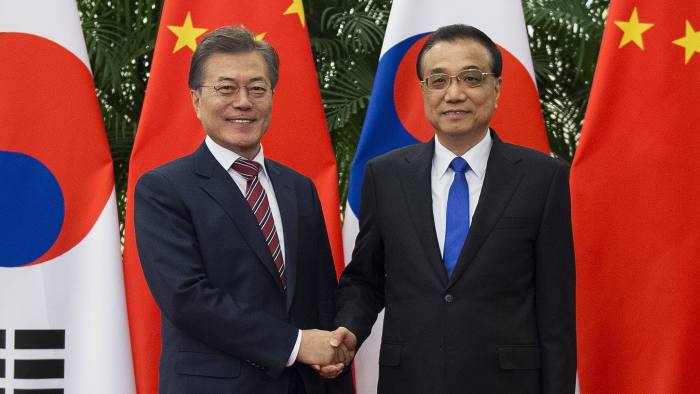
The ephemeral friends: South Korean President Moon Jae-in meeting Li Keqiang in Beijing last week

China has once again banned tour groups from visiting South Korea, signalling that a brief period of detente between the two nations is already coming to an end.
The development underscores the geopolitical complexities of north-east Asia, a region increasingly overshadowed by the threat of a conflict between the US and North Korea over Pyongyang’s development of strategic nuclear weapons.
The ban on tour groups by China, confirmed by two South Korean tourism groups, comes less than two months after Beijing agreed to cease harsh economic retaliation against South Korean companies and organisations over Seoul’s decision to a host a US-operated missile shield.
It also comes less than a week after Moon Jae-in, South Korea’s president, went to China on a state visit that was hailed by officials as heralding a “new era” in ties between the two Asian neighbours. However, the visit was marred by a series of unfortunate incidents, including the hospitalisation of a South Korean journalist who was kicked in the head by a Chinese security guard at one of the official events. 
Mr Moon and Xi Jinping also failed to make a joint statement, a clear indication of the lingering tensions between the two nations over Seoul’s decision to install the Terminal High Altitude Area Defence platform, better known as Thaad.
After its deployment earlier this year, China launched stinging economic retaliation against South Korean interests, including a ban on tour groups that officials in Seoul calculated cost the tourism industry about $7bn.
In October, the two countries agreed to bury the hatchet after South Korea offered assurances that it would not enter a full military alliance with Japan and the US nor deploy another US missile battery to defend against North Korea. 
China fears the installation’s powerful radar may be used to monitor its own military activities. However, since the agreement China has renewed complaints about the shield and on Tuesday revived the ban on organised groups vacationing in South Korea.
“From yesterday, the Chinese tourism organisation has rejected agencies’ tour group applications, meaning the Chinese government is refusing approval for group tours for no reason whatsoever,” said Jang Yoo-jae, head of the Korea Culture and Tourism organisation, which is comprised of inbound tourism agencies.
Another group representing travel agents added that the Chinese authorities had also rejected its applications.
Shares in South Korean tourism companies and makers of cosmetics, which are popular with Chinese shoppers, fell on Wednesday when reports of the Chinese ban first emerged.
The development comes just four days after Mr Moon left Beijing. 
Since then, relations have quickly turned sour. 
On Monday, five Chinese military aircraft, including two bombers, entered South Korea’s air defence identification zone, prompting Seoul to scramble fighters. 
Two days later, the South Korean coast guard fired more than 200 rounds at dozens of Chinese fishing boats that had violated Seoul’s exclusive economic zone.  
The two nations share deep historical and commercial ties as well a common interest in preventing a US war with North Korea, which could threaten the entire region. 
However, China is wary of South Korea’s close military ties with Washington as well as the presence of the almost 30,000 American troops on the peninsula.
Japan and South Korea are Washington’s key allies in north-east Asia.

samedi 18 novembre 2017

The Finlandization of South Korea

CHINA WINS ITS WAR AGAINST SOUTH KOREA’S US THAAD MISSILE SHIELD – WITHOUT FIRING A SHOT
BY DAVID JOSEF VOLODZKO

A detente between China and South Korea may be good news for the Korean economy and a necessary step towards resolving the North Korea issue, but at the same time it threatens to degrade regional security for years to come.
When South Korean President Moon Jae-in and Xi Jinping agreed on November 11 to “normalise exchanges”, they ended a conflict that began more than a year ago with Seoul and Washington’s decision to deploy an anti-ballistic missile system in South Korea.
Beijing, which claims the system’s radar can be used by the United States to spy on China, retaliated against the deployment of the Terminal High Altitude Area Defence (THAAD) system with unofficial sanctions against the South. 
Seoul has now agreed to accept military constraints in return for the lifting of those sanctions, creating a worrying precedent for Beijing’s rivals in the region.
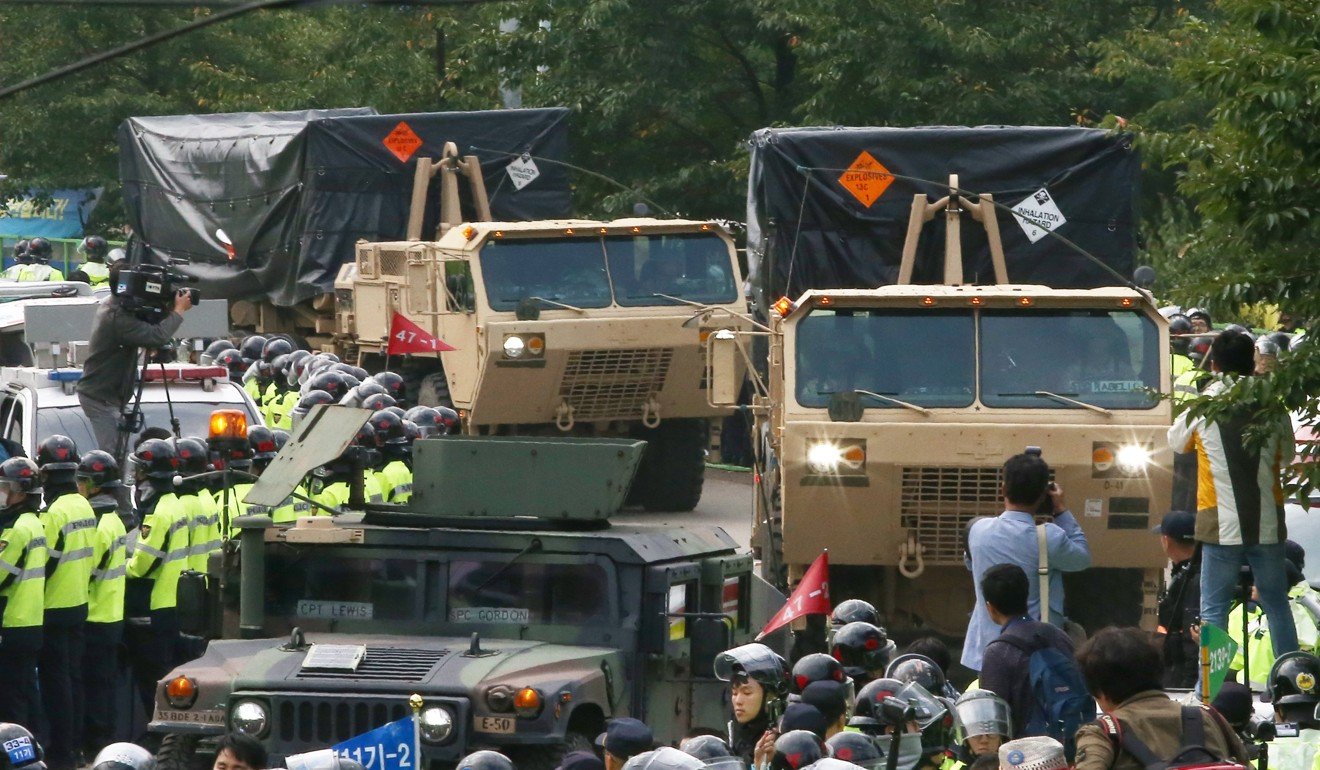
South Korean protesters try to block two US military vehicles hauling THAAD missile defence systems in Seongju. 

The military constraints are known as the “three nos”, meaning Seoul agrees there will be no further anti-ballistic missile systems in Korea, no joining of a region-wide US missile defence system and no military alliance involving Korea, the US and Japan. 
This is an enormous sacrifice but for reasons both economic and political Moon had few other options.
Economically, after being suffocated for 16 months by China’s “doghouse diplomacy”, many South Korean businesses were left gasping for air. 
Hyundai’s sales in China dropped 64 per cent in the second quarter of 2017 from a year before, Lotte’s supermarket sales in China fell 95 per cent over the same period and Chinese tour groups to South Korea were banned outright, which alone led to an estimated revenue loss of US$15.6 billion this year, according to Hyundai Research Institute.
Politically, a better strategy might have been playing both ends against the middle by fostering better ties with Japan and the US but this would have alienated Moon from his base and may not even be something he wants at the moment.
“Moon Jae-in is on the political left, which tends to believe ‘the enemy of my enemy is my friend’, so they dislike Japan and feel closer to China for historical and political reasons,” said Joseph E. Yi, associate professor of political science and international studies at Hanyang University. 
“The left-wing in Korea is very anti-Japan and has a post-colonial outlook, seeing China and Korea as opponents of Japanese colonialism.”
It all depends, Yi said, on how one views the past. 
If Koreans view themselves and Chinese as victims of Japanese oppression, they will be more likely to sympathise with China. 
But, he noted, the problem with this perspective is that Japan today is not the country it was 60 or 70 years ago – neither is China.
As such, Korea and Japan are arguably better allies, according to the political philosophy of liberalism, which suggests liberal democracies should ally against non-liberal states because whatever their differences, their goals ultimately overlap.
China’s economic retaliation is an example of this, since it constitutes a violation of its free trade agreement with Korea, whereas Japan, which also has a free trade agreement with Korea, has honoured its part of the deal.
But liberalism is the philosophy of Korea’s political right, while its political left is defined by social constructivism, or the theory that decisions and knowledge are based not on liberal like-mindedness or realpolitik, but on certain narratives.
“If you see Japan as an unrepentant, evil colonial power then you’d rather ally with China against Japan,” Yi said. 
“So when Moon met Trump, instead of trying to develop a stronger alliance between Korea, Japan and China, Moon introduced a comfort woman, and they had Dokdo shrimp.”
Comfort women is the euphemism given to the tens of thousands of Korean women forced to work as sex slaves in Japanese brothels during the second world war; Dokdo shrimp are caught in waters around islets at the centre of a territorial dispute between South Korea and Japan – Tokyo lodged a protest about both issues after the Trump visit.
“[Moon is] focused on redemption against the past,” Yi said. 
“He wants the Japanese prime minister to apologise, and I think this kind of focus on the past shapes politics in an unhealthy way.
“The ‘three nos’ creates a precedent that links economics to political and national security. Korea would never do that if it was any other country, like Vietnam or Japan, but they’re doing it for China because the only other way is to ally with Japan and that’s not an option for the left.”
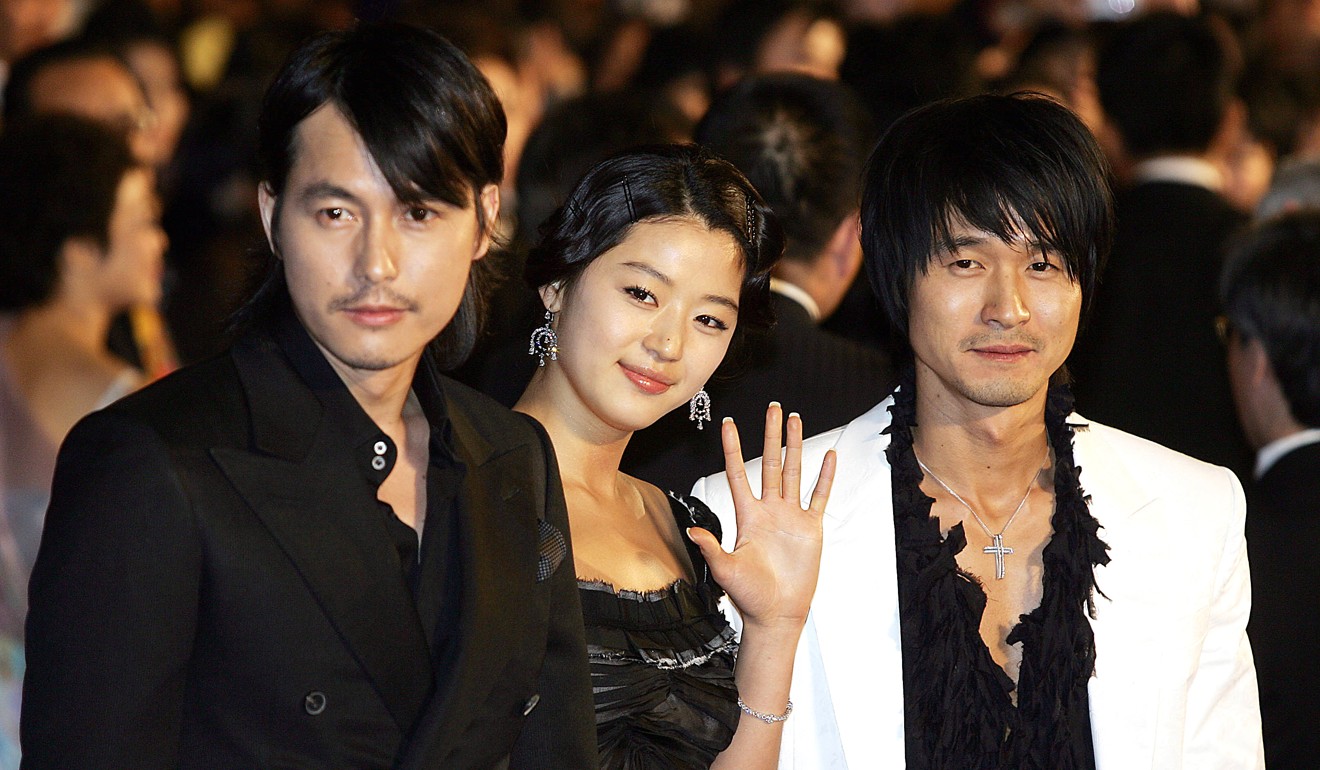
South Korean actress Jun Ji-hyun, centre. 

Already, however, the first signs of an economic thaw are visible. 
Two days after Moon and Xi’s agreement, South Korean actress Jun Ji-hyun appeared in an ad for health products on China’s biggest online shopping website, Taobao by Alibaba, the owner of the South China Morning Post.
Also, during their November 11 summit in Vietnam, Moon and Xi agreed that Moon would visit China in December, and Moon invited Xi to attend the upcoming Winter Olympics in Pyeongchang, South Korea. 
During the same trip, Japanese Prime Minister Shinzo Abe suggested he and Xi visit each other next year to mark the 40th anniversary of their nations’ friendship treaty.
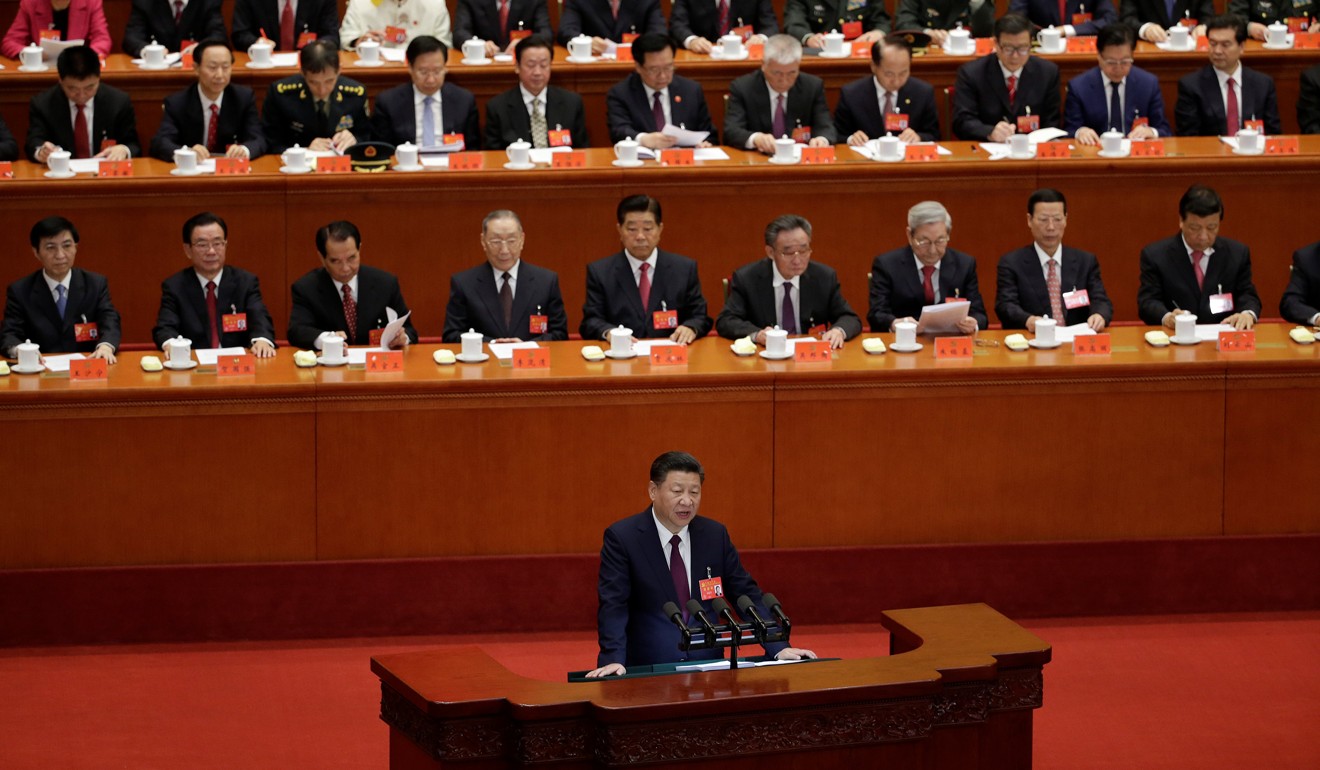
Xi Jinping gives his speech to the 19th National Congress. 

This raises further questions about China’s efforts to isolate Japan and constrain South Korea’s military options. 
According to Donald K. Emmerson, director of the Southeast Asia programme at Stanford University, China’s 19th National Congress, which was held from October 18-24, provides some answers. 
For one thing, the recent congress has further cemented Xi’s hold on power. 
That shift, Emmerson said, coupled with China’s economic means, provides Beijing the capacity for expansion.
So capacity is there, what about desire?
Xi opened the congress with a speech that lasted more than three hours, in which he said China had entered a “new period” and must now “take centre-stage in the world”. 
Emmerson said this language suggested that while Beijing’s expansionist ambitions might not extend to Europe, “China wants dominance in its immediate periphery”.
The South China Sea, for example, is administered in domestic Chinese law through the province of Hainan, which means Beijing sees the South China Sea as a Chinese lake. 
Subsequently, when former Philippine president Benigno Aquino filed a suit against China at the United Nations, China refused to take part and denounced the tribunal’s decision, which was not in China’s favour. 
China then blocked fruit exports from the Philippines and discouraged tourists from visiting.
“China was furious,” Emmerson said. 
“They denounced the Philippines and punished it economically, kind of an equivalent to what happened to Lotte in [China] after the THAAD incident in South Korea. The idea is to do economic damage until the state in question behaves properly, according to Beijing.” ■

vendredi 13 octobre 2017

Axis of Evil: The Fight With North Korea Is Really About Rogue China

China sees the conflict as a way of keeping the U.S. off-balance in Asia while maintaining its influence over its immediate neighbors.
By Elizabeth Dias

In recent weeks, Trump and Pyongyang have escalated their war of words over North Korea's nuclear weapons testing, with both sides hinting it could end with a nuclear conflict.
But while the rhetoric has focused on North Korea, the Central Intelligence Agency is just as worried about China.
CIA analysts say the North Korean tests have heightened the concerns the U.S. has about managing the rise of China, which sees the conflict as a way of keeping the U.S. off-balance in Asia while maintaining its influence over its immediate neighbors.
“It is, to us, not just an immediate national security threat,” the CIA’s Michael Collins, deputy assistant director for East Asia Mission Center, said last week at a national security conference at George Washington University. 
“It is forcing us to think about the long-term management of China.”
The North Korea problem looks different from Beijing’s eyes than it does from Washington’s. 
Neither country wants a nuclearized North Korea, and China, like Washington, condemned North Korea’s recent missile launches and backed the United Nations’ latest sanctions against North Korea in September. 
But China’s strategic interests in the region are different from the U.S.’s objectives. 
China is focused on expanding its regional influence in Southeast Asia, and in the long term, increasing its global might.
“China still looks at the North Korea problem through the lens of what the U.S. is doing,” the CIA’s Yong Suk Lee, deputy assistant director for the Korea Mission Center, said at the same security conference last week. 
“China’s strategic goal is to frustrate the U.S. and maintain a permanent division of the Korean peninsula.”
Division on the peninsula is especially important for China because it helps counter the impression that the U.S. could contain China’s rise. 
North Korea serves as a “buffer state” for China amid strong U.S. alliances with its neighbors, South Korea and Japan. 
China also sees the demise of North Korea as tied to the rise of South Korea, and thus U.S. power.
“It would be perceived as a victory for America, a defeat for China,” says longtime diplomat Christopher Hill, an assistant Secretary of State under George W. Bush who is now dean of the University of Denver’s Josef Korbel School of International Studies.
This calculus does not mean China is not concerned about nuclear war, but rather that China has its own geostrategic timeline. 
Beijing would rather deal with a nuclear North Korea later, ideally when Chinese power is greater than the U.S.’s, says the Center for Strategic and International Studies’ senior vice president for Asia and Japan Chair, Michael Green.
“A nuclear North Korea, if it behaves, is acceptable,” he says, “and far more acceptable than the regime collapsing and China finding on its border a unified Korea that is aligned with the United States, or China finds all of the chaos that comes from war on the peninsula.”
Chinese are split on the issue, says Hill. 
But for some, the cure for a nuclear North Korea may be worse than the disease. 
“Especially from the vantage point of China’s national security state, they have real concerns about the perception that the U.S. has once and for all won the cold war on the Korean peninsula,” Hill says. 
“There could be concerns about what this would to do to China’s security policy, that is, if the U.S. put listening posts or troops up on the Yellow River, on the Chinese border.”
But already, China is facing a cost. 
South Korea has installed and deployed launchers of the U.S. anti-missile THAAD system, designed to shoot down missiles mid-flight. 
Japan, South Korea, and the U.S. are forming a closer alliance. 
Missile defense technology is still only linked bilaterally, but multilateral strength is growing more broadly among U.S. allies, who are doing joint missile defense exercises. 
“Their worst nightmare is coming together,” says the American Enterprise Institute’s Dan Blumenthal, director of Asian Studies.
It is complicated because China also wants stable relationship with U.S. 
China also might not have the luxury of pushing action on North Korea down the road. 
Pyongyang conducted its sixth nuclear test last month. 
Weeks later, Trump expanded the Treasury Departments’ ability to target those who financially engage North Korea. 
Trump also said that Xi Jinping told Chinese banks to stop doing business with North Korea, which the Chinese government has not confirmed. 
“They have to respond to the Trump administration’s pressure,” says Green.
Just how deeply the Trump Administration wants to engage China in dealing with North Korea remains to be seen. 
Trump is scheduled to visit China in November. 
Last month Secretary of State Rex Tillerson made his second visit to China. 
His trip was slated to focus on the North Korean crisis, but events were overshadowed when Trump tweeted that Tillerson was “wasting his time” negotiating with Kim Jong Un.
“As soon as Tillerson went out there, he essentially got recalled by a tweet,” Hill says. 
“There’s a lot of work that needs to be done with China, but unfortunately there is no one in place to do that work.”

dimanche 3 septembre 2017

Axis of Evil

How to Punish Rogue China for North Korea's Latest Missile Test
By Zachary Keck

North Korea’s reckless missile test over Japan this week once again highlighted the growing danger Pyongyang poses to the United States and its allies in the region. 
Yet, as the National Interest’s Harry Kazianis and I argued back in July, “Pyongyang’s missiles should not distract us from the fact that the greatest long-term challenge to America in Asia comes from China’s determination to dominate that vital part of the globe.”
Furthermore, we pointed out, the United States can use the North Korean threat to deploy military capabilities that would also be effective against China. 
This would not only put Washington in a better position to deal with China, but would also be the best means of forcing Beijing to rein in its erstwhile ally, North Korea.
The most recent North Korean test presents a perfect opportunity to begin to implement such a policy. Specifically, the United States should strengthen its ballistic missile defense systems around U.S. military bases in Japan. 
This is absolutely necessary for dealing with the North Korean threat. 
During the Korean War, American forces deployed in Japan were crucial in quickly coming to the aid of the South Koreans. 
Although the United States now has a permanent military presence in South Korea, its forces in Japan would be instrumental in any conflict on the Korean Peninsula. 
Kim Jong-un know this, and is therefore certain to try to knock these bases out in the beginning stages of a war.
He is not alone in this regard. 
As I previously highlighted, a June report from the Center for a New American Security (CNAS) persuasively argued that “the greatest military threat to U.S. vital interests in Asia may be one that has received somewhat less attention: the growing capability of China’s missile forces to threaten U.S. bases in the region.” 
The report, which was authored by Thomas Shugart and Javier Gonzalez, notes that China could use precision-guided conventional missiles to preemptively strike U.S. bases in the region in order to prevent America from intervening in a conflict over Taiwan or the Senkaku Islands. 
Shugart and Gonzalez also conduct a simulation of Chinese saturation strikes on U.S. bases in Japan and find Beijing could effectively cripple American forces in that country.
America’s Japanese bases are so vulnerable to these attacks because they lack sufficient missile defense systems. 
To be sure, Japan has extensive, layered missile defense capabilities, including about seven Patriot/PAC-3 ground-based launchers and four destroyers equipped with Aegis ballistic missile defense (BMD) systems. 
Tokyo is also now seriously considering complementing these systems with an Aegis Ashore system. 
But, as Shugar and Gonzalez note, these systems are primarily used to defend Japanese cities and population centers (although in a drill this week Japan did temporarily deploy these PAC-3 systems to U.S. bases).

The United States also has its own missile defense capabilities in Japan, including four Patriot PAC-3 systems, two TPY-2 radars and seven Aegis BMD-equipped vessels that are home stationed in Japan. 
Still, this is hardly sufficient. 
The TPY-2 radars don’t have interceptors, and the Aegis-vessels have responsibilities all over the Pacific theatre. 
It is long past time that the United States better protect its military bases in Asia with stronger missile defense systems. 
Although Tokyo has decided against purchasing the Terminal High Altitude Area Defense (THAAD) system, the United States should still deploy THAAD systems to protect its own bases from North Korean and Chinese missile strikes. 
It could also consider Aegis Ashore systems, additional Patriot PAC-3 and specific Aegis BMD vessels dedicated to protecting U.S. bases.
Shugar and Gonzalez recommend two dedicated BMD vessels armed with SM-3 Block IIA interceptor missiles, seven THAAD systems (five new ones and converting the two existing TPY-2 radars into full THAAD batteries), and deploying new Patriot-PAC-3 missile batteries to protect U.S. bases at Sasebo and Iwakuni. 
This would be enough to protect these bases against North Korea for the foreseeable future. 
Although Chinese extensive missile arsenal could probably overwhelm these systems, it would give most U.S. aircraft and ships enough time to get off the ground or out of port, which would limit the effectiveness of Beijing’s attack.
As noted above, besides being prudent from a military standpoint, this policy is also the best way to force China to increase its pressure on North Korea. 
This is evident from Beijing’s reaction to the decision to deploy a THAAD battery in South Korea. Following North Korea’s second intercontinental ballistic missile (ICBM) in July, Beijing spoke out more strongly against South Korea’s decision to allow additional THAAD launchers than it did about Pyongyang’s actual test. 
Notably, the THAAD interceptors in South Korea don’t even threaten Beijing; it is the TPY-2 radar system that concerns China. 
If the United States responds to North Korea’s missiles by deploying systems that can help defend against China’s own forces, it will make Pyongyang Beijing’s problem. 
And China always acts to defend its national interests.

lundi 12 juin 2017

The Duterte Contagion: Where Have All My Friends Gone?

Moon Jae-in thinks that South Korea has a better chance working with China to contain North Korea than working with the United States
by Joel Gehrke"It's my fear that Moon thinks that South Korea has a better chance working with China to contain North Korea than working with the United States," Senate Minority Whip Dick Durbin, D-Ill., told the Washington Examiner. 

U.S. leaders are increasingly worried that China is gaining influence over traditional American allies, as the rising Communist power charts a more aggressive foreign policy course.
Those concerns are primed most recently by the new South Korean president's decision to suspend deployment of a U.S. missile defense system, known as a THAAD. 
American and South Korean officials agreed in recent years that the THAAD is necessary protection against North Korea, but China fears that the system could undermine the power of its own nuclear arsenal. 
So they demanded an "immediate" halt to the deployment of the system, backed up by economic measures to hurt the South Korean economy.
South Korea complied, as the newly elected President Moon Jae-in suspended the deployment of the THAAD, citing the need for an environmental review of the program.
Moon's decision spurred concerns in the U.S. 
"It's my fear that Moon thinks that South Korea has a better chance working with China to contain North Korea than working with the United States," Senate Minority Whip Dick Durbin, D-Ill., told the Washington Examiner.
If Moon comes to regard China as a more reliable partner on his top national security issue — the threat of North Korea — that would represent a significant step away from the traditionally close cooperation between the United States and South Korea. 
And Moon isn't the only leader in the region to trouble U.S. policymakers. 
Rodrigo Duterte of the Philippines spent months last year railing against the Obama administration and calling for a "separation" from the United States.
"China is going to have a heavy hand," predicted Rep. Ted Yoho, R-Fla., who chairs the Committee on Foreign Affairs' subcommittee on the Asia Pacific region. 
"China is going to want them to do what China says and I think Durbin is correct in that he is seeing Moon do that ... He's trying to appease the Chinese government, and we know how they're going to play. They're not going to play well."
Heavy-handed influence over South Korea and the Philippines could have significant implications for American national security and economic interests, given China's ambitions in the region. 
Chinese fighter jets flew hundreds of missions last year into airspace claimed by the Japanese, in an attempt to assert control over the East China Sea. 
China is also building artificial islands, complete with military installations in the South China Sea. 
If China accomplishes its objectives in those waters, it would control some of the world's most vital shipping lanes, as well as valuable underwater oil and gas reserves.
Yoho praised Trump for sending the U.S. warships through the South China Sea on freedom-of-navigation missions that contest China's sovereignty claims. 
"That's something we should have been doing all along," he told the Washington Examiner.
The Florida Republican acknowledged that other Trump policies had strengthened China's standing in the region, however. 
The "America First" foreign policy platform created a "false narrative" that Trump would lead the United States into "isolationism," according to Yoho. 
Trump's decision to pull out of the Trans-Pacific Partnership, a trade agreement with 11 Pacific Rim countries, exacerbated that perception.
"They were counting on TPP and they saw that as a strong message from America," Yoho said. 
"But it wasn't going to pass. The Democrats weren't going to support it, the majority of them. I wasn't going to support it, being a Republican. And they use that to say, well, we've got to go to China."
Yoho thinks that countries such as the Phillipines might hesitate to oppose China's aggression "in the short-term" — "six months to a year," he suggested — but that trend could be reversed by freedom-of-navigation operations and economic deals with Asia-Pacific countries. 
"And then the more we do, it builds up our credibility and as we build up our credibility these people say, 'they are back,'" Yoho said.
If that doesn't work, however, and China comes to dominate the region, they would be poised for a military conflict with another U.S. friend. 
"If you look at what China is doing in the South China Sea ... they're boxing in Taiwan," Yoho warned. 
"They're definitely prepping for [conflict]."

jeudi 8 juin 2017

The Duterte Contagion: Where Have All My Friends Gone?

Top senator fears South Korea is choosing China over U.S.
by Joel Gehrke 
A top Senate Democrat is worried that South Korea, a major American ally in Asia, is increasingly looking to "partner" with the Chinese government on their most critical national security concern — North Korea.
That concern is the result of a decision by South Korean President Moon Jae-in to suspend the deployment of a U.S. missile defense system that could protect against the danger of incoming North Korean rockets. 
China has long protested the deployment of the system over fears that the radar could be used against their military.
"It's my fear that Moon thinks that South Korea has a better chance working with China to contain North Korea than working with the United States," Senate Minority Whip Dick Durbin, D-Ill., told the Washington Examiner.
The United States and South Korea have been allies for decades and fought together in the Korean Conflict against North Korea. 
China backed North Korea in that conflict, which is technically ongoing because there was only an armistice rather than a peace treaty. 
Durbin and other American officials have tried to persuade Moon to allow the deployment of the weaponry, called a Terminal High Altitude Area Defense system, particularly given the thousands of U.S. military personnel deployed to the country.
"I said to him [last week] if I were living in South Korea I would want missile defense in South Korea and I don't understand why you don't," Durbin told the Washington Examiner, describing a conversation with the South Korean president. 
"What he told me is they wanted to go through due process, he thought their Assembly would approve it. I can't understand the delay, why they even need to vote on it, but I said, ‘proceed with this, but it's $900 million-plus from the United States we're spending to put this in place and then to maintain it. So, I mean, from where I'm sitting, it's a pretty good deal for the South Koreans."
China has used economic measures to retaliate against South Korea for allowing the THAAD to go through, thereby undermining support for the missile defense system in the South Korean business community.
"I think he is trying to find a diplomatic way to slow down the process to placate the business community," Stephen R. Nagy, senior associate professor of politics and international studies at International Christian University in Tokyo, told the New York Times.
The United States can hardly require the South Koreans to accept protection, as Durbin acknowledged. 
"We are protecting them and protecting ourselves because the new Camp Humphries south of Seoul — which they paid for, the South Koreans paid for 92 percent of it — but that Camp Humphries is a huge military facility and I believe that the THAAD system is part of the defense of that facility," he said.

mercredi 31 mai 2017

China Woos South Korea’s New Leader

To THAAD or not to THAAD?
By JANE PERLEZ
Moon Jae-in, center, at the presidential Blue House in Seoul in May. China is trying to woo Mr. Moon and chip away at the American alliance with South Korea. 

BEIJING — When he assumed power in 2013, Xi Jinping tried to court one of America’s main Asian allies, South Korea. 
It worked for a while. Then the relationship soured.
South Korea’s president at the time, Park Geun-hye, showed great respect for Xi, appearing shoulder to shoulder with him at a military parade in Tiananmen Square, the only American ally to do so. 
Then she turned on Xi when he declined to rein in North Korea as much as she had expected.
Now Xi is trying again, wooing South Korea’s new leader, Moon Jae-in, and still hoping to chip away at the American alliance with South Korea and to fortify China’s position in Northeast Asia.
Moon, a proponent of engagement with North Korea, is a more natural friend for Xi than the conservative Ms. Park, who is in jail facing corruption charges.
As North Korea steps up the frequency of its missile tests and prepares for a sixth nuclear test, it has become more important for China to make common cause with South Korea if it wants to find a diplomatic solution to the standoff with the North, as Beijing insists that it does.
China’s relationship with North Korea, its ostensible ally, is at a ragged low, and its ties with the South are in poor shape. 
All at once, Beijing is at odds with both Koreas.
But while Xi welcomes Moon as a preferable alternative to Ms. Park, he is concerned about one point of contention.
Xi has made it clear that an American missile defense system that was authorized by Ms. Park and quickly set up by the United States in South Korea just before Moon took office is a major obstacle to good relations.
Beijing complains that the system, the Terminal High Altitude Area Defense battery, known as Thaad, which the Americans designed to protect South Korea against the North, undermines China’s missile force and its ability to deter a nuclear attack.
China views Thaad as just one element in an effort to contain its military by building a strategic architecture that would eventually connect South Korea, Japan and the United States.
Part of the American missile defense system arriving in Seongju in April. During the South Korean election campaign, Moon said he opposed the rushed deployment of the system, known as Thaad.

“Stopping the deployment of Thaad is the bottom line of China,” said Global Times, a state-run newspaper that often reflects the thinking of the Communist Party leadership, soon after Moon’s election. 
“Seoul needs to make a choice between deploying Thaad and resuming Sino-South Korean relations. It should not hope to have it both ways.”
How is Moon, a lawyer, going to finesse the demands of China that Thaad disappear, and the insistence of the United States that it remain?
It will be difficult, Chinese experts say. 
Xi will try to persuade Moon to make some unpalatable compromises, they say, ones that would not sit well with the American military.
Already, Moon appears to be at loggerheads with the Pentagon. 
On Tuesday, he ordered a wide-ranging investigation into how four new Thaad launchers had arrived in South Korea without his knowledge. 
The launchers are intended to supplement the two Thaad installations already in place.
But even rejecting the new equipment may not satisfy China.
“South Korea could make a promise to only allow one set of Thaad on its territory,” said Cheng Xiaohe, an associate professor of international relations at Renmin University in Beijing. 
Cheng was referring to assessments that South Korea does not have sufficient Thaad batteries yet to protect the entire country, and will need more.
“But that’s not enough,” Cheng added. 
“China could ask South Korea not to join a trilateral alliance with Japan and the United States.” 
Since the 1990s, China has been concerned that the United States wants to form a NATO-like alliance on its doorstep.
China could also demand that Moon’s government allow China to verify that Thaad’s radar system can detect incoming missiles only within 800 kilometers (about 500 miles) and not 2,000 kilometers (about 1,200 miles), Cheng said.
But intrusive inspection of Thaad on South Korean territory by China for verification purposes would be rejected by the Pentagon, he acknowledged.
A Chinese rocket scientist, Wu Riqiang, said in an interview that the Thaad system allowed the United States to monitor Chinese intercontinental ballistic missiles from the moment they were fired from bases in central China. 
The American military would then have the ability to differentiate between real warheads and decoys carried on the missiles, thus weakening China’s deterrent.
“I don’t think China can persuade South Korea to give up Thaad,” said Wu, an arms control expert who has worked at China’s Defense Ministry. 
In response to the missile defense system next door, he added, “China will build more nuclear weapons but won’t do so publicly.”
During the South Korean election campaign, Moon said he opposed the rushed deployment of Thaad, noting that it had not been put to a vote.
A South Korean envoy, Lee Hae-chan, meeting with Xi Jinping in Beijing in May. Lee was on a mission to mend the rift between the countries that began under President Park Geun-hye.

Moon has asked South Korean lawmakers to assess the initial decision on deployment, a move intended to buy some time.
“There is a search for a face-saving trigger,” said John Delury, associate professor of Chinese studies at Yonsei University in Seoul, South Korea. 
“During the review, the Thaad equipment would stay there but would be turned off.”
Despite the difficulties over the missile defense system, China senses that it has a better chance of driving a wedge between South Korea and the United States with Moon than with his predecessor, especially with Trump in the White House.
Since the Korean War, when the United States fought to prevent the North from overrunning the South, American presidents have kept their commitments to the alliance.
Xi can capitalize on Trump’s distaste for alliances. 
In April, Trump called a five-year-old American trade accord with South Korea “a horrible deal” that had left America “destroyed.”
During his campaign, Trump accused South Korea of not paying its share to maintain 28,500 American troops in the country, although once he took office he called the alliance “ironclad.”
Trump’s grumbling probably strikes South Koreans as more true to form. 
The president sent shudders through the South Korean election campaign in April when he said he wanted Seoul to pay the estimated $1 billion cost of Thaad.
The opening moves between Xi and Moon have taken place indirectly and under subdued circumstances. 
They have yet to meet.
A South Korean envoy, Lee Hae-chan, arrived in Beijing shortly after Moon assumed office.
Xi took matters into his own hands, showing who was in charge. 
At a session between the Chinese and South Korean delegations in Beijing, Xi sat alone at a head table with the other officials seated below him, a choreography meant to show China’s dominance that was widely noted.
After the deployment of Thaad, Beijing, which is Seoul’s largest trading partner, encouraged Chinese consumers to boycott South Korean cars, phones, bands, television shows and even kimchi. 
Using the pretext of safety violations, the Chinese authorities closed half of the 112 stores operated in China by the South Korean conglomerate Lotte, and the company’s website was hacked. 
Chinese tourism to South Korea slowed to a trickle.
There has been only grudging relief.
The day after Lee’s visit, the Lotte website was restored. 
But the stores remain shuttered, possibly pending a positive move by Moon on the American missile defense system in South Korea.

mercredi 10 mai 2017

World's Stupidest President

Trump is mistaken to take a softer line with China over North Korea
  • China cannot be trusted to cooperate with US on North Korea
  • US instead must assume a larger leadership role in East Asia
By Mike Gallagher
Résultat de recherche d'images pour "trump mongolism"
Following Xi Jinping's visit to the United States in early April, there is new hope that China will join efforts to crack down on North Korea's nuclear program. 
While the Chinese have acted to halt North Korean coal imports temporarily and the Trump administration has struck a conciliatory tone with China to gain further cooperation, the United States should be under no illusions that China will readily change its longstanding support of North Korea.
Rather than relying on flattery and accommodation to alter Chinese policy, we should recognize that the path to peace in East Asia runs through increased American leadership. 
The United States must demonstrate that any aggression -- whether emanating from Pyongyang or from Beijing -- will not go unanswered.
For decades, American administrations of both political parties have sought to use China's considerable leverage over North Korea to compel Pyongyang to moderate its behavior. 
While Chinese leaders have at times sounded cooperative, their actions have told a different story. 
Despite constant American efforts to find common ground over reining in North Korea, time and again, Beijing has obfuscated and deflected in the face of unmistakable North Korean aggression. 
Most famously, when North Korea sank a South Korean navy vessel in 2010, China called on both countries to show restraint. 
This moral equivalence between aggressor and victim would have been laughable if the circumstances hadn't been so tragic.
Even today, China has covered for North Korea while feigning otherwise. 
As public attention has focused on China's cessation of coal imports, total Chinese trade with North Korea has grown by more than 37% in the first quarter of 2017, compared with the same period last year. 
Moreover, China's attempted bullying of South Korea over the deployment of the Terminal High Altitude Area Defense, or THAAD, system demonstrates it is more concerned about limiting America's military capabilities in Asia than it is in reducing risks stemming from Pyongyang's aggression.

South Korea: Mixed messages from the US 

China's defense of North Korea should come as no surprise. 
After all, the two regimes share a foundation of domestic oppression and external aggression. 
Indeed, it is their common interest in overturning the American-backed order in Asia that drives their alliance.
At the end of the World War II, the United States made a conscious decision to play a leading role in Asia and to provide a security umbrella for our friends and allies. 
We took on this role not as a burden, but as an investment in the security and prosperity of the region.
Coupled with our economic and diplomatic engagement, American leadership in Asia helped South Korea, Taiwan and Japan grow into successful and mature democracies that share our desire for a free and stable world. 
Moreover, as economies in the region have grown, American companies and workers have enjoyed the opportunity to sell goods and services to rising middle classes around the world.
However, despite this enormous success, not everyone in Asia is happy with the American-led order. Both China and North Korea dream of a world where autocracies can bully their neighbors while the international community turns a blind eye to domestic oppression. 
That these behaviors come as a pair is no accident.
After all, autocratic regimes often seek to channel their people's frustrations at external adversaries, real or imagined. 
And in the case of North Korea and China, that adversary is the United States. 
Both countries have long deployed propaganda designed to bolster nationalist credentials and enflame anti-American sentiment, and despite periodic changes in temperature, their relationship is ultimately one of alliance.
Indeed, the central policy goals of both North Korea and China are directly at odds with almost a century of American statecraft. 
For Kim Jong Un, this means shattering America's alliances and reunifying the Korean Peninsula under his totalitarian rule. 
For Xi, this means driving American forces and influence outside of the island chain stretching from the Japanese home islands to the Philippines and returning Asia to Chinese political and cultural hegemony.
The alignment of Chinese and North Korean strategic objectives means that Beijing will not readily act to moderate North Korean behavior. 
If the United States is to extract more than empty promises from Chinese leadership, we must first demonstrate our resolve and our enduring commitment to peace and self-determination in the region.

China pumps billions into North Korea 

The good news is that a more secure future is within our grasp -- if we have the willpower. 
First, we must immediately reverse the Obama-era cuts to our military. 
With more resources, we can begin to make good on Donald Trump's goal of a 355-ship Navy, including 12 aircraft carriers. 
Coupled with a stronger military presence in Asia, we will make crystal clear to China that aggression will not be tolerated -- whether it comes from Beijing or Pyongyang.
In the South and East China seas, we must more aggressively challenge Chinese territorial claims. Recent reports suggest that the White House has been avoiding ramping up pressure in the South China Sea as it courts Chinese cooperation on North Korea. 
This is precisely backward. 
A resolute message of strength in disputed seas is far more likely to win cooperation than meek acceptance of Chinese expansionism. 
And on the Korean Peninsula, we must publicly stand up to Xi's attempted intimidation of South Korea. 
Each of these actions will have a mutually reinforcing effect. 
As we rebuild our military, we will be enhancing the effectiveness of our diplomacy.
After all, diplomacy does not occur in a vacuum. 
In any negotiation, the side with the greatest leverage tends to come out on top. 
Investing in our military means increasing our leverage at the international negotiating table. 
And moreover, as our diplomatic resolve strengthens in the South and East China Seas, Xi will be less likely to take aggressive action on the Korean Peninsula.
Critically, we are not in this alone. 
Our allies in the region have an indispensable role to play in helping to promote peace and security. While our bilateral relationships in the region are strong, we must further develop the American, Japanese and South Korean trilateral relationship. 
After all, it is South Korean and Japanese civilians who would bear the brunt of the casualties if war were to erupt with North Korea. 
Our allies intuitively understand the stakes in this mission, and we must stand unwaveringly at their side.
Beyond deterring Chinese aggression, we should also consider economic coercion to influence Chinese policy. 
As we seek to isolate North Korea economically, we should implement sanctions against Chinese individuals and firms that do illicit business with Pyongyang. 
The time for excuses is over. 
Because China accounts for more than 80% of all North Korean trade, it possesses unique leverage over Pyongyang. 
We must harness that leverage to weaken the Kim regime before it is too late and North Korean aggression leads to cataclysm. 
Ultimately, through projecting strength and demonstrating our resolve, we will be far more likely to achieve lasting denuclearization on the Korean Peninsula than we will through pursuing a conciliatory approach with China.
For more than 60 years, American foreign policy in Asia has been a remarkable and bipartisan success story. 
The Asia that emerged with assistance from the United States lifted millions out of poverty. Democracy spread across the region. 
And human rights became a pillar of governance. 
These achievements are worth celebrating -- and defending. 
The United States cannot and must not let oppressive regimes in China and North Korea undermine the triumph of the postwar era.
We must use all of the considerable tools at our disposal to relentlessly and ceaselessly defend the Asia -- and the world -- that we helped to shape. 
If we stand proud and act confidently in service of our interests and our values, we will ensure that the world for which our forefathers fought for will endure long after we are gone.

samedi 6 mai 2017

Chinese Paranoia

China urged U.S. to fire Pacific Command chief Harris in return for pressure on North Korea
KYODO
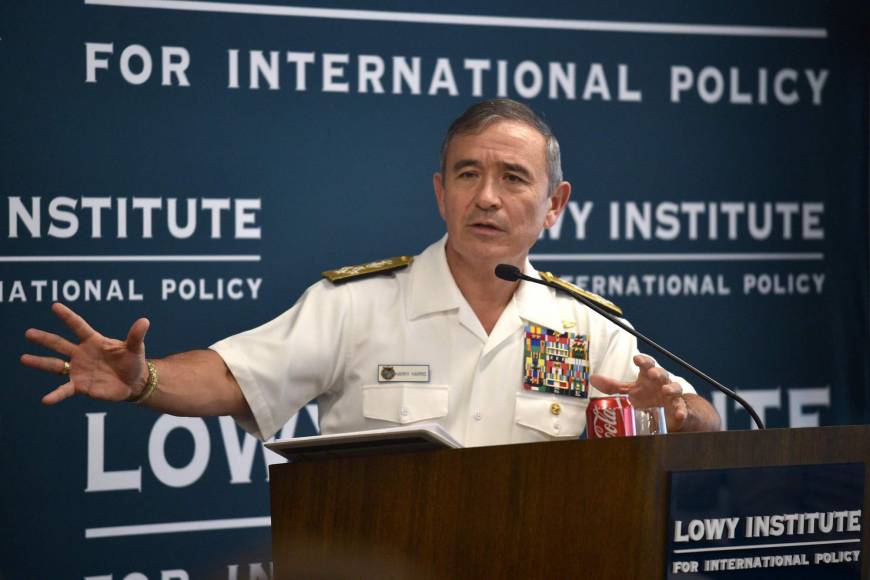
Adm. Harry Harris, head of the U.S. Pacific Command, addresses the Lowy Institute think tank in Sydney last December. 

BEIJING – China urged the United States to sack the head of the U.S. Pacific Command in return for exerting more pressure on North Korea amid concerns over its growing nuclear and missile threats, a source close to U.S.-China ties said Saturday.
Xi Jinping made the request, through his ambassador in the United States, to dismiss Adm. Harry Harris, known as a hard-liner on China, including with respect to the South China Sea issue, the source said.
China’s envoy to the United States, Cui Tiankai, conveyed the request to the U.S. side, to coincide with the first face-to-face, two-day meeting between Donald Trump and Xi in Florida from April 6, but the Trump administration likely rejected it, the source said.
China is a longtime economic and diplomatic benefactor of North Korea.
As the head of Pacific Command, Harris, who was born in Japan and raised in the United States, plays a vital role in the security of the region.
He was responsible in ordering last month the dispatch of the USS Carl Vinson aircraft carrier to waters near off the Korean Peninsula in a show of force amid signs the North was preparing to test-fire another ballistic missile or conduct a sixth nuclear test.
The Trump administration has called for exerting “maximum pressure” on North Korea to prod it to give up its nuclear and missile programs. 
The administration has said all options — including a military strikes — remain on the table.
Harris has pushed for the U.S. deployment of the advanced Terminal High Altitude Area Defense (THAAD) anti-missile system to South Korea. 
China has opposed the deployment, saying it could undermine its security interests and the strategic balance of the region.
He has also called for continuing U.S. “freedom of navigation” operations in the contested South China Sea. 
Overlapping territorial claims, as well as land construction and militarization of outposts in disputed areas in the sea, remain a source of tension in the region.
According to the source, Cui also asked the Trump administration not to label China as a currency manipulator. 
As per the request, the United States did not label China as such.

jeudi 4 mai 2017

Chinese Aggressions

South Korea is the latest to suffer from a hostile campaign backed by Beijing, but do such sanctions work in changing policy? 
By Ben Bland, Tom Hancock and Bryan Harris

Jeju used to bristle with Chinese tourists who flocked to the South Korean island to enjoy its beach resorts and rugged landscape.
But an industry set up to serve Chinese consumers shrivelled up almost overnight in March after Beijing stopped travel agencies from sending groups to South Korea in retaliation at Seoul’s decision to deploy a US missile defence system to protect itself against unpredictable North Korea.
The number of daily visitors from China dropped to 1,000 from more than 7,500 days earlier, according to official figures.
The situation is similar in Seoul, where shopping areas once popular with Chinese tourists are deserted.
“Since March 15, I haven’t seen a single Chinese person come to our shop,” says one salesperson. Another adds: “The company is forcing us to take unpaid leave simply because of the declining number of Chinese tourists.”
The impact has not just been felt by retailers and hotels.
Korean carmakers have also been badly hit.
Hyundai reported that sales in China, the world’s biggest automobile market, were down 14 per cent year on year in the first quarter, while Kia’s sales slid 36 per cent, even as the overall market in the country grew 4 per cent over the same period.
China has been implementing such boycotts against its foes for more than 100 years and it knows how to make them hurt economically and politically.

Tourist information helpers in Seoul. Chinese-speaking tourist guides have seen their work dry up as visitor numbers have plummeted.

Controlling access to China’s vast market gives Xi Jinping and the ruling Communist party tremendous leverage over trading partners and allows them to signal their nationalist credentials to the domestic audience.
But Beijing must play a delicate balancing act to ensure that its embargoes neither damage the Chinese economy nor unleash forces of jingoism and protest that could threaten one-party rule. Japanese carmakers, Philippine banana farmers and Taiwanese tourism workers have all previously been on the wrong end of hostile campaigns instigated to varying degrees by Beijing and the Communist party-controlled media.
Foreign diplomats and executives dread the accusation of having “upset the feelings of the Chinese people”, the Communist rhetoric often used to trigger an embargo.
Their fears are heightened by China’s growing economic might, the strident nationalist tone adopted by Xi and the fact that consumers are easily marshalled on social media sites such as Weibo and WeChat.
The results can be devastating, with cars smashed up, factories attacked and years of effort to crack one of the world’s biggest markets undone overnight.
“For foreign companies, there’s very little they can do to protect against this kind of politicised action, except lobbying domestically for maintaining strong relations with China,” says Duncan Innes-Ker, a China analyst at the Economist Intelligence Unit.
The history of the Chinese boycott predates the word itself, which came from 1880s Ireland, and it is a story that encompasses patriotism, anti-colonialism, economic rivalry and occasional outbreaks of violence.
In 1905, US President Theodore Roosevelt called for reform of a discriminatory law restricting Chinese immigration after an “especially injurious” boycott of US cotton.
“It is short-sighted indeed for us to permit foreign competitors to drive us from the great markets of China,” he warned.

A US intercept test using the THAAD missile defence system.

China’s role in the global economy as a manufacturer and end-market is now far more significant. And Beijing’s grip on the economy, through state-owned enterprises and leverage over private sector businesses, is powerful.
So for many countries and companies, Roosevelt’s warning about the risk of upsetting China resonates more than ever.
Yet China’s economic integration also acts as a restraint.
South Korea is the biggest supplier of imports to China and its fourth-biggest export market.
Like Japan, which has often suffered from Beijing’s embargoes, South Korea provides many high-technology components and machines to drive the Chinese manufacturing industry.
“This economic retaliation will also harm Beijing’s interests as China imports intermediate Korean goods to finish manufacturing and sell on to other markets,” warns Kim Tae-hwan, an official at the Korea Federation of Small and Medium-Sized Enterprises.
“Korean companies also employ many Chinese workers.”
 *** 
While Japan earned Chinese ire in recent years for opposing Beijing over disputed islands in the East China Sea, South Korea seemed to have pulled off a delicate balancing act by deepening its investments in China even while hosting a large contingent of US troops.
But that all changed with the decision last year to deploy the Terminal High Altitude Area Defence platform, a US missile defence system, to shoot down North Korean missiles.
Beijing was deeply angered by the move, which it fears could enhance US security architecture in the region and lead to greater surveillance of its own activities.
US forces said on Tuesday that Thaad had gone into operation.
China’s response to Thaad evolved gradually.
Initially Beijing targeted specific South Korean companies over health and safety issues.
But its position hardened as it became clear that Seoul would push ahead with the deployment.
Goods were held up at customs. 
Employees at Korean companies were harassed. 
Lotte, the South Korean retail group, was particularly hard hit, with 87 of its 99 Chinese stores closed because it had handed over a golf course to Seoul to assist the Thaad deployment. 

A protest calling for the boycott of South Korean goods in Jilin, north-eastern China, earlier this year.

The retaliation became blatant only when the US began installing the first parts of the missile battery in March.
Wang Yi, China’s foreign minister, warned that South Koreans “will only end up hurting themselves”. South Korea complained to the World Trade Organisation that China “may be in violation of some trade agreements”.
But Seoul is caught between its military and ideological alliance with the US and its commercial and economic ties with China, its largest trading partner.
The situation has been complicated by the ousting in March of president Park Geun-hye. 
Moon Jae-in, the leading contender in next week’s presidential election, is sympathetic to China and has long expressed reservations about the missile shield.
In a debate, he called on Beijing to “immediately stop” its boycott but added that Seoul should “make diplomatic efforts to persuade China”.
The campaign against South Korea has been driven by Beijing with the help of state media, which have unleashed a barrage of stories condemning the missile system and suggesting it is part of a US plot to contain China’s rise.
But, as with previous boycotts, local authorities fear protests may get out of hand.
After demonstrators outside a Lotte store in the southern province of Hunan smashed up a South Korean car in March, local police told residents that vandalism was illegal and called for “rational patriotism”.
“The tensions between the state and popular nationalism are at least 100 years old,” says Robert Bickers, author of Out of China, a book on Chinese nationalism.
“Sometimes the government is trying to agitate, sometimes it is trying to keep people in check and at other times it is taken completely by surprise.”
Kaiser Kuo, a Chinese-American cultural commentator and former executive at technology group Baidu, has suggested that the country’s leaders are standing “over the fire pit of nationalism with a fan in one hand and a hose in the other”.
“They can whip up the flames to intimidate, or to point to during a negotiation so their choices appear constrained by a loud domestic constituency,” he wrote in a recent essay.
“But with the hose they can also keep that fire from leaping out and burning down the valuable surrounding countryside.”
 *** 
Economists and investors have long debated the effectiveness of boycotts.
In his 1933 Study of Chinese Boycotts, CF Remer, a professor of economics at the University of Michigan, argued they had a strong “psychological” impact on the target nation, even if China also suffered economic blowback.
“Boycotting by a single nation is like the labour strike,” he wrote.
“The threat to strike is powerful; the strike itself is likely to be costly and inefficient.” 
More recent research points to a significant initial impact, followed by a later recovery in trade, suggesting that orders are delayed rather than cancelled for good.
In some cases, the embargoes fizzle out as the news agenda moves on.
In others, lengthy negotiations are necessary to mend ties.
Andreas Fuchs, an economics researcher at Heidelberg University, has found that countries tend to experience a temporary drop in exports to China if their governments meet the Dalai Lama, the Tibetan Buddhist leader seen by Beijing as a dangerous separatist.

A Chinese marine surveillance ship monitors a Japanese fishing boat off Uotsuri island, one of the disputed islands in the East China Sea.

The pattern was similar for the 2012 boycott of Japanese products.
Kilian Heilmann, a researcher at the University of California, San Diego, found that Japanese car exports to China tumbled 32 per cent, or $1.9bn, in the 12 months after the boycott launched in September 2012 in response to Tokyo’s purchase of the Senkaku islands
But trade returned to normal levels the next year.
Such recoveries beg the question of whether these boycotts are successful in changing the policy of foreign governments.
There have certainly been some big victories for China in recent years.
British investors successfully lobbied the UK government not to receive the Dalai Lama again after they were cold-shouldered by Chinese officials when David Cameron, then prime minister, met the spiritual leader in 2012.
Beijing had cancelled numerous meetings with UK ministers and investment deals were put on hold until it was clear that the meeting would not be repeated.
Norway had to go through years of talks and pledge to attach “high importance to China’s core interests and major concerns” last year in order to re-establish ties, after Beijing had punished Oslo over the 2010 decision by an independent group appointed by Norwegian politicians to award the Nobel Peace Prize to dissident Liu Xiaobo.
“The Chinese government can effectively use economic sanctions to affect the foreign policy positions of democratic governments, with potentially chilling effects for international progress on human rights,” argued Ivar Kolstad, the economist, in a paper for Norwegian think-tank CMI.
He calculated that the dispute cost Norway $780m to $1.3bn in exports and concluded that China had become “too big to fault”.
Philippines President Rodrigo Duterte took a similar view, reversing the confrontational stance of his predecessor over the South China Sea disputes in the hope of winning economic concessions from Beijing.
 *** 
Rory Medcalf, head of the National Security College at Australian National University, is urging countries to fight back against Beijing’s attempts to push the narrative of Chinese economic power with a more nuanced analysis of its actual influence. 
“China has done extremely well at exploiting the shadow of its growth,” he says. 
“There’s a myth in Australia that our economy is completely dependent on China’s demand for our mining exports.” 
China is the biggest market for Australian products, accounting for 27.5 per cent of exports, much of that iron ore and coal.
Yet unlike other developed economies, including South Korea and Singapore, trade is less important to Australia, so those exports add up to just over 5 per cent of gross domestic product.
Japan, the most frequent target of Chinese boycotts, is adapting to offset potential damage. 
“After the 2012 protests, many Japanese companies realised that our position in China would remain precarious, which has accelerated our move into other, friendlier markets like Southeast Asia,” says an executive from a Japanese manufacturer in Indonesia.
While different countries have varying degrees of exposure to Chinese economic pressure, Prof Bickers says the threat for all will continue to grow in line with Beijing’s increasing projection of its political and military might and the Communist party’s fears of losing power.
“We are entering a new phase with a successfully assertive China in the South China Sea,” he adds. “When Xi’s line on the rejuvenation of China comes together with China’s insecurity, I do worry very much.”

Action and reaction 
1843 Shanghai landlords refuse to rent properties to foreigners in opposition to the Nanking Treaty which ended the first opium war the previous year and forcibly opened China to more international trade 
1884 Chinese dock workers in Hong Kong refuse to service French ships, in opposition to the Sino-French war, leading to a general strike and violent clashes with police 
1905 Worldwide boycott of US products by Chinese merchants in opposition to discriminatory laws in the US. Action was taken by Chinese communities from Shanghai to Singapore and San Francisco.
1925-26 Strikes and boycotts in Hong Kong cripple British trade as part of the anti-imperialist May Thirtieth Movement, after colonial police in Shanghai open fire on protesters 
1930-32 The Kuomintang government leads boycotts of Japanese goods, as tension rises ahead of Japan’s invasion of Manchuria in 1931 
1946 Huge rallies and anti-US boycotts are staged after the alleged rape of a Peking University student by two US marines. The communists use the incident to rally opposition to the US-backed Kuomintang, which it defeats in 1949 
1999 Protests break out after the US bombs the Chinese embassy in Belgrade, killing three Chinese journalists. Washington’s ambassador to Beijing is trapped for several days as mobs attack US diplomatic facilities 
2010 China blocks exports of rare earths, vital for the electronics industry, to Japan after clash between a Chinese fishing boat and a Japanese coast guard in the East China Sea 
2010 China punishes Norway over the award of the Nobel Peace Prize to dissident Liu Xiaobo. 
2012 Demonstrations break out after an escalation of the Senkaku islands dispute. Protesters smash up Japanese cars and attack Japanese factories and shops selling Japanese goods 
2016-17 China takes action against South Korean businesses because of its opposition to Seoul’s US missile defence shield.

vendredi 28 avril 2017

World's Stupidest President

Trump talk about Koreas draws China silence, dispute from Seoul
By Christopher Bodeen and Youkyung Lee

In this Tuesday, April 25, 2017 photo released by the U.S. Navy, the Arleigh Burke-class guided-missile destroyer USS Wayne E. Meyer, left, is underway alongside the Republic of Korea multirole guided-missile destroyer Wang Geon during a bilateral exercise. Wayne E. Meyer was on a scheduled western Pacific deployment with aircraft carrier USS Carl Vinson. 

BEIJING — Trump's assertions about the Koreas drew silence Friday in Beijing, which refused to confirm it was turning up pressure on North Korea, and consternation in Seoul, which dismissed Donald Trump’s claim that he would get South Korea to renegotiate a trade deal and make it pay for a missile defense system.
South Korea contradicted statements Trump made in an interview Thursday with Reuters news agency in which he also said there is “a chance that we could end up having a major, major conflict with North Korea,” as the North continues to develop nuclear weapons and long-range missiles.
Regarding the South, Trump said he would fix or end what he called a “horrible” bilateral trade deal, and would make the Asian ally pay $1 billion for the THAAD missile defense system now being deployed in its territory.
Woo Taehee, South Korea’s vice trade minister, said the country had not been notified of any trade renegotiation, and that there have been no working-level talks with the U.S. regarding the 5-year-old trade deal.
Woo said the trade ministry was trying to confirm the details of the media reports on Trump’s remarks. 
He said there have been “no pre-talks” with the U.S. regarding the issue.
The U.S.-South Korea free trade deal is not the only free trade pact that the Trump administration is reconsidering. 
Earlier this week the White House leaked the possibility of the U.S. abandoning the North American Free Trade Agreement. 
Trump called that off hours later, saying he would seek to renegotiate the trade deal with Canada and Mexico and pull out of NAFTA only if he couldn’t secure a favorable deal.
In a separate statement, South Korea’s defense ministry said there is no change in its plan under which the U.S. covers the cost for operating THAAD, now being deployed in the country’s southeast. Under an agreement reached during the administration of Trump’s predecessor, Barack Obama, South Korea offers the land and facilities for THAAD but not the cost of operations, the Defense Ministry said.
The U.S. missile defense system, meant to deter North Korean aggression, has become a thorny issue between South Korea and China, which opposes it because its powerful radars can peer through not only North Korean but Chinese defenses. 
At the same time, Trump has lauded Xi Jinping since their meeting in Florida early this month, expressing confidence that China will try to persuade North Korea to give up its nuclear weapons program.
U.S. Secretary of State Rex Tillerson went a step further Thursday, saying that China has threatened to impose unilateral sanctions on North Korea if it conducts further nuclear tests. 
Foreign ministry spokesman Geng Shuang would not confirm that Friday.
Geng reiterated China’s support for U.N. sanctions on the North but repeatedly avoided giving a direct answer when asked at a daily news briefing about what other plans China might be considering.
“As for what kind of actions China will take if North Korea conducts another nuclear test, it is a hypothetical question and there is much speculation about that, so I have no comment on it,” Geng said.
“China firmly opposes any actions that violate the United Nations Security Council resolutions. This position is quite clear,” he said.
China wants North Korea to end its nuclear weapons program, but has opposed unilateral sanctions imposed without a U.N. mandate.
Beijing has come under growing U.S. pressure to use its leverage as North Korea’s largest trading partner and main source of food and fuel aid to compel it to heed U.N. resolutions.
Tillerson said Thursday that Washington was aware that China was in communication with the government in Pyongyang.
“They confirmed to us that they had requested the regime conduct no further nuclear test,” he said on Fox News Channel.
Tillerson said China also told the U.S. that it had informed North Korea “that if they did conduct further nuclear tests, China would be taking sanctions actions on their own.”
While Beijing says it backs the U.S. in finding a diplomatic solution to the crisis, it remains unclear what actions it has taken or plans to take beyond those mandated by the U.N.
China in January suspended coal imports from North Korea for the rest of the year, but it did so following the passage of a Security Council resolution capping the North’s coal exports. 
Other economic activity with North Korea remains robust.
Notwithstanding Tillerson’s comments, there’s scant evidence that China’s government has changed policies, said Daniel Sneider, a Korea expert from Stanford University’s Shorenstein Asia-Pacific Research Center.
While China might take actions intended to send a message to North Korea — a recent shortage of gasoline in Pyongyang sparked speculation that China was working behind the scenes — Beijing is firmly opposed to measures that might seriously destabilize the regime, possibly sending refugees across the border into China and placing U.S. and South Korean troops in the North.
“North Korea exists as a client state of China for the sake of China, not us, and because the Chinese don’t want to have the Korean Peninsula dominated by the U.S.,” Sneider said.
“Their main goal is to keep the Americans from doing something crazy and see if they can drag the North Koreans back to the negotiating process where they can reduce the level of tensions.”

jeudi 27 avril 2017

China Cannot Revise South Korea's Democratic Sovereignty

By Anders Corr
  • Year 1948 is the moment when the South Korean people, rather than the Chinese or Korean kings and emperors, began significantly participating in their own governance.
  • That is the governance that should serve as the strongest foundation of a contemporary understanding of sovereignty. That is democratic sovereignty

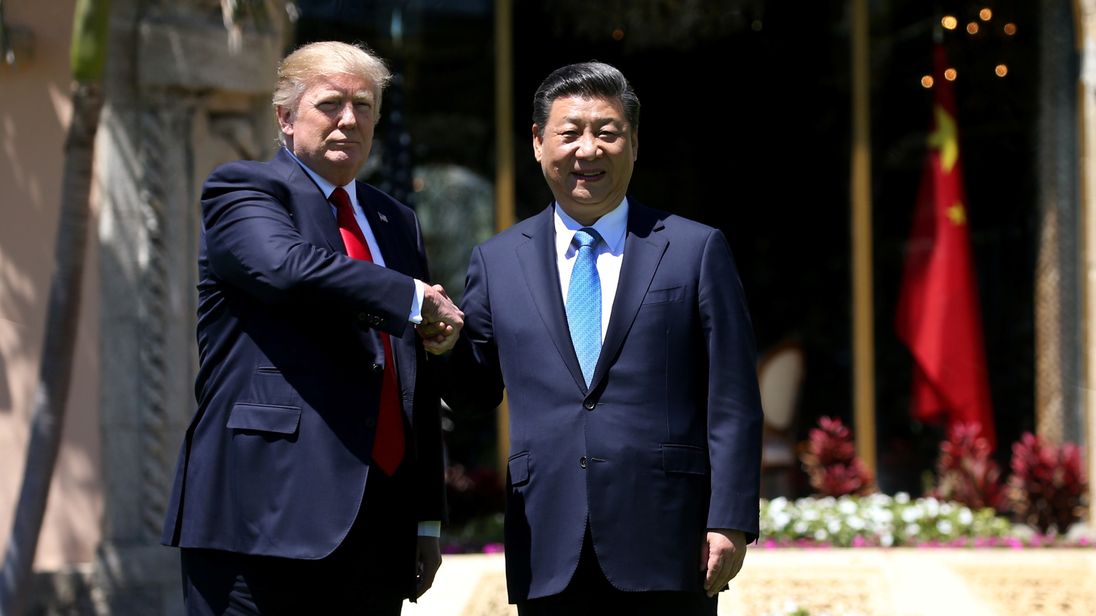
According to Trump on April 12, Xi Jinping told him that Korea used to be a part of China. 
“He then went into the history of China and Korea,” said Trump. 
“Not North Korea, Korea. And you know, you’re talking about thousands of years . . . and many wars. And Korea actually used to be a part of China. And after listening for 10 minutes, I realized that it’s not so easy.”
Résultat de recherche d'images pour "trump and xi jinping"
Xi’s claim, via Trump, that Korea historically belonged to China has South Koreans legitimately nervous. But South Korea’s real and unassailable sovereignty comes not from a history of kings, but from its democratic constitution of 1948.

A White House official on Friday "kindly" confirmed that Korea was independent. 
But a day prior, China’s Foreign Ministry spokesman, Lu Kang, shockingly refused to clarify Xi’s comment. 
He replied that, “There is nothing for South Koreans to worry about.” 
There is something wrong when superpowers are looked to by the international community for confirmation of another country’s democratic sovereignty. 
It is too reminiscent of the most hierarchical periods of international relations, such as colonialism or the Cold War.
Contrary to China’s assertion not to worry, South Koreans are doing just that. 
According to one Asian government official who prefers to remain anonymous, “although China has an intention to rewrite the ancient history based on its own nationalistic approach, it has been keeping low profile at least at government level.” 
But, he added that for domestic consumption, “the Chinese government keeps arguing that ancient kingdoms in Manchuria established by ethnic Koreans are parts of their history.”
Academics are also worried, and are not fooled. 
“China may seek to take advantage of it [Trump's comment on Korea] all the way,” said international relations Professor Jae Ho Chung of Seoul National University in an email. 
“Lu Kang’s comment is for that purpose – maximum advantage through ambiguity.”
The Global Times, a Chinese nationalist state-run newspaper, opined on Friday, “So far, the South Korean foreign ministry has not made an official request [for clarity], which, if it does, will be disrespectful.” 
This in itself seems to be an affront to South Korea, implying paternalistically that South Korea has to show “respect” to China.
Pedestrians walk past a newstand in Beijing with the Chinese edition of the Global Times newspaper on May 16, 2011 in Beijing. 

Chinese media was incensed at South Korean media. 
“[T]he South Korean media resorted to nationalism, with some claiming this is ‘a grave challenge to the identity of the Korean people,’” continued the Global Times. 
“History is there, but some South Koreans want to remove any connection their country had with ancient China and request China’s absolute respect for their interpretation of history. This is narrow-minded.” 
South Koreans who know how China warps history for its own territorial expansion are anything but narrow-minded. 
Contrary to those who question whether Xi actually made the remark, Dr. Chung said that such a comment by Xi would “not [be] so surprising given his constant references to China’s past history.”
More concerning is that China could again seek to impose the old tributary relationship anew on South Korea.
“China’s ‘History Project’ with South Korea and elsewhere is not over,” said Dr. Chung, “but, as Chinese refer to it, has been just put aside 搁置 for now.” 
Needless to say, Dr. Chung is highly critical of China’s characterization of the history between China and South Korea.
China’s actions, or more exactly lack of clarifications, has done itself harm. 
The train wreck of events surrounding Xi’s alleged claim caused widespread outrage among South Koreans across the political spectrum. 
“The backlash in South Korea is massive,” said political science Professor Shelley Rigger at Davidson University. 
“I don’t see how it will be possible to avoid this incident having a negative effect on Sino-Korean relations.” 
If Xi’s new history applies to South Korea, it could also apply to other countries. 
“If [Xi] really said so, that is a huge strategic mistake and will destroy the very foundation of the ROK-China relationship,” according to the official quoted previously. 
“It is like saying ‘Vietnam, Mongolia and all the neighboring countries of China used to be a part of China.’”
China’s popularity in South Korea has nose-dived before, but with explosives rather than words, and triggered by North Korea not China. 
In 2010 North Korea sank the Cheonan, a South Korean navy ship, causing 46 deaths. 
Later that year, North Korea killed two South Korean marines in an artillery strike on the island of Yongpyong. 
These North Korean actions, because of the country’s close alliance with, and some would say direction from, China, had a negative effect on attitudes toward China. 
“During 2010-12, South Korea-China relations hit the nadir after the Cheonan sinking and the Yonpyong bombing by North Korea,” said Dr. Chung. 
“Then, the new administration came in, warming up the bilateral relations up to the late 2015.”
China’s adverse reaction to South Korea’s deployment of a missile defense system, called the Terminal High Altitude Area Defense system (THAAD), has further decreased support for China in South Korea. 
“Public opinion in South Korea about China has been worsening since China’s ‘sanctions’ related to the deployment of THAAD but, due to the presidential election fervor (May 9), this particular issue hasn’t quite grabbed the kind of media attention it should have,” said Dr. Chung. 
“At least among intellectuals, however, concerns are growing. I am sure the Chinese are acutely aware of the flammability of the issue given the previous experiences over Kokuryo,” an ancient Korean empire.
SEOUL, SOUTH KOREA – JULY 13: South Koreans watch a television broadcast reporting the deployment of the Terminal High-Altitude Area Defense.

Most Korean historians noted that contrary to Xi’s alleged statement, Korea had a subordinate but still independent tributary relationship with China. 
The way Trump phrased the history was Chinese nationalist spin. 
Other pro-China historians have noted as justification that China once treated Korea as a colonial possession. 
But that is even worse.
Nationalist China sought the “return” of Korea from the U.S. after the Japanese were defeated in World War II. 
“Chiang Kai-shek insisted to FDR in 1942-1943,” according to political scientist Edward Friedman at the University of Wisconsin, “soon after the U.S. Navy defeated the Imperial Japanese Navy at the Battle of Midway that Korea be ‘returned’ to China after the U.S.-led military coalition totally defeated Hirohito’s military expansionists. FDR ignored Chiang on that imperialist demand to Korea.”
A protester walks past two portraits of the late Taiwan president Chiang kai-shek written with ’228 murderer’ at the Education Ministry in Taipei during a demonstration on August 4, 2015. Talks between Taiwanese student protesters and education officials broke down after an emotional meeting about controversial changes to the school curriculum which have been slammed as ‘China-centric.’ 

Treating other nationalities as tributaries, colonies, or their territory as somehow like property that should be returned, is flat wrong. 
Territories that have broken off from another country at some point for whatever reason should only be rejoined through a democratic referendum by the people. 
China’s economic, political, and diplomatic pressure on Taiwan over the years shows that they do not respect the vote of Taiwan’s people. 
That should be a warning sign to South Korea.
Since 1948, after it was liberated from Japanese colonialists, South Korea has been an independent and sovereign democracy. 
China should publicly and explicitly recognize this for China’s own good, and to put the minds of South Koreans at rest. 
That China failed to do so when given the opportunity on Thursday raises the question as to why China would pay a present public relations cost to keep alive the option of a historical argument for Chinese sovereignty over South Korea. 
China’s intentions toward South Korea are now publicly in question. 
Does China want to “reconquer” or influence South Korea to rejoin the mainland like it is attempting or nearly succeeded at doing with the South and East China Seas, Taiwan, Tibet, Xinjiang “autonomous” area, and in the Indian Himalayas?
South Korea does not want to become the next Taiwan, Taiwan does not want to become the next Hong Kong, and Hong Kong does not want to become the next Tibet. 
China’s reinvention of history in places like the South China Sea, East China Sea, and the Indian Himalayas have eventually led to Chinese militarization of those places, and incrementalist military tactics to take territory. 
The compromise, through valued goods, services or property, of democratically-elected officials is another method of eroding democratic sovereignty. 
In this multilayered historical, ethical, and military erosion of democratic or other sovereignty, territory and political independence is gradually lost, and in extremis, the sovereignty of the democratic polity is extinguished.
China is arguably using such incrementalist tactics against South Korea by attempts to influence domestic politics through imposing unofficial economic hardships on South Korean companies operating in China, including on rock bands, tours and retail stores. 
These companies understandably want to expand or at least maintain their revenues, so are in turn incentivized by China’s economic influence tactics to put pressure on the democratically elected government of South Korea. 
These mini-sanctions are thereby an attempt to influence South Korean foreign policy on critical issues such as THAAD and North Korea. 
China has used similar economic pressure tactics against the Philippines, for example by slowing orders to import bananas, against Japan with autos, and in the U.S., for example by threatening to cancel orders of Boeing jets.
A primary cause of the problem is an ideology of autocratic revanchist nationalism that sees distant territories or even individuals as somehow “belonging” to China long after those people took their own path. 
This includes countries like Taiwan and South Korea, but also individuals of Chinese heritage who have moved elsewhere and taken new citizenship. 
China treats its “lost” territories and people as if they could be property and should continue to be under the autocratic control of Beijing.
This leads to Chinese forced renditions (kidnapping) from places like Thailand, Burma and Hong Kong of people, including with Swedish or British citizenship. 
Whether or not China’s revision of Korean history takes hold, we should recognize that upon Korea’s democratization, the legitimacy of its sovereignty became sacrosanct. 
It should be permanently recognized as a sovereign entity by all other nations. 
The international community must resist any other state, with a literally trumped up historical argument, that seeks to peacefully or otherwise “reconquer” the territory. 
The world’s democratic countries have in the past two decades failed to defend the territories and sovereignty of democracies like Taiwan, the Philippines and Ukraine. 
We must do better, and we must do better for South Korea if push comes to shove.
Not fully recognizing the sovereignty of democratic entities, as China has done with Taiwan and now apparently South Korea, should be an international crime akin to the promotion of serfdom or slavery. 
It goes against a democratic approach that prioritizes people and a human right to democracy, over autocratic revanchism and the almost feudal notion that chunks of territory, and the people who live there, could possibly revert to elites in distant capitals based on historical arguments.
The government should belong to the people, rather than the people belonging to the government. 
In 1948 South Korea held a Constitutional Assembly that reified its own sovereignty as a nation. 
That assembly is the true lodestone of its sovereignty. 
It is an additional, and ultimately more important, claim to sovereignty than a history of succession from the ancient kingdoms of Korea. 
Any historical argument made by Beijing, whether believed or not, has no normative, ethical, or moral bearing on the sovereignty of South Korea, because South Korea is now a democracy. 
Year 1948 is the moment when the South Korean people, rather than the Chinese or Korean kings and emperors, began significantly participating in their own governance. 
That is the governance that should serve as the strongest foundation of a contemporary understanding of sovereignty. 
That is democratic sovereignty.